A lost tomb, the discovery of an ancient tome, or perhaps the unveiling of a city lost to time remembered only in whispered rumor. In the hot sands of the desert, one man’s quest to discover these lost treasures will bring him glory and riches beyond imagining. He slowly brushes away the sands to reveal a puzzle. With baited breath, he presses various stone pieces into place. A slow groan builds as ancient mechanisms shift into place after thousands of years. The door opens, light pouring into the long forgotten room now glittering with gold. At least, that is often the popular imagery of archeology in movies. The truth is a bit less dramatic, but can be just as exciting! At least, to us nerds.
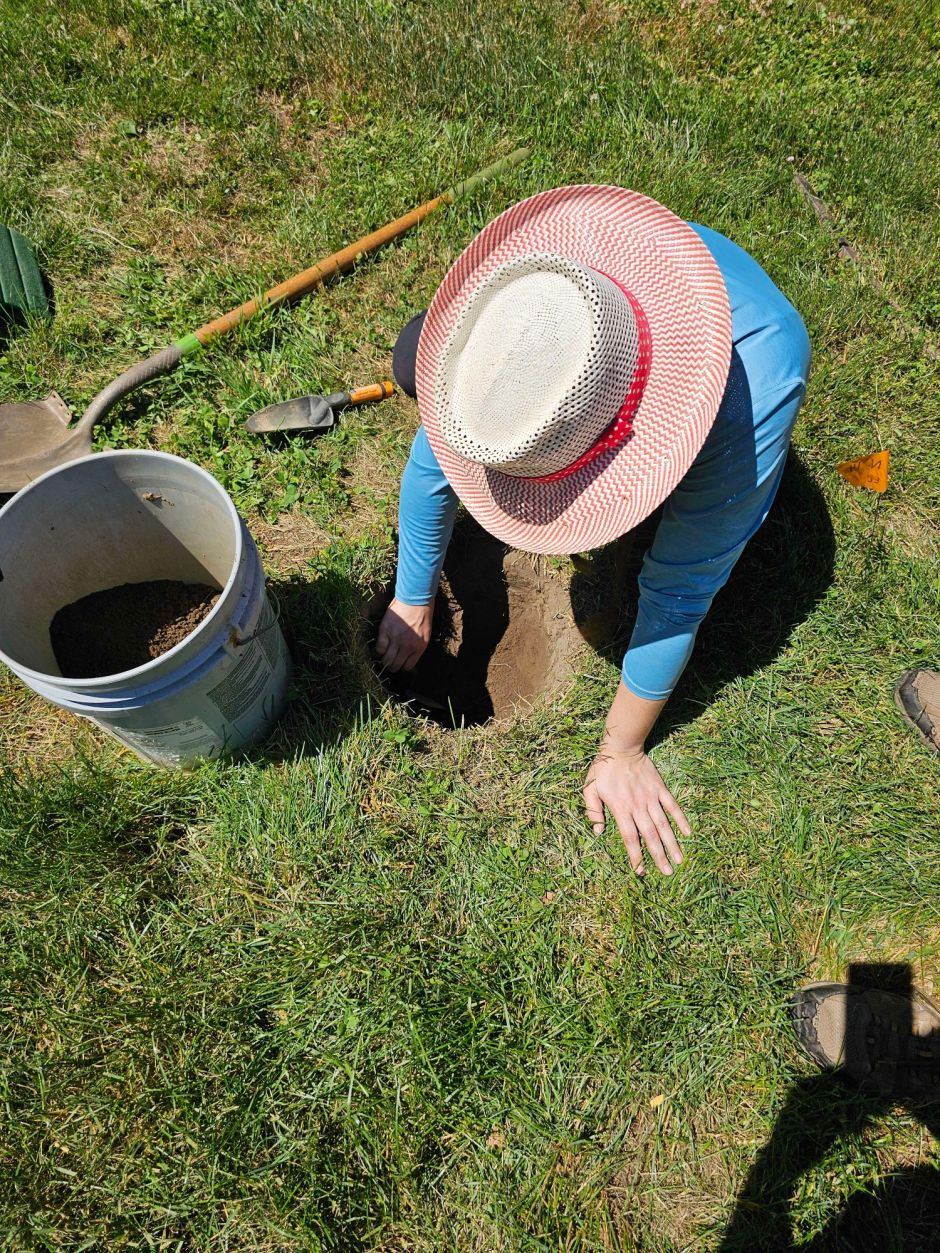
On a warm day in June, I and my sister embarked to discover our own time lost civilization. Using a technique popular among professionals although less glamorous than Hollywood, I assisted in uncovering the boundaries of a people almost forgotten. We drove out to the Blue Rock Heritage Center to meet with Paul Nevin as leading authority on the local pre-columbian peoples of my area. Together we and two other volunteers laid out a grid of 100 feet by 50 feet to conduct a survey. At every intersection of 10 feet, we dug a small circular hole down to the depth of a plow (about 12 inches) to discern where the greatest concentration of artifacts were.
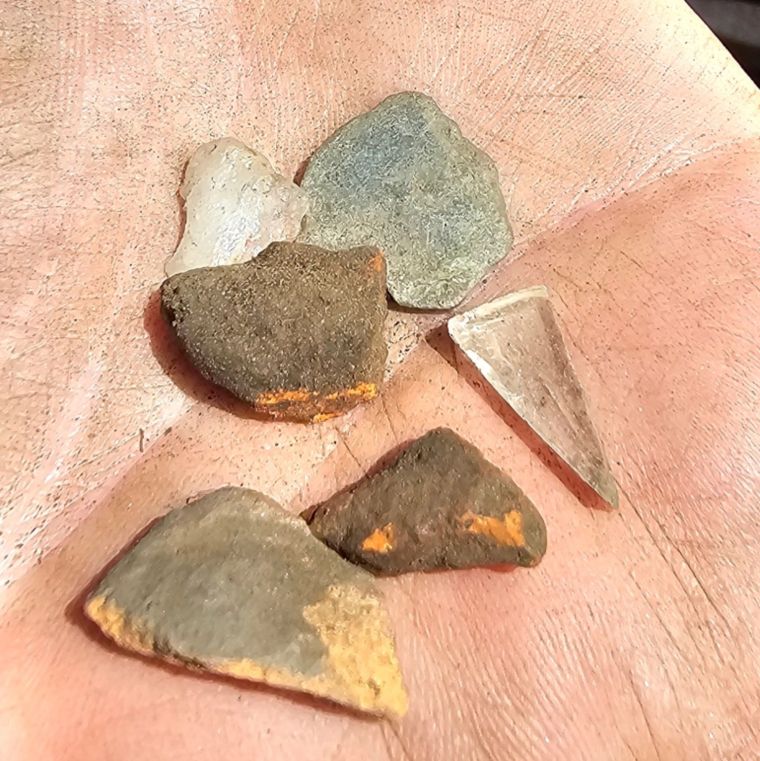
You will be forgiven dear reader if you are picturing the same sort of artifacts displayed in the museums throughout the globe. Beautifully crafted pots, towering statutory, elegantly carved facades of stone all almost perfectly preserved just waiting to be uncovered. You may want to re-evaluate your expectations before embarking on such a journey, for ours was to discover tiny fragments of flint produced during the manufacturing of arrowheads or pieces of broken pottery. You see, the survey was conducted in the top of the soil only about a foot or so down, which is about the depth of a plow. Obviously, if the area has been ploughed many times over there years, anything worth finding has now been shattered into tiny pieces. It was tedious, but rewarding work.
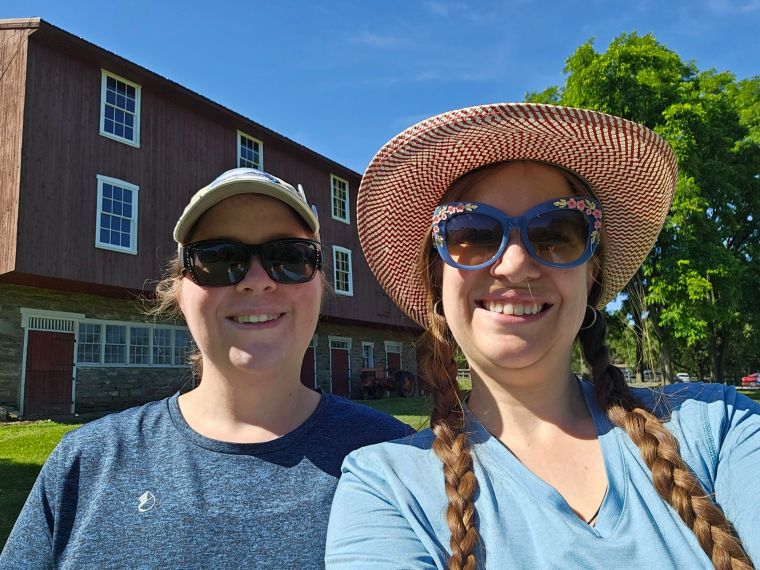
My sister and I assisted in shifting through layers of dirt trying to locate evidence of a semi-forgotten culture. Most of what we found were pieces of brick from the farmhouse and “diagnostic glass” (also from the farm house). While, intriguing in their own right, they were not from the era Mr. Nevin was primarily interested in. He was primarily interested in pre-columbian cultures rather than the intervening years. However, he did not dismiss the fragments outright as trash, but rather had us carefully bag up the remains for later analysis. After all, just because he wasn’t very interested in that time period doesn’t mean that the time period is of no value for study.
Each bag was carefully labeled to correspond with the location that was surveyed. The archeologist would later assess where the highest concentration of artifacts were found in order to discern where a larger dig should be conducted. This method is rarely seen in documentaries but is utilized the world over. I often wondered how did they know where to dig, how did they find that tomb, or that village. My question was never answered to satisfaction when watching various films; it often seemed that they just stumbled upon these sites like some sort of game of chance. The answer was in this or other methods of survey. In short, simple data collection and analysis. Too boring to make most television shows, but vital to my own understanding of the craft.
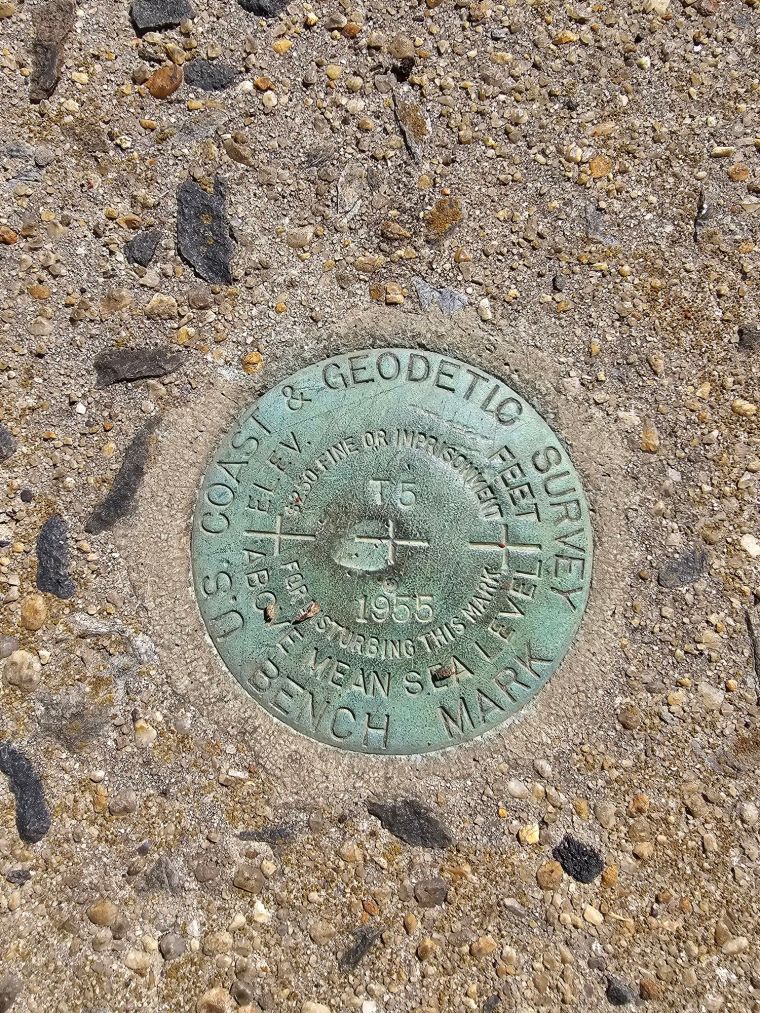
Most of what we found would be considered negative data. In other words, we didn’t find anything where we dug that was of interest to Mr. Nevin. I believe my sister and I surprised him in our enthusiasm for negative data but for us the treasure was in experiencing the technique and hearing the explanation for how a dig is done much more so than any treasure we may have found. Mr. Nevin explained that many years ago a site survey was conducted to determine there was a site of interest, but that the boundaries had not been recorded. Therefore, it fell to us to make that determination for purposes of a larger dig later. The medallion recording a geodetic survey in the 1950’s was considered the 0,0 point for purposes of the survey and it was primarily conducted along the north, east quadrant of the the 0,0 point. Hence, the designation of N (for north) and E for (east) for the different places we dug.
Even though we did not find much in the way of positive data, the other pair found several different shards from flint making. Prior to digging in, Nevin showed us several examples from previous surveys of what we were looking for, pottery shards, arrowheads and flint. He seemed somewhat apologetic that we did not find anything in our own adventures, but we reassured him that “no” data was still data worth finding. Afterall, that was the whole point of the survey as most points were not expected to yield much since the area utilized was likely to be small.
It was not the most exciting morning, if one expected to find troves of artifacts. However, it will remain a highlight of my life, because I have always wanted to participate in a dig. I value the pursuit of knowledge and the preservation of culture. Had I thought it would be a less competitive field of study, I would have happily embarked on a journey to become an archeologist. There are times when I regret not pursuing archeology as career, as it continues to remain a passion of mine.
Mr. Nevin’s own journey was not typical of most experts. He did not go to school, but was rather an enthusiast of Native American culture, traveling around the country to sacred sites. Approximately, forty years ago, he began his own study and documentation of the little known and scarcely studied petroglyphs of the Susquehanna River. Safe Harbor is home to the highest concentration of petroglyphs this side of the Mississippi River. The act of creating petroglyphs was a sacred practice. Creating them demanded a significant investment of time and energy. And to carve capriciously on the bosom of Mother Earth would be to desecrate her. Petroglyphs are not prehistoric graffiti. They are messages left by the Ancestors to be “read” by those who would come in the future.
Though, we were not looking at petroglyphs which were intended to be read, we were looking at the messages left from those gone before. What sort of lives did they live? What did they do on a day to day basis? What was important to them? Even things we did not think could be felt hundreds of years later could still be discerned by an expert eye. For example, the use of wood can still be seen in the analysis of the soil and used to map out where a house used to sit. These are the questions we set out to answer. I hope to get an invite to Mr. Nevin’s larger excavation once he determines where the former site lies.
One thing that impressed me about Mr. Nevin was his reasoning for picking the petroglyphs as his area of study. He said that he did not enjoy taking artifacts away from sacred spaces and with the petroglyphs one cannot take those away (at least not easily). His interest stemmed from a deep respect and desire to preserve rather than to exploit. It is these same values that I have in my own drive to explore that which has been semi-forgotten. I want to assist in the preservation of culture and the re-discovery of a people, to help them have a voice even if they no longer exist. I am curious to understand how we know what we know about ancient cultures and to experience the process of discovery for myself. It was truly a glorious morning and I look forward to participating in further digs.
How can you participate in a dig?
Most people when they think of archeological digs, picture going to far flung places like Greece or Egypt. They forget that while those places have been popularized in our public imagination, there are many other places where ancient people existed. Native American people have lived in various places throughout the United States. Most likely you live near an archeological site and don’t even realize it. The trick of course is finding the people who are conducting the digs.
How I found mine was I simply googled archeology sites in my home state and stumbled upon the Pennsylvania Archeological Association. My nearest chapter was based primarily out of a neighboring county. For fifteen dollars, I was able to join in order to be invited to participate in one of their digs. Naturally, I submitted the application for both myself and my sister. Upon our acceptance into the association, I reached out to Mr. Nevin to sign up for the dig.
There are plenty of places which you can travel to and volunteer for a several days or even a week to help in a dig. Those are a bit more expensive than fifteen dollars each. My recommendation is to keep an eye out for your local archeology chapters or even local universities. Many colleges and universities have archeology and anthropology majors who may be leading various studies nearby. You could also be like Nevin and simply find a site worth studying and preserving that no one else is currently doing. He does not have a formal degree but through his own passion has become the expert on the local tribes.
If you cannot, or do not have the inclination to shift through tons of dirt looking for tiny fragments of ancient trash, you could do something else that reflects the value of cultural preservation. Perhaps visit a museum or donate to a cause. Maybe you want to learn a craft from a given culture that is dying out to work to preserve it or record a language before it dies. Maybe participate in an anthropological study instead. Whatever it is explore your area and see what is out there, you may be surprised.
 Budget Bliss: Bucket List