
Subscribe to continue reading
Subscribe to get access to the rest of this post and other subscriber-only content.
Leading an enriching life without being rich
Subscribe to get access to the rest of this post and other subscriber-only content.
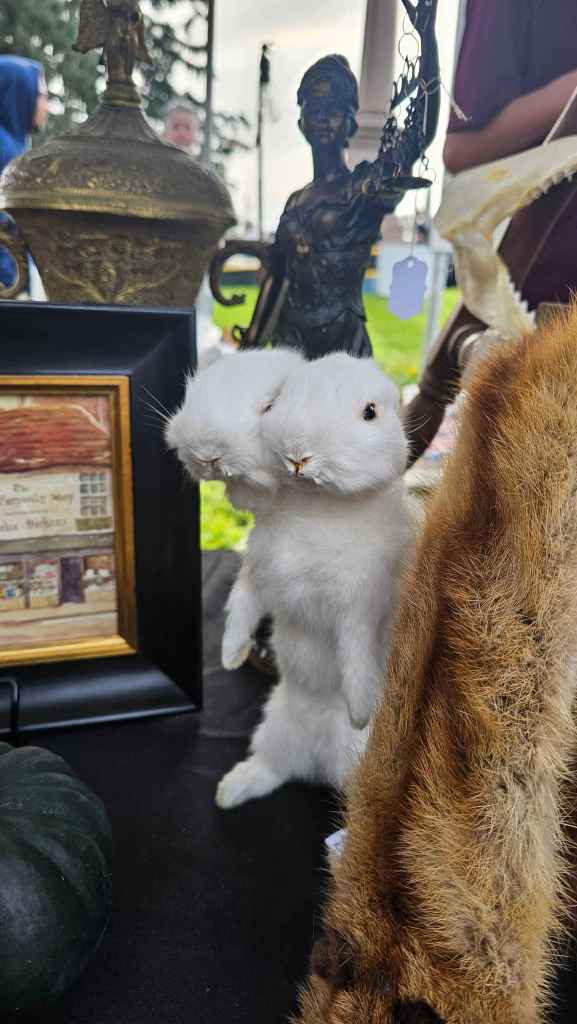
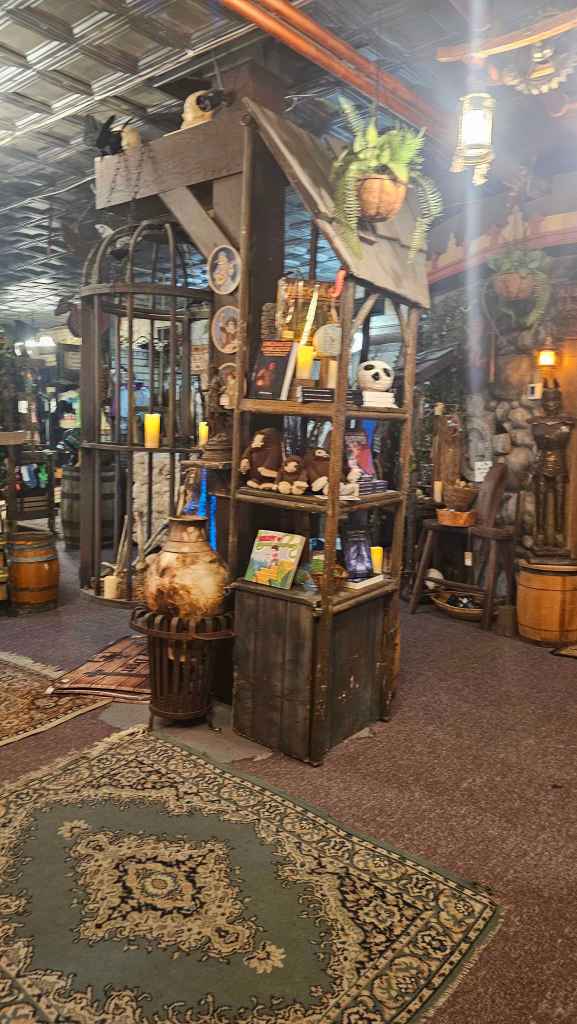
The other weekend, on a rainy afternoon, my sister and I ventured into a massive indoor antique store housed in an old warehouse. Two stories of treasures stacked on top of each other unfolded into a sprawling maze of booths, each one as varied as the colors of the rainbow.
Old uranium glassware sat beside vintage clothing. A now-derelict gas pump stood comfortably next to forgotten household tools. It was a hodge-podge of decades and even centuries, all jumbled together in a kind of quiet, chaotic harmony. A cacophony of objects, each with its own story, none of them particularly concerned with being organized by time period.
We happily set off on a kind of treasure hunt, letting whatever caught our eye guide us. There is something uniquely joyful about wandering without purpose except curiosity, being delighted by strange finds and pausing often to compare notes.
Being both history nerds, we took turns educating one another, filling in the gaps of each other’s knowledge as we went. “Oh, that’s a…” inevitably became the start of several long conversations that may or may not have been entirely accurate but were delivered with great confidence nonetheless.
What makes antique stores so uniquely fun is that unlike museums, where objects are carefully preserved behind glass with a strict “do not touch” policy, here you are invited to engage directly. You can pick things up. Turn them over in your hands. Imagine not just where they came from, but what it would feel like to let them live in your space now. History becomes something you can hold, not just observe.

My sister and I have many fond memories of antiquing with our mother when we were younger, learning about objects we didn’t yet have the language to name, and giggling over cultural relics that felt ancient at the time but are now beginning to resemble our own childhood.
There is always a slightly unsettling moment, of course, when you realize something from your own past has made its way into an antique store. Yes, I am approaching forty, but are we really prepared to call the Tamagotchi “historical artefact” rather than simply “vintage nostalgia with battery anxiety”? Time, it turns out, is a bit unkind that way.

But that is part of the charm. Antique stores collapse time in on itself. What was once ordinary becomes curious again. What was once discarded becomes interesting. And what was once personal history becomes someone else’s discovery.
It turns out you don’t always need a destination to have an adventure. Sometimes you just need a rainy afternoon, a large warehouse full of forgotten things, and someone beside you willing to say, “Wait, come look at this.”
My sister, in her own successful treasure hunt, found a brass penguin, her husband’s favorite animal, which will now take up residence in her living room as a small but very specific piece of joy.

I, on the other hand, left empty-handed in the most literal sense. Well… almost.
There was an adorable purse shaped like a magazine that I briefly considered adopting. Unfortunately, it failed the most important test of all: it would not fit my phone. And if a purse cannot carry the one object I am legally required to bring everywhere, then it is more sculpture than accessory.
Honestly, my phone has probably saved me more money on impulsive purse purchases than any amount of self-control ever could. Perhaps it has already paid for itself in avoided financial mistakes alone.
And yet, even without a purchase, I did not leave empty. Because sometimes the point is not what you bring home. It is what you notice along the way.

How can you experience the thrill of the hunt?
If you ever find yourself with a rainy afternoon and a bit of curiosity, I would encourage you to go on your own treasure hunt. You never quite know what you will find when you let yourself wander without expectation. What’s wonderful is that antique stores litter the US so you’re almost certain to live nearby one. Of course, you will be hard pressed to beat Adamstown, the Antique Capital of the United States (located conveniently in my backyard), but don’t let that discourage your treasure hunt!
If you do it right, you might even come home with something unexpected. Maybe a story. Maybe an object. Maybe both. Or, if you are my sister, a brass penguin that now lives quite happily on a living room shelf, quietly reflecting on the meaning of life but never sharing.
Either way, the hunt is the point.
Miles from home:
Cost: Free (well gas is getting expensive)
Completed: First in childhood

There is a particular kind of exhaustion that does not come from doing too much, but from feeling like your life only really happens in rare bursts. Oh certainly vacations, “milestones”, trips and celebrations are all well and good. After all these are the “big moments” which make everything else feel worth it. Or are they?
Because if that’s true then….everything in between starts to feel like waiting. Waiting for the next thing that will make life feel real again.
I think, in some quiet way, many of us fall into this pattern without noticing it. We begin to outsource our sense of aliveness to future events. We tell ourselves, I’ll feel better when I travel, or when this season is over, or when things finally calm down, or when I get to that version of my life that feels more like mine. And slowly, without meaning to, the present becomes something we are simply passing through.Not living in. Just moving through.
Don’t get me wrong, there is nothing inherently wrong with looking forward to things. Anticipation is a form of joy. But there is a difference between anticipation that enriches your life and anticipation that replaces it. One expands your experience. While the other quietly erases it.
Modern life does not exactly discourage this pattern. If anything, it reinforces it. We are surrounded by highlight reels, curated moments, and constant reminders of what life could look like if we were elsewhere, doing something else, being someone slightly different. So it becomes very easy to believe that life is happening over there rather than here or now. I am tempted dear reader to quote Yoda when he was talking to Luke Skywalker “All his life has he looked away… to the future, to the horizon. Never his mind on where he was. Hmm? What he was doing.” Forgive me there are just some temptations I cannot deny.

If you are not careful, your ordinary days begin to feel like maintenance. Something to get through. Something to manage. Something to endure until the next meaningful thing arrives. But a life that only feels real in its highlights is a fragile kind of life. Because highlights are, by definition, rare. And everything else is where you actually live.
This is where the trouble starts. Not in the big moments themselves, but in the assumption that they are the only moments that matter. Because if that is true, then most of your life becomes a kind of emotional outsourcing. You send your sense of meaning elsewhere and wait for it to return in concentrated form. A weekend. A trip. A breakthrough. A celebration. A “milestone” (whatever those actually are).
And in between those moments, you are left with everything else. The ordinary. The repetitive. The unglamorous structure of being a person who still has to answer emails and wash dishes and figure out what dinner is going to be. It is easy to dismiss those moments as unimportant. But they are not the exception to your life. They are your life where you wish to admit that or not.
And this is where things begin to shift, because once you notice this pattern, you start to see how much of life is not actually made of peaks, but of repetition. The same mornings. The same responsibilities. The same quiet routines that shape your days more than any single highlight ever will. So the question becomes not how to eliminate the big moments, but how to stop abandoning your life in the meantime.
Because a life worth living cannot only be something you visit occasionally. It has to be something you can exist inside of. Something that does not require escape in order to feel bearable. This does not mean every moment must be exciting or meaningful in a dramatic sense. That would be its own kind of pressure.

Instead, it might mean learning to notice what is already here, even in its simplicity. The small textures of a day that is not special, but is still yours. The way light comes through a window. The rhythm of familiar tasks. The quiet continuity of being alive without anything particularly remarkable happening.
And sometimes, it means gently asking yourself what you are waiting for. Not in a harsh way. Not as judgment. But as awareness. Because often, when we are honest, we are not waiting for one specific thing. We are waiting for life itself to begin feeling like it counts.
If you’ve ever watched or read the play “Our Town” there is a specific scene in which a woman, Emily Webb, has died in childbirth and asks to go back to relive parts of her life. She’s warned not to pick a big day like her wedding because it will be too much. No, she’s told to pick a quite ordinary day and so she picks her birthday as a young girl. She is immediately overwhelmed by how young and beautiful her mother looks, but she is instantly struck by a painful realization. The living are moving too fast, completely caught up in the routine details of the day. When her mother hands her a birthday gift without truly pausing to look at her, Emily experiences a rush of grief. She sees that human beings are blind to the preciousness of the present moment, treating time as if they have a million years to waste.

How often do we live that way? How many times do we not really look at one another and savor the small moments of connection?
But life is not waiting for permission to be meaningful. It already is happening. Even here. Even now. Even in the in-between.
“Oh, earth, you’re too wonderful for anybody to realize you. Do any human beings ever realize life while they live it—every, every minute?” – Emily Webb “Our Town”
So perhaps the invitation is not to chase fewer big moments, but to stop outsourcing your aliveness to them. To let the big moments be a part of your life, not the place where your life finally starts. And to remember, gently, that a life well lived is not built in rare highlights. It is built in the ordinary days you stop overlooking.
There are some places that aren’t readily accessible by taking a train or plane. Because it isn’t a place that one can easily get to through travel, at least not through any normal means. Places that require a little sideways step and a wink at quantum physics, because the place one is trying to get to is lost in time. I speak, of course, of managing through some quirk of the universe to go back to a time before, to re-experience what has now been forgotten or perhaps experience for the first time things we never had the chance to do.
One must slip in between in order to step back and Decades is exactly one of those sorts of places where time doesn’t quite behave the way it should. Tucked in the far northern corner of Lancaster this 95 year old gymnasium has been transformed into a full-service restaurant, bar, six-lane bowling alley, and retro arcade. From the moment you step foot inside you know you’ve left the 2020s behind for some strange pocket of the universe where the late decades of the 20th century have collided together.

High above the vaulted ceiling, bright lights spell out the name “Decades.” Friendly faces greet you at the front desk like agents of time itself directing you through the confusing maze of games and tables. After all, with all these time warps one must be careful not to get too sucked in. To the right, a bowling alley straight out of the 1980s harkens back to the days of your father’s and grandfather’s bowling league. Perhaps you may glimpse a phantom in the timestream sending a ball down for a strike.
To the left is the arcade and restaurant. The old wooden floors creak softly beneath your feet with the sort of comforting wear that only decades of use can produce. The lighting shifts strangely as you walk, never quite settling into a single mood. One moment you stand beneath the icy blue glow of a racing game, the next beneath the feverish reds and yellows of a fighting cabinet. Neon flashes ripple across the floorboards and tables so that the whole arcade feels alive, constantly changing depending on which machines are calling out nearby. Along the far left wall stretches a long polished bar lined with gleaming glasses and rows upon rows of illuminated bottles, half hidden behind the dense forest of arcade cabinets like some secret oasis for weary travelers lost in time. Beside nearly every machine sits a small table thoughtfully placed for drinks and baskets of fries, allowing patrons to linger between rounds as though there is nowhere else in the world they need to be.
Games from the late 1970s sit proudly beside their more modern cousins from the early 2000s. The evolution of technology can be a bit jarring when one is able to compare them side by side.

I felt this contrast the most with the two Terminator games that I played. The first one was fully immersive, a gun with real-time feedback requiring a frantic reload through a cartridge at the bottom of the weapon. The second was a janky stationary gun mounted behind glass and pointed at what looked like an aging television screen. Oddly enough, both had their charm. The newer one was undeniably smoother and more exciting, but there was something endearing about the older machine’s clunky stubbornness. Still, I spent a good hour gleefully blasting killer androids into scrap metal.
But I digress, the arcade was not my first impression. My first impression was the restaurant. In the back is a set of booths which provide a bit of respite from the constant chorus of arcade jingles, pinball clatters, and bowling pins crashing in the distance. The menu consists mostly of standard American fare: burgers, sandwiches, wings, and fries. They certainly have salads and your typical appetizers as well, pretzel bits, tacos, pierogies, and onion rings. Now most of these have a different twist than one might expect. For example, the Irish Breakfast Burger consists of a beef patty, portobello mushroom, bacon, sausage, smoked gouda, fried egg, tomato jam, and mayo. Meanwhile the Fire & Ash Burger is stacked with smoked blue cheese, scorched earth sauce, charred leeks, and lemon aioli.
Be warned dear reader, this particular burger is not for the faint of heart. It is quite spicy and left my lips tingling for hours. It was delicious and I highly recommend it for the thrill seekers among you. As one can see, the chefs here are as peculiar as the setting itself. For those concerned by the oddities I’ve just described, worry not. The chef has not taken complete leave of their senses and has mercifully left several menu items unchanged from expectation.

The drink menu is equally surprising in the twists it offers the usual fare. Of course there are sodas and beers, but there is also a delightful collection of specialty cocktails and mocktails for those who do not wish to imbibe. Watching the bartenders work beneath the dim amber glow of the shelves behind them almost feels theatrical, as if one has wandered into some hidden establishment where arcade champions and bowlers have gathered for decades.
After dinner, it really is recommended that you purchase a cup of tokens to enjoy the full bounty of games available across the spectrum of time. There are plenty of games for a whole group to enjoy or for the lone wolves among you.
I had met a few friends there from the sci-fi podcast that I run. Scott was visiting from Europe and we jumped at the chance to spend quality time with him. We updated each other on our lives and made plans for the upcoming summer, the local sci-fi convention, and movies that will be coming out shortly.

Naturally, we engaged in the games, some cooperative and others competitive. I already spoke on my fondness for the Terminator game. Dave was particularly good at it as he placed fifth on the machine. I did manage to beat him in kill count during one of the rounds, so naturally I was quite proud of myself. Scott managed first place in a racing game while Miles took his turn conquering Space Invaders.
True to its nature, Decades managed to warp the passage of time as well, for it seemed that I had only blinked and hours had passed in the outside world. Perhaps that is the true magic of places such as these. Not merely nostalgia, nor novelty, but the rare ability to make adults forget the clock entirely.
How might you find such a place?
And should you wish to find an antique arcade of your very own, I encourage you to seek out the strange little corners of old cities and forgotten downtowns. Often these places hide inside repurposed factories, aging theaters, old gymnasiums, or warehouses whose glory days seem long behind them. Look for neon signs glowing faintly against brick walls, listen for the distant chorus of pinball bells and synthesized music, and do not be afraid to wander through an unassuming doorway. Every now and then, if the universe is feeling particularly generous, you may just stumble into a pocket of lost time yourself.

Cost: $50 (that covered two drinks, my Fire & Ash Burger and my arcade experience)
Completed: 2026
Miles from home: 18 miles
I think it is fair, dear reader, to believe that there are many of you who have gone through trials and tribulations in this life. It is also fair to believe that there are many of you who have not made it through those trials unscathed. You may think that you are irreparably broken from the experience. I assure you, you are not. You are probably quite resilient and resourceful. However, you may not yet realize it and I do not think you are entirely to blame.
Something that frequently irritates me is the media’s depiction of healing. A character suffering from PTSD suddenly has a realization that they are able to face their fears and suddenly the flashbacks stop. A story about a girl grieving the loss of her mother goes back to being happy by writing a letter, stuffing it in a bottle and throwing it in the ocean. Healing is done through a flashbulb moment, a small act or a one time therapy session with a counselor. So when we have our flashbulb moments, take those small acts and go to counseling and we still aren’t “fixed”, we begin to wonder if we will ever be healed. Because why wouldn’t we question our ability to heal when the narrative we’ve been given is that it’s quick and easy.
It’s like everything else in our society, we want a quick solution without a lot of effort. Take this shot, you’ll lose weight. Play this game for 10 minutes a day and you’ll be fluent in Spanish months! Go to counseling for a few sessions and your trauma will be cured. And you won’t ever have a set back again!

The truth is that isn’t how healing works. It’s a messy, difficult and sometimes frustrating process. It’s taking what feels like three steps forward only to fall five steps back and then have to walk three steps forward to have taken one actual step. It’s like cleaning out the refrigerator where you have to open the old tupperware knowing that you’re about to discover what might be the start of new intelligent life because you’ve allowed it to evolve for so long. No one wants to open the tupperware to see what’s inside and unlike the tupperware you don’t have the option to just throw the whole thing in the trash. You have to open it up and deal with whatever you find, no matter how unpleasant.
Emotions, unfortunately, require care and ignoring them doesn’t make them go away. Because when we turn off our ability to feel the negative emotions, we also turn off our ability to feel positive emotions. That’s why we can end up feeling emotionally numb even when the difficult times are over and we don’t understand why we can’t be happy now. No one wants to sit in the negative emotions. We often jump to problem solving or attempting to reason with them rather than simply sit and hold space for whatever may be there.

You don’t want to face it because it’s not enjoyable but the only way to the other side is through it. Not once, not twice but again and again and again. Because processing once often isn’t enough, not with more complex and complicated issues. If it were, you could just write a journal entry and be on with your life. What really sucks is when you you think you’re good only to get into a situation many years later where you’re triggered all over again. So you take deep breaths, count out 5 things you can see, four things you can hear, three things you can feel, two things you can smell and one thing you can taste – an excellent grounding technique. You remind yourself that you’re in the present and that what you’re responding to is in the past. It’s followed by the frustration of not being “over it”, forgetting that our emotional minds aren’t subject to logic or even the constraints of time.
If you aren’t going through something then chances are you know someone who is and it can be tempting to try and fix the problem. Remember your presence is all that is required to let them know that they aren’t alone.
If you find yourself overwhelmed in your healing journey, I recommend reaching out to your supports and consider expanding your support system as well whether that be a therapist, counselor, life coach, priest, etc.
This isn’t a post about how to heal, but rather about being kind to yourself in the process. Healing isn’t linear nor is grief. It’s a process that’s often circular, confusing and paradoxical. Which is, honestly, the human experience. In living a life well lived, taking the time to allow ourselves to feel the full spectrum instead of trying to rush through it can be one of the best things you can do because healing takes time.

The day was winding down. The museum had closed, and the sun was beginning its slow descent. Erika and I stepped out into the cool, crisp spring air, the kind that carries just a hint of evening chill beneath the fading warmth of the day.
The urgency that had driven us, our mad dashes across the city, our constant checking of maps, began to dissolve. In its place came something softer. A quiet curiosity. Without a list to check off, we were once again free to fully embrace the moment.
We wandered without purpose through streets washed in dusky light, watching as Paris slowly stirred to life for the night. Café lights flickered on one by one. The low hum of conversation drifted out onto the sidewalks. Glasses clinked. Laughter rose and fell like a tide.
Paris, it seemed, was just waking up.
It was in this gentle wandering that we met Julian and his girlfriend, Sandra.

They asked what had brought us to Paris, and we answered in kind. Soon, we were deep in conversation, trading stories of our lives, ours in America, theirs in Paris. There is a certain kind of fleeting camaraderie that forms in moments like these, where neither side expects permanence, and yet both lean fully into the connection.
For a few hours, we were simply part of one another’s stories.
They led us to a club, one far removed from anything we had originally planned.
It was the sort of place where locals belonged, where the rhythm of the night pulsed differently. It was tucked along a street. Do not ask me where, for I doubt I could find it again. With a nod from Julian to the bouncer, we slipped inside, crossing an invisible threshold into another version of Paris.
The air was warm and thick with music. The dim light created an intimate atmosphere like it was holding a secret only Parisians knew. We sipped wine and talked, our voices rising to meet the hum of the crowd as the hours stretched on.
And then, suddenly, the room erupted.
A woman appeared, dressed in something delightfully eccentric, a candle balanced atop her head (and I am not entirely sure if her chest was bare, she had on quite the number of necklaces). She sang loudly, joyfully, with a theatrical abandon, moving with a confidence that demanded attention. The crowd joined her instantly, clapping, singing, cheering.
Sandra leaned in to tell us it was her birthday.
It was not how I would have chosen to celebrate, but who was I to question a Parisian in her element?

As the night wore on, exhaustion crept in, the kind that settles deep in your bones after days of walking, of seeing, of feeling everything all at once.
Reluctantly, we apologized and said our goodbyes.
We exchanged Facebook information with every intention of keeping in touch. But as life so often goes, we never did.
Some things, perhaps, are meant to remain exactly where they happened.
In Paris.
Back at the hostel, I checked my email and confirmed our meeting place with Frieman.

The next morning, we set out once more into the city, this time successfully finding him. Though we did not have long together, we lingered over lunch, swapping stories and savoring the flavors of a city that had already given us so much. He drew me a small Eiffel Tower on a napkin, the perfect memento of my trip.
After lamenting our struggles with the metro, Frieman kindly took the time to explain it to us. Confident now, we set off to retrieve our luggage before catching our train.
We followed his directions carefully.
At least, we thought we did.
Emerging from the metro into the bright spring afternoon, we found ourselves somewhere entirely unexpected.
The red light district.

We stood there for a moment, taking it in, the bold storefronts, the neon signs, the unapologetic nature of it all.
Then we looked at each other and burst into laughter.
Never one to miss an opportunity, I leaned in and said, with what I hoped was convincing innocence, “Well… since we’re here, and we’re both engaged, we may as well find something memorable for the honeymoon.”
Smirking and trying not to laugh too loudly, we stepped into a shop and that may or may not have been our only stop.
What exactly we purchased shall remain between Erika and me, and left to your imagination, dear reader.
But we did make certain to stop for a picture in front of the Moulin Rouge before making our way back to the hostel… and eventually, to the train. Only stopping a few times to ask for directions from bemused shop owners.

All in all, it was a weekend in Paris well spent.
A true bucket list adventure, full of mishap and magic, art and laughter, wine and wandering, fleeting friendships and unexpected stories.
And perhaps that is what travel is meant to be.
Not a perfect itinerary.
But a collection of moments, some planned, many not, that come together to form something far richer than anything we could have designed ourselves.
We left our story (Part 1, Part 2, Part 3), dear reader, at the steps of the Basilique du Sacré-Cœur, with the universe laughing as I stared in disbelief at a place I had already declared far too distant to reach that day. In the years since, I have often found myself accomplishing things that once felt equally out of reach. When doubt creeps in, I return to this memory. The path may not be direct, but you will arrive. The trick is learning to enjoy the detours.
And perhaps, if I am being honest, that is part of why I share stories like this at all.
Occasionally, I wander further afield in these tales. Not to abandon the spirit of this blog, but to present it honestly. Some dreams require more than staying close to home. Some experiences ask you to stretch beyond your usual borders. I have no desire to present a life neatly curated into something it is not. The truth, as it turns out, is far more interesting. And far more instructive.
Had we marched straight to Sacré-Cœur, we would have missed the Eiffel Tower and the Archaeological Museum entirely. Travel, when approached with openness, teaches far more than what sits behind glass displays.
The Basilique du Sacré-Cœur stood in quiet contrast to the more widely known Notre-Dame Cathedral. There was a preserved sacredness here. Where Notre-Dame hums with the steady rhythm of tourism, Sacré-Cœur felt… guarded. Not unwelcoming, but intentional.

No photographs. Voices lowered to a hush. Nuns gently, but firmly, reminding visitors that this was not merely a site to be consumed, but a space still in use, still sacred.
Some may find that restrictive. I found it grounding.
We were the ones intruding, and we were given boundaries. Watching worshippers in quiet devotion, I felt something I can only describe as a pull upward, a stillness that settled over the space and demanded respect. It remains one of my favorite memories, not despite those restrictions, but because of them.
We left eventually, though I could have lingered longer, stepping once more into the lively streets of Paris as though emerging from another world.
Our destination was the Musée d’Orsay, home to some of my favorite artists. In those pre-smartphone days, coordinating across countries required optimism and a bit of guesswork. When the appointed meeting time with Frieman came and went, we were left waiting… and waiting… only to discover later we had managed to wait for one another at entirely different museums.

A perfect summary of early 2000s travel, really.
Accepting defeat for the day, we went inside anyway, trusting that an email later would sort things out.
The Musée d’Orsay itself deserves more than a passing mention. Once a grand train station, its soaring ceilings and iron framework still echo its former life. There is something poetic about a place once built for movement now holding stillness. Light pours in through enormous windows, illuminating canvases that themselves chase fleeting moments.
We wandered slowly, letting the space guide us. Monet’s work shimmered with that signature softness, as though the world itself refused to stay still long enough to be fully captured. Renoir’s figures felt alive in a different way, their warmth and movement drawing you into their world. Impressionism has always felt less like observation and more like memory, imperfect, glowing, and deeply human.

With our plans unraveled, we turned next to Sainte-Chapelle.
There are beautiful places, and then there are places that feel almost unreal.
Sainte-Chapelle belongs firmly in the second category.
The structure itself nearly disappears, replaced by walls of stained glass that stretch impossibly high. Over a thousand panels catch the light and fracture it into color so vivid it feels alive. Reds, blues, and golds spill across the floor and over the people standing within it. You do not simply look at the windows. You stand inside them.

It is overwhelming in the best possible way. Quiet falls over the room, not because it is enforced, but because it feels required.
Still caught in that awe, we wandered into the gift shop, and it was there that something clicked into place.
I had been seeing unicorn tapestries everywhere.
At first, I dismissed them. Tourist fare. Decorative patterns meant to evoke something vaguely medieval. But they kept appearing, on bags, on notebooks, in displays. Persistent.
Curious, I asked the woman behind the counter, half expecting a vague answer.
Instead, she smiled and told me exactly where they were.
Right here. In Paris. At the Musée de Cluny.
Now, dear reader, it should come as no surprise that I love unicorns. This is me after all.
(If you’d like the full story behind that lifelong obsession, and a deeper dive into the tapestries themselves, you can read it here.)
This is not a casual appreciation. This is a lifelong commitment.
My very first stuffed animal was a unicorn named Rainbow, a music box that played Somewhere Over the Rainbow. She traveled with me across countries and still sits on a shelf in my room. Growing up in the 90s, unicorns were not nearly as easy to find as they are now, which only made each one feel that much more special. Books, toys, anything I could find, I devoured it. Really today’s children have no idea how easy it is to find them!

And somewhere along the way, I discovered The Lady and the Unicorn.
A series of six medieval tapestries, each rich with symbolism, each woven in the millefleurs style—“a thousand flowers”, their backgrounds alive with intricate botanical detail. Created around the turn of the 16th century, likely in Flanders, they depict the five senses: taste, touch, smell, sight, and hearing. The sixth, bearing the phrase À mon seul désir, “to my only desire”, remains something of a mystery.
Interpretations vary. A renunciation of earthly pleasures. A declaration of free will. Perhaps even a representation of a sixth sense, something beyond the physical. I have always liked that it resists certainty.
It felt fitting.
Armed with directions and far too much enthusiasm, Erika and I set off at once. My feet protested. Fifteen miles the day before had seen to that. But there are moments when discomfort becomes irrelevant.
This was one of them.
There were unicorns to see.

I did my best to behave like a reasonable adult upon entering the museum. I failed. Spectacularly. While I attempted to maintain composure, I am fairly certain my barely contained excitement gave me away. To her credit, Erika insisted we take our time, lingering over artifacts, allowing the museum to unfold properly.
I tried.
I truly did.
And then we reached them.
The tapestries did not merely meet expectations. They erased them.
Reproductions flatten them. They shrink them. They strip away the very things that make them extraordinary. In person, every thread is visible. Every flower distinct. The scale alone is commanding, but it is the detail that captures you. And I apologize dear reader that my photos do them little justice. As it was the early 2000s technology was woefully lacking and I did not use flash photography. However, the ones you see are the ones I took.
You begin to think about the time embedded in them. The hands that worked them. The months, perhaps years, of labor required to bring them into existence. These were not casual creations. They were declarations of wealth, of artistry, of devotion to craft.
In a world where we can summon decoration with a click, it is difficult to comprehend that level of patience.
As I stepped into the dim gallery, my excitement softened into something quieter.
Awe.

My breath caught as I approached, drawn forward as though the space itself required stillness. I do not know how long I remained there. Time loosened. I studied each panel carefully, tracing patterns, noting symbols, wishing—once again—that I knew enough about botany to name every plant.
I said very little.
What could be said?
Some things refuse translation. They must be experienced fully, in person, to be understood at all.
Too soon, we moved on. There was still more of Paris waiting.
And so, from a missed meeting, a chance question, and a persistent pattern I almost ignored, we found ourselves swept into yet another unexpected adventure.
We continue our journey through beautiful, enchanting Paris.
It is important, dear reader, that when traveling one is not too set on any particular place or thing, lest you miss out on a spectacular find or hidden gem the guidebook overlooked. This is one of the reasons I rarely book a full day of activities. I like to leave space for moments of serendipity to take hold.
Which is precisely where we found ourselves next.
For beneath the vaulted ceilings and looming gargoyles, the Lady of Paris holds a small secret: the Archaeological Crypt. A title, as you know, certain to get my attention.
Just as we were about to leave the cathedral in search of the Eiffel Tower, we stumbled upon a small sign beckoning us to explore below.

It felt almost mythical descending the steps into the dimly lit corridors of the crypt, as if stepping through a portal in time.
Unlike most museums, where artifacts are removed, broken apart, and neatly arranged in brightly lit halls with placards explaining their importance, this space preserves them exactly where they were found.
The layers tell the story of Paris.
Stone remains whisper of traders calling out their wares, pilgrims making their way to holy places, children laughing in the morning sun. The quiet of the crypt stands in sharp contrast to the cacophony above.
Most tourists pass it by in their rush toward the next “must-see.” They do not pause to reflect on the centuries that built this city.
Yet the stones remember.
Roman ruins: wharves and docks once used for trade. Bathhouses where elites conducted business. Defensive walls against invading Germanic tribes. Medieval streets leading travelers toward the cathedral. Remnants of an ancient chapel. Foundations of a Renaissance orphanage.
Today, the museum includes interactive displays that bring the past to life. But even without them, I could feel the weight of history, a hundred generations whispering across time.
We emerged from the crypt back into the sunlight, now drifting toward the horizon.

Consulting our map, we had two more “must-sees” to check off our list: the Arc de Triomphe and, of course, the Eiffel Tower.
Now, dear reader, a word of warning. The Arc de Triomphe sits in the middle of a very busy traffic circle. Do not do as we did and dart across the road, flirting equally with traffic and death.
There are underground entrances, as we later discovered, that allow for safe and easy access to this memorial honoring those who fought in the Revolutionary and Napoleonic Wars.
To be honest, while impressive in size, it lacked emotional weight for me. In contrast to the crypt, it felt flashier but ultimately hollow.
Perhaps for a French citizen, it carries far greater meaning, standing as a reminder of the blood shed for their country. But for me, it was something I could have skipped in favor of lingering in a café.

And then, of course, the Eiffel Tower.
What other landmark is more instantly recognizable as the symbol of a city, or even a country? A single silhouette, and the mind goes immediately to Paris.
Dear reader, I highly recommend visiting the tower at dusk.
The daytime crowds begin to thin, and a kind of hush settles over the air. Oh, there are still tourists milling about, but there is a softness to the evening, as if people have remembered that life is not about rushing, but about savoring small moments.
We approached the tower after a long day of walking and purchased tickets for the elevator (though today, you would be wise to book ahead).
The top level was closed for renovations, but we did not mind. We could still visit the café and take in the view.
As the sun dipped below the horizon, the city transformed.
Lights flickered on like scattered stars. Colors softened into shades of gray. And the tower itself shimmered to life in a glittering display.
We sipped warm hot chocolate and looked out across the city, quietly content.

Exhausted, famished, and thrilled, we made our way back toward the hostel, stopping at a restaurant for dinner.
I had taken one year of French in eighth grade, which proved entirely useless when attempting to decipher the menu. I could identify mushrooms and cheese in a few places, but the rest was complete gibberish.
Hungry and overwhelmed, I did not relish the idea of struggling through a back-and-forth with the wait staff.
So I employed a trick that has served me well ever since: I asked the waiter what his favorite dish was and told him to bring me that.
He seemed delighted that I was entrusting my palate to him.
This approach is not for picky eaters, but I am fairly adventurous. In fact, there are only two foods I genuinely detest: pickles and Jell-O.
In the years since, this trick has never failed me. Wait staff often know the menu better than anyone. They return to the same dishes again and again, and those are often exactly what you want to try.
Now, I would be remiss not to mention the shameless flirting that followed, nor the belated April Fool’s joke he played on two unsuspecting Americans.
Having entrusted him with our meal, we had also, to some extent, entrusted him with our wallets.
So imagine my surprise when he returned with a bill for nearly 300 euros, entirely in French.
Unsure what else to do, I prepared to pay it. After all, we had ordered the food. If there had been a misunderstanding, I was ready to take responsibility for it.
I believe he was just as surprised by my reaction as I was by the bill.
Instead of arguing, I simply accepted it.

Fortunately, he did not take advantage of my naivety. He laughed and revealed it was a joke, much to my immense relief.
He did, however, invite us dancing. We politely declined. We were both spoken for and had no desire to lead him on.
The lesson here is simple: if you let someone choose your meal, have them point to it on the menu. No surprises.
And do not be intimidated by a language you do not know. A little pointing and a rough mental tally go a long way.
We were fortunate. The lesson came through humor rather than costly experience.
Late that evening, we wandered back to our hostel through quiet, darkened streets.
Surprisingly, whether due to youth or good shoes, I was not footsore despite walking all day. Instead, I was happily exhausted, my head filled with history and excitement.
It felt like a waking dream. Paris was no longer an abstract idea, but something real and tangible.
Still, exhaustion finally caught up with me, and I fell asleep almost instantly.
Morning came with sunlight streaming through the window.
I stretched lazily, not quite as energized as the day before, but still eager to see what lay ahead.
As we discussed our plans before meeting Frieman later, I happened to glance up.
There, just beyond the buildings, stood the white dome of the Basilique du Sacré-Cœur.

I turned to Erika.
“Remember how I said there was no way we were walking all the way across the city to see that church?”
“Yes?”
“Well… we already did. Because it’s right there.”
Oh, how the universe laughs, dear reader.
We live in a digital age where we can curate our lives to project an idea of who we are into the world. Are we bubbly and outgoing? Sophisticated and refined? We can place almost any lens or filter over our photos and our lives. With artificial intelligence, that line blurs even further. We can compose music, generate art, write entire essays, and pass them off as our own. We can feed in a photo and receive a picture-perfect version in return.
All of it in pursuit of likes and comments.
All of it for confirmation that we are enough.
Which is what we’re all striving for, isn’t it?
It becomes easy to let these illusions shape our identity. The mask we wear for acceptance begins to fuse with who we are. Much like The Mask, it clings to us until we can no longer separate it from our face. And without it, we’re not entirely sure who we are.
Maybe when you were younger, your father took you to baseball games. You wore the jersey, learned the lingo, found community in the crowd. When he asked if you wanted to play, you said yes. You spent your childhood in a sport that never quite fit, quietly forgetting about the gymnastics class you once wanted to try. When the Olympics came on, you changed the channel rather than sit with the ache in your chest as athletes flipped and soared with ease.
After all, that’s not what earns a high five from Dad.
That’s not what earns acceptance.

Or maybe you were told you were too loud, so you became soft. Too much, so you became small. You watched a sibling get scolded for being wild, so you became controlled, composed. You saw a parent retreat when overwhelmed, so you learned to hide your emotions. You absorbed opinions about “the kind of people” who go to college or work with their hands, and somewhere along the way, your own desires got quieter.
Without the judgment of others, who are we?
What do we actually like?
What are our passions?
If no one were watching, what would we choose?
If no one were clapping, what would we keep?
Deciding to live authentically is not a small thing. Especially when our relationships have been built on versions of ourselves that were easier to accept. There’s a quiet fear that lingers: Who stays if I change? If they really see me, will they accept me? If I tell them my truth, will I be cast out? They say they love me, but if they never knew who I really am, was it ever actually love?
Not every truth is seismic. Not every revaluation risks losing everything. Sometimes it’s quieter. You grow up dismissing a genre of music you’ve never actually heard, repeating what you were taught. Then one day, you listen. And you like it. You begin to question what else you’ve inherited without examination.
You realize how much of you was shaped before you ever had the chance to choose.
Of course, not all of this comes from a place of harm. A father may have brought his child to baseball games simply to connect, to give what he never received. A mother may have hidden her tears to protect her child from carrying burdens that were never theirs to hold.
But even well-intentioned messages can clip our wings.

We try on identities like hats, convinced they fit, until one day they don’t. We outgrow them. Or maybe we never grew into them at all. We become fractured. The version of us at work looks different from the one at a party, which looks different from the one who sits alone in the quiet.
And eventually, the question surfaces:
Who am I, really?
Maybe that’s the real fear.
Not that others won’t recognize us…
but that we won’t recognize ourselves.
If the mask came off, would you recognize yourself?
Forgive the brief interlude in my tale of Paris, but as you well know, I always sprinkle tidbits of wisdom between my stories of adventure. After all, I don’t just want you to go off and have fun. I truly hope this is a place where we can grow together and create lives punctuated by adventure rather than longing for it as an escape from daily misery.
Now, we left off, dear reader, with my arrival: tired and exhausted from a sleepless night but pumped full of adrenaline, the equivalent of five or six cups of coffee coursing through my veins.
I had already gotten thoroughly lost on the way to the hostel and had largely given up on public transit as a viable means of navigating the city. Honestly, that’s only a feat a young twenty-something can get away with.
Now, I’m not entirely certain what the rules are for crossing the streets in Paris, but they did not appear to follow the ones I had grown up with. There were multiple occasions when the light was clearly red and people were walking, and others when it was green and everyone simply stopped.
Both my travel partner and I were quite confused by this apparent inconsistency.
It was decidedly not like Germany, where people display an almost obsessive adherence to rules. Even if there isn’t a car in sight, they will dutifully wait at the crosswalk until the light indicates it is time to cross.
However, after one or two close calls with traffic, we simply looked at each other, shrugged, said “when in Rome,” and followed the Parisians for guidance, forgoing the lights entirely since they clearly could not be trusted.

Our first stop was the Louvre, which is a must for any lover of art and history. Not only does it house one of the most famous paintings on earth, it is also the largest and most visited art museum in the world.
Originally built as a fortress and later expanded into a royal palace, the Louvre now spans roughly 2.3 million square feet. Of its approximately 380,000 objects, around 35,000 are on display at any given time.
Considering it would take over three months to see the entire collection, we decided to focus only on the highlights and the pieces that spoke most to us.
There are plenty of guides that will tell you the “must-see” works at the Louvre. But if something doesn’t speak to you, skip it. Focus on the areas of art and history you genuinely enjoy.
I, for one, would recommend skipping the Mona Lisa.
All it really amounts to is a photo opportunity for social media. It’s tiny, placed behind thick glass in a poorly lit room with hundreds of people pushing and shoving for a better look. You’re honestly better off googling a picture for all you’ll actually see.
Any contemplative awe you might have felt is drowned out by the din of the crowd and the smell of raised armpits as phones are hoisted into the air for a better shot.

If you aren’t paying attention, your belongings might get nicked, and you could spend the rest of your Paris trip trying to recover stolen credit cards while cursing the day you were introduced to the pernicious lady with her sly smile.
After all, she too was once stolen. Why not cavort with thieves once again?
As I’ve said in other posts, don’t let other people’s opinions dictate what you do or do not do. So if you must see the Mona Lisa, I shall not judge you for it.
Just remember that the Louvre houses centuries of art, offering millennia of history to explore, not just stuffy Italians and pretentious French painters.
Its oldest piece is estimated to be around 9,000 years old and is well worth the trek to see.
Since I was traveling with an archaeology major, we spent most of our time in the Greek and Roman sections, along with some of the French collections.
My personal favorite was the sculpture Psyche Revived by Cupid’s Kiss. Not because I have a particular fondness for eighteenth-century French sculpture, but because one of my favorite books is Psyche and Cupid by C. S. Lewis.
Art isn’t always just about what the artist intended, its place in history, or the techniques used. It is also about what it evokes in us.
I would argue that this is what art is most about: what we bring to the moment of encounter.
When I looked at that sculpture, I did not simply see the Greek myth. I saw it retold through a different lens. A revival not just of Psyche, but of myself.

Small tip: book your ticket in advance.
Prior to the pandemic, the best way to get into the Louvre was through one of the side entrances to skip the long lines. However, with its ever-growing popularity, daily visitor numbers are now capped, meaning the only way to guarantee entry is with a pre-booked ticket.
Sorry to all my free-spirited wanderers.
Having conquered a small portion of the Louvre, we ventured forth to the Lady of Paris: the Notre Dame Cathedral.
Walking through Paris instead of taking public transit allows you to experience the city in a completely different way. You breathe it in.
On foot, you notice the small shops and hidden corners that would otherwise blur past from a bus window or subway seat. The scent of coffee lingers in the air as you stroll by cafés, while the temptation of fresh-baked bread drifts from bakeries onto the street.
In early spring, the flowers spill across the sidewalks and painters emerge as if the season itself has burst through the concrete, refusing to remain buried beneath winter any longer.
Everywhere is a riot of color and life. Musicians greet you with cheerful melodies, and you cannot help but sway your hips just a bit in time with the music.

It was on our way to Notre Dame that we stumbled upon an artist selling watercolor paintings of the Eiffel Tower, the Arc de Triomphe, Notre Dame, and the Basilica of the Sacred Heart of Montmartre.
For a set of four, it was perhaps forty euros, an absolute steal, and it was there that my habit of buying art as a souvenir was born.
Erika and I split the cost and decided we would determine who received which painting at the end of the trip.
Long before we saw its doors, the twin towers of Notre Dame rose proudly above the surrounding buildings, beckoning us closer.
The cathedral was completed in 1260, though additions were made in the centuries that followed. Like any church nearly eight hundred years old, it has seen its share of glory and hardship: wars, neglect, desecration, and most recently, fire.
Fortunately, we visited before the fire and the subsequent debates over the restoration of its windows.
As a Christian myself, I was fascinated by the displays of Catholic artifacts that told the story of the church’s role in medieval Europe. I saw relics carefully displayed and read about how the church intersected with everyday life in the heart of France.

However, much like the Mona Lisa room, it was not a place of hushed awe but rather a chaotic stream of tourists passing through.
Contemplation was not something I readily found there. (For that, I recommend seeking out some of the lesser-known churches.)
By this point my legs were beginning to feel the day’s journey, but that did not dissuade me from climbing to the top of the cathedral to take in the city below.
From there we saw, glittering in the bright spring sun, the white dome of the Basilique du Sacré-Cœur.
At the time, I must admit my ignorance. I had never heard of the church, and neither had Erika.
She suggested we should visit it.
I squinted across the grid of busy streets at what appeared to be an impossible distance to walk and declared quite confidently that there was absolutely no way I would trek all the way there.
Oh, dear reader, how the universe loves to laugh at the things we believe are beyond us.
For unbeknownst to me, I would indeed walk there.
But that is a story for another day.
And so, in the interest of time, I must pause my tale here.

You will have to return for Part Three.