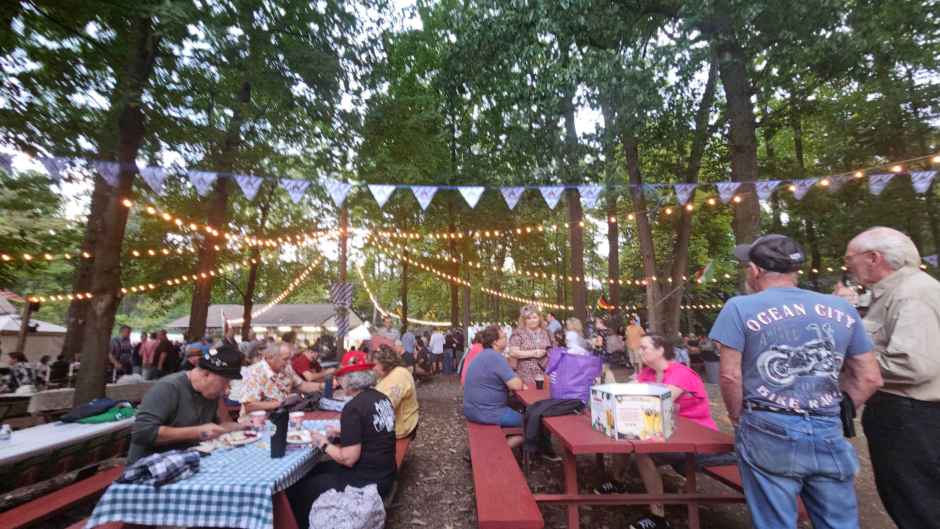
The day was winding down. The museum had closed, and the sun was beginning its slow descent. Erika and I stepped out into the cool, crisp spring air, the kind that carries just a hint of evening chill beneath the fading warmth of the day.
The urgency that had driven us, our mad dashes across the city, our constant checking of maps, began to dissolve. In its place came something softer. A quiet curiosity. Without a list to check off, we were once again free to fully embrace the moment.
We wandered without purpose through streets washed in dusky light, watching as Paris slowly stirred to life for the night. Café lights flickered on one by one. The low hum of conversation drifted out onto the sidewalks. Glasses clinked. Laughter rose and fell like a tide.
Paris, it seemed, was just waking up.
It was in this gentle wandering that we met Julian and his girlfriend, Sandra.
They asked what had brought us to Paris, and we answered in kind. Soon, we were deep in conversation, trading stories of our lives, ours in America, theirs in Paris. There is a certain kind of fleeting camaraderie that forms in moments like these, where neither side expects permanence, and yet both lean fully into the connection.
For a few hours, we were simply part of one another’s stories.
They led us to a club, one far removed from anything we had originally planned.
It was the sort of place where locals belonged, where the rhythm of the night pulsed differently. It was tucked along a street. Do not ask me where, for I doubt I could find it again. With a nod from Julian to the bouncer, we slipped inside, crossing an invisible threshold into another version of Paris.
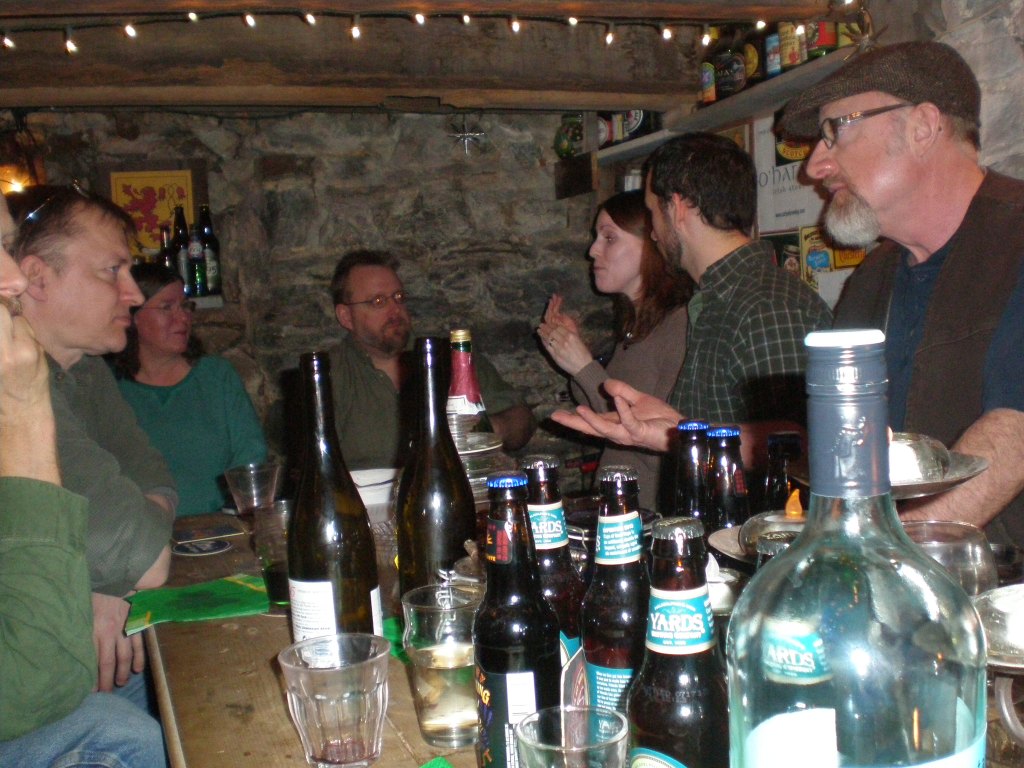
The air was warm and thick with music. The dim light created an intimate atmosphere like it was holding a secret only Parisians knew. We sipped wine and talked, our voices rising to meet the hum of the crowd as the hours stretched on.
And then, suddenly, the room erupted.
A woman appeared, dressed in something delightfully eccentric, a candle balanced atop her head (and I am not entirely sure if her chest was bare, she had on quite the number of necklaces). She sang loudly, joyfully, with a theatrical abandon, moving with a confidence that demanded attention. The crowd joined her instantly, clapping, singing, cheering.
Sandra leaned in to tell us it was her birthday.
It was not how I would have chosen to celebrate, but who was I to question a Parisian in her element?
As the night wore on, exhaustion crept in, the kind that settles deep in your bones after days of walking, of seeing, of feeling everything all at once.
Reluctantly, we apologized and said our goodbyes.
We exchanged Facebook information with every intention of keeping in touch. But as life so often goes, we never did.
Some things, perhaps, are meant to remain exactly where they happened.
In Paris.
Back at the hostel, I checked my email and confirmed our meeting place with Frieman.
The next morning, we set out once more into the city, this time successfully finding him. Though we did not have long together, we lingered over lunch, swapping stories and savoring the flavors of a city that had already given us so much. He drew me a small Eiffel Tower on a napkin, the perfect memento of my trip.
After lamenting our struggles with the metro, Frieman kindly took the time to explain it to us. Confident now, we set off to retrieve our luggage before catching our train.
We followed his directions carefully.
At least, we thought we did.
Emerging from the metro into the bright spring afternoon, we found ourselves somewhere entirely unexpected.
The red light district.
We stood there for a moment, taking it in, the bold storefronts, the neon signs, the unapologetic nature of it all.
Then we looked at each other and burst into laughter.
Never one to miss an opportunity, I leaned in and said, with what I hoped was convincing innocence, “Well… since we’re here, and we’re both engaged, we may as well find something memorable for the honeymoon.”
Smirking and trying not to laugh too loudly, we stepped into a shop and that may or may not have been our only stop.
What exactly we purchased shall remain between Erika and me, and left to your imagination, dear reader.
But we did make certain to stop for a picture in front of the Moulin Rouge before making our way back to the hostel… and eventually, to the train. Only stopping a few times to ask for directions from bemused shop owners.
All in all, it was a weekend in Paris well spent.
A true bucket list adventure, full of mishap and magic, art and laughter, wine and wandering, fleeting friendships and unexpected stories.
And perhaps that is what travel is meant to be.
Not a perfect itinerary.
But a collection of moments, some planned, many not, that come together to form something far richer than anything we could have designed ourselves.
We live in a digital age where we can curate our lives to project an idea of who we are into the world. Are we bubbly and outgoing? Sophisticated and refined? We can place almost any lens or filter over our photos and our lives. With artificial intelligence, that line blurs even further. We can compose music, generate art, write entire essays, and pass them off as our own. We can feed in a photo and receive a picture-perfect version in return.
All of it in pursuit of likes and comments. All of it for confirmation that we are enough.
Which is what we’re all striving for, isn’t it?
It becomes easy to let these illusions shape our identity. The mask we wear for acceptance begins to fuse with who we are. Much like The Mask, it clings to us until we can no longer separate it from our face. And without it, we’re not entirely sure who we are.
Maybe when you were younger, your father took you to baseball games. You wore the jersey, learned the lingo, found community in the crowd. When he asked if you wanted to play, you said yes. You spent your childhood in a sport that never quite fit, quietly forgetting about the gymnastics class you once wanted to try. When the Olympics came on, you changed the channel rather than sit with the ache in your chest as athletes flipped and soared with ease.
After all, that’s not what earns a high five from Dad. That’s not what earns acceptance.
Or maybe you were told you were too loud, so you became soft. Too much, so you became small. You watched a sibling get scolded for being wild, so you became controlled, composed. You saw a parent retreat when overwhelmed, so you learned to hide your emotions. You absorbed opinions about “the kind of people” who go to college or work with their hands, and somewhere along the way, your own desires got quieter.
Without the judgment of others, who are we? What do we actually like? What are our passions?

If no one were watching, what would we choose? If no one were clapping, what would we keep?
Deciding to live authentically is not a small thing. Especially when our relationships have been built on versions of ourselves that were easier to accept. There’s a quiet fear that lingers: Who stays if I change? If they really see me, will they accept me? If I tell them my truth, will I be cast out? They say they love me, but if they never knew who I really am, was it ever actually love?
Not every truth is seismic. Not every revaluation risks losing everything. Sometimes it’s quieter. You grow up dismissing a genre of music you’ve never actually heard, repeating what you were taught. Then one day, you listen. And you like it. You begin to question what else you’ve inherited without examination.
You realize how much of you was shaped before you ever had the chance to choose.
Of course, not all of this comes from a place of harm. A father may have brought his child to baseball games simply to connect, to give what he never received. A mother may have hidden her tears to protect her child from carrying burdens that were never theirs to hold.
But even well-intentioned messages can clip our wings.
We try on identities like hats, convinced they fit, until one day they don’t. We outgrow them. Or maybe we never grew into them at all. We become fractured. The version of us at work looks different from the one at a party, which looks different from the one who sits alone in the quiet.
And eventually, the question surfaces:
Who am I, really?
Maybe that’s the real fear. Not that others won’t recognize us… but that we won’t recognize ourselves.
If the mask came off, would you recognize yourself?
Dear readers, I have a bit of a confession to make. I am not always the posh, delicately spoken flower you may have come to know me as. There are moments when I am decidedly less than ladylike, especially when I am in the throes of passion. Passionate nerdom, to be precise.
Picture me fiercely debating and analyzing the world of science fiction with three of my friends. Add to that the unfortunate fact that I learned to swear from a literal sailor, and when I get salty, I bring the whole ocean with me. It is actually rather freeing to allow a different aspect of myself to shine. After all, we are all multifaceted beings with many sides to ourselves. I am not always channeling my inner Victorian. Sometimes it is my inner Viking warrior, and in this case, it is a girl with some serious beef with filmmakers who simply cannot respect the source material. Is it really so difficult? But honestly, that is part of the fun. My wit and banter at full strength, turned loose on a topic near and dear to my heart: science fiction.
About twice a month, I get together with Scott, Miles, and Dave to review and discuss all things sci-fi. We tend to focus on movies and television, largely because not everyone in the group is as avid a reader as I am. Asking someone to complete an 800-page novel in two weeks is unlikely to end happily. A film, by contrast, is a two-and-a-half-hour commitment instead of twenty hours of reading. Well, twenty hours for them. I can usually polish off a book in eight to ten, depending on how compelling it is.
Alongside reviews, we dive into science fiction news, theories, and the occasional heated debate. Opinions are shared freely, defended passionately, and sometimes gleefully attacked. There is a lot of laughter, teasing, and the kind of spirited disagreement that only works when everyone genuinely enjoys one another. Lest you worry that the boys cannot hold their own against me, fear not. Listen long enough and you will hear them all start to sing “It’s Been a Long Road” just to derail me. Of course, we cannot help but needle Dave for his love of lens flares in Star Trek (for the record, he detests the J. J. Abrams films known for them).
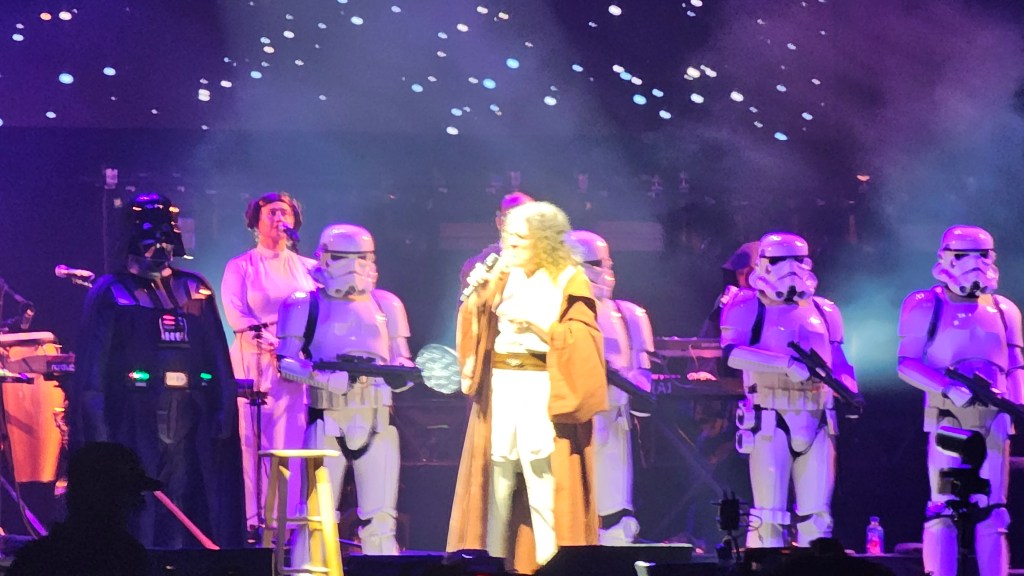
It wouldn’t be a convention without cosplayers
One of my favorite aspects of the podcast is that we do not limit ourselves to recent releases. Often, we revisit older films, the kind that have been forgotten, overlooked, or never widely known in the first place. Sometimes we strike gold. Other times we are left staring into the abyss, wondering how something ever made it to screen. Either way, the process has expanded my palate and deepened my appreciation for different kinds of media.
Some of the films I have ended up loving are ones I never would have chosen on my own. Not because they were masterpieces, but because they offered a fascinating window into how past generations imagined the future. One surprising treasure was Battle Beyond the Stars, which drew inspiration from The Magnificent Seven and the classic Japanese story Seven Samurai. Was it campy? Yes. Was it ridiculous? Absolutely. But goodness, was it funny to watch. Which, admittedly, I was already primed to enjoy given my fondness for older Japanese films. Believe it or not, it was nominated for five Saturn Awards, including Best Science Fiction Film and Best Special Effects. Watching films like this, you can see how cultural values, fears, and hopes were projected forward in time. I have found myself thinking more about how special effects have evolved, how our expectations of technology have shifted, and how often we miss the mark when predicting where we will be in twenty, fifty, or even a hundred years. It makes me wonder what things we consider innate and unchanging now will one day be quietly overturned.
That is what I love most about science fiction. It asks questions. It forces us to examine the implications of technologies just beyond our reach and to consider whether they will ultimately be used for good or for harm. Science fiction reflects the norms of its time, but at its best, it challenges them.
My pilgrimage to Star Trek’s Enterprise housed in the Smithsonian
Star Trek, in particular, has always excelled at this. It does not just explore the possibilities among the stars, but asks us to consider what is possible here on Earth. It gave us the first interracial kiss on television. It pushed audiences to wrestle with the idea of artificial personhood through Data, asking what consciousness really is and what, if anything, separates us from a machine.
This franchise comes up the most on our podcast, likely because it has spanned generations, but also because it is such a deeply philosophical show, challenging and shaping its viewers’ thinking. It certainly shaped mine growing up. I vividly remember watching the Voyager episode “Nemesis,” where Chakotay is seemingly taken in by an alien race, the Vori, who are fighting against the technologically advanced and oppressive Kradin. It is later revealed that this conflict is part of a brainwashing simulation designed to condition him to hate the Kradin. Even after the truth is uncovered, Chakotay struggles to be in their presence. That episode left a lasting impression on me, illustrating how propaganda can turn a compassionate heart toward hatred more effectively than any history book ever could.
I have been podcasting with the guys for nearly ten years now, and it has been a wild ride. Beyond broadcasting my thoughts and engaging with listeners on social media, the podcast has taken me to science fiction conventions, where I have had the opportunity to interview actors, creators, and other figures within the genre.
None of them have been A-list celebrities, but many have graced a red carpet or two. More importantly, the vast majority have been genuinely lovely people: gracious, thoughtful, and generous with their time. They offer insightful answers, often laced with humor, and seem truly appreciative that anyone still cares about the stories they helped bring to life.
Star Trek Panel 2025 Shore Leave Convention
I still vividly remember my first solo interview. It was surreal walking up to the booth at the start of the convention and being handed a press pass. Me? Press? I had not gone to school for journalism. I was a cheeky woman arguing on the internet with her friends for entertainment. I glanced down again and began taking pictures of the wild chaos that is a convention: costumed characters from different franchises co-mingling with those of us dressed in street clothes. I studied the map and instructions for where I needed to go and made my way through the crowd, stopping to take photos and absorb everything around me. Since the interview would not happen for an hour or two, I scouted the location so I knew exactly where I needed to be. In the meantime, I checked the convention schedule, trying to determine which panels to cover so I could report back properly to my colleagues who were counting on me. Ever the overachiever, I was determined not to disappoint the guys.
As the time approached, my nervousness grew. Here I was, face to face with someone who surely had better things to do than talk to me, yet had kindly agreed to do so anyway. I had carefully written and submitted my questions in advance for approval, determined to avoid any last-minute improvisation. My stomach fluttered with butterflies as I reread my notes, silently begging my ADHD impulse control to please, just this once, stick to the script. Somehow, I managed not to fumble with the recording equipment.
After the first question, something shifted. The nerves faded, and the conversation began to flow. Perhaps it was the therapist in me, instinctively comfortable in a question-and-answer rhythm. I promise there was no psychoanalyzing involved. Mostly. Some habits are harder to turn off than others. I walked away with the realization that these people are, at their core, just like everyone else I have met along the way. One particularly lovely memory from this past summer is of Tracee Cocco, who was simply delightful. She seemed genuinely stunned by the crowd cheering for her, walking out on stage with her phone raised, filming the audience with the same awe we felt toward her. This from a woman who has spent over thirty years in Hollywood as an actress, model, and stuntwoman, appearing in more than one hundred Star Trek episodes and rubbing elbows with the likes of Patrick Stewart.
Not all my interviews were famous for their screen time: Charles Dunbar is an anthropologist who studies anime
Being on the podcast has opened doors I never imagined possible and has cemented friendships across generations: Boomer, Gen X, and Millennial, with the occasional appearance by Scott’s son, a Gen Z. When I was first invited on, I never imagined I would still be doing this years later, or that saying “sure” to chatting about shows I loved would lead to such unexpected experiences.
What it has ultimately given me is a space where all my selves are welcome: the thoughtful analyst, the passionate fan, the therapist, the nerd, the woman who swears too much and cares deeply. In a genre devoted to imagining better futures, the podcast has quietly given me something just as meaningful in the present, a place to belong, to question, to laugh, and to keep wondering.
Thinking About Starting a Podcast?
If you have ever considered starting a podcast, my best advice is to begin simply. Pick a topic you genuinely care about and find people you enjoy talking to. You do not need professional equipment or a perfectly polished format right out of the gate. What matters most is consistency, curiosity, and a willingness to keep showing up even when the audience is small. A good podcast grows out of conversation, not performance. If you are having fun and asking thoughtful questions, listeners will feel it.
Give yourself time to find your rhythm. Early episodes may feel awkward, unfocused, or rough around the edges, and that is completely normal. Podcasting, like any creative practice, is learned by doing. The skills come with repetition, reflection, and the humility to improve as you go.
Miles getting attacked by an alien
A Gentle Reality Check
It is also worth saying that starting a podcast does not automatically lead to press passes, convention access, or interviews with celebrities. Those opportunities take time and careful cultivation. They are built on reputation, respect for the process, and a genuine appreciation for the people whose work you are covering.
If you hope to conduct interviews at conventions, begin by reaching out to the event’s leadership to learn their specific process. Each convention handles media requests differently, and respecting those boundaries matters. From there, reach out to guests thoughtfully, ideally through their handler or publicist when possible, and be prepared to hear no. A declined request is not a failure; it is simply part of the landscape.
Always do your research. Know who you are speaking with, understand their work, and come prepared with questions in advance. Showing up informed and professional signals that you value their time. Over time, that consistency builds trust. And trust, more than anything else, is what earns you a reputation as someone who is respectful, reliable, and welcome in these spaces.
Completed: Started 2018
Cost: I honestly have no idea how much it costs Scott to host the website each month or the recording equipment for me it’s free.
Miles from home: We record virtually
For more reflections on meaningful experiences, future dreams, and moments worth remembering, explore my Bucket List and Reverse Bucket List posts.