One Big Inside Joke: An Evening with Weird Al in Hershey, Pennsylvania

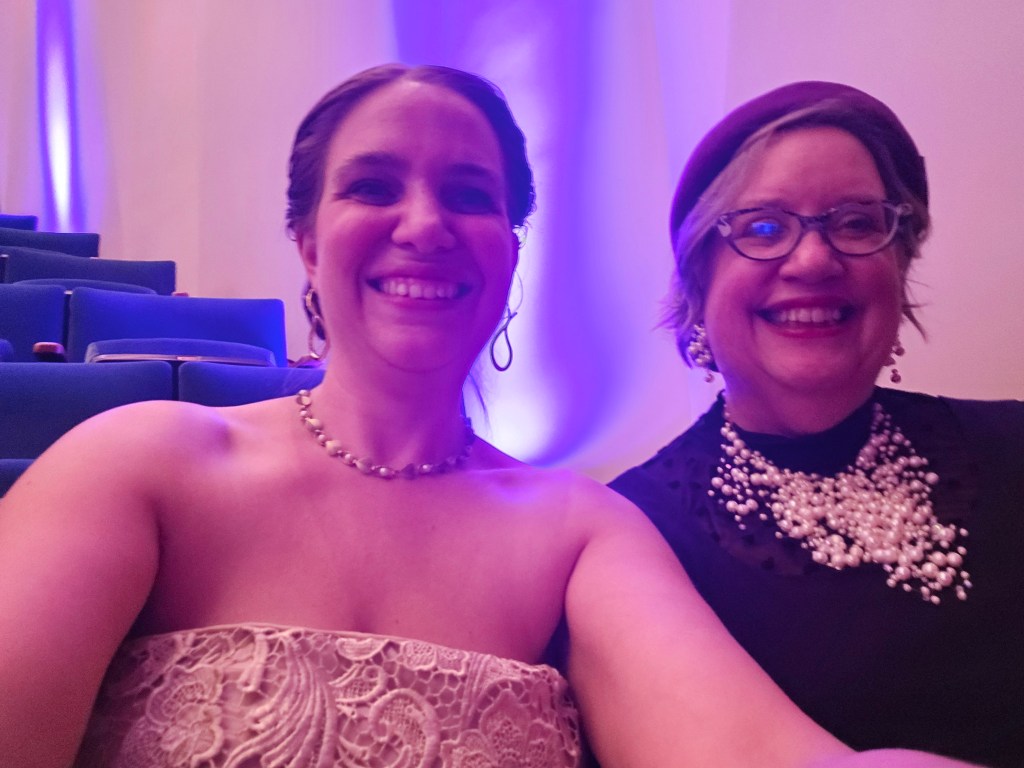
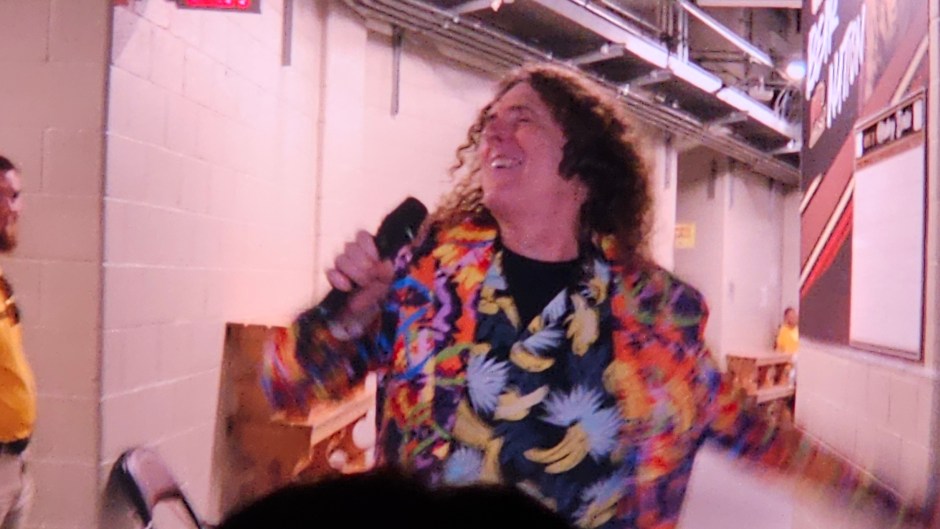
The entire stadium buzzed with barely contained energy that only seemed to grow with each passing moment, like an electric current caught in a positive feedback loop. On the giant screen, a figure danced and sang through the backstage corridors, weaving ever closer to the arena. At first everyone’s attention remained fixed on the video. Then, almost imperceptibly, a ripple spread through the crowd as people realized they had been looking in the wrong direction. Heads began to turn one by one until the entire stadium pivoted toward the aisle behind us.

Then he appeared.

The stadium erupted.

Cheers crashed over us like a tidal wave. People leapt to their feet, phones shot into the air, and for a few glorious moments it was impossible to hear anything except the roar of thousands of delighted fans. It just so happened that I was sitting directly beside the path he took to the stage. I really must remember to thank my sister’s father-in-law for buying those tickets. They may not have been the best seats in the house for watching the entire concert, but they were certainly among the best seats in the house for one unforgettable entrance.
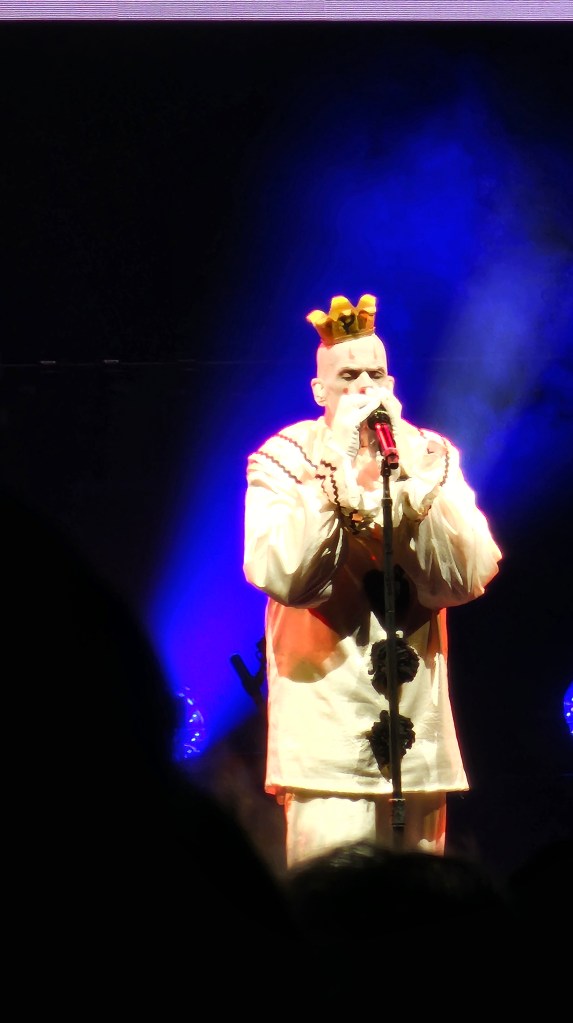
Of course, before Weird Al took the stage, we were introduced to his opening act, Puddles Pity Party. Now, dear reader, if someone had told me beforehand that I would thoroughly enjoy watching a giant sad clown sing power ballads, I would have questioned their sanity. Yet there he stood: towering over the stage, face painted in permanent sorrow, speaking scarcely a word while delivering one astonishing vocal performance after another. The juxtaposition was equal parts hilarious and impressive. Somewhere beneath the oversized clown costume was a voice worthy of Broadway. It was the perfect opening for a Weird Al concert because it left the audience delightfully confused, thoroughly entertained, and wondering what wonderfully bizarre thing could possibly happen next.
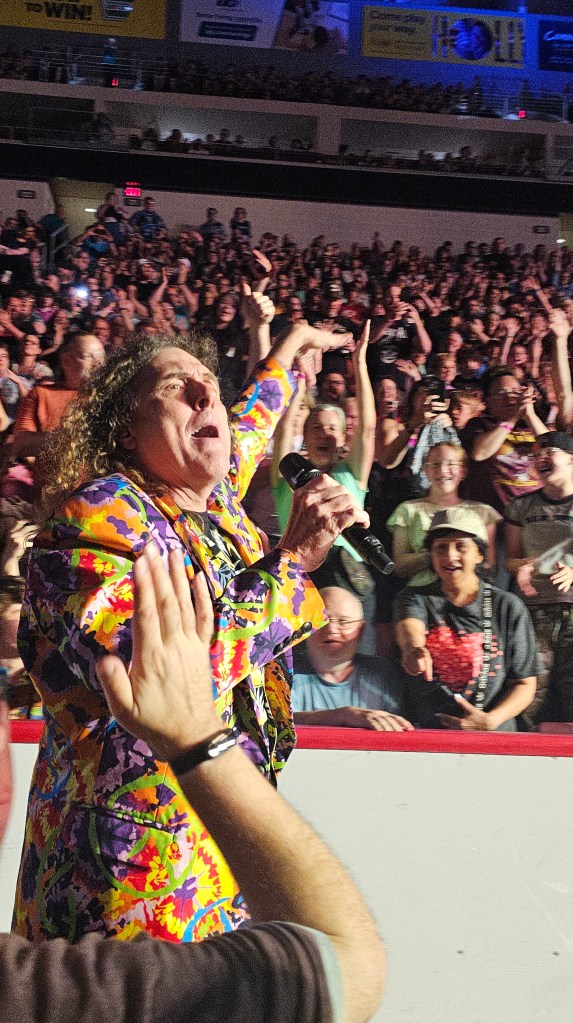
As the evening unfolded, I was delighted by the familiar songs I have come to love over the years. I could not help but dance along from my seat, much to the amusement of my sister beside me. Between songs came the signature humor I have come to expect from none other than Weird Al, who is truly a national treasure.

I am certain, dear reader, that he needs little introduction. For over four decades he has somehow managed the impossible: parodying popular culture with biting wit while never feeling mean-spirited. His songs gently poke fun at our favorite artists, our culture, and ourselves, all while celebrating the very music they imitate. If by some extraordinary chance you have never experienced his work, then by all means pause here for a few minutes, or perhaps a few hours, and explore his library on YouTube, Spotify, or whichever musical service you happen to use. I’ll happily wait.

After his grand entrance, he quickly pivoted to Polkamania! Announced by an accordion descended majestically from the ceiling as though it were some sacred relic delivered from the heavens. Before a single note had been played the audience exploded into cheers. I challenge you to find another performer capable of making thousands of people wildly enthusiastic over the arrival of an accordion. Only Weird Al could transform an instrument often associated with polka festivals into the undisputed rock star of the evening.

The performance itself was every bit as delightfully absurd as one would hope. Costume changes happened at an almost impossible pace. During the compilation numbers it seemed jackets, wigs, and entire outfits vanished and reappeared between verses so quickly that I found myself wondering whether there was some hidden portal backstage devoted entirely to quick changes. It was choreography in its own right.
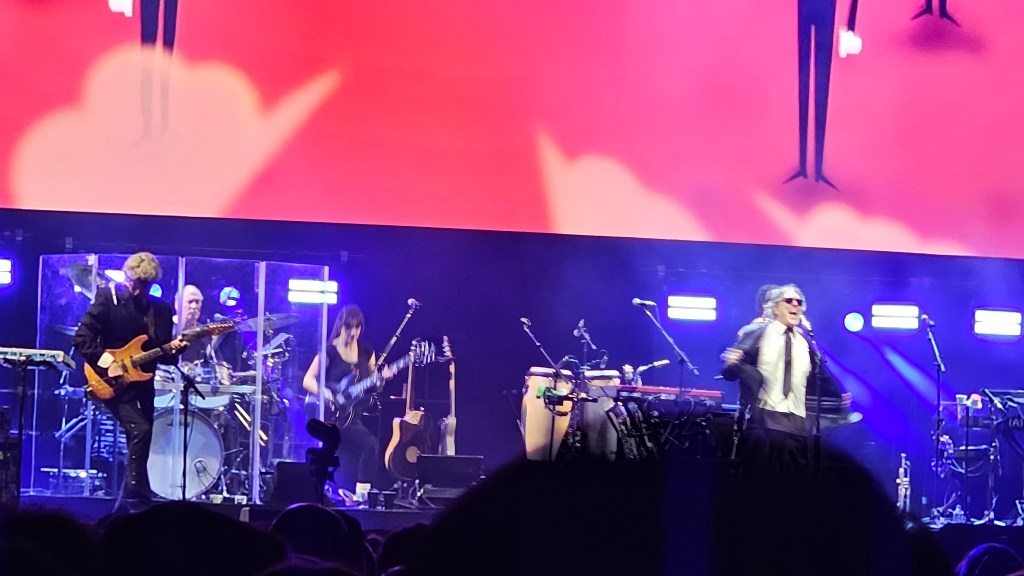
The comedy never stopped. At one point Weird Al paused, looked thoughtfully at the audience, and confessed that he felt as though we were all waiting for something that we had a sort of weird energy he could sense and only one thing would satisfy us:

“A drum solo.”

The drummer dutifully struck the drums perhaps twice.

The crowd responded with thunderous applause as though we had just witnessed the greatest drum solo in rock history. You would have thought John Bonham himself had returned to perform Fool in the Rain. That, perhaps, was the joke’s greatest strength. Every single person in the arena understood exactly what was happening and committed wholeheartedly to the bit.

Of course, the crowning jewel of the evening for me was Amish Paradise.
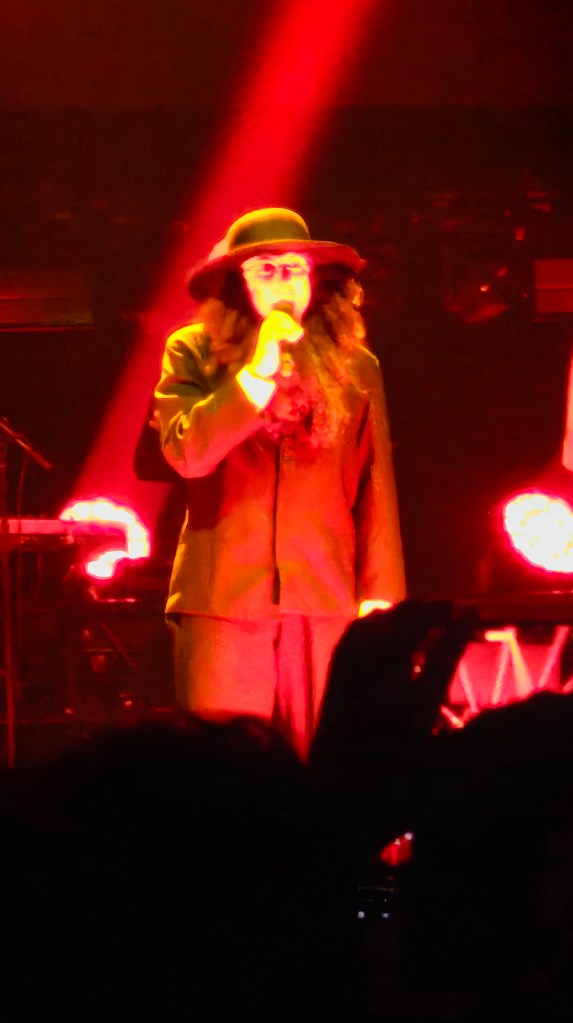
Living in Lancaster County gives one a rather unique appreciation for that particular song. Much of the music video was filmed less than an hour from where I live, and here we were in Hershey, practically in the shadow of Amish Country itself, singing along with thousands of fans. It was the first Weird Al song that I ever heard, the first rap song I ever liked and I am not ashamed to admit I know every word. It felt oddly fitting, almost as though the song had come home.

I will readily admit, dear reader, that I am not usually one for concerts. First, there is the crowd. Simply reaching your seat involves weaving through a maze of people carrying trays piled high with pretzels and bags of popcorn, balancing oversized drinks, or standing uncertainly in the aisle while trying to decipher the seat numbers. Then there are the inevitable lines for merchandise, food, and the restroom. Add in the ever-present smell of buttery popcorn, soft pretzels, spilled drink, and several thousand warm bodies packed together like sardines, and I have generally concluded that my headphones provide a far more civilized musical experience.

Not to mention the audience often has the audacity to sing along. I realize this is considered one of the principal attractions of concerts, but listening to my favorite songs accompanied by hundreds of enthusiastic yet spectacularly off-key strangers has never struck me as a compelling selling point. Throw in questionable acoustics and modern ticket prices, and I have often wondered whether many people attend concerts simply to say they were there.
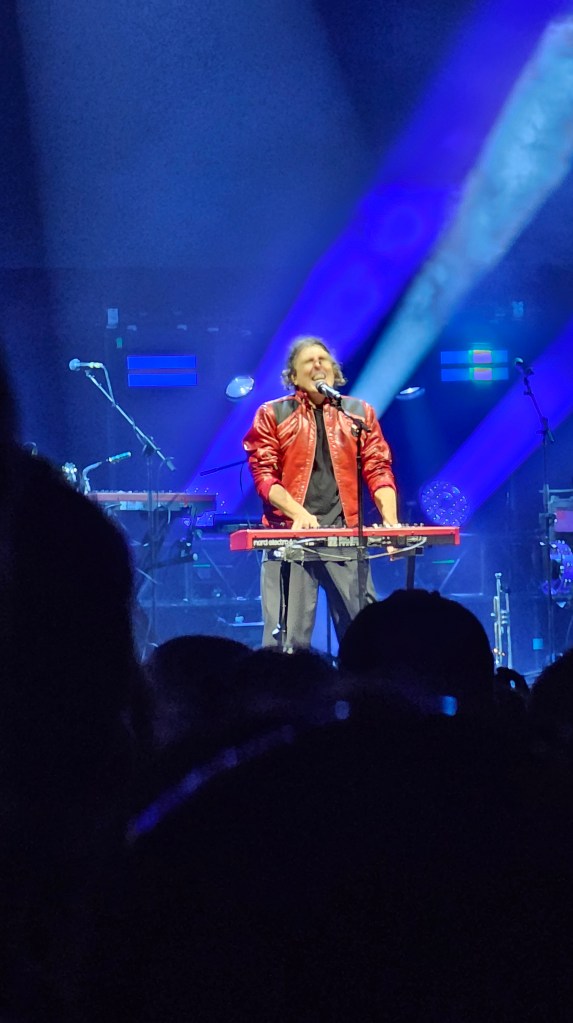
Yet somewhere around the third or fourth song, I began to see why people do.

There is something remarkable about standing among thousands of complete strangers who all understand the same references, laugh at the same jokes, and erupt into applause because an accordion has descended from the ceiling. Before the show you chat with the people beside you in line. During the performance you exchange knowing glances at jokes only fellow fans could appreciate. For one evening, you become part of a wonderfully peculiar little community brought together by a shared affection for one delightfully eccentric musician.

The excitement becomes contagious. Energy flows from the audience to the stage and back again in an endless feedback loop. I found myself shouting lyrics to songs that would not even make my personal top ten simply because everyone around me was having such an incredible time. Somewhere along the way I stopped observing the concert and became part of it.

It was certainly a different experience from seeing Joshua Bell last fall, where the audience sat in near reverent silence between movements, hanging on every note. Nor was it quite like attending Flogging Molly years ago, where the energy was louder, rougher, and far more chaotic. Each concert possessed its own distinct atmosphere.
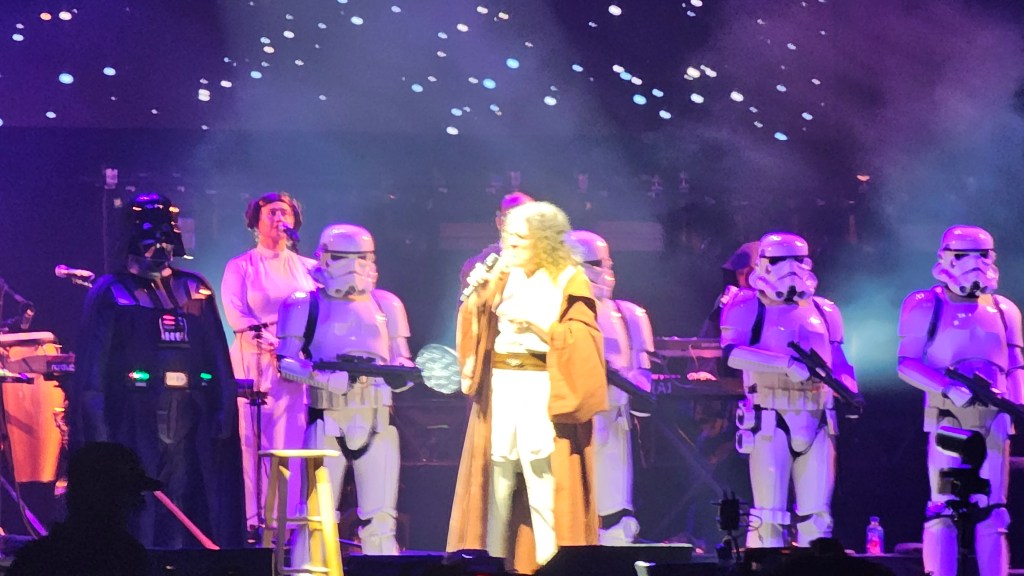
But Weird Al’s felt less like attending a performance and more like being invited to the world’s largest inside joke. For one evening, thousands of strangers gathered not merely to listen to music, but to laugh together, sing together, and celebrate an artist who has spent his entire career reminding us that perhaps we should all take ourselves just a little less seriously.

So remember dear reader, to be a little bit bigger and little bit weirder. 

How might you find a little weirdness in your own life or at least some music?

You don’t have to be a devoted music fan to appreciate the experience of a live performance. In fact, I would argue that’s precisely the point. Bucket lists aren’t always about checking off your favorite activities; sometimes they’re about discovering something you never expected to enjoy. Whether it’s a local orchestra, a bluegrass festival, an outdoor Shakespeare production, a tribute band in the park, or your favorite artist on tour, give yourself permission to step into someone else’s world for an evening. You may leave with more than a few songs stuck in your head—you may discover a community you never knew you belonged to.
The Alchemy of Sand

Have you ever really looked at a piece of glass?

Not through it. Not as a window or a drinking glass or the screen you are likely reading this on. I mean truly looked at it.

Hold it up to the light and watch it catch the sun. Run your fingers across its perfectly smooth surface. Notice how something so rigid can seem almost fluid, bending and reflecting the world around it. It is such a common part of our daily lives that we rarely stop to consider what a marvel it truly is.

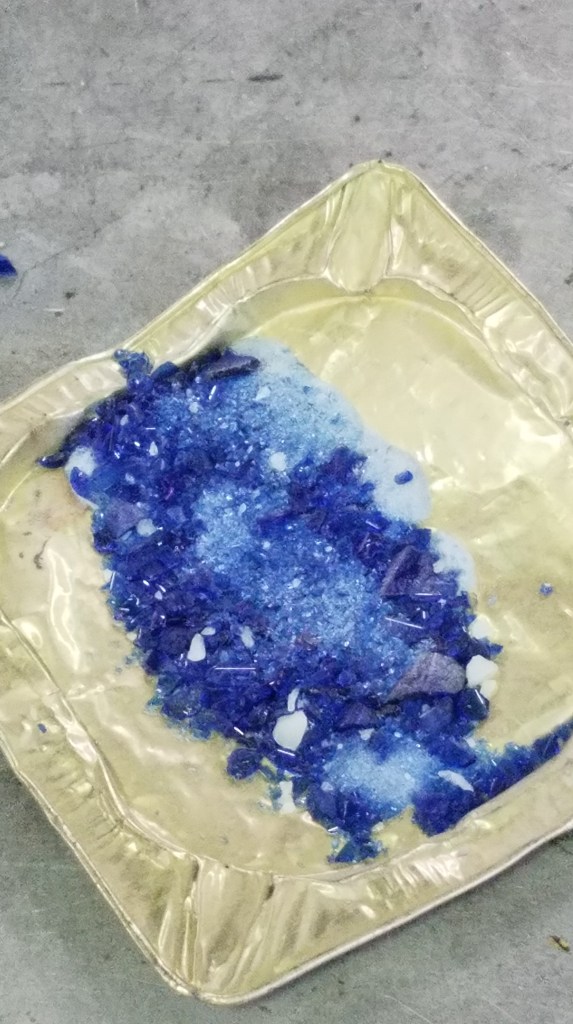
After all, who looks at sand and imagines it becoming something so beautiful? Pick up a handful and let it run through your fingers. Feel the grit against your skin. It seems impossible that the same material could one day become a crystal-clear vase, a stained-glass window, or the screen of a smartphone. Yet mix it with soda ash—not the kind you drink—and limestone, heat it to thousands of degrees, and transformation occurs.

Perhaps that is why glass has always seemed a little magical to me.

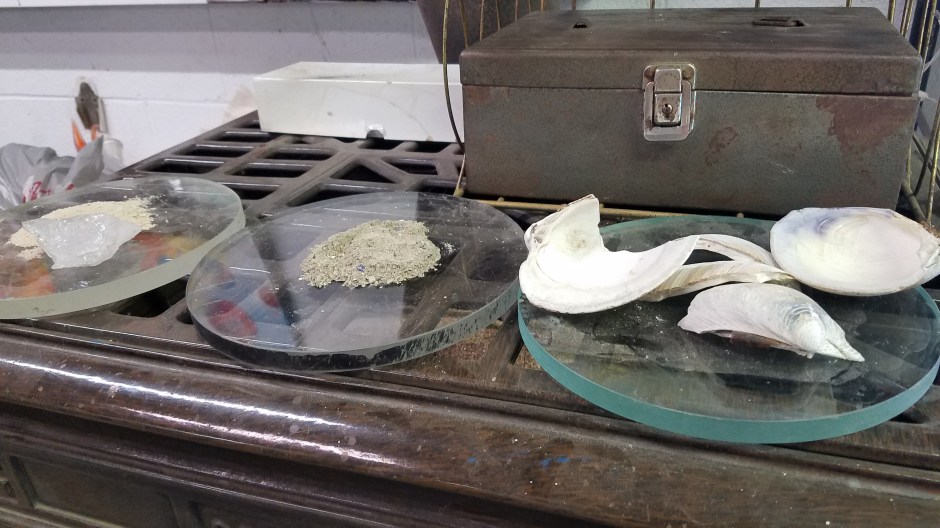
I grew up attending the Renaissance Faire and was familiar with the art of glassmaking from the many demonstrations. It was fascinating watching artisans transform solid minerals into a glowing liquid and then cool them back into entirely different forms. One could only conclude that magic, at least in a sense, was indeed real as dragons, unicorns, flowers, and delicate ornaments emerged from what had once been little more than sand.

Glassmaking is a tradition thousands of years old, originating somewhere in the ancient world, perhaps Syria, perhaps Egypt. However it began, one cannot help but marvel at the discovery. Imagine being the first person to witness the transformation. One day you are standing before a furnace filled with sand and stone. The next, a strange translucent substance emerges from the flames. It is easy to understand why ancient peoples often blurred the line between craftsmanship and magic.

It was this appreciation for its rich history and fascination with magic that seemed just out of reach that piqued my curiosity to seek out a glassblowing class during the midst of COVID restrictions. Yes, flights may have been canceled, cruise ships docked, some states open, others shuttered. Travel seemed impossible, and any chance at adventure seemed out of reach. However, for someone who knows that adventure can be just outside the door, it seemed like the perfect time to explore opportunities closer to home.

Besides, what better activity could there be in a pandemic than one that involves blowing into glass that’s thousands of degrees while the vents continually suck out the air, ensuring one is only breathing fresh air? Any germs you may have will certainly perish in the flames of oblivion. Forgive the dramatic flair, but this is my blog, and I can be dramatic if I desire.

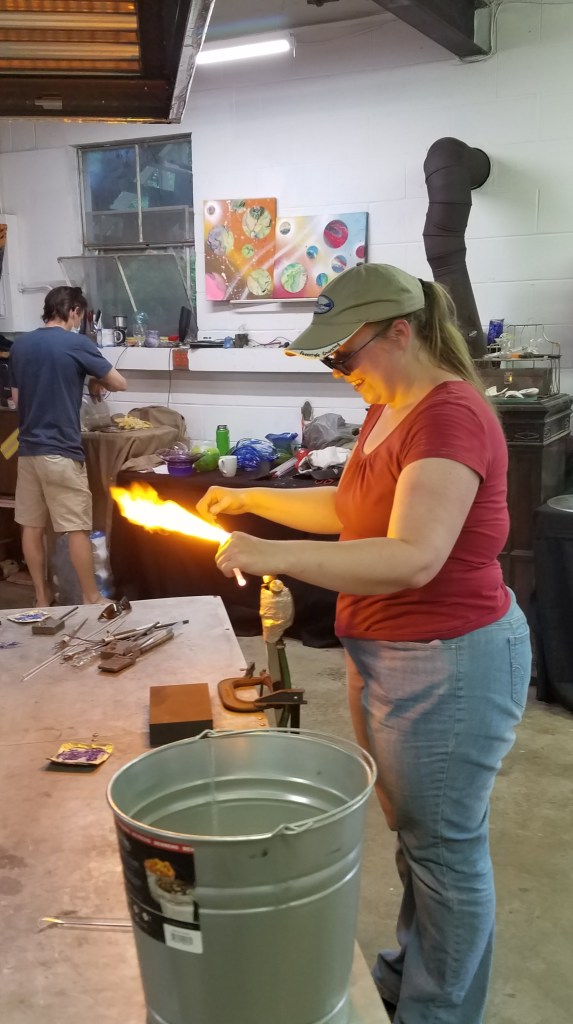
I set out in the beginning of July, just when the first COVID restrictions were being lifted in my home state of Pennsylvania. We reached out to a local craftsman who offered classes and booked a session for two to make glass ornaments. We met with a very friendly teacher, Michael, who first assured us of the safety of the activity before launching into some of the science and history of glassmaking.

Even though it was mostly review for the two of us, we still listened with rapt attention, barely containing our excitement. He explained how we were going to add color to our glass and gave us an overview of the technique: how to blow and turn to keep the glass even, and how quickly the glass cooled despite the heat, making it a little tricky to manipulate. Then we were able to start.

The workshop itself sat open to the warm Pennsylvania summer. One entire wall functioned as a garage door and had been rolled up to welcome the evening air. Beyond it stretched fields and trees glowing beneath the golden light of late afternoon. It was a surprisingly peaceful setting for an activity centered around furnaces hot enough to soften stone.

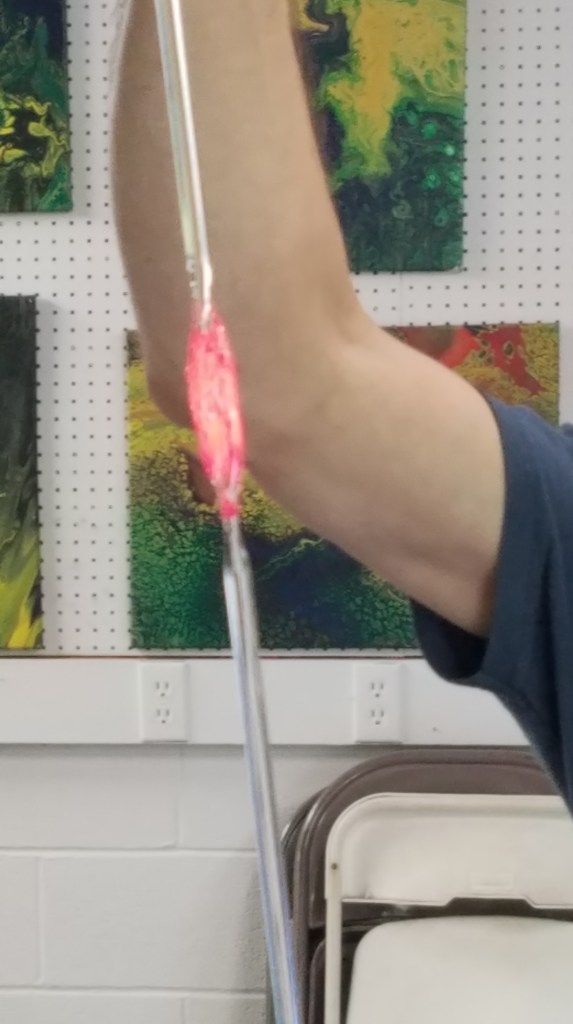
Inside, the studio pulsed with heat and orange light. Glass gathered from the furnace emerged glowing yellow-white before fading through shades of orange, amber, and red as it cooled. Every few moments Michael would send us back to the furnace to reheat our work before the glass stiffened once again.

It was both easier and harder than I anticipated. The glass came to temperature and cooled more rapidly than I thought it would despite his warnings. I had fun experimenting with twisting it and manipulating it into various shapes, not much minding whether it turned out to be a piece of art or not. After all, the idea was simply to experience the process, not necessarily to create something worthy of display.

Although, I must say, for a first attempt, I did quite well.

As the lesson progressed, I became so focused on the task that I barely noticed the passage of time. My attention narrowed to the rhythm of turning the blowpipe, reheating the glass, and carefully shaping it before it cooled. Only occasionally would I glance up and realize the world outside had changed.

The bright summer afternoon had softened into twilight. Long shadows stretched across the fields beyond the open doorway, and the golden light that had greeted us slowly gave way to the blues and purples of evening. Somewhere between the furnace and the workbench, hours had slipped away unnoticed.

How can you create your own magic?

If reading this has awakened a bit of curiosity, you may be surprised to learn that glassblowing classes are more accessible than you might think. A quick search for “glassblowing classes near me,” “glass art studios,” or “glass workshops” will often reveal local artisans offering beginner-friendly lessons. Community art centers, craft schools, and independent studios frequently host one-time classes where no prior experience is required.

Perhaps you will make an ornament, a paperweight, or a vase. Perhaps your creation will emerge a little lopsided, much like mine. That hardly matters. The real magic lies in stepping through the studio door, feeling the heat of the furnace, and experiencing an ancient craft with your own hands. You never know what wonders may be hiding just around the corner of your hometown, waiting to transform an ordinary afternoon into an adventure.

Completed: 2020

Cost: $95

Miles from home: 30 miles

Want to discover more adventures? Check out my whole Bucket List and Reverse Bucket List

Paris, Part 5: A Perfectly Imperfect Weekend

The day was winding down. The museum had closed, and the sun was beginning its slow descent. Erika and I stepped out into the cool, crisp spring air, the kind that carries just a hint of evening chill beneath the fading warmth of the day.

The urgency that had driven us, our mad dashes across the city, our constant checking of maps, began to dissolve. In its place came something softer. A quiet curiosity. Without a list to check off, we were once again free to fully embrace the moment. 

We wandered without purpose through streets washed in dusky light, watching as Paris slowly stirred to life for the night. Café lights flickered on one by one. The low hum of conversation drifted out onto the sidewalks. Glasses clinked. Laughter rose and fell like a tide.

Paris, it seemed, was just waking up.

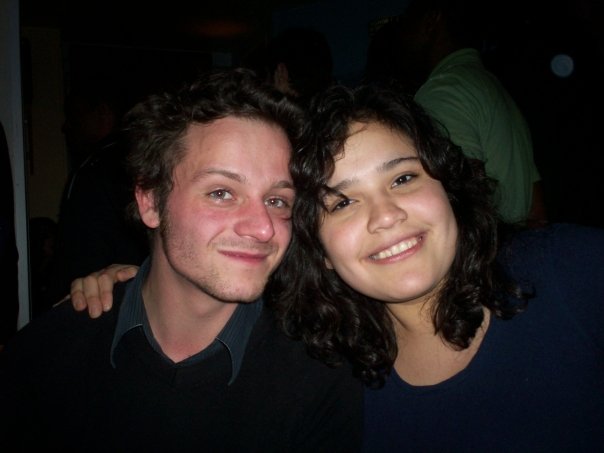
It was in this gentle wandering that we met Julian and his girlfriend, Sandra.

They asked what had brought us to Paris, and we answered in kind. Soon, we were deep in conversation, trading stories of our lives, ours in America, theirs in Paris. There is a certain kind of fleeting camaraderie that forms in moments like these, where neither side expects permanence, and yet both lean fully into the connection.

For a few hours, we were simply part of one another’s stories.

They led us to a club, one far removed from anything we had originally planned.

It was the sort of place where locals belonged, where the rhythm of the night pulsed differently. It was tucked along a street. Do not ask me where, for I doubt I could find it again. With a nod from Julian to the bouncer, we slipped inside, crossing an invisible threshold into another version of Paris.

The air was warm and thick with music. The dim light created an intimate atmosphere like it was holding a secret only Parisians knew. We sipped wine and talked, our voices rising to meet the hum of the crowd as the hours stretched on.

And then, suddenly, the room erupted.

A woman appeared, dressed in something delightfully eccentric, a candle balanced atop her head (and I am not entirely sure if her chest was bare, she had on quite the number of necklaces). She sang loudly, joyfully, with a theatrical abandon, moving with a confidence that demanded attention. The crowd joined her instantly, clapping, singing, cheering.

Sandra leaned in to tell us it was her birthday.

It was not how I would have chosen to celebrate, but who was I to question a Parisian in her element?

As the night wore on, exhaustion crept in, the kind that settles deep in your bones after days of walking, of seeing, of feeling everything all at once.

Reluctantly, we apologized and said our goodbyes.

We exchanged Facebook information with every intention of keeping in touch. But as life so often goes, we never did.

Some things, perhaps, are meant to remain exactly where they happened.

In Paris.

Back at the hostel, I checked my email and confirmed our meeting place with Frieman.

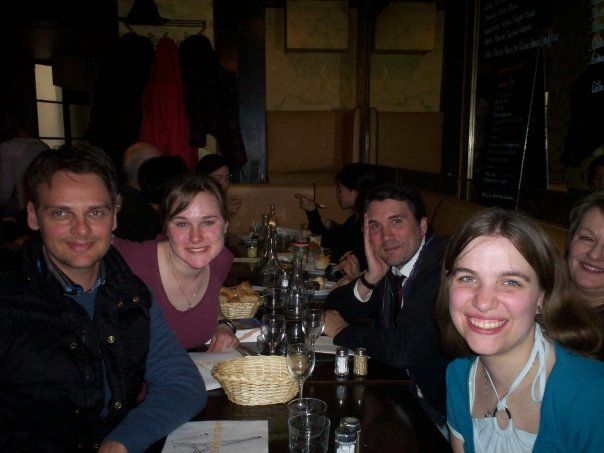
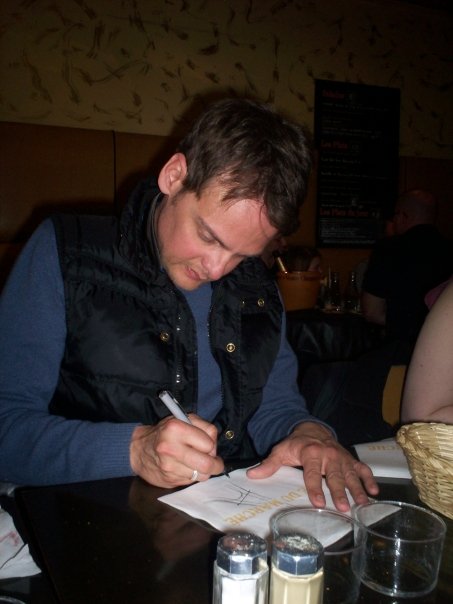
The next morning, we set out once more into the city, this time successfully finding him. Though we did not have long together, we lingered over lunch, swapping stories and savoring the flavors of a city that had already given us so much. He drew me a small Eiffel Tower on a napkin, the perfect memento of my trip. 

After lamenting our struggles with the metro, Frieman kindly took the time to explain it to us. Confident now, we set off to retrieve our luggage before catching our train.

We followed his directions carefully.

At least, we thought we did.

Emerging from the metro into the bright spring afternoon, we found ourselves somewhere entirely unexpected.

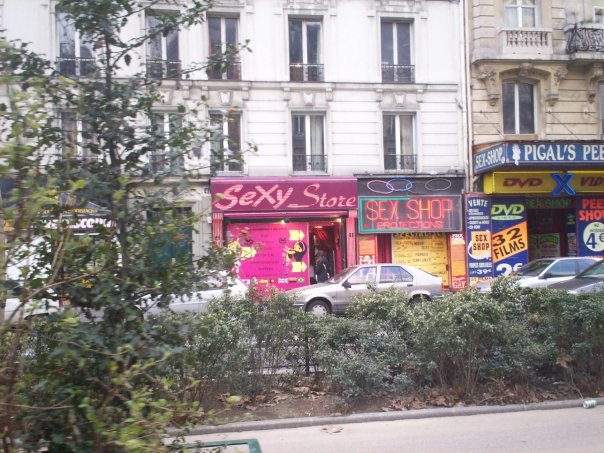
The red light district. 

We stood there for a moment, taking it in, the bold storefronts, the neon signs, the unapologetic nature of it all.

Then we looked at each other and burst into laughter.

Never one to miss an opportunity, I leaned in and said, with what I hoped was convincing innocence, “Well… since we’re here, and we’re both engaged, we may as well find something memorable for the honeymoon.”

Smirking and trying not to laugh too loudly, we stepped into a shop and that may or may not have been our only stop.

What exactly we purchased shall remain between Erika and me, and left to your imagination, dear reader.

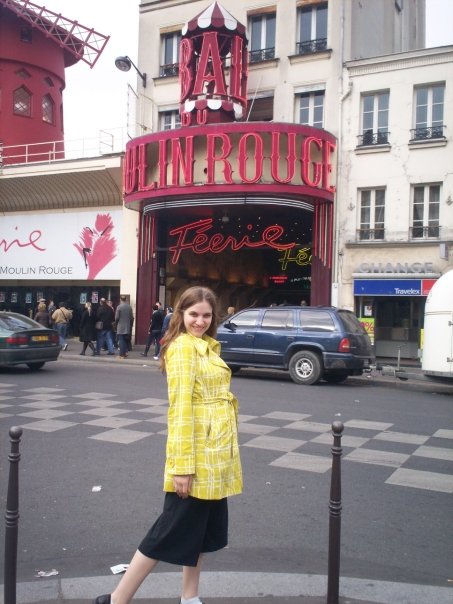
But we did make certain to stop for a picture in front of the Moulin Rouge before making our way back to the hostel… and eventually, to the train. Only stopping a few times to ask for directions from bemused shop owners. 

All in all, it was a weekend in Paris well spent.

A true bucket list adventure, full of mishap and magic, art and laughter, wine and wandering, fleeting friendships and unexpected stories.

And perhaps that is what travel is meant to be.

Not a perfect itinerary.

But a collection of moments, some planned, many not, that come together to form something far richer than anything we could have designed ourselves.

Want to discover more adventures? Check out my whole Bucket List and Reverse Bucket List

Paris Part 4: The Paris You Don’t Plan For

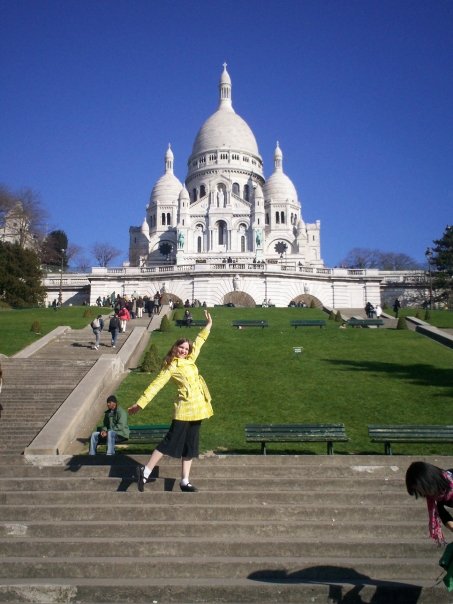
We left our story (Part 1, Part 2, Part 3), dear reader, at the steps of the Basilique du Sacré-Cœur, with the universe laughing as I stared in disbelief at a place I had already declared far too distant to reach that day. In the years since, I have often found myself accomplishing things that once felt equally out of reach. When doubt creeps in, I return to this memory. The path may not be direct, but you will arrive. The trick is learning to enjoy the detours.

And perhaps, if I am being honest, that is part of why I share stories like this at all.

Occasionally, I wander further afield in these tales. Not to abandon the spirit of this blog, but to present it honestly. Some dreams require more than staying close to home. Some experiences ask you to stretch beyond your usual borders. I have no desire to present a life neatly curated into something it is not. The truth, as it turns out, is far more interesting. And far more instructive.

Had we marched straight to Sacré-Cœur, we would have missed the Eiffel Tower and the Archaeological Museum entirely. Travel, when approached with openness, teaches far more than what sits behind glass displays.

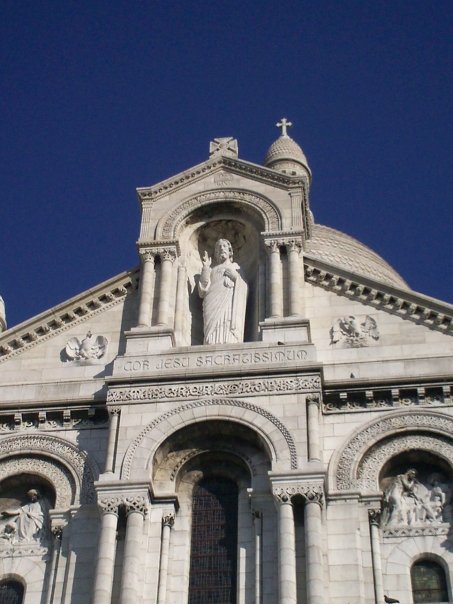
The Basilique du Sacré-Cœur stood in quiet contrast to the more widely known Notre-Dame Cathedral. There was a preserved sacredness here. Where Notre-Dame hums with the steady rhythm of tourism, Sacré-Cœur felt… guarded. Not unwelcoming, but intentional.

No photographs. Voices lowered to a hush. Nuns gently, but firmly, reminding visitors that this was not merely a site to be consumed, but a space still in use, still sacred.

Some may find that restrictive. I found it grounding.

We were the ones intruding, and we were given boundaries. Watching worshippers in quiet devotion, I felt something I can only describe as a pull upward, a stillness that settled over the space and demanded respect. It remains one of my favorite memories, not despite those restrictions, but because of them.

We left eventually, though I could have lingered longer, stepping once more into the lively streets of Paris as though emerging from another world.

Our destination was the Musée d’Orsay, home to some of my favorite artists. In those pre-smartphone days, coordinating across countries required optimism and a bit of guesswork. When the appointed meeting time with Frieman came and went, we were left waiting… and waiting… only to discover later we had managed to wait for one another at entirely different museums.

A perfect summary of early 2000s travel, really.

Accepting defeat for the day, we went inside anyway, trusting that an email later would sort things out.

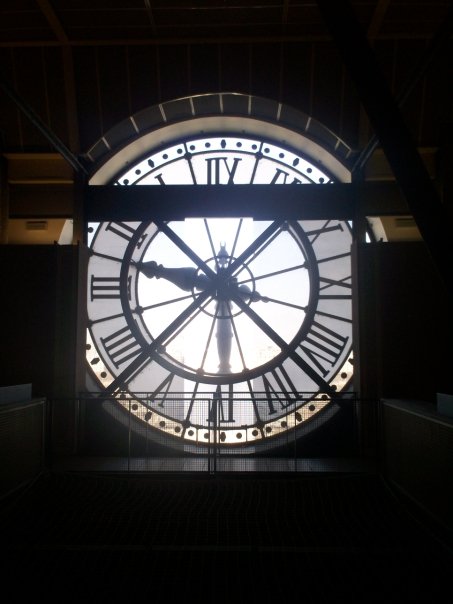
The Musée d’Orsay itself deserves more than a passing mention. Once a grand train station, its soaring ceilings and iron framework still echo its former life. There is something poetic about a place once built for movement now holding stillness. Light pours in through enormous windows, illuminating canvases that themselves chase fleeting moments.

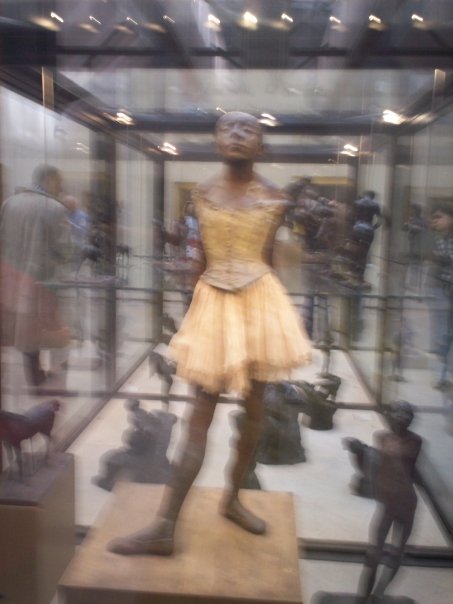
We wandered slowly, letting the space guide us. Monet’s work shimmered with that signature softness, as though the world itself refused to stay still long enough to be fully captured. Renoir’s figures felt alive in a different way, their warmth and movement drawing you into their world. Impressionism has always felt less like observation and more like memory, imperfect, glowing, and deeply human.

With our plans unraveled, we turned next to Sainte-Chapelle.

There are beautiful places, and then there are places that feel almost unreal.

Sainte-Chapelle belongs firmly in the second category.

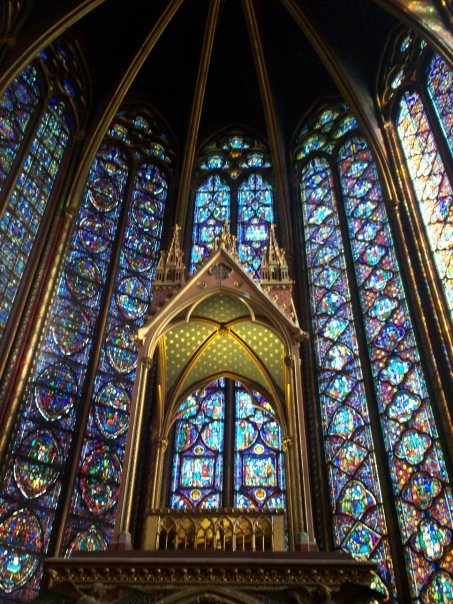
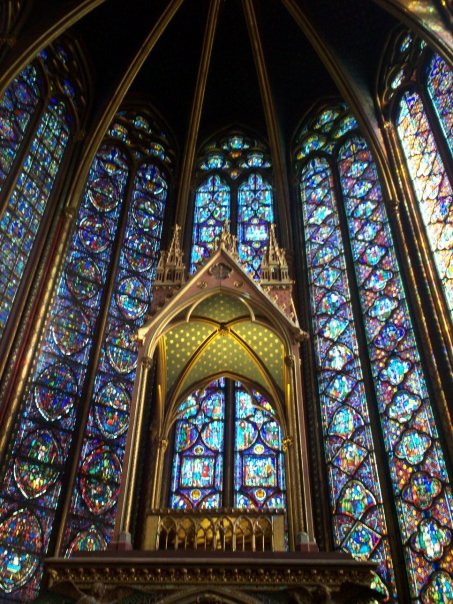
The structure itself nearly disappears, replaced by walls of stained glass that stretch impossibly high. Over a thousand panels catch the light and fracture it into color so vivid it feels alive. Reds, blues, and golds spill across the floor and over the people standing within it. You do not simply look at the windows. You stand inside them.

It is overwhelming in the best possible way. Quiet falls over the room, not because it is enforced, but because it feels required.

Still caught in that awe, we wandered into the gift shop, and it was there that something clicked into place.

I had been seeing unicorn tapestries everywhere.

At first, I dismissed them. Tourist fare. Decorative patterns meant to evoke something vaguely medieval. But they kept appearing, on bags, on notebooks, in displays. Persistent.

Curious, I asked the woman behind the counter, half expecting a vague answer.

Instead, she smiled and told me exactly where they were.

Right here. In Paris. At the Musée de Cluny.

Now, dear reader, it should come as no surprise that I love unicorns. This is me after all.

(If you’d like the full story behind that lifelong obsession, and a deeper dive into the tapestries themselves, you can read it here.)

This is not a casual appreciation. This is a lifelong commitment.

My very first stuffed animal was a unicorn named Rainbow, a music box that played Somewhere Over the Rainbow. She traveled with me across countries and still sits on a shelf in my room. Growing up in the 90s, unicorns were not nearly as easy to find as they are now, which only made each one feel that much more special. Books, toys, anything I could find, I devoured it. Really today’s children have no idea how easy it is to find them!

And somewhere along the way, I discovered The Lady and the Unicorn.

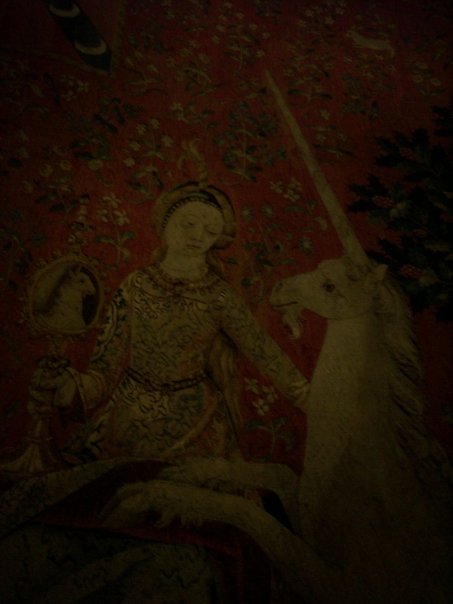
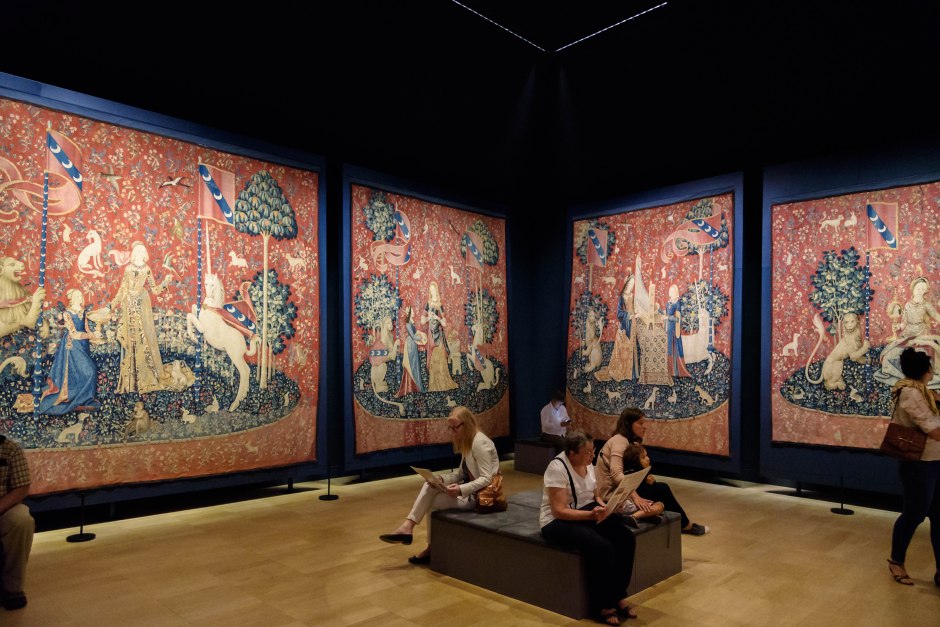
A series of six medieval tapestries, each rich with symbolism, each woven in the millefleurs style—“a thousand flowers”, their backgrounds alive with intricate botanical detail. Created around the turn of the 16th century, likely in Flanders, they depict the five senses: taste, touch, smell, sight, and hearing. The sixth, bearing the phrase À mon seul désir, “to my only desire”, remains something of a mystery.

Interpretations vary. A renunciation of earthly pleasures. A declaration of free will. Perhaps even a representation of a sixth sense, something beyond the physical. I have always liked that it resists certainty.

It felt fitting.

Armed with directions and far too much enthusiasm, Erika and I set off at once. My feet protested. Fifteen miles the day before had seen to that. But there are moments when discomfort becomes irrelevant.

This was one of them.

There were unicorns to see.

I did my best to behave like a reasonable adult upon entering the museum. I failed. Spectacularly. While I attempted to maintain composure, I am fairly certain my barely contained excitement gave me away. To her credit, Erika insisted we take our time, lingering over artifacts, allowing the museum to unfold properly.

I tried.

I truly did.

And then we reached them.

The tapestries did not merely meet expectations. They erased them.

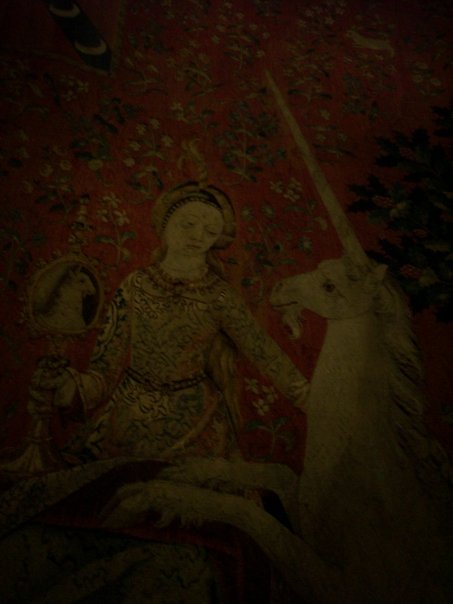
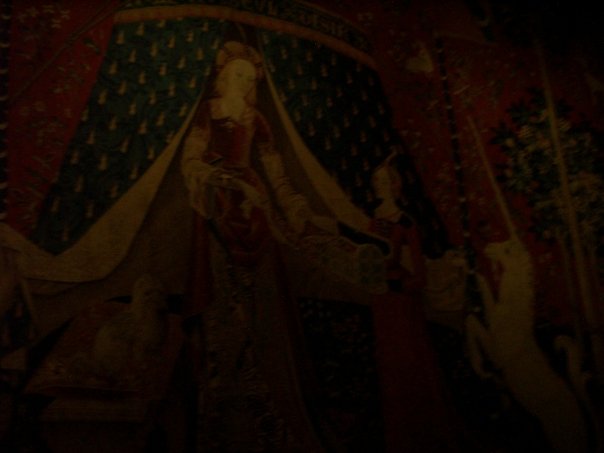
Reproductions flatten them. They shrink them. They strip away the very things that make them extraordinary. In person, every thread is visible. Every flower distinct. The scale alone is commanding, but it is the detail that captures you. And I apologize dear reader that my photos do them little justice. As it was the early 2000s technology was woefully lacking and I did not use flash photography. However, the ones you see are the ones I took.

You begin to think about the time embedded in them. The hands that worked them. The months, perhaps years, of labor required to bring them into existence. These were not casual creations. They were declarations of wealth, of artistry, of devotion to craft.

In a world where we can summon decoration with a click, it is difficult to comprehend that level of patience.

As I stepped into the dim gallery, my excitement softened into something quieter.

Awe.

My breath caught as I approached, drawn forward as though the space itself required stillness. I do not know how long I remained there. Time loosened. I studied each panel carefully, tracing patterns, noting symbols, wishing—once again—that I knew enough about botany to name every plant.

I said very little.

What could be said?

Some things refuse translation. They must be experienced fully, in person, to be understood at all.

Too soon, we moved on. There was still more of Paris waiting.

And so, from a missed meeting, a chance question, and a persistent pattern I almost ignored, we found ourselves swept into yet another unexpected adventure.

Want to discover more adventures? Check out my whole Bucket List and Reverse Bucket List

When Winter Howls, Let the Opera Sing

We are experiencing a bit of a cold snap here in Pennsylvania. The wind howls outside as I write this, and temperatures plummet from merely chilly to, quite frankly, unbearable. We are advised to stay indoors, and even the sun itself has decided to deprive us of what little warmth it might have offered. While I can certainly enjoy winter outdoor activities, it is on days like these that perhaps we ought to turn to indoor pursuits. Ones that do not come with frostbite warnings attached.

Given the gloomy monotony of the outdoors, I also tend to gravitate toward things with a bit more flair and ambiance. And what could offer more of both than the opera?

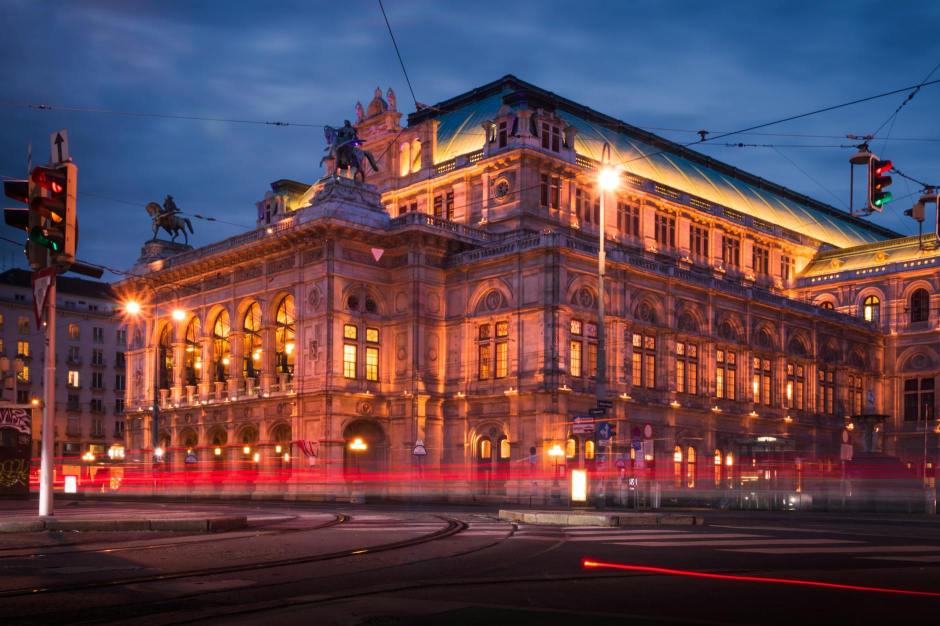
Now, dear reader, I can imagine what you may be thinking. The opera? Where everything is sung in a language you do not understand? Where people dress in finery and say things like, “Why, Penelope, your gown looks absolutely divine. I am certain it will catch Edward’s eye,” as if you have been whisked away to eighteenth-century England. Perhaps you are intimidated by the grand architecture of the opera house itself, the richness of the spectacle, or the sheer weight of history behind it all. You may worry the plotlines will feel distant or the music dull.

Allow me to assuage your fears. Opera is far more down to earth than it first appears, especially today, when it has become a welcoming space for all, not just wealthy elites and snobbish intellectuals. Though I am sure they are still wandering about somewhere, we need not pay them any mind.

As for dressing up, you certainly can, but you do not have to. I did on my first visit, simply for the fun of it. Besides, I had a beautiful gown begging for a night out, and how could I deny it the pleasure of an opera house? It was stunning, a deep purple with a jeweled neckline that hugged my waist before falling into an A-line skirt. It swirled around my legs as I practically danced through the halls in excitement. As a senior in high school at the time, I earned a mixture of approving and amused glances from my elders.
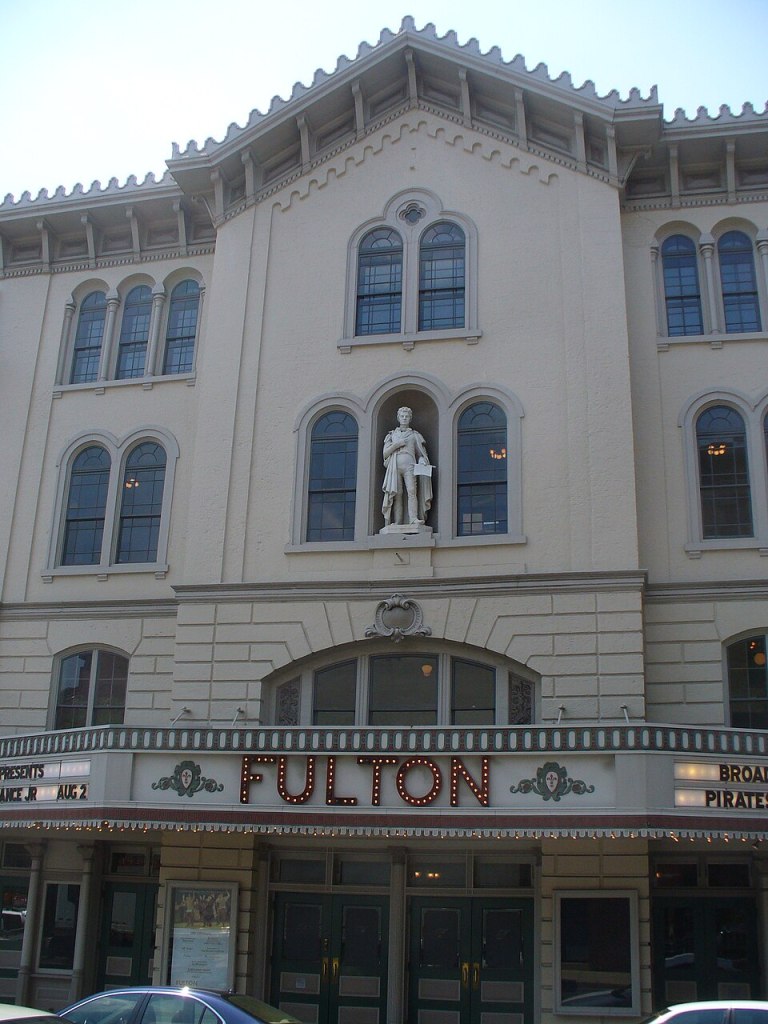
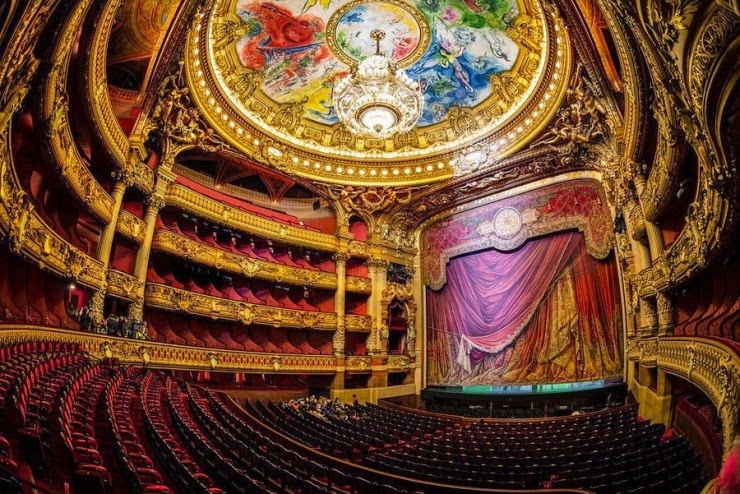
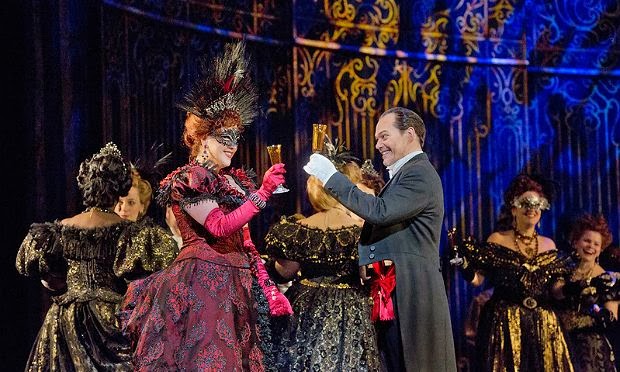
That first experience was a German opera, Die Fledermaus (The Bat), at the Fulton Opera House, one of the few opera houses designated as a National Historic Landmark. The building itself was breathtaking, restored in 1995 to its original Victorian elegance. One step inside, and you might think yourself transported to the opera halls of Europe, with ivory hues, rich red accents, gilded columns, and balconies adorned with swirling gold details. The ceiling features elegant arches and intricate designs that invite the eye upward. I remember being awestruck by this unassuming treasure in my own community.

From the outside, the Fulton sits modestly among other historic buildings, its facade surprisingly plain. The sign announcing “Fulton” feels more reminiscent of a mid-century movie theater than an esteemed opera house, which is fitting in a way. For a time, it did serve as a run-down movie theater before its restoration transformed it into the jewel of Lancaster City that it is today.

My second opera experience, however, was far more casual. It did not take place in an opera house at all, but rather at my local movie theater. It is hard to find anything less intimidating than a relaxed afternoon at the cinema, complete with popcorn and soda. You could show up in pajamas and no one would bat an eye.

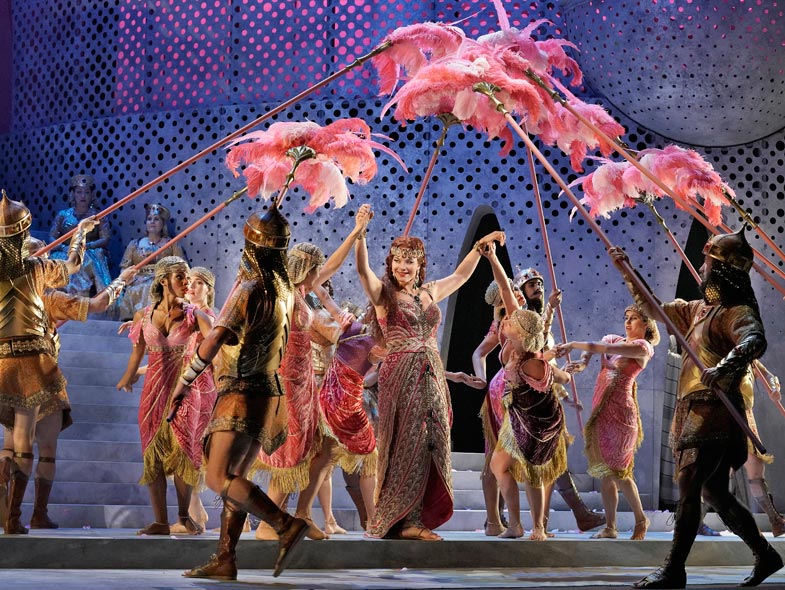
This accessibility is thanks to the Metropolitan Opera, often shortened to the Met, which streams live performances to movie theaters around the world. The Met is one of the most renowned opera houses in existence and sits high on any opera lover’s list of must-visit destinations. With the Met: Live in HD series, one no longer needs to travel to New York City to experience world-class performances. Depending on your theater, the seats may even be more comfortable. Mine has reclining chairs and serves alcohol, which makes a four-hour performance surprisingly enjoyable.

One of my favorite parts is coordinating visits with friends who live far away. We attend the same performance in different cities, text during intermission, and discuss it afterward. Even separated by hundreds of miles, it becomes a shared experience. The Met: Live in HD series offers a wide range of composers and styles. Some productions are modernized with contemporary settings and costumes, while others lean into the historical period in which they were written. Still others fully embrace fantasy, transporting audiences into worlds of myth and legend. Because the performances are filmed, you never miss a detail. Every embellishment on a costume and every carefully placed set piece is visible.

Of course, far beyond the costumes, props, scenery, and architecture is the music itself. It is enchanting, enrapturing, and enthralling in equal measure. Opera spans the full breadth of human emotion, joy, sorrow, longing, fury, tenderness, capturing your heart and refusing to let go. I still remember the hush that fell over the audience as the first notes rose from the orchestra pit, the way sound seemed to ripple through the room. Then came the singers, their voices soaring with jaw-dropping range and power, filling every corner of the space. You do not simply hear opera. You feel it vibrating in your chest, settling into your bones.

Although I speak German conversationally, it is nowhere near sufficient to follow an opera. Thankfully, modern audiences no longer need fluency in French, Italian, or German to enjoy the art form. Operas are almost always subtitled in English, allowing viewers to follow the plot while fully immersing themselves in the music. I vividly remember sitting in the theater, completely enraptured in a way I had never experienced through recordings at home. The notes were richer and fuller, the harmonies more layered, the emotion unmistakable.

Opera is more than a theatrical performance. It is poetic song and living art. It carries a rich cultural history across Europe, filled with timeless stories and enduring truths. Nor is opera confined to the past. Contemporary operas continue to be written and performed, carrying the tradition forward into the modern world.


First Operas to Try (A Gentle Introduction)

If you are curious about opera but unsure where to begin, starting with the right work makes all the difference. These operas are frequently recommended for newcomers because they feature engaging stories, memorable music, and emotional clarity.

Die Fledermaus – Johann Strauss II
A lively comic opera full of humor, mistaken identities, and infectious music. Lighthearted and approachable. It was also my own first opera, so it comes highly recommended.

La Bohème – Giacomo Puccini
A deeply human story of love, friendship, and loss, paired with lush, emotionally direct music.

Carmen – Georges Bizet
Dramatic, passionate, and instantly recognizable, with a strong central character and unforgettable melodies.

The Magic Flute – Wolfgang Amadeus Mozart
A blend of fantasy, symbolism, and humor, written to appeal to broad audiences and still accessible today.

The Barber of Seville – Gioachino Rossini
Fast-paced, witty, and energetic, this comedy is a joy from start to finish.


How to See an Opera Yourself

If you find yourself intrigued, seeing an opera is easier than you might expect.

Check local listings.
Many cities have regional opera companies or host touring productions. Local arts calendars are a great place to start.

Look into streaming performances.
The Met: Live in HD series brings world-class opera to movie theaters worldwide, often at a much lower cost than live tickets.

Seek out local opera houses and smaller companies.
Do not overlook intimate venues. Smaller productions are often more affordable and can feel wonderfully personal.

Do not be afraid to start small.
Matinees, shorter operas, or chamber performances can be ideal first experiences.

Opera has a way of meeting you where you are. All you need to do is step inside and listen.


Opera does not have to be intimidating. It is a welcoming, fantastical place that offers refuge from the cold and invites you into a world of sound and story. So when the wind howls and winter presses in, consider, dear reader, letting the opera sing you warm.

Completed: 2006

Cost: $23 (The Met Live is typically $23 and Opera house tickets can range from $25 to $100)

Miles from home: Home town

Want to discover more adventures? Check out my whole Bucket List and Reverse Bucket List

From Fire and Ash a Phoenix Rises: Firebird Festival in Phoenixville

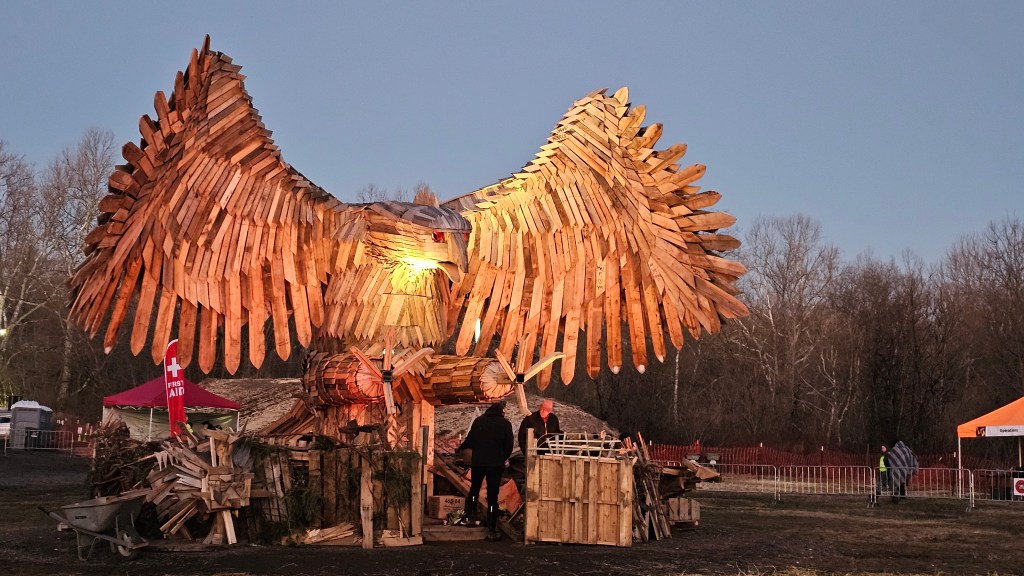
For the past twenty years a mysterious sight has unfolded in the midst of the winter’s cold. A community builds a giant wooden bird and then sets it on fire much to the delight of the spectators. And, dear reader, it is as awesome as it sounds. 

The Firebird Festival, was a dream of a Henrik Stubbe Teglbjaerg, an immigrant from Denmark who has resided in the States since the late 1980’s. He, with four other Phoenixville residents, came up with the idea, in part inspired by similar festivals of Europe where they build things and set it on fire. When he first arrived Phoenixville was a dreary little town. However, it started to revive itself, opening up a theater, art galleries, coffee house and it was as if there was a rebirth, a town rising up out of the ashes. So what could be a more perfect fit than to celebrate with the symbol of rebirth and the town’s own namesake? 

What is more is that each year, the ashes from the burned phoenix are taken and made into clay birds which are then placed inside the wooden bird. When set on fire, the wooden structure acts as a kiln, firing the birds and thus completing the cycle of last year’s bird when they are transformed into decorative pottery. 

What started as a small 150 person event has grown into a 20,000 person festival. Complete with food trucks, fire dancers, a parade, live music, and various wares for sale. It is a celebration of the town and the arts. But rather than relying on fancy performance artists most of the event is volunteer and community run which only speaks to the strength and spirit of the community, despite the growing size of the festival they have protected its heart as a grassroots events that remains untainted by the scale of the crowd. 

Most years, this event takes place in December just as the northern hemisphere enters its darkest stage and the year is coming to a close. However due to an unusually dry spell, the 2024 Firebird Festival was delayed as having a 20 foot wooden set aflame near exceedingly dry forest isn’t exactly the safest idea. Remember dear reader, as much as we all desire to check off our lists we want to make sure we live to check off the rest of our lists when doing so. 

This misfortune of weather was my opportunity. For you see, my sister and I typically celebrate the holiday season each year with our extended family on the second weekend of December. It so happens that the Firebird Festival also happens on that same weekend meaning that we are always previously engaged as the annual Holiday Feast has been a set date since before I was born. So when the organizers moved the Firebird Festival to the first weekend in February it became the must do event of the winter season. 

The new date was also fortuitous as it coincided with an ancient celebration of spring’s light returning. The ancient Celtic holiday of Imbolc was associated with the Celtic Goddess Brigid, the guardian of Hearth and Flame, a perfect pairing for the new date. The ancient holiday was a time of purification, renewal and preparation for the change in season. Fire rituals which honored the returning sun were frequently integrated into the Imbolc celebrations. It was celebrations like these which inspired the Firebird Festival in the first place making the new date perfect. 

As it happened, it was one of the coldest nights of the winter as arctic wind was carried down from the north freezing all that it touched with its icy fingers. Only a few days before the weather had been warm thawing out the ground and making it moist and muddy. Posts about the event warned celebrants of the potential for treacherous conditions on the field as the mud became slick and icy. 

My sister and I did our best to buddle up in preparation for the cold. I fared a bit better than her having a coat that mimicked a fur one, leather gloves lined with kashmir, thick socks and shoes with thick soles to keep out the cold. She had a rather old coat that she put several layers on beneath but the wind still managed to cut through the fabric and whisk away what warmth she had. As the Germans say “there is no bad weather, only bad clothing” and this was a prime example. I stayed pretty toasty throughout the evening but my poor sister struggled. Worry not, I often acted as a wind break once the crowd gathered. 

The festival occurs in two different places, the field where the bird is and downtown Phoenixville where most of the art events occur. After looking at the events and options, we determined that we wouldn’t arrive at 4 pm when the event started but rather closer to 5:30 pm to find parking, walk down to the field. That gave us about 21/2 – 2 hours before the bird was scheduled to be lit at 8 and the fire dancers would start their own performances around 6 (something else I’ve been wanting to see as part of my BucketList, maybe I’ll have to add Fire Dancing to the list now that I know I can volunteer to be one!) 

We followed the instructions for parking and managed to snag a great spot that was near enough to the field to make an easy walk in and out. It was a place that opened for parking after the official event time, I assume in part to help manage crowds. This made it a breeze to get to the Veterans Memorial Park where we were greeted by friendly volunteers who directed us into the event. They had buckets to collect donations which went to supporting it. When we got there we were a little surprised as the lackluster crowd as it seemed only a hundred people were milling about. There were a few food trucks and some tents set up. The band wasn’t playing yet and the sun was only just starting to set. We milled around looking at the different options and then decided to watch the Fire Dancers. We saw some people had chairs set up right at the center of the staging area but other than directly in front, the area was clear. We picked a spot to the left to watch and decided we’d take turns running to the food trucks. 

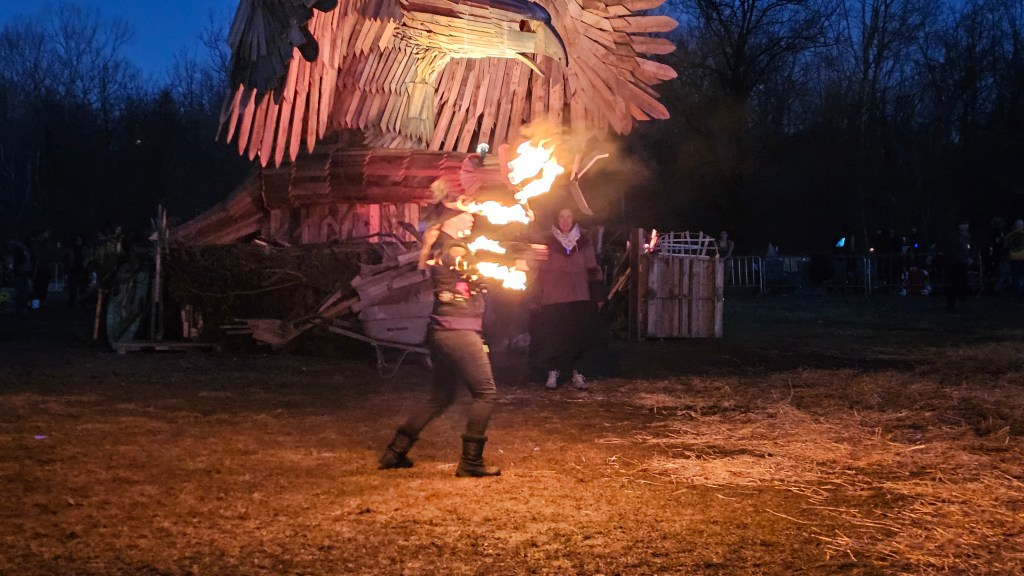
It felt a little paranoid to hold our spots when there were so few people, but as it turned out this was a crucial strategy because it seemed that within 15 minutes the crowd had tripled in size and the entire perimeter of the bird was lined with spectators enthralled by the fire dancers. Just as twilight fell, the arrived each with a unique costume and different types of instruments to move the flames about. They juggled, they moved around balls of fire, they twirled long lances and staves, they mimicked a bird with wing-like props, they used hoops of fire to make large circles. One wore a plaque mask, another looked like she came from the assassin’s creed, there were knights with shields and spears, there was a woman in a leopard catsuit. Some of the volunteers were better than others but all of them were mesmerizing in their own way as in the background a band played music. 

By the time the sky had gone dark, the crowd had ballooned behind us and we had to jostle our way to back to each other when we went for warm drinks or snacks. We nibbled on delicious food from a truck and sipped on warm apple cider available for purchase from some enthusiastic teens manning a volunteer tent. It seemed a little pricey for warm cider but the proceeds went to support the event and as it didn’t have an entry fee I was happy to pay a little more. The cider warmed my hands which had gotten cold from taking pictures of the fire dancers. 

As the appointed hour grew near, the crowd and the cold intensified. However, it was all great fun as we stood there making friends with the people behind us, chatting and laughing. We helped them hold a spot for their friend when she slipped out. Then around 7:45 the parade arrived. Headed by a giant pheonix of paper mache and cloth, the parade was host to more costumed revelers adorned with lights who danced to the beat of drums. Around the bird they circled to the cheers of the onlookers as the crowd only grew more excited in anticipation of the main event. 

Unfortunately, there seemed to be a bit of a delay as 8 pm came and went. Then 8:05, then 8:10, then 8:15, by the time 8:20 rolled around there were chants of “light the bird” which would be taken up and then die down after a minute or so. This went on for another 10 or 15 minutes until finally the torch bearers chosen by lottery were assembled and permitted to put torch to wood. At first, the flames barely licked up the wooden structure. It seemed as if the wind would snuff out the small fires struggling to find purchase against such icy conditions. How could such small flames survive? Would we be disappointed? 

No, the flames did not die. They continued their merry dance along the wooden structure, flickering brightly in the night. While it was a nice sight to see, it was hardly worth the nearly 3 hours in the freezing cold, perhaps we should pack it in, my sister suggested. I told her that I wanted to spend a little bit longer because we had been there so long and I wanted to enjoy it regardless. Then suddenly, conflagration! The whole thing was alight, the phoenix was finally truly lit. The heat pushed back the cold becoming almost more than we could bear even so far way. I pushed my hands out towards it drinking in the sudden heat. It was a glorious sight to behold as it was truly worthy of its name.It really did look like a mythical creature crackling in the cold night with the promise of the summer’s sun. We stood there enthralled by it, saying goodbye to the old and welcoming the new. 

How can you experience a Firebird Festival?

Obviously if you don’t live near Phoenixville attending this event won’t be cheap or easy and while it is certainly something I recommend if you’re in the area, it isn’t something I would plan an entire vacation around. However, there are lots of different local traditions and festivals throughout the country with their own unique and special. Florida is home to an Underwater Music Festival,  New Mexico has one dedicated to UFOs, Ohio is obsessed with Duck Tape and Washington State hosts a Kite Festival and there are many more. With some searching, you’re almost certain to find a quirky festival near you. Many of these festivals take place in the Spring and Summer months so now is the perfect time to look around your wider area for fun and interesting events.

What’s awesome is that the story of the Firebird Festival demonstrates that it only takes a few people gathering together to make something amazing. It started off as 4 friends getting together, building a small phoenix and setting it alight for 150 people. It has ballooned into an event that attracts thousands each winter. Your own event doesn’t have to be this “big thing” and there’s nothing to stop you from starting your own tradition! Don’t worry about a 20 year commitment though, as once it takes off there will be people to pass the torch to (pun very much intended). 

Small disclaimer:

Technically, there are things that can stop you from starting your own tradition. Local ordinances may prohibit you from doing certain activities like setting things on fire and I really don’t recommend that you do that if you live out in places that a prone to wildfires. I don’t want this blog to be in the news because after reading this, you decided to start your own firebird festival and set the state of California on fire. So as always check your local ordinances and use common sense before trying something you read online.

Cost: Free

Miles from home: 50

Be sure to check out the other festivals and events that I’ve attended on my Bucket List and Reverse Bucket List.

Step Up: Irish Step Dancing

When I was a little girl, I loved watching people dance. I was absolutely obsessed, spending hours watching the Nutcracker Ballet and Riverdance on VHS. I wanted so badly to take dance lessons, but sadly, growing up in a lower middle class household we lacked the funds for dance. This meant I would have to content myself with mimicking what I saw on the screen in my living room with little success both from lack of coaching and space. Jumping around in my room, causing a ruckus wouldn’t have been appreciated. 

As I entered my teen years, it was something that I began to mentally put away. Dance was something that kids and teens did and after highschool, if you didn’t “make it” by having the skill and talent to progress beyond, it was “too late”. I enjoyed color guard for three of my six years in marching band, but that was as close as I came to it. I still sighed somewhat wistfully whenever I got a chance to watch professional dancers especially ballet or Irish Step dance, but I accepted they were things that I wouldn’t be doing. 

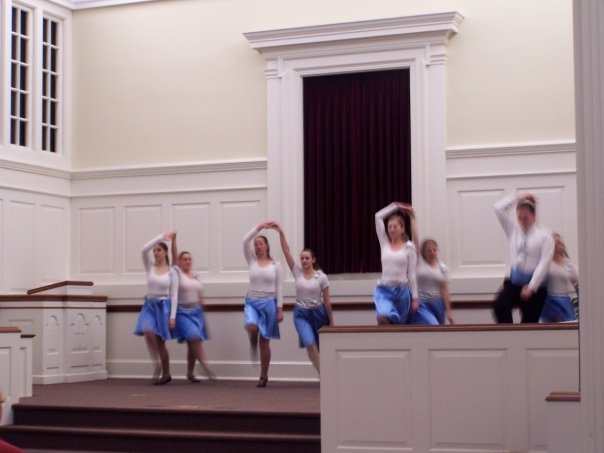
However, that was not to be the final chapter on my foray into dance. Because, in the fall of my freshman year at college, I discovered there was in fact a dance ministry on campus. The ministry was student run by young women who had been doing dance since they were young and were willing to pass on their knowledge and skills to anyone who wanted to join up. They did group us by skill level so the more advanced dancers could still be challenged and grow, but they were incredibly welcoming to those of us who had never danced before. 

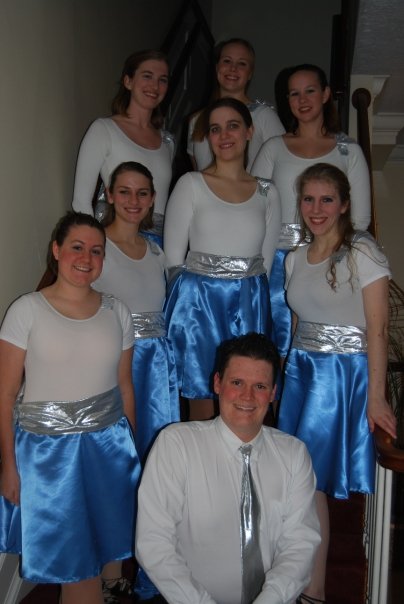
We were given the option to try out different dances and then commit for the semester (or full year). I ended up picking Irish Step Dancing and flags. We paid a small membership due of about $10 each semester. So for $20 bucks, I was able to have a year’s worth of dance classes. Not only that, but also they had a huge collection of costumes meaning that I had very little to buy for the concerts. They directed us to a discount retailer for things like our shoes and I was able to snag my Irish Step Dancing shoes for $10. I believe the total cost for the year was about $50 between the dues, the shoes and one or two items for the costumes.

I will say my first day of class, I felt a bit like a five year old again. I was so excited to finally learn at least something of a dance I’ve loved so much for so long. My teacher was absolutely amazing and the sweetest person. She was a junior year nursing student who brought her calm, compassionate bedside manner into the classroom. She never scolded or lectured us when we messed up, but instead offered gentle correction and critique. We never sought perfection, only to do better each time. 

There are references to Irish step dancing as far back as the 16th century. In a letter to Queen Elizabeth, Sir Henry Sydney references his love for Irish jigs. At first, the music was primarily bagpipes with the hornpipe entering in the 1760’s giving the music its distinctive rhythms. There is some arguments as to when the fiddle was introduced with some people placing it in the 1700’s, but there are references in writing to fiddles in the mid to late 1600’s. 

The modern day form is recognizable for its rigid torso and dancing primarily on the balls of ones feet – like in Riverdance. However, that wasn’t always the case and it is as the name suggests a more modern form of the dance. There are also two distinctive types known as hard shoe and soft shoe. Hard shoe is basically like the tap dance of Irish Step. The hard shoe clacks on the floor making a noise and so the dancer becomes a moving percussion instrument. I danced soft shoe as hard shoe was for the more advanced students. I, sadly, did not get to dance hard shoe. Long story short, I needed to have two years of experience to be able to go into the more advanced class, I went abroad my junior year to study German and in my senior year, there was no one to teach Irish Step as the dances offered depended on having dancers with enough experience to teach it. 

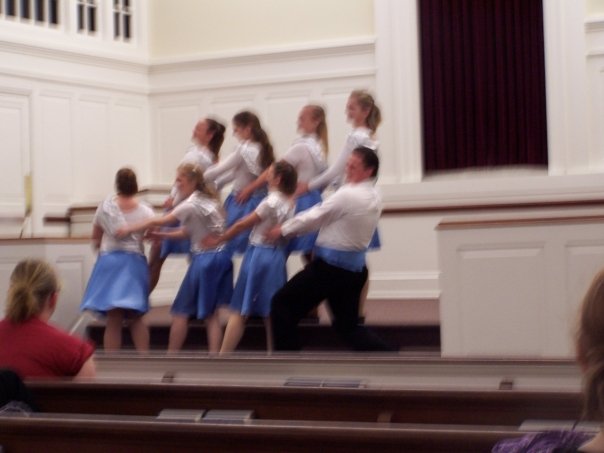
What I found interesting about learning Irish step was that I expected the steps to have fancy Irish sounding names like how ballet has french words for their many movements. We did not have those at all, we had a seemingly limited vocabulary mostly consisting of lifts, beats, cuts, steps, and overs. She would tell us “now we’re going to do the step, step, back” or “Lift, step, step” to help us figure out what set of movements we were about to do. We’d put them together to the beat do them with one foot, then reverse it and do it on the other foot. The pieces of the whole movement would last a few bars of the music. We’d take turns circling our partners and join up as a larger circle going in and out. I cannot say that we were ready to take on the world stage by any stretch of the imagination. Our lifts were certainly not as high as they could be, legs lower, foot movements were decidedly sloppy at times, but we had fun learning. 

Each week I looked forward to going to it even if I was left exhausted by the end of class. Although, it did make going to flags right afterward difficult. My legs would feel like jelly by the time we were finished and instead of being able to go back to my nearby dorm room, I had to trek across campus, often in the cold darkness to the racquetball courts where we held flag practice. By the time I finished flags both my legs and my arms were exhausted. In between class, I practiced my steps in my dorm room and tried to increase my flexibility. I like to think it paid off in our performances.

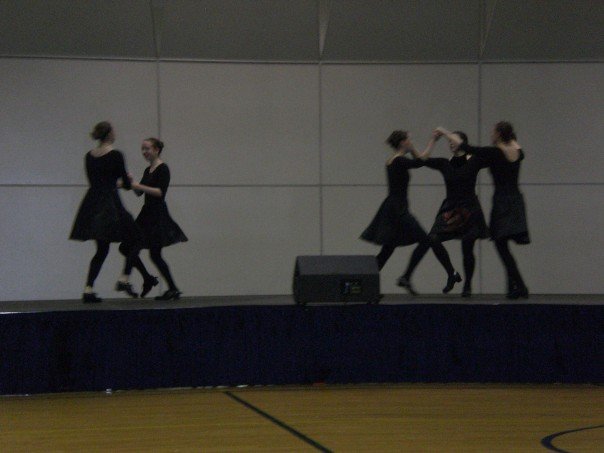
Every year, we put on two concerts. One was the Christmas concert in the small chapel on campus. That one was free for anyone to attend. The other was the larger one in the gymnasium which was put on each spring, to the delight of the entire school. The second one had a small fee to attend to help us raise money to continue to buy costumes. The college let us have access to the sound system and set up a stage for us. During the concerts, each class picked a bible verse to share which went along with the song that we picked. 

My favorite song and verse combination came from my freshman year. Our song was the Salt Lick by Gaelic Storm and our verse was Mathew 5:30 “You are the salt of the earth. But if the salt loses its saltiness, how can it be made salty again? It is no longer good for anything, except to be thrown out and trampled underfoot.” It was a verse to remind us to be as salt, preserving, enhancing and flavoring the world with God’s love and light. 

I was incredibly blessed to have the opportunity to dance in college and to live out a childhood dream of learning a skill I thought was closed off to me. I think many of us wish we had certain opportunities to learn things when we were younger, but we think that there won’t be people to teach us. Perhaps, like me, you may think that unless you’re super talented there isn’t aren’t opportunities for you as an adult to learn. It may seem that the time to try and get into an interest has passed, but there are actually opportunities all around you if you keep your eyes and ears open. I can say that there are places which offer adult dance lessons even if they are harder to find. I also see that there are places for adult beginners to learn martial arts, sports, music, art and more. 

One of the people I do a podcast with, started his martial arts journey in his late 40’s. While he may not be as flexible or learn as quickly as some of the younger guys, he is doing it and loving it. He wasn’t afraid to be embarrassed by his lack of skill and embraced learning something new. Nor is the goal or focus to be a world champion or professional, it’s something that can be done just for fun. 

So often the activities we do in childhood semi-translate to work at this thing really hard so you can get a scholarship or go be a professional. The messages we receive as children is that these activities are not for themselves, they’re for doing something with them. They have to be tied to these larger goals. There’s also this obsession with accomplishing things as a young person and this false narrative that if you don’t master it by the time you’re 20, you’re never going to, so don’t even bother. So as adult learners we have to say to the first, actually, I can do this just for fun. To the second, we can say my life has not already been completely written and I can still accomplish a lot, so if I want to master this thing, I still can. It really depends on your own individual goals for whatever it is you want to do. 

So how can you step up as it were?

As I said earlier, it’s a matter of keeping your eyes and ears open. In my area, there are several places which offer adult classes for dance. One place is another dance ministry which helps keep the cost down. It is even offering a martial arts class which I am hopeful to join next year! Occasionally, you can find places offering introductory workshops for dance which gives you a taste of what a class would be like. It’s really a matter of actively seeking out those opportunities. 

Now, I have seen some online dance apps and courses. I’m not sure how effective they are because you may not have the feedback that you’d get from a live person to help correct your form and to explain a move more fully if you don’t understand the first explanation. Also you won’t be in an actual dance studio. I personally found the mirrors in the dance studio to be really helpful because I could visually see exactly what my body looked like. So I knew that my leg wasn’t perfectly straight or the lift was sloppy. I could see if my arms weren’t held up evenly with one side dropping down. I think they’d be really good for absolute beginners and for people who just want to try it for fun. There is of course no substitution for personalized instruction that live classes bring, but I do think the apps provide access to tools and information that are difficult to otherwise obtain.

Completed: Fall 2006 through Fall 2008

Cost: $100 for 3 semesters

Miles from home: 0 from college dorm / 39 from home

An Evening with Joshua Bell

Perhaps for many people spending an evening listening to a violin virtuoso may not top the list of things to do. However, for those in the classical music world, he is our Taylor Swift or Beyonce or insert your favorite singer/band here. He is a household name, even those who do care for the music he plays, they are still familiar with him. Joshua has been wowing audiences around the world since he was 17 years old. 

As his debut on the world stage coincided with the earliest parts of my childhood, I grew up listening to him on cassette tape and CD. I would be able to pick out his playing the moment I walked into the room being able to determine his playing from other violinists. I started playing the violin in 3rd grade and only became further in love with his command of the instrument as my knowledge grew. Needless to say, that hearing him play on a famous stradivarius violin, has been a long time dream. 

Considering that Joshua is a world-renowned musician having played to sold out concerts in the best concert halls throughout his 40 years of playing, with ticket prices only skyrocketing in recent years, it never even crossed my mind to hope that I could see him in person. Imagine my shock and surprise to see that he would grace the small stage of the Millerville’s Ware Center in Lancaster. Now the tickets were a bit more expensive that are typical of Millersville’s performances, but they were still reasonably priced for a performance of this caliber. In considering the cost of travel to venues further afield, I determined that this was simply the cost of seeing the Paganini of our time. 

I invited my mother and my sister to attend with me. My sister declined as she is not as enamored with the violin as I am, but my mother was more than happy to join me as she shared my love of Joshua Bell. We planned to go out to dinner a little early so that we would have plenty of time to find parking and get to the venue. We both dressed to impress as suitable for the occasion. We enjoyed a glass of wine with our swordfish which was complemented by the butternut squash risotto. Parking was secured in a garage which was just around the corner from the Ware Center. 
I was a little surprised to see that there was an entire reception in the front of the Ware Center with complimentary wine and a small buffet of food. A grand piano was playing softly and everyone was mingling with an air of barely contained excitement. I took the opportunity to mingle with the crowd, stopping to chat with people using small opportunities to open up conversation. A few people stopped me to compliment both my own outfit and my mother’s. After a short wait which felt like an eternity with anticipation, the doors were finally opened and we were able to make our way in. 

I hadn’t paid much attention to the seat numbers as we hadn’t been able to select our seats at the time of purchasing. The tickets had simply arrived in my email and I printed them out ahead of time not wanting to take any chances of last minute technical difficulties. Which meant that once again, I was surprised by my sheer luck. As I slowly descended further down the steps closer and closer to the stage it slowly dawned on me that I was to be in the second row from the stage on the far right (stage left) where Joshua would enter and exit. I was dangerously close to the legend himself. 

From the first note, I knew I was hearing something particularly special;it was clear no recording had ever quite done either the player or the instrument justice. The sound washed over me commanding my attention and I swear I could see the sound as colors dancing across my mind. The notes were like electricity through me filling every limb with it. Words do not quite capture the physical and emotional transcendent experience that happened as I was held hostage by the majesty of the music.  

As I watched and listened, I wanted to take everything in at once, every note, every movement of his bow arm and fingers over the strings. I could see every expression in his face and the way he moved with the music as he played. I could hear him take a breath at the beginning of the musical phrases, breathing in sync with the music. When I had recovered from my initial shock, I did manage to start to study what he was doing to produce such phenomenal sounds. Truly, the violin on which he is playing is a singular instrument, but let us not fool ourselves into thinking that should I ever be handed a Stradivarius such as the Gibson ex Huberman (provided I didn’t faint first), I would not be able to produce the same caliber of music. Whereas many people might focus on how expertly his fingers moved up and down the fingerboard keeping them perfectly disciplined, I was enthralled by the control he exhibited over the bow and how he could subtly move his wrist to change the entire tone. I found myself enraptured in an entirely new way as there is nothing quite like watching a master at work. 

After what seemed an age and all too quickly, time which had been suspended resumed and the concert came to its seeming end. However, there was a small surprise at the end of the published repertoire, he had two more songs for us, Nocturne Chopin No. 9 and The Gypsy Airs. The first Josh dedicated to a dear friend who had only died that morning, though his voice almost broke as Josh begged the audience’s indulgence to dedicate the piece to him, the voice of his instrument remained clear. Only a heart of stone would have remained unmoved by the communication of grief in the notes. The second song, was a balm to soothe the hearts of those listening, with its oft times cheeky and bright tones. 
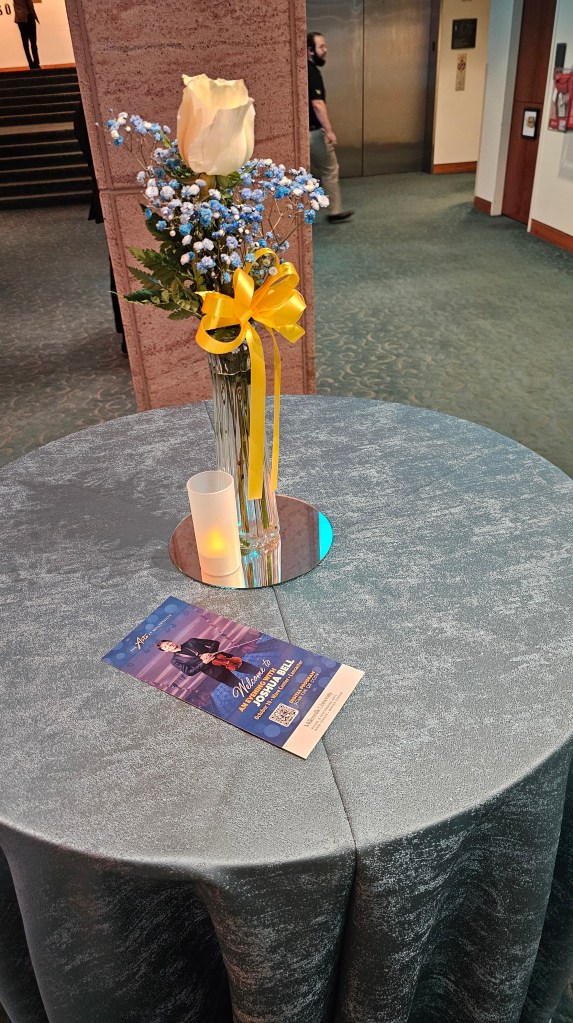
I never wanted it to end, but once again, we came to a halt, with his bow held in the air the audience held its breath and then with all the confidence of a conductor at the start of a symphony his hand dropped and a chorus of clapping began. We rose to our collective feet giving a standing ovation of a performance truly worthy of it. He graciously accepted our accolades and made a quick exit stage left. The magic of the evening would not soon wear off as the music continues to echo in my mind and I will long to hear it again, knowing that I will have to make due with mere recordings. I understand now why women would faint to hear Paganini play. 

How can you hear a world renowned musician?

As I often remind you dear reader, one will be shocked and surprised at the offerings from your local colleges and universities. Not all world class performances take place in the vaunted halls of opera houses and symphony halls, some take place on much smaller, more intimate stages. I always check in early August for the listings of performances that I can expect over the next 8 to 9 months. I also check my local theaters and community stages. Often these places have shows that are much more affordable to see than in the larger and more famous venues. Yes, seeing a world renown artist performing on a world famous stage can be exciting, it’s also very expensive and many of the newer smaller stages have great acoustics with modern building techniques. By not overlooking my smaller, local venus, I managed to check seeing Joshua Bell playing his famous Stradivarius off my list.  

Completed: Oct. 2024

Cost: $250 

Miles from home: 20 

A Wickedly Good Time: A Broadway Musical in New York

Considering the movie version is at its height of being popular, It seems that now is the perfect time to write about my very first Broadway Musical experience, Wicked (from my Reverse Bucket List).

I must confess my confusion that after 20 plus years of being on the stage, the musical is still so beloved that it should have such a large fanbase that has flocked to the theaters to see it and sing along. It certainly is a good musical, catchy music, compelling characters, interesting plot, and full of deeper themes that will stand the test of time. However, I just hadn’t heard much about it since it first debuted back in 2003 which followed on the heels of the 1995 book. Seeing all the excitement surrounding the movie version of it has made me reminisce about my Broadway experience.  

I was in my senior year of high school when the music department was able to schedule a trip up to New York city in order to see Wicked the musical. As our high school was about a 3 hour drive from New York, it wasn’t too far for us to do occasional class trips. As it happened, this trip was scheduled for the day after another trip to New York to see the Darwin Exhibit – so I happened to go twice in one week (but a post for another time). I had recently read the book from my library, curiosity finally winning out to discover what precisely had everyone in such a frenzy of excitement. As my school had done the Wizard of Oz musical in my freshman year, i was extremely curious to not only read the story from an alternative point of view but see the story from an alternative point of view. 

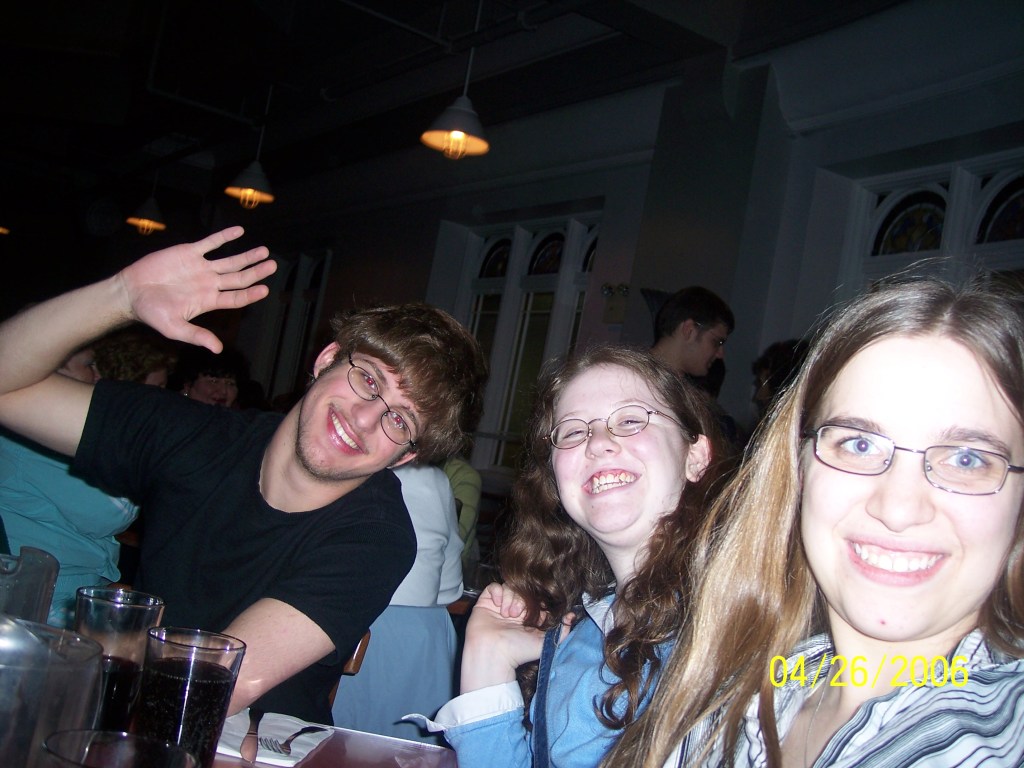
Our field trip actually began in the later part of the school day as the performance would not be until the twilight hours. We piled onto the charter bus as a group of exuberant, nerdy teens ready to take on the world. For most of us, this would be the first time seeing a Broadway musical and for some it was their first time going to New York. The air was palpable with excitement which soon wore off after the initial jostling for seats and everyone settled into their places for the long trip up. There was the usual chatter, the occasional flirtatious glance between people, whispered gossip and playful teasing for which groups of teens are known for. 

I was no different sitting with my friends and giggling most of the way uncertain of exactly what I was in for. I had of course heard of the infamous broadway and grew up watching various performances of musicals recorded on video. I didn’t know precisely what made Broadway so special other than that was where musicals were born. Even though I had just seen the famous city, I had not yet visited when the daylight fades and gives way to the bright lights of the streets. Would it really transform itself as I had been lead to believe? 

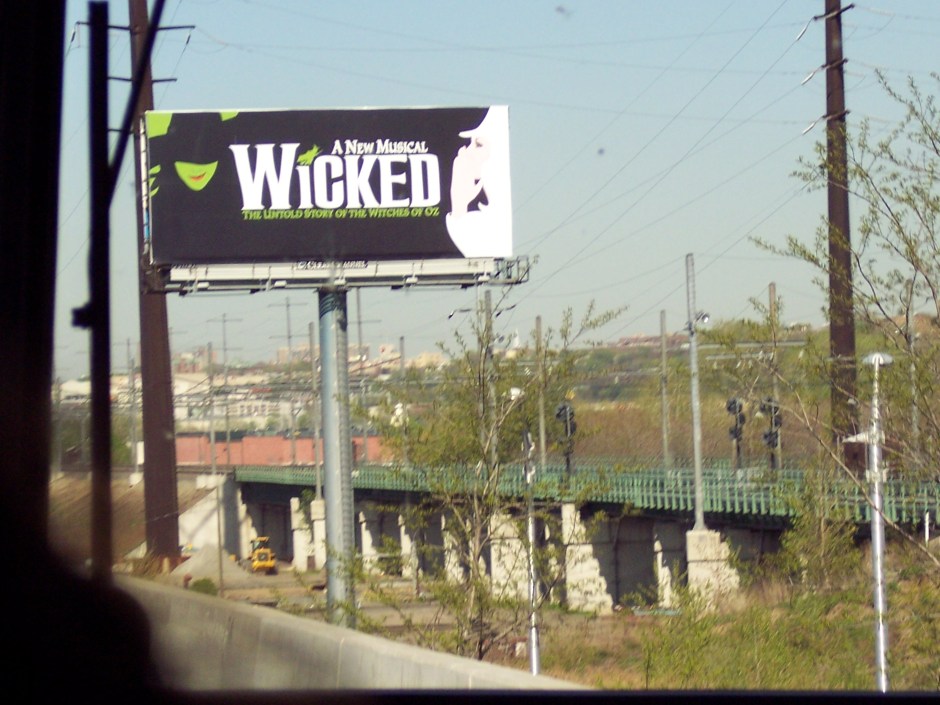
As the bus rolled along, we began to start seeing signs for New York and signs for Wicked. The excitement on the bus began to build once again. The energy was barely contained within the seats. For myself, I remember half bouncing up and down in glee. Shortly – though not nearly quick enough – we had arrived in the big city. We were given leave to divide ourselves up into groups and we were taken to have pizza. 

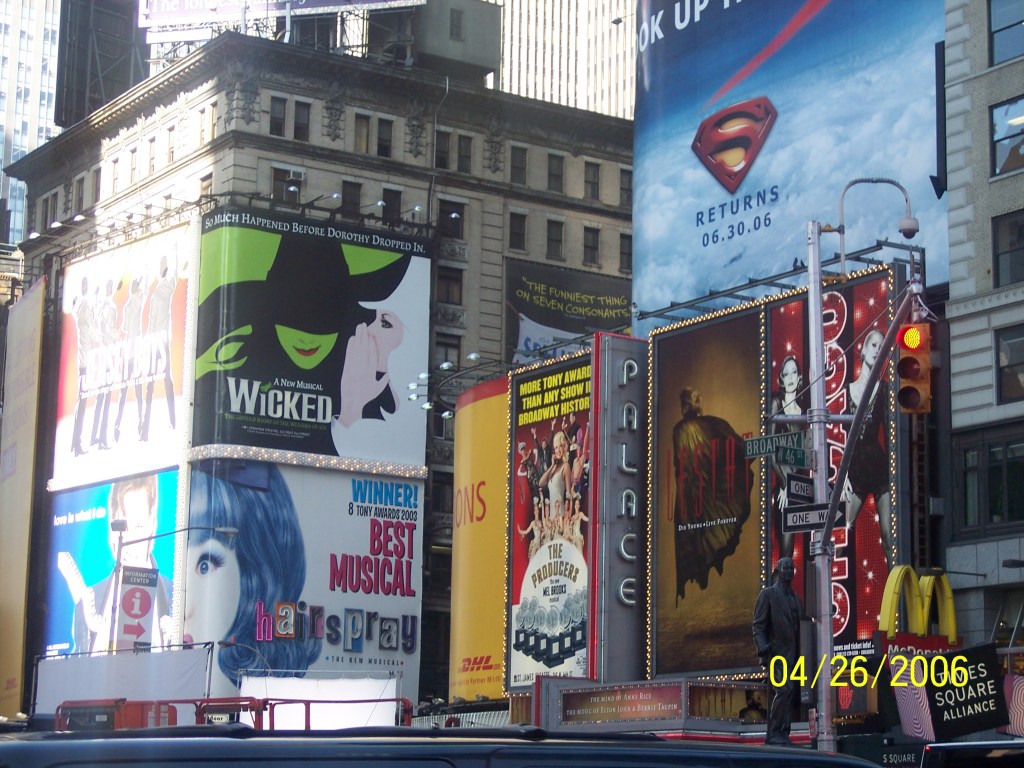
I remember walking through the streets taking in all the sites. The daylight had just started to fade, turning the sunlight to rose. There seemed to be too much to take in at once. Buildings towering over us. Music blared over the cacophony of sounds, traffic, horns, and construction. We spotted a street performer. Cars were everywhere, some of them quite unique like the limo humvee which alternatively amused and baffled us as quintessentially New York. Looking up we saw the famous billboards and lights, soon they would light the night and block out the stars and moon. 

We were ushered into an upscale restaurant which was known for its pizza, though to this day I cannot quite recall its name. But I recall the atmosphere quite well. Like most upscale restaurants, the lighting was dim which only accentuated the richness of the dark wooden panels on the lower part of the walls. The upper half seemed to be a lighter cream though the shadows obscured the truth. I distinctly recall that we ate on the upper level looking down over the rest of the patrons. Perhaps, knowing that they would play host to rambunctious adolescents they wisely seated us away from their other customers lest we became a disturbance. If we were, I did not hear of it, though I cannot quite imagine that we were not at least slightly disruptive. However, most of us had been raised with at least decent enough manners, the problem of course is that when in the company of other teens, those manners seem to get forgotten. 

I will fully admit that while yes, I had the infamous New York pizza, it didn’t really taste all that much better than the pizza I order from down the block monthly. Granted, the pizzeria is owned by a 2nd generation Italian immigrant whose grandparents owned a restaurant in Italy, so I may be a bit spoiled when it comes to Italian food. 

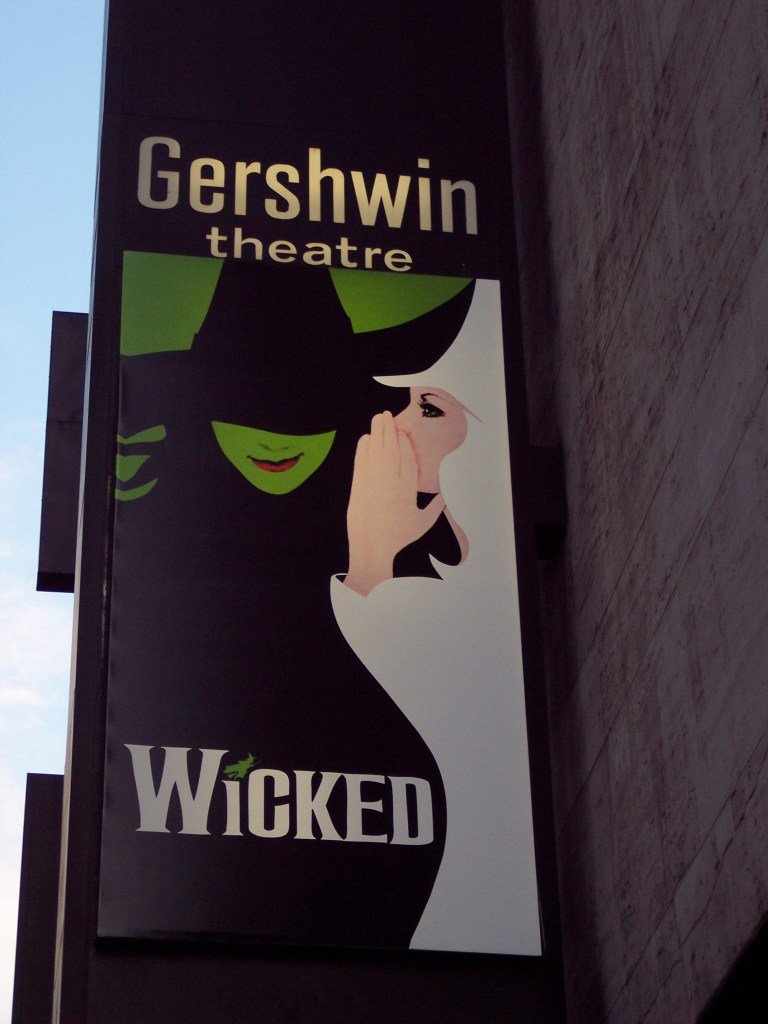
What I remember most about the evening after arriving at the theater was that it was both exactly what I expected and not what I expected at all. First, dear reader, you must recall that a Broadway musical or really any theatrical performance “on Broadway” could take place on any one of 41 stages in New York City which can seat 500 or more persons. There are in point of fact only three theaters located on Broadway itself: Broadway Theater, Palace Theatre and Winter Garden Theatre. So even though one might picture Broadway and one of these three theaters, one might find oneself in a theater several blocks away.

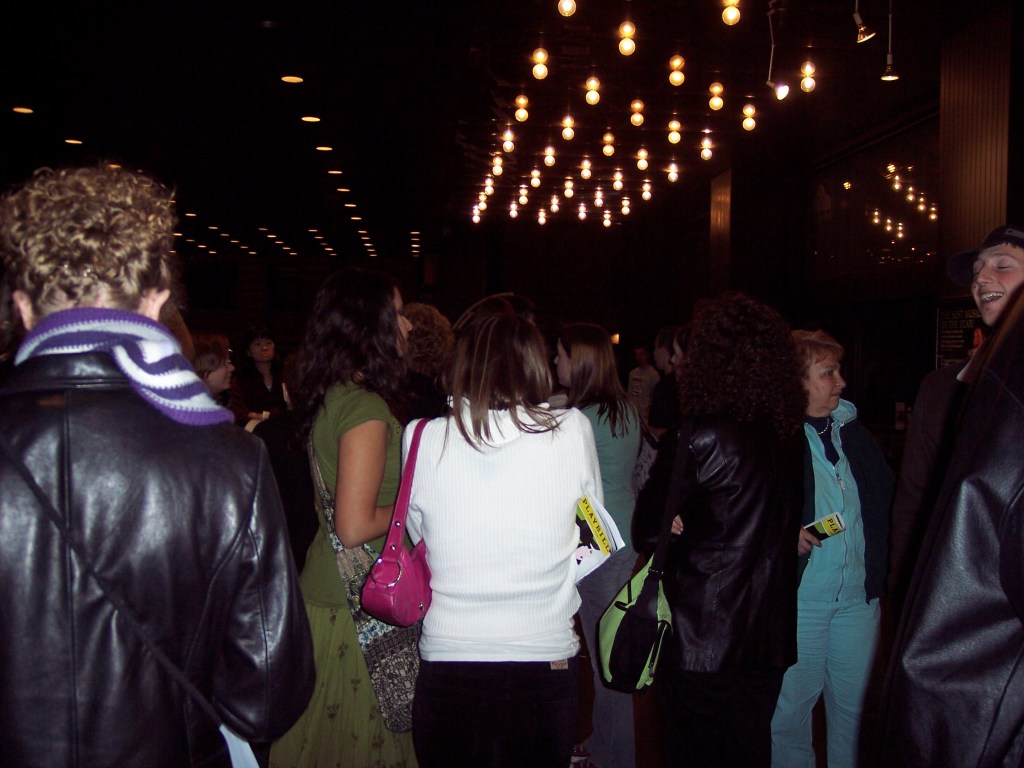
Prior to going to a Broadway production, my theater experiences consisted of the Fulton in Lancaster and the Hershey Theater, neither of which are architectural sisters to those in New York. So while I had a vague notion of what a theater looked like from pictures and movies, it was still in juxtaposition to the Hershey which was designed after a cathedral in Venice and the Fulton which was designed as a Victorian Opera house. What struck me most was the sheer amount of red velvet that they had at the entrance. It seemed quite a bit odd while still ornate. I remember thinking that the entrance was a bit smaller than I had imagined as we were ushered into what seemed to be too small a space before opening up into a larger area. 

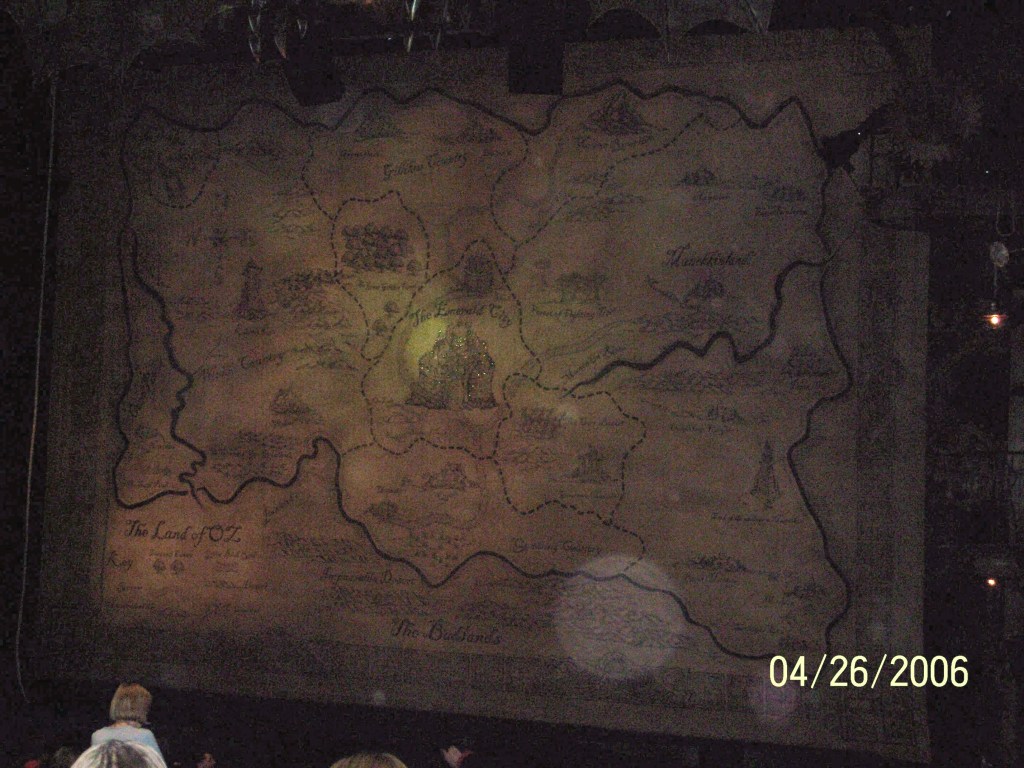
To be honest, the venue vaguely reminded me of a posh movie theater. It had a more modern flair and everything was a rich dark red and black accented with golds. Sound was softened by the lush carpet so that the conversation of the crowd swarming inside was a hushed murmur around me. Everywhere I looked people were smiling with an eagerness of anticipation. Once inside the theater, the air positively hummed with the activity of people quickly seeking out their spots. I was situated stage left towards the middle of theater close enough to see well enough but not to really see the more subtle expressions of the actors. 

It hardly mattered, from the moment the curtain rose and the first notes rang out, I was transfixed. Glinda floated down in a sparkling blue dress singing that no one would mourn the Wicked Witch. I remember watching the Wizard dance around the stage with Elphaba’s mother singing and giggling with one another, a slight deviation from the book already. By the second song of Dear Ol’ Shiz, I was taken up into the story which asks what makes someone wicked? The very same question that first led me to explore psychology and later a career in social work. 

It’s hard to exactly describe the sheer spectacle of a broadway production from the sets to the costumes; everything is meticulously crafted to convey subtle messages and create impressions which help tell the story. Scattered throughout were small references to the original Wizard of Oz while still firmly establishing the differences from the source material. It began to take an almost dreamlike quality where your mind begins to fill in the holes that the set leaves open, a few trees become a forest, a few mock houses spring into a whole town until your mind is sort of tricked into thinking there was more than there really was.

It could be that it’s the songs that help weave the enchantment for there is ever magic in song. It makes it easy to slip out of solid reality and into the dream realm. After all, it’s really only in dreams that people would be singing and dancing to tell a story. Perhaps, the music really does help place your mind in an altered state allowing you to more fully experience it. The choreography only adds to dream as people twirl about the stage becoming whirls of color. During the songs with larger ensembles it becomes too much to take all in, your eyes unable to drink in each movement and the lyrics blend together in your ears. 

However, just like the spells woven in the musical, so too, does the spell the cast holds over the audience eventually shatter. The last song sung, the last line spoken and as if on cue the audience breaks into applause the thundering of hundreds of hands slapping together creating a wave of discordant sound which rouses them out of their half dazed slumber. Half stumbling out into the night and slightly stiff from sitting too long, the crowd begins to dissipate. Each person with a sort of half glazed look in their eyes as if they aren’t quite free from the enchantment of the stage. Patrons speak excitedly to one another, a few hum, fewer still hum on key. A number of them will most likely find themselves in bars later drunk on more than just showtunes. For a group of rowdy teens, the only thing left to do was to be herded back onto the coach bus. 

Considering the lateness of the night, we returned in relative quiet, the lights were turned low to allow us the opportunity to sleep. I was never one to really sleep during transportation, did not. Although the next day, I was exhausted for yet a third field trip with my German class, but that is a post for another time. I recall mostly stumbling into my bed in the wee hours of the morning resigned to the idea that in only a few short hours I would have to return to the waking world. Still, as I lay in my bed the songs played over in my mind and my dreams were swirls of color. 

Years later, I went to another Broadway Musical, this time Kiss Me Kate, a retelling of Shakespear’s Taming of the Shrew. The magic that was cast was as real as the first time. Time once again was suspended and I was overtaken by the spell of the theater. 

How can you see a Broadway Musical?

If you are lucky enough to be relatively close to New York City, then it is quite easy for one to get there. You can either be like my music department and secure transportation for the same day knowing that you may end up crawling back into your bed in the wee hours of the morning utterly spent and exhausted or you can arrange to stay overnight like I did when I went with my sister with a hotel close by. The latter option is of course far more expensive.

However, my sister and I had tacked on an evening in New York as part of a larger trip as we were departing from New York. We had determined that rather than trying to get to New York the same day as departure we opted to go the day before to ensure that we did not miss our cruise ship. This is certainly an option I encourage you to consider when traveling, dear reader. If you find that you need to arrive to or depart from a city you otherwise would not travel to, consider if it’s possible to extend your trip by a day in order to enjoy the sights. My sister did this in Barcelona as well and I hope to do so in London. If one is going to be there anyways then it is far cheaper in the long run to spend a little extra on a day rather than spending even more later on a separate trip. 

Still, not everyone will be traveling in and out of New York nor is everyone able to travel to it on a lark for a day trip. Then the principle of the thing is what one must turn to. Now a Broadway production is a grand thing, but it is not the only way to enjoy a Broadway Musical which is a genre rather than the thing itself. There are many beautiful and glorious venues which put on performances of musicals. Take the earlier mentioned Hershey Theater which is a masterpiece of architecture. The quality of performances that have graced its stage are certainly equal to New York’s Broadway or London’s West End. Some performances may even surpass what one may see on Broadway depending on the quality of the actors, costumes and set pieces.

There is after all nothing inherently magical about a particular venue, Broadway just happens to be the place where most musical productions are developed and debuted. It is the place to go if you want to see the newest musicals; it is not the only place with capable of phenomenal performances. This is great news, as you, dear reader, are almost certainly within a reasonable distance of a grand theater which hosts performances. I encourage you to go forth to your nearest performance hall and find yourself lost in the magic of musical theater!

Completed: Spring 2006

Cost: Current cost $100 – 200 per ticket 

Miles from home: 150

Be sure to check out my other Bucket List items whether my current list or my reverse list.

Reverse Bucket List: Unicorn Tapestries

Occasionally, I like to share items from my reverse bucket list or include tales from further afield. Not to stray from the purpose of this blog, but to present an honest picture of the life I am living and the goals I’ve pursued. I would be remiss to showcase only the things I’ve done close to home, as that would create the false impression that everything meaningful can be accomplished without ever leaving it.

Depending on where you are, and what you want from life, some travel may be required.

More importantly, I have no desire to present a polished illusion. I’ve watched enough influencers and internet personalities over the years to know that the truth has a way of surfacing. I do myself no favors by crafting a narrative that isn’t real.

Who knew honesty was the best policy?

This particular item belongs both to my reverse bucket list and to those adventures further afield.

It should come as no surprise, dear reader, that I love unicorns.

I know, you’re shocked. Completely blindsided. Never in a million years did you see this confession coming.

Sarcasm may be my second language, followed closely by questionable English and then German.

Photo by Karolina Grabowska on Pexels.com

I digress.

My love of unicorns began early. My very first stuffed animal, given to me the day I was born, was a unicorn named Rainbow. She doubled as a music box, playing Somewhere Over the Rainbow, and for years she was my constant companion. She even made the journey with me to Germany during my college days. Today, she still sits on a shelf in my room.

Growing up in the 90s, unicorns were not nearly as easy to find as they are now. That scarcity made each one feel special. My mother somehow always managed to track them down—books, toys, anything she could find. I devoured every unicorn story I could get my hands on, including one that introduced me to The Lady and the Unicorn.

This series of six medieval tapestries, now housed in the Musée de Cluny in Paris, is among the most famous examples of millefleurs design—literally “a thousand flowers.” The backgrounds bloom with intricate botanical detail, each thread contributing to a lush, almost dreamlike landscape.

Woven around the year 1500, likely in Flanders from wool and silk, the tapestries depict the five senses: touch, taste, smell, hearing, and sight. The sixth panel, bearing the phrase À mon seul désir, “to my only desire”, remains something of a mystery. Interpretations vary. Some see it as a renunciation of earthly pleasures, others as a declaration of free will, and still others as representing a kind of sixth sense.

I have always appreciated that it resists a single, definitive meaning.

Interestingly, the tapestries were rediscovered in 1841 at Boussac Castle after being hidden away for centuries. The novelist George Sand helped date them to the 15th century based on the clothing depicted—a reminder never to underestimate a woman’s eye for fashion.

Beyond their beauty, the tapestries reveal much about the world that created them. They reflect the relationship between artists and their patrons, with heraldic symbols woven into the designs. They echo the influence of the Christian church, as much of the art from this period does. Even the unicorn itself often carried symbolic meaning, sometimes representing Christ in medieval imagery.

They were not merely decorative. They were statements of wealth, power, and belief, while also serving the practical purpose of insulating cold stone walls.


I almost missed them entirely.

When I traveled to Paris in April of 2009 during my study abroad, the trip itself was something of a last-minute decision. A friend mentioned he would be there, and so Erica, a fellow American and fellow fantasy enthusiast, agreed to join me.

There I was, in Paris, soaking in museums, history, and food (they did not lie, the food is exceptional), when I began noticing unicorn imagery everywhere. Bags, notebooks, pillows, souvenirs of every kind.

At first, I dismissed them as standard tourist fare.

It wasn’t until I found myself in Sainte-Chapelle, one of the most breathtaking churches I have ever seen, that curiosity got the better of me. I asked, somewhat casually, “Are those tapestries here in Paris?”

“Yes,” came the reply.

My excitement escalated rapidly.

“Where?”

“The Medieval Museum,” she said, kindly providing directions to what was clearly an overly enthusiastic American.

Erica, being an archaeology major, needed very little convincing. We immediately changed course and set off across the city. Did my feet hurt from walking nearly fifteen miles that day? Yes. Did I care?

Absolutely not.

There were unicorns to see.

(We will not discuss how we failed to navigate the subway system and instead walked nearly the entire historical district.)

It took considerable self-control not to sprint through the museum upon arrival. I made a valiant effort to behave like a reasonable adult, though I suspect I failed. While I attempted composure, I may have been not so quietly repeating “unicorn” under my breath.

I was twenty-one. Such enthusiasm was permissible. Although when exactly does that stop being permissible? I think I ought to be able to go through a museum excitedly bouncing up and down at all the artifacts and history regardless of age.

Finally, we reached them.

They were even more extraordinary in person than I had imagined.

Some works of art suffer from familiarity, diminished by reproduction. These did not. If anything, every image I had ever seen had undersold them. Up close, every thread becomes visible. Every flower distinct. The scale alone is impressive, but it is the detail that truly captivates.

It is impossible not to consider the time and labor embedded in them. Estimates suggest that a set of tapestries of this size could take dozens of weavers many months, if not over a year, to complete, not including the design work beforehand.

In today’s world, where we can purchase something decorative with a few clicks and have it delivered in days, it is difficult to fully grasp that level of craftsmanship and patience.

As I entered the dimly lit gallery, my excitement softened into something quieter.

Awe.

My breath caught as I approached. Time seemed to slow. I studied each panel carefully, tracing patterns, noting details, and wishing I had the botanical knowledge to identify every plant woven into the scene.

I said very little. What could be said?

No photograph does them justice. Images flatten them, shrink them, strip away their presence. Some things must be experienced in person to be understood at all.

Too soon, it was time to leave. There was still more of Paris waiting, and far too little time to take it all in.

Adieu, mon amour.

Perhaps we shall meet again.

Pardon the darkness of the picture, this was taken in 2009 and flash photography was not permitted

How can you see tapestries?

Well, you don’t have to hop on a plane to France to see tapestries. There are museums here in the United States that display various tapestries from the Medieval and Renaissance eras. If you are particularly interested in seeing unicorn tapestries after reading me wax poetic about them, there is a set of them at the Cloisters in New York which are governed by the Metropolitan Museum of Art. They are a set of seven tapestries, also from around the same period as The Lady and the Unicorn and are in the style of the thousand flowers. Just as with the tapestries in France, these also hold mysteries such as how to interpret the tapestries and even who they were made for. Depending where you are in the country, a plane ride may or may not be necessary. 

I highly recommend if you ever get to either New York or Paris, to take time to see these masterpieces. Provided of course such things are of interest to you. You know by now, that I always tell people to skip that which holds no interest or intrigue to them. Life is too short to waste it on things you don’t enjoy.