
Occasionally, I like to share items from my reverse bucket list or include tales from further afield. Not to stray from the purpose of this blog, but to present an honest picture of the life I am living and the goals I’ve pursued. I would be remiss to showcase only the things I’ve done close to home, as that would create the false impression that everything meaningful can be accomplished without ever leaving it.
Depending on where you are, and what you want from life, some travel may be required.
More importantly, I have no desire to present a polished illusion. I’ve watched enough influencers and internet personalities over the years to know that the truth has a way of surfacing. I do myself no favors by crafting a narrative that isn’t real.
Who knew honesty was the best policy?
This particular item belongs both to my reverse bucket list and to those adventures further afield.
It should come as no surprise, dear reader, that I love unicorns.
I know, you’re shocked. Completely blindsided. Never in a million years did you see this confession coming.
Sarcasm may be my second language, followed closely by questionable English and then German.

I digress.
My love of unicorns began early. My very first stuffed animal, given to me the day I was born, was a unicorn named Rainbow. She doubled as a music box, playing Somewhere Over the Rainbow, and for years she was my constant companion. She even made the journey with me to Germany during my college days. Today, she still sits on a shelf in my room.
Growing up in the 90s, unicorns were not nearly as easy to find as they are now. That scarcity made each one feel special. My mother somehow always managed to track them down—books, toys, anything she could find. I devoured every unicorn story I could get my hands on, including one that introduced me to The Lady and the Unicorn.
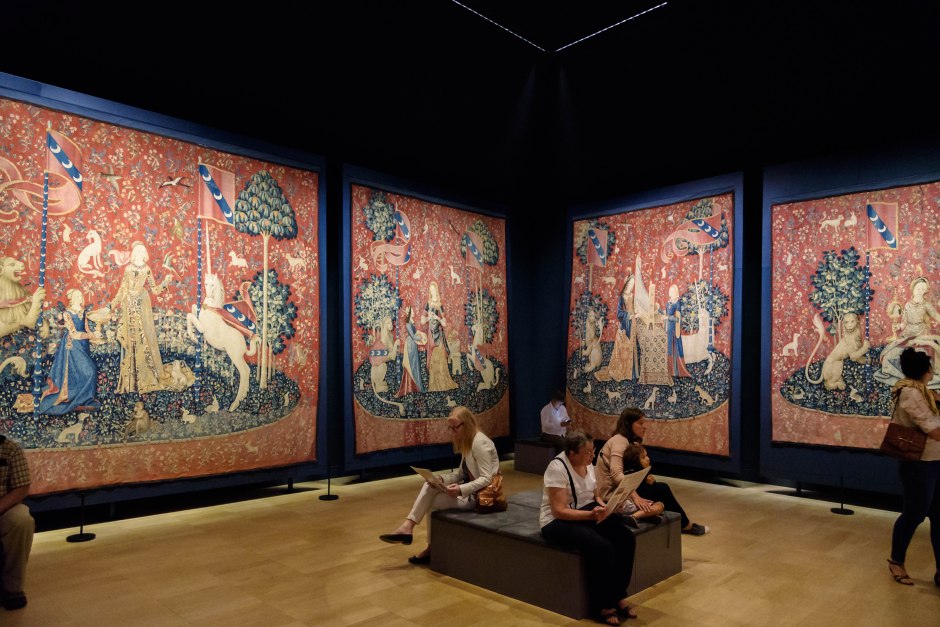
This series of six medieval tapestries, now housed in the Musée de Cluny in Paris, is among the most famous examples of millefleurs design—literally “a thousand flowers.” The backgrounds bloom with intricate botanical detail, each thread contributing to a lush, almost dreamlike landscape.
Woven around the year 1500, likely in Flanders from wool and silk, the tapestries depict the five senses: touch, taste, smell, hearing, and sight. The sixth panel, bearing the phrase À mon seul désir, “to my only desire”, remains something of a mystery. Interpretations vary. Some see it as a renunciation of earthly pleasures, others as a declaration of free will, and still others as representing a kind of sixth sense.
I have always appreciated that it resists a single, definitive meaning.
Interestingly, the tapestries were rediscovered in 1841 at Boussac Castle after being hidden away for centuries. The novelist George Sand helped date them to the 15th century based on the clothing depicted—a reminder never to underestimate a woman’s eye for fashion.
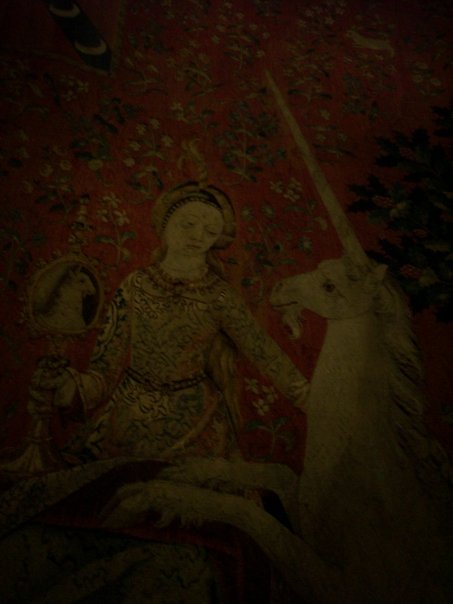
Beyond their beauty, the tapestries reveal much about the world that created them. They reflect the relationship between artists and their patrons, with heraldic symbols woven into the designs. They echo the influence of the Christian church, as much of the art from this period does. Even the unicorn itself often carried symbolic meaning, sometimes representing Christ in medieval imagery.
They were not merely decorative. They were statements of wealth, power, and belief, while also serving the practical purpose of insulating cold stone walls.
I almost missed them entirely.
When I traveled to Paris in April of 2009 during my study abroad, the trip itself was something of a last-minute decision. A friend mentioned he would be there, and so Erica, a fellow American and fellow fantasy enthusiast, agreed to join me.
There I was, in Paris, soaking in museums, history, and food (they did not lie, the food is exceptional), when I began noticing unicorn imagery everywhere. Bags, notebooks, pillows, souvenirs of every kind.
At first, I dismissed them as standard tourist fare.
It wasn’t until I found myself in Sainte-Chapelle, one of the most breathtaking churches I have ever seen, that curiosity got the better of me. I asked, somewhat casually, “Are those tapestries here in Paris?”
“Yes,” came the reply.
My excitement escalated rapidly.
“Where?”
“The Medieval Museum,” she said, kindly providing directions to what was clearly an overly enthusiastic American.
Erica, being an archaeology major, needed very little convincing. We immediately changed course and set off across the city. Did my feet hurt from walking nearly fifteen miles that day? Yes. Did I care?
Absolutely not.
There were unicorns to see.

(We will not discuss how we failed to navigate the subway system and instead walked nearly the entire historical district.)
It took considerable self-control not to sprint through the museum upon arrival. I made a valiant effort to behave like a reasonable adult, though I suspect I failed. While I attempted composure, I may have been not so quietly repeating “unicorn” under my breath.
I was twenty-one. Such enthusiasm was permissible. Although when exactly does that stop being permissible? I think I ought to be able to go through a museum excitedly bouncing up and down at all the artifacts and history regardless of age.
Finally, we reached them.
They were even more extraordinary in person than I had imagined.
Some works of art suffer from familiarity, diminished by reproduction. These did not. If anything, every image I had ever seen had undersold them. Up close, every thread becomes visible. Every flower distinct. The scale alone is impressive, but it is the detail that truly captivates.
It is impossible not to consider the time and labor embedded in them. Estimates suggest that a set of tapestries of this size could take dozens of weavers many months, if not over a year, to complete, not including the design work beforehand.
In today’s world, where we can purchase something decorative with a few clicks and have it delivered in days, it is difficult to fully grasp that level of craftsmanship and patience.
As I entered the dimly lit gallery, my excitement softened into something quieter.
Awe.
My breath caught as I approached. Time seemed to slow. I studied each panel carefully, tracing patterns, noting details, and wishing I had the botanical knowledge to identify every plant woven into the scene.
I said very little. What could be said?
No photograph does them justice. Images flatten them, shrink them, strip away their presence. Some things must be experienced in person to be understood at all.
Too soon, it was time to leave. There was still more of Paris waiting, and far too little time to take it all in.
Adieu, mon amour.
Perhaps we shall meet again.

How can you see tapestries?
Well, you don’t have to hop on a plane to France to see tapestries. There are museums here in the United States that display various tapestries from the Medieval and Renaissance eras. If you are particularly interested in seeing unicorn tapestries after reading me wax poetic about them, there is a set of them at the Cloisters in New York which are governed by the Metropolitan Museum of Art. They are a set of seven tapestries, also from around the same period as The Lady and the Unicorn and are in the style of the thousand flowers. Just as with the tapestries in France, these also hold mysteries such as how to interpret the tapestries and even who they were made for. Depending where you are in the country, a plane ride may or may not be necessary.
I highly recommend if you ever get to either New York or Paris, to take time to see these masterpieces. Provided of course such things are of interest to you. You know by now, that I always tell people to skip that which holds no interest or intrigue to them. Life is too short to waste it on things you don’t enjoy.

