
Why I Finally Fell in Love with Tiki Bars

Ever curious, I pressed my hand against the weathered wooden door beneath an otherwise unassuming sign. My eyes struggled to adjust from the brilliant Florida sunshine to the dim interior where a carved wooden mask silently greeted us. Tropical plants spilled from every corner, framing walls covered in intricate carvings. A smiling hostess emerged from the shadows.

“Two?”

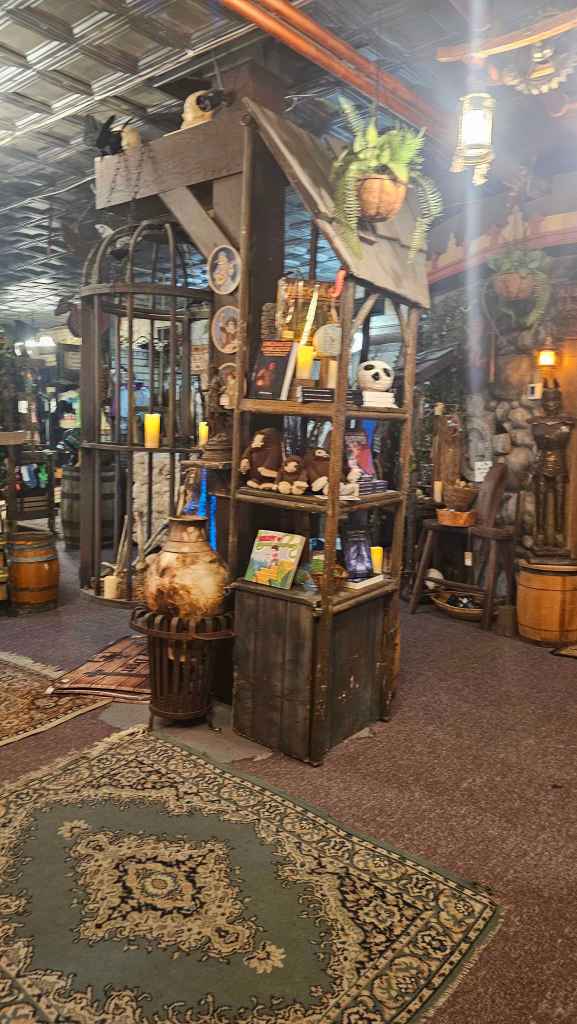
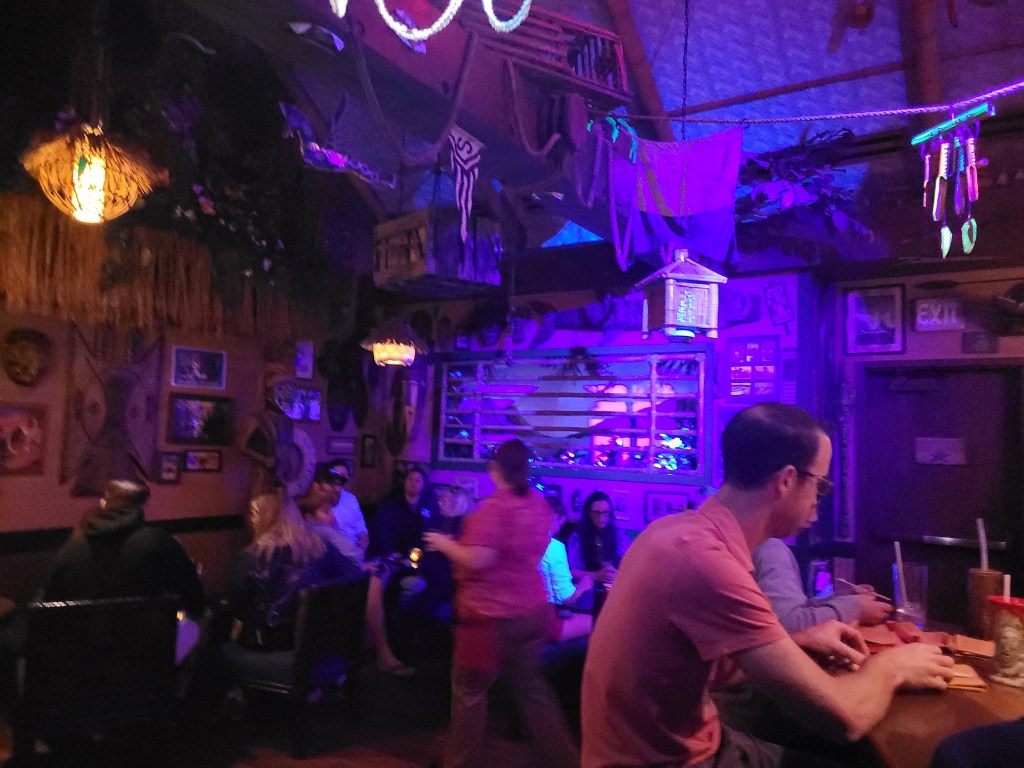
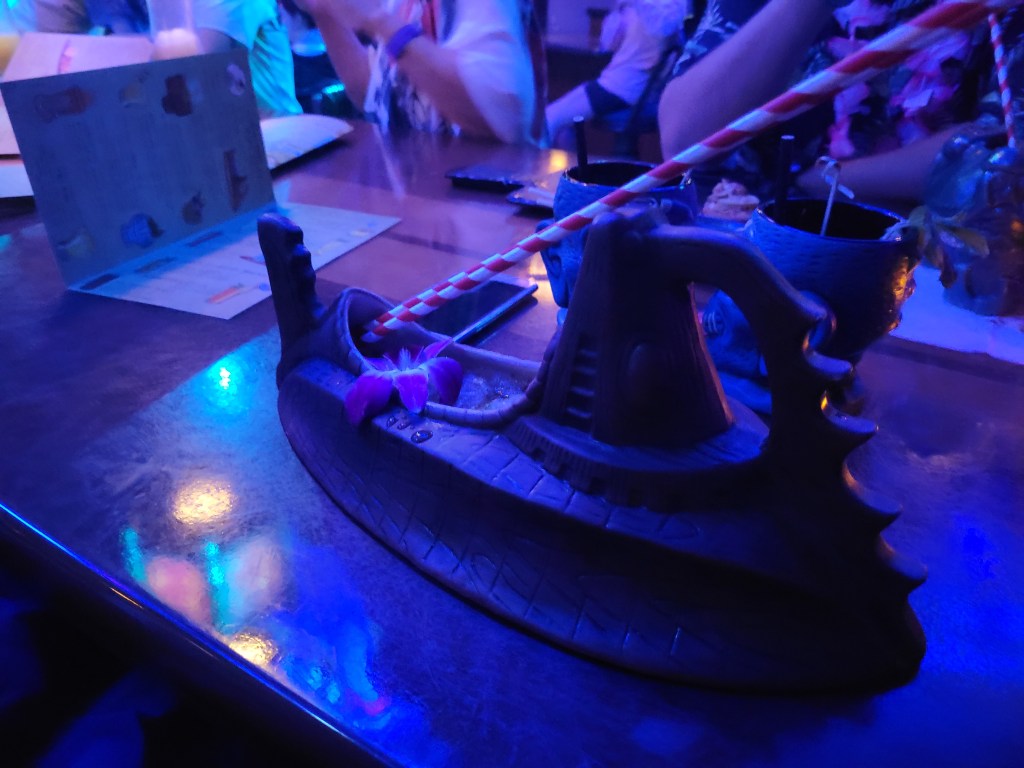
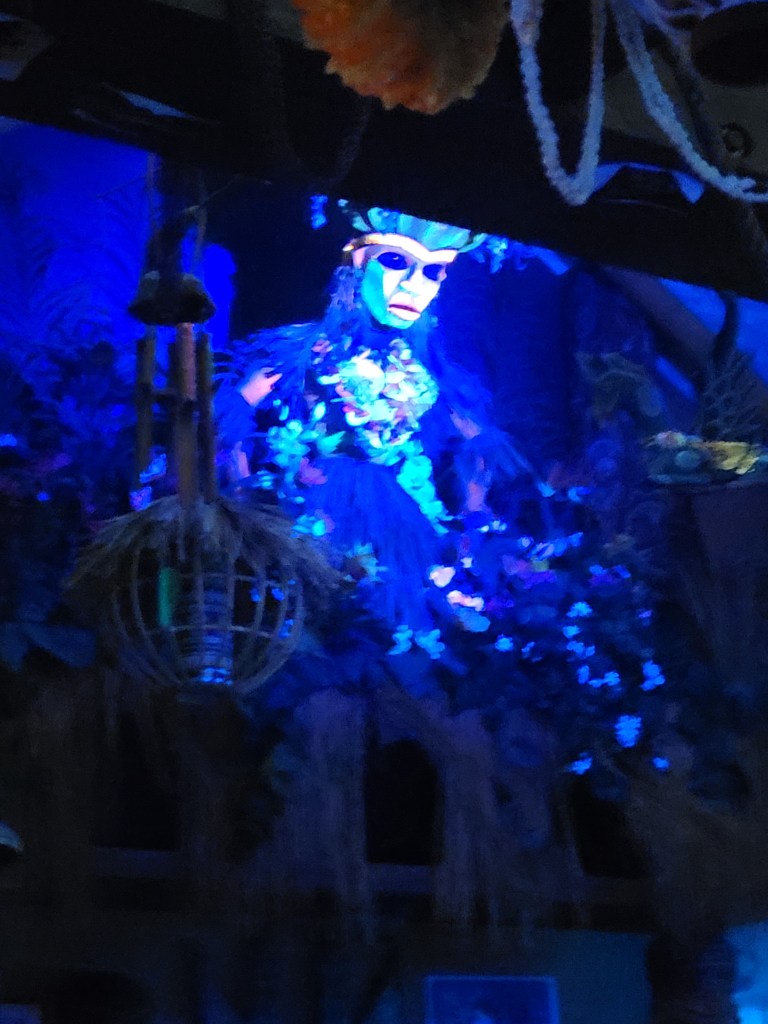
Following after her felt like stepping into another world. Everywhere my eyes wandered I discovered something new: mischievous masks peering from the walls, towering totems, dancing island maidens frozen in carved wood, and ceramic mugs shaped like volcanoes, sea monsters, and forgotten gods. Bamboo, woven rattan, stained wood, and shimmering tile blended together into organized chaos. Colored lanterns bathed the room in a warm amber glow while deep rhythmic drums pulsed beneath the conversations, as though the building itself had a heartbeat.

I had heard of tiki bars before, but I never understood why people became so enamored with them.

Trader Sam’s Grotto

The tiki bar as we know it began during the Great Depression when Ernest Raymond Beaumont-Gantt, better known as Donn Beach, opened a Polynesian-inspired bar unlike anything Americans had seen before. It wasn’t meant to be authentic Polynesian culture so much as an elaborate fantasy, complete with exotic décor, inventive rum cocktails, and the promise of escaping everyday life for a few hours. After World War II, America’s fascination with the South Pacific exploded, and tiki bars flourished throughout the 1950s before gradually fading into kitsch. Thankfully, the craft cocktail movement of the early 2000s rediscovered what made those original bars so magical.
Now, I should confess that my first tiki bar experience wasn’t exactly inspiring.

Back in the early 2000s I found myself sitting beneath a thatched roof at an outdoor bar in Atlantic City during Biker Weekend, surrounded by enough leather jackets and chrome to outfit a small motorcycle dealership. Palm trees had been added with varying degrees of enthusiasm, the drinks were decent enough, and I left wondering why anyone made such a fuss over tiki bars.

Nautilus Drink at Trader Sam’s

Years passed before my boyfriend insisted we visit Trader Sam’s Grog Grotto at Disney’s Polynesian Village Resort.

Apparently, getting inside is something of an adventure. Guests begin lining up well before opening just to earn a place on the waiting list. After finally securing our names, we were quoted nearly a two-hour wait, so we wandered over to Adventureland. Since we were already embracing the tropical mood, we stopped at Walt Disney’s Enchanted Tiki Room to visit the singing parrots before boarding the Jungle Cruise, a leisurely voyage powered almost entirely by terrible puns.
Halfway through the afternoon we discovered we’d missed the phone notification summoning us back forty-five minutes earlier than expected. We hurried across the park, explained our predicament to the hostess, and, thankfully, she smiled and waved us inside.

Behind the ordinary wooden door waited tropical magic.

Storm clouds rolled overhead. Thunder cracked across the room. Ancient gods awakened. A volcano erupted. Every specialty cocktail seemed to trigger another hidden surprise as lights flashed, effects sprang to life, and the entire room joined the performance. We shared appetizers served on a surfboard while chatting with another couple eager to recommend their favorite drinks and point out effects we hadn’t yet witnessed.

Naturally, we ordered the cocktail that required sacrificing to the gods in hopes of calming their wrath and preventing the volcano from erupting.

Interactive dining at its finest.

The gods were angry!

One sip later, I understood.

The drinks weren’t simply fruity cocktails dressed up in novelty mugs. They were surprisingly complex, balancing citrus, spice, bitters, and multiple varieties of rum into something far more sophisticated than I expected. Combined with the immersive atmosphere, the whole experience felt less like visiting a bar and more like stepping onto the set of an adventure movie.

I was hooked.

Now, one might think Disney had perfected the tiki experience.

In Lancaster, that may very well be true.

Max’s South Seas Hideaway

But my boyfriend, being from Michigan, introduced me to a place that somehow raised the bar even higher: Max’s South Seas Hideaway in Grand Rapids.

Home to one of the world’s largest private collections of tiki artifacts, Max’s feels less like a themed restaurant and more like an interactive museum where someone happens to serve exceptional cocktails. Every wall, ceiling beam, corner, and shelf is covered in carvings, masks, vintage mugs, outrigger canoes, glowing lanterns, tribal artwork, and enough hidden details to reward several laps around the building. Upstairs, the bar recreates the deck of a Polynesian sailing ship, complete with a carved mermaid figurehead extending proudly from the bow.

The cocktails are every bit as memorable as the décor, but be warned, dear reader: one or two are more than enough to leave even the most steadfast landlubber feeling delightfully unsteady.

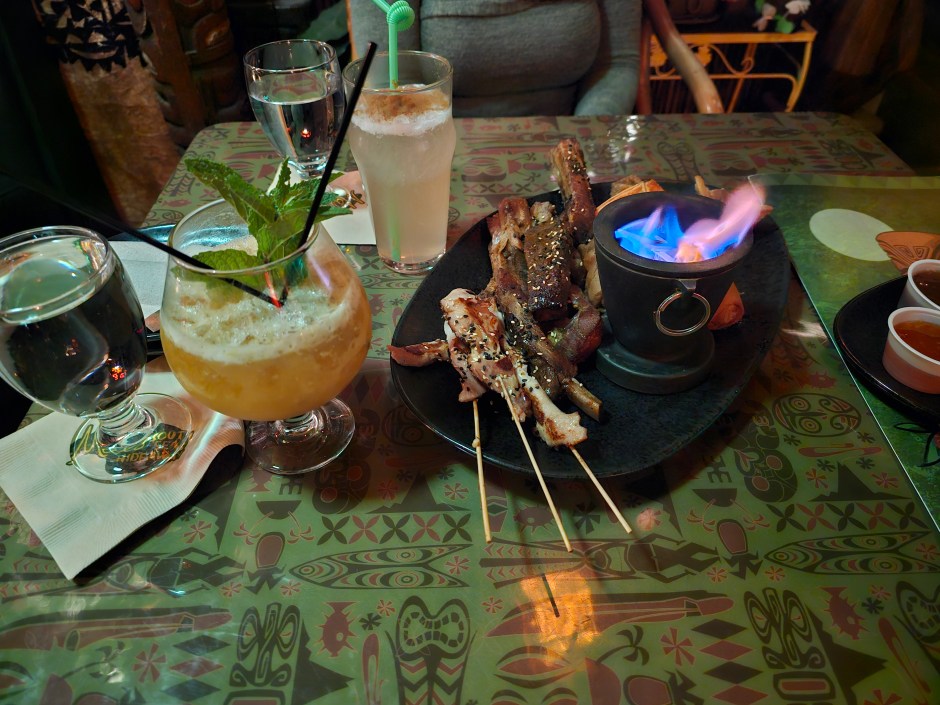
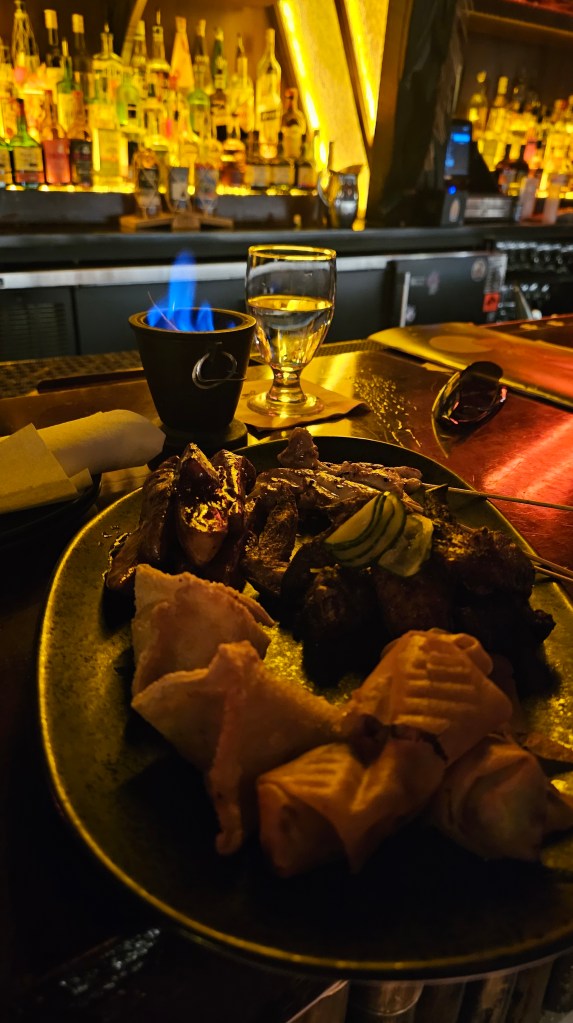
As for the food, order the pu pu platter.

Not because it’s the best value, though it is.

Order it because it arrives at your table surrounding a miniature bonfire.

Because if you’re going to escape to paradise for an evening, your dinner really ought to be on fire.

the famous pu pu platter!

How can you go on your own tiki adventure?

Of course, dear reader, Google is always happy to point you toward the nearest tiki bar. But if you happen to find yourself traveling through one of these cities, these are a few destinations that have earned a reputation among tiki enthusiasts for transporting guests far beyond their front doors. Consider them worthy additions to your own bucket list.

Smuggler’s Cove (San Francisco, CA) – Often considered the gold standard of modern tiki, with an extraordinary rum selection and immersive pirate-inspired décor.

False Idol (San Diego, CA) – Hidden behind another restaurant, this intimate speakeasy-style tiki bar feels like discovering a secret island.

Latitude 29 – Created by legendary tiki historian Jeff “Beachbum” Berry, this New Orleans favorite is a pilgrimage site for cocktail lovers.

Trader Sam’s Grog Grotto – Disney’s delightfully interactive bar, where cocktails can literally change the room around you.

Max’s South Seas Hideaway – Home to one of the world’s largest private tiki collections and, in my admittedly biased opinion, one of the most immersive tiki experiences anywhere.

Three Dots and a Dash (Chicago, IL) – A hidden basement escape serving exceptional cocktails in an unforgettable setting.

The Inferno Room (Indianapolis, IN) – Equal parts restaurant, museum, and tiki bar, with authentic décor and fantastic food.

Undertow – Designed to make you feel as though you’re aboard a nineteenth-century trading ship crossing the Pacific.

The Sorrow Drowner – A newer addition to the tiki scene that has quickly developed a devoted following.

Tiki Tatsu-Ya (Austin, TX) – A wonderfully theatrical blend of inventive cocktails, immersive storytelling, and excellent food.

Whether you’re planning a cross-country road trip or simply looking for an excuse to escape reality for an evening, perhaps there’s a little tropical paradise waiting just around the corner. Sometimes all it takes is opening an unassuming wooden door.

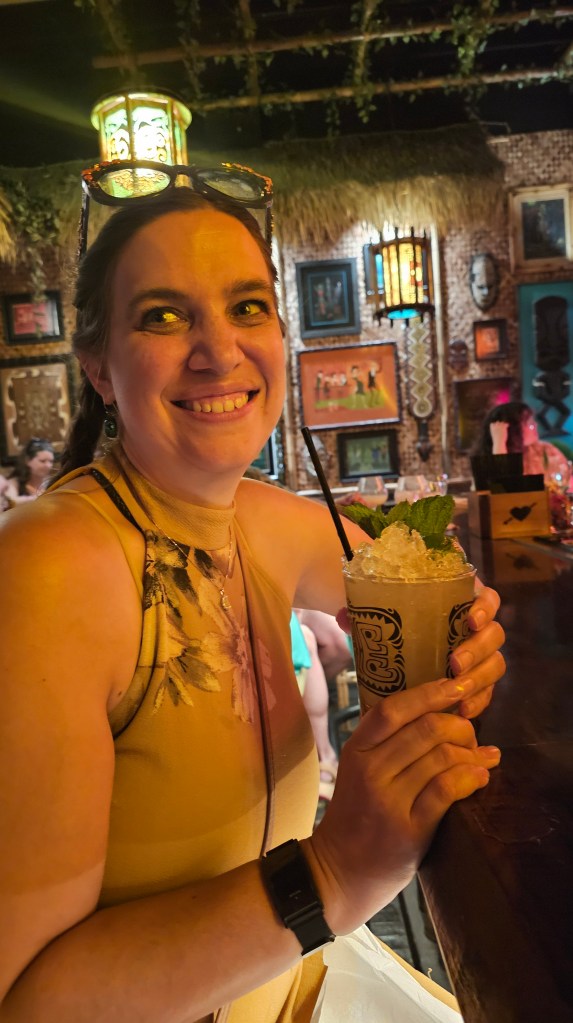
Enjoying a delicious cocktail

Finding Opportunities in the Storm

Dear reader, life does not always go as planned. There are times when fires, storms, and even pandemics disrupt our carefully laid plans. We are, after all, but mere mortals battered about by fate’s whims. That does not mean we should throw in the towel. Quite the contrary, we should throw our hats into the ring, step forward to meet fate where she stands, take her hand, and dance.

Which is exactly what I did on a recent trip to Michigan, where the bucket list adventure happened not at my destination but somewhere along the journey.

I certainly had no intention of adding an airport to my bucket list, but when life hands you lemons, make lemonade, or perhaps lemon drops if you’re inclined to add a little vodka and triple sec (and I am inclined). But I digress.

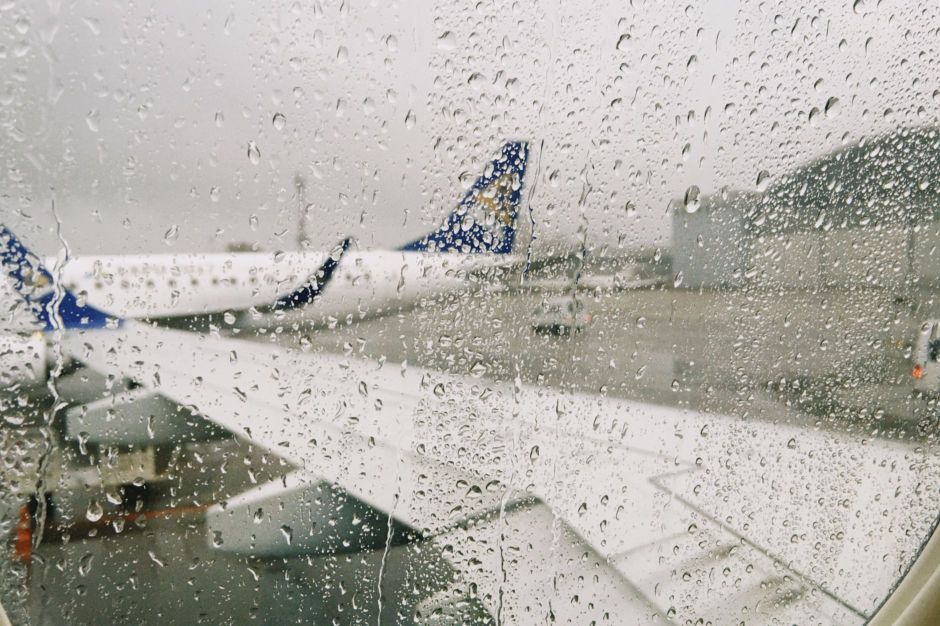
The plan had been simple: depart from Harrisburg, make a brief connection through Chicago O’Hare, and continue on to a small airport in Michigan. As it turns out, dear reader, one ought to be cautious about booking evening flights to the Midwest during thunderstorm season. A powerful summer storm settled over Chicago, grounding flights for hours. 

Consider this your bonus travel tip: Don’t schedule evening flights in the summer if you’re going to the mid-west.

At first, I did what nearly every traveler does when a delay appears on the departure board. I sighed, checked the app for the tenth time, looked hopefully toward the gate agent and realized I had a decision to make; chance going to Chicago once the ground order was lifted and potentially miss my connecting flight late that night or wait until the next morning and have a significant layover. 

After discussing my options with the gate agent, it was clear that if I missed my connecting flight there wouldn’t be another flight until nearly 1 pm the next day and if I went out the next morning on the first flight out I would still be stuck in the airport for hours until 1 pm. I opted for the second option rather than chance a 15 hour layover in an airport. I wasn’t going to chance falling asleep and then missing my flight.  

Regardless, I found myself red eyed in the wee hours of the morning in Chicago sighing in frustration wondering if I shouldn’t have chanced it the night before. 

Then I realized something.

How often does one actually have the opportunity to explore one of the busiest airports in the world?

Normally airports are places we hurry through with singular determination. We race from terminal to terminal, clutching boarding passes, eyes darting from gate numbers to departure screens, scarcely noticing where we are. This time, however, there was nowhere I needed to be except exactly where I already was.

Freed from the tyranny of the boarding clock, I began to wander.

Sunlight poured through towering vaulted windows high above the concourse, washing the polished floors in warm afternoon light. Massive American flags hung proudly from the ceiling while a giant globe floated overhead, quietly reminding travelers just how many corners of the world intersected beneath this roof. Off to one side, almost hidden from the hurried crowds, I discovered displays detailing the airport’s history, small exhibits that most people likely rushed past without ever noticing. Another terminal displayed banners from all over the world proudly declaring all the destinations one might jet off to if only one could secure a boarding pass. 

The airport itself felt less like a transportation hub and more like a bustling indoor city.

The aroma changed every few dozen steps. Fresh coffee drifted from cafés just opening another pot. Warm pretzels perfumed the air outside bakeries while cinnamon, butter, and freshly baked pastries tempted even those who had no intention of eating again. Somewhere nearby onions sizzled on a grill while deep-dish pizza disappeared into ovens. Every restaurant seemed to compete with the next, each trying to lure weary travelers in with one more irresistible smell. I found the juxtaposition of a restaurant pretending luxury next to a kiosk of questionable food to be quite curious. Where else can one find the appearance of luxury sitting so comfortably beside convenience? 

The shops were equally fascinating. Tiny storefronts overflowed with merchandise, every square foot carefully maximized. Shelves stretched from floor to ceiling. Jewelry glittered beneath bright display lights while colorful clothing spilled from crowded racks. Stacks of books, souvenirs, snacks, electronics, and travel gadgets filled every available corner, transforming even the smallest kiosk into something resembling a magician’s cabinet of curiosities. Of course, basic necessities were priced for desperation, but we’ll leave the commentary on exploitive practices for a different author.

Then there were the people.

Thousands upon thousands of them.

Business travelers marched purposefully toward their gates while families attempted the impossible task of shepherding overtired children through the crowds. Couples wandered hand in hand. Flight crews glided confidently through the chaos as though they possessed some secret map unavailable to the rest of us. I caught snippets of conversations in languages I couldn’t identify. Some travelers wore tailored suits destined for important meetings while others looked as though they had rolled directly out of bed and into the security line. Matching family vacation shirts mingled with backpacks, hiking boots, designer luggage, and neck pillows.

The people watching alone was worth the delay.

My favorite moments, however, were the unintentionally comedic ones. Travelers had surrendered completely to exhaustion, sleeping wherever they could find an empty patch of floor. Some curled up beneath windows. Others stretched across rows of chairs. One industrious soul had somehow wedged themselves into a quiet corner between two pillars, blissfully oblivious to the constant parade of rolling suitcases. Nearby, passengers jockeyed for position as boarding announcements echoed through the terminal, each convinced that standing in line fifteen minutes early would somehow get them onto the airplane faster. Even if they did manage to get on sooner, it’s not like the plane was going to leave until everyone in the line was on. Such a curious practice, I never did quite understand.

Naturally, I couldn’t leave Chicago without adding one more item to my bucket list: eating Chicago-style pizza in Chicago. Was it the greatest deep-dish pizza ever created? Probably not. But considering I have little intention of making a dedicated trip into the city itself, I decided this was my one and only opportunity, and it seemed a shame to let it pass me by.

Another traveler might have grumbled about their bad luck. Instead, I found myself unexpectedly grateful.

Normally, I write a paragraph about how you can experience this for yourself. However, this is one instance in which the only advice I offer is this:

Sometimes the greatest adventures arrive disguised as inconveniences. They invite us to slow down, pay attention, and discover that even an airport, a place designed simply to move us somewhere else, can become a destination if we are willing to wander.

Perhaps the next time your carefully crafted itinerary falls apart, don’t immediately look for the nearest customer service desk. Look around instead.

You may discover your next bucket list adventure waiting exactly where you never intended to stop.

The Arcade Lost Between Decades

There are some places that aren’t readily accessible by taking a train or plane. Because it isn’t a place that one can easily get to through travel, at least not through any normal means. Places that require a little sideways step and a wink at quantum physics, because the place one is trying to get to is lost in time. I speak, of course, of managing through some quirk of the universe to go back to a time before, to re-experience what has now been forgotten or perhaps experience for the first time things we never had the chance to do.

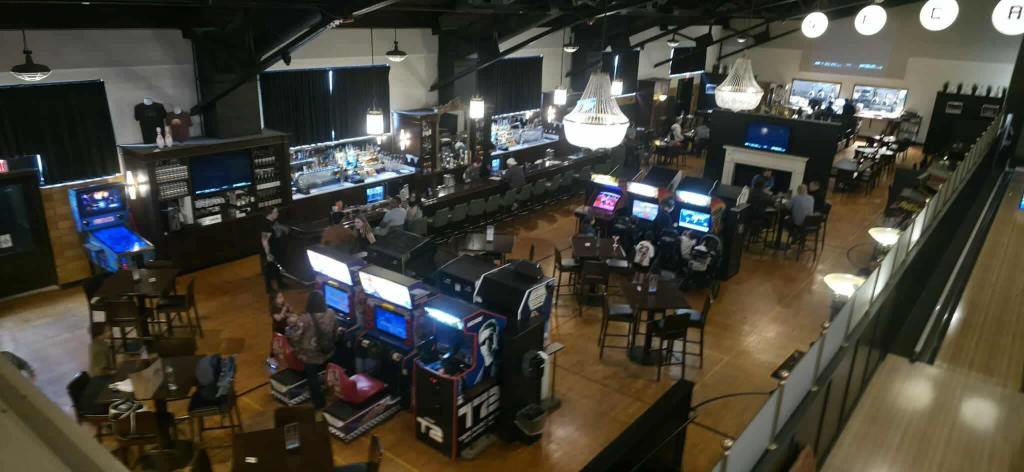
One must slip in between in order to step back and Decades is exactly one of those sorts of places where time doesn’t quite behave the way it should. Tucked in the far northern corner of Lancaster this 95 year old gymnasium has been transformed into a full-service restaurant, bar, six-lane bowling alley, and retro arcade. From the moment you step foot inside you know you’ve left the 2020s behind for some strange pocket of the universe where the late decades of the 20th century have collided together.

High above the vaulted ceiling, bright lights spell out the name “Decades.” Friendly faces greet you at the front desk like agents of time itself directing you through the confusing maze of games and tables. After all, with all these time warps one must be careful not to get too sucked in. To the right, a bowling alley straight out of the 1980s harkens back to the days of your father’s and grandfather’s bowling league. Perhaps you may glimpse a phantom in the timestream sending a ball down for a strike.

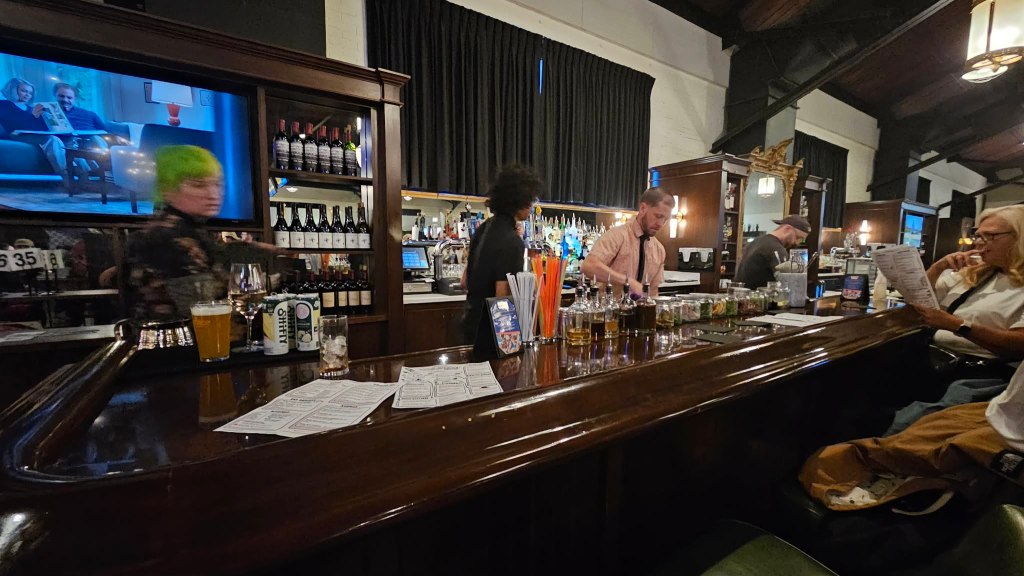
To the left is the arcade and restaurant. The old wooden floors creak softly beneath your feet with the sort of comforting wear that only decades of use can produce. The lighting shifts strangely as you walk, never quite settling into a single mood. One moment you stand beneath the icy blue glow of a racing game, the next beneath the feverish reds and yellows of a fighting cabinet. Neon flashes ripple across the floorboards and tables so that the whole arcade feels alive, constantly changing depending on which machines are calling out nearby. Along the far left wall stretches a long polished bar lined with gleaming glasses and rows upon rows of illuminated bottles, half hidden behind the dense forest of arcade cabinets like some secret oasis for weary travelers lost in time. Beside nearly every machine sits a small table thoughtfully placed for drinks and baskets of fries, allowing patrons to linger between rounds as though there is nowhere else in the world they need to be.

Games from the late 1970s sit proudly beside their more modern cousins from the early 2000s. The evolution of technology can be a bit jarring when one is able to compare them side by side.

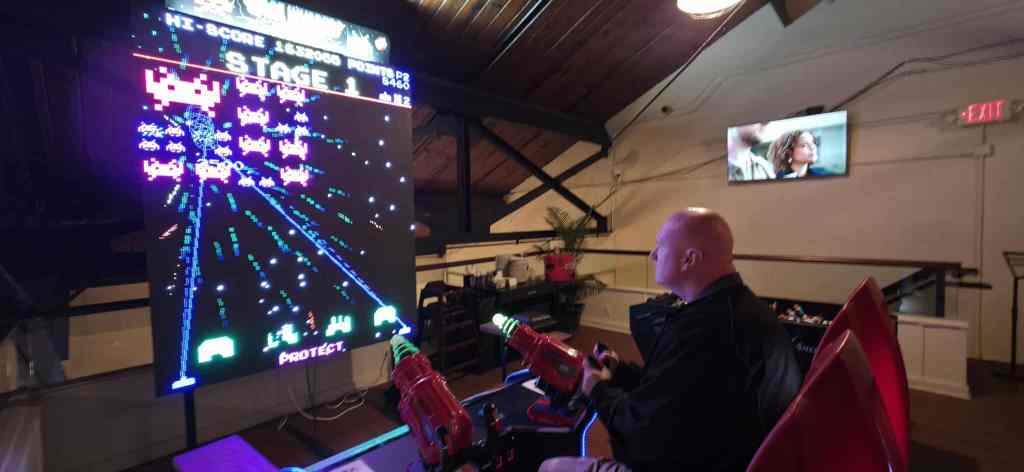
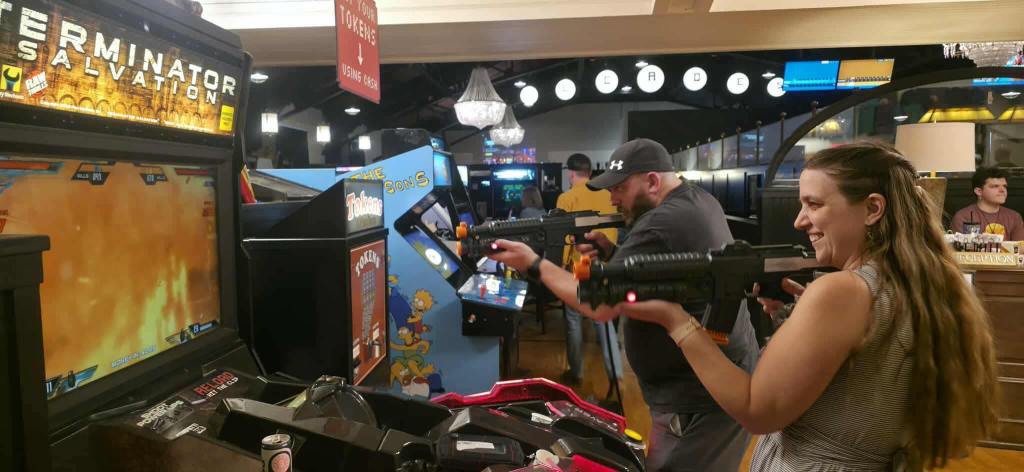
I felt this contrast the most with the two Terminator games that I played. The first one was fully immersive, a gun with real-time feedback requiring a frantic reload through a cartridge at the bottom of the weapon. The second was a janky stationary gun mounted behind glass and pointed at what looked like an aging television screen. Oddly enough, both had their charm. The newer one was undeniably smoother and more exciting, but there was something endearing about the older machine’s clunky stubbornness. Still, I spent a good hour gleefully blasting killer androids into scrap metal.

But I digress, the arcade was not my first impression. My first impression was the restaurant. In the back is a set of booths which provide a bit of respite from the constant chorus of arcade jingles, pinball clatters, and bowling pins crashing in the distance. The menu consists mostly of standard American fare: burgers, sandwiches, wings, and fries. They certainly have salads and your typical appetizers as well, pretzel bits, tacos, pierogies, and onion rings. Now most of these have a different twist than one might expect. For example, the Irish Breakfast Burger consists of a beef patty, portobello mushroom, bacon, sausage, smoked gouda, fried egg, tomato jam, and mayo. Meanwhile the Fire & Ash Burger is stacked with smoked blue cheese, scorched earth sauce, charred leeks, and lemon aioli.

Be warned dear reader, this particular burger is not for the faint of heart. It is quite spicy and left my lips tingling for hours. It was delicious and I highly recommend it for the thrill seekers among you. As one can see, the chefs here are as peculiar as the setting itself. For those concerned by the oddities I’ve just described, worry not. The chef has not taken complete leave of their senses and has mercifully left several menu items unchanged from expectation.

The drink menu is equally surprising in the twists it offers the usual fare. Of course there are sodas and beers, but there is also a delightful collection of specialty cocktails and mocktails for those who do not wish to imbibe. Watching the bartenders work beneath the dim amber glow of the shelves behind them almost feels theatrical, as if one has wandered into some hidden establishment where arcade champions and bowlers have gathered for decades.

After dinner, it really is recommended that you purchase a cup of tokens to enjoy the full bounty of games available across the spectrum of time. There are plenty of games for a whole group to enjoy or for the lone wolves among you.

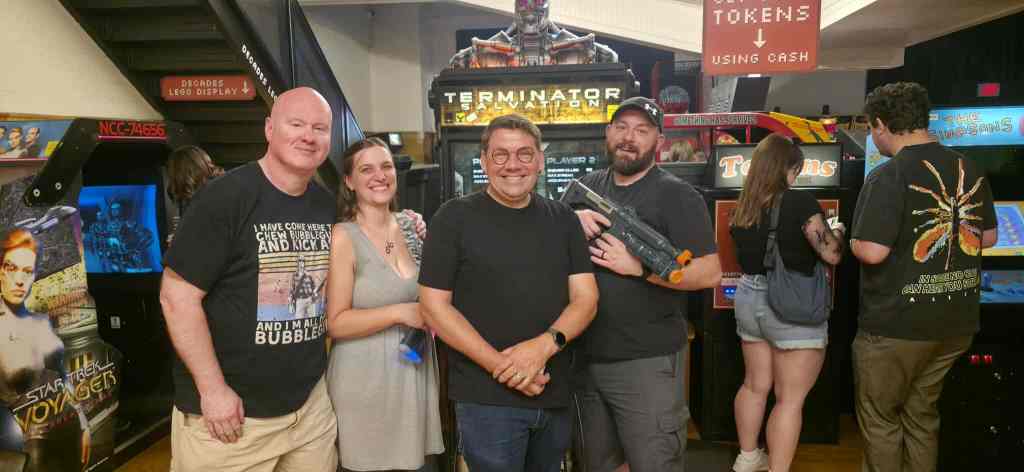
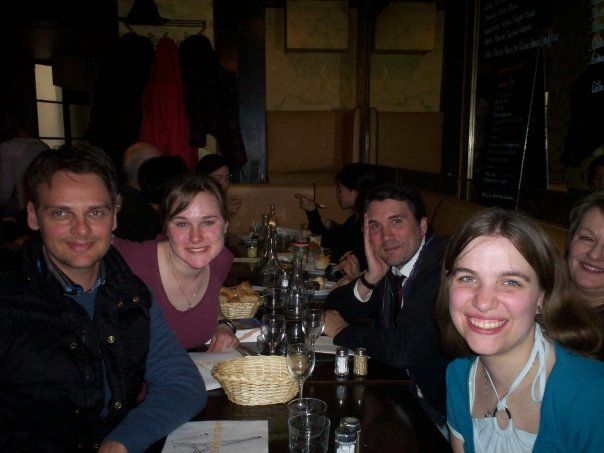
I had met a few friends there from the sci-fi podcast that I run. Scott was visiting from Europe and we jumped at the chance to spend quality time with him. We updated each other on our lives and made plans for the upcoming summer, the local sci-fi convention, and movies that will be coming out shortly.

Naturally, we engaged in the games, some cooperative and others competitive. I already spoke on my fondness for the Terminator game. Dave was particularly good at it as he placed fifth on the machine. I did manage to beat him in kill count during one of the rounds, so naturally I was quite proud of myself. Scott managed first place in a racing game while Miles took his turn conquering Space Invaders.

True to its nature, Decades managed to warp the passage of time as well, for it seemed that I had only blinked and hours had passed in the outside world. Perhaps that is the true magic of places such as these. Not merely nostalgia, nor novelty, but the rare ability to make adults forget the clock entirely.

How might you find such a place?

And should you wish to find an antique arcade of your very own, I encourage you to seek out the strange little corners of old cities and forgotten downtowns. Often these places hide inside repurposed factories, aging theaters, old gymnasiums, or warehouses whose glory days seem long behind them. Look for neon signs glowing faintly against brick walls, listen for the distant chorus of pinball bells and synthesized music, and do not be afraid to wander through an unassuming doorway. Every now and then, if the universe is feeling particularly generous, you may just stumble into a pocket of lost time yourself.

Cost: $50 (that covered two drinks, my Fire & Ash Burger and my arcade experience)

Completed: 2026

Miles from home: 18 miles

Want to discover more adventures? Check out my whole Bucket List and Reverse Bucket List

Paris, Part 5: A Perfectly Imperfect Weekend

The day was winding down. The museum had closed, and the sun was beginning its slow descent. Erika and I stepped out into the cool, crisp spring air, the kind that carries just a hint of evening chill beneath the fading warmth of the day.

The urgency that had driven us, our mad dashes across the city, our constant checking of maps, began to dissolve. In its place came something softer. A quiet curiosity. Without a list to check off, we were once again free to fully embrace the moment. 

We wandered without purpose through streets washed in dusky light, watching as Paris slowly stirred to life for the night. Café lights flickered on one by one. The low hum of conversation drifted out onto the sidewalks. Glasses clinked. Laughter rose and fell like a tide.

Paris, it seemed, was just waking up.

It was in this gentle wandering that we met Julian and his girlfriend, Sandra.

They asked what had brought us to Paris, and we answered in kind. Soon, we were deep in conversation, trading stories of our lives, ours in America, theirs in Paris. There is a certain kind of fleeting camaraderie that forms in moments like these, where neither side expects permanence, and yet both lean fully into the connection.

For a few hours, we were simply part of one another’s stories.

They led us to a club, one far removed from anything we had originally planned.

It was the sort of place where locals belonged, where the rhythm of the night pulsed differently. It was tucked along a street. Do not ask me where, for I doubt I could find it again. With a nod from Julian to the bouncer, we slipped inside, crossing an invisible threshold into another version of Paris.

The air was warm and thick with music. The dim light created an intimate atmosphere like it was holding a secret only Parisians knew. We sipped wine and talked, our voices rising to meet the hum of the crowd as the hours stretched on.

And then, suddenly, the room erupted.

A woman appeared, dressed in something delightfully eccentric, a candle balanced atop her head (and I am not entirely sure if her chest was bare, she had on quite the number of necklaces). She sang loudly, joyfully, with a theatrical abandon, moving with a confidence that demanded attention. The crowd joined her instantly, clapping, singing, cheering.

Sandra leaned in to tell us it was her birthday.

It was not how I would have chosen to celebrate, but who was I to question a Parisian in her element?

As the night wore on, exhaustion crept in, the kind that settles deep in your bones after days of walking, of seeing, of feeling everything all at once.

Reluctantly, we apologized and said our goodbyes.

We exchanged Facebook information with every intention of keeping in touch. But as life so often goes, we never did.

Some things, perhaps, are meant to remain exactly where they happened.

In Paris.

Back at the hostel, I checked my email and confirmed our meeting place with Frieman.

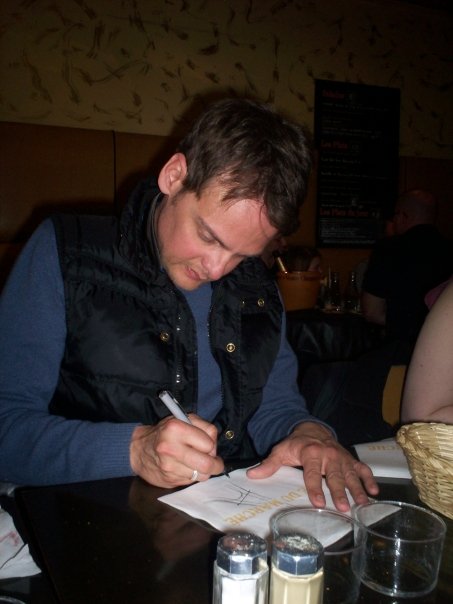
The next morning, we set out once more into the city, this time successfully finding him. Though we did not have long together, we lingered over lunch, swapping stories and savoring the flavors of a city that had already given us so much. He drew me a small Eiffel Tower on a napkin, the perfect memento of my trip. 

After lamenting our struggles with the metro, Frieman kindly took the time to explain it to us. Confident now, we set off to retrieve our luggage before catching our train.

We followed his directions carefully.

At least, we thought we did.

Emerging from the metro into the bright spring afternoon, we found ourselves somewhere entirely unexpected.

The red light district. 

We stood there for a moment, taking it in, the bold storefronts, the neon signs, the unapologetic nature of it all.

Then we looked at each other and burst into laughter.

Never one to miss an opportunity, I leaned in and said, with what I hoped was convincing innocence, “Well… since we’re here, and we’re both engaged, we may as well find something memorable for the honeymoon.”

Smirking and trying not to laugh too loudly, we stepped into a shop and that may or may not have been our only stop.

What exactly we purchased shall remain between Erika and me, and left to your imagination, dear reader.

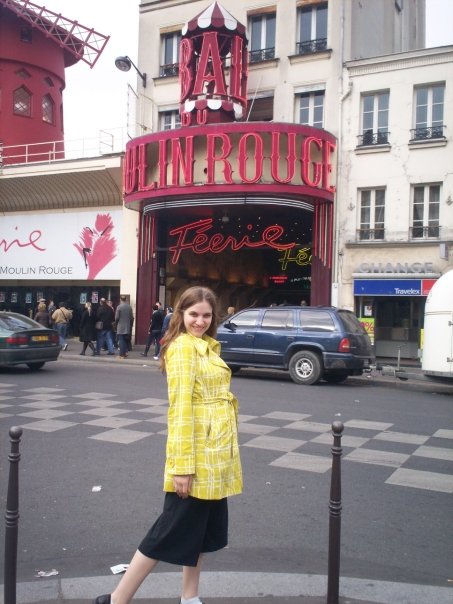
But we did make certain to stop for a picture in front of the Moulin Rouge before making our way back to the hostel… and eventually, to the train. Only stopping a few times to ask for directions from bemused shop owners. 

All in all, it was a weekend in Paris well spent.

A true bucket list adventure, full of mishap and magic, art and laughter, wine and wandering, fleeting friendships and unexpected stories.

And perhaps that is what travel is meant to be.

Not a perfect itinerary.

But a collection of moments, some planned, many not, that come together to form something far richer than anything we could have designed ourselves.

Want to discover more adventures? Check out my whole Bucket List and Reverse Bucket List

When Winter Howls, Let the Opera Sing

We are experiencing a bit of a cold snap here in Pennsylvania. The wind howls outside as I write this, and temperatures plummet from merely chilly to, quite frankly, unbearable. We are advised to stay indoors, and even the sun itself has decided to deprive us of what little warmth it might have offered. While I can certainly enjoy winter outdoor activities, it is on days like these that perhaps we ought to turn to indoor pursuits. Ones that do not come with frostbite warnings attached.

Given the gloomy monotony of the outdoors, I also tend to gravitate toward things with a bit more flair and ambiance. And what could offer more of both than the opera?

Now, dear reader, I can imagine what you may be thinking. The opera? Where everything is sung in a language you do not understand? Where people dress in finery and say things like, “Why, Penelope, your gown looks absolutely divine. I am certain it will catch Edward’s eye,” as if you have been whisked away to eighteenth-century England. Perhaps you are intimidated by the grand architecture of the opera house itself, the richness of the spectacle, or the sheer weight of history behind it all. You may worry the plotlines will feel distant or the music dull.

Allow me to assuage your fears. Opera is far more down to earth than it first appears, especially today, when it has become a welcoming space for all, not just wealthy elites and snobbish intellectuals. Though I am sure they are still wandering about somewhere, we need not pay them any mind.

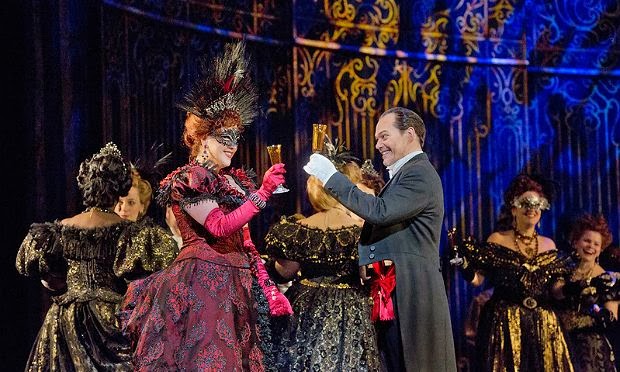
As for dressing up, you certainly can, but you do not have to. I did on my first visit, simply for the fun of it. Besides, I had a beautiful gown begging for a night out, and how could I deny it the pleasure of an opera house? It was stunning, a deep purple with a jeweled neckline that hugged my waist before falling into an A-line skirt. It swirled around my legs as I practically danced through the halls in excitement. As a senior in high school at the time, I earned a mixture of approving and amused glances from my elders.

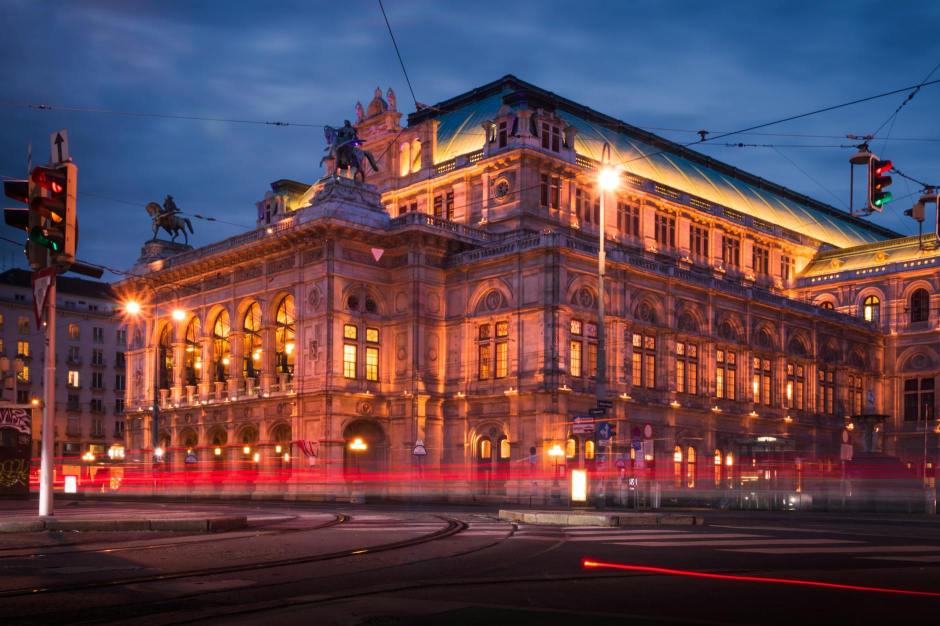
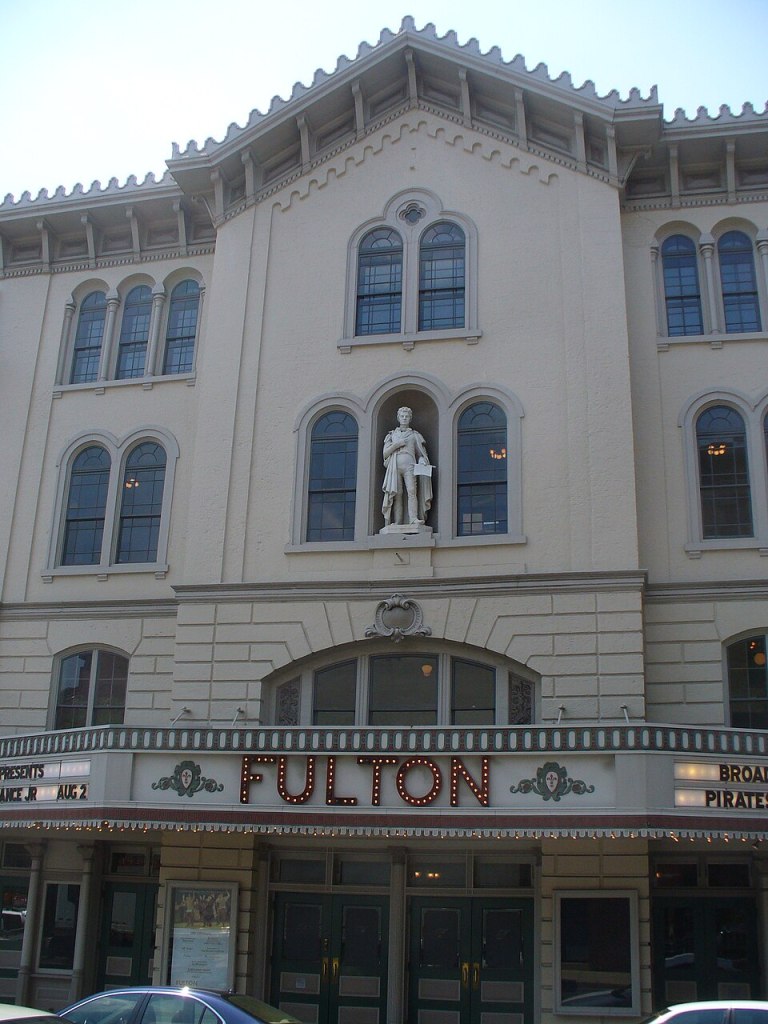
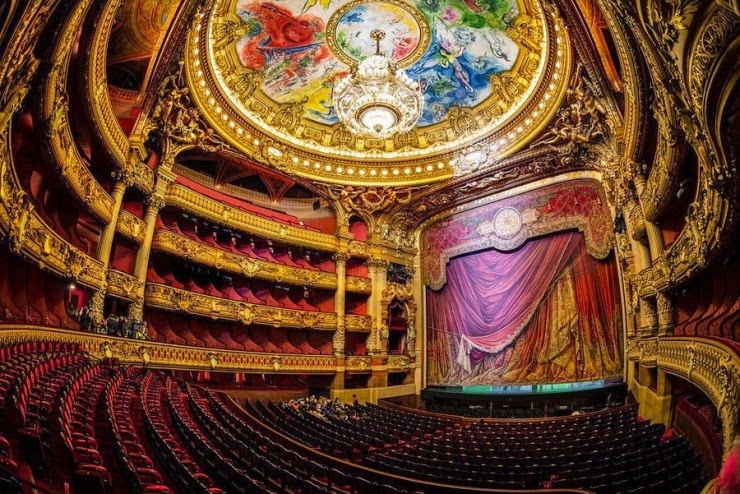
That first experience was a German opera, Die Fledermaus (The Bat), at the Fulton Opera House, one of the few opera houses designated as a National Historic Landmark. The building itself was breathtaking, restored in 1995 to its original Victorian elegance. One step inside, and you might think yourself transported to the opera halls of Europe, with ivory hues, rich red accents, gilded columns, and balconies adorned with swirling gold details. The ceiling features elegant arches and intricate designs that invite the eye upward. I remember being awestruck by this unassuming treasure in my own community.

From the outside, the Fulton sits modestly among other historic buildings, its facade surprisingly plain. The sign announcing “Fulton” feels more reminiscent of a mid-century movie theater than an esteemed opera house, which is fitting in a way. For a time, it did serve as a run-down movie theater before its restoration transformed it into the jewel of Lancaster City that it is today.

My second opera experience, however, was far more casual. It did not take place in an opera house at all, but rather at my local movie theater. It is hard to find anything less intimidating than a relaxed afternoon at the cinema, complete with popcorn and soda. You could show up in pajamas and no one would bat an eye.

This accessibility is thanks to the Metropolitan Opera, often shortened to the Met, which streams live performances to movie theaters around the world. The Met is one of the most renowned opera houses in existence and sits high on any opera lover’s list of must-visit destinations. With the Met: Live in HD series, one no longer needs to travel to New York City to experience world-class performances. Depending on your theater, the seats may even be more comfortable. Mine has reclining chairs and serves alcohol, which makes a four-hour performance surprisingly enjoyable.

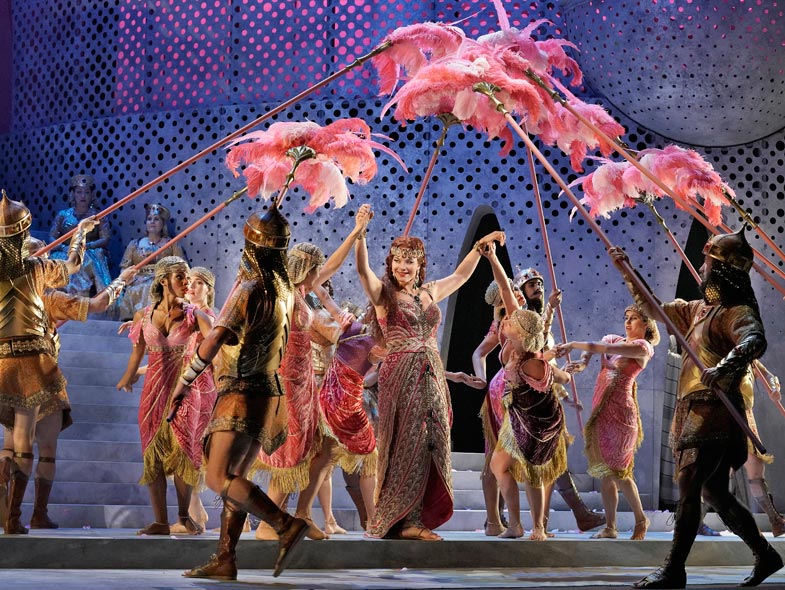
One of my favorite parts is coordinating visits with friends who live far away. We attend the same performance in different cities, text during intermission, and discuss it afterward. Even separated by hundreds of miles, it becomes a shared experience. The Met: Live in HD series offers a wide range of composers and styles. Some productions are modernized with contemporary settings and costumes, while others lean into the historical period in which they were written. Still others fully embrace fantasy, transporting audiences into worlds of myth and legend. Because the performances are filmed, you never miss a detail. Every embellishment on a costume and every carefully placed set piece is visible.

Of course, far beyond the costumes, props, scenery, and architecture is the music itself. It is enchanting, enrapturing, and enthralling in equal measure. Opera spans the full breadth of human emotion, joy, sorrow, longing, fury, tenderness, capturing your heart and refusing to let go. I still remember the hush that fell over the audience as the first notes rose from the orchestra pit, the way sound seemed to ripple through the room. Then came the singers, their voices soaring with jaw-dropping range and power, filling every corner of the space. You do not simply hear opera. You feel it vibrating in your chest, settling into your bones.

Although I speak German conversationally, it is nowhere near sufficient to follow an opera. Thankfully, modern audiences no longer need fluency in French, Italian, or German to enjoy the art form. Operas are almost always subtitled in English, allowing viewers to follow the plot while fully immersing themselves in the music. I vividly remember sitting in the theater, completely enraptured in a way I had never experienced through recordings at home. The notes were richer and fuller, the harmonies more layered, the emotion unmistakable.

Opera is more than a theatrical performance. It is poetic song and living art. It carries a rich cultural history across Europe, filled with timeless stories and enduring truths. Nor is opera confined to the past. Contemporary operas continue to be written and performed, carrying the tradition forward into the modern world.


First Operas to Try (A Gentle Introduction)

If you are curious about opera but unsure where to begin, starting with the right work makes all the difference. These operas are frequently recommended for newcomers because they feature engaging stories, memorable music, and emotional clarity.

Die Fledermaus – Johann Strauss II
A lively comic opera full of humor, mistaken identities, and infectious music. Lighthearted and approachable. It was also my own first opera, so it comes highly recommended.

La Bohème – Giacomo Puccini
A deeply human story of love, friendship, and loss, paired with lush, emotionally direct music.

Carmen – Georges Bizet
Dramatic, passionate, and instantly recognizable, with a strong central character and unforgettable melodies.

The Magic Flute – Wolfgang Amadeus Mozart
A blend of fantasy, symbolism, and humor, written to appeal to broad audiences and still accessible today.

The Barber of Seville – Gioachino Rossini
Fast-paced, witty, and energetic, this comedy is a joy from start to finish.


How to See an Opera Yourself

If you find yourself intrigued, seeing an opera is easier than you might expect.

Check local listings.
Many cities have regional opera companies or host touring productions. Local arts calendars are a great place to start.

Look into streaming performances.
The Met: Live in HD series brings world-class opera to movie theaters worldwide, often at a much lower cost than live tickets.

Seek out local opera houses and smaller companies.
Do not overlook intimate venues. Smaller productions are often more affordable and can feel wonderfully personal.

Do not be afraid to start small.
Matinees, shorter operas, or chamber performances can be ideal first experiences.

Opera has a way of meeting you where you are. All you need to do is step inside and listen.


Opera does not have to be intimidating. It is a welcoming, fantastical place that offers refuge from the cold and invites you into a world of sound and story. So when the wind howls and winter presses in, consider, dear reader, letting the opera sing you warm.

Completed: 2006

Cost: $23 (The Met Live is typically $23 and Opera house tickets can range from $25 to $100)

Miles from home: Home town

Want to discover more adventures? Check out my whole Bucket List and Reverse Bucket List

Podcast From a Galaxy Not All That Far Away

Dear readers, I have a bit of a confession to make. I am not always the posh, delicately spoken flower you may have come to know me as. There are moments when I am decidedly less than ladylike, especially when I am in the throes of passion. Passionate nerdom, to be precise.

Picture me fiercely debating and analyzing the world of science fiction with three of my friends. Add to that the unfortunate fact that I learned to swear from a literal sailor, and when I get salty, I bring the whole ocean with me. It is actually rather freeing to allow a different aspect of myself to shine. After all, we are all multifaceted beings with many sides to ourselves. I am not always channeling my inner Victorian. Sometimes it is my inner Viking warrior, and in this case, it is a girl with some serious beef with filmmakers who simply cannot respect the source material. Is it really so difficult? But honestly, that is part of the fun. My wit and banter at full strength, turned loose on a topic near and dear to my heart: science fiction.

About twice a month, I get together with Scott, Miles, and Dave to review and discuss all things sci-fi. We tend to focus on movies and television, largely because not everyone in the group is as avid a reader as I am. Asking someone to complete an 800-page novel in two weeks is unlikely to end happily. A film, by contrast, is a two-and-a-half-hour commitment instead of twenty hours of reading. Well, twenty hours for them. I can usually polish off a book in eight to ten, depending on how compelling it is.

Alongside reviews, we dive into science fiction news, theories, and the occasional heated debate. Opinions are shared freely, defended passionately, and sometimes gleefully attacked. There is a lot of laughter, teasing, and the kind of spirited disagreement that only works when everyone genuinely enjoys one another. Lest you worry that the boys cannot hold their own against me, fear not. Listen long enough and you will hear them all start to sing “It’s Been a Long Road” just to derail me. Of course, we cannot help but needle Dave for his love of lens flares in Star Trek (for the record, he detests the J. J. Abrams films known for them).

It wouldn’t be a convention without cosplayers

One of my favorite aspects of the podcast is that we do not limit ourselves to recent releases. Often, we revisit older films, the kind that have been forgotten, overlooked, or never widely known in the first place. Sometimes we strike gold. Other times we are left staring into the abyss, wondering how something ever made it to screen. Either way, the process has expanded my palate and deepened my appreciation for different kinds of media.

Some of the films I have ended up loving are ones I never would have chosen on my own. Not because they were masterpieces, but because they offered a fascinating window into how past generations imagined the future. One surprising treasure was Battle Beyond the Stars, which drew inspiration from The Magnificent Seven and the classic Japanese story Seven Samurai. Was it campy? Yes. Was it ridiculous? Absolutely. But goodness, was it funny to watch. Which, admittedly, I was already primed to enjoy given my fondness for older Japanese films. Believe it or not, it was nominated for five Saturn Awards, including Best Science Fiction Film and Best Special Effects. Watching films like this, you can see how cultural values, fears, and hopes were projected forward in time. I have found myself thinking more about how special effects have evolved, how our expectations of technology have shifted, and how often we miss the mark when predicting where we will be in twenty, fifty, or even a hundred years. It makes me wonder what things we consider innate and unchanging now will one day be quietly overturned.

That is what I love most about science fiction. It asks questions. It forces us to examine the implications of technologies just beyond our reach and to consider whether they will ultimately be used for good or for harm. Science fiction reflects the norms of its time, but at its best, it challenges them.

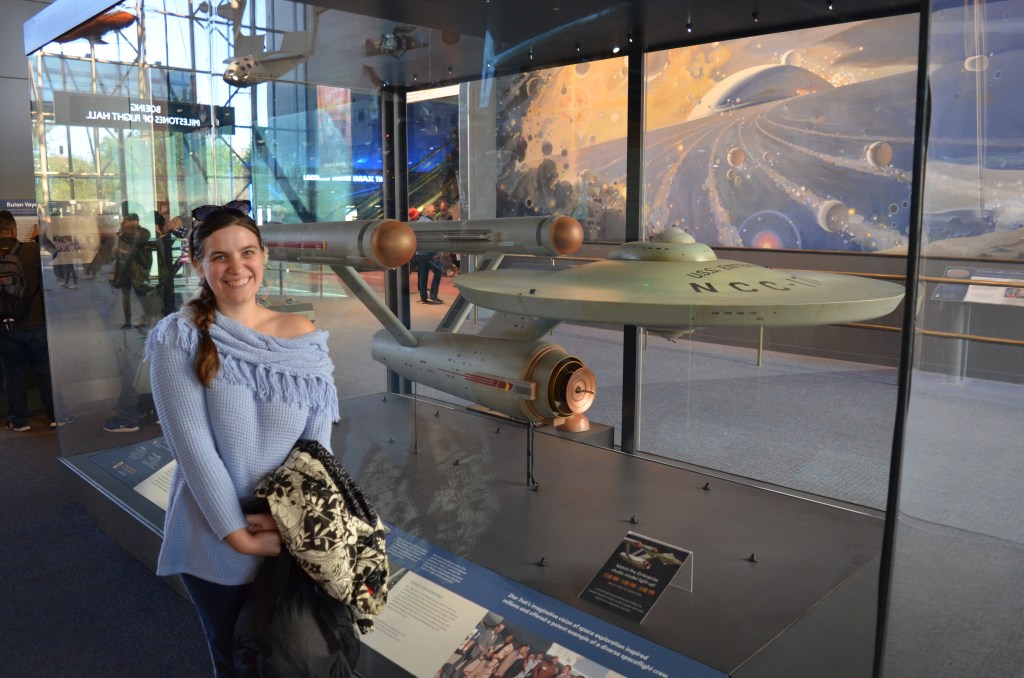
My pilgrimage to Star Trek’s Enterprise housed in the Smithsonian

Star Trek, in particular, has always excelled at this. It does not just explore the possibilities among the stars, but asks us to consider what is possible here on Earth. It gave us the first interracial kiss on television. It pushed audiences to wrestle with the idea of artificial personhood through Data, asking what consciousness really is and what, if anything, separates us from a machine.

This franchise comes up the most on our podcast, likely because it has spanned generations, but also because it is such a deeply philosophical show, challenging and shaping its viewers’ thinking. It certainly shaped mine growing up. I vividly remember watching the Voyager episode “Nemesis,” where Chakotay is seemingly taken in by an alien race, the Vori, who are fighting against the technologically advanced and oppressive Kradin. It is later revealed that this conflict is part of a brainwashing simulation designed to condition him to hate the Kradin. Even after the truth is uncovered, Chakotay struggles to be in their presence. That episode left a lasting impression on me, illustrating how propaganda can turn a compassionate heart toward hatred more effectively than any history book ever could.

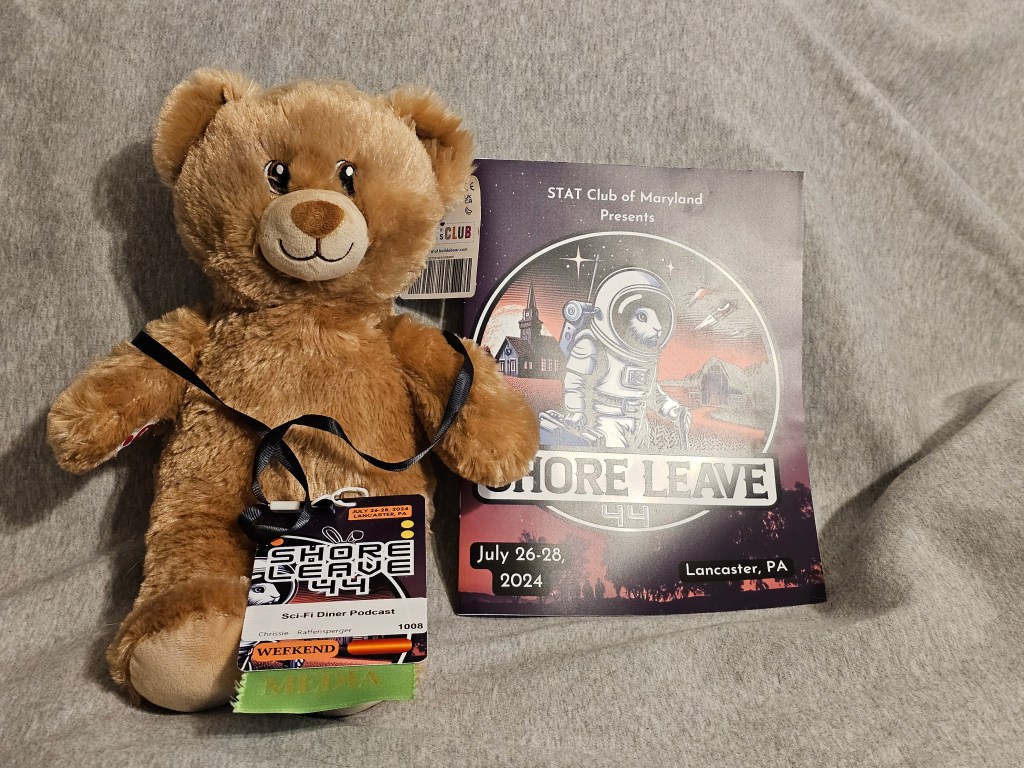
I have been podcasting with the guys for nearly ten years now, and it has been a wild ride. Beyond broadcasting my thoughts and engaging with listeners on social media, the podcast has taken me to science fiction conventions, where I have had the opportunity to interview actors, creators, and other figures within the genre.

None of them have been A-list celebrities, but many have graced a red carpet or two. More importantly, the vast majority have been genuinely lovely people: gracious, thoughtful, and generous with their time. They offer insightful answers, often laced with humor, and seem truly appreciative that anyone still cares about the stories they helped bring to life.

Star Trek Panel 2025 Shore Leave Convention

I still vividly remember my first solo interview. It was surreal walking up to the booth at the start of the convention and being handed a press pass. Me? Press? I had not gone to school for journalism. I was a cheeky woman arguing on the internet with her friends for entertainment. I glanced down again and began taking pictures of the wild chaos that is a convention: costumed characters from different franchises co-mingling with those of us dressed in street clothes. I studied the map and instructions for where I needed to go and made my way through the crowd, stopping to take photos and absorb everything around me. Since the interview would not happen for an hour or two, I scouted the location so I knew exactly where I needed to be. In the meantime, I checked the convention schedule, trying to determine which panels to cover so I could report back properly to my colleagues who were counting on me. Ever the overachiever, I was determined not to disappoint the guys.

As the time approached, my nervousness grew. Here I was, face to face with someone who surely had better things to do than talk to me, yet had kindly agreed to do so anyway. I had carefully written and submitted my questions in advance for approval, determined to avoid any last-minute improvisation. My stomach fluttered with butterflies as I reread my notes, silently begging my ADHD impulse control to please, just this once, stick to the script. Somehow, I managed not to fumble with the recording equipment.

After the first question, something shifted. The nerves faded, and the conversation began to flow. Perhaps it was the therapist in me, instinctively comfortable in a question-and-answer rhythm. I promise there was no psychoanalyzing involved. Mostly. Some habits are harder to turn off than others. I walked away with the realization that these people are, at their core, just like everyone else I have met along the way. One particularly lovely memory from this past summer is of Tracee Cocco, who was simply delightful. She seemed genuinely stunned by the crowd cheering for her, walking out on stage with her phone raised, filming the audience with the same awe we felt toward her. This from a woman who has spent over thirty years in Hollywood as an actress, model, and stuntwoman, appearing in more than one hundred Star Trek episodes and rubbing elbows with the likes of Patrick Stewart.

Not all my interviews were famous for their screen time: Charles Dunbar is an anthropologist who studies anime

Being on the podcast has opened doors I never imagined possible and has cemented friendships across generations: Boomer, Gen X, and Millennial, with the occasional appearance by Scott’s son, a Gen Z. When I was first invited on, I never imagined I would still be doing this years later, or that saying “sure” to chatting about shows I loved would lead to such unexpected experiences.

What it has ultimately given me is a space where all my selves are welcome: the thoughtful analyst, the passionate fan, the therapist, the nerd, the woman who swears too much and cares deeply. In a genre devoted to imagining better futures, the podcast has quietly given me something just as meaningful in the present, a place to belong, to question, to laugh, and to keep wondering.

Thinking About Starting a Podcast?

If you have ever considered starting a podcast, my best advice is to begin simply. Pick a topic you genuinely care about and find people you enjoy talking to. You do not need professional equipment or a perfectly polished format right out of the gate. What matters most is consistency, curiosity, and a willingness to keep showing up even when the audience is small. A good podcast grows out of conversation, not performance. If you are having fun and asking thoughtful questions, listeners will feel it.

Give yourself time to find your rhythm. Early episodes may feel awkward, unfocused, or rough around the edges, and that is completely normal. Podcasting, like any creative practice, is learned by doing. The skills come with repetition, reflection, and the humility to improve as you go.

Miles getting attacked by an alien

A Gentle Reality Check

It is also worth saying that starting a podcast does not automatically lead to press passes, convention access, or interviews with celebrities. Those opportunities take time and careful cultivation. They are built on reputation, respect for the process, and a genuine appreciation for the people whose work you are covering.

If you hope to conduct interviews at conventions, begin by reaching out to the event’s leadership to learn their specific process. Each convention handles media requests differently, and respecting those boundaries matters. From there, reach out to guests thoughtfully, ideally through their handler or publicist when possible, and be prepared to hear no. A declined request is not a failure; it is simply part of the landscape.

Always do your research. Know who you are speaking with, understand their work, and come prepared with questions in advance. Showing up informed and professional signals that you value their time. Over time, that consistency builds trust. And trust, more than anything else, is what earns you a reputation as someone who is respectful, reliable, and welcome in these spaces.

Completed: Started 2018

Cost: I honestly have no idea how much it costs Scott to host the website each month or the recording equipment for me it’s free.

Miles from home: We record virtually

For more reflections on meaningful experiences, future dreams, and moments worth remembering, explore my Bucket List and Reverse Bucket List posts.

All Aboard for Christmas Magic

There is something undeniably quintessential about a model train at Christmas. Perhaps it is the nostalgia of it, those miniature worlds humming softly beneath a glowing tree, harkening back to simpler times. Or perhaps it is the romance of travel itself, when journeys felt grand and full of promise, long before crowded terminals and flight delays dulled their shine.

Model trains were not just toys but marvels. At the turn of the twentieth century, railroads represented the height of modern technology. They stitched together cities, transformed commerce, and shrank vast distances into something manageable. It was only natural that this fascination would find its way into the home. Trains became one of the earliest mechanized toys of the modern era, first gaining popularity in the early 1900s. These were not flimsy playthings but sturdy, intricate machines meant to be admired as much as played with.

By the 1920s and 1930s, model trains had cemented their place in Christmas tradition. Department stores leaned heavily into the spectacle, constructing increasingly elaborate displays that wound through snowy villages and bustling cities, all carefully designed to stop shoppers in their tracks. The base of the Christmas tree became the perfect stage. It was practical, yes, but it was also symbolic. A glowing tree overhead, a circling train below, motion and magic contained within the heart of the home.

Whether by convenience or clever marketing, Christmas and trains became inseparable. That connection only deepened over time. Films like The Polar Express reignited the wonder for new generations, reminding us that belief, imagination, and a little suspension of disbelief are part of the season. During the pandemic, when traditions were disrupted and people sought comfort in familiar rituals, many rediscovered hobbies that had quietly faded into the background. Model trains experienced a resurgence, not as relics, but as reminders of patience, craftsmanship, and shared joy.

In recent years, that magic has increasingly moved into public spaces. Libraries, historical societies, and community centers across the country now host model train displays each December. Often these exhibits double as fundraisers, particularly for children’s literacy programs, ensuring that the magic of stories and imagination carries on long after the trains are packed away.

It was on a cold December evening that I found myself invited to see one of these displays for myself. I will admit, dear reader, that I was not initially enthused. I am not someone who has ever considered myself a “train person,” and model trains seemed, at best, mildly interesting. However, I was willing to indulge my companions in a bit of whimsy; I am nothing if not whimsical. Imagine my surprise, then, at just how utterly delightful the library display turned out to be.

The small library’s basement had been transformed into a sprawling miniature world. The display ran nearly wall to wall, a carefully constructed metropolis alive with motion and detail. Multiple tracks wove through snowy villages and industrial hubs. A baseball field sat mid-game, an airport buzzed with tiny planes, shipping lanes carried cargo through a busy harbor, and a circus burst with color and whimsy. There was even a theme park, complete with rides in motion.

What made it truly special was how interactive it all was. Throughout the display, visitors were encouraged to press buttons and bring the city to life. A ski slope sprang into motion. Barrels were loaded onto a train car. Lights flickered on in tiny buildings. Each interaction revealed another layer of thought and care poured into the exhibit.

I felt like a child again, eagerly pressing buttons and craning my neck to take it all in. Every section had been lovingly created by a volunteer using their own personal train sets. One display even featured a train over a hundred years old, still running, still enchanting, a direct link to the earliest days of electric model trains. It was humbling to realize how many Christmases that little engine had seen.

For nearly an hour, I was completely absorbed, pointing out details to my companions and discovering something new with each pass around the room. The volunteers were just as much a part of the experience as the trains themselves. They eagerly shared stories about the models and about the local area. One tale recounted the time a major league baseball team stopped to play the local team while passing through town, a small but vivid slice of history preserved alongside the miniature world.

It was, in every sense, magical.

Where can you see Christmas Magic?

For those inspired to seek out a display of their own, they are often closer than you think. Local libraries are a wonderful place to start, especially in December. Historical societies, model railroad clubs, botanical gardens, and even shopping centers frequently host seasonal displays. Many towns also have dedicated train shows or open houses where hobbyists invite the public to view their layouts. And for the truly adventurous, there is always the option of creating a small display at home. Even a single loop of track under a tree can carry more charm than one might expect.

Sometimes, Christmas magic arrives in unexpected forms. Sometimes, it hums quietly, circles endlessly, and reminds us that wonder is often found in the smallest of worlds.

Completed: 2025

Cost: Suggested donation $2

Miles from home: 18 miles

Want to discover more adventures? Check out my whole Bucket List and Reverse Bucket List

From Chaos to Charm: Rediscovering Black Friday in a Small Town

Is there anything more quintessential to the American Christmas experience than Black Friday shopping? After we’ve filled ourselves with turkey, stuffing and assorted sides, whether that’s salad, mashed potatoes, rolls, cranberry sauce or something entirely unique to your family, we transition from a day of gratefulness to a day dedicated to preparing for giving.

A cynic might look at this shift and scoff. We spend one day proclaiming gratitude for everything we have only to spend the next guzzling greedily from capitalism as we scramble for more. And that criticism isn’t completely unfounded. Yet more often than not, our Black Friday shopping isn’t about ourselves. It’s about stretching every dollar to bring joy to the people we love. Perhaps I’m getting soft in my “old age” of my mid-to-late thirties, but I choose to focus on that spirit of giving rather than the cynicism.

I’ve only gone Black Friday shopping twice in my life. I’ve never been someone who enjoys crowds, chaos or traffic, and for years I couldn’t comprehend the whiplash of Thanksgiving gratitude followed by a pre-sunrise battle for discounted televisions.

Photo by Max Fischer on Pexels.com

When I was a teenager, my brother, sister and I decided we wanted to see what all the fuss was about. We had heard stories from friends whose families braved the early-morning madness each year, tales of “insane” bargains, crowds so tight you could barely breathe and people practically wrestling over toys. It all seemed equal parts thrilling and preposterous. In our house, where our mother had every birthday and Christmas gift purchased by November 1 (the benefit of children with birthdays spanning Nov. 3 through Jan. 16), the tradition seemed very foreign. But we were curious.

I remember the three of us piling into the car while our father drove us to the mall and nearby stores. People were everywhere. It felt like the entire town had the same idea, and the sheer crush of humanity threatened to sweep us along with it. One moment I’d be looking at an item and the next I’d glance up to realize a sibling had been carried several aisles away by the crowd.

Every store was decked out in holiday finery. Decorations blinked and sparkled, loudspeakers belted out everything from 1950s classics to early-2000s pop renditions of Christmas songs and more than once we passed the Salvation Army bell ringer. I dutifully tossed in a few dollars, still not entirely sure what the organization did beyond running the thrift store my father was forever dragging me to, much to my teenage horror. (This was before I learned how to create a fashionable outfit from a thrift-store treasure hunt.)

But the bright lights, blaring music, crushing crowds and snaking traffic were far too overstimulating for my ADHD brain. I bought what I needed as quickly as possible, then begged to go home. My siblings weren’t far behind. We left exhausted, overstimulated and unanimously convinced we’d never do Black Friday again. And honestly? For nearly twenty years, I didn’t.

Now, you might be wondering why I’m writing about an experience that was so thoroughly miserable. I generally write about things that enrich my life, not ones that leave me wrung out. But here’s the thing, trying new things is part of living a rich, curious life. Not every new experience is going to be a good one, but that doesn’t mean we’re worse off for trying. That first Black Friday taught me that environments with overwhelming crowds, lights and noise simply aren’t for me. It helped me understand what I need to feel comfortable, and now I plan accordingly.

The second reason I’m writing about it is that time changes things. Something awful twenty years ago may not be awful now. Clinging to old assumptions can keep us from discovering something new, something better, something transformed.

Fast-forward almost two decades. My sister now hosts Thanksgiving for our family and her in-laws each year. Some years my brother joins; other years I host a small get-together that weekend for the immediate family. My sister often uses the Saturday after Thanksgiving to participate in Small Business Saturday.

But this year, after we hosted a breakfast with my brother on Black Friday, she suggested we wander into our small town instead of making two trips. At first, my old aversion surged back. I could practically feel the traffic inching along, recall the shoulder-to-shoulder crowd and hear the echo of blaring speakers in my mind.

But this wouldn’t be malls and big-box stores. It would be my charming little town, complete with twinkling star decorations on lamp posts and small Christmas trees outside each storefront. Maybe, just maybe, it would be different.

On a whim, I decided to lean into the cheer by wearing my green Victorian coat and a wreath of ivy with white and cranberry ribbons in my hair. We planned to arrive around 9:30, hoping crowds would still be at the big stores. We guessed right. The streets were lively, but not chaotic, and I easily parked at the local elementary school, a trick locals use to avoid the meters and keep street parking open for tourists.

My sister and I wandered through our favorite small shops: The Tea Affair, Matthew 25 Thrift Store, Wilbur Chocolate, Purple Robin, Aaron’s Bookstore, Earth to Lititz, Bunyaad and more. Rather than being crushed by crowds, we could browse comfortably. The Tea Affair was especially delightful, a sensory experience of smelling teas and choosing blends. Most stores didn’t even play music. Instead, they relied on tasteful decor and genuine smiles to create the holiday atmosphere.

As we walked, the holiday window displays felt magical. People stopped me frequently to ask about my outfit, and my answers ranged from “spreading Christmas cheer” to “the occasion is myself,” depending on my mood. By noon the vibe shifted as more determined shoppers began to appear and the stores grew crowded. Fortunately, we had completed our shopping and decided to wrap up the day.

This time, I didn’t leave exhausted or vowing never to return. I left thinking I might like to do it again next year. It turns out that timing matters. Crowds aren’t what they used to be now that online shopping dominates early-morning sales and Cyber Monday exists. People are savvier about deals throughout the year, and many prefer to shop from home in pajamas, significantly thinning out those old-school Black Friday mobs.

Did I score any spectacular deals? Not really. The closest was a six-dollar apron from the thrift store, a lucky find that probably would’ve vanished had I arrived later. But I loved supporting my local shops, knowing my money stayed in my own community and circulated among people I care about. I loved shopping with my sister and finding her the perfect gift: a painting by a local artist.

Time does change things. Experiences can transform, soften or reinvent themselves. Of course, the opposite can also be true (as my different Disney World trips will attest, one lovely, the other quite disappointing), which is why approaching familiar things with an open mind matters, especially when years have passed.

Black Friday is a time-honored American tradition. It isn’t for everyone, but then again, nothing I write about is. Still, it sits on many Christmas bucket lists and holiday-season must-dos. And because I try to live life with curiosity, openness and a willingness to rediscover old things anew, I gave it another chance.

And I’m glad I did.

(Usually, I include a short section on how you can experience this bucket list item for yourself. However, I shaln’t cover that which the marketing departments have so thoroughly disseminated.)

Completed: Once in childhood

Miles from home: Local mall 12 miles from home

Cost: Budget in childhood was $50

There is so much more to discover. Check out my list so far!

How I Became a Lady (Sort Of)

It finally happened, dear reader, I’ve ascended the social ladder or perhaps I was just finally given my due. After years of modest living and an enduring fondness for mud-splattered hiking boots, I am now… a Lady. Or at least, that’s what the certificate says.

This rather illustrious transformation occurred thanks to my brother, who, in an act of Christmas generosity (and perhaps a touch of mischief), purchased me an “Irish title.” Technically, I am now the Lady of Kerry, complete with a small plot of land, or as the fine print clarifies, a symbolic square foot that could just about accommodate a particularly skinny daisy. I can go visit it, but I can’t redecorate or reside there on a permanent basis. 

A castle in Kerry, Ireland

Now, before you curtsey, a word of reality: companies like Established Titles offer honorary recognition rather than true nobility. My title doesn’t come with a castle, serfs, or even a teapot emblazoned with my crest. Although, now that I think of it, I could perhaps purchase one for my stove here at home. Historically, “Lord” and “Lady” were titles granted by monarchs or inherited through noble bloodlines, not acquired via online checkout. But honestly, who am I to let historical accuracy get in the way of a good story?

Besides, the funds go toward preserving the land and history of Ireland, a cause close to my heart. My mother’s family is Scots-Irish, and I’ve always felt a deep connection to that misty emerald isle. I fell in love with its spirit: the wild cliffs, the songs that seem to rise from the earth itself, and the way history hums beneath every stone wall and ruined abbey. I love reading its stories, exploring its history back into the very days of Newgrange over 7,000 years old.

When I was younger, I took up the Irish fiddle and have returned to the instrument of my youth. I dabbled in Irish step dance in college. More recently, I even tried my hand at learning the language through Duolingo — Dia dhuit, if you will. When I finally visited Ireland, it felt like walking into the pages of an old legend. The Book of Kells took my breath away, and the rolling green hills seemed to whisper secrets older than time. Part of me was quite tempted to simply disappear into the countryside and see if the fae truly existed.

A day in Dublin

So yes, while my noble title may be symbolic, the sentiment behind it is genuine. And as an avid fantasy reader, I’d be lying if I said I hadn’t dreamed of being a Lady, though perhaps more the sword-wielding, dragon-slaying kind. If this little piece of parchment brings me one step closer to that dream, then I say it was money well spent.

Of course, being a lady hasn’t exactly transformed my daily routine. I still brew my own tea, scrub my own floors, and trip over my own dignity with regularity. No invitations to high society luncheons have arrived (yet), and my “estate” is still contained within a flowerpot on my porch. But perhaps the true nobility lies not in titles, but in finding humor, history, and heart in the small things.

So here I stand, Lady of Kerry, warrior of laundry day, slayer of dust bunnies, and humble admirer of the Irish hills. My crown may be metaphorical, but my affection for Ireland is entirely real.

My very own title!

So how might you become a “lord” or “lady”

Ever since the launch of Established Titles, there has been a plethora of copy-cat companies all offering the same thing, a little certificate saying you “own” a piece of land or castle in Ireland or elsewhere in the British Isles and therefore can now call yourself a “lady”. The money raised usually goes to the preservation of that land or castle, because it is expensive to maintain that history. Who knew that nobility was only a mouse click away?

Completed: 2021

Miles from home: 0

Cost: $25- $60 depending on the kit purchased

Want to check out my other adventures?

Start exploring here

Beyond the Classics: Fantasy Books to Add to Your Reading Bucket List

While most bucket list items require at least a trip out your front door, some of the best ones ask for nothing more than a comfortable chair, a cup of tea, a purring cat, and a book. Not everyone thinks of reading as a bucket list activity, but plenty of readers consider finishing the “greats” an accomplishment worth doing before you “kick the bucket.”

Lists of Books to Read Before You Die are everywhere, compiled by literary authorities, publishers, or critics. The argument for reading them is solid: classics can enrich your life through timeless themes, enduring wisdom, and universal insights into the human condition. They can expand your vocabulary, sharpen your writing, and deepen your appreciation for culture and history. Sometimes, one book really does shift your perspective forever.

And yet, I don’t always agree with these lists. It’s not that the classics aren’t worthy, it’s just that… well… many of them are boring. There, I said it and I shan’t take it back! I’m a fantasy and science fiction reader at heart. Outside a few exceptions, books outside those genres are of little interest to me. Oh, do not mistake me for an uneducated plebian. I’ve read my share of “required” classics (even in German, no less), but some really do go on. Did I really need to know that much about the Parisian sewer system, Victor? I appreciate the symbolism, but I nodded off halfway through. Perhaps, it’s my ADHD mind which just wanders off when things don’t spark my intrigue.

Photo by Suzy Hazelwood on Pexels.com

That doesn’t mean I don’t have a reading bucket list outside my “To Be Read Pile”, which we aren’t discussing. They will be read, when they are read! I digress.

My Reading Bucket List simply reflects my love for fantasy and science fiction, the genres that spark my imagination most. A few years ago, I stumbled upon a “Top 20 Fantasy Series of All Time” list, not compiled by critics, but by a survey of BookTube influencers. Yes, it’s biased toward modern titles (and leans millennial/Gen Z), but I liked the idea of readers (not industry insiders) deciding which stories deserved a place on the list. (We won’t get into all the politics behind what books get placed on those classic lists, we’d be here all day with me ranting.)

To my delight, I had already read about half. The rest became my summer project in 2022. Armed with my library card and Kindle, I sampled each new series, reading at least the first book to see if it hooked me. Some didn’t, but then not every book will be my cup of tea. Others were revelations, hidden gems I never would have found without the list. They were witty, profound, beautifully written, and layered with history, culture, and insight, even while transporting me to other worlds. While none of them were life-changing, they certainly sparked introspection and reflection, opened up ideas, and at times challenged my ways of thinking.

If you’ve struggled through traditional “must-read” lists and found yourself uninspired, maybe it’s time to look at fantasy. Between epic sagas and modern masterpieces, there’s a wealth of stories waiting to change the way you think, or at least keep you delightfully entertained. The list below is a great place to start. You’ll find household names alongside underappreciated treasures, each with the potential to expand your reading horizons.

Photo by Jeffry S.S. on Pexels.com

Suggested Top 20 Fantasy Series to Read Before You Die

Rank 19 (3 series)

  • Ash and Sand — Richard Nell
  • The Dandelion Dynasty — Ken Liu
  • The Earthsea Cycle — Ursula K. Le Guin

Rank 17 (2 series)

  • Harry Potter — J.K. Rowling
  • The Kingkiller Chronicle — Patrick Rothfuss (warning this series is unfinished and has been for over 10 years)

Rank 15 (2 series)

  • The Books of Babel — Josiah Bancroft
  • The Broken Earth Trilogy — N.K. Jemisin

Rank 14

  • Memory, Sorrow, and Thorn — Tad Williams

Rank 13

  • The Green Bone Saga — Fonda Lee

Rank 11 (2 series)

  • The Poppy War Trilogy — R.F. Kuang
  • Gentleman Bastard — Scott Lynch (also an unfinished series, my recommendation is you read the first as a stand alone as it does give a satisfying ending)

Rank 10

  • The Greatcoats — Sebastien de Castell

Rank 9

  • Discworld — Terry Pratchett

Rank 8

  • Malazan — Steven Erikson & Ian Esslemont,

Rank 7

  • The Realm of the Elderlings — Robin Hobb

Rank 5 (2 series)

  • A Song of Ice and Fire — George R.R. Martin (Also unfinished, but feel like you all should know this by now)
  • The First Law Universe — Joe Abercrombie

Rank 4

  • The Wheel of Time — Robert Jordan

Rank 3

  • The Banished Lands — John Gwynne

Rank 2

  • Middle-earth — J.R.R. Tolkien

Rank 1

  • The Cosmere — Brandon Sanderson

Photo by Lisa from Pexels on Pexels.com

Final Thought

Reading bucket lists don’t need to be confined to dusty classics or daunting tomes. If fantasy and sci-fi are what light you up, then let those genres guide your journey. After all, books are more than assignments, they’re invitations into new worlds. And what better way to spend your limited time than wandering through worlds filled with wonder?

Completed: Ongoing

Costs: Free depending on your library, borrowing from friends and book exchanges

Miles from home: Light years depending on the book

There’s a surprising amount of things to do just outside your door if you know where to look. Check out my Bucket List and Reverse Bucket List to see how I have checked out my list without having to go very far.