

One may be forgiven for thinking that I’ve already covered preparation in the packing section. After all, is that not where one places all the things that one will need in the luggage? Well yes, but this is a dedicated section to logistical and necessary paperwork considerations.
Americans have been a bit spoiled since the advent of commercial flights given that our passports have pretty much cleared us through most countries without much fuss. However with the increased concern for security over the years more and more countries are implementing pre-checks and restrictions to people looking to cross their borders. For example, when I was a student studying in Germany I could have easily hopped a plane last minute to visit the UK without any additional paperwork than my passport. In fact, I was a little disappointed that most of the borders I crossed didn’t require any stamp or passport check during my time in Europe because of the European Union allowing for easy travel across borders. However, on my recent trip to the UK, I was required to download an app and apply for an Electronic Travel Authorization. It’s essentially a pre-screening tool for people intending to travel into a country and it is linked to your passport. They’re intended to help catch high risk individuals who may overstay their welcome or pose other security threats. I imagine that more and more countries will be adopting these in the future. Some countries require your passport to be no more than 6 or even 3 months from expiration. Other countries require visas, even for US citizens. As always research the country’s requirements before visiting and do not assume that because you were able to freely cross even a few months ago that you will be able to freely cross again as laws are constantly being updated.
Another lesser known consideration is vaccinations. During COVID some places were requiring proof of vaccination and even to this day there are countries which require you to show proof of a yellow fever vaccination. While a COVID shot was easily obtained at a local pharmacy or doctor’s office, a yellow fever vaccination is less readily available and may require an appointment at a travel clinic. Keep in mind most of these vaccinations are not necessarily covered by insurance and will cost you out of pocket to obtain them. Double check which vaccinations are covered by insurance and arrange with your doctor to obtain them there since many travel clinics don’t accept insurance.

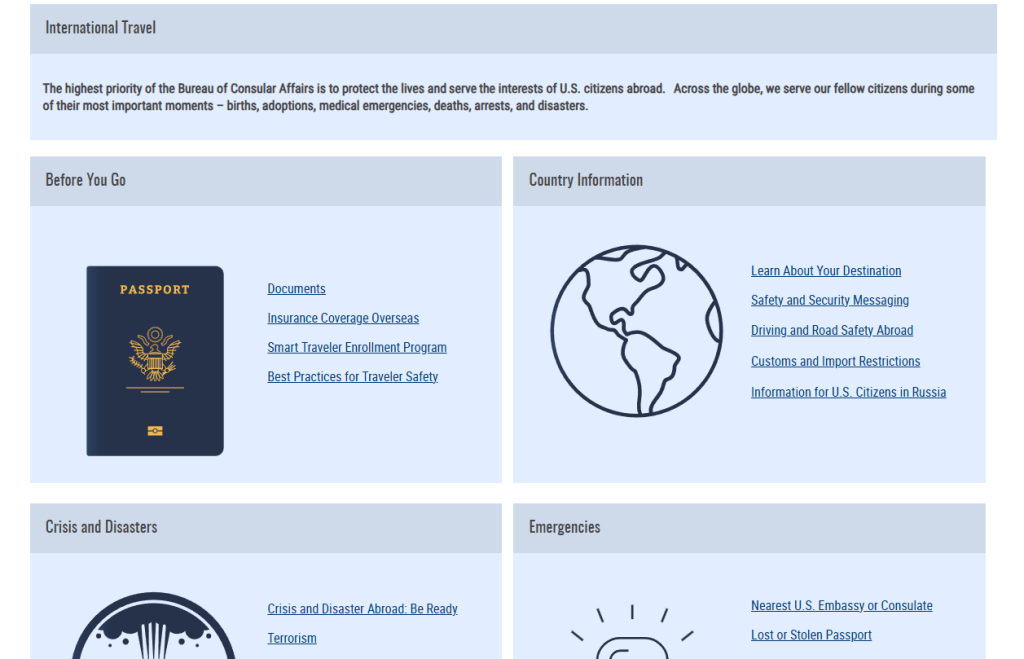
Now just because a country doesn’t require a vaccination doesn’t mean you shouldn’t consider visiting a travel clinic anyways. While traveling to many countries along the equator is affordable they do tend to be places with higher levels of disease and thus pose an increased health risk. My personal recommendation is to visit the U.S. Department of State for travel advisories. This website often lists potential concerns for travelers including diseases. When going on a mission trip to Haiti, I invested in some malaria medication to ensure I did not contract it. Not everyone in my group did but given that mosquitos adore me, I felt that I ran a higher risk than others. This website can also tell you about other risks that a country may pose. It may advise you to stay away from certain areas or of ongoing conflicts that the news may have not covered. Be mindful that when you go to the travel clinic they will try and upsell you additional things, be certain of what you want before you go in to avoid unnecessary expenses.
When looking up information on the US Department of State, I make sure to write down the US Embassy information for the country I will be visiting and you can even register your visit with the US Consulate to help smooth out processes should the need arise. I always make a copy of my passport and other travel documents, not that these will get your very far but they are helpful in emergency situations where they’ve been stolen or lost.
In addition to safety, be sure to look up the local emergency number for the country you are visiting. Dialing 911 is not a universal number which will connect you to emergency services. Be sure to program that number in your phone along with the number of the US consultant for the country you’ll be going to.
I also try and google “things Americans should know about traveling to x” to help keep me appraised of local laws we typically run afoul of. Did you know in certain countries wearing camouflage is illegal? Not that I am a fan of wearing camo for myself, but I know many Americans are. There may also be certain customs and social expectations that we frequently break through ignorance. For example, while visiting in Boston, I took up with a few German tourists and we went out to eat together. I was horrified when I realized that they were only going to round up to the nearest dollar amount as a tip instead of giving the customary minimum of 15%. I had to explain to them that what they were doing was extremely rude to the waitstaff. See, Americans aren’t the only ones who mess up when traveling abroad. It is easy to assume similarities when visiting other Western nations since we are so culturally similar in most respects, but still do your research and don’t be afraid to inquire about local customs. If people see you are earnestly trying to be polite, they usually appreciate the effort and are happy to educate you if you miss something.
Now when traveling it can be tempting to simply call your bank, inform them of your plans and then use your credit or debit card. However, this can lead to unexpected charges and cost you money in the end. Many bank cards charge additional fees unless you have obtained a card intended for travel, so double check with your bank to avoid unexpected costs. Additionally, consider going to the bank and exchanging your money for the local currency. As always double check the currencies that a country accepts. Many Caribbean and Central American countries accept dollars when visiting. As of this writing, Venezuela even accepts bitcoin if you happen to have that. Keep in mind, it can take several days for your bank to get the money in so my advice is to do it two weeks prior to your departure that way in case you make a mistake, you have time to rectify the situation. Remember most banks will exchange notes and not coins so when you are abroad be sure to use up your coins when possible to maximize your ability to exchange the money upon your return. Always take more money than you think you’ll need as you may need the money for tips, parking and other miscellaneous items.Your cards can be lost, stolen or mistakenly locked out. You’ll be grateful to have cash to get you through emergency situations.
The other phone call to make is to your phone company for potential international plans. AT&T offers a 12 dollar a day plan and you only pay for the days you access their network. It’s not terribly expensive if you plan to keep your phone in airplane mode and only plan to use it for emergencies as I personally don’t recommend using your phone abroad. Instead, if your phone is unlocked you can purchase a sim card or download an app for an electronic sim card for the country you’re in. Often you can purchase plans for about 10-15 dollars for an entire month rather than per day. If your phone isn’t unlocked, you can either get it unlocked or purchase a cheap phone for purposes of GPS and local phone calls. To communicate to people back in the US, I currently recommend Whatsapp as a way to make phone calls without incurring tons of additional costs. Along the same lines with the phone, don’t assume your apps and things will work to access items like tickets. Always download the tickets to your phone or print them out and pack them.
Depending on where you’re going, you may want to consider purchasing a camera instead of using your phone as one. Certain places in the UK, are known for phone theft and there are plenty of videos of thieves snatching phones right out of the hands of unsuspecting victims. Don’t think that because you’re going to a first world country that you won’t encounter crime. I had a work colleague whose phone was stolen off the secretary’s desk. Within minutes the thieves had broken into her phone, accessed a money transfer app and stole $1,000 out of her bank account. Her photos were never recovered and she was out $1,000 because neither the bank nor the app would reimburse her. It can and does happen here at home and abroad, so consider the risks carefully.
Along with other electronic devices, make sure you know what the electrical outlet situation is like in the places you’re going to. Nothing would be more frustrating than arriving with a low battery only to discover that the plug you packed doesn’t fit! If you think you’ll be going to a lot of different countries you can purchase one that has different attachments and then you won’t have to worry about it.
Finally consider the pros and cons of travel insurance. Are you traveling to a place where you can access their healthcare? What sort of healthcare are they offering? Are you planning on going hiking in the mountains? Do you have emergency evacuation covered? There are lots of different options and some of them are practically scams promising coverage for things that in the fine print aren’t as covered as one would think or offer coverage for things that you could have gotten for free or low cost. Research, research and research.
When encountering issues with my phone abroad, I was grateful I had the foresight to print out my tickets having solved the problem before it even happened. When driving in a foreign country, I had already looked up the common road signs so I knew what they meant and avoided potential tickets. By looking up potential risks, I knew better than to pet the local cats as they may have been carrying rabies (it was very tempting to befriend them). Although, I suppose for $700 I could have gotten a rabies vaccine and then felt free to pet, so maybe next time? With the right preparation, your trip can run smoothly even with unexpected difficulties and pitfalls.
 Budget Bliss: Bucket List