
In late summer of 2020, the world was still reeling from COVID. Depending on where you were in the world, you were still subjected to lockdowns and restrictions of movement or gatherings. In my own state, there were restrictions on gatherings well into 2022. I have written earlier how those of us with intrepid spirits were not daunted by restrictions on traveling further afield when it came to living life. As it turns out, myself and my co-workers did not need to look any further than the local corn fields for fun.
After the lockdowns, my co-workers and I made a concerted effort to plan things to do together as a team after work hours once a month. It not only was helpful for team building and morale but also our mental health as it gave us the opportunity to go out and have fun. As social workers dedicated to helping the homeless this was a particularly stressful time and it was important to foster connection with others as part of resilient coping strategies. One of the activities we chose was a corn maze. In part because some of us had never done them before and we also had a corn maze aficionado in our office. After some debate on which one would be the best to introduce us to, we settled on Oregon Dairy’s. We decided on a smaller, more beginner friendly one rather than the one at Cherry Crest Adventure Farm.
Now as with everything in 2020, what could go wrong, did. In a completely on brand 2020 accident, the GPS system which helped the farmers cut the design for the maze failed dramatically and cut the maze in a completely wobbly way. Unfortunately, while yes, it will grow back there was no way for the corn to grow back in time to for a re-do. However, I don’t think this deterred anyone from enjoying the maze because like myself were so amused by it and thought it made the experience even better.
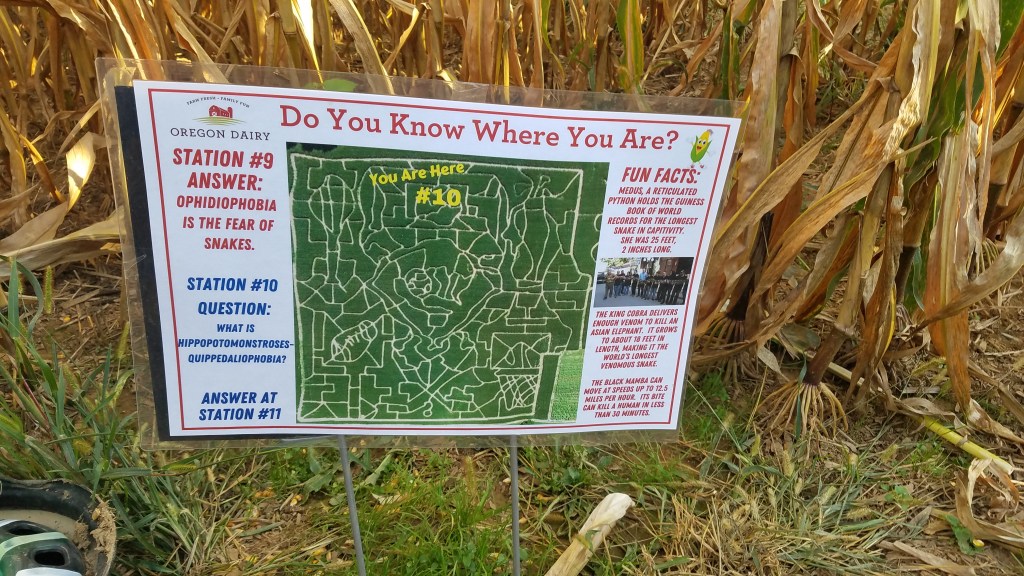
Now, I will be the first one to admit that going through a corn maze was not my idea of a good time. Being allergic to dust, pollen and bees spending time out in a dusty corn field with the pollen floating through the air and bees potentially buzzing in from nearby fields had placed this activity firmly on the “things I’d rather not” list. However, seeing Melissa’s enthusiasm for it peaked my interest. We were also going later in the season when the corn was no longer an attractor of pollinators meaning that bees and pollen were at a minimum. Given the amount of foot traffic it would see, the dust would be pounded firmly into the ground rather than in the air.
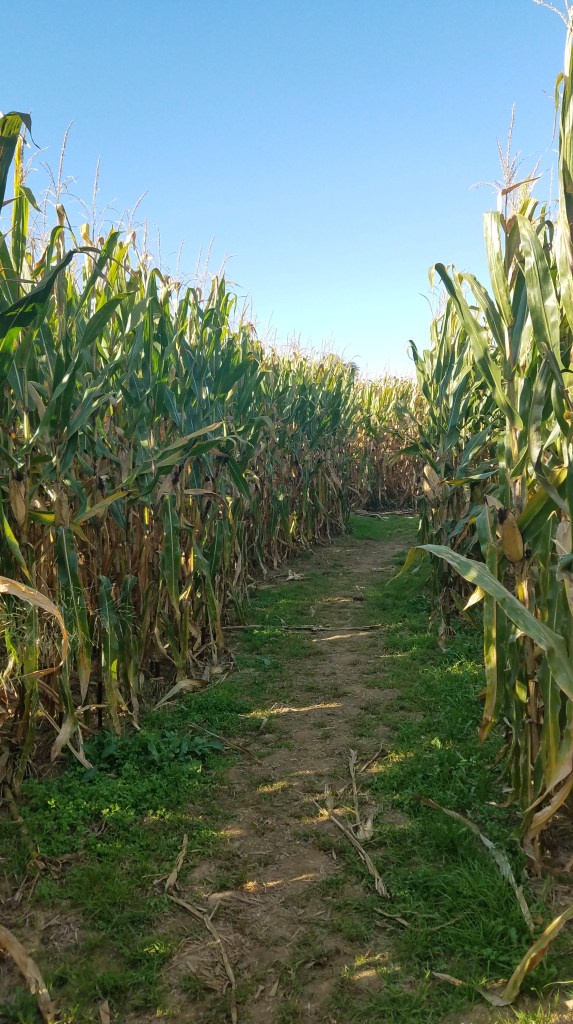
In Lancaster county, there are plenty of corn fields to see, so the point of going to a corn maze isn’t to look at a field of corn, but rather the experience of getting lost together. What’s quite comical is that when you have the map in your hand standing outside the entrance, it looks quite easy, a casual stroll even. Oh, how wrong you would be. The maze quickly becomes disorienting, especially a maze that is as zig-zaggy as that one. Having no real straight lines it was almost impossible to tell if you had turned a corner or merely curved with the path. The corn was too tall to get a good bearing on anything. And of course being corn, it all looked exactly the same, even if you could peek through to the other side.
You think you know where you are and then you turn a corner only to be faced with unexpected options, this isn’t where you’re supposed to be. The simple, easy maze has transformed into a dizzying labyrinth of twists and turns. If you’re not careful, you may lose sight of your companions turning this group adventure into an unexpected solo adventure. You may call out to them but they’re gone. Or perhaps you hear each other but cannot figure out how to get back on the same path. So tread carefully and do not wander too far from your friends.
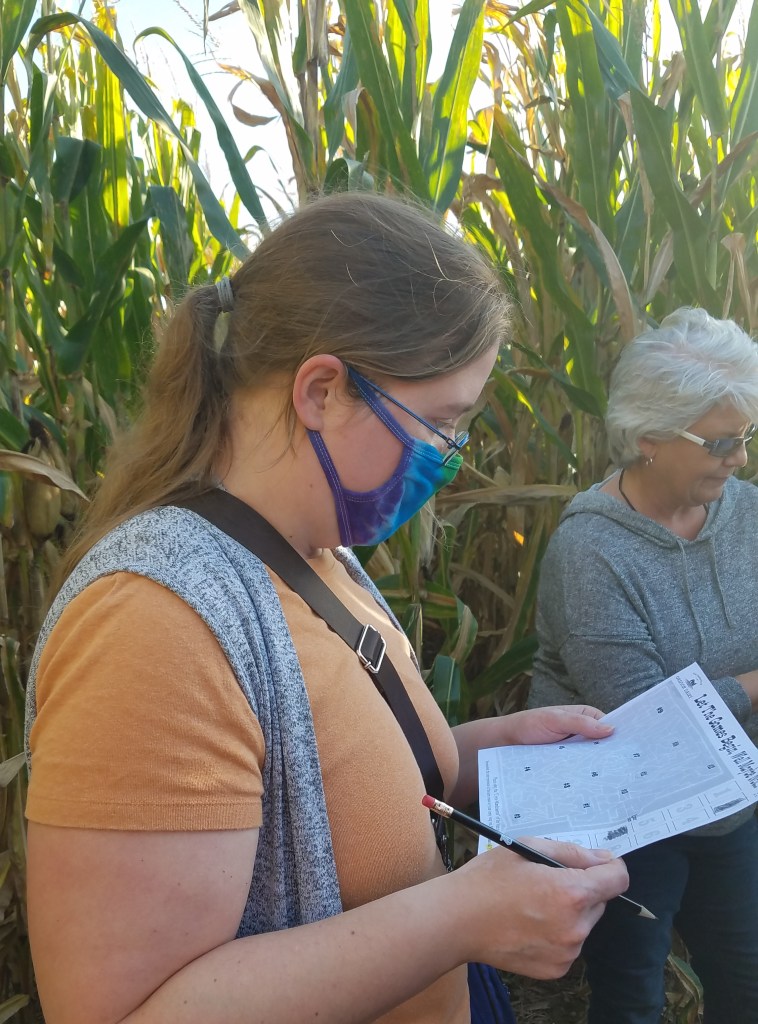
No one was really sure how long we walked or how far. We did manage to find markers which were various points that we were supposed to find and mark off in order to “complete” the maze. They helped to orient us to where we were and help keep us on track. As with any group of activity, it was all about communication and collaboration.
Some of us took a more backseat approach, content to let the others lead rather than become overly focused on the goal. I purposefully avoided trying to take charge as there were already several chiefs taking the lead and I had played enough videogames to know that I am terrible at reading maps and knowing where I am. Though, I have gotten better at it since 2020. I enjoyed the time wandering aimlessly trying to figure out where we were and where we were going. In the age of GPS, google maps it is so rare to be truly lost and having to use what few tools you have available to answer those basic questions. It felt like a small adventure, even though there were plenty of people to help you get out of the maze if you were truly lost.
We found about half the markers before we decided that it was beginning to get late and it was time to go home. Many of them had young children and those without children, had pets who were waiting at home for their dinner and evening snuggles. I would love to try to finish a corn maze in the future as I truly did find it enjoyable. So not only did I get to try something new, but also I got to re-evaluate an activity I previously thought would not be for me.
I encourage you dear reader to reconsider your own “I’d really rather not” lists. Often the barriers to new and potentially exciting things are only in your mind. With careful planning as to when we went, most of my concerns for why the journey would be anything but enjoyable for me were laid to rest.
How can you experience getting lost in a corn maze?
Mazes have been part of human cultures for thousands of years. They crop up in stories like the labyrinth and the minotaur and there is a reference to one in ancient Egypt by the writer Herodotus. In more recent history, hedge mazes were a popular form of entertainment found in gardens of the elite such as the ones at the Palace of Versailles or Hampton Court Palace. Today, corn mazes are the hedge mazes of the people.
The first corn mazes started cropping up (pun intended) in my home state of Pennsylvania. The very first one was in the neighboring county of Lebanon in 1993 by Earl Beal. It was inspired by his father’s work on mazes at a local amusement park and the idea quickly spread across America to other farming communities. Now they are found all over the country where farmers make their living.
I do recommend not going for the “biggest” corn mazes if you’ve never done one before or don’t have the best sense of direction. As I said, the maps are deceptively simple, because once inside you will get turned around pretty easily. Try some of the smaller ones, you will have just as much fun and feel a sense of accomplishment when you’re able to complete most if not all of the maze. This helps to ensure you have a good time as it gives you an attainable goal for a novice. It’s important with our bucket list to keep ourselves in a place where we are being stretched without being overwhelmed.
 Budget Bliss: Bucket List