As an avid fantasy reader, blacksmithing has always carried a bit of an allure. So when I was invited to attend a birthday party with my sister at the Drunken Smithy, I naturally acquiesced and trekked with her on a cold’s winter day to get warmed up by the forge. To say I was excited is an under-exaggeration. What could be more exciting than combining some of my favorite things, sharp objects, fire and hitting things?
I was stoked to put my muscles to the test hammering out molten hot metal and shaping it to my will. I do work out and I always enjoy using my muscles for something other than merely moving weights up and down semi-pointlessly. It makes all those hours spent sweating worth it when I can use them competently to accomplish my goals independently.
Forging weapons is an ancient human art. In fact the very materials that we humans used for weapons give rise to the delineation of pre-historical epochs Stone Age (stone weapons and tools – though this is such a long period of time it’s now broken down into palaeolithic, mesolithic and neolithic), Copper Age (copper weapons), Bronze Age (bronze weapons), and Iron Age. There is evidence that we humans have been using metals for over 40,000 years with the discovery of gold in some Spanish caves dating back to the neolithic era. The oldest known culture which utilized smelting was located in Serbia in the 6th millennium BC. Many places say that it originated there, but I allow for the possibility that there is an even older, yet undiscovered culture which may go back even further either in the same area of the world or perhaps, another part.
It is this very long and ancient history that has always captured my imagination when reading about blacksmithing or other metallurgical crafts. In a way, it is the magic of our world. We take two lumps of unrefined metal and somehow through fire and our own sheer will manage to craft it into something truly useful. It was this craft that gave the rise to empires and civilizations. Advance knowledge or lack thereof could topple a once mighty kingdom or stop an invading horde. I was always fascinated by how different styles of weaponry and fighting arose in different parts of the world and how their strengths and weaknesses interacted with the styles of other cultures to rise to power or fall into ruin.
There is reading about something and then there is doing something. I am someone who relishes doing, even if it’s only a small taste of the activity as it gives me a more intimate understanding of what I’m reading or studying. Being able to physically see how the metal really does slowly flow when it’s heated up and to feel the feedback of my strikes against the anvil through my arm really made it a visceral connection to all the things I’d learned. Abstract concepts became cemented in firm reality. Also, it’s just really fun to hit stuff.
The gentlemen of the Drunken Smithy were excellent teachers. They gave general guidance to the whole group and then one on one assistance as we needed it. They listened to your goals and vision first, to try and give you enough information to go in the direction you desired without holding your hand or doing it for you. They provided just enough scaffolding for us as students of the craft to keep us engaged and excited without feeling overwhelmed.
They did this by first limiting the range of options we could choose from keeping the initial lessons fairly simple, throwing axes or knives. Each of those options came with a pre-cut piece of metal which meant it shortened the process of crafting considerably. We would not be melting down the metals, mixing them and then shaping our weapons from a hard lump. That would be one too advanced for beginners and two take way too long for a single afternoon.

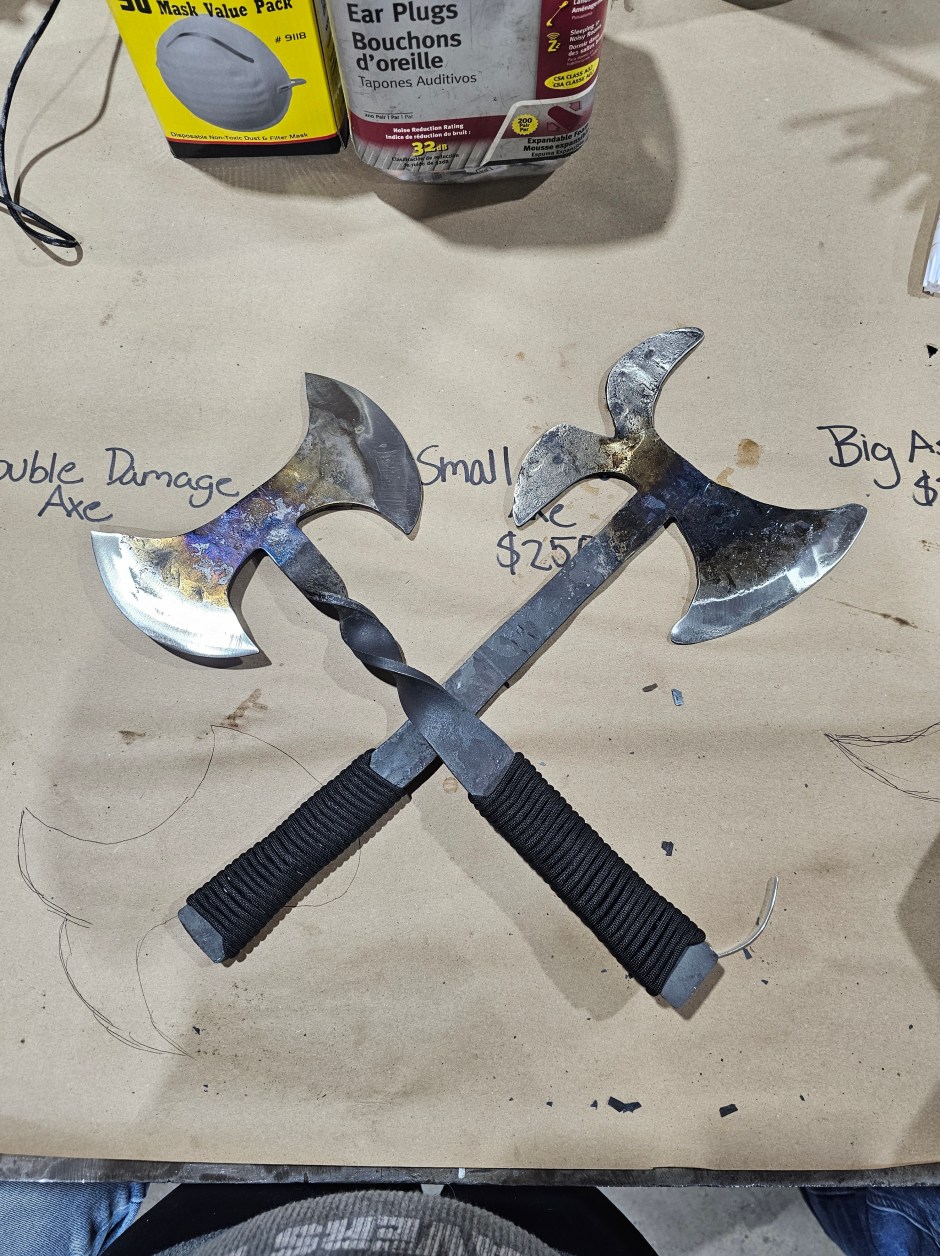
I picked a throwing ax, because I am a Viking at heart, and my sister picked the knife. As the one who always has to go slightly off the beaten path, I naturally added a little bit of flair to my ax by splitting butt into two artfully curled pieces. I was informed this was a little more of an advanced technique but rather than discourage me from my vision, they supported me by spending a little more time one on one with me to help me see it through.
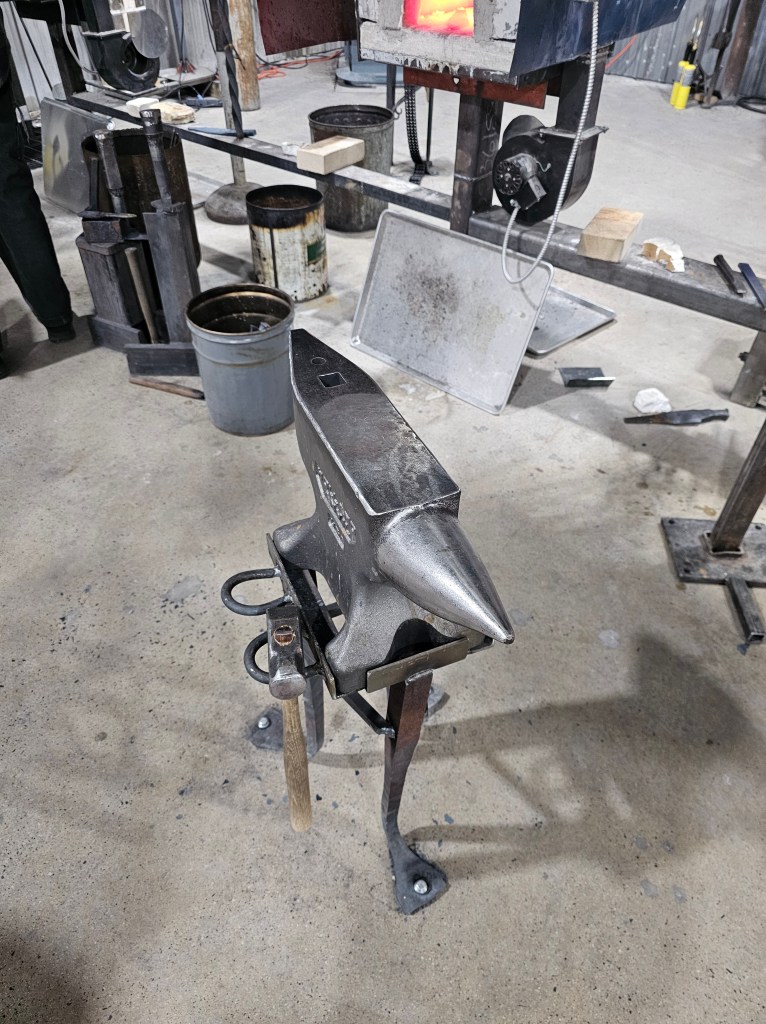
After picking out our templates, we set to work by first making them extremely hot. We did this by placing them inside the forge which is about 1,800 degrees fahrenheit and waited until the metal looked red. Once they were red, we pulled them out with tongs and took them to the anvil. The anvil is a peculiar shape, but each part is useful in creating the different desired shapes of the various tools and weapons a smith may desire to create. The act of hammering causes the metal to flow in a desired direction and shape in the process of “drawing out” the metal. In my case, rather than only focusing on the blade of the ax, I also focused on the butt of the ax. In order to achieve the desired shape, the butt had to be split. They did this by first cutting a small piece of the metal out and then helping me drive down the split. I then drew the metal out in two different directions giving it a distinctive shape.
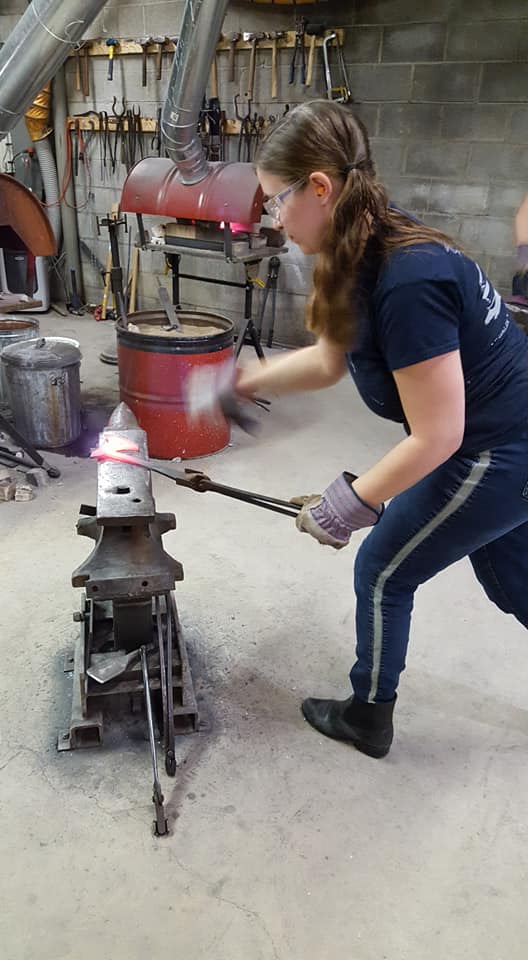
What I appreciated about the process was they consistently told us that it was when we felt the blade had reached a desired shape that it was done. They gave praise and constructive feedback about how a given shape may affect the weapon’s performance, but never dissuaded people from what they were doing or trying to achieve. If we were happy with it, they were happy with it.
After we got our weapons into the general desired shape, we left them all to cool off in sand. As they were cooling, our gracious hosts offered us snacks including sausage that we could roast near the forge. They also allowed us free reign of their drinks which included some delicious cider. If you are a vegetarian, vegan or do not eat pork products you may wish to bring something along as the primary source of protein was sausage.
After a quick snack, we then went to the sanding machines to further refine and grind down the rougher parts. Once sanded, we dipped them in some sort of chemical that I don’t really remember what they said it was (oil?) to give them a characteristic black color rather than the gray of stainless steel. Then we put the final touches on our work by sharpening the edges into a true blade worthy of the shield wall!
The day could not have been complete, without some ax throwing. It is a bit trickier than you’d think because the ax has to hit the target bladeside up in order to stick otherwise it bounces harmlessly off. We had a glorious time trying to hit the target and make it stick. My sister was a little better at it than myself, but in my next attempt at ax throwing, I not only hit the target, I managed a bullseye (more on that later).
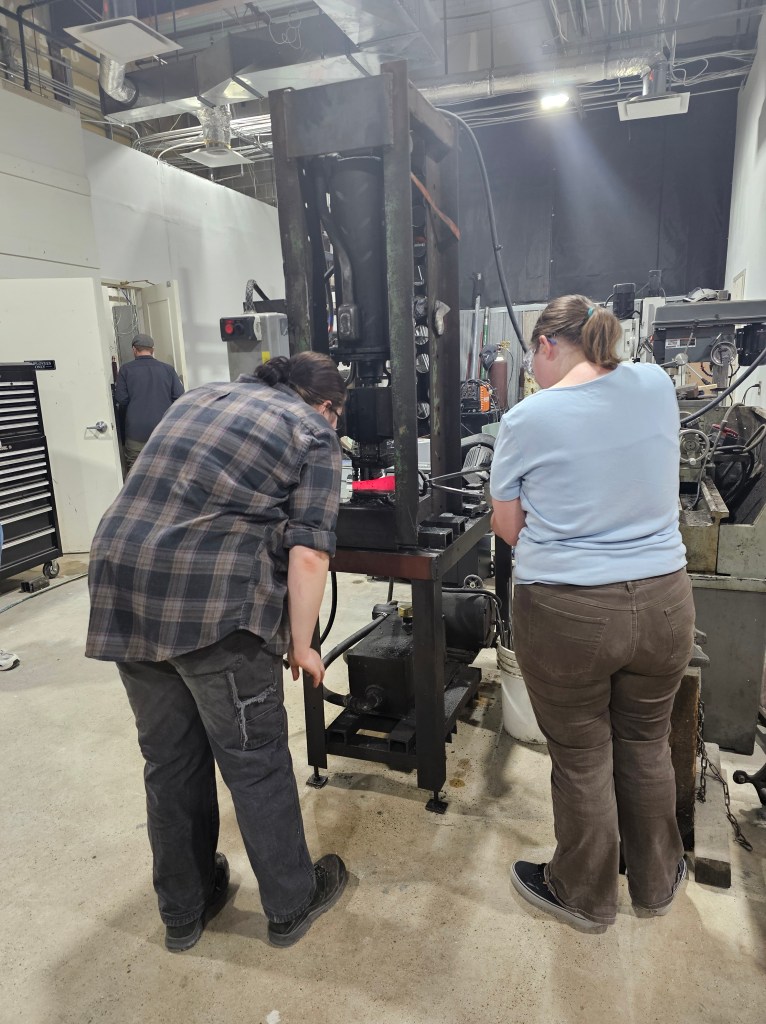
Satisfied with our weapons, we got back into our car and the first thing we said was “We have to take Josh!” (our brother). It took almost five years (thanks COVID), but we did return to the forge with our brother and forged again. The smithy has moved to a bigger location and has another expansion in the works. Once again, my sister chose a knife, but a bigger one. I chose an ax (but a bigger one) and my brother also chose an ax. We truly enjoyed both experiences and look forward to returning to the forge for another time. Who says Bucket List items can’t be done more than once?
How can you forge your own weapon?
If you’re in the south-central PA area then the Drunken Smithy is the best choice. There are blacksmiths throughout the United States, some of them may offer classes like this one. Depending on how hands-on they want to be, the classes may range from a half day (like this one) or several days, if they are trying to give you more of the process. If you want a more intensive course, then your local college, trade school or arts centers may offer an introductory course. Artist Blacksmith Association of North America may be a good online resource to find blacksmiths in your area.
Be on the lookout for demonstrations and ask the person where they got their start or if they know of any instructors who may be interested in teaching. One of the great things about artisans is that they desire to keep their craft alive especially in this age of technology when crafts are in danger of dying out, so many are very eager to find and direct students to keep the craft alive.
Completed: Feb. 2019 & May 2024
Miles from home: 23
Cost: Ranges depending on the project and type of class. The Drunken Smithy has weapons ranging from $150 – $375, but they have other options such as rings and flowers which are about $50.
My siblings and I opted for a more expensive experience. We were able to do this in part because the following month the sister outing was much cheaper.
 Budget Bliss: Bucket List