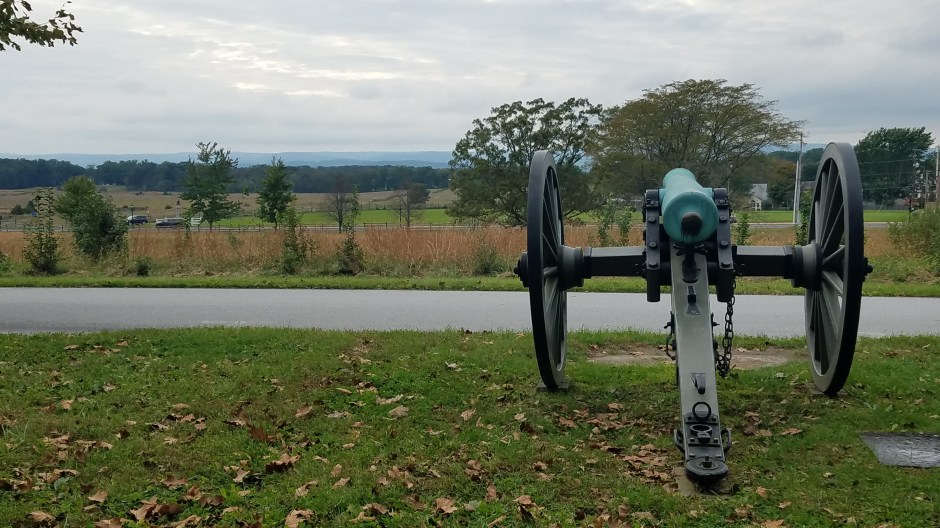
The battle of Gettysburg was one of the defining moments of American history. The Union’s victory over the Confederate army was the turning point in the Civil War, leading to the restoration of the union and ensuring the end of slavery. The battle took place over the course of three days from July 1st to July 3rd, almost coinciding with our nation’s 86th birthday. It was also one of the bloodiest most devastating battles in our history.
Visiting the site of this place can be a bit surreal. Today, the fields lay semi-empty. The dead have been given proper burial. The gunfire has long since ceased and it only returns for reenactments and salutes to honor the fallen. To the educated eye one can still see the evidence of the battle and how the lay of the land was shaped by it and helped to shape the battle itself. For example, one can still see clearly how the Union’s superior position of the high ground helped them win despite having less troops.
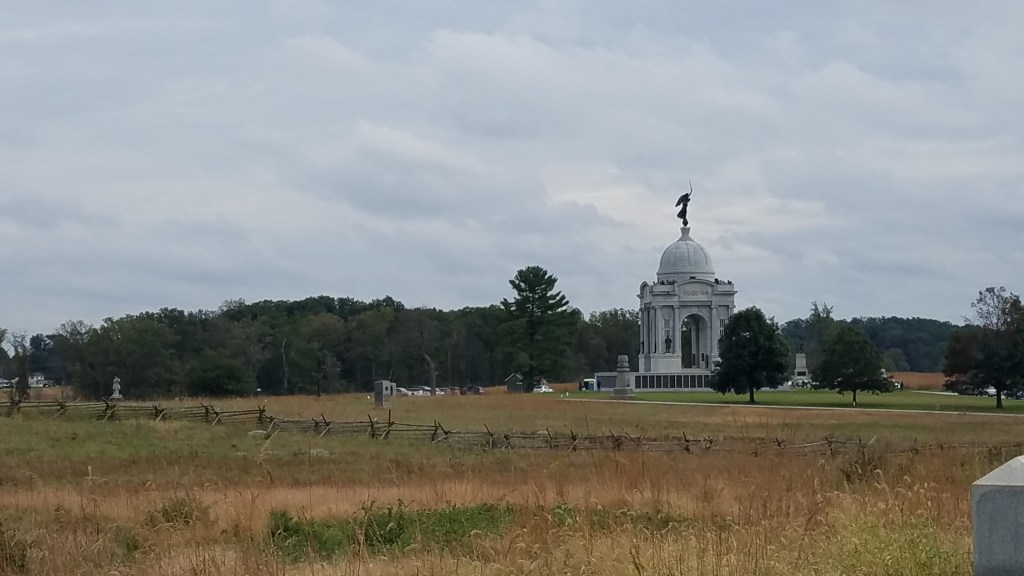
It is now home to many monuments to the fallen from all over the states. Naturally, the Pennsylvania monument is absolutely massive, but others are smaller. Some are dedicated to large groups, but then there are more specific battalions and legions remembered. It is easy to forget that each of the men who perished on the field had a name, a story and purpose to be there. It is not easy to take up arms against one’s own countrymen.
In the surrounding town, they offer various walking tours highlighting moments of history. They talk about the miracle that only one civilian died in the fighting, they point out bullet holes. What is really striking though is the sheer amount of death the residents saw, the description of pools of blood from the surgeries and piles of limbs that had been hacked off to try to save lives. They describe the stench that lingered for weeks in the hot summer. They whisper of ghosts still lingering on over a century later. If one believes in such things.
Still in among the ghost stories, there is real history being remembered. There was a high cost to pay to preserve our country more than the cost to form it originally. It answered the question of whether we truly were a nation of freedom for all or only for some. A question that will need to be periodically asked and answered as we continue to navigate conflicting rights and values. It is a place that when visited demands at least some reflection of the cost that had to be paid for today’s America.
Despite growing up relatively close to it, I had not really visited the battlefield until I was an adult. The annual classroom field trip that year had been replaced with a trip to Philadelphia to see the visiting display of the Russian Tsars. When my family did finally visit, I was a teenager and the thought of tramping about a field in the heat of summer with my father was unappealing, and I opted to go elsewhere with my mom and let my brother and father walk about the fields. So in the fall of 2018, I finally went with my boyfriend to see where it all happened, put history in perspective and learn more about this monumental event in our nation’s history.
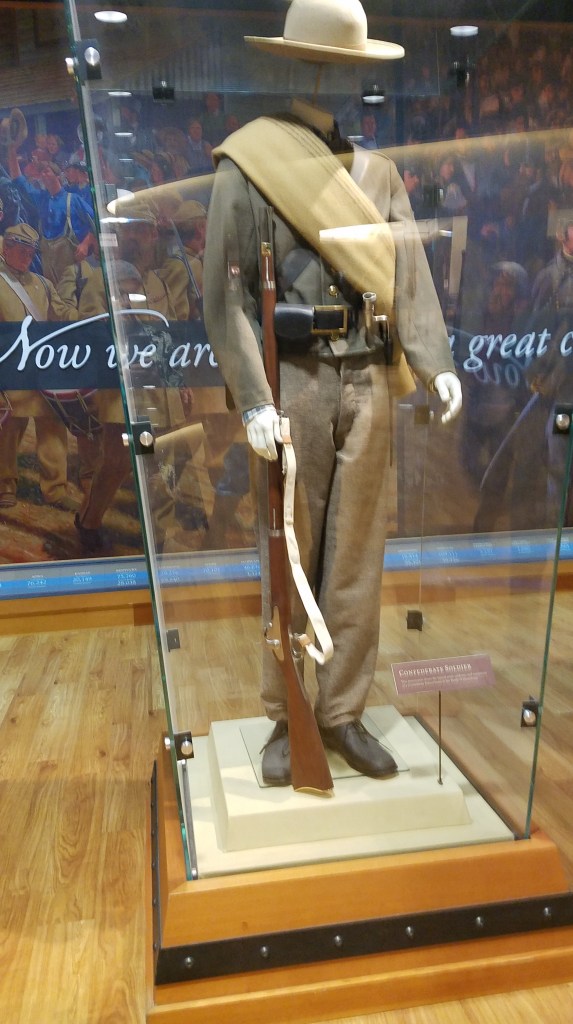
I can’t say that I necessarily learned anything new about the battle that I hadn’t already heard in the classroom or seen in documentaries, but what I did know was brought to life by seeing the physical artifacts from the battle and hearing the intimate stories of the people who were there both solider and civilian on both sides of the war. There’s something to be said about seeing and interacting with physical objects that allows our minds to form a more emotional connection with the knowledge or at least enhance our knowledge through other senses.
It is always strange to visit the site where tragedy took place and one must acknowledge the Civil War was tragic. It was tragic for a nation to be ripped apart and that the effects of that can still be seen over a hundred years later. It is also tragic it took a civil war to confer the basic human right of freedom from slavery to all living under our nation’s flag. On one hand, it is a place of history that should be remembered and respected, a place where people died to give other people freedom. On the other hand, it’s a site of enjoyment and relaxation. People come to visit on their vacations and for a day off of school. They enact the battle for entertainment, as well as to keep the stories alive. Children run through the fields laughing and playing around the cannons. Tourists take goofy pictures in front of memorials. For me the juxtaposition of both is important, because in some ways it means healing has taken place and is a testament to the resilience of people and our nation.
How can you add this to your own bucket list?
Unfortunately, this is one of those things that cannot be substituted easily if going to the actual Battlefield of Gettysburg is on your list. It’s in PA and unless you’re nearby, it won’t be cheap or easy to get here. In which case, may I recommend google flight tracker and hotels.com? This may be an instance of the principle of the item rather than the item itself. The principle behind visiting Gettysburg was to see an important site of our nation’s history that helped shape our identity and defined us. If you live in the south, there are many other Civil War battlefields that you can visit. If you live in the North East, especially in New England, then you can visit many sites from the Revolutionary War. In the South West, you have the Mexican-American War. California was home to the gold rush as well as the Japanese Internment Camps and the Watts-Riots. The Midwest is of course home to the west itself and the expansion of white settlers into the territories. I highly recommend seeing what is near your hometown. You may be surprised to find your seemingly insignificant part of the country actually helped shape us in the amazing country that it is today.
Completed: 2018
Miles from home: 75
Cost: Free to visit the Battlefield, Visitor’s Center. Museum is $15, Museum+ Film is $21
 Budget Bliss: Bucket List