I want to drink deeply from the cup of life. I want to see the wonders of nature. I want to try new things. I want to challenge myself. I want to grow and change and become a better version of myself than I was yesterday. I want to gain new skills. I want to meet interesting people. I want to see art, appreciate beauty, appreciate architecture and see with new eyes. I want to listen to music that is reminiscent of heaven and speaks to my soul. I want to stay up so late I see the sunrise the next morning. I want to dance and sing without regard to what others think. I want to take candid pictures and post them without filtering or editing. I want to take road trips. I want to be spontaneous. I want to run through the forest. I want to chase fog and make flower crowns. I want to visit coffee shops, browse thrift stores for treasures and explore craft fairs. I want to visit museums and archaeological sites. I want to explore places. I want to simply stop and admire the view. I want to make memories and deepen my relationships with people.
I don’t want to spend my life in regret wondering about the chances I never took. I don’t want to spend hours scrolling through on my phone wishing I could have the life I see on social media. I don’t want to waste my time dreaming of things I can’t afford or do or places I can’t afford to travel to. I don’t want to miss out on the things I could be doing because I was too busy wishing for the things that are out of reach. I don’t want to spend all day with my head in the clouds not minding what is right in front of me. I don’t want to listen to the people telling me that what I am isn’t good enough or that my life isn’t there yet. I don’t want to miss the blessings I have demanding the blessings I don’t have yet. I don’t want to live in fear of what people might think or say or do because of being authentic to myself.
My bucket list isn’t just a checklist, it’s a call to action to remind me that I get to create an adventurous life. It helps push me to keep trying new things and to seek out new experiences. I’m always adding things to my list and revising it. I am constantly on the lookout for opportunities and unexplored areas. I may not always be doing things that people would consider “bucket list worthy”, but they’re moments outside my usual routine whether it’s taking a train ride to do a wine tasting or dying a scarf.
It’s also not about chasing the next thing because life is supposed to have the mundane and the routine. There will be dishes and laundry, there will be days at home with tea and books. There will be lazy mornings snuggling with cats. Those are moments to savor as well which is why adopting a cat is on my list. It’s about living. Whether it be the everyday moments or the extraordinary and all the moments in between.
And more than anything, dear reader, I want to live.
It can be quite easy to forget that wherever you live, someone dreams of visiting. Maybe not your particular town or neighborhood, but certainly places nearby. I once worked with a young woman whose dream was to move to South Dakota much to my bewilderment and last time I spoke with her, she was absolutely loving her decision. I used to dream of going to the west to see the Rocky Mountains or the west coast. Others apparently dream of coming to my part of the country to see the Amish.
I remember when I was seeking inspiration for my bucket list and I stumbled across one that included visiting Lancaster County. I knew growing up that I lived in a tourist destination and that people came here, but it wasn’t until I saw it on someone’s bucket list that it truly sunk in that the place I was constantly trying to escape from, other people wanted to come to and it was a big deal to do so.
I started exploring what made Lancaster so unique and special that made it a destination worthy of someone’s list. What I discovered is that it actually is a special place with its own subculture and quirks that make it so charming to outsiders. I began to appreciate what was in front of me, enjoying the rolling farmlands near my house, seeing beauty in the corn and wheat fields, savoring the seasonal changes and stopping to admire the farm animals frolicing in their pens. I learned the ubiquitous fruit stands and farmers markets scattered throughout the county were rare treats elsewhere. It’s home to America’s Coolest Small Town 2016, Lititz, and recently two of America’s best buffets, Shady Maple and Miller’s Smorgasbord.
Is it still Coolest Small Town in America? Maybe, maybe not – but it is pretty awesome.
In addition to all things Amish, we boast a rich art scene with its many art galleries and Lancaster’s School of the Arts. We’re home to the Fulton Theater as well as Sight & Sound and American Music Theater. We still preserve many of the folk arts here which can be found at many shops in the tourist areas. However, if you want a more hands-on experience, there are tons of workshops in the area through PA’s Artisans Guild which helps keep these crafts going.
We have street fairs throughout the fall as well as craft fairs in the spring and late summer. We host farms shows and even have tractor square dancing! Although, don’t ask me about it, I had no idea that was a thing until my early 30s.
The truth is, I am now grateful to be living here whereas before I was always looking to escape to far flung places instead of realizing what I had in my own backyard. It would be easy to dismiss my small town as boring and “uninteresting”, looking to the bigger cities or tropical islands of the caribbean. I can make every day moments bucket list worthy. Instead of being annoyed when I am driving and I come across a farmer helping his flock across the road, I take the time to savor what I’m seeing. It’s actually quite pastoral and idyllic to watch. I get excited when I hear the tell-tale clop of hooves on the road signaling the approach of a horse and buggy. I take time to stop at the stalls along the road rather than continuing to drive on.
Sheep! I love seeing the little lambs in the spring time.
My everyday life is another person’s vacation. Sure it’s easy when you’re on a vacation to enjoy the mundane as extraordinary. On a vacation you aren’t worried about the everyday stresses of life like getting to work on time, picking up the groceries, rushing home to the wife and kids, so lingering at a farmer’s market is a luxury the tourists have that I don’t have. When you’re on vacation, you aren’t quite as pressed for time, you can linger and savor what you’re experiencing. Your worries take a backseat to the present moment. Without the worry of time and everyday responsibilities, it’s easy to mistake a foreign place as better than our own homes. I think that’s why some people will regret moving to a place they loved to vacation in, because the reality of everyday life doesn’t match the rosy picture they had as a tourist. We can apply the opposite approach to our homes, realizing that we can recreate those feelings for ourselves at home with the right approach.
How can you cultivate hometown pride?
The first is to take the message of this post to heart. Somebody wants to come to your area and visit and that someone is willing to pay money, perhaps not an insignificant amount to do it. It’s so easy to miss the life that’s in front of us when we spend our lives looking ahead to the future, to excitement and adventure, scrolling on our phones while life passes us by. Your adventure is right out your front door!
The trick is to stop taking your surroundings for granted, to ground yourself in the moment and be mindful about your sensory experience. Instead of rushing into the farmer’s stand grabbing my groceries and leaving as quickly as possible. I will try and make time to pursue the produce, carefully examine the baked goods and give into temptation with the local honey. Last time, I even purchased a cool meadow mint tea in a glass bottle. For those of you not in the know, Lancaster has a unique meadow mint tea that the Amish make and it is a summer treat for the locals. Rather than drinking it down quickly, I slowly sipped it, letting it dance upon my tongue just like I used to do as a child. Did I still have to return back to my housework and garden? Yes, but for about ten minutes, I let all the stress melt into the background and took in my hometown with an outsider’s eyes.
Completed: Around 2017
Miles from home: 0
Cost: Free
Stables near my home, I pass it almost every week. I finally took the time to pull over an appreciate the sight.
It has been noted by my fellow therapists that I am exceptionally good at what is called “reframing” or the practice of looking at a seemingly negative circumstance and seeing the positives in it. Even something like a loss may be reframed in a positive light despite the pain of the loss.
A forest fire is painful, but necessary for the life cycle of the forest. Loss in life is the same. The part that burned will take years, even decades to recover and the marks of the fire do remain even centuries later, else we would not find it in the records of the forest. However, without the fire new growth could not happen and the forest would ultimately suffer.
Consider the loss of a relationship after a break up. This could be a very good thing. After all, we only have so much time to cultivate and grow our relationships with other people. On average, we can really only maintain about 200 relationships, if someone leaves, what a delightful opportunity this could be! You may spend your energy elsewhere, growing deeper more meaningful relationships with those you already spend time with or it leaves you open to a new one. It is not to devalue the relationship that you had or have, people are not cogwheels easily replaced. We should also not adopt an attitude of not valuing relationships at all, having deep and meaningful relationships are important to our mental health and well-being. It is to say that we should mourn the loss and allow ourselves the opportunity to grow.
The reframe is not about finding a silver lining or putting a false positive “spin” on the facts. It is about not dwelling and getting ourselves mired in the muck. We are like cameras shifting our focus from the foreground where all the action is to the background where the action is about to happen. So often you’ll be watching a movie with a battle scene and right before the reinforcements arrive, the scene shifts to a blurry hill and then just as the cavalry crests the hill, it comes sharply into frame. That’s the reframe! It’s about focusing on what is going well or what could go well rather than what is going wrong or about to go wrong.
The cynical reader will rightly be grumbling about now about how the calvary doesn’t always come and the loss of the relationship didn’t result in any positive outcomes. This is true dear reader! Life can often seem terribly unjust and it is one catastrophe after another! A silver lining person may say something trite about how you gained all this resilience and built all this character. Character is nice and all but it doesn’t keep a roof over my head or food in my belly – unless you’re an actor then I suppose that’s sort of the job.
My response to this is that it isn’t helpful to dwell on the negative. Absolutely, acknowledge it, process it, be emotionally honest about the problems and then shift your focus to a growth mindset. You should never try to invalidate or suppress your feelings because that leads to its own problems. It isn’t helpful to impose self-limiting beliefs when you’re already in a limiting situation. This isn’t about false hope. My reframes are often from a very pragmatic and practical mindset focusing on positive things and trying to build on those positive items because that is what works.
Reframing is always asking if there is another way to view this issue. It challenges the current thought process to consider if your view realistic, is it based on facts or feelings, what other theories could you come up with to explain this situation, is it as black and white as you may think it is and is your view out of habit or is there something there to support it? It’s about questioning the current narrative to one where you can take steps towards the things you want. When we reframe, we remove roadblocks that we don’t even realize we set up.
The earlier reframe about a loss relationship is a direct challenge to the idea that it was the ONLY quality relationship a person could have and that without that relationship the person would die alone. By looking at it as an opportunity to cultivate the current relationships or allow a new relationships the narrative shifts from one of hopelessness to one of hope, from one of being closed off to relationships to openness to them.
Reframing about opening ourselves up to different stories that allow us to shape more desirable endings. It empowers you to take those negative thoughts around a problem and transform them into potential solutions. We aren’t able to control very much in this crazy chaotic world that we live in, but we can control our thoughts and how to respond to all the craziness that happens. When we overly focus on the negative aspects of a given issue, we give those more power than they have a right to have. By working to reframe, we shift the power back to ourselves, and place ourselves in a position to pivot to the opportunities that the universe presents us with.
I have written earlier about the choices we make and that there is always a cost to be paid. I encourage you dear reader, not to be disheartened with this advice. It is not an admonishment to not do things. It is only a word of caution to walk through a given door with your eyes open and prepared for what the task ahead will ask of you.
Consider the high performing lawyer. She goes to school, gets into a prestigious practice, starts working very hard, makes partner, earns a lot of money, and works very long hours. Suddenly, one day she wakes up and realizes she has lost touch with her family, she have no real friends because the only people she interacts with are her fellow lawyers who are only out to compete with her, she has a beautiful apartment she never sees and decides to quit taking a much lower paying job so that she can actually have a life outside the office, maybe get married, and have a child.
If she chooses to get married, have a child and keep her career working 70 to 80 hours a week, who will raise that child? Certainly not her directly, but whatever hired help she has. What kind of relationship will she have with that child? It would be difficult to cultivate a close personal relationship with a child she barely sees, especially when she is probably missing out on all the important things to a child like dance recitals and birthday parties. This is not to judge someone who chooses this life, it’s just not the choice I would want to make. The good Lord knows I don’t want to be away from my cats that much, I imagine I will want to spend even more time with my own children. However, to each their own.
Now it is not always something as grand as career vs family when we make these choices. They can be small. We cannot be a master of all trades given our limited time and resources. Choosing to pursue one hobby will probably mean giving up another. If I choose to weight lift, I may not have time to learn how to paint. If I choose to play the violin, I probably won’t have time to learn to sew. If I spent all my time out of the house going places, I would not be able to have my cats. I am not saying that these are the only dichotomies. Rather a single yes to one thing closes the door on almost hundreds of others, but a choice must always be made. Even choosing not to choose is still a choice – often the worst option you can take as it almost always leads to less than optimal conditions.
A yes to learning German was a no to the other 7,000+ possible other languages. A yes to pursue psychology and social work, was a no to thousands of other career paths. The point of course is to consider what doors your “yes” is closing and what ones it is opening. As a goal oriented person, it can be easy to get “lost” in the pursuit of the goal. To blindly plough forward heedless of the destruction in your wake until you stand upon the mountain top to gaze upon a ruined domain.
How often did I find myself alienating my project partners blindly completing the project and “getting us the A” in school? I was often confused when they reacted badly to my process. We got it done didn’t we? Are you unhappy with our success? The goal was to get a good grade, mission accomplished. I did not know that there were other pieces of the project not on the rubric that I was supposed to learn like how to cooperate with people and cultivate working relationships. In my pursuit of the goal, I burned the relationships with my peers in school. In the pursuit of other goals, we may neglect relationships or lose sight of things that really matter.
What might we still be missing in the pursuit of our goals? That is not to say that we should not pursue those goals only to be cautious in the pursuit. When your life narrows down to a single goal or passion, be aware that chances are you are about to give up a lot of things. If you want to become a doctor, you will probably give up a lot of free time and sleep. Traveling the world may mean giving up secure roots and long term relationships. Becoming a star athlete will mean missing out on a lot of fun parties to train and compete. When picturing your best life what are the things that you most wish to preserve? What things do you want to accomplish and what do they require of you to do? Are there things you absolutely won’t give up? Are they worth holding onto even it means giving up on a dream?
Often what we feel will make us happy, money and fame leave us empty and unfulfilled. In chasing those dreams, we often damage the relationships that truly enrich us. That isn’t to say don’t pursue your dreams. There are plenty of worthy goals and dreams to pursue. Depending on your own internal value system what one person finds most important may not be the same for you. However, it’s important to reflect on what you really value before diving headlong in pursuit of a goal that doesn’t really align with who you are. It’s also important to not get too hung up on a singular path to achieve a goal. I wanted to help people live better lives. I’ve become a therapist, but if this blog takes off, maybe I’ll do this full time instead. Maybe, I’ll become a professor and teach. Maybe I’ll start a non-profit. I’m open to where God leads me to serve and I’ve been willing to forgo obtaining higher paying jobs to do so. If you feel the reward is worth the cost, by all means pay it, just reflect on what the costs may be before you agree to pay it.
It started off as an exercise during the season of Lent. Rather than giving up something, I would post for forty days one thing that I was grateful for. Sometimes, it was small things like my morning coffee or the joke someone told at work, other times it was big things like having a house and a job. I enjoyed it so much that I kept it up for nearly 3 years as a daily practice.
It did not transform my life per say. It did not lead me to riches or status or really much of anything “big”, at least not visually. Instead the practice brought me peace and joy. It is, perhaps, the reason, I started focusing on all my small outings with my friends and family as moments worthy of a bucket list. You can see throughout my posts expressions of gratitude towards challenges, hardship and loss. You may see it in how I now look with child-like wonder at the ordinary going-ons around me. It is not as one might suppose naivety about the world, but of this secret practice.
I have a naturally optimistic outlook, though where I got it from, remains a mystery as I come from a family of pessimists. For me even an empty glass is not truly empty or even a bad thing, why an empty glass may be better than a glass half full because now I get to choose what to fill it with like water or wine or healthy herbal infusion. An empty glass is full of potential!
I am known for my ability to “reframe” as my fellow therapists call it or the ability to look at a seemingly negative circumstance and see the positives in it. It is not a pollyanna approach where you place the “at least” game and border on toxic positivity. The reframe is about seeking opportunities in the situation to help you pivot in a positive direction rather than dwelling on the negatives. The job that did not work out is an opportunity for a different one. The break up, while heart wrenching, is a time for you to focus on your own growth and perhaps even find yourself again.
I find it is much easier to get into this growth mindset when I’ve been practicing gratitude on a daily basis. It is a semi-unconscious catalog of all the tools in your belt to handle situations. I have on any given day various coping skills and things that help me feel better. I remember people that I can tap to help me in tough situations and developed skills that let me overcome obstacles. It stretches my mind for creative thinking and problem solving. In practicing daily gratitude you begin to seek out more and more opportunities in almost any frustrating circumstances.
Anticipating an increased commute due to construction? Instead of grumbling, What books might you finally tackle on audiobook during that commute? Perhaps, you will even find yourself slipping into the slower lane because you really want to finish that chapter. Maybe you can use the time to listen to a podcast, or finally learn Spanish in the car with listening exercises. I have crossed off many books off my reading list with my car ride, because I was grateful for my commute. Do not think that I have mixed up the order of that previous sentence. I was indeed first grateful for my commute and then I began to use it for a positive thing. That is right, I was thankful for a hardship and then it became an opportunity.
An unexpected obstacle in my daily commute
My praise does not always have to start with something that seems positive. I have learned to be thankful even in the difficult moments so that they can be transformed. It is not an easy practice; I am not always successful, and I don’t recommend you start there. One must walk first and then run. Instead, start where I began, finding at least one positive thing each day to be happy about. The way your cat greeted you at the door. The smell of rain after a storm. The return of the spring flowers. A good night’s sleep. I recommend keeping yourself accountable with posts or a note in your calendar. You will find at first that some days it seems like you have a million things to be happy about and other days, you cannot think of one single thing. Go for low hanging fruit on those days, the roof over your head, the clothes on your back, the bed you can sleep in.
After a few months, you will probably begin to experience the same peace and joy for your daily life that I began to have. It is not always the easiest thing and there are times when periods of melancholy set in, but this practice has helped me through even the toughest of times. It has transformed my outlook towards the dales of life and even let me start to see that I really am living an amazing life. I’m sure you are as well if you just stop to see it.
Growing up, there was a cross stitch that hung on the wall of our house. On it was an except from “A Song for the Seventh Child” and it ended with the following line “Cleaning and scrubbing can wait ‘till tomorrow, for children grow up as I’ve learned to my sorrow, so quiet down cobwebs and dust go to sleep, I’m rocking my baby ‘cause babies don’t keep.”
One might wonder why such a thing stayed with me all these years, not yet having children. However, I have almost always had a beloved cat or dog and they grow old as I’ve learned to my own sorrow. There are moments when the dishes sit undone because a cat is snuggling on my lap. In fact, when my sister lived with us there was an established rule that if a cat decided to sit on you, the other sister did the dishes. It might seem like a strange thing but both of us agreed that it was more important to spend the time giving love and attention to a creature who would only be with us a short time than to fuss over whose turn it was to wash dishes. What was more important?
If I can apply that to pets, how much more to people? Almost no one gets to the end of their lives thinking they should have worked more or spent more time at the office. So often the refrain is “I should have spent more time with my family and friends. I should have made time for my children when they needed me. I should have snuggled my puppy just a little while longer.” Nor do we know how much time we really have with anyone.
My sister hugging me at graduation; she made sure to be there for me.
I have been surprised by the number of classmates already lost to accidents and diseases even though I’m not yet 40. The expectation is that you won’t hear of loss so young and that you won’t face the news of their passing until you’re well into your 70’s or 80’s. Car accidents happen, cancer happens, life happens. I’ve shared my mother had a stroke at 46 and clots in both her lungs in her late 50’s. These are precious moments you won’t get back so choose how you spend them wisely!
Furthermore, it is important to make sure we are cultivating relationships with our loved ones. There are plenty of stories to illustrate that when you do not prioritize your loved ones, your loved ones will find people who do. You may find yourself having built a beautiful life of loneliness without those you care about. How empty it must be to work so hard and sacrifice so much only to have accidentally sacrificed the thing you were working so hard to provide for? In the pursuit of a goal, you may lose contact with friends and family, over time they may simply conclude that you do not care about them, unless you make the time to be there. Be careful about what you give up when chasing a dream even if the dream is for a good reason.
There are times when I do consider pursuing higher things, pushing myself further, adding yet another hobby or taking on yet another responsibility. But then I consider what I would give up. The time I would miss out on spending with my friends, my family and yes, my cats. When such thoughts tempt me, I make a nice cup of tea, lay on my bed to have my cats nestle next to me and settle in for an afternoon of reading and snuggles. I have yet to regret a day spent with cats or those I love dearly.
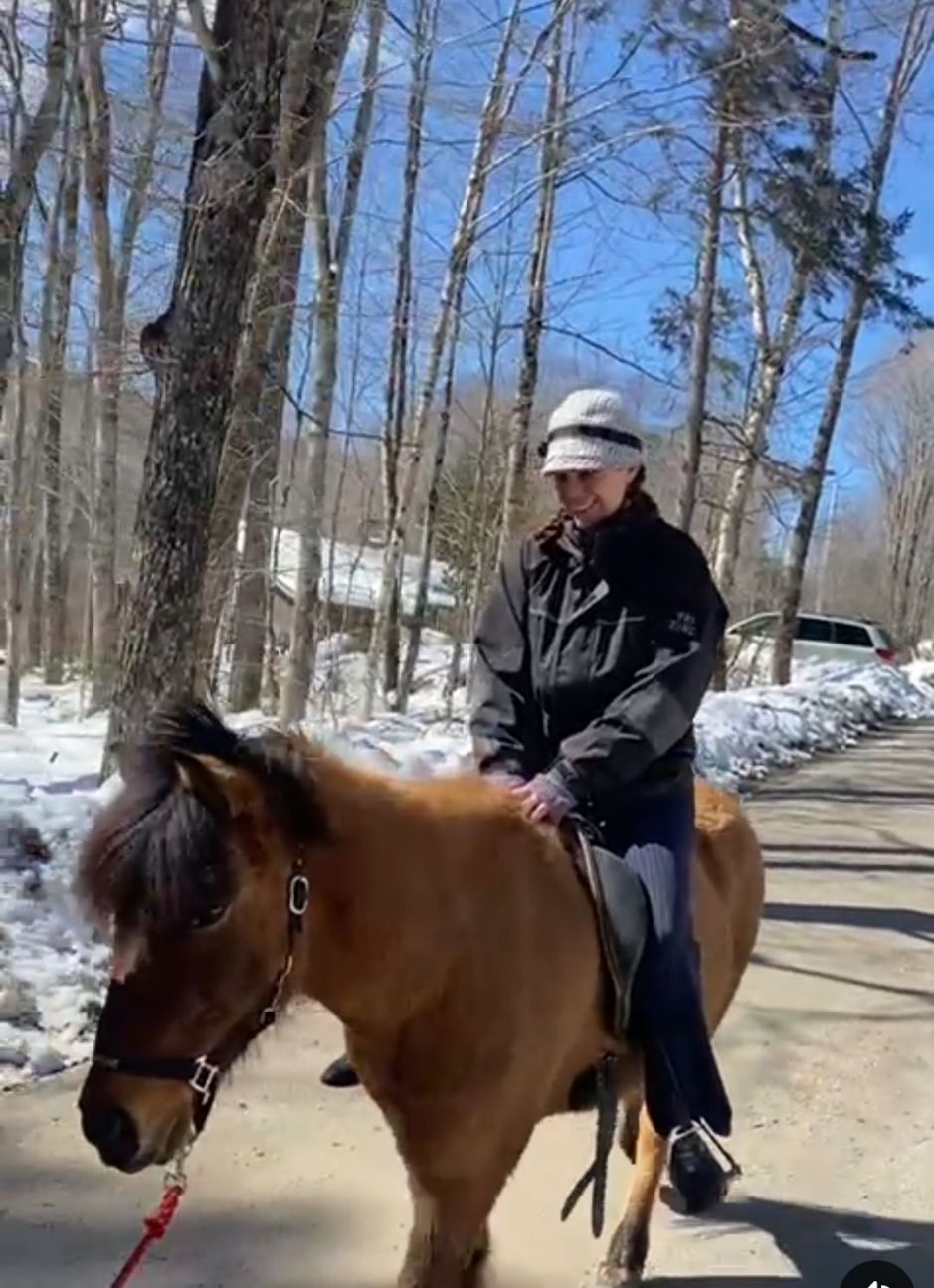
Sometimes in the process of completing one bucket list item, you stumble upon another. I call these “bonus bucket list items”. They were not pre-planned or even hoped for, they are simply opportunities that present themselves and it is up to you to seize the moment. After all, have I not said we should make the most of our travels? These I call “bonus” items and they follow my principle of making the most out of the longer, further afield trips. There are times when travel becomes a necessity [see post], so it becomes important to consider what other items you can include. It isn’t about avoiding travel altogether, rather limiting travel. On my trip to see the eclipse in Vermont [see post], I stayed with a family friend who happened to have horses.
I offered to assist her with their care having never had many close interactions with the noble creatures, despite growing up in a farming community. Truthfully, I have probably had more direct interactions with cows than horses, but I was an eager student. Shelia showed me the proper way to brush them and introduced me to each horse, telling me their stories. Each had come from an owner who had not understood their unique needs or read the signs of discomfort and pain resulting in them acting out.
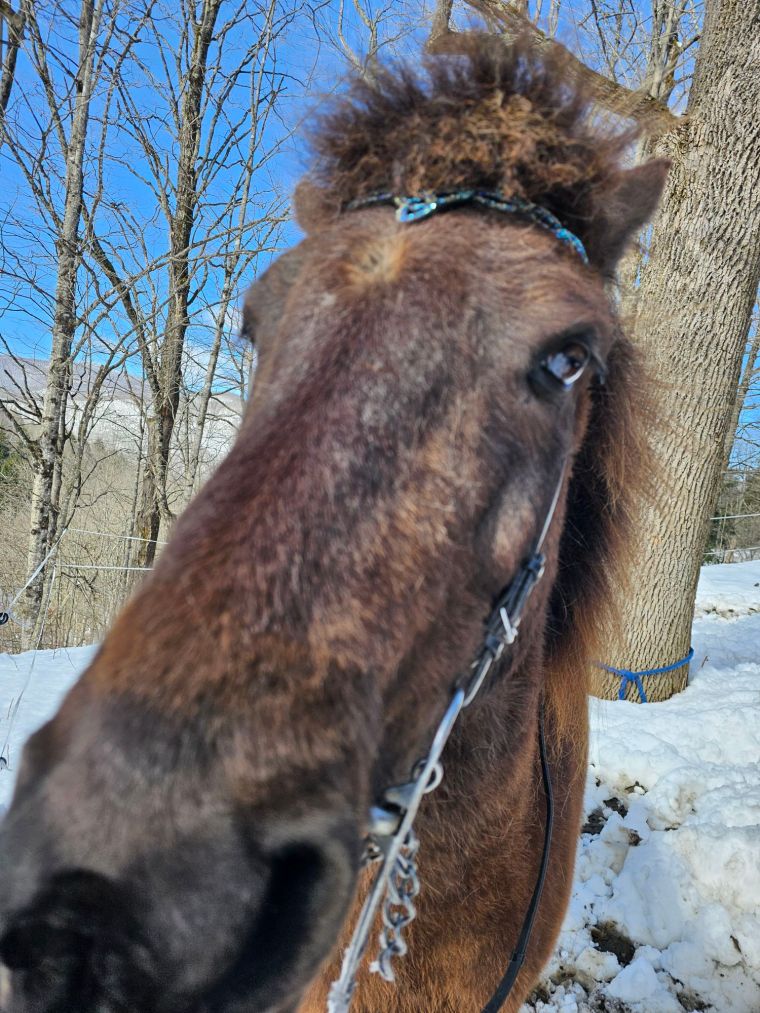
The horses were a special breed, Icelandic, known for their smooth gait. Much like with dogs, it is important to understand what a breed is bred for. One would not expect a husky to do well at shepherding sheep nor would you want a border collie to pull a dog sled. Each breed was carefully curated for a specialized task, one the dog is a natural athlete at. There is an old saying that a fish will think itself stupid if its judged by its ability to climb a tree. Stoltur came from an owner who had tried to use him as an Olympic Dressage horse, something an Icelandic would not be good for as he was punished for his natural gait and motion. This meant that it was important for me to demonstrate first that I could be trusted with such a special set of horses before any overtures of riding could be made. Luckily, Sheila had already worked to restore trust between horses and man, so making friends with them was rather easy.
The three horses were gentle as lambs with me as I groomed them. Stoltur even began to engage in mutual grooming, nibbling ever so gently on my arm. In the crisp air of the early spring, the horses and I spoke to one another each learning the other’s cues. I would brush them and see how they reacted ensuring I first went to the head of the heard, Mjolner and worked my way down to Stoltur. The Icelandics are known for their gentleness and good tempers, and they were admirable hosts. I made fast friends with hay and treats hidden away in my jacket. I remembered the advice to hold out the treats on the palm of my hand, keeping my fingers straight to avoid any mishaps with teeth.
After spending some time getting properly introduced to one another. Sheila offered to let me ride one. I could barely contain my excitement as I enthusiastically said yes. She saddled them up and asked her son, Astri, to accompany us as lead. She assigned Stoltur to me as he was the best kind of horse for a beginner, forgiving of mistakes and of an easy temper. She choose to ride Gimli. She told me my only job was to keep my seat. I was given a vague idea of how to get up into the saddle, put my foot in the stirrup, grab the mane to help me up and hoist myself over. I did quite well. Sheila observed dryly that I was no couch potato.
Riding a horse was rather a natural thing for me. The key of course was to keep my posture without being stiff. Having had six years of marching band in highschool, I was well acquainted with the idea of good posture without stiffness. It was a matter of feeling the rhythm of the horse and moving my hips with his movements. I found myself relaxing into the motion and adjusting as I needed to. She only needed to correct me once saying that I was slightly off balance to one side.
It was magical riding a horse along a mountain trail. The soft sound of hooves against hard dirt. The way the world melted away. It was rather meditative. For once, I felt very much grounded in my own body as I am prone to being a bit air-headed. I had never been called a natural athlete before having always been clumsy, slow and generally the opposite of everything athletic, but when it came to horses, Sheila told me I was one. I suppose it makes me a bit like an Icelandic horse trying to do Dressage or a husky trying to herd sheep, without being given the right sort of task and the right sort of environment, I did spend my whole life thinking I was useless at anything athletic.
I had not embarked to see an eclipse thinking I would be able to check off horseback riding from my list. Instead it was an opportunity that presented itself and I made every use of that chance. While I could book a horseback trail ride near my house, the experience of being able to connect with the horses first, to hear their stories and bond with them isn’t something that could be bought..
Gimili with his bling
One never knows what opportunities are lurking around the corner or what things could present themselves when venturing outside one’s door. It isn’t about forcing anything to happen, but rather cultivating genuine relationships. Sheila probably would not have allowed me the opportunity to ride her horses had I not demonstrated that I was someone who could be trusted with them. I demonstrated that I could listen to their cues and respond well to them. When Stoltur nibbled my arm, I could have easily freaked out or misunderstood. Instead, I backed off from grooming and observed him for any signs of irritation before proceeding any further. I checked in with her to ensure I was reading him correctly. She confirmed it was a good sign that I was doing well with him. It was a matter of giving him the respect he deserved and following her directive. One cannot approach a horse like a dog or a cat anymore than one can approach a cat like a dog. Each creature has its own way of communicating and engaging. It is up to us to follow the terms set by them. By fostering a good connection with her horses and her, it opened up the door for a magical experience. By cultivating authentic connection, all sorts of opportunities and horizons will become open to you.
How can you experience horseback riding?
Now, it would be rare for you to meet a horse owner who can present you with the opportunity to ride a horse, like I did. However, there are many stables throughout the country which offer horseback rides or trail rides. A quick google search is all you need to get started and many of these are under $100. For a more intimate experience with a horse, you may want to sign up for a series of lessons.
Completed: April 7, 2024
Miles from home: Bonus bucket list!
Cost: Free ($60 – $100 without a friendship discount)
A lost tomb, the discovery of an ancient tome, or perhaps the unveiling of a city lost to time remembered only in whispered rumor. In the hot sands of the desert, one man’s quest to discover these lost treasures will bring him glory and riches beyond imagining. He slowly brushes away the sands to reveal a puzzle. With baited breath, he presses various stone pieces into place. A slow groan builds as ancient mechanisms shift into place after thousands of years. The door opens, light pouring into the long forgotten room now glittering with gold. At least, that is often the popular imagery of archeology in movies. The truth is a bit less dramatic, but can be just as exciting! At least, to us nerds.
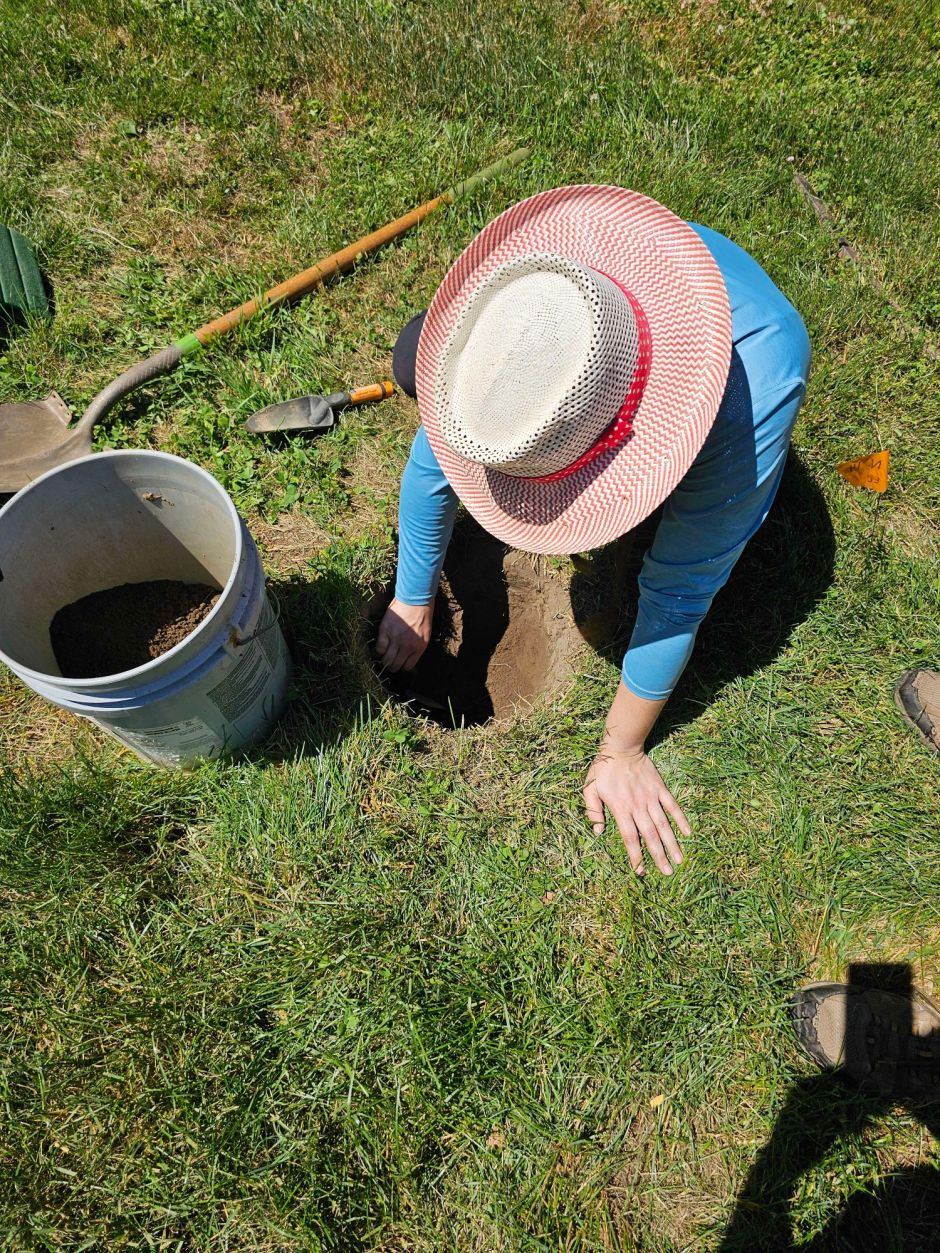
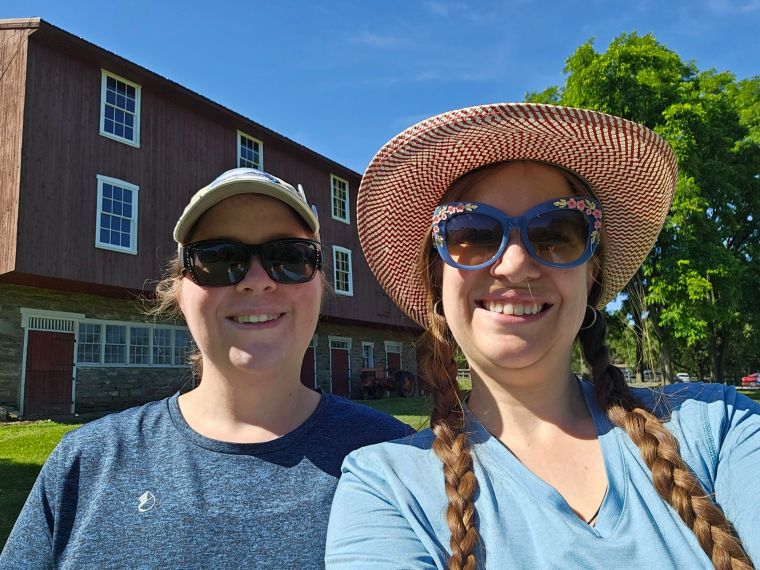
On a warm day in June, I and my sister embarked to discover our own time lost civilization. Using a technique popular among professionals although less glamorous than Hollywood, I assisted in uncovering the boundaries of a people almost forgotten. We drove out to the Blue Rock Heritage Center to meet with Paul Nevin as leading authority on the local pre-columbian peoples of my area. Together we and two other volunteers laid out a grid of 100 feet by 50 feet to conduct a survey. At every intersection of 10 feet, we dug a small circular hole down to the depth of a plow (about 12 inches) to discern where the greatest concentration of artifacts were.
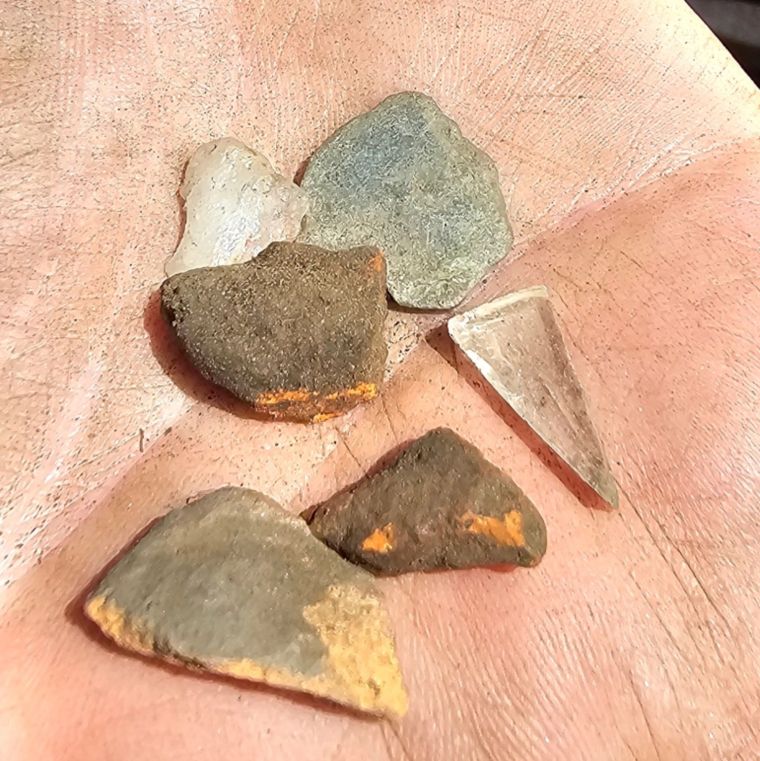
You will be forgiven dear reader if you are picturing the same sort of artifacts displayed in the museums throughout the globe. Beautifully crafted pots, towering statutory, elegantly carved facades of stone all almost perfectly preserved just waiting to be uncovered. You may want to re-evaluate your expectations before embarking on such a journey, for ours was to discover tiny fragments of flint produced during the manufacturing of arrowheads or pieces of broken pottery. You see, the survey was conducted in the top of the soil only about a foot or so down, which is about the depth of a plow. Obviously, if the area has been ploughed many times over there years, anything worth finding has now been shattered into tiny pieces. It was tedious, but rewarding work.
My sister and I assisted in shifting through layers of dirt trying to locate evidence of a semi-forgotten culture. Most of what we found were pieces of brick from the farmhouse and “diagnostic glass” (also from the farm house). While, intriguing in their own right, they were not from the era Mr. Nevin was primarily interested in. He was primarily interested in pre-columbian cultures rather than the intervening years. However, he did not dismiss the fragments outright as trash, but rather had us carefully bag up the remains for later analysis. After all, just because he wasn’t very interested in that time period doesn’t mean that the time period is of no value for study.
Each bag was carefully labeled to correspond with the location that was surveyed. The archeologist would later assess where the highest concentration of artifacts were found in order to discern where a larger dig should be conducted. This method is rarely seen in documentaries but is utilized the world over. I often wondered how did they know where to dig, how did they find that tomb, or that village. My question was never answered to satisfaction when watching various films; it often seemed that they just stumbled upon these sites like some sort of game of chance. The answer was in this or other methods of survey. In short, simple data collection and analysis. Too boring to make most television shows, but vital to my own understanding of the craft.
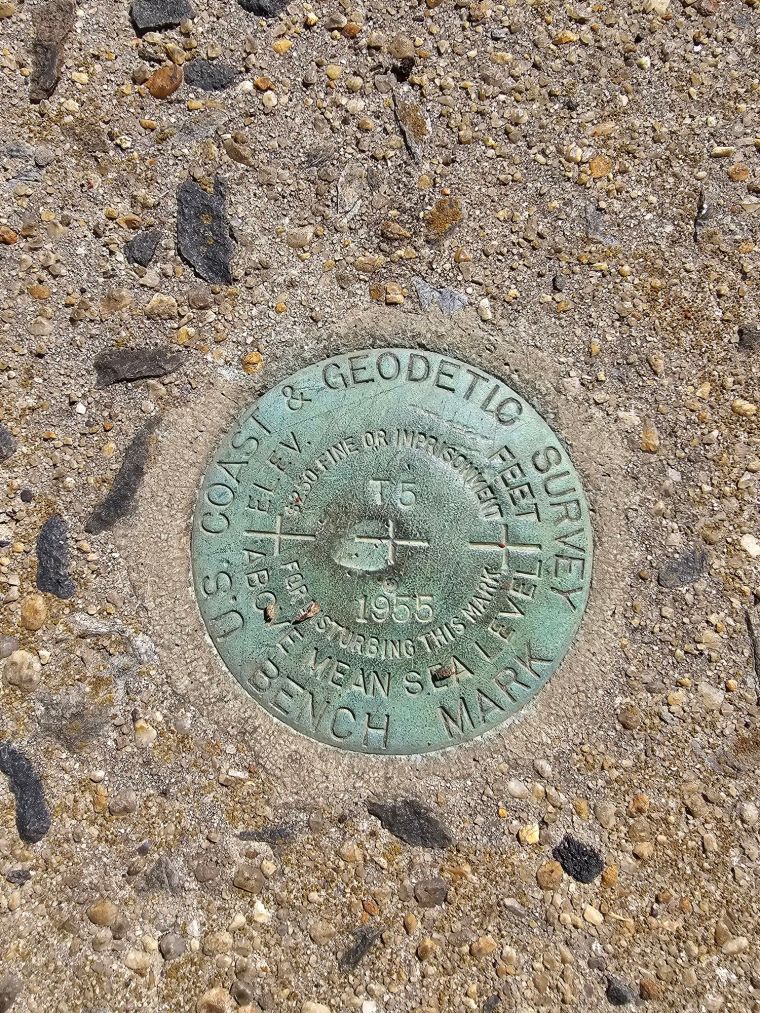
Most of what we found would be considered negative data. In other words, we didn’t find anything where we dug that was of interest to Mr. Nevin. I believe my sister and I surprised him in our enthusiasm for negative data but for us the treasure was in experiencing the technique and hearing the explanation for how a dig is done much more so than any treasure we may have found. Mr. Nevin explained that many years ago a site survey was conducted to determine there was a site of interest, but that the boundaries had not been recorded. Therefore, it fell to us to make that determination for purposes of a larger dig later. The medallion recording a geodetic survey in the 1950’s was considered the 0,0 point for purposes of the survey and it was primarily conducted along the north, east quadrant of the the 0,0 point. Hence, the designation of N (for north) and E for (east) for the different places we dug.
Even though we did not find much in the way of positive data, the other pair found several different shards from flint making. Prior to digging in, Nevin showed us several examples from previous surveys of what we were looking for, pottery shards, arrowheads and flint. He seemed somewhat apologetic that we did not find anything in our own adventures, but we reassured him that “no” data was still data worth finding. Afterall, that was the whole point of the survey as most points were not expected to yield much since the area utilized was likely to be small.
It was not the most exciting morning, if one expected to find troves of artifacts. However, it will remain a highlight of my life, because I have always wanted to participate in a dig. I value the pursuit of knowledge and the preservation of culture. Had I thought it would be a less competitive field of study, I would have happily embarked on a journey to become an archeologist. There are times when I regret not pursuing archeology as career, as it continues to remain a passion of mine.
Mr. Nevin’s own journey was not typical of most experts. He did not go to school, but was rather an enthusiast of Native American culture, traveling around the country to sacred sites. Approximately, forty years ago, he began his own study and documentation of the little known and scarcely studied petroglyphs of the Susquehanna River. Safe Harbor is home to the highest concentration of petroglyphs this side of the Mississippi River. The act of creating petroglyphs was a sacred practice. Creating them demanded a significant investment of time and energy. And to carve capriciously on the bosom of Mother Earth would be to desecrate her. Petroglyphs are not prehistoric graffiti. They are messages left by the Ancestors to be “read” by those who would come in the future.
Though, we were not looking at petroglyphs which were intended to be read, we were looking at the messages left from those gone before. What sort of lives did they live? What did they do on a day to day basis? What was important to them? Even things we did not think could be felt hundreds of years later could still be discerned by an expert eye. For example, the use of wood can still be seen in the analysis of the soil and used to map out where a house used to sit. These are the questions we set out to answer. I hope to get an invite to Mr. Nevin’s larger excavation once he determines where the former site lies.
One thing that impressed me about Mr. Nevin was his reasoning for picking the petroglyphs as his area of study. He said that he did not enjoy taking artifacts away from sacred spaces and with the petroglyphs one cannot take those away (at least not easily). His interest stemmed from a deep respect and desire to preserve rather than to exploit. It is these same values that I have in my own drive to explore that which has been semi-forgotten. I want to assist in the preservation of culture and the re-discovery of a people, to help them have a voice even if they no longer exist. I am curious to understand how we know what we know about ancient cultures and to experience the process of discovery for myself. It was truly a glorious morning and I look forward to participating in further digs.
How can you participate in a dig?
Most people when they think of archeological digs, picture going to far flung places like Greece or Egypt. They forget that while those places have been popularized in our public imagination, there are many other places where ancient people existed. Native American people have lived in various places throughout the United States. Most likely you live near an archeological site and don’t even realize it. The trick of course is finding the people who are conducting the digs.
How I found mine was I simply googled archeology sites in my home state and stumbled upon the Pennsylvania Archeological Association. My nearest chapter was based primarily out of a neighboring county. For fifteen dollars, I was able to join in order to be invited to participate in one of their digs. Naturally, I submitted the application for both myself and my sister. Upon our acceptance into the association, I reached out to Mr. Nevin to sign up for the dig.
There are plenty of places which you can travel to and volunteer for a several days or even a week to help in a dig. Those are a bit more expensive than fifteen dollars each. My recommendation is to keep an eye out for your local archeology chapters or even local universities. Many colleges and universities have archeology and anthropology majors who may be leading various studies nearby. You could also be like Nevin and simply find a site worth studying and preserving that no one else is currently doing. He does not have a formal degree but through his own passion has become the expert on the local tribes.
If you cannot, or do not have the inclination to shift through tons of dirt looking for tiny fragments of ancient trash, you could do something else that reflects the value of cultural preservation. Perhaps visit a museum or donate to a cause. Maybe you want to learn a craft from a given culture that is dying out to work to preserve it or record a language before it dies. Maybe participate in an anthropological study instead. Whatever it is explore your area and see what is out there, you may be surprised.
The year was 2020. The season was summer and Covid had only just begun to rock our world. Flights had been canceled. Cruise ships were docked. Some countries were completely shut down. Some states were open, others were shuttered. Travel and its exotic experiences seemed out of reach. The bucket list seekers, the vacation planners all had to place their desires back on the shelf for the foreseeable future. They would have to content themselves with the mundane of their local parks and restaurants, expanding their horizons only in their dreams. At least for travel minded, not so for the opportunist like myself who is careful to find hidden treasures lurking just around the corner. Naturally, shutdowns and limits on travel, could not deter myself and my sister for long from our sister dates. So in early July, after being in semi-lockdown since late March, we departed from our home on a special adventure.
Hershey Pennsylvania is famous for its chocolates, candies and amusement park. What many do not know is that the founder of Hershey Chocolate did not only make candies. He had a hotel and a garden as well. It was not always so, but today the hotel is home to a particularly unique experience, falconry.
Falconry is an ancient art going back thousands of years. Falconers would take and train birds of prey for the purposes of hunting, often forming close bonds with the bird for a number of years. It takes months of dedication and attention to develop the necessary training and trust to have this wild animal be willing to hunt on the falconer’s behalf and consistently return to the glove. Most falconers have had the experience of “losing” a bird where the bird makes the decision to fly free rather than come back. It should be noted that these birds are not domesticated nor are they really all that tame. They are still wild animals and not pets. Most falcons will not respond well to an untrained falconer, which is why the falconry experience is so unique. There is one hawk species which makes such an experience possible, the Harris Hawk.
Harris Hawks are known for their odd sociability for birds of prey. In other words, they are quite willing to interact with a large number of handlers and are not quite as selective. It is this breed of hawk that Mr. Jack Hubley utilizes in his demonstrations. The demonstrations are made up of small groups to ensure an intimate experience between yourself and the bird. First, you are given the overall history of falconry and a little background on the different birds in his possession. Having been avid watchers of many falconry demonstrations before (as they are frequent at the PA Renn Faire), my sister and I were quite familiar with most of the information and surprised him with our ready answers to the questions he posed.
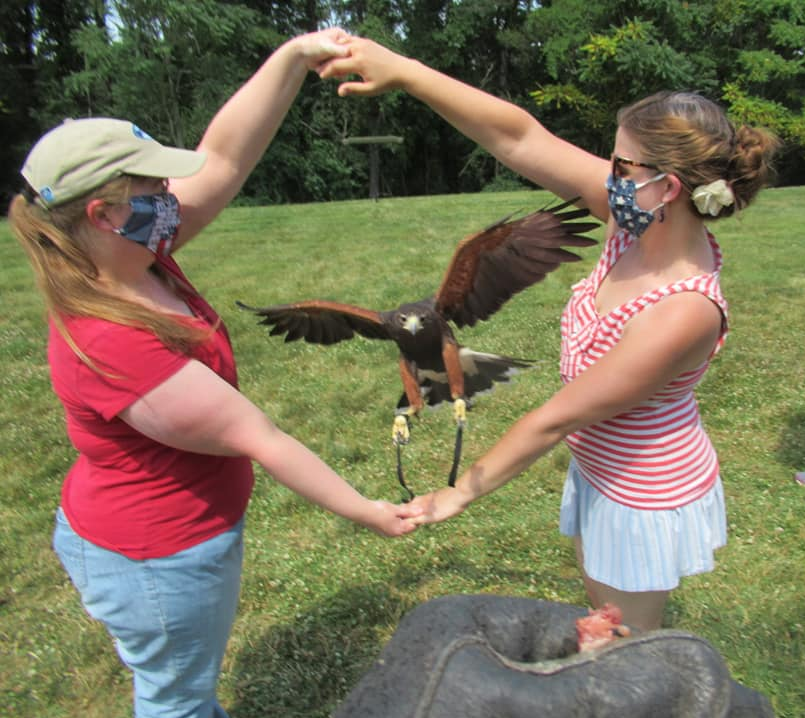
Holding a Harris Hawk at Hershey Hotel’s Falconry Experience
With great eagerness, the time had arrived to actually interact with the hawks themselves. The first task was to ensure safety. Hawks as you may already know have sharp talons designed for ripping and tearing into soft flesh, much like your arm’s. For your own comfort and that of the bird’s (who would want to hang onto a yelping, flailing human?)wearing a glove is highly recommended. We were given some basic instructions and allowed to hold the Harris Hawk on our hands. We did so by raising our gloved hands signaling it to land on us. It was exhilarating.
The bird was surprisingly light on my hand. Even through the gloves I could feel the strength of its grip. It stared at me with its golden eyes clearly investigating this new human. It was clearly a marvelous creature with a keen intellect and clever mind. I will never quite forget the wonder at having called it to my fist. I can only imagine what a true falconer feels when they finally bond enough with the other birds to have them consistently choose to return, but I shall have to content myself with this taste. After each participant had the opportunity to call the bird, we took turns putting it through different flight exercises such as having it fly through a tunnel of people or through hooped arms.
Despite the oppressive heat of the summer afternoon, it was truly an amazing experience that I would recommend to anyone. It is one thing to view these magnificent creatures behind glass or wire at the zoo or to watch a falconer showcase their skills with a bird, it is quite another to be able to try it out yourself. One of the best parts what that it included photography, so I was able to focus completely on the activity. I am eager to take the next step with my sister, A Hawk Walk, where we walk the grounds of Hershey in an intimate affair of just us, the falconer and of course the Harris Hawk.
How can you experience falconry?
The sport of falconry is alive and well throughout the country as there is only one state where it’s not legal, Hawaii – I feel for obvious reasons. There are many places that you can look to find similar excursions such as Wing Blade Falconry in Nashville, TN, Troutbeck Hotel in New York, Rancho Bernardo Inn in California, Sky Island Falconry in Tucson, AZ just to name a few!
Unfortunately, in my brief research it does seem that in the time between this writing and when I went, the price has increased significantly and most places are charging close to $100 per person. Things are only getting more expensive, but by staying in our own backyards we can minimize the costs of travel, hotels, and food so free up our money for the things we really want to do.
Completed: July 3, 2020
Miles from home: 30 miles
Cost: As of this writing (2024) these experiences will cost about $100.
The first thing about any bucket list on a budget is simply to take stock of all the things you’ve already accomplished in life. Obviously, most of you will start with trips you have already taken since most bucket lists involve some sort of travel. I won’t rant about our cultural obsession with travel in this post, but at some point, you can expect one.
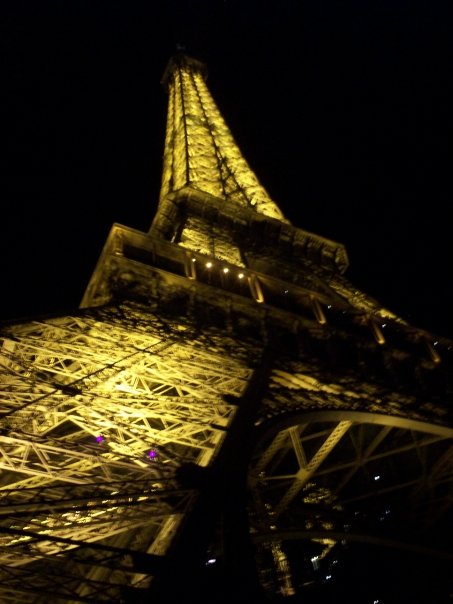
At the time of my bucket list creation, I had already spent a semester abroad allowing me to check off many of the European destinations I would desire to go: Germany, Ireland, France, Austria and Italy. I had taken a small trip to support a school in Haiti (more on that later) and there were a handful of states I had visited outside my own.
After the obvious travel, many bucket lists will break themselves up into various categories for consideration. Travel may have subcategories such as specific things to do and see. On mine seeing the Statue of Liberty and Checkpoint Charlie were in a subcategory along with visiting a butterfly garden, making a wish at the Trevi Fountain and seeing King Tut. Nature might be another sub category in travel. In which case the Rocky Mountains may grace your list as it does mine.
However, we want to do more than simply travel and look at things we want to experience. We may want to learn or at least try specific arts and skills. Some which would require many years to truly master may just be an introduction of sorts as with my glassblowing class. I dabbled for a few hours and learned more about the process. I also watched multiple demonstrations of glassblowing. There may be specific food you have tasted like a truffle mushroom. Festivals or cultural events you may have enjoyed such as going to a lantern fest where they release lanterns into the air.
Often life experiences or milestones will make up some items of the list. These milestones could be the major ones we consider such as graduating college and having children, but others may be having started a retirement fund or being in a friend’s wedding.
There are also goals that we may have completed for self-improvement, languages learned, instruments played, weight lost, or miles run. With self-improvement, there are things we have most likely done to help the world be a better place whether that was attend a protest, sign a petition or volunteered at an animal shelter.
I cannot stress enough that this is not the time to be modest. It is the time to realize your many blessings and to embrace the spirit of childlike wonder. There are many things that you see everyday that some people only dream about. The mountains of snow you experience each January that makes you sick thinking about, is on someone’s bucket list who has never seen snow. There are many who live in those same snow-capped mountains who dream of being able to swim in the ocean and would be happy to have the experience of finding sand still in their shoes two weeks later.
In order to make my own list, I surfed the web for other people’s lists and added items that normally would not occur to me as all that exciting such as walking across a suspension bridge or seeing a horse and buggy. However, when looking back at these activities which seemed rather mundane, I realized that I had taken those experiences for granted as something commonplace rather than things to be excited about. I was able to better appreciate those everyday moments as something joyful and carry with me that joyful spirit of the mundane as a blessing.
As I completed my list several things happened. First, I was surprised by all the things I had already accomplished in my almost thirty years (I was 29 ½ when I first wrote my bucket list), despite having grown up in a lower middle class home and barely making it since college. My list was actually close to 200 items!
Second, I was filled with gratitude for having done so much already. I was especially filled with gratitude for all the things I had taken for granted in my area and saw things with new eyes, embracing an almost childlike enthusiasm for the world around me. The next time snow fell instead of grumbling about having to drive in it and shoveling the blasted stuff, I took time to really marvel at it. The way it sparkles in the sunlight, and glitters as it floats down from the trees. I stopped to listen to how sound changes after a snowfall, becoming soft and crisp. Fall has now become a time when I track the peaking of the leaves. One year for my birthday, I drove out to a trail and went about collecting the most colorful and best leaves. The magic which had faded was renewed and leaves were once again as jewels.
Third, it instilled a spirit of adventure where rather than sitting about waiting for things to happen or worse for me to have a carefully curated plan, I started going about my days open for things to happen, my ears and eyes on the lookout for quests. Sometimes things that weren’t on the list suddenly became part of the list, like my cameo in a very small film production. One never knows what might be lurking around the corner and that is half the fun!
Finally, it gave me a lot of hope that even the things I didn’t think would ever happen will happen. In the past seven years since that first list, I have been continually surprised by how the blessings have been poured forth and all I’ve been able to do.
I hope that in the completion of your own reverse bucket list you find yourself marveling at all the things you’ve already done, filled with gratitude for those things, embracing a child’s spirit and filled with optimism about all you’re going to do.

















 Budget Bliss: Bucket List