
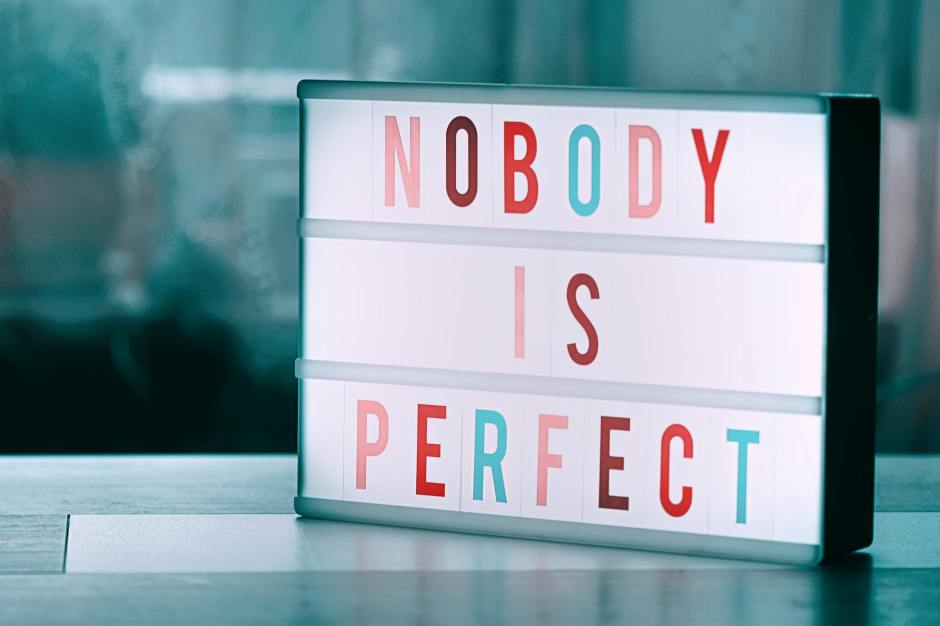
Grace Over Perfection

Dear reader, first, allow me a brief apology for my slight inconsistency in posting. As I have previously shared, I am in the process of starting my own business, and that adventure has proven to be a bit more of an undertaking than it first appeared. There have also been a number of misadventures on the home front, including a flooded basement.Worry not for my misfortunes though. I assure you that everything is well in hand, aided by my signature sarcasm, a few well placed witty quips, and an almost stubborn ability to find the silver lining in nearly any situation.

Life, after all, is largely about navigating the slings and arrows of outrageous fortune with a bit of grace. Lately, that grace has been directed inward. It would be easy to begin beating myself up over the missed, self imposed deadline of faithfully posting each Wednesday. I am, after all, a bit of a recovering perfectionist. The familiar spiral is always waiting: berating myself, stressing over unmet expectations, and allowing those expectations to quietly dictate my sense of self worth.

But let us be honest for a moment. Is my self worth really tied to my ability to publish a blog post on schedule? Is it tied to the success of this new business venture? To my accomplishments, my travels, or the neat little checkmarks on a to do list?

Photo by RDNE Stock project on Pexels.com

Of course not.

And yet, that is the trap of perfectionism. It persuades us to tether our value to outward measures. What begins as a guiding star slowly becomes a chain. Aspirations harden into obligations. Joy drains out of the very pursuits that once inspired us.

When that happens, even the things we love can begin to feel heavy. You may scoff at the idea that expectations can weigh so heavily, but consider the world of elite athletics. During the recent Winter Olympics, the world watched in awe as figure skater Alysa Liu performed with what could only be described as unrestrained joy.

Not long ago, she had stepped away from the sport entirely. The pressure, the constant scrutiny, and the relentless push toward winning had transformed her love of skating into something burdensome. Burnout followed close behind. But when she returned, she did so on her own terms, with one simple rule: she was there to have fun.

And suddenly, everything changed.

Her skating appeared effortless and relaxed. The tension was gone. Instead of skating cautiously under the weight of expectation, she moved with the freedom of someone who had remembered why she loved the ice in the first place. That joy was contagious. Viewers could feel it through the screen.

Ironically, when she stopped chasing the gold medal, it found her anyway.

The Olympics also remind us of the other side of the coin. Even the most extraordinary athletes can crumble under the immense weight of expectation. We watched this unfold in recent years when Simone Biles stepped back to protect her mental health. And this past winter, Ilia Malinin carried the kind of pressure that comes from being called a once in a generation talent.

This is not an indictment of any of them. If anything, it is a reminder of how human we all are.
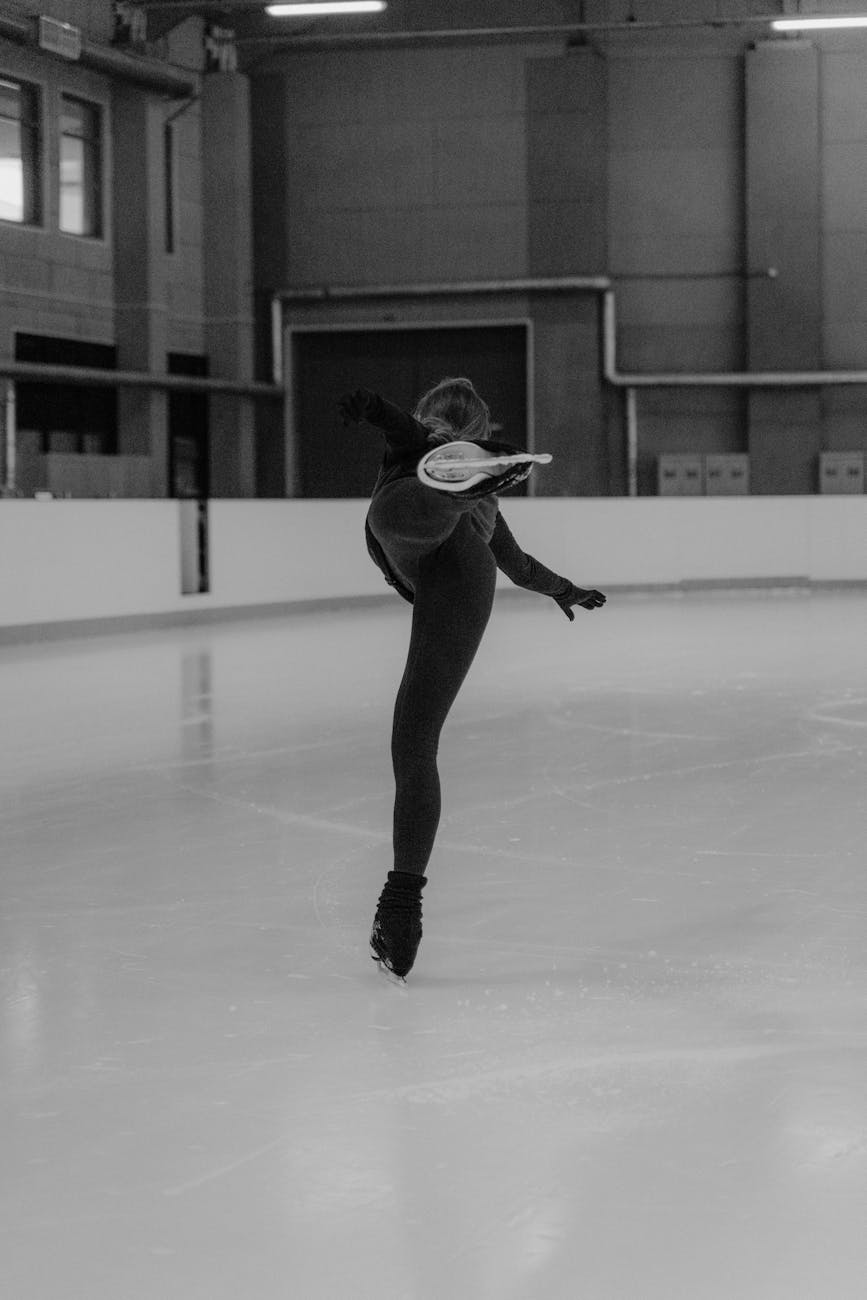
Photo by Tima Miroshnichenko on Pexels.com

I know that pressure well myself. I have shared before that public speaking and violin auditions once triggered intense anxiety for me. What had once been joyful became something to dread. Performance turned into judgment. Eventually, I stopped playing for many years altogether, silencing a part of myself that once brought me immense joy.

But the strange thing about joy is that it often waits patiently for us to rediscover it.

When we allow space for play, when our work becomes exploration instead of obligation, something shifts. We loosen our grip on perfection and suddenly our creativity can breathe again. Our spark returns.

And sometimes that spark does more than illuminate our own path.

It becomes a catalyst for others. Perhaps that is what I am learning in this strange season of flooded basements and fledgling businesses. Progress is rarely tidy. The best things in life are rarely perfect. They are messy, unpredictable, occasionally inconvenient, and often accompanied by a small amount of water damage.

But they are also alive.

So I will continue writing, even if Wednesday occasionally becomes Thursday. I will continue building this business, even if the process involves a few wrong turns and lessons learned the hard way. I will continue picking up the violin, even if the notes are not always as polished as they once were.

Perfection may impress people from a distance. Joy invites them closer. So, dear reader, perhaps the real invitation is this: release the crushing weight of expectation. Allow yourself to try, to stumble, to learn, and occasionally to laugh at the absurdity of it all. Let your aspirations guide you, but do not allow them to chain you. And when life floods your basement, metaphorically or otherwise, remember that grace often begins the moment we stop demanding perfection.

After all, a life well lived is rarely flawless.

But it is very often joyful.

Not my Monkey, Not my Circus 

Those have got to be six of the most freeing words I have ever heard uttered. They were spoken by the executive director of my internship placement and it was a lightbulb moment. As a young, budding professional still in graduate school, I often took on more than what was mine. I was shouldering burdens, piling on unnecessary stress and adding to my every growing pile of responsibilities. Seeing her close her eyes and utter those words were deeply profound, it was like getting permission to start setting boundaries around my professional and personal responsibilities even if the actions of other people affected my responsibilities. It gave me the freedom to say if someone else doesn’t get their piece done, it doesn’t mean I have to step in. 

The idiom actually comes from a Polish proverb, but its colorful imagery resonates so strongly that it needed almost no translation when it crossed over to the English speaking world. It perfectly encapsulates personal boundaries and discretion, encouraging us to consider where our responsibilities lie. We we invoke this phrase it means that we must practice discernment about what is ours to handle and what we have to others handle. It helps us prioritize our energy and attention rather than leaping to intervene. It also helps us relinquish control to others. 

I can at times be a bit of a control freak. This probably stems from perfectionism and anxiety. I want to do a good job; I want to be helpful; I want the whole group to do well, and I want to know that it’s done. This means that if someone else on the team isn’t doing their part, I just step in and take over without necessarily being asked or considering that maybe the other person was in the process of doing it, just not on my timeline. This means that sometimes I jump in and just do for someone rather than allowing them to do it themselves.

Photo by RF._.studio on Pexels.com

I was on the receiving end of this once and I was rather annoyed. I was working with a partner in class and we had split the parts of the project it was due in three weeks. Not a week after the assignment, she had completed the entire thing, robbing me of the experience of learning and I was worried I’d get a bad grade on the project because she didn’t let me do anything. It communicated a lack of trust and a poor assessment of my skills. So, instead of both of us being happy with the work and doing well, she felt resentful and overburdened and I felt insulted. 

My mother is also someone who has needed to learn this phrase. She is a go-getter and also a bit of a perfectionist- I can’t imagine where I got my perfectionistic trait from, ‘tis a mystery that only the wisest of sages shall ever be able to solve. Alas, us mere mortals shall simply have to remain in the dark. 

My mother too has fallen into the trap taking on that which was not hers. I saw this play out in her stories from her job. Where one of her co-workers would fall behind and leave work undone. My mother, being the responsible person that she is, would complete her work and then help that person. Well, that person kept leaving more and more work for my mother. Until, she would simply never do anything she didn’t feel like doing leaving my mother feeling resentful and angry. The final straw was when my mother’s supervisor tried to start holding my mother accountable for the undone work instead of her fellow employee! 

So you can see dear reader, the dangers that lurk when one forgets which monkeys belong to your circus and which monkeys belong to the other persons. Your relationships with others suffer. You may reinforce the idea that the person is a failure and can’t be trusted with responsibility undermining their sense of competency and self-worth. You may find them upset that you rob them of opportunities to grow and try. You may find that they take advantage of you by constantly passing on the responsibility to you. You will also find that you’re overburdened and burned out. You will be resentful towards those whose responsibilities you now hold. One thing we know about resentment is that it is a relationship killer. It often leads to anger, fuels criticism and feeds contempt. 

Photo by Merilin Kirsika Tedder on Pexels.com

This phrase is part of setting boundaries, of knowing where you start and stop. It is not my responsibility to get my neighbor to mow his lawn, even though the tall grass might annoy me. Going over there and mowing the lawn for him, may be seen as a nice gesture, but only if I knocked on the door and asked if he would like some assistance. Otherwise, it’s trespassing on private property and socially unacceptable. While it may be nice for me to watch my friend’s child when she goes to the hospital, it’s not my responsibility to do so and if I can’t watch the child because I have other responsibilities that I need to take care of, those needs come before hers. It is not my responsibility to complete the work of my neighbor, partner, parent, friend, co-worker or anyone else. 

My co-worker recently asked if I could switch on-call weeks with her. I almost said yes, but then checked my calendar. I had an appointment that weekend and I purposefully had not taken the on-call phone so I could keep that appointment. I told her no. The on-call phone was not my monkey that week and it wasn’t my problem that she had forgotten about her plans that weekend when she agreed to take it. She did get another co-worker to switch, but had I not heard that phrase I probably would have said yes and then felt resentful and angry if I had gotten called that weekend. 

When I can clearly see what monkeys belong in my circus, I can focus on the things that I am responsible for and let go of what I am not. This freeing phrase is a stable of my life and I hope, dear reader, it becomes a stable of yours.