
Occasionally, I like to share bucket list items from my reverse bucket list or include tales from further afield. It isn’t to necessarily go off track or to undermine the purpose of my blog, but rather present an open and honest representation of my list, the things I’ve accomplished and how I’ve done them. I would be remiss to only showcase the things that I’ve done close to home as that would be creating a false impression that one really can complete everything without travel. Depending on where you are and what you want to do with your life, some travel may be required. I also don’t want to be held up as some sort of standard of perfection or be accused later on of not practicing what I preach. I’ve watched many influences and internet personalities over the years to see that the truth will come out and I do myself no favors by presenting a false narrative of my life. Who knew honesty was the best policy?
This item is from both my reverse bucket list and from tales further afield. It should come as no surprise dear reader that I love unicorns.
I know – you’re in absolute shock, never in a million years did you see this confession coming! Sarcasm may be a 2nd language for me, followed closely by bad English and then German.

I digress. I love unicorns. My very first stuffed animal from the day I was born was in fact a unicorn. It doubled as a music box that played Somewhere Over the Rainbow. The unicorn’s name is Rainbow and she was my favorite toy. I even took her to Germany with me when I was in college. She still sits on a shelf in my room. Growing up in the 90’s unicorns were difficult to find, but my mother still managed to get me the rare unicorn toy and find me the rare unicorn book. I read every book that had a unicorn in it, including a book which showcased the La Dame a la Licorne or The Lady and the Unicorn.
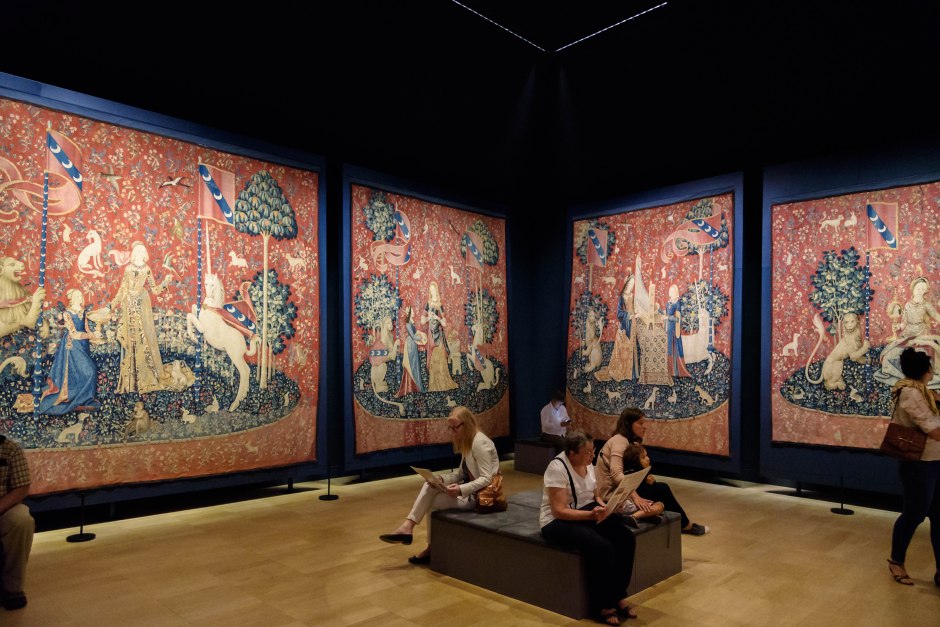
The Lady and the Unicorn tapestries are a collection of six tapestries housed in Paris France. They were created in the style known as thousand flowers and it is easy to see where it gets its name as the background of the tapestries are woven with hundreds of flowers. The tapestries were woven in Flanders out of wool and silk from designs created about 1500 AD. They were hidden away for potentially centuries in Boussac castle until their discovery in 1841. Interestingly enough they were dated correctly by the novelist George Sand as coming from the 15th century based on the depiction of the ladies’ costumes. Never underestimate a woman’s eye for fashion.
The six tapestries depict five of the senses, touch, taste, smell, hearing and sight. The sixth one is a bit of a mystery as it displays the following motto on the lady’s tent “A Mon Seul Desir” or “my sole desire”, but it has been translated differently by different people leaving us with some ambiguity. I find it rather strange that the tapestries with no words are the ones with the clearest meanings, but the one with words leaves us scratching our heads. Some interpretations believe is a renunciation of the passions, an assertion of her free will; others see it as representing a sixth sense of understanding. This last one is based on sermons from 1420 which lines up with the timeline of the tapestries.
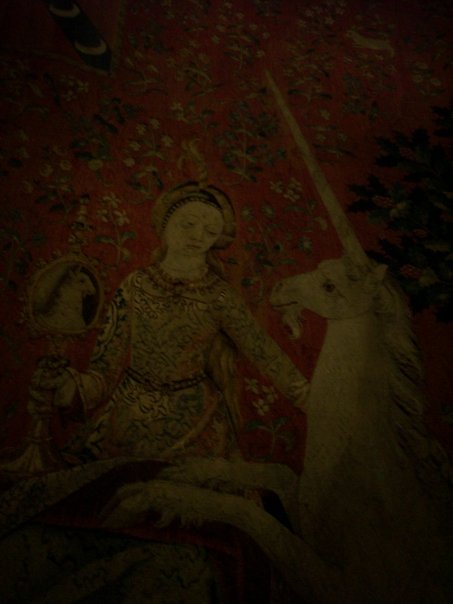
Nevertheless these tapestries are beautiful works of medieval art. They not only depict six scenes, but also they are representative of the interplay between the arts and their patrons at that time period with the banners depicting the heraldry of the nobility who sponsored them. The arts could not have survived without the support of patrons. This interplay was an important part of the social structure of the time. Additionally, it is reflective of the importance of the Christian church as like most art of the time period it carries themes from the Christian faith. One of the reasons I so loved unicorns was they were often a reference to Christ in medieval art. Finally, they demonstrated fashion at the time of their creation. Larger tapestries, like these, were used to showcase wealth and power as well as to provide extra insulation in drafty castles. They were both art and a craft.
Today, the suite of The Lady and the Unicorn is housed in the Musee de Cluny in Paris. A fitting home for these tapestries and the Cluny mansion was built in the late 1400’s and houses many medieval artifacts like these. I almost missed them entirely on my trip to Paris. I will fully admit that I never thought I would get to Paris. I knew that the tapestries were housed in France, but where in France, I could not have told you where exactly. Because I never thought I’d go, I did not pay much attention to what was actually in Paris other than the famous monuments and the Mona Lisa.

However, I did get to go in April of 2009, during my study abroad. It was a semi-last minute decision. I found out a friend of mine was going to be in Paris and so I asked Erica, a fellow American girl and fantasy book nerd, if she’d like to go with me to Paris to meet up with him. There, I was in Paris enjoying the museums, the history, the culture, the food – they did not lie, they have delicious food. I kept noticing the unicorn tapestries on bags, pillow covers, notebooks, all those touristy things they try to sell you in the gift shops. At first, I dismissed them as just standard French tourist crap that they sell all over the country. When finally, while at the Sainte Chapelle (one of the most gorgeous churches on the planet), I asked a person behind the counter in a curious voice, “Are those tapestries here in Paris?” “Yes.” I am certain they could feel my excitement go from zero to hundred in under 10 seconds, for they seemed a bit alarmed by my enthusiastic and semi-desperate, “Where?” They politely answered, “The Medieval Museum, it is nearby.” And proceeded to give the overly excitable American directions. Luckily for me, Erica being an archeology major had zero objection to my abrupt course correction to the Medieval Museum and we rushed to get there before it closed for the day. Did my feet hurt from walking nearly 15 miles that day? Yes. Did I care? Absolutely, not there were unicorns to see! (We won’t talk about how we couldn’t figure out the darn subway system and walked the entire historical district of the city).
It took most of my self control not to simply rush through the museum to the tapestries, but I respected Erica’s desire to linger over the various pieces of history displayed. I did my best to hold my excitement back, even though I may have been bouncing up and down at the front desk chanting “unicorn” upon entry to the museum. I was twenty-one, child-like displays of youthful enthusiasm were perfectly permissible. Now, I must display my excitement in more subdued expressions or so I’ve been told. Some people are simply no fun.
Finally, we came to the tapestries and they were even more glorious in person than on any page or screen. There are many pieces of art that I have seen in the printed form that I have not found to be all that different or impressive in person leaving me a bit disappointed after the build up. The tapestries were certainly not disappointing in person. Because one can really see each piece of woven thread and appreciate every flower. The magnitude of the work cannot be understated when confronted with the sheer size and detail of this masterpiece. It represents hundreds of hours of work. According to a post from the metropolitan museum of art, a set of six large tapestries would have taken thirty weavers between eight and sixteen months to complete. That is not accounting for the hours of design that went into the cartoon that the weavers would need to produce the tapestry.
To most people reading this, a textile project taking that long is unthinkable, not when you can hop on amazon, buy a woven blanket for 60 bucks and be enjoying it with prime 2 day delivery. A wall hanging in the medieval style can also be yours for about $220 and also be in your home in about two days. A tapestry at the time of their making would be worth thousands in today’s dollars.
Upon entering the dark room, my excitement turned to quiet awe. My breath caught in my throat at the sight of them. I floated to them as if caught in a dream. I cannot say for certain, how long I sat there admiring them, taking in their craftsmanship and cursing my lack of botanical knowledge to identify the plants. I examined each one carefully noting the themes and subtle details. I doubt I said much to my travel companion as I studied them. The pictures never did them justice, how could they? How do you capture in words their beauty and masterful craftsmanship? How do you fully appreciate their vibrant colors and shapes without seeing them in person? A picture loses so much when it’s shrunken down to fit on a page and our imaginations are limited by what we’ve experienced. Too soon, I left them, but there was the rest of Paris to see and far too little time to fully appreciate the City of Lights. Adieu mon amour, perhaps we shall meet again one day.

How can you see tapestries?
Well, you don’t have to hop on a plane to France to see tapestries. There are museums here in the United States that display various tapestries from the Medieval and Renaissance eras. If you are particularly interested in seeing unicorn tapestries after reading me wax poetic about them, there is a set of them at the Cloisters in New York which are governed by the Metropolitan Museum of Art. They are a set of seven tapestries, also from around the same period as The Lady and the Unicorn and are in the style of the thousand flowers. Just as with the tapestries in France, these also hold mysteries such as how to interpret the tapestries and even who they were made for. Depending where you are in the country, a plane ride may or may not be necessary.
I highly recommend if you ever get to either New York or Paris, to take time to see these masterpieces. Provided of course such things are of interest to you. You know by now, that I always tell people to skip that which holds no interest or intrigue to them. Life is too short to waste it on things you don’t enjoy.



 Budget Bliss: Bucket List