Getting Lost in a Corn Maze

In late summer of 2020, the world was still reeling from COVID. Depending on where you were in the world, you were still subjected to lockdowns and restrictions of movement or gatherings. In my own state, there were restrictions on gatherings well into 2022. I have written earlier how those of us with intrepid spirits were not daunted by restrictions on traveling further afield when it came to living life. As it turns out, myself and my co-workers did not need to look any further than the local corn fields for fun. 

After the lockdowns, my co-workers and I made a concerted effort to plan things to do together as a team after work hours once a month. It not only was helpful for team building and morale but also our mental health as it gave us the opportunity to go out and have fun. As social workers dedicated to helping the homeless this was a particularly stressful time and it was important to foster connection with others as part of resilient coping strategies. One of the activities we chose was a corn maze. In part because some of us had never done them before and we also had a corn maze aficionado in our office. After some debate on which one would be the best to introduce us to, we settled on Oregon Dairy’s. We decided on a smaller, more beginner friendly one rather than the one at Cherry Crest Adventure Farm.

Now as with everything in 2020, what could go wrong, did. In a completely on brand 2020 accident, the GPS system which helped the farmers cut the design for the maze failed dramatically and cut the maze in a completely wobbly way. Unfortunately, while yes, it will grow back there was no way for the corn to grow back in time to for a re-do. However, I don’t think this deterred anyone from enjoying the maze because like myself were so amused by it and thought it made the experience even better. 
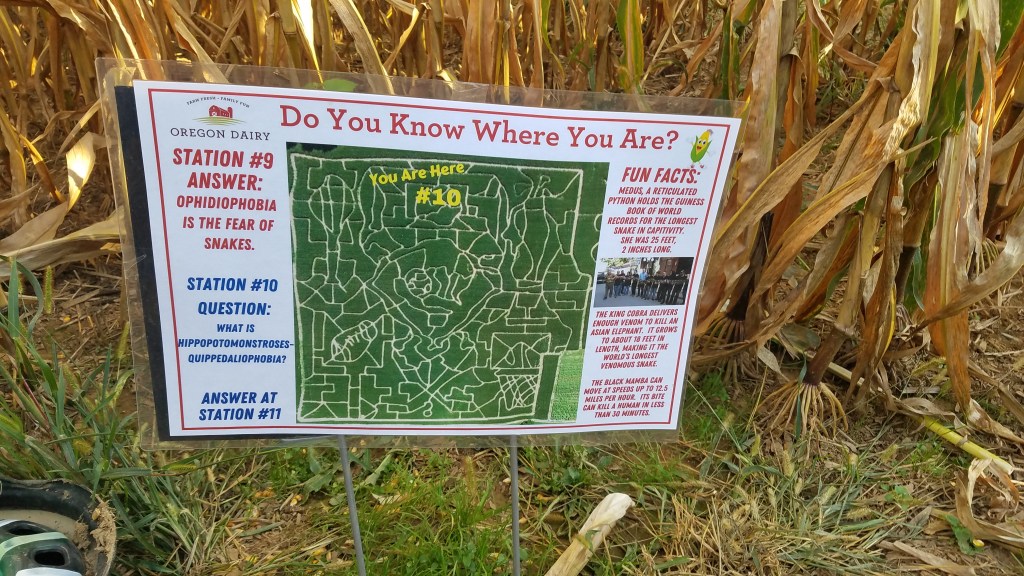
Now, I will be the first one to admit that going through a corn maze was not my idea of a good time. Being allergic to dust, pollen and bees spending time out in a dusty corn field with the pollen floating through the air and bees potentially buzzing in from nearby fields had placed this activity firmly on the “things I’d rather not” list. However, seeing Melissa’s enthusiasm for it peaked my interest. We were also going later in the season when the corn was no longer an attractor of pollinators meaning that bees and pollen were at a minimum. Given the amount of foot traffic it would see, the dust would be pounded firmly into the ground rather than in the air. 

In Lancaster county, there are plenty of corn fields to see, so the point of going to a corn maze isn’t to look at a field of corn, but rather the experience of getting lost together. What’s quite comical is that when you have the map in your hand standing outside the entrance, it looks quite easy, a casual stroll even. Oh, how wrong you would be. The maze quickly becomes disorienting, especially a maze that is as zig-zaggy as that one. Having no real straight lines it was almost impossible to tell if you had turned a corner or merely curved with the path. The corn was too tall to get a good bearing on anything. And of course being corn, it all looked exactly the same, even if you could peek through to the other side. 

You think you know where you are and then you turn a corner only to be faced with unexpected options, this isn’t where you’re supposed to be. The simple, easy maze has transformed into a dizzying labyrinth of twists and turns. If you’re not careful, you may lose sight of your companions turning this group adventure into an unexpected solo adventure. You may call out to them but they’re gone. Or perhaps you hear each other but cannot figure out how to get back on the same path. So tread carefully and do not wander too far from your friends. 
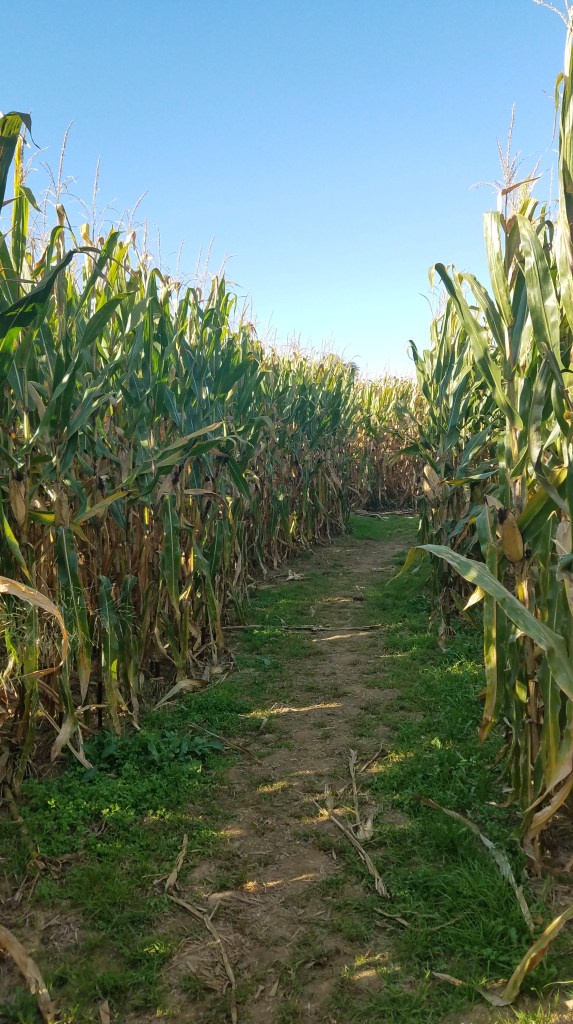
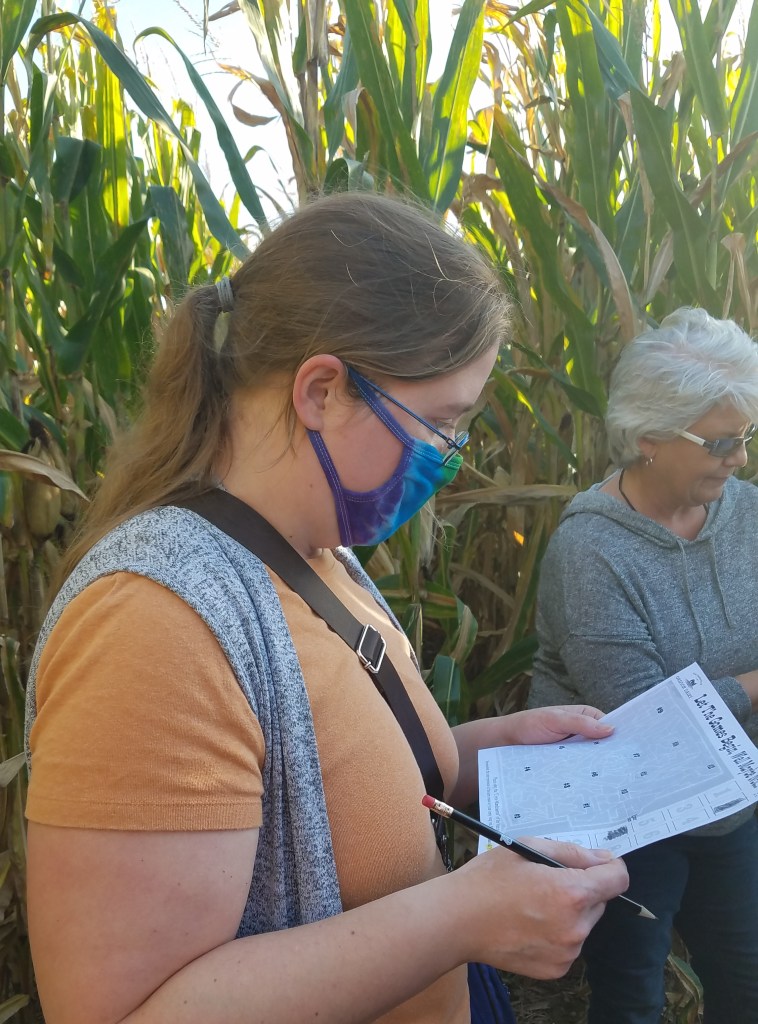
No one was really sure how long we walked or how far. We did manage to find markers which were various points that we were supposed to find and mark off in order to “complete” the maze. They helped to orient us to where we were and help keep us on track. As with any group of activity, it was all about communication and collaboration. 

Some of us took a more backseat approach, content to let the others lead rather than become overly focused on the goal. I purposefully avoided trying to take charge as there were already several chiefs taking the lead and I had played enough videogames to know that I am terrible at reading maps and knowing where I am. Though, I have gotten better at it since 2020. I enjoyed the time wandering aimlessly trying to figure out where we were and where we were going. In the age of GPS, google maps it is so rare to be truly lost and having to use what few tools you have available to answer those basic questions. It felt like a small adventure, even though there were plenty of people to help you get out of the maze if you were truly lost. 

We found about half the markers before we decided that it was beginning to get late and it was time to go home. Many of them had young children and those without children, had pets who were waiting at home for their dinner and evening snuggles. I would love to try to finish a corn maze in the future as I truly did find it enjoyable. So not only did I get to try something new, but also I got to re-evaluate an activity I previously thought would not be for me. 

I encourage you dear reader to reconsider your own “I’d really rather not” lists. Often the barriers to new and potentially exciting things are only in your mind. With careful planning as to when we went, most of my concerns for why the journey would be anything but enjoyable for me were laid to rest. 
How can you experience getting lost in a corn maze?

Mazes have been part of human cultures for thousands of years. They crop up in stories like the labyrinth and the minotaur and there is a reference to one in ancient Egypt by the writer Herodotus. In more recent history, hedge mazes were a popular form of entertainment found in gardens of the elite such as the ones at the Palace of Versailles or Hampton Court Palace. Today, corn mazes are the hedge mazes of the people. 

The first corn mazes started cropping up (pun intended) in my home state of Pennsylvania. The very first one was in the neighboring county of Lebanon in 1993 by Earl Beal. It was inspired by his father’s work on mazes at a local amusement park and the idea quickly spread across America to other farming communities. Now they are found all over the country where farmers make their living. 

I do recommend not going for the “biggest” corn mazes if you’ve never done one before or don’t have the best sense of direction. As I said, the maps are deceptively simple, because once inside you will get turned around pretty easily. Try some of the smaller ones, you will have just as much fun and feel a sense of accomplishment when you’re able to complete most if not all of the maze. This helps to ensure you have a good time as it gives you an attainable goal for a novice. It’s important with our bucket list to keep ourselves in a place where we are being stretched without being overwhelmed.
Bonus Bucket List: Riding a Horse

Sometimes in the process of completing one bucket list item, you stumble upon another. I call these “bonus bucket list items”. They were not pre-planned or even hoped for, they are simply opportunities that present themselves and it is up to you to seize the moment. After all, have I not said we should make the most of our travels? These I call “bonus” items and they follow my principle of making the most out of the longer, further afield trips. There are times when travel becomes a necessity [see post], so it becomes important to consider what other items you can include. It isn’t about avoiding travel altogether, rather limiting travel. On my trip to see the eclipse in Vermont [see post], I stayed with a family friend who happened to have horses. 

I offered to assist her with their care having never had many close interactions with the noble creatures, despite growing up in a farming community. Truthfully, I have probably had more direct interactions with cows than horses, but I was an eager student. Shelia showed me the proper way to brush them and introduced me to each horse, telling me their stories. Each had come from an owner who had not understood their unique needs or read the signs of discomfort and pain resulting in them acting out.

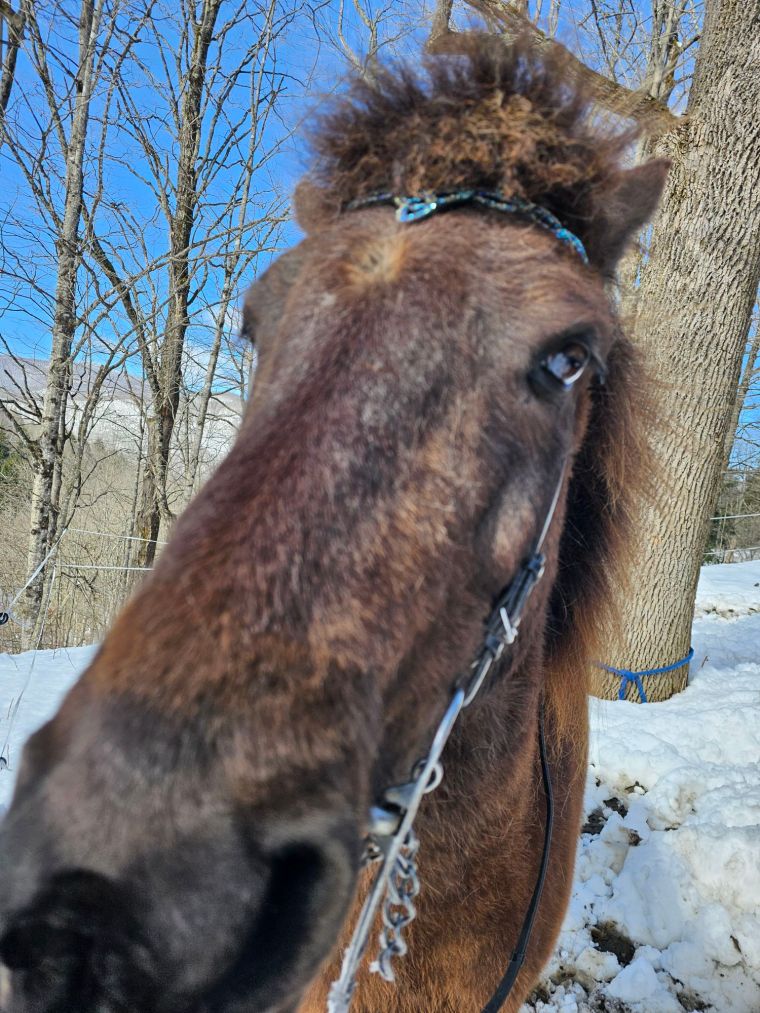
The horses were a special breed, Icelandic, known for their smooth gait. Much like with dogs, it is important to understand what a breed is bred for. One would not expect a husky to do well at shepherding sheep nor would you want a border collie to pull a dog sled. Each breed was carefully curated for a specialized task, one the dog is a natural athlete at. There is an old saying that a fish will think itself stupid if its judged by its ability to climb a tree. Stoltur came from an owner who had tried to use him as an Olympic Dressage horse, something an Icelandic would not be good for as he was punished for his natural gait and motion. This meant that it was important for me to demonstrate first that I could be trusted with such a special set of horses before any overtures of riding could be made. Luckily, Sheila had already worked to restore trust between horses and man, so making friends with them was rather easy.

The three horses were gentle as lambs with me as I groomed them. Stoltur even began to engage in mutual grooming, nibbling ever so gently on my arm. In the crisp air of the early spring, the horses and I spoke to one another each learning the other’s cues. I would brush them and see how they reacted ensuring I first went to the head of the heard, Mjolner and worked my way down to Stoltur. The Icelandics are known for their gentleness and good tempers, and they were admirable hosts. I made fast friends with hay and treats hidden away in my jacket. I remembered the advice to hold out the treats on the palm of my hand, keeping my fingers straight to avoid any mishaps with teeth.

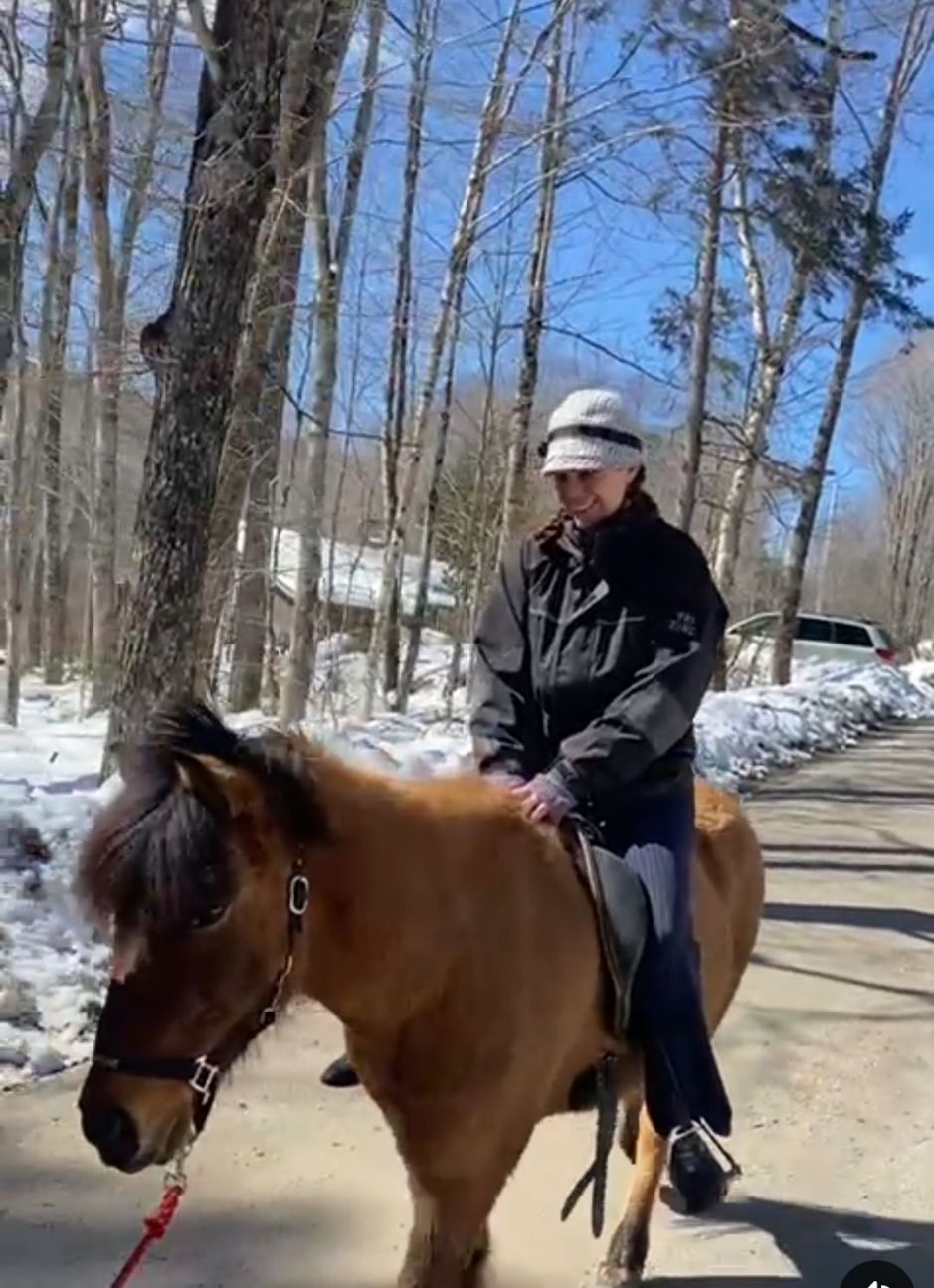
After spending some time getting properly introduced to one another. Sheila offered to let me ride one. I could barely contain my excitement as I enthusiastically said yes. She saddled them up and asked her son, Astri, to accompany us as lead. She assigned Stoltur to me as he was the best kind of horse for a beginner, forgiving of mistakes and of an easy temper. She choose to ride Gimli. She told me my only job was to keep my seat. I was given a vague idea of how to get up into the saddle, put my foot in the stirrup, grab the mane to help me up and hoist myself over. I did quite well. Sheila observed dryly that I was no couch potato. 

Riding a horse was rather a natural thing for me. The key of course was to keep my posture without being stiff. Having had six years of marching band in highschool, I was well acquainted with the idea of good posture without stiffness. It was a matter of feeling the rhythm of the horse and moving my hips with his movements. I found myself relaxing into the motion and adjusting as I needed to. She only needed to correct me once saying that I was slightly off balance to one side. 

It was magical riding a horse along a mountain trail. The soft sound of hooves against hard dirt. The way the world melted away. It was rather meditative. For once, I felt very much grounded in my own body as I am prone to being a bit air-headed. I had never been called a natural athlete before having always been clumsy, slow and generally the opposite of everything athletic, but when it came to horses, Sheila told me I was one. I suppose it makes me a bit like an Icelandic horse trying to do Dressage or a husky trying to herd sheep, without being given the right sort of task and the right sort of environment, I did spend my whole life thinking I was useless at anything athletic. 

I had not embarked to see an eclipse thinking I would be able to check off horseback riding from my list. Instead it was an opportunity that presented itself and I made every use of that chance. While I could book a horseback trail ride near my house, the experience of being able to connect with the horses first, to hear their stories and bond with them isn’t something that could be bought..

Gimili with his bling

One never knows what opportunities are lurking around the corner or what things could present themselves when venturing outside one’s door. It isn’t about forcing anything to happen, but rather cultivating genuine relationships. Sheila probably would not have allowed me the opportunity to ride her horses had I not demonstrated that I was someone who could be trusted with them. I demonstrated that I could listen to their cues and respond well to them. When Stoltur nibbled my arm, I could have easily freaked out or misunderstood. Instead, I backed off from grooming and observed him for any signs of irritation before proceeding any further. I checked in with her to ensure I was reading him correctly. She confirmed it was a good sign that I was doing well with him. It was a matter of giving him the respect he deserved and following her directive. One cannot approach a horse like a dog or a cat anymore than one can approach a cat like a dog. Each creature has its own way of communicating and engaging. It is up to us to follow the terms set by them. By fostering a good connection with her horses and her, it opened up the door for a magical experience. By cultivating authentic connection, all sorts of opportunities and horizons will become open to you. 

How can you experience horseback riding?

Now, it would be rare for you to meet a horse owner who can present you with the opportunity to ride a horse, like I did. However, there are many stables throughout the country which offer horseback rides or trail rides. A quick google search is all you need to get started and many of these are under $100. For a more intimate experience with a horse, you may want to sign up for a series of lessons. 

Completed: April 7, 2024

Miles from home: Bonus bucket list!

Cost: Free ($60 – $100 without a friendship discount)

Ice Skating: Let Go of the Wall

Having lived my whole life in Pennsylvania, I am no stranger to winter. Having been a child through some of our largest snowstorms in history, including the blizzards of 1996 and 1993, I am well versed in the traditions of winter. I have enjoyed many-a-cup of hot chocolate after spending hours building snow forts, engaging in snow fights and making snow angels. However, there was one thing I did not do growing up, ice skate. 

I would be lying if I said I hadn’t spent a significant amount of my time as a child watching ice skating competitions. I love watching figure skating or really any sort of physical movement to music, dancing, gymnastics, ballet, the human body in elegant, poetic motion. It may just be a girl thing we seem attracted to such displays. Sure there is a certain beauty in the movements of sports, but there isn’t the same restrained, control of strength that comes from holding an impossible pose for an extended period of time. Don’t get me wrong, I enjoy seeing a chiseled warrior wielding a hammer smashing things to smithereens just as much as the next woman. I digress. I was never a connoisseur of the sport, only a modest observer of it. 

Winter in Pennsylvania

One may be forgiven for the mistake of believing that ice skating is a relatively recent invention in human history, not until the 13th and 14th centuries when steel blades were attached to shoes. But there is evidence to suggest it actually has been utilized in Finland for over 5,000 years and they found a pair of Ice Skates in China that are almost 3,500 years old. This discovery helped establish a clear link of trade between China and Europe! There is a rather silly notion that until the age of exploration with the advent of Christopher Columbus that people didn’t move around much. Not so, the need to explore is etched in our very bones! But to avoid a long winded tangent about the history of trade and interactions over the centuries of human history, I will leave you with that declaration and encouragement to go do your own research.

The first skates were actually made of bone. The first official clubs naturally rose in London – because where else? Metal skates were brought over in the 1600’s and by the 1700’s all sorts of skating clubs had emerged which is also when figure skating emerged. The Dutch, Finns and Swedes had all been competing with one another in races for years back in the 13th and 14th centuries. At first it was just done by men doing circles and figure-eights, but it was an American of all things that incorporated ballet moves into his skating, and thus figure skating was born! 

It was under the auspices of this long and nobel tradition that my sister and I set out one late February day to our local mall. I had seen an advertisement for a “pop-up” ice rink on facebook around back in December. Anticipating the crowds of Christmas, we opted to wait until the initial excitement had died down. Our patience was rewarded with an almost empty rink where we could get the feel for it. The weather was almost perfect, it was right around 30 degrees. The near cloudless sky was that deep, brilliant blue that we only ever see in winter. We walked up to the counter to rent our skates and then on tottering legs took our first steps onto the ice. 

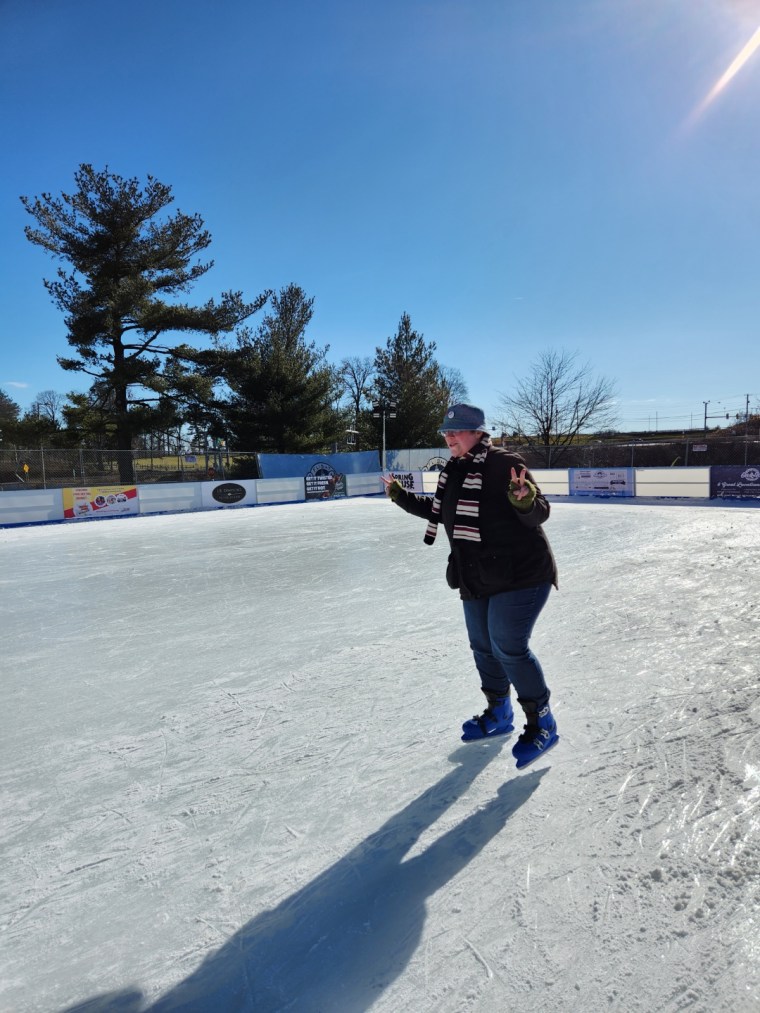
My first moments away from the wall and “flying” free

I will say that many movies lie about the ease by which one can simply strap on a pair of skates and flit about on the ice for the first time.  I was not fooled and well prepared for what was in store! I remembered the first time I had ever gone rollerblading as an equally difficult task. When one has never done it, your body doesn’t quite know what to do with itself in terms of balance. Suddenly, your legs are going in all sorts of directions and the decided lack of friction makes it damn difficult to control. Ah, the eternal law of physics, what is in motion stays in motion and skates are made for motion!  

Slowly, more so than I care to admit, I did start to get the hang of it. I clutched the wall for balance until I began to feel much more confident in my ability to maneuver safely. When one has had four concussions in one’s life, you tend to take the possibility of a head injury a bit more seriously than other people. This made me a bit more timid than my sister with regards to letting go of the safety of the wall and skating away from it. 

As we were making our way around, a few others joined us. They were also first timers on the ice and we built a quick camaraderie through mutual struggle. My sister and I called out the tips we had learned in our short education to the newcomers. Some picked it up faster than others, but rather than jealousy, we cheered enthusiastically for one another’s accomplishments. When my sister fell, I was not the only one who checked on her or encouraged her to keep going. 

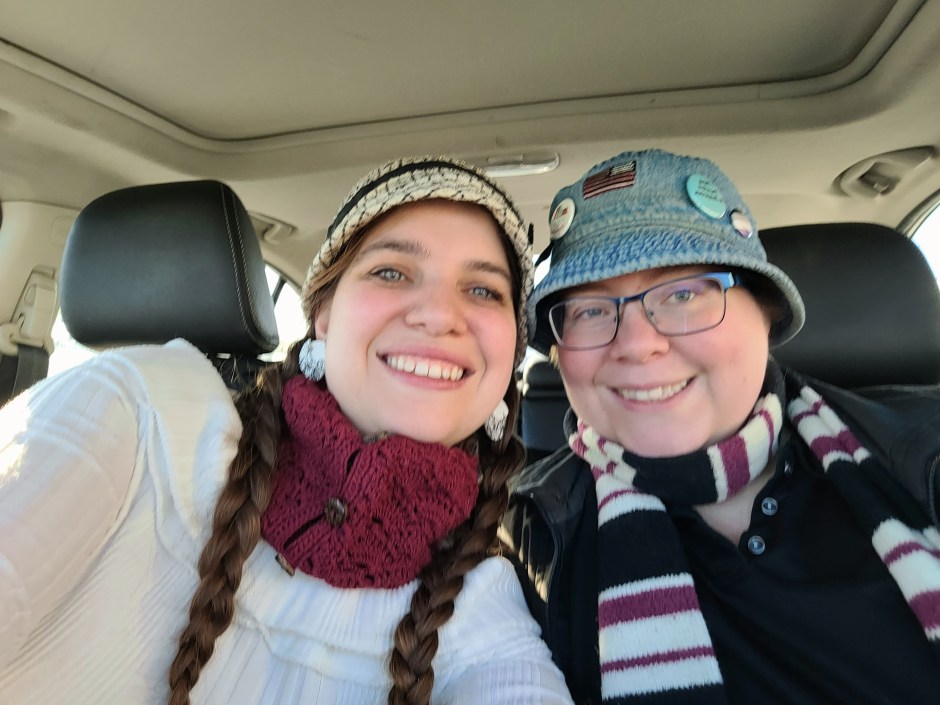
Just two sisters living the dream!

Finally, I let go of the wall and began to skate on my own. There was a thrill of accomplishment even though arguably it was a rather small conquest. Still to glide across the ice confidently was a dream come true at last. Naturally, the small group of strangers cheered for me and it gave others the confidence to join me. I certainly wasn’t going to be adding any ballet moves that day and it was enough to go around in a circle a few times. I am sure that just as with rollerskating, I could quickly begin to conquer the ice, had I more time and inclination. My sister and I will no doubt return to the ice again in the coming winters. 

Bucket lists are more than just doing, they’re about experiencing. That morning was more than just ice skating, it was a reminder of some life lessons. In life one must venture forth from the safety of the nest to really live. At some point every olympic skater had to make the choice to let go of the safety net to risk danger and injury, to trust in their skill and ability to fly. They also had to make the choice, like my sister, to get up after a fall. Life is about risk, it’s about letting go and about getting back up after a fall. It’s also about cheering each other on through the difficulties. No one could skate for anyone else, but each of us uplifted the others there and I’d like to think that because of that encouragement everyone succeeded more than had we stayed silent. Studies demonstrate that positive feedback increases performance. It is important to cheer each other on through the difficulties and celebrate victories big or small. 

My sister may have fallen but she got right back up!

How can you ice skate?

Once the Christmas season starts, look for pop up ice rinks in your area or sales for your local ice rink. If you live in a hotter part of the country, sadly there will be few pop up ice rinks in your area no matter how much Christmas spirit your town may have. You will probably need to look for a local ice rink. Ice skating is fairly easy if you’ve been roller skating or blading before, but if you’re like me and have only done either of those a handful of times in your life you will still probably be pretty wobbly. However, that’s all part of the fun of doing new things. No one is expecting you to land a quad your first time on the ice, that’s obviously for your 3rd time. 

Completed: 2023

Miles from home: 12 miles 

Cost: Tickets were about $20 and ice skate rentals were an additional $10 for a total of $60 for two.