I believe it shall come as no surprise to you, dear reader, that I’ve long held a dream of visiting Japan and count myself as a bit of an otaku. I’ve imagined seeing Mt. Fuji rising above the mist, taking in the sights of Tokyo, enjoying the fashion, engaging in traditional dances, exploring vibrant festivals, wandering through a pagoda, pausing at a temple, sipping macha in a teahouse, visiting a cat café, contemplating nature in a garden and, of course, strolling beneath the cherry blossoms.
A few of these I’ve managed to do here in the States. Others remain only possibilities, others still achievable only if I someday find myself walking on Japanese soil.
Each spring, I see flowering trees dotting my neighborhood and lining the roads, and I sigh wistfully. They tease me with just a taste of what could be. My social media feeds fill with dreamy pictures from the far East (or perhaps more accurately, the West?). Japan’s landscape becomes a fleeting spectacle of pink and white blooms, a soft riot of ephemeral beauty.
This delicate flower, sakura, is more than just a seasonal joy. It is a cultural icon, deeply rooted in Japanese tradition and mythology. The goddess of blossoms and delicate matters is said to have nurtured the cherry trees. One beloved tale tells of Princess Sakura, cursed to bloom and wither like the trees she loved. Only a prince who could watch her fade without despair could break the spell. The blossoms have graced artwork for centuries, inspired poets, and appeared again and again in anime and manga as symbols of renewal and hope.
Is it any wonder, then, that I too have fallen in love with this flower?
So, each spring, I look longingly at the blooming trees and wish I could follow the blossoms across Japan, chasing their brief splendor up the country. Imagine my delight, then, when I discovered that a nearby town is home to a row of 150 cherry trees that burst into bloom each year. Naturally, I set out on a quiet morning to witness the display.
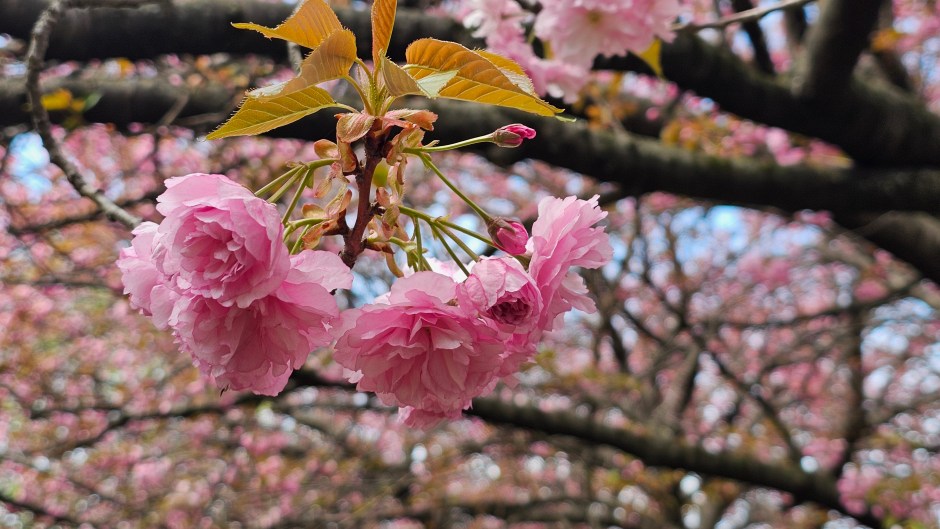
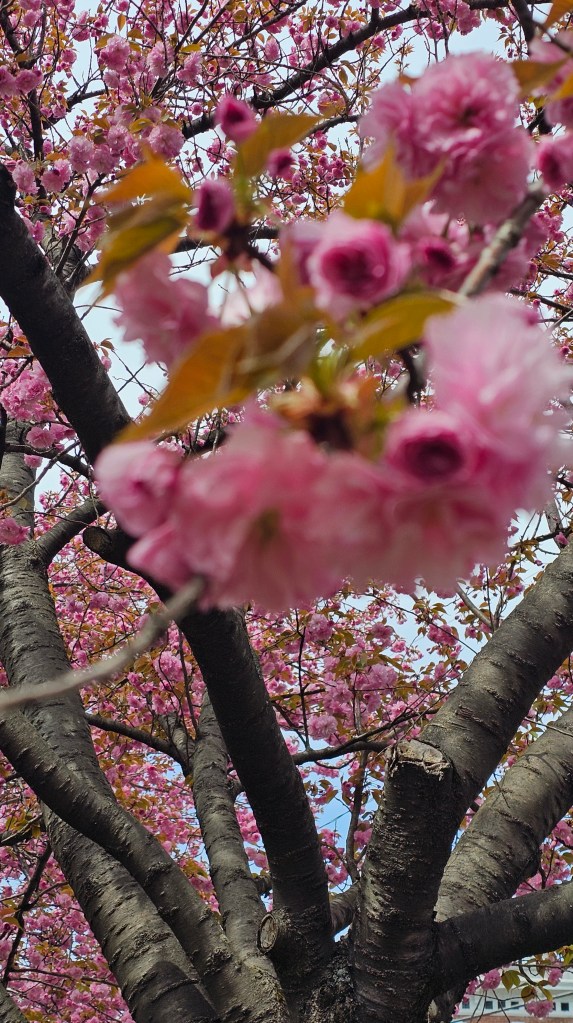
The trees stood in a stately row, forming a tunnel of soft pink. The delicate scent hung in the air, and a gentle breeze coaxed the blossoms into a graceful dance. Bicyclists glided past on the quiet street, and two painters sat capturing the season’s glory on canvas.
I wandered beneath the trees, breathing in the fragrance, taking photos to help preserve the memory. There was no formal path beneath them, just dark, soft earth that yielded slightly beneath my feet. The blossoms hadn’t yet begun to fall, though a few brave petals had already drifted to the ground, a gentle reminder that all too soon the branches would give way to summer’s green.
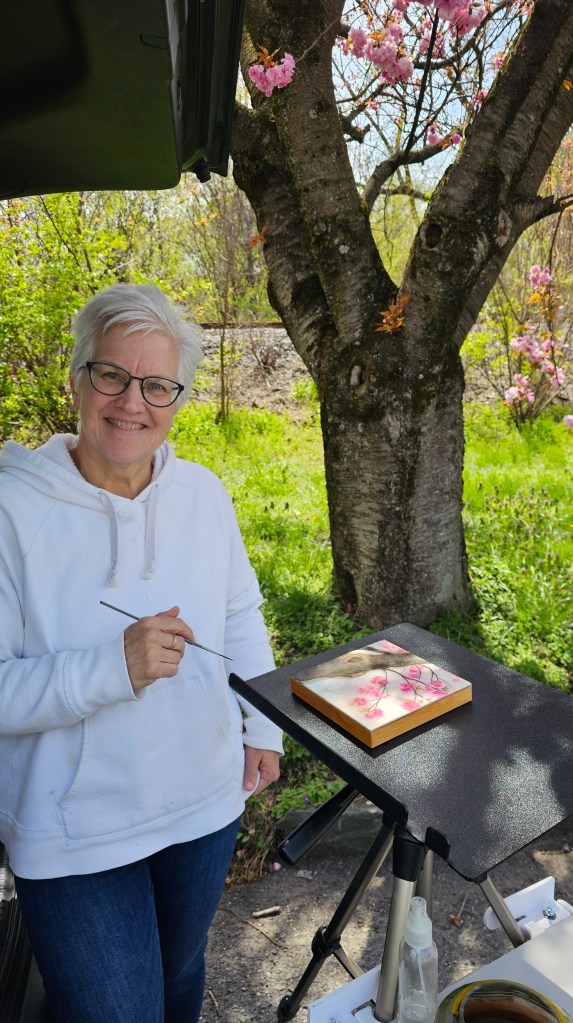
I was in good company as several painters were scattered along the row of trees. It was a delightful treat to be able to watch them capture the beauty of the trees extending it beyond the ephemeral spring season.
While it may not rival the landscapes of Japan, it was a small and beautiful taste of a dream. I’m glad I made the short journey to Marietta to witness their bloom, even if only for a moment.
How can you stroll beneath the cherry blossoms?
You may not need a passport or a plane ticket to find them. Sometimes, the dreams we tuck away for “someday” bloom quietly just down the road. Perhaps your local trees are smaller, or fewer, or missing the dramatic backdrop of a mountain temple, but their beauty is no less worthy of awe. A few trees in a quiet town, the whisper of petals in the breeze, and a moment stolen from the rush of life to simply stand and marvel, that, too, is magic.
So, dear reader, look around. Google may be your travel agent, but curiosity is your compass. The world, as it turns out, is blooming right outside your door.
Completed: 2025
Miles from home: 20
Cost: Free
Don’t forget to look around the rest of my Bucket List and Reverse Bucket List to get your curiosity going!
Ah, social media. A window to the wider world, filled with sweeping drone shots, glamorous airport lounges, perfect sunsets. A bastion of lies and filtered falsehoods.
I particularly love the “expectation vs. reality” videos: serene music turning to off-key chaos as the camera pans from a peaceful mountaintop to the hordes of tourists swarming the same spot. A perfect reminder that what’s posted is rarely what’s actually experienced.
Most social media travel stars wake up at 4 a.m. to beat the crowds and capture that “authentic” moment. What they don’t show? The sweaty hikes, the blistered feet, the questionable toilets, the stress, the transit delays, and the minor existential crises that often come free with your ticket.
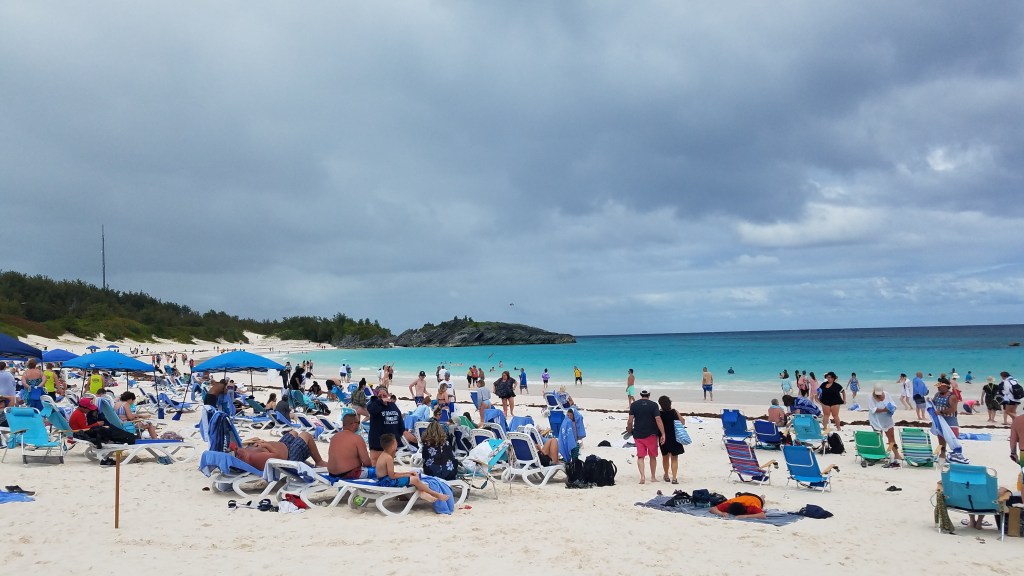
A crowded beach on the pink sands of Bermuda.
Let’s be honest, travel isn’t always glamorous. Plane rides can feel like being packed into a flying sardine tin. That dreamy Airbnb may smell like artificial lavender death. And the less we say about the bathroom situation in some places, the better. Seriously, though.
Even the photos lie. Take the pyramids, for example; they’re usually depicted as isolated wonders in the desert. In reality? Turn around and there’s the city of Cairo, complete with a McDonald’s. The rainbow hills of Peru? Instagram makes them look like Lisa Frank threw up on the Andes. In person, they’re fascinating but much more subdued.
And even when something is worth the hype, there are still snags. During my trip to England, I didn’t plan for a closed castle (thanks, high winds) or a GPS signal that vanished the minute I needed it. I didn’t expect public transit to lack accessibility for my mom, or for delays with the trains. My trip was amazing and beautiful; it was everything I would have hoped for, but there were still moments that kind of sucked.
2017 Solar Eclipse
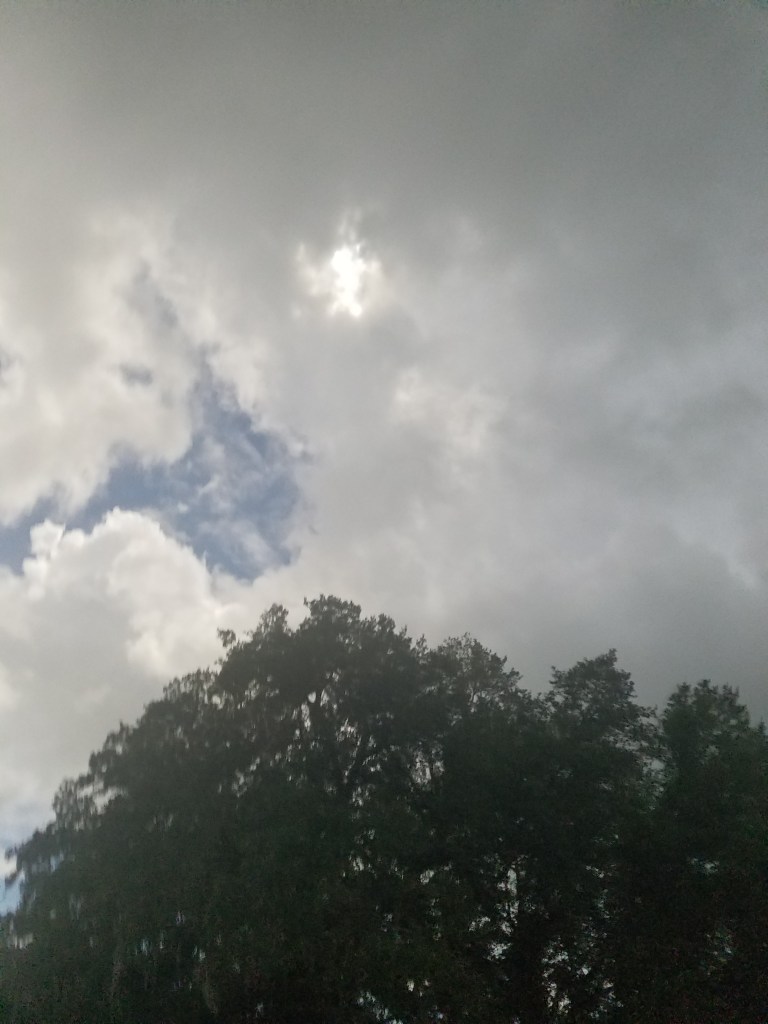
The 2017 solar eclipse? Cloud cover rolled in exactly at totality after I waited sweating in the southern heat for hours! Nature has a sense of humor.
Closer to home, even my local excursions are rarely perfect. The Firebird Festival? Visually stunning, yes, but also freezing cold and delayed by 30 minutes. My toes were plotting a rebellion as soon as they were thawed. The Tea Festival? Lovely, but forced into a crowded church basement by rain. Less “royal tea” and more “steamy sardine can.” That long-awaited hot air balloon ride? Grounded due to “iffy conditions” on what looked like a perfectly fine day. Perhaps, the balloon was sick.
And yet, those imperfect moments are the ones that stick. They’re the ones you tell stories about. They’re the quirks that make a trip memorable instead of just photogenic.
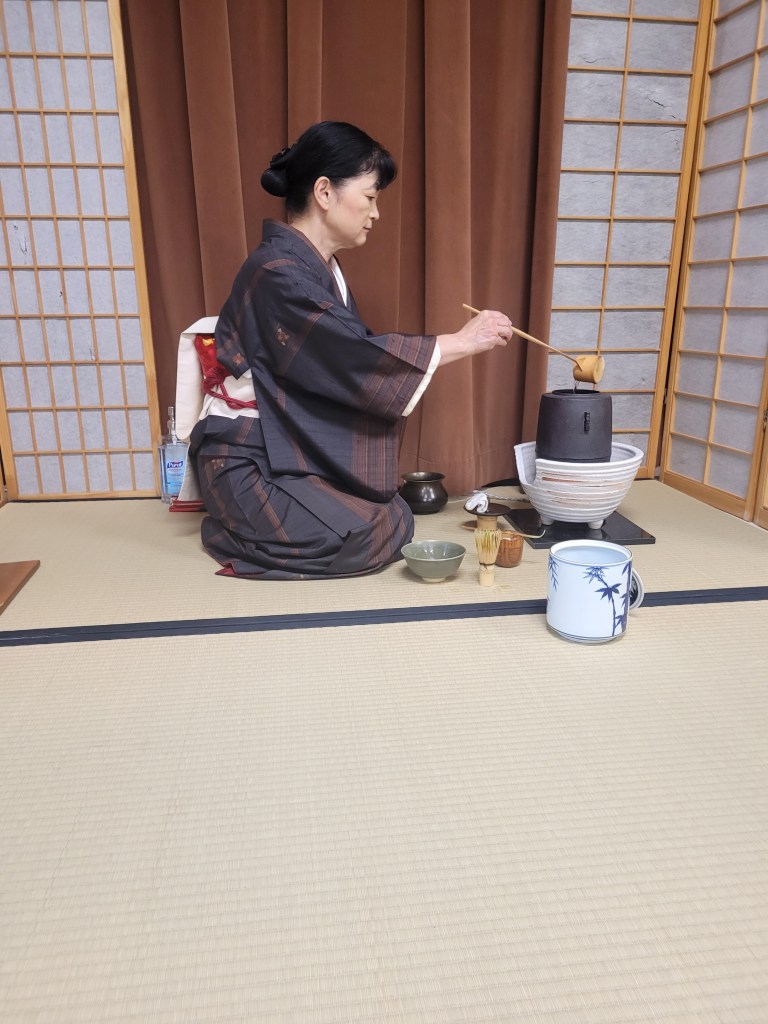
An intimate Japanese Tea Ceremony
When the Firebird crowd chanted “Light the bird!” in shared frostbitten frustration, I joined in. It was hilarious. When the rain forced us indoors at the tea festival, I ended up experiencing an intimate Japanese tea ceremony I otherwise would’ve missed. The cancelled balloon ride meant exploring a unique Star Barn one of the last in the nation. And a delayed train led me to a delightful conversation with fellow travelers about the cultural quirks of the U.S. and the U.K., a highlight of that entire trip. Getting lost in Washington D.C. led to snagging the last tour of the Congressional Building.
Setbacks create space for serendipity. They force us to slow down, reframe, or reroute, and in doing so, they give us something richer than a postcard-perfect moment. They give us stories, growth, and sometimes even stronger relationships.
That attitude—embracing the obstacle—has completely transformed how I travel. My sister and I started tackling trips together we never thought we could. Our bond has grown deeper because of the messiness, not despite it. I’ve even expanded my circle because of the chance encounters that travel disasters can bring.
Alright gentle reader, technically, it was a bay and not a sea. However, I did get to hoist the sails and attempt to steer the ship. Yes, technically it was a boat; although I”m not sure I know the difference if we’re being honest. Regardless of the pesky nomenclature, I provided an excellent afternoon tea out on a large body of water in a sailing vessel of some sort. Additionally, I made sure to be properly attired for a day’s outing on the water. With the help of a well placed hat pin not even the wind could dissuade me from my determination to have a little extra flare. After all, where would we be as a society if we allowed ourselves to descend into the mundane and boring, especially when it comes to fashion?
In the midst of COVID, with everything shut down and limitations on movement and gathering, the small but scrappy non-profit I worked for decided to offer its employees a day out with one of our board members, Peggy, on her private boat. To say that I was excited is truly an understatement. It was once again, one of those Bucket List Items that I had mentally placed under “most likely not happening any time soon” as I thought it would cost a lot of money to go. This might be the reason I was a little over the top, but honestly that’s part of who I am. I’m the woman who will put together an entire costume or outfit for even the most slightly themed party or obscure holiday.
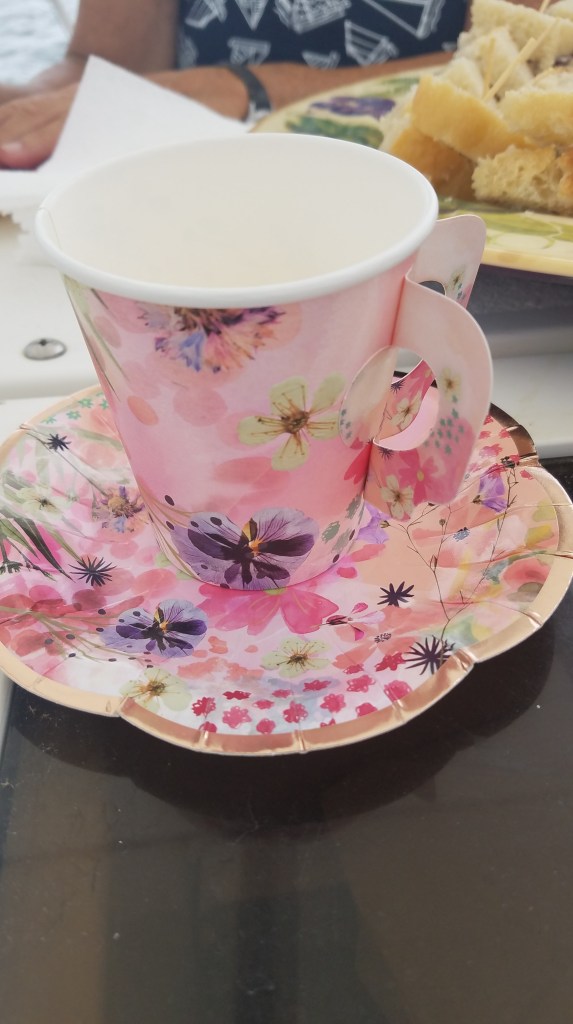
It was truly the morale boost that we needed. To avoid a disruption of vital client services and given the size of the boat, we divided ourselves into two teams which would go on two different days. We also divided up bringing food and other snacks to share. I led the way with letting them all know that I was going to have us do a tea at sea, I would provide the sandwiches, the tea cups, scones and clotted cream. Was it the more costly and time consuming option? Yes, but I was going to take this opportunity that the universe presented me and make the absolute most of it. Before you question my judgement of bringing tea cups on board a ship, know I take quite good care of my china and wouldn’t subject them to the dangers of the open waters. I found these absolutely gorgeous paper cups online!
We loaded ourselves up early that morning, crammed into one of my co-worker’s vans like the start of some quiet, well-mannered heist armed with gps and good humor. I had chosen to go with the more reserved, soft-spoken of my co-workers. What can I say? They paired better with tea than with the loud, pirate-hearted group that went the day before, I am fairly certain they snuck booze despite the prohibition against it, like I said, pirates. Not that I couldn’t hang with both, I absolutely could. And the temptation to burst into sea shanties was quite real, I assure you.
As we drew closer to our destination, the world around us began to shift. The foliage thinned, and the trees gave way to the briny breath of the sea. The air changed too, tinged with salt and carried on a breeze that hinted at something just beyond the horizon. We heard the call of gulls before we even saw the water. Then suddenly, there it was—a small forest of masts rising from the docks like white trees, standing in quiet anticipation.
Waiting for us at the dock was our fearless leader and Executive Director, Deb, who waved us down with her signature confidence. She led us up the wooden planks to our boat, where we were introduced to our captain for the day, Peggy’s husband, Captain Bob.
I was surprised by the size of the boat as it was deceptively spacious, like a magician’s trick. Every inch of it had a purpose. Storage tucked into nooks, seating that converted, a compact bathroom that came with very specific instructions. Bob walked us through the essentials with the seasoned calm of someone who knew that one improperly flushed toilet could quite ruin the whole experience.
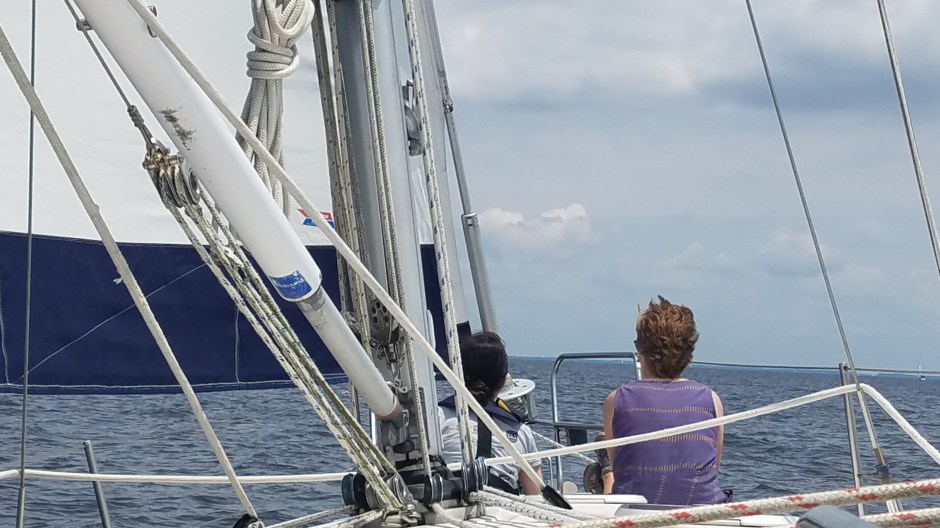
After a short safety overview, it was time to sail. Bob asked for volunteers, and I naturally stepped forward to hoist the sails. He called out instructions with the steady ease of a man who’s done this a thousand times, while Peggy provided cheerful backup support. I took hold of the rope with both hands to gleefully, heave ho and all that. The wind caught, the sails filled, and the boat surged forward with a kind of wild grace.
From that moment on, everything shifted into something more elemental. The boat leaned into the wind, the ropes pulled taut, and the world became motion and sound—the rush of air, the splash of spray, the low groan of wood and rope in motion. It felt like stepping out of the everyday and into something ancient.
Those brave enough made their way to the prow, legs dangling over the edge, laughing as waves splashed up to greet them. Time didn’t pass in hours out there. It passed in shadows, in sunlight shifting on the water, in bursts of laughter and long silences where we just watched the horizon breathe.
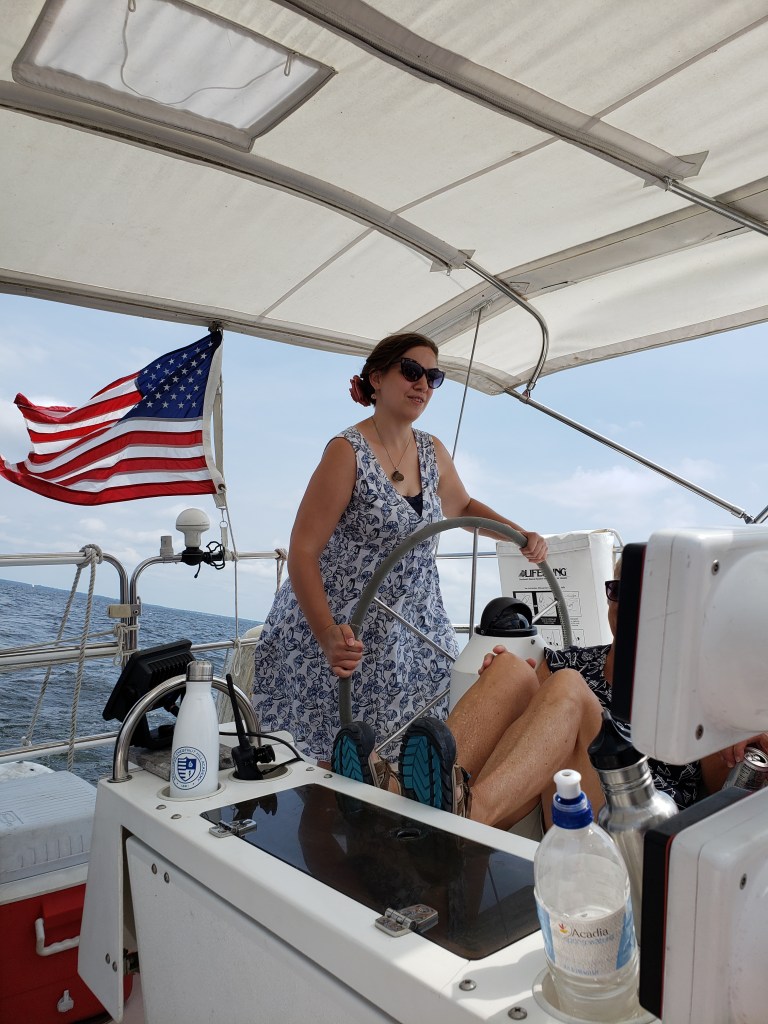
Then came the offer I hadn’t expected, Bob asked if anyone wanted to steer.
Of course, I wanted to steer the ship!
Taking the wheel was like grabbing hold of something alive. The boat didn’t just move; it responded. The wind pulled one way, the water pushed another, and the rudder spoke a language I didn’t quite know but instinctively wanted to understand. Every twitch of my hands echoed through the vessel. I had to fight the urge to overcorrect—big boat, big movements, right? Wrong. It was the subtle shifts that mattered. I wasn’t just steering a boat, I was holding a moment in my hands, trying not to crush it. I shall admit, I was not the best helmsman, but it wasn’t bad for a first go!
At lunchtime, I unveiled my small, slightly theatrical feast of tea sandwiches and scones. Though there was no clinking of teacups, people were quite amused by them. A delighted Peggy gasped when she spotted the clotted cream asking for where on earth I had found it; she hadn’t had clotted cream since she was in England years ago.
I smiled and told her, with all the drama she deserved, “The local grocery store.”
We laughed, we feasted, we sipped, and apart from poor Beth, who succumbed to a bit of seasickness, our tea at sea was a grand success.
The rest of the sail was a blend of freedom and focus, the hiss of waves, the sudden thrill of turning into the wind, the scent of salt and sun warming the deck. It was chaos and calm, all wrapped into one. I couldn’t have asked for a more perfect day for checking off my list. .
By late afternoon, we returned to the dock. We changed into swimsuits and slipped into the pool, letting the cool water wash away the heat of the day. We splashed and floated, reluctant to let the water go.
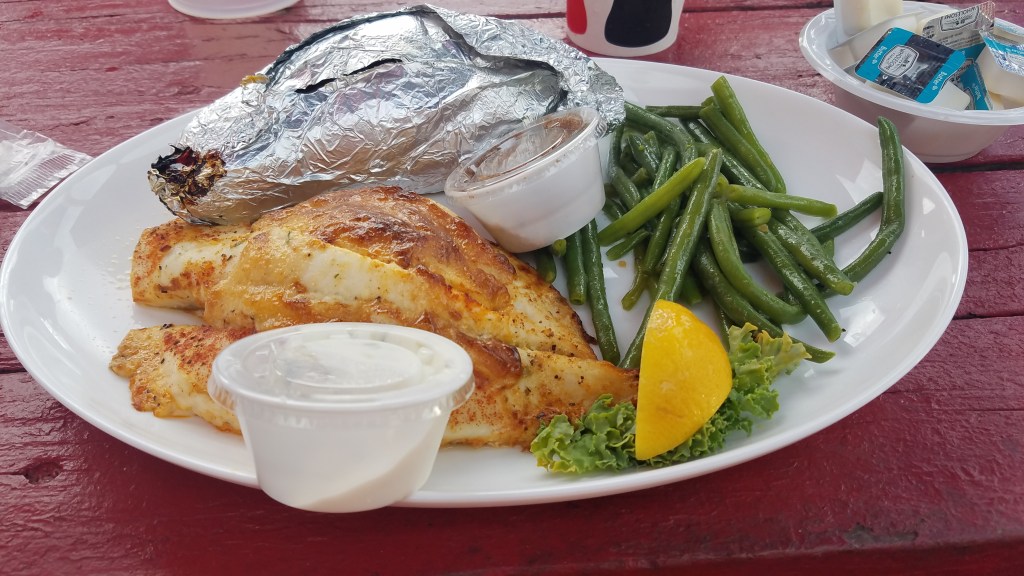
That evening, we gathered for dinner at a local seafood spot, the kind with fresh-caught fish, buttery hushpuppies, and that oh, so infamous, Maryland crab. I will say the crab practically demanded a moment of silence in appreciation. Luckily for the crab, eating is just about the only time I am quiet. And just when we thought the day had ended, someone suggested a detour when they spotted a sign for ice cream. Because some days deserve a sweet ending. And this one? This one absolutely did.
So how can you enjoy a sailing adventure?
I’ll admit, not everyone has a friend with a boat—or a boss generous enough to invite you aboard. But that doesn’t mean a day at sea is out of reach. You can always charter a boat for yourself and a few intrepid comrades. Prices can range from around $200 to upwards of $2000, depending on the type of vessel and the duration of your trip. That said, splitting the cost among your group makes it much more manageable. If you’re like me and pack your own feast, you can trim expenses even further. The boat we sailed on would’ve likely cost each of us about $50 to $75 had we booked it ourselves. Sure, we probably wouldn’t have been trusted to hoist the sails or steer, but with seven of us, the cost would have been quite reasonable.
This was one of those rare gifts from the universe, an unexpected adventure in the middle of a pandemic, at a time when most people could only dream of checking something off their list. I felt deeply grateful, especially after working so hard to help people who were experiencing homelessness with nowhere to go. Those long hours, with little reprieve and a general feeling of hopelessness at times to solve the problem can begin to wear on a person’s spirit. Sometimes, when you’re out there trying to do good, life surprises you with something beautiful in return.
So go ahead, pursue the good. You never know where it might take you, gentle reader.
I am, as of this writing, recently returned from a trip to Merry Ol’ England after finding myself with the unexpected invitation to join a family friend, Shelia, at her long term rental in the beautiful Penzance area of Cornwall. The previously unaffordable trip of plane tickets, lodging, food and sightseeing, suddenly became much more affordable with her willingness to host myself and my mom for over a week. Naturally, I did not let such an opportunity slip through my fingers as England was home to one of my top Bucket List items, Stonehenge.
Now, my non-American readers may be a bit perplexed at my excitement of going to Penzance when Stonehenge is a good four hours away. You may very well think, it’s so far, you couldn’t possibly add that on to your trip! First, dear reader, you underestimate the American enthusiasm for driving. After all, the road trip is a quintessential American experience! Besides lacking any sort of reasonable public transit, driving is just what we do and if you’re like me who drives for a living (at the time of this writing) spending several hours in the car is nothing. I had a co-worker who regularly thought nothing of driving 8 hours every other weekend up to New England to help take care of her ailing mother. Americans love driving.
Second, given that in order to have the opportunity to see Stonehenge again I would need to take another 6 hour flight after needing to take up an additional 2 to 3 hours just to get onto the flight after arriving at the airport after a 2 hour drive to the airport, and another 2 hours driving from London to Stonehenge, I think I can afford the day trip back and forth when considering the time and money it would cost to do at a later date. It was this cost analysis that really tipped the scales in favor of renting a car and visiting this site. As I am always reminding you, dear reader, that when one travels one ought to maximize the opportunity in order to get the most bang for your buck. We are, as much as it pains us all to admit, on a budget and when’s the next time we’re gonna be able to hop a plane to England from America? Exactly.
After determining that in addition to Stonehenge there were sites scattered about Cornwall that were simply too inconvenient to get to via bus (why they don’t go to the neolithic sites like the Merry Maidens or the Cuny Village is beyond me) and given that taking multiple taxis in a day would prove to be quite expensive to do multiple trips to various places around Cornwall in one day, renting a car ended for the week ended up being the optimal solution of almost $175 in savings when I broke down the costs. Plus, I didn’t have to wait around for rides or worry about meeting my taxi driver at a designated pre-booked time. Once again, my cost benefit analysis kicked in and it tipped it in favor of car rental as much as I prefer relying on public transit.
Now, the best laid plans of mice and men will go astray. In this case, the hiccup I encountered was my phone’s gps. Despite paying for the ability to roam and setting it up ahead of time, when I arrived in England my phone refused to connect and kept telling me that I needed to turn on international data. I would go into the phone settings to see that it was indeed turned on and got a text message from my provider stating that it was turned on. We tried several different work-arounds suggested by the internet once I got to my friend’s place and was able to connect to her internet but nothing worked. Luckily, Sheila allowed us to use her phone for the day to get around. With the crisis adverted, we set out in the wee hours of the morning to make it for our 10 am admission time.
I had downloaded music to my phone for us to jam to and decided to put my newfound mastery of the British road system to the test. I had (smartly in my estimation) scheduled Stonehenge for the middle of the week in order to give me two full days of test driving on the opposite side of the road in more rural areas before trying to go to more populated and congested places. I actually took to it quite well and credit my dyslexia for being an advantage as I really could hardly tell the difference. I just kept the steering wheel in the middle and followed the visuals provided by the gps rather than following her left or right turns since I can’t do that anyways. So, cross off driving on the opposite side of the road as a bonus!
The way up to Stonehenge was relatively uneventful and I got to really take in the rolling English countryside. The morning started out with classic English weather of rain. However, by the time we reached our destination the rain had cleared leaving a mostly overcast sky that threatened sunshine.
Now to say that I was excited to see this legendary place, is bit of an understatement. Of all the monuments and sights in this world, Stonehenge is without a doubt one of my top destinations and probably one of the first places I ever truly longed to visit. I was fascinated by the ancient world of Great Britain and Ireland, obsessed with learning about them even though I could (when I was younger) find very little about it. It was this blank hole of questions that burned into my mind, what were they like, why did they build this, how did they build it, what spiritual meaning did it have, how did it connect to other sites and on and on these questions plagued me. I loved the theories, no matter how crazy or outlandish they were. And what I love is that we’re still uncovering things about it, only just last year they did yet another study of the stones and discovered that they come from all over indicating that this may have been a unifying project to unite the island.How does that fit with other archaeological evidence for the rest of Britain? There’s just so much we don’t know.
Stonehenge is over 5,000 years old and is the largest neolithic monument in Britain. There is evidence of important structures and even other henges prior to the building of Stonehenge in the general area marking it as an important or prominent site in the stone age. Some of those sites are from 8000 BC You may be forgiven dear reader for thinking it’s just a stone circle, as impressive as that may be; it actually sits upon an earther work with a marked avenue leading up to it. A “heel stone’ marks the alignment with the summer solstice. This avenue and stone is the reason we can say it aligns with solstice and not some other random astrological event. It is also not just one stone circle but two concentric circles and other stone pieces to create a masterpiece of that era.
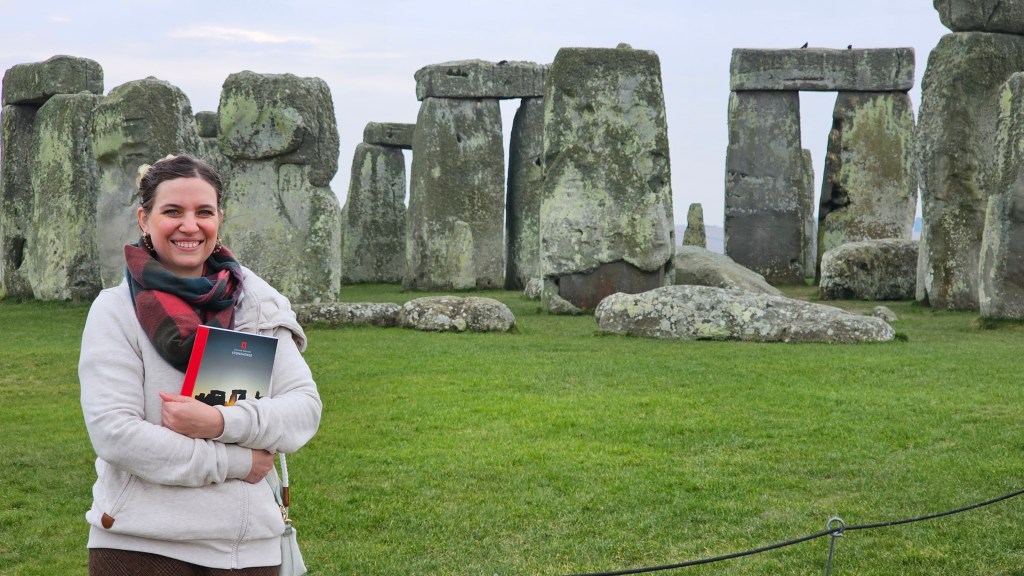
I am standing by the “heel stone” which marks the line of the summer solstice
It took over 1,500 years to complete in four different stages. The first stage was in 3100 BC, the second stage occurred in 2500 BC; the third took place 150 years later and the final stage occurred in 1,500 BC. This is when the stones were rearranged into their iconic horseshoe shape. There were about 60 stones originally, but sadly many are broken or even missing today. Despite the presence of human remains, it is not believed to have been a burial site but that these remains were utilized in religious ritual. Although if you read other people’s opinions they’ll tell you that it was a burial site. See? So much mystery!
It was being armed with this knowledge (and much more, but I shalln’t bore you with all the details), that I practically squealed in sheer anticipation more than once as we approached. I was finally actually there, instead of seeing it on a screen or in a book. There was equal parts excitement and awe as we drew closer. The thing about the site is it is actually located in an almost surreal location because one expects that it would be in an area relatively built up. However, it is just out in the middle of nowhere surrounded by sheep and farmer’s fields. Yet, it fits exactly in the landscape that one finds it in because thousands of years ago the builders may have had sheep. For all we know sheep have been hanging out near those stones this entire time.
I loved being able to closely study the stones, to see how they may have been joined together by the knobs at the top of some of them and to picture how it may have once been so many years ago. I marveled at the craftsmanship that must have taken to hew rock into rough formations of giant blocks and to lift them up atop each other.
What was particularly nice was that I went at the slower time of the year for England, choosing to go right before spring at the end of winter, so it was relatively uncrowded. I didn’t have to fight to look at it and I was even able to snag pictures without people in them. Most pictures contained very few people. This also meant that I was able to really focus on what I was seeing without having to worry about what everyone else was doing around me. After my first circle around the stones snapping lots of pictures, I put my phone away and made another loop so that I would be able to just enjoy the place taking in the sight and locking it in my memory. Too often we are so busy “documenting” our experiences we forget to actually experience them. I was determined to not make that mistake.
After spending nearly two hours at Stonehenge, we journeyed back on the bus to the visitor center for a quick bite to eat before departing. There was a reconstructed Stoneage village that I took a brief detour in. But having been in the ancient village of Carn Euny the day before (another post on that later), I didn’t spend very long. They also had a small museum of the artefacts found in and around Stonehenge which is very informative if you haven’t spent a lot of time studying the site.
How to visit Stonehenge (and other suggested sites):
I’ll not insult you with instructions on how to get to England. However, it is important to know Stonehenge is located about 2 hours south of London making it a fairly easy trip for most people who are intended to tour the country. It is a far less easy trip if you’re flying into Scotland. My American readers may be forgiven for underestimating the size of Great Britain as it is about a 7 hour drive between the two and while we do love driving that is a bit of a haul even for us unless it’s part of an entire road trip especially since most of us only have two weeks of vacation a year.
However upon arrival, you have two options to see the actual site. Option 1: Is paying the admission ticket (and parking) to Stonehenge which grants you access to the bus transfer over, the reconstructed village and museum. The main advantages to this option is the bus transfer if you’re with someone with mobility issues and the ability to walk around the entire site to see it from all angles.
Option 2: Is parking a little away from the site and accessing the footpath which traverses right next to the walkway in front of Stonehenge. It does require a bit of a hike to get from where you can park the car and Stonehenge. The path isn’t well maintained, in part because while the English have the right to roam on the ancient footpaths, the right to roam doesn’t necessarily convey the promise that someone will be maintaining those footpaths. It also only allows you to really see the front, but it is the best and most famous vantage point. If you go during the peak season you’ll probably be disappointed by the sheer number of people blocking your view and any pictures you’ll want to take. If you go during the non peak season you will probably be able to get a decent view and maybe a few pictures with only a few people milling around in the background. It honestly depends on your priorities.
My wonderful and amazing mum!
For me, I was traveling with my mom, who doesn’t have the best health and needed the extra support with mobility. I also wanted to be able to get as close as I was permitted. There was an option to get there at 8 am, pay a lot of extra money and be able to go into the circle at sunrise, but I would have needed to leave by like 3:30 am, wake up at like 2:30 am which would have meant no sleep for me and I didn’t want to be driving that long on no sleep as driving without sleep is akin to driving drunk. I wanted to see Stonehenge, not die in a car accident on the way there. Remember we want to check off our bucket list, not hurry the bucket along.
Now, you may be thinking that there is absolutely no way that I could possibly write a list of “good enoughs” when comparing them to Stonehenge, but it entirely depends on you as an individual. For me, Stonehenge has been a top priority since childhood, so when given the opportunity I jumped on it. However, there are many Neolithic sites and Neolithic stone circles scattered not only across Britain and Europe but also throughout the world and you may be closer to them than you think. Granted there aren’t many that are quite as old as Stonehenge but there are many that are within the 3,000 – 1,000 range.
If you don’t care much about the size of the stone circles, Britain, Ireland, and Brittany (France) has over 1,300 circles. Many are quite impressive in their own way. They are also less visited and often allow you to be able to go right up to them without needing to pay for tickets or have them roped off, meaning you don’t have to fight with crowds, you can actually touch them and you can enjoy them more as they were intended, as places of spiritual connection, celebration and reflection.
The Merry Maidens of Cornwall!
Stone circles aren’t just found in Europe. There are stone circles in Australia which are sacred to the Aboriginal peoples like the stone arrangements in Victoria at Carisbrook. You may also be surprised to find out that Japan has stone circles from the late Jomon period located in the northern region. Like Stonehenge the Japanese Stone circles contain an inner and outer ring which is aligned with solstices. Even the states has its own stone circle in Wyoming called the Medicine wheel. There are other less famous circles hidden in Nebraska’s Sandhills and Bluemont Virginia.
If you don’t really care what formation a neolithic site takes, then the world is truly your oyster because scattered throughout the globe are sites from ancient pre-civilization peoples. Ohio is famous for its Great Snake Mound as well as the Newark Earthworks. White Sands New Mexico has footprints from over 20,000 years ago – take that Stonehenge! Colorado is home to the Cliff Palace located in Mesa Verde National Park. New Mexico has its own cliff dwellings as well as Aztec ruins. The small island of Malta has Megalithic temples. Ireland is home to Newgrange. One of the oldest known megaliths in the world, Gobekli Tepe, can be found in Turkey. Spain is home to the Dolmen Menga. India has its own dolmens in Marayoor Munnar and I could go on. As you can see dear reader the world is awash with ancient monuments if you know where to look. You may very well be shocked at how close you are to one. So don’t feel the need to put Stonehenge on your list of “must-do’s” if you haven’t already developed an obsession like me, but if you happen to find yourself in England the it is decidedly something I would recommend you make part of your trip.
Cost: $50*
* give or take with the exchange rate, going during non-peak season for a “super saver” discount and pre-booking online for an additional 15% discount and then accounting for the gas to arrive there from the rental.
Miles from home: 2,000
Miles from rental: 200 miles
Cost accounting for plane tickets, etc.: $150*
* You may wonder how I arrived at this number, it’s simple, I took the total cost of my travel (planes, buses, taxis, etc.) and then counted up all the places I checked off my list as a result of traveling to England, divided the total cost of travel by the number of places I got to go to arrive at about $100 per place. As it turns out England has a lot of places and experiences that are on my list which is why it was a top place to visit. I made certain to check off that list to maximize the money I was spending.Using this basic formula is something you can do when deciding where to go and what to do in order to maximize your travels. Yes, the upfront overall cost is quite high, but when considering how many things you can do at once, it may be worth the cost.
While this post was from an adventure many miles from home and involved a plane ride, many of my adventures were just a short drive away. Be sure to check my other posts listed on my Bucket List and Reverse Bucket List.
Book lovers know the allure of bookstores and libraries. There’s something about walking into these sanctuaries of knowledge and stories. The distinct smell of the books, the quiet atmosphere that is seldom found in other public spaces, the aesthetic symmetry of rows and rows of carefully shelved worlds. The promise that an entire universe may be unlocked with just the turn of a page. The stories almost seem to whisper an invitation and your fingers start to itch with an eagerness to begin the search. So many dance partners want to fill your card and it is almost dizzying.
There is even something extra special about a bookstore that offers a little more. Beautiful bookstores, charming bookstores, the ones with cats and tea, the ones with stacks upon stacks of books. Ones that even use books as structures like the book tunnel in L.A.’s famous Last Bookstore. Baldwin’s bookstore is just the sort of bookstore for booklovers. Named one of the most beautiful Bookstores in America, this hidden treasure of Chester County can be easily overlooked if one is not careful.
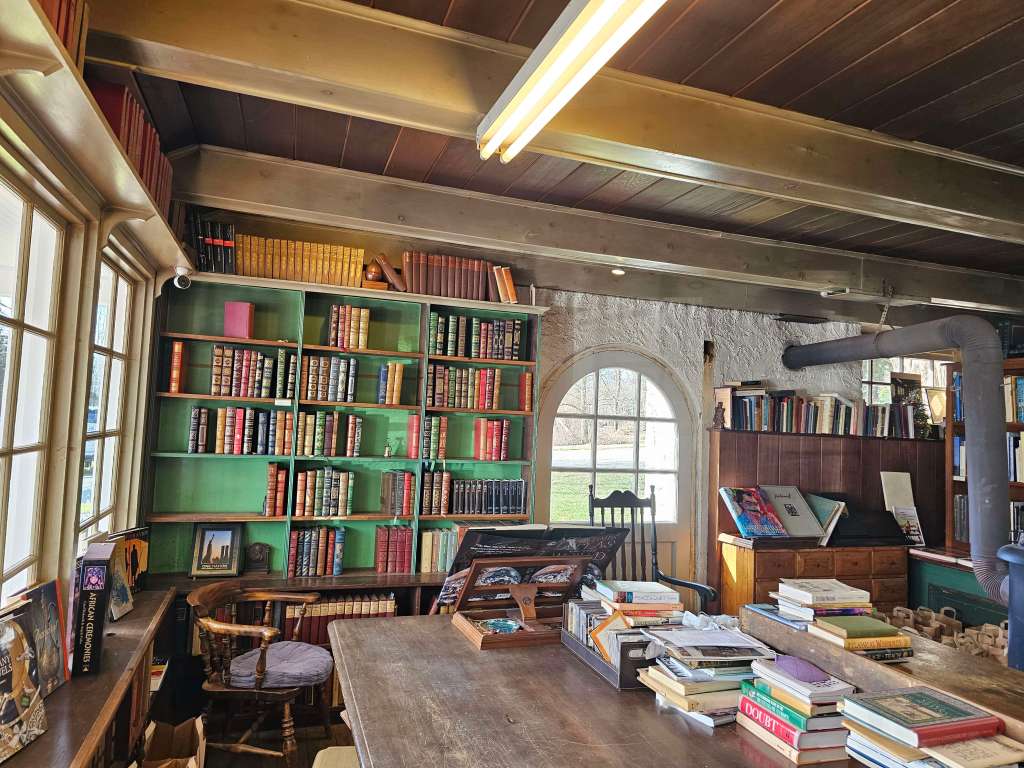
Seriously, you can drive right by it and not even notice that you’ve passed it as outside it is an unassuming stone barn. One would never guess that it houses 5 stories of books and has a sizeable collection of rare and antique books. As it is primarily a used bookstore, it is always a treasure hunt and one never knows what one will find tucked away on the shelves. It is so large and extensive that it has a map for visitors at the front and even with the map, one can find oneself semi-lost among the stacks of books.
A quirk of the bookstore is that many of the shelves are not shelves at all, but rather nailed together crates. This charming store invites you to venture up stairs to ever higher levels. Tucked around every corner are chairs, some more enticing than others, for you to sit and read to your heart’s content. It would be easy to spend hours if not days inside the store.
My sister and I ventured forth on a cold’s winter’s day after grabbing breakfast together at a coffee shop near my house. We had saved this particular outing for the colder months as we are not overly fond of extreme hot or cold weather. It is always good to have a few indoor activities in your back pocket for those times when it is simply too miserable to spend much time outdoors.
Upon entering the store, we were greeted by a delightful display of older and rare books. We breathed in deep, savoring the familiar smell of books. The older gentleman behind the front desk said good morning and inquired as to whether it was our first time to the store. He showed up the map and politely explained the general layout of the store and encouraged us to peak in the backroom which housed a few artifacts from when this barn was also a home. After the short orientation, we began our exploration of the store.
We carefully meandered through the rows of books of over 300,000 books, stopping to peruse for overlooked gems. One of the gems was the map of Philadelphia from over 100 years ago displayed on a table (not for sale). Both my sister and I adore old maps, so it was an unexpected treat to be able to sit and study it before continuing our book adventure.
One thing of note for the taller readers, there are numerous signs to “duck” when going up and down the stairs, so be wary when transitioning between floors. Despite being in a barn, most of the areas were quite comfortable with only one or two places lacking in proper insulation for the temperature to be comfortable. We did stop to take a few pictures of ourselves in the books.
It was easy to see why it was named one of the loveliest bookstores both inside and out. The original stone building was built in 1822 and the rustic shelving and floors only add to its charm. Sadly, I did not spy any of the rumored cats said to be residing in the barn. It is possible they were sleeping in a corner somewhere or perhaps they were no longer in residence.
My sister and I found a few treasures and made our way down the steps to the front of the building for our purchases. Satisfied with our treasure hunt, we went home to enjoy our books. I am certain that I will make the journey again for another visit. After all, with an ever changing inventory there is certain to be other diamonds in the rough to find in the future.
How can you visit a beautiful bookstore?
Bookstores abound and business is booming. Something good that came out of the pandemic was the increased demand for real things, real recommendations from real people. We’re wired for community and connection, something that a digital reality can’t really replicate (though they do try). Not only are books a form of entertainment, but also people are forming communities around books. Bookstores are also one of the few places that seemed to sell a variety of board and card games aimed at adults. Bookstores have become hubs of community and connection.
Going to Indie and used bookstores like Baldwin’s is often a treat not only for finding books but also for the atmosphere they provide. I encourage you to seek out the hole in the wall places. They don’t necessarily have to make a list of “most beautiful” because with all the hundreds of bookstores, how could a writer of a popular magazine or blog really know if they missed yours? And besides beauty is in the eye of the beholder.
I had the privilege of spending a semester abroad in my academic studies. For five months, I was halfway across the world, in a non-English speaking country for the most part on my own with limited support. This was a world before smart phones and easy roaming charges. I was for the most part armed with a local flip phone for emergencies, my wits and conversational German. It was just as daunting and fun as one imagines.
I suppose it was this experience that really solidified my adventurous spirit. How many times have I thought to myself “If I can get lost in the middle of Paris and still catch the train back to Marburg how hard can this be?” It instilled in me a sense of confidence to be able to navigate foreign places, solve problems on the fly and still be successful. There were certainly challenges.
There were the physical challenges that Germany presented me on day one. I thought I was a fairly experienced traveler having flown numerous times in the United States and I figured that Germany being another Western Country wouldn’t be too different. Stairs are apparently a thing everywhere in Germany and pose a much more serious problem than in the US when it comes to traveling with multiple bags. I had packed my bags anticipating the ease of traversing an airport with multiple rolling bags that I had in America, but Germany wasn’t as accommodating when it comes to rolling suitcases. Luckily, I did have some help in that I was traveling with a group of students, but they weren’t always the most helpful.
First, getting the bags down the escalators was a nightmare. I distinctly remember one of our bags just tumbling down the escalator as a complete hazard. Second, the trains had stairs. I had never encountered trains with stairs. I don’t even think I had seen such things in movies. Now, it does seem that since I’ve been in the country the train system is not as ruthlessly efficient as I remember it being. However, when I went, the trains were almost always on time and they did not wait for you to finish boarding, you had to get on or you would be left behind and the staff would not wave to the conductor to hold for you.
So there I was tossing my bags up onto the train and trying to get myself on with probably less than two minutes to get myself on board. The stairs were more akin to ladders than stairs, so I was trying to frantically climb onto the train with my bags. Being a naturally clumsy person, in a situation where balance was particularly challenging, I of course started to fall backwards. Luckily for me, the train doors shut just as I was about to stumble back onto the platform. Had I fallen back sooner, I would have been left on the platform with my bags on the train in a strange country and no real way to contact anyone. Had I not managed to get my bags on, I would have been on the train with the bags left behind! Certainly not my best moment! The saga of the stairs did not end there, there were stairs everywhere with almost no elevators to speak of, my legs looked amazing my the end of the trip and I do recommend the Germany Stair Master 5000, 5 month workout plan to you aspiring models.
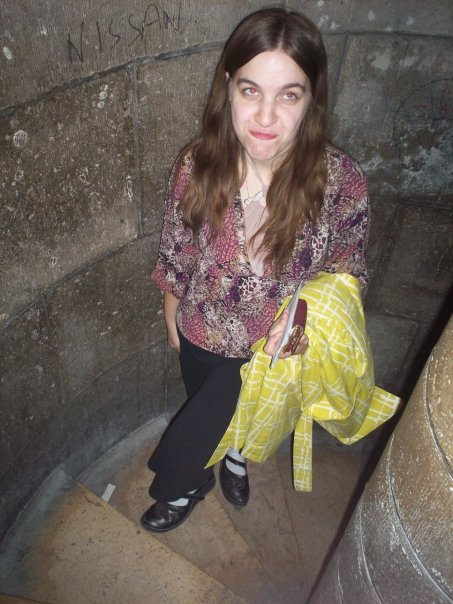
My face at seeing that I had to climb yet MORE stairs!
I faced the challenge of navigating a truly arcane system for signing up for classes. I had never seen such a discombobulated, uncoordinated system in my life. Some classes you signed up for in person, some were online, some you had to practically hunt down like some sort of secret cult meeting. I’m still not exactly sure how I managed to actually sign up for my classes, but I somehow squeaked by with the requirements and managed to get myself in courses I felt i could handle with my level of German. Although Frankfurt in Mittelalter was more than I could chew since the first day they wanted me to read latin and I had to read 15th century German documents for a research paper. Essentially, it was like handing a non native speaker of English the original Canterbury Tales and telling them to have at it. I may have spent 3 days researching the history of the German language in order to translate what I was reading before attempting to write anything.
While I was there, I independently traveled to Paris, Dublin, Nuremberg, Cologne, Frankfurt, and Rome. I planned every part of those trips from booking the plane tickets, navigating transportation to and from the airports, found the hostels and traversed the cities learning the unique public transit of each one. I went with a group of school students on a trip to Berlin and joined Brethren Colleges Abroad for trips to Vienna and Strasbourg. These trips did not involve how to get there or where to stay, but I did have to traverse them on my own, figure out which sights I wanted to see and ensure that I was on time for the checks in.
While there, I bought my own groceries on a strict budget (most of my money went to my trips rather than to food). I cooked my own food learning how to use a gas oven which terrified me the first time I used it because I had never had to light an oven with a match before. I had to learn how to sort trash like the Germans and all the quirks of their culture. I learned to navigate a completely arcane university system as well as see the world a little differently. I met a fantastic travel companion, a fellow American who shared my love of reading. I wish I could say we stayed in touch and are still best friends, but sadly like many adult friendships it did not last much beyond our semester in Germany as we were from and returned to different parts of the country.
My trip to Dublin
While I was in Germany, I took advantage of the relatively cheap travel through Ryanair and checked many things off my list. I will say that for the most part I was unable to savor the cities that I visited as I often only had 1 ½ to 2 days in which to see them. That did require me to at times semi-race through places focusing on the absolute “musts” rather than casually strolling through as I may have liked. The Louver itself is a whole day affair if one is to truly take it all in. Sadly, I only saw the highlights rather than everything it had to offer. Which is really what can be said of several of the places I visited (Paris, Dublin, Berlin, and Strasbourg) other places I like Vienna and Rome, I had an entire week to see which allowed me to do much more. I even took a day trip to the beach while in Rome, so I can say that I swam in the Mediterranean. It is unsurprisingly much like swimming in the Atlantic, at least just outside of Rome it is. Also, after Paris I was much more able to navigate the foreign public transit system as I had very little experience prior to coming to Europe
Through all my adventures, I was required to bring a “can do attitude” and resourcefulness. I managed almost all my mistakes or set backs with grace under fire with one exception. But even that turned out well.
I got to know so many people in my travels. I listened to their perspective and saw how the different parts of the world views America and by extension me as an American. Some of them were harsh criticisms, others were high praise. I was baffled by the Spaniard who was insulted that I hadn’t chosen to learn Spanish rather than German. I was embraced by a very drunk Irishmen who was just thrilled to death about Obama’s recent election after George Bush. I got to witness a student protest over tuition which blew my mind because back home we all just sort of shrugged with a “what can we do?” when faced by yet more college fees. I listened to young and old shared their lives, their hopes and their thoughts.
Traveling abroad expanded my horizons, strengthened my character and taught me resilience. It reinforced my spirit of adventure and voracious appetite to learn about places, experience things and know new people.
Myself and my travel buddy Erica whom I met in Marburg
How can you live abroad?
For many people this is a Bucket List item. Although, I suspect it was mostly put there by people who are much richer than the rest of us. If you aren’t a college student, this is a much more difficult prospect as the semester abroad only cost me $600 more than staying at college (not counting the extra trips I took). To me it was well worth the $600 extra investment on top of the investment I was already making in my education. Otherwise living abroad can be quite costly without gainful employment and how many of us realistically are going to find jobs where we can work in another country? I have seen some groups which advertise house sitting in Europe which would help take care of your accommodations, but there’s still pesky things like food that you need to pay for and if you’re house sitting you can’t really travel around all that much. Plus, what about your own house back home and your job?
That doesn’t mean that all is lost. One of the principles of the thing is that you’re willing to put yourself in a fairly unfamiliar situation, with limited access to outside supports forcing you to navigate unique challenges and overcome. A solo road trip through the United States where you just jump in the car and go, may present you with similar challenges.
The other principle is that you’re interacting with a lot of different people from around the globe with a willing and humble spirit to be shown their perspective. I continue to do both things in my life. Taking a short week backpacking in Mexico or Peru can be just as challenging if not more than navigating a semester in Germany. Talking to someone online who’s from Beirut may expand your understanding of the world far more than talking to someone you met in France because of the greater cultural differences.
Just living abroad does not necessarily confer these challenges either. It is easy to wall yourself off in an English speaking enclave and never leave depending on where you go. Had I gone to Germany, only hung out with American students, taken classes in English and never left my dorm, would that have given me the same experience? No, I may as well have stayed in America for all it did for me other than give me some social clout to say “I spent a semester abroad”. Remember, dear readers, we do not marry the principles of what we desire to the thing itself. Our desires can manifest in many forms and be just as satisfying if not moreso.
Still if you truly desire to do so, then my recommendation is to learn another language and start applying for jobs abroad. You obviously don’t need to learn another language, but it is certainly helpful. As of this writing the best jobs abroad are teacher, volunteer, medical industry, tour guide, yachting, au pair, scuba dive instructor, yoga instructor, working for an international company and obtaining a working holiday visa. As you can see many of them are easier said than done and do require some sort of specialization. So do your market research and consider what it would really mean to go abroad. After all you only live once, why not live it a little unbound?
Completed: Spring 2009
Cost: $600
Miles from home: about 4,000
Full disclosure: As stated above, it was only $600 in addition to my college tuition, so I’m not counting the cost of tuition as I would have paid that one way or the other. I also didn’t include my additional travels but all told they probably cost me about $1500. Two of those trips were covered in the cost of my studies.
It seems almost impossible to think about Christmas without thinking about lights. In Western culture almost no other holiday is so linked with light, which is appropriate considering it is celebrated at the darkest time of the year (for those of us in the Northern hemisphere). There’s just something so mesmerizing about small points of light holding back the dark. They always bring a smile to my face. I especially enjoy seeing larger displays where people can showcase their creativity and transform an ordinary place into something extraordinary, and Koizar’s Christmas village is exactly that sort of place!
Since 1948, the Spring Lake Dairy Farm has been delighting people. Originally, a display created for the enjoyment of his wife Grace and their four children, it quickly expanded front he original house and barn. People soon began to flock every year to see the display at the locally named “Christmas House.” Eventually, Koziar began to admit visitors while still operating the dairy farm. Overtime, the dairy farm and even the house were abandoned to the ever expanding light displays. For over 75 years, the farm has been literally lighting up the night as the lights can be seen from miles around. It has even been named Best Outdoor Christmas Display in the World by Display World magazine (according to Wikipedia anyways).
It takes approximately 90 minutes to walk through the many displays which run the gambit of themes from beloved classic tales like the Nutcracker to Bible scenes from displays showing Christmas traditions around the world to prehistoric dinosaurs. There were plenty of places for photo ops, tucked in various places and with such frequency most of them were without long lines. There are panoramas, a kissing bridge, gift shops and snack shops. One can warm up with a hot beverage like apple cider or hot chocolate while munching on popcorn or chocolate chip cookies. There is one place which serves more substantial food such as pizza and burgers. It is almost entirely outside, so dressing warmly was a must for this particular outing.
How does one capture in writing what 8 acres of over a million lights looks like in simple words? Even the pictures I share here, dear reader, are only the smallest snippets of the sheer magnitude of that many lights. Each area held a new delight and theme, some had seamless and natural transitions, others were abrupt and almost disjointed side by side.
What most delighted me was how simple and even outdated everything was. There were wooden decorations clearly from the 60’s and 70’s. There were handmade items which had been lovingly repainted over the years. It was in stark contrast to so many of the other light displays that one could go see, because it felt organic and human. It was clearly a labor of love untaken over decades. There were many store bought displays but they were interspersed with homemade characters and storyboards. It was simultaneously a display of Christmas lights and a museum of decorations over the decades. One of my favorites was the Wild West section with the christmas buffalo. There’s even a whole section featuring a model train. Despite being a professionally run tourist attraction, it still felt like a display cobbled together by your overly enthusiastic neighbors, perfectly capturing the nostalgia of seeing Christmas lights.
My sister and I ambled through the lights, taking time to soak in the array of themes. We stopped to study the displays, finding small touches which brought us smiles of delight, like the angel fawn near a nativity or the zoo train with the tigers. We stopped to enjoy hot apple cider and churros. I also bought a pair of gloves having realized I accidently left mine at home. There were only a few places where we could slip into to escape the biting cold of the evening, but we were lucky that it wasn’t too cold. Eventually we ended up passing through a large garage which proudly displayed the history of the village before going into the final gift shop. We left fully satisfied and well in the Christmas spirit.
How can you see amazing displays of Christmas Lights?
Luckily, this is something that you can see almost anywhere during the Christmas season and there is almost always a place nearby with overly enthusiastic neighbors. Some may be drive through places, others may be like Koziar Christmas Village where you can walk. It depends on whether you wish a slow meandering stroll in the cold where you can stop and really take in each display or if you wish to remain warm in your car. There may be ones that are put on by professionals such as Candy Lane at Hershey Park or family affairs with all their quirks like Kozier’s Christmas Village. You can also find a local neighborhood and walk around to see everyone’s displays. In the last few years, my home town has been holding a contest which has helped to revitalize people’s interests in putting up lights. You could even start a contest in your hometown if you’re feeling particularly entrepreneurial.
Completed: December 2023
Cost: $13 per person (It would have been an extra five dollars to attend on a weekend or the week of christmas)
The battle of Gettysburg was one of the defining moments of American history. The Union’s victory over the Confederate army was the turning point in the Civil War, leading to the restoration of the union and ensuring the end of slavery. The battle took place over the course of three days from July 1st to July 3rd, almost coinciding with our nation’s 86th birthday. It was also one of the bloodiest most devastating battles in our history.
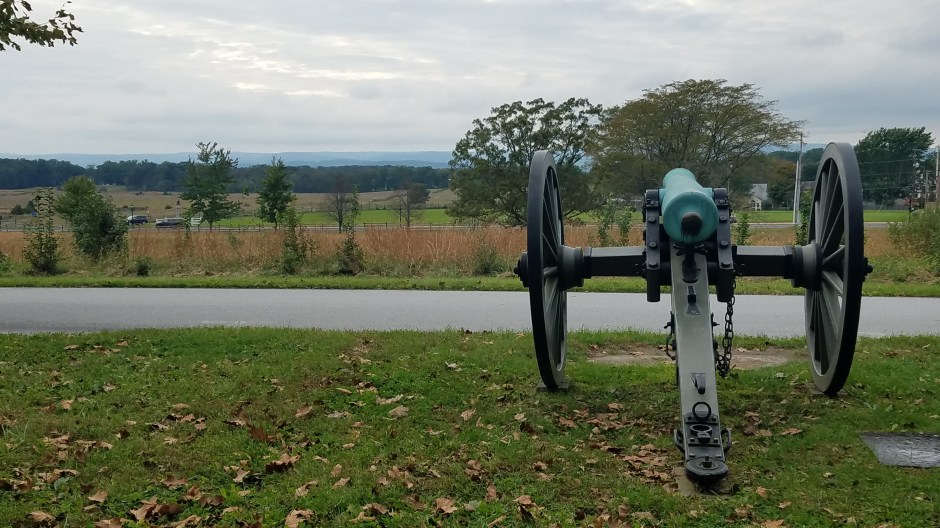
Visiting the site of this place can be a bit surreal. Today, the fields lay semi-empty. The dead have been given proper burial. The gunfire has long since ceased and it only returns for reenactments and salutes to honor the fallen. To the educated eye one can still see the evidence of the battle and how the lay of the land was shaped by it and helped to shape the battle itself. For example, one can still see clearly how the Union’s superior position of the high ground helped them win despite having less troops.
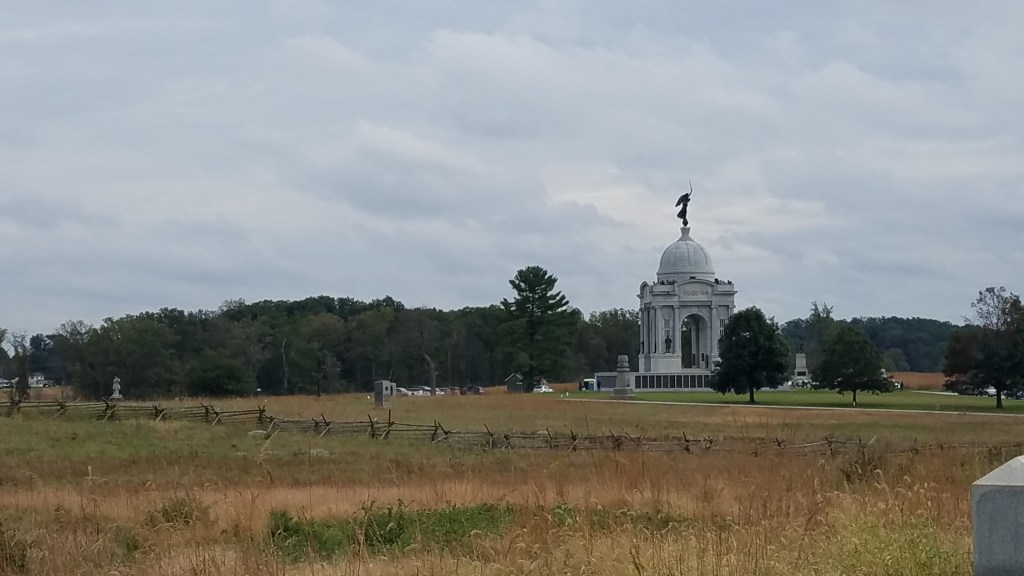
It is now home to many monuments to the fallen from all over the states. Naturally, the Pennsylvania monument is absolutely massive, but others are smaller. Some are dedicated to large groups, but then there are more specific battalions and legions remembered. It is easy to forget that each of the men who perished on the field had a name, a story and purpose to be there. It is not easy to take up arms against one’s own countrymen.
In the surrounding town, they offer various walking tours highlighting moments of history. They talk about the miracle that only one civilian died in the fighting, they point out bullet holes. What is really striking though is the sheer amount of death the residents saw, the description of pools of blood from the surgeries and piles of limbs that had been hacked off to try to save lives. They describe the stench that lingered for weeks in the hot summer. They whisper of ghosts still lingering on over a century later. If one believes in such things.
Still in among the ghost stories, there is real history being remembered. There was a high cost to pay to preserve our country more than the cost to form it originally. It answered the question of whether we truly were a nation of freedom for all or only for some. A question that will need to be periodically asked and answered as we continue to navigate conflicting rights and values. It is a place that when visited demands at least some reflection of the cost that had to be paid for today’s America.
Despite growing up relatively close to it, I had not really visited the battlefield until I was an adult. The annual classroom field trip that year had been replaced with a trip to Philadelphia to see the visiting display of the Russian Tsars. When my family did finally visit, I was a teenager and the thought of tramping about a field in the heat of summer with my father was unappealing, and I opted to go elsewhere with my mom and let my brother and father walk about the fields. So in the fall of 2018, I finally went with my boyfriend to see where it all happened, put history in perspective and learn more about this monumental event in our nation’s history.
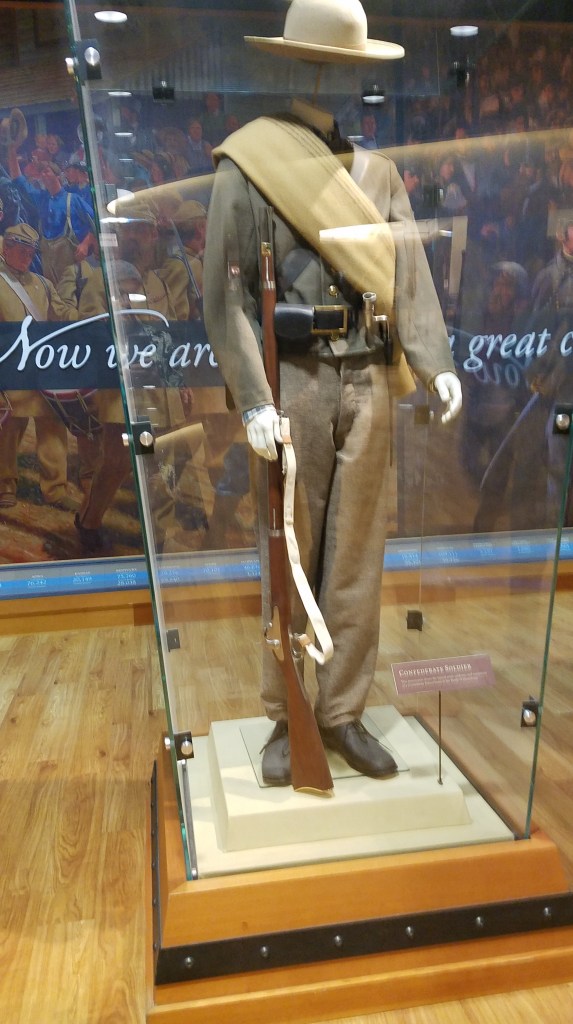
I can’t say that I necessarily learned anything new about the battle that I hadn’t already heard in the classroom or seen in documentaries, but what I did know was brought to life by seeing the physical artifacts from the battle and hearing the intimate stories of the people who were there both solider and civilian on both sides of the war. There’s something to be said about seeing and interacting with physical objects that allows our minds to form a more emotional connection with the knowledge or at least enhance our knowledge through other senses.
It is always strange to visit the site where tragedy took place and one must acknowledge the Civil War was tragic. It was tragic for a nation to be ripped apart and that the effects of that can still be seen over a hundred years later. It is also tragic it took a civil war to confer the basic human right of freedom from slavery to all living under our nation’s flag. On one hand, it is a place of history that should be remembered and respected, a place where people died to give other people freedom. On the other hand, it’s a site of enjoyment and relaxation. People come to visit on their vacations and for a day off of school. They enact the battle for entertainment, as well as to keep the stories alive. Children run through the fields laughing and playing around the cannons. Tourists take goofy pictures in front of memorials. For me the juxtaposition of both is important, because in some ways it means healing has taken place and is a testament to the resilience of people and our nation.
How can you add this to your own bucket list?
Unfortunately, this is one of those things that cannot be substituted easily if going to the actual Battlefield of Gettysburg is on your list. It’s in PA and unless you’re nearby, it won’t be cheap or easy to get here. In which case, may I recommend google flight tracker and hotels.com? This may be an instance of the principle of the item rather than the item itself. The principle behind visiting Gettysburg was to see an important site of our nation’s history that helped shape our identity and defined us. If you live in the south, there are many other Civil War battlefields that you can visit. If you live in the North East, especially in New England, then you can visit many sites from the Revolutionary War. In the South West, you have the Mexican-American War. California was home to the gold rush as well as the Japanese Internment Camps and the Watts-Riots. The Midwest is of course home to the west itself and the expansion of white settlers into the territories. I highly recommend seeing what is near your hometown. You may be surprised to find your seemingly insignificant part of the country actually helped shape us in the amazing country that it is today.
Completed: 2018
Miles from home: 75
Cost: Free to visit the Battlefield, Visitor’s Center. Museum is $15, Museum+ Film is $21
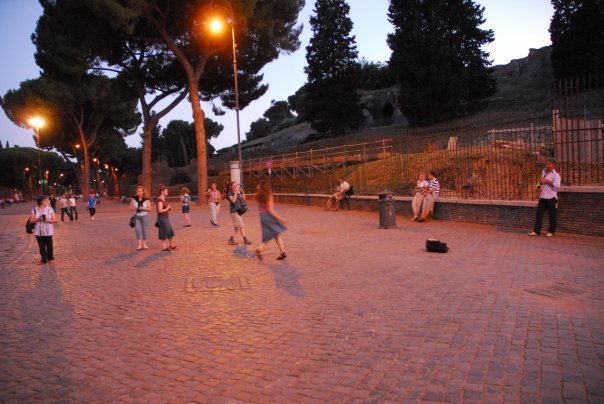
Maybe it was the music itself that enticed me. Perhaps, it was the wine at dinner. Or maybe it was the allure of Italy itself that wound itself around my legs and compelled me to dance. All I knew was the night was still young as the sky was turning to twilight and the saxophone drew me towards it. What else could I do, but begin to sway and dance to its siren call? As I twirled and danced upon cobblestones, I caught glimpses of the musicians smiling as they played, keeping the song going as I was caught up in its magic spell. My skirt swished gently about my legs, my arms flowed of their own accord. I can still almost hum the low, almost slow almost sensual tune, though in truth it plays along the boundaries of memory, faded with time and unfamiliarity.
To be young and uninhibited again, unbound by the constraints of societal expectations and propriety. To simply find yourself in a place where the music is playing and the urge to dance takes hold. It is not very often one stumbles upon street musicians unless one is in a city, such as Rome, but one must take advantage of such moments. It is one of my favorite memories from my semester abroad because I danced as if I were alone, unconcerned about the crowd or who might be watching. I let myself live freely in the moment, embracing the serendipity of music at twilight.
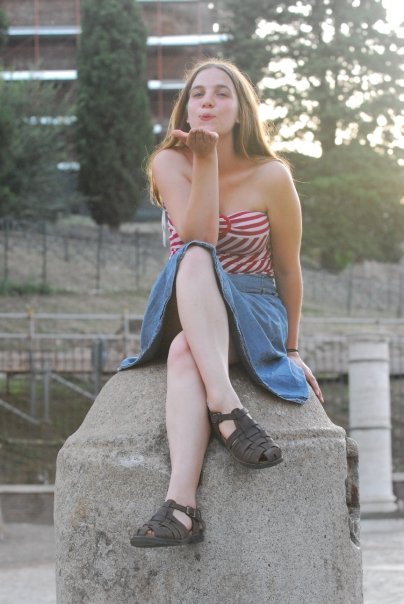
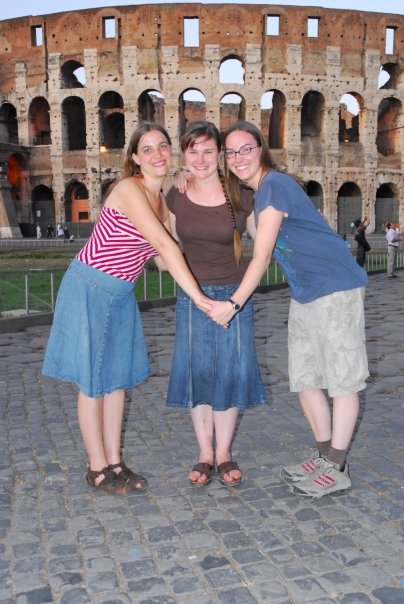
As it so happens, not only did I delight those playing by my ample appreciation of the music, but also of a nearby photographer. He happened to catch me dancing and was inspired by my boldness. For a short time afterward, I was his muse with a short and impromptu photoshoot in the plaza before the Great Colosseum itself! I unfortunately only have the pictures which were sent on to me and lost the gentleman’s name. But I will forever be grateful for the phenomenal memories he helped preserve. Perhaps, this blog post will find him and I will be able to give him proper credit.
It was not my first foray into impromptu dancing, for I also danced at the spring festival in Marburg in the rain, again much to the delight of the musicians. I may have said only moments ago, “to be young and uninhibited again”, but the truth is, I still am! Uninhibited that is – I’m almost 40, one has to embrace middle age gracefully and not cling to youth in some sort of grotesque fashion. One should not stop dancing to street performers just because one is no longer in one’s 20’s! One should not stop embracing moments of joyful abandon. Is there a song to sing at karaoke? Belt it out! Did you stumble across a public art project inviting you to paint? Join in! Be spontaneous! Embrace your impulses and passions! Be silly! Don’t be afraid to look foolish! Had I not been fearless to dance in the middle of public, it would not have led to a photoshoot in the middle of Rome! How many people can say that of their journeys? Not many? Exactly! Fortune favors the bold after all!
Now dear reader, you may be wondering why this would grace a bucket list as it seems like rather a small thing. Really, dancing on the street of all things to a “lowly” street performer? What sort of standards do you have for your bucket list, you may ask.
First, it’s my blog and I’ll blog what I want to. My list, my rules. You go make your own list with your own rules.
Second, consider how few people would actually be bold or brave enough to do this? How many of them hold back? Does it even occur to them to dance? Or have they been so conditioned against any sort of unauthorized or predesignated fun that they don’t even think to dance? Have you, dear reader, ever acted with such impulsive abandon? For me this was about living without fear or anyone’s judgements. A life well lived includes doing things off the beaten path, allowing your passions and impulses to occasionally run riot. I love music and I love dancing, why should I deny the urge to embrace life when it so fervently invites me to its arms?
Besides, when you do embrace life not only do you bring delight to yourself, but also you bring joy to other people. In my hometown, there is a young man who frequently goes out dressed as a templar knight. His reasons are his own, but he started to become a bit of a celebrity. People are posting sightings of him. They’re excited to see him. It brings us joy. I love that there’s someone out there just living his best life as a templar knight! There’s another town in Canada where a man walks around with a giant carrot and people LOVE it. There’s stories of people passing out flower crowns or leaving chalk art on the sidewalk of their neighbors to bring them joy. The world needs our whimsy dear reader!
Sidenote: Before doing chalk art, check your local ordinances as in some towns this may be illegal – some places really have outlawed fun!
All of these are stories of people doing something a little impulsive and making the world a better, more magical place because of it. The third reason is that it made my trip to Rome that much more memorable. Consider how many travel stories seem to consist of the same things, especially such destinations as Rome. Don’t get me wrong there is a reason people go to the same places and see the same things, it would be silly to go to Rome as a tourist and eschew the Colosseum as plebeian because everyone goes to Rome to see it. But this punctuated my week-long trip with a truly memorable experience, it made the Colosseum special to me. When I think about the Colosseum, I think about dancing! I strain to recall that haunting tune. For a moment, I am back there. If we don’t authentically express ourselves out in the world, what are we even doing? Are we really deeply experiencing life or just pretending to?
How can you dance like no one’s watching?
If you are interested in replicating the magic of impromptu dancing, the best way is to use your ears. Pay attention to your surroundings. Obviously if you visit a city, you are much more likely to encounter the stray musician. Be sure to pack along a few dollars to show your appreciation if you are intending on seeking out someone to dance to. However, I will admonish you to not seek this out specifically. After all, half the fun is stumbling about it naturally to let the music extend its hand with a flirtatious invitation to join it. Then by all means accept the invitation, let it embrace you in its arms and let go.
The principle of course is to be open to serendipity and to take advantage of the opportunities that arise. When a creative opportunity presents itself, meet it head on, boldly and passionately. Dive in with careless abandon. After all, a life well lived is one with passion and risk. Not every boldly taken action will end well. You may be booed off stage of the open mic comedy club. You may be told afterward you sang worse than a braying donkey. But that’s okay! In the words of Theodore Roosevelt, “It is not the critic who counts….The credit belongs to the man who is actually in the arena.” Do not content yourself with sitting on the sidelines dear reader! Enter the arena of life and dance as if no one was watching!
Completed: Spring 2009
Miles from home: 4,371 (though this can be completed almost anywhere)
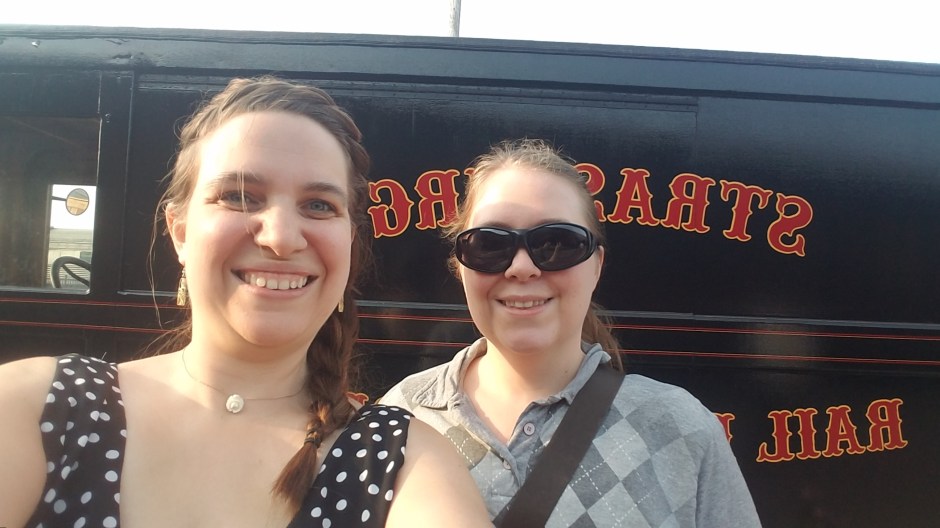
hat could possibly be more romantic than an antique train through the summer countryside, the cornfields lush and green, cows grazing in their pastures and the blue skies dotted with clouds? Other than including a companion known for her poise and stimulating conversation? Why a little wine, of course! And what could be a more perfect place for such an adventure than the oldest continuous railroad in the United States?
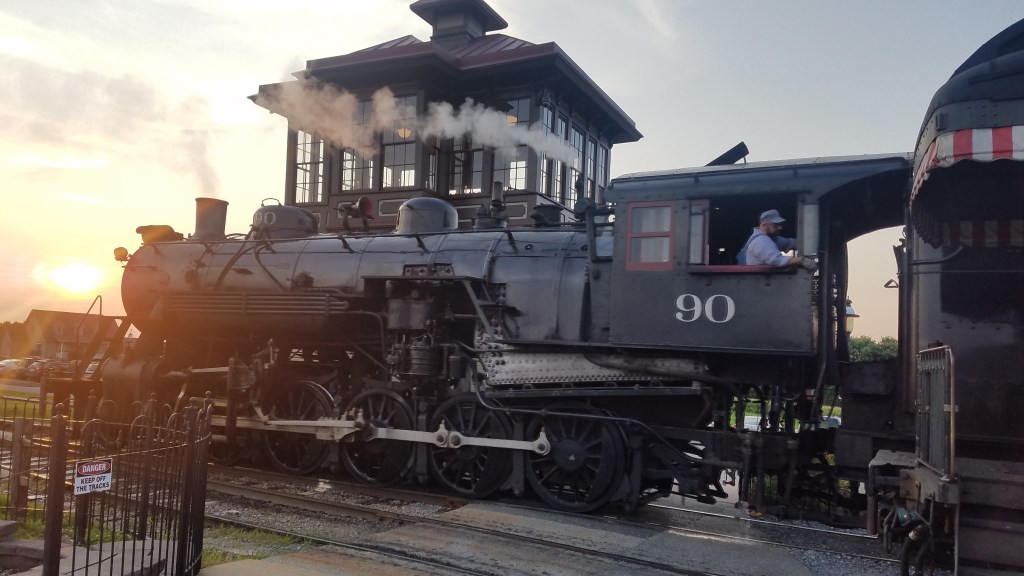
Built in the mid 1800’s, the Strasburg Rail line faithfully provided transportation to the residents of Lancaster county to ensure they stayed connected to the larger railroads. However, with the rise of the automobile and significant changes in rail usage, it had been reduced to the poorest and smallest railroads in the country. In order to save this piece of history, a group of railroad enthusiasts purchased the railroad and began to offer tourist excursion trips. Within three years, ridership had grown from 9,00 a year to 125,000. In order to keep up with customer demand the directors turned to the steam engine. Today, Strasburg offers visitors the opportunity to climb aboard a fully restored steam locomotive in a beautifully restored wooden railcar and gaze out at the lovely Lancaster County countryside.
While not train enthusiasts per say, my sister and I are history buffs who enjoy experiencing how life once was. What was impressive was not only were the trains historical, the railroad itself from the ticket booth to the staff were also historical. It felt like stepping into a history book where we could leave the hustle of modern life to embrace a slower time. We had arrived early so we were able to not only stake out our seats but also to explore the railcar a little. We loved the details that went into every inch of the car from the light fixtures to the woodwork. It is difficult to imagine such care and craftsmanship being put into our railcars or airplanes today. The environment of the old-fashioned railcar was warm and welcoming rather than the cold industrial experience public transit currently offers. I immediately relaxed into the comfortable leather seats settling in for my 45 minute ride.
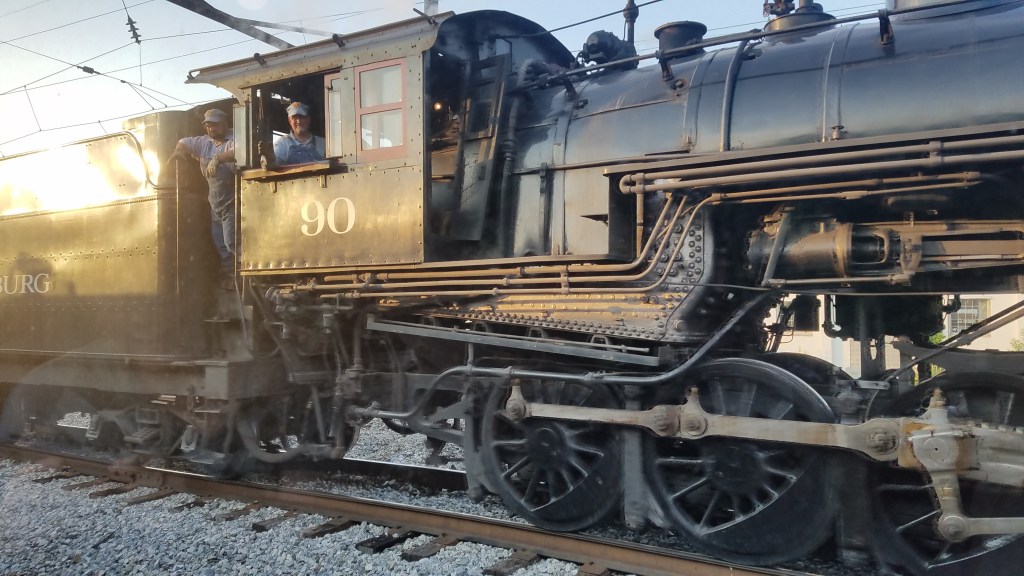
The steam locomotive, also called the Iron Horse, dominated the railways from the early 19th century through the middle of the 20th century. They were a vast improvement over the old system where horses were used to pull carts along rail tracks – hence their nickname. An early model was designed and constructed by John Fitch a steamboat pioneer in the United States in 1794, but it’s the United Kingdom that gets the credit for fully developing the idea and utilizing it for commercial use. They work by using steam to push the pistons of the engine up and down. That movement is converted into the back and forth motion of the wheels through a series of rods – piston rod to main rod, main rod to side rod, side rode to driving wheels. Through such a simple system the age of steam revolutionized the west.
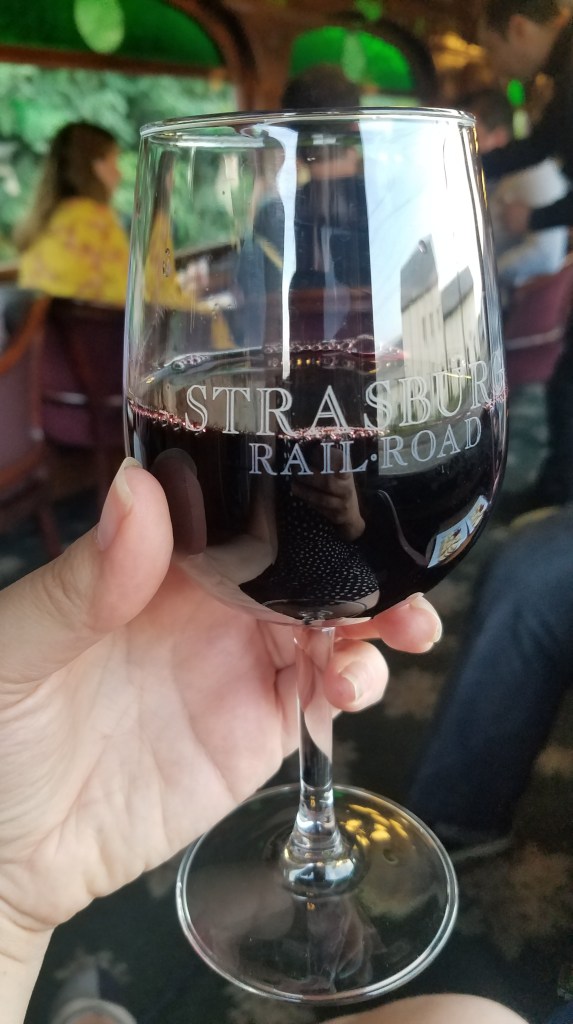
The staff, like the staff at the ticket booth, were dressed as they would have been in the 1800’s when the train was operating to connect passengers to the larger rail systems. They punched our tickets to get us started and gave a brief overview of the train. Then we began the wine tasting being offered two different whites and reds. From the four wines, we would be able to select one to enjoy a full glass. Naturally, I chose one of the reds and my sister, surprisingly, enjoyed the same one – she usually prefers the whites.
As we snacked on the offering of cheese, crackers and grapes, we gazed out at the rolling hills. The rail car shook rhythmically and under the murmur of conversations, one could hear the characteristic pattern of the steam engine chugging along. The sun began to set, changing the sky from a near perfect blue to a paler almost lavender hue. We sipped on the full bodied red, toasting to life and adventure. We were able to catch sight of another steam engine on the tracks and even snap a few pictures of it in action as it passed us by.
How forty five minutes manages to stretch out into what could have easily felt like two hours of relaxation can only be explained by the time machine that was the Strasburg Railroad. It seemed as if no time had passed since we started our journey and yet it also felt as if we had just spent hours traversing the fields. We disembarked fairly content with our adventure and with hopes to enjoy the other offerings that the railroad has to offer in the future. Though with an ever growing list of adventures to try, it may be a while until we are able to step back into the history books.
How can you experience a historic train ride?
Luckily, there are many places where you can experience a ride on a historic steam locomotive, from the line of Whitepass & Yukon in Alaska to the State Train Museum in Georgia. Many places can be found https://www.trainchasers.com/steamdirectory.html though if you don’t see your state listed, it’s not an exhaustive list. It’s just a very good starting point for where you might a locomotive near you. Unfortunately, for those of you living in the middle of the country, most of our rail lines have disappeared, so if this interests you, consider checking out if there are any historical railways near your next travel destination. Remember when we do travel, we want to try and make the most of our travels and explore things we don’t typically have access to. You may also see if there are other historic modes of transportation available to you such as a steamboat ride or early automobile. Perhaps, you can enjoy a steam engine in a train museum. Remember, it isn’t about doing the exact thing but looking at what it symbolizes and what sort of experience you desire to have.
Additionally, I cannot promise that any of these will offer a wine and cheese pairing, but each of them offer a unique experience from Murder Mystery theaters to sight-seeing to simply moving from one place to the next. On a historic train ride in Panama, we were treated to seeing the country from coast to coast, sampling coffee and being entertained with songs.