Japanese Tea Ceremony

“There is no trouble so great or grave that cannot be diminished by a nice cup of tea.”. – Bernard-Paul Heroux. 

When I was about five years old, I was obsessed with tea parties. I was first introduced to them through my mother’s own passion. She would take us to the local herb shop and the tea shop nearby to purchase quality tea and scones. At home, the water would be boiled and poured into a china pot, a timer set for the proper amount of time for brewing and then carefully poured out into the cups. It was during this time that she imparted to me the rules of tea, how to hold the cup, what order the tea should be poured out to each guest, the polite amount of sugar to add, when to add milk, how to stir it without making a ruckus. I learned the difference between afternoon tea and high tea (it’s not the same thing), that one eats the savory first then the sweets and exactly how one eats a scone properly (by breaking it apart into small bits). 

Over tea, she taught me about Victorian England and the antiques that decorated our house. She was quite fond of the late Victorian era, and I developed the same fondness. As part of my education, she bought me a tea book for my birthday. I was elated (yes, I was a strange child, I grew up to be a strange adult and I’m okay with this fact). I flipped through the pages and discovered an entirely new sort of tea, the Japanese Tea Ceremony. The book did not go into it overly much but it did allude to the sorts of things one might encounter, the special Macha tea, the whisk and the sweet that they might serve. In combination with my discovery of the Karate Kid, my love of Japanese culture was solidified and later reinforced with my introduction into anime (which I won’t get into here, other than Princess Mononoke was a definitive experience of my childhood). 

Ever since my discovery of the Japanese Tea Ceremony and all things Japan, I had wanted to experience it for myself. I got the chance in the summer of 2021, when I took the hour drive out to Shofuso Japanese Cultural Center.  The house was designed by Junzo Yoshimura as a 17th century style home. It was built in Japan in 1953 utilizing traditional techniques and then shipped to New York as part of the Museum of Modern art. It found its home, however, in West Fairmount Park in 1958 where it has graced the greater Philadelphia area ever since nestled in a beautiful Japanese Garden. It includes a pond garden with a waterfall, island, koi fish, traditional tea house and bathhouse.  
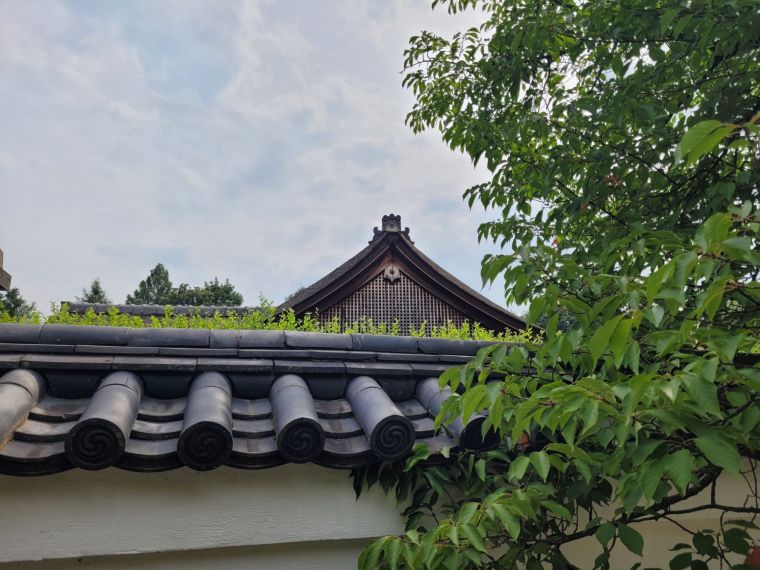
Walking through its gates, one could easily forget that one has not in fact hopped on a plane to the middle of Japan. Every corner of the building is a beautiful work of art, carefully tended and maintained. What delighted me was the dedication to keeping the building authentically Japanese. Unlike in America when something like a floorboard has some sort of damage or rot, the Japanese do not uproot the whole floorboard and replace it. Instead they cut around the damaged section and then fill it in like a puzzle piece. There was a sort of beauty in keeping the story of time rather than a focus on perfection. Flaws were a natural outgrowth of a house in use and there was a sort of artistry in the repair. 

Men and women in kimonos graciously answered questions about the house and pointed out its secrets. They informed us that the murals of the house were donated by an artist in 2007 and were inspired by the waterfalls. They told us about the hinoki bark root (the only one outside of Japan) and how it took 1.4 million dollars to repair it back in 1999. They were excellent hosts whose presence engendered a sort of respectful quiet in the guests. It is not that we did not speak, only more in hushed whispers as to not disturb the peaceful atmosphere. It is a house that invites calm reflection and relaxation rather than exuberant outbursts. 

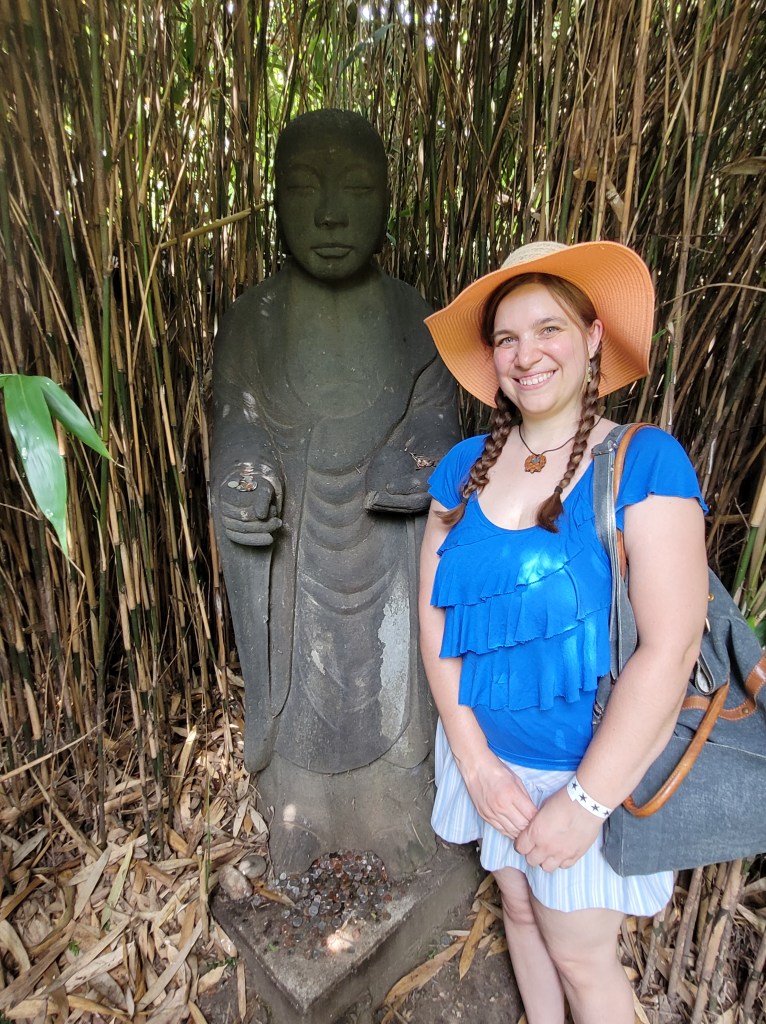
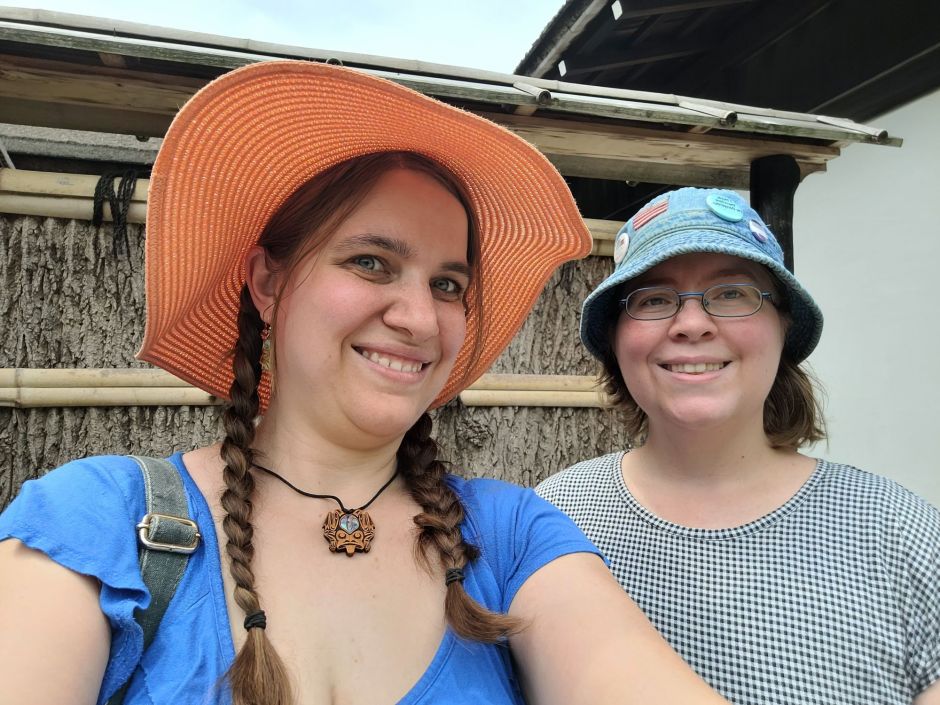
In the heat of the summer, my sister and I explored the small garden which encircles the house. We took a moment to pause by the Buddha statue, littered with small offerings and tucked away among the bamboo. We sat in quiet reflection watching the lazy circles of the koi fish which were only interrupted when a tourist decided to feed them. The noise of the nearby city melted away and one could almost believe that we had stepped through a portal to the other side of the world. 

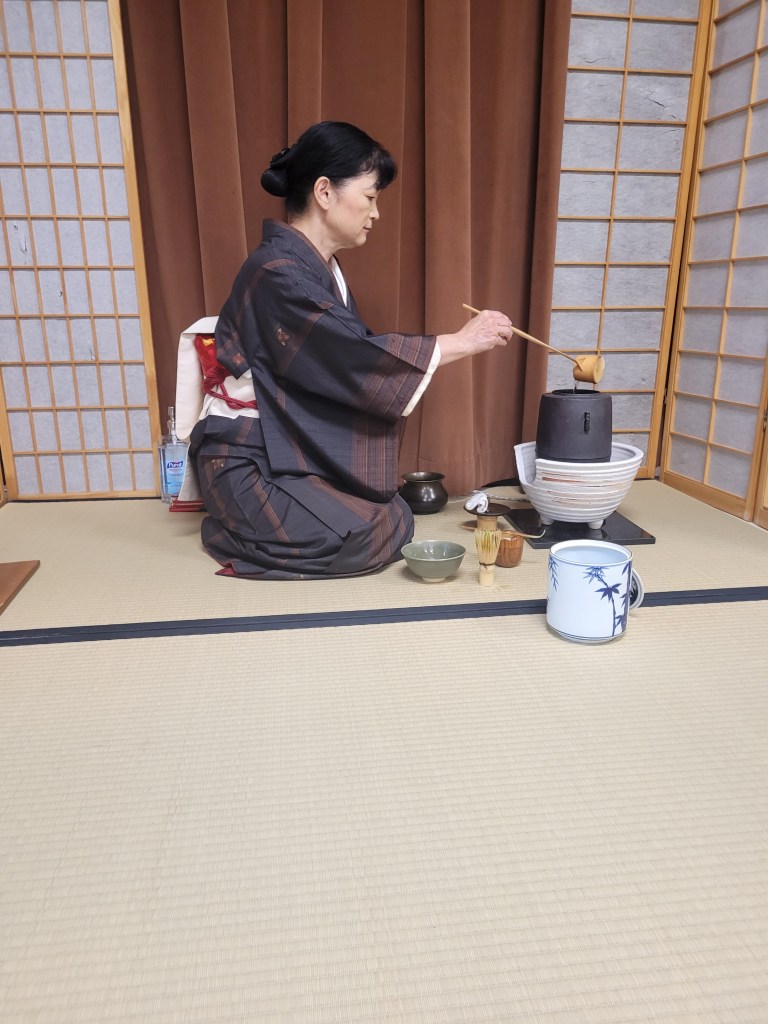
Soon we were invited to sit for tea. A woman dressed in a beautiful kimono came out to prepare the tea for us. While she began to prepare the tea. The male host graciously explained the “ceremony” as not a ceremony but more a set of expectations of manners that one should adhere to when invited to a formal tea in Japan. I suppose in truth, it was no more a “ceremony” than a proper English tea though perhaps the rules were a bit more structured to give the illusion of ceremony or ritual. One could make arguments either way – but he was speaking as a Japanese person and he indicated that it wasn’t a ceremony persay, so I am going to believe him as the expert in his own culture. 
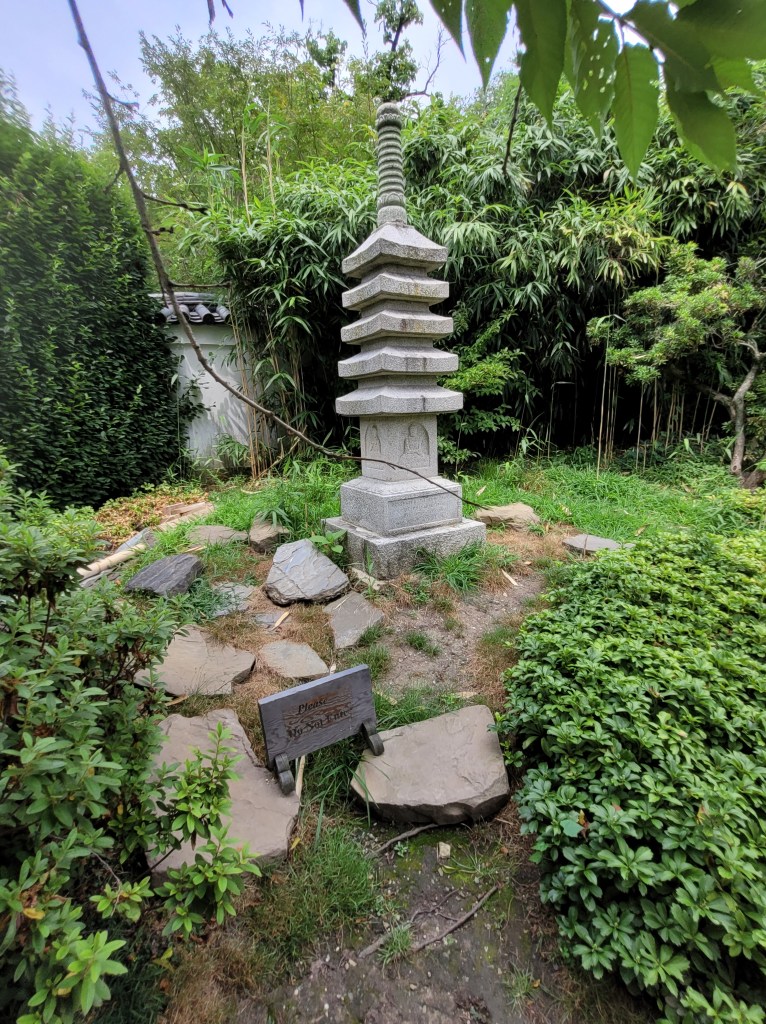
We were instructed that we would be expected to admire the carefully chosen decorations such as the scroll. He explained the symbolism of the arrangement of the flower. As the woman began to prepare the tea he explained the different instruments and tools that she was using the small white cloth, the bamboo whisk, the scoop, tea powder and the metal pot to heat the water. 

First, the hostess brings in all the tools necessary for the tea preparation and then begins cleansing the utensils. Then she carefully places in the powder and hot water into the cup and whisks it expertly into a perfectly foamed tea. The cups of tea were passed around to the various guests and our male host continued his lesson. 

We were instructed in how to pick up our cups, turn it the proper 90 degrees and to take slow sips. He explained that we would be expected to admire the craftsmanship of the cups and to express appreciation for everything the host had done for us.

The tea made from the matcha powder had almost a soft, velvety texture in my mouth. It was a bit more potent than a typical green tea, but lacked the harsh bitterness that the black teas can have. Despite the heat of the day the hot tea was refreshing. I enjoyed the texture of the cup in my hand and took in the smell of the tea. 

We were also given a sweet to enjoy along with the tea. I felt quite terrible as the host had gone through great trouble to prepare the sweets and it had a jello like substance to it. Unfortunately, I have a sensory issue with jello as it makes me gag. I graciously accepted it and forced it down as I did not wish to offend her by refusing. However, I may still have offended her with my face. It did taste delicious, it was the texture of the jello that made it difficult to swallow. 

Despite my potential faux-pas, it was a delightful time and dream come true and the following year, I was surprised to find myself once again at a Japanese Tea Ceremony. This time armed with previous knowledge and in a more intimate though less peaceful setting. 
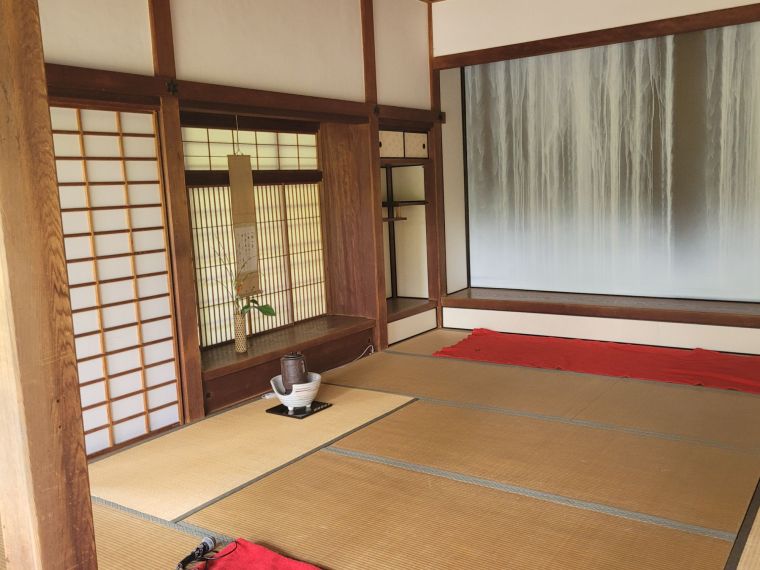
Each year, there is an annual tea festival in my state. As previously stated, I am a bit obsessed with tea. Together my sister, myself and my mom journeyed to a small town only an hour and a half away from home to a cozy tea shop tucked away along the main street. Behind the unassuming little tea house is a beautiful hidden garden which is where the highlights of the festival take place. Unfortunately for us, the day was quite wet, necessitating for much of the festival to be moved to the inside of a nearby church. This meant that the church basement was crowded, loud and somewhat uncomfortable. 

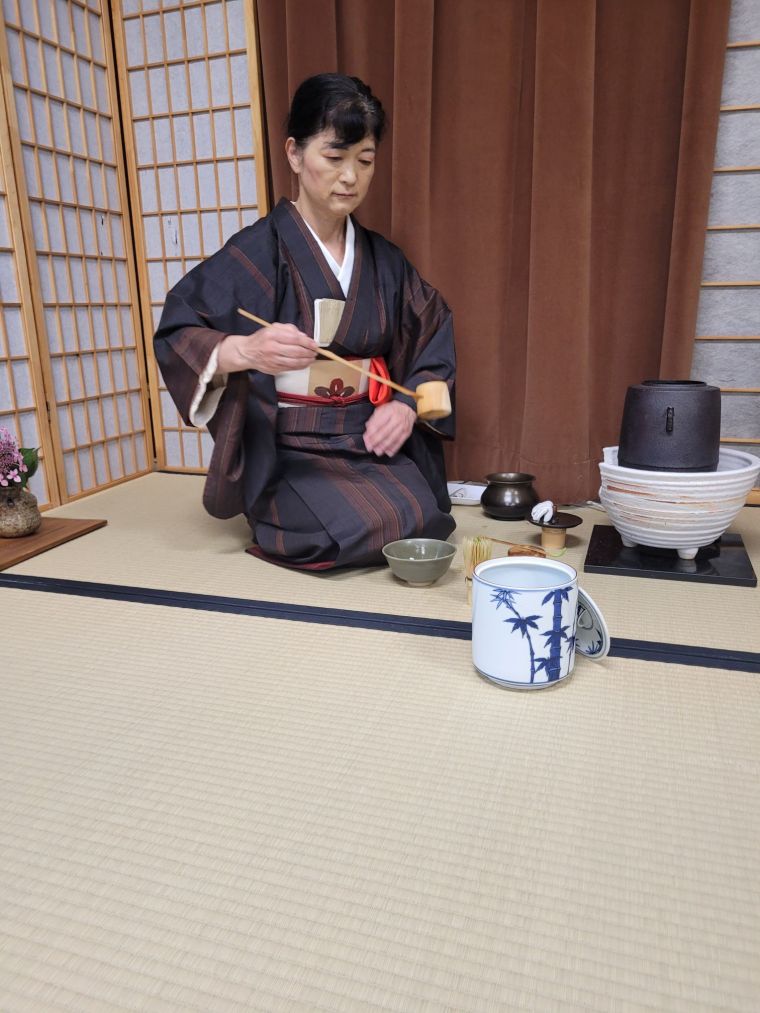
So it may surprise you to hear that within the noise and the crowd, I stumbled across an oasis of peace and zen, a small tea ceremony. A woman sat on the stage, her small tea house set up and invited you to sit. My sister and I eagerly took our seats in anticipation having so thoroughly enjoyed our last tea ceremony and my mother followed close behind. With a small polite bow and a tiny smile tugging on the woman’s lips, the ceremony began. Do not ask me what magic spell the woman wove, I only know that under her expert care, the crowd disappeared from my mind. For a small window of time, we were transported out of the world and into a quiet pocket of serenity. We took our time sipping the tea and making conversation. As expected, my sister and I expressed admiration for the cups and remarked on her beautiful display. We enjoyed the sweet treat offered (thankfully nothing gelatin, so I did not have to repeat my unfortunate behavior of last time!) We complimented her and thanked her for her time and consideration both verbally and with a small donation to help support the tea house in Philadelphia. All too soon, we found ourselves back in the crowded basement, but I shall always remember the spell that such skill can weave. That is after all part of the point of the tea ceremony, to approach the act of drinking tea with a mindfulness; to transform the mundane into an extraordinary art that allows the participants to enter into a calm space. Tea, dear reader, really can be magic. 
How can you participate in a tea ceremony?

If you live within a reasonable distance to Philadelphia, then you can buy tickets to the Shofu Teahouse and for an additional cost, participate in their tea ceremony. You can also check out the PA Tea Festival as the teahouse typically sends a representative to perform small ceremonies for the guests of the festival. 

If not, then google is as always, your friend. See if there are any Japanese cultural clubs or organizations in your area. They may offer classes or demonstrations to the public.

A word of caution, do not join a cultural organization only to check off something off your list; someone else’s culture is not your personal playground. As with any cross-cultural experience it should be done with genuine curiosity and humility. The tea ceremonies I attended were extended by invitation to the general public. I did my best to participate with respect and to be a student of their culture.   

Good Enough

There are many experiences that absolutely require “authenticity”. They require the larger cultural context of a given region, country, ethnicity, culture, etc. to be the genuine item. There are many others that don’t require much more than themselves. These are the “good enough” items that clear the bar of the Bucket List without the rest of trappings of a given thing (often those trappings require you to hop on a plane and go to a different country). 

I often work backwards to my “good enoughs”. I may find myself dreaming of going to Japan. I may picture walking through a traditional Japanese house, enjoying a tea ceremony, taking in a Japanese garden, visiting one of their Buddhist temples, strolling through the bamboo, seeing the cherry blossoms, eating their street food, and seeing demonstrations of their weaponry and armor. Upon reflection, I realized I could do almost all of these things here in America. I was able to go to the Japanese Gardens with the tea house and enjoy a tea ceremony. I went down to the annual cherry blossom festival in D.C. and enjoyed street food, weapons demonstrations, music, fashion and more. These are my “good enoughs”. I didn’t need to go to Japan in order to say that I experienced the genuine item, because I found them here.

By thinking about a given Bucket List place and considering what I wanted to get out of a trip there, I was able to then build up a list of things to find nearby. I really want to see the lavender fields in France. I found a lavender field within driving distance to go visit, the same with the sunflower fields of Italy and grape stomping. Some things may be more accessible than you might imagine. I have been consistently surprised at what’s in my own backyard and what I could potentially do.

What makes a genuine item, “genuine”? It is often up to our own ideas and definitions. There may be people who say that unless I strolled through the crowded streets of Tokyo and ordered a ramen bowl from a street vendor in Japanese, I didn’t have the real Japanese experience. Perhaps, but I tend to feel that such a view comes from self-important snobs trying to aggrandize their own experiences at the expense of trying to cheapen the experiences of others. Don’t fall for the lie that the only “genuine”, “authentic” thing has to be done in the context of the “homeland” or that the necessary cultural context to appreciate them can only be achieved in a certain location. 

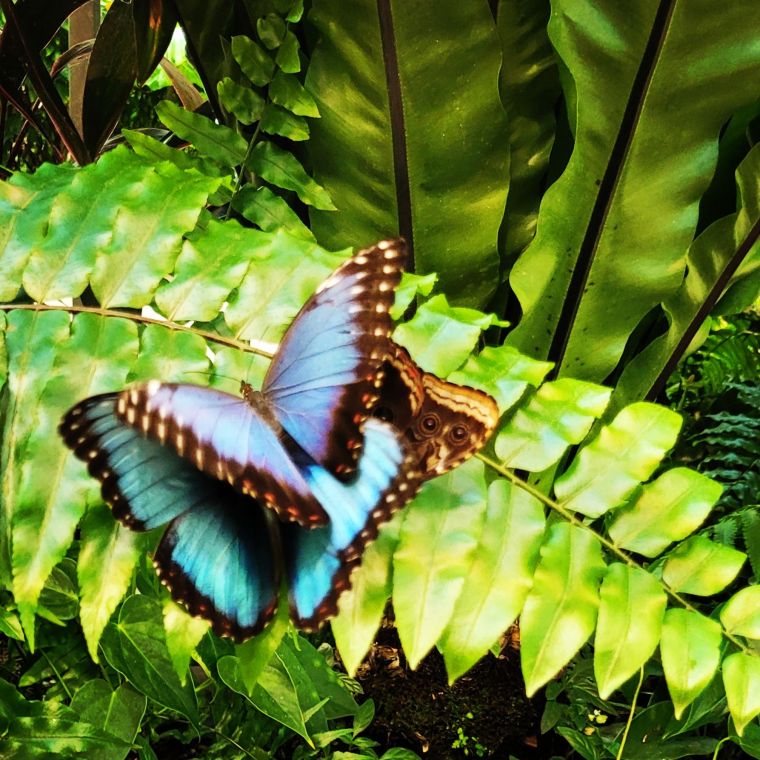
When visiting the rainforest in Costa Rica, they took us into a butterfly house. The butterfly house in Hershey is just as lovely and just as amazing. Unless you are a butterfly expert, you aren’t going to notice that the ones in Hershey, PA are a mix of various tropical butterflies vs. the 100% butterflies exclusively from Costa Rica and frankly, does it matter? Don’t let your friend who is a butterfly expert ruin it for you by telling you how this species would just never be seen in the wild with this other species. It was still amazing to see the butterfly house in the rainforest, but I could have skipped the butterfly house and been perfectly fine. I did go on a small hike through the rainforest after the butterfly house to see a waterfall. For me hiking through the rainforest isn’t something that can be re-created in America. For someone else, maybe the fake rainforest at Disney World is good enough. 

It is up to you to make the decision about what constitutes as “good enough”. If it met the desired outcome of what you wanted then it is good enough and no one gets to decide what that is other than you. You are a unique individual with unique reasons for wanting to have an item on your list. What might be good enough for you isn’t good enough for someone else, but they don’t get to dictate that to you and you don’t get to dictate that to them. 

I have had a tea ceremony at the Japanese Gardens and also in the crowded, noisy basement of a church during a tea festival. Surprisingly, I enjoyed the second more because it was a more intimate affair. It speaks to her skill as a hostess that I do not really remember the crowd or the noise, only the calm and meditative nature of the ceremony. She created a space of serenity among chaos. The noise seemed to melt away as we conversed and made light conversation. I can still taste the tea on my tongue even now. Given that if I did go to Japan and schedule a tea ceremony to achieve the same level of intimacy I would have to pay a fairly high premium. For me, that is good enough and if/when I go to Japan a tea ceremony isn’t something that is going to be on my must do list. That isn’t to say I wouldn’t do one, just it’s not on my list of musts and can be sacrificed to allow me to do something else. 

In fact after meeting so many “good enough”s you may find that certain places begin to lose their appeal. For example, I have been to so many museums with egyptian artifacts that honestly, Egypt isn’t that high on my list of places to go. I would rather see the Mayan pyramids to see pyramids. When I was younger, I had a much stronger desire to see Egypt because what I really wanted to see was the artifacts. However, despite checking off so many things on my Japan list, I still want to go to Japan. For some places, my good enoughs have only enhanced my desire to go whereas for others the desire has decreased. 

Stay Local: Buy Local

There is a movement of staying local and buying local. The idea is based on a simple economic principle that if you want to have a strong local community you need to keep your money in that community. If I go and buy a hand thrown piece of pottery from the local gallery and pay $30 bucks for it, that is $5 dollars to the owner of the gallery and $25 to a local artist. That they can then take to the local grocery story and if they buy locally grown produce that’s $30 to a local farmer who can then go and buy their goods at the gallery or perhaps purchase a service I’m offering. Not to mention that each time that money is spent, there is a small tax paid to the local and state government. Taxes which are spent on public goods that you use everyday. When money stays local it benefits the whole community which benefits you. 

Now if I go onto etsy and order the same mug for $30, well first less money to the artist because $5 for the shipping and handling, plus the cost of the box and shipping materials, then etsy gets its cut and so we’ll say $20 goes to the artist. Well now that $20 is in his community and he’s paying his local farmers for their local produce, etc. So you’ve benefited their community and not yours. So if given the choice between spending $30 for a locally produced item or $30 on an item not from here, I’m going to choose my local producer. 

The same can be said of travel. There is a reason why so much is invested in tourism. Tourism is a huge industry that attracts tons of outside money into your local community. States spend thousands on advertising to people not living nearby to come to where you live.? I remember the story my 8th grade history teacher told of some tourists that had come to my area. He asked them semi-perplexed “why would you come here?” They said their choice for their family was between Amish Country and Disney World. Amish Country won out. My whole class was flabbergasted, who one earth would want to come here of all places? The answer is a lot of people. No matter where you live, there are people who are paying lots of money to go there or at least to a place nearby. They are bringing a lot of money into your local area and not putting it into their local economy. 

Which begs the question if people are  paying lots of money to come to your area and are supporting local businesses while doing it, shouldn’t you check it out too? After all, they’re paying a lot of money to come there, maybe your town isn’t as boring as you think. Shouldn’t you consider keeping your money in the local community? I’ve already outlined why keeping your money in your local area is so important. Your own leaders wouldn’t spend so much money trying to get more money into the economy if it wasn’t important. 

One other thing to consider is that by encouraging locals to enjoy these venues and events it keeps a certain amount of leverage with the tourism industry. I’ve written about overtourism. Often calls to curb tourism by locals fall upon deaf ears as the response by politicians is typically something about the local community being reliant upon these tourists. However, if the local population are the ones going to these areas then they can say “actually, we’re huge supporters so we don’t need these tourists”.  

This is just one of the many reasons I choose to travel less. I am keeping my community strong all while living richly. It turns out being a budget bucket lister is good for my wallet and my neighbor’s. 

Ice Skating: Let Go of the Wall

Having lived my whole life in Pennsylvania, I am no stranger to winter. Having been a child through some of our largest snowstorms in history, including the blizzards of 1996 and 1993, I am well versed in the traditions of winter. I have enjoyed many-a-cup of hot chocolate after spending hours building snow forts, engaging in snow fights and making snow angels. However, there was one thing I did not do growing up, ice skate. 

I would be lying if I said I hadn’t spent a significant amount of my time as a child watching ice skating competitions. I love watching figure skating or really any sort of physical movement to music, dancing, gymnastics, ballet, the human body in elegant, poetic motion. It may just be a girl thing we seem attracted to such displays. Sure there is a certain beauty in the movements of sports, but there isn’t the same restrained, control of strength that comes from holding an impossible pose for an extended period of time. Don’t get me wrong, I enjoy seeing a chiseled warrior wielding a hammer smashing things to smithereens just as much as the next woman. I digress. I was never a connoisseur of the sport, only a modest observer of it. 

Winter in Pennsylvania

One may be forgiven for the mistake of believing that ice skating is a relatively recent invention in human history, not until the 13th and 14th centuries when steel blades were attached to shoes. But there is evidence to suggest it actually has been utilized in Finland for over 5,000 years and they found a pair of Ice Skates in China that are almost 3,500 years old. This discovery helped establish a clear link of trade between China and Europe! There is a rather silly notion that until the age of exploration with the advent of Christopher Columbus that people didn’t move around much. Not so, the need to explore is etched in our very bones! But to avoid a long winded tangent about the history of trade and interactions over the centuries of human history, I will leave you with that declaration and encouragement to go do your own research.

The first skates were actually made of bone. The first official clubs naturally rose in London – because where else? Metal skates were brought over in the 1600’s and by the 1700’s all sorts of skating clubs had emerged which is also when figure skating emerged. The Dutch, Finns and Swedes had all been competing with one another in races for years back in the 13th and 14th centuries. At first it was just done by men doing circles and figure-eights, but it was an American of all things that incorporated ballet moves into his skating, and thus figure skating was born! 

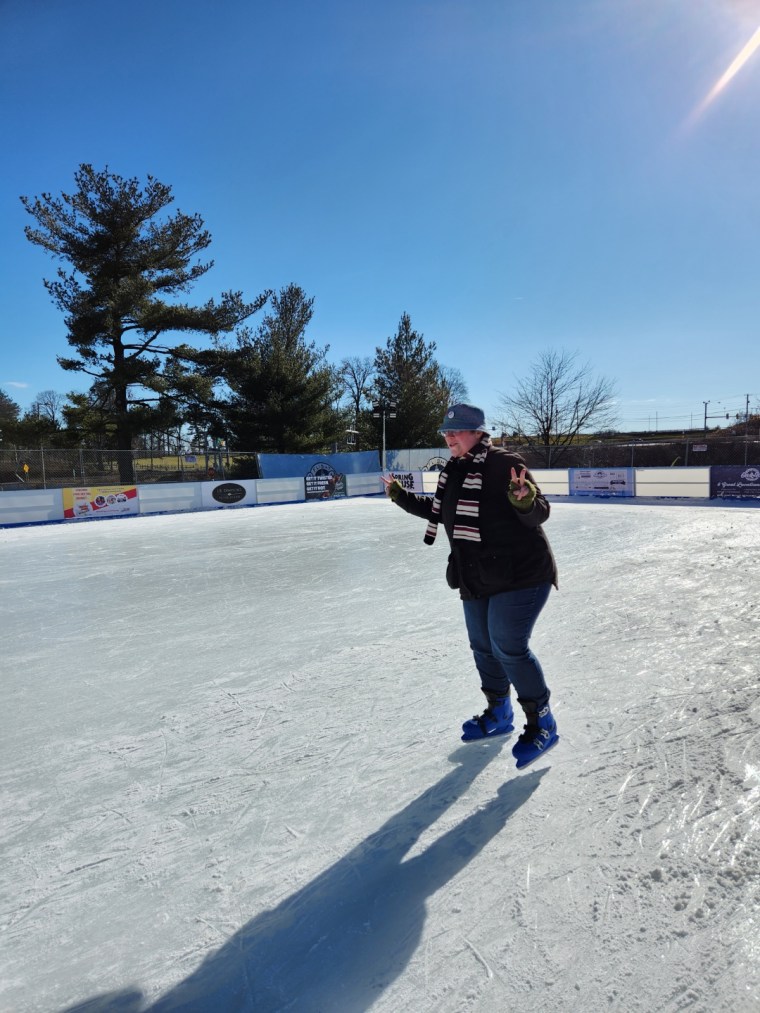
It was under the auspices of this long and nobel tradition that my sister and I set out one late February day to our local mall. I had seen an advertisement for a “pop-up” ice rink on facebook around back in December. Anticipating the crowds of Christmas, we opted to wait until the initial excitement had died down. Our patience was rewarded with an almost empty rink where we could get the feel for it. The weather was almost perfect, it was right around 30 degrees. The near cloudless sky was that deep, brilliant blue that we only ever see in winter. We walked up to the counter to rent our skates and then on tottering legs took our first steps onto the ice. 

My first moments away from the wall and “flying” free

I will say that many movies lie about the ease by which one can simply strap on a pair of skates and flit about on the ice for the first time.  I was not fooled and well prepared for what was in store! I remembered the first time I had ever gone rollerblading as an equally difficult task. When one has never done it, your body doesn’t quite know what to do with itself in terms of balance. Suddenly, your legs are going in all sorts of directions and the decided lack of friction makes it damn difficult to control. Ah, the eternal law of physics, what is in motion stays in motion and skates are made for motion!  

Slowly, more so than I care to admit, I did start to get the hang of it. I clutched the wall for balance until I began to feel much more confident in my ability to maneuver safely. When one has had four concussions in one’s life, you tend to take the possibility of a head injury a bit more seriously than other people. This made me a bit more timid than my sister with regards to letting go of the safety of the wall and skating away from it. 

As we were making our way around, a few others joined us. They were also first timers on the ice and we built a quick camaraderie through mutual struggle. My sister and I called out the tips we had learned in our short education to the newcomers. Some picked it up faster than others, but rather than jealousy, we cheered enthusiastically for one another’s accomplishments. When my sister fell, I was not the only one who checked on her or encouraged her to keep going. 

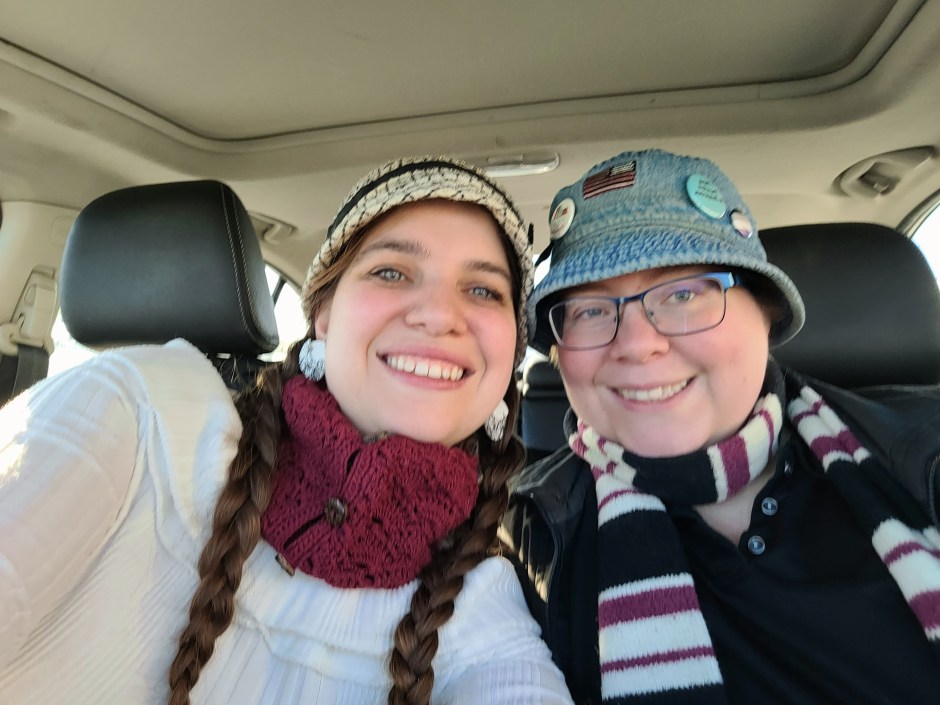
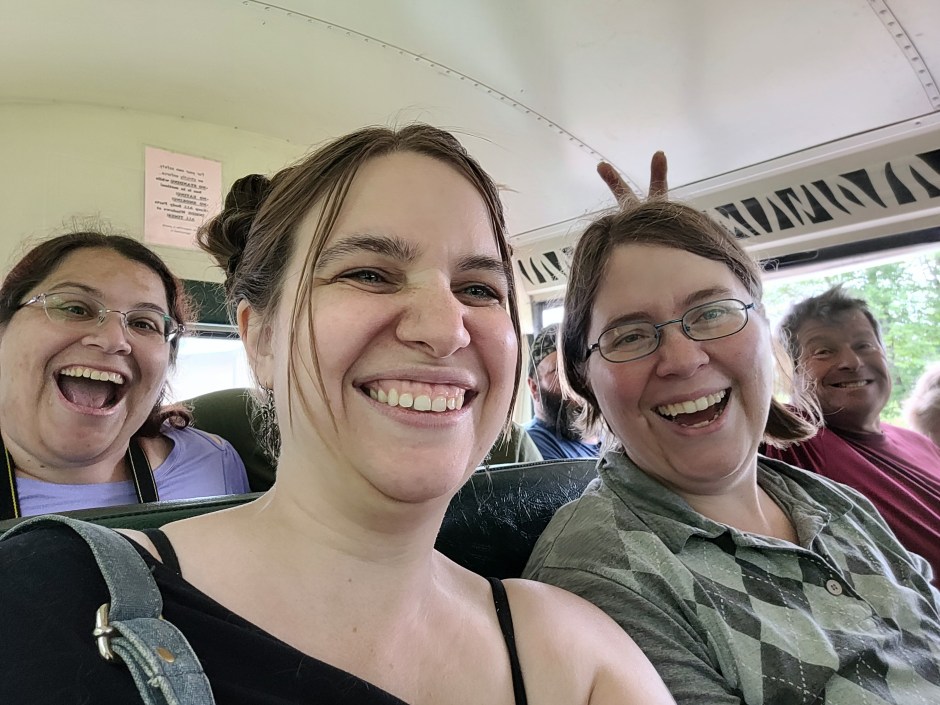
Just two sisters living the dream!

Finally, I let go of the wall and began to skate on my own. There was a thrill of accomplishment even though arguably it was a rather small conquest. Still to glide across the ice confidently was a dream come true at last. Naturally, the small group of strangers cheered for me and it gave others the confidence to join me. I certainly wasn’t going to be adding any ballet moves that day and it was enough to go around in a circle a few times. I am sure that just as with rollerskating, I could quickly begin to conquer the ice, had I more time and inclination. My sister and I will no doubt return to the ice again in the coming winters. 

Bucket lists are more than just doing, they’re about experiencing. That morning was more than just ice skating, it was a reminder of some life lessons. In life one must venture forth from the safety of the nest to really live. At some point every olympic skater had to make the choice to let go of the safety net to risk danger and injury, to trust in their skill and ability to fly. They also had to make the choice, like my sister, to get up after a fall. Life is about risk, it’s about letting go and about getting back up after a fall. It’s also about cheering each other on through the difficulties. No one could skate for anyone else, but each of us uplifted the others there and I’d like to think that because of that encouragement everyone succeeded more than had we stayed silent. Studies demonstrate that positive feedback increases performance. It is important to cheer each other on through the difficulties and celebrate victories big or small. 

My sister may have fallen but she got right back up!

How can you ice skate?

Once the Christmas season starts, look for pop up ice rinks in your area or sales for your local ice rink. If you live in a hotter part of the country, sadly there will be few pop up ice rinks in your area no matter how much Christmas spirit your town may have. You will probably need to look for a local ice rink. Ice skating is fairly easy if you’ve been roller skating or blading before, but if you’re like me and have only done either of those a handful of times in your life you will still probably be pretty wobbly. However, that’s all part of the fun of doing new things. No one is expecting you to land a quad your first time on the ice, that’s obviously for your 3rd time. 

Completed: 2023

Miles from home: 12 miles 

Cost: Tickets were about $20 and ice skate rentals were an additional $10 for a total of $60 for two.

Being a Tourist in Your Own Backyard

It may seem at first a bit strange to consider being a tourist in your own town. It is, after all statistically speaking, boring as most of those reading are not luckily enough to live in those more exciting areas and I am certain that even the epicenters of culture become mundane and dull. The denizens of Paris are most likely quite sick to death of the art in the Louvre, the towering cathedrals and intimate cafes. Perhaps, they dream of the snow capped Rockies and Yellowstone National Park or perhaps, tropical beaches of the caribbean. It is after all human nature to long for the very things we don’t have and abjure the things we do.   

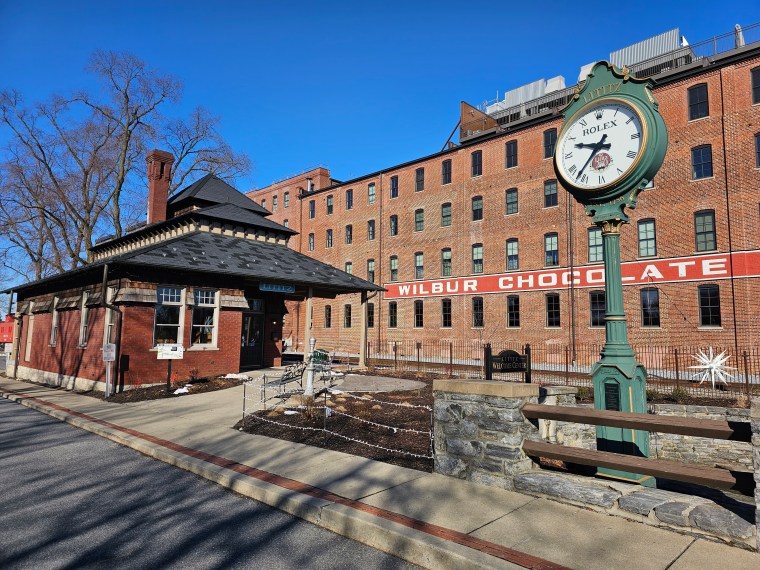
Tourist Center of Lititz, PA

You might wonder what you could possibly do that you have not already done or seen what you have not already seen. I am here to encourage you to look again and to pay attention. As I have mentioned in another post, I had the privilege of seeing several bucket list items: a Russian Ballet, King Tut and the treasures of the Tsars. Those things were only made possible because I or someone I knew was paying attention to what was going on in the local area. This means you must first become aware of the museums and theaters in your area and check their websites regularly for visiting exhibitions and shows. 

Luckily, we live in the age of the internet and knowledge is but a few searches and clicks away. I like to start out by looking at my area’s tourism page and their events calendar. I have been surprised by what actually is around my area that I had no idea existed like the “catacombs” of the local brewery with their ghost hunting or the annual hot air balloon festival. I looked at the website “Only In Your State” and discovered all sorts of interesting places only a few hours away like dog sledding in the winter or lavender fields in the spring. It looks like I don’t need to travel to Alaska or France after all! There’s even indoor sky-diving just 45 minutes from me! I also semi-religiously check Facebook events calendar which is how I discovered that 3 hours away there is a winery where I could stomp grapes, cancel my flight to Italy! Facebook was also how I found out about the pop-up Ice Skating Ring at my local mall. Other touristy sites might be good to check out like Trip Advisor, although I find it’s not as good for finding things I don’t already know about. AtlasObscura is another site similar to Only in Your State that has led me to some interesting ideas. 

A display of Greek artifacts in Reading, PA

The main thing is not to rest on your laurels as it were but be on the lookout for different experiences. Eventually, you will learn what hidden gems your area is hiding. Take the unassuming Reading Museum in Reading, PA. You would never guess that such a small city would be home to a truly remarkable museum. It hosts an Egyptian mummy, a full knight’s armor, items from the Greek and Roman empires and its visiting exhibitions are usually quite good as well. My favorite thus far was Da Vinci’s inventions, where innovative individuals utilized his sketches and ideas to bring his many inventions to life. So often we see his art and hear of his inventions, but this exhibit focused on the more practical and scientific Da Vinci. Less than an hour away from me is a forge where you can make your own throwing ax and they have targets available to test them out afterwards. Hershey has a falconer where you can spend an afternoon learning about the sport of falconry and interacting with a bird yourself. I have attended a Gallery Opening. I have enjoyed a full moon with wolves and so many more things nearby. None of these things I would have found scrolling through some travel influencer’s instagram and all of them were far closer to home than I might have possibly imagined when I first started out.  

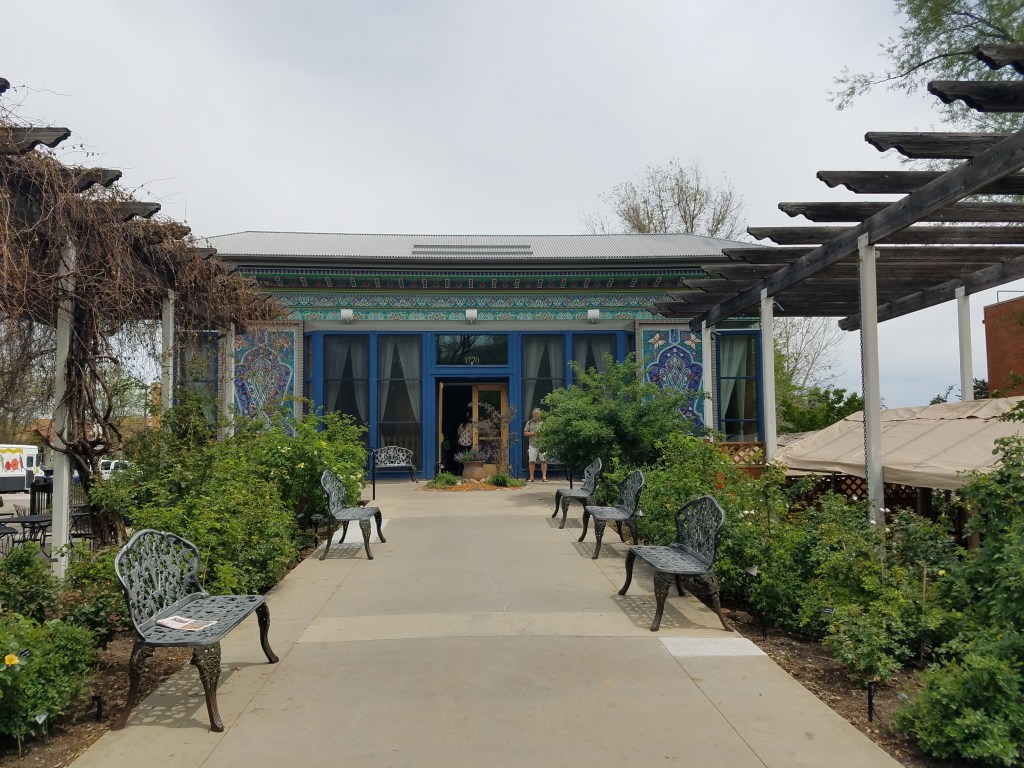
I do recognize that I am lucky to live so close to many cities and hubs of activities, Pennsylvania is after all the keystone state for a reason. Washington D.C., Philadelphia, and New York are all within quite reasonable driving distance from me and can be easily connected to via the train which runs from a city not 20 minutes away from my home. It was nothing to do a day trip down to the Cherry Blossom festival in D.C. back in college to see the showcase of Japanese culture or a trip to see a Broadway show in New York in high school. However, I am confident that there are things in your area which are worthy of your time to go discover. After all, despite being rather in the middle of nowhere Boulder, Colorado turned out to be a bit of a tea mecca when I visited, being home to both Celestial Teas and an authentic Russian Tea House! It also plays host to the National Center for Atmospheric Research and a cat cafe. Tea, science and cats, what more could you ask for?! 

Russian Tea House

Some of you may need to go further afield for some of those experiences which may have you scratching your head thinking this advice is contradictory to this blog. It is not intended to be a contradiction, more a recognition that not everyone has the same opportunities and access to extraordinary things near them. Most of the population of the United States is concentrated on the coasts and so there is a high likelihood that you dear reader, live near many hubs of culture. However, some really are living in places where the nearest neighbor is a 30 min drive past miles of cornfields. No amount of internet searches and creative thinking is going to offer them the same opportunities as those of us living on the coasts. This is not to be defeatist for those people who through no fault of their own are forced to go further afield than some of us.

The spirit of this blog is that we can find extraordinary things in our own regular vicinity to live a full life right where we are (generally). Some of us may need to draw wider borders than others of us and that is fine. I don’t often do day trips to New York or D.C. maybe once every five or so years as I have plenty to enjoy nearby. For me to make frequent trips to those places would not be in the spirit of what I am trying to achieve because I can usually find things closer to home. Others may be forced to do more frequent day trips just to see anything at all. Let us not be legalistic but rather embrace the spirit of this blog where we recognize that we can find joy where we are rather than needing to rush off to the far flung corners of the world.

Falconry: Ancient Arts

The year was 2020. The season was summer and Covid had only just begun to rock our world. Flights had been canceled. Cruise ships were docked. Some countries were completely shut down. Some states were open, others were shuttered. Travel and its exotic experiences seemed out of reach. The bucket list seekers, the vacation planners all had to place their desires back on the shelf for the foreseeable future. They would have to content themselves with the mundane of their local parks and restaurants, expanding their horizons only in their dreams. At least for travel minded, not so for the opportunist like myself who is careful to find hidden treasures lurking just around the corner. Naturally, shutdowns and limits on travel, could not deter myself and my sister for long from our sister dates. So in early July, after being in semi-lockdown since late March, we departed from our home on a special adventure.

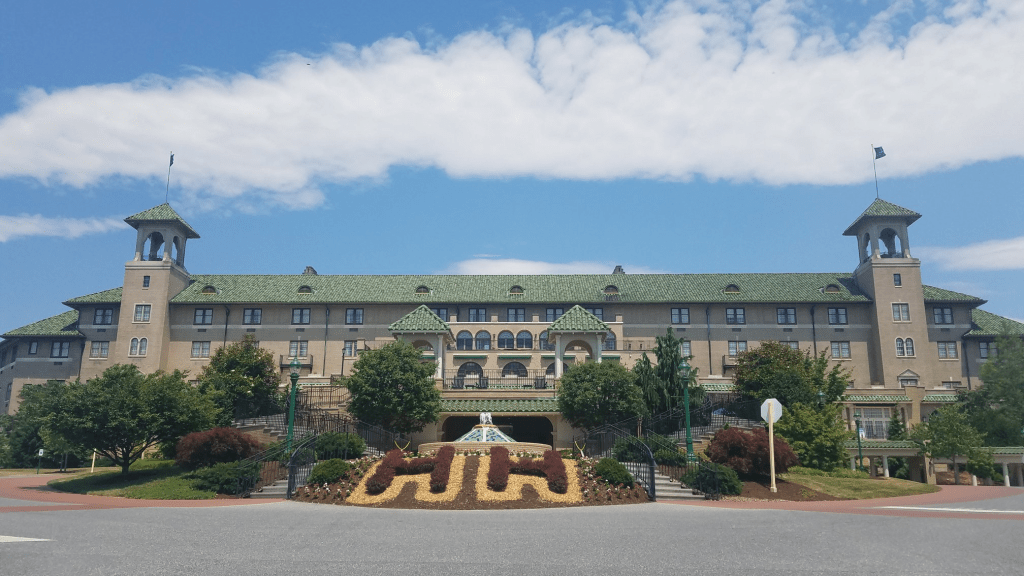
Hershey Pennsylvania is famous for its chocolates, candies and amusement park. What many do not know is that the founder of Hershey Chocolate did not only make candies. He had a hotel and a garden as well. It was not always so, but today the hotel is home to a particularly unique experience, falconry. 

Falconry is an ancient art going back thousands of years. Falconers would take and train birds of prey for the purposes of hunting, often forming close bonds with the bird for a number of years. It takes months of dedication and attention to develop the necessary training and trust to have this wild animal be willing to hunt on the falconer’s behalf and consistently return to the glove. Most falconers have had the experience of “losing” a bird where the bird makes the decision to fly free rather than come back. It should be noted that these birds are not domesticated nor are they really all that tame. They are still wild animals and not pets. Most falcons will not respond well to an untrained falconer, which is why the falconry experience is so unique. There is one hawk species which makes such an experience possible, the Harris Hawk.

Harris Hawks are known for their odd sociability for birds of prey. In other words, they are quite willing to interact with a large number of handlers and are not quite as selective. It is this breed of hawk that Mr. Jack Hubley utilizes in his demonstrations. The demonstrations are made up of small groups to ensure an intimate experience between yourself and the bird. First, you are given the overall history of falconry and a little background on the different birds in his possession. Having been avid watchers of many falconry demonstrations before (as they are frequent at the PA Renn Faire), my sister and I were quite familiar with most of the information and surprised him with our ready answers to the questions he posed. 

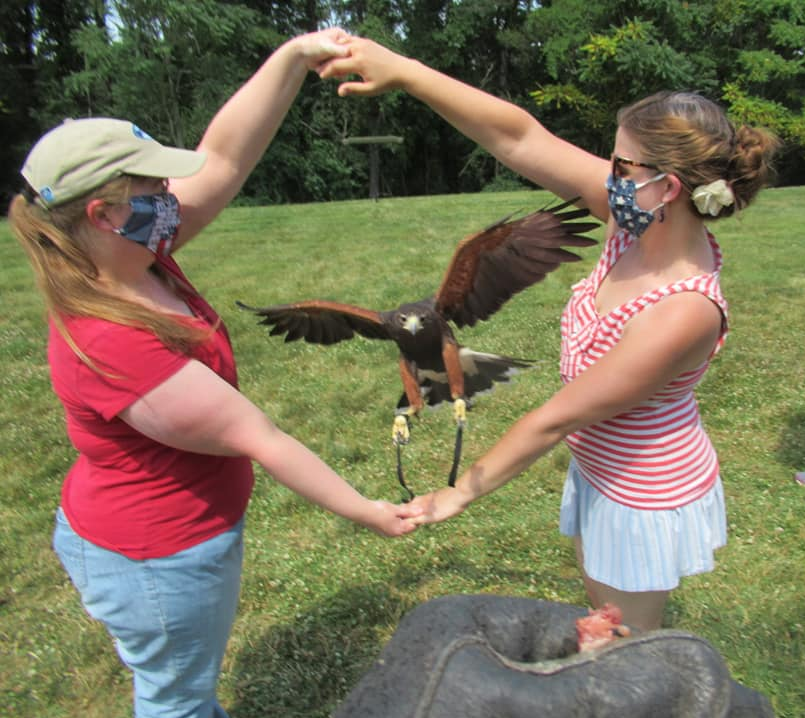
Holding a Harris Hawk at Hershey Hotel’s Falconry Experience

With great eagerness, the time had arrived to actually interact with the hawks themselves. The first task was to ensure safety. Hawks as you may already know have sharp talons designed for ripping and tearing into soft flesh, much like your arm’s. For your own comfort and that of the bird’s (who would want to hang onto a yelping, flailing human?)wearing a glove is highly recommended. We were given some basic instructions and allowed to hold the Harris Hawk on our hands. We did so by raising our gloved hands signaling it to land on us. It was exhilarating. 

The bird was surprisingly light on my hand. Even through the gloves I could feel the strength of its grip. It stared at me with its golden eyes clearly investigating this new human. It was clearly a marvelous creature with a keen intellect and clever mind. I will never quite forget the wonder at having called it to my fist. I can only imagine what a true falconer feels when they finally bond enough with the other birds to have them consistently choose to return, but I shall have to content myself with this taste. After each participant had the opportunity to call the bird, we took turns putting it through different flight exercises such as having it fly through a tunnel of people or through hooped arms. 

Despite the oppressive heat of the summer afternoon, it was truly an amazing experience that I would recommend to anyone. It is one thing to view these magnificent creatures behind glass or wire at the zoo or to watch a falconer showcase their skills with a bird, it is quite another to be able to try it out yourself. One of the best parts what that it included photography, so I was able to focus completely on the activity. I am eager to take the next step with my sister, A Hawk Walk, where we walk the grounds of Hershey in an intimate affair of just us, the falconer and of course the Harris Hawk. 

How can you experience falconry?

The sport of falconry is alive and well throughout the country as there is only one state where it’s not legal, Hawaii – I feel for obvious reasons. There are many places that you can look to find similar excursions such as Wing Blade Falconry in Nashville, TN, Troutbeck Hotel in New York, Rancho Bernardo Inn in California, Sky Island Falconry in Tucson, AZ just to name a few! 

Unfortunately, in my brief research it does seem that in the time between this writing and when I went, the price has increased significantly and most places are charging close to $100 per person. Things are only getting more expensive, but by staying in our own backyards we can minimize the costs of travel, hotels, and food so free up our money for the things we really want to do.  

Completed: July 3, 2020

Miles from home: 30 miles 

Cost: As of this writing (2024) these experiences will cost about $100. 

Combating Over-tourism: Stay Home

There is a growing problem in the world that has exploded post pandemic: overtourism. It was a problem prior to the pandemic, but it has increased exponentially after several years of people being cooped up and prevented from traveling with little signs of stopping. This has resulted in iconic places being overrun by tourists turning once beloved authentic experiences into Disney World attractions with about as much spirit and an equal amount of crowds. 

How can one even enjoy these places with the crowds and the jostling for position? How can you say that you were actually in a place if all you did was stand in line, snap a picture of yourself there and move on to the next “iconic” spot in the area? At least at Disney World the line culminates in a 60 second ride rather than a 10 second picture, as you will feel equally soulless afterward. To be fair, the enjoyment you will get from that experience will most likely be from the many likes and shares that you get; an equally fleeting reward as a ride but less honest, at least the ride isn’t pretending to be something it isn’t. 

The crowd at the fountain was shockingly huge even late at night. As you can see, there was no way to get a shot without people in the background.

The local population suffers for our own over indulgence. Short term rentals push residents out of their homes and local food markets cater to tourists looking for a grab and go snack rather than produce for a home cooked meal. Local festivals, once a point of pride for residents, become activities they no longer recognize nor enjoy as their voices and concerns are drowned out by the ring of outside cash. 

Worse, in participating in this overtourism, you are contributing to the ruination of the very thing you espouse desiring to preserve. We travel for the cultural experience to interact with people and places that are different from us to enrich our lives and to support the existence of that precious human expression in an increasingly homogeneous, industrialized and globalized world. It would be better to watch a documentary and never step foot in Venice than to contribute to its ever increasing decline. Given the declining likelihood of encountering locals its not like you’ll be missing out on interacting directly with the local populace. 

By staying closer to home, I am ensuring that I am not contributing to the problem of over-tourism elsewhere. It also means that I can enjoy similar bucket list experiences, but with less crowds. I do live in a tourist area and we are seeing an increase of tourism and in some cases, over-tourism. Luckily, most of the tourists are focused on Amish and farm experiences, leaving the things I want to do alone. Sometimes going to a specific place that is known for a certain thing is the worst thing you can do for your bucket list experience because of over-tourism. You will be dealing with crowds and shortened snippets of the very thing you came to do. 

When I was in the Cayman Islands we went to the turtle center where we had the opportunity to wade with the turtles after the tour and before being set free to explore the center on our own. Because it was a tour group of about forty people we were only given a few minutes to wade with the turtles and interact with them. This resulted in people trying to frantically take pictures in the short time they were given and of course the shots were full of people. It meant we weren’t actually focused on the activity that we were there to do, interact with and enjoy the turtles. I went back to the wading pools about 40 minutes later in between tour groups when there was almost no one present. I was able to get into a pool with the turtles by myself, my sister snapped a few pictures of me in the pool while I was able to completely focus on the turtles. I barely remember the first time I went in because the clock was ticking and there were too many people jostling and getting in the way. Yes, we all got a turn and it was in the interest of allowing everyone the opportunity to enjoy these beautiful creatures. However, it wasn’t the experience I dreamed about having when I first booked my tour. It was only when I was able to get away from the crowd and be mindful about what I was doing that I was able to have the moment I wanted.

Once the crowd cleared, I was able to spend an intimate moment with the turtles

I also tell people to skip the Mona Lisa, as it is so small, protected behind thick glass in a dimly lit area, surrounded by a throng of people all vying for a picture held back by a rope, you may as well look at it online for all the good seeing it in person will do you. Besides, it’s only special because some nutter waxed poetic about it in some book before pictures in art books were more common and then it was stolen for a bit causing a sensation around the whole thing when it was finally returned. The nonsense surrounding it never really died down. Go look at DaVinci’s lesser known works if you are so inclined to see a Da Vinci in person, and if you don’t know much about his technique and art in general enough to appreciate it, then by all means don’t bother with him at all and spend your time looking at art you actually like! There are plenty of other artists from that age who were talented and innovative. There are some artists who may arguably be better – art enthusiasts please don’t die of shock reading this. And if it’s not your thing, certainly don’t waste precious time on any of the Italian Renaissance painters, there’s a great wide world of art out there just waiting to be discovered! Perhaps later after you’ve developed a great appreciation you may wish to return to Da Vinci, but then it will be something you actually want to do. Although, no matter how much I learn about sports that I do enjoy (archery, horseback riding, falconry), I have yet to develop an interest in the more common ones (soccer, football, baseball), art may be the same for you. And, that’s okay! It isn’t an indictment on your character, intelligence or worth as a person! Some people have a more narrow interest in certain areas. 

The point being if you go to a place that is overrun with tourists you won’t be able to enjoy the very thing you set out to enjoy in the first place and you are far better not bothering with all the packing, planning, flying, walking and standing about in a line. You may as well find something similar closer to home that you can actually enjoy. Not that you can’t learn to be mindful in a crowd of people and enjoy something despite all the barriers but it’s going to be damned hard when you’re given all of 30 seconds to snap a picture and ogle the view. 

Don’t let the picture full you, I didn’t hop on a plane to visit this Japanese Garden, I drove less than two hours!

You may actually be quite surprised at the things that are nearby that you thought you had to cross oceans to find. Living in Pennsylvania I discovered that I could attend a tea ceremony demonstration in the Japanese Gardens just outside of Philadelphia. It is home to a lovingly built Japanese house built exactly as you might find in Japan. There, a small group of Japanese-Americans are willing to share their culture and traditions with visitors. I was able to see some of my top things without any jet lag or expensive plane tickets. I have seen a performance by the Moscow Ballet Company when they graced the stage at Hershey Theater. I have released lanterns to the sky as they might in Asia. I have seen King Tut’s treasures when they were on display in Philadelphia and the treasures of the Russian Tsars. I recently discovered there’s a place in Northern PA that has dog sledding!

Some of those things were chance items that were here for a brief time before moving on and I was able to take the opportunity to see them. However, I was on the lookout for such opportunities because I was being a tourist in my own backyard instead of ever dreaming of places elsewhere. You never know what you might find if you stop looking up at the sky, daydreaming and started looking at what’s happening on the ground where you’re at.

Living Life to the Fullest Where You Are

We have all been there, browsing through the internet of far-flung places dreaming of all the place we long to visit, the things we’d see, the activities we’d do. We put them on a list either mental or physical for later. We may scroll through social media bombarded with advertisements for “cheap” travel options. We may not even be all that picky about the place and would happily take advantage of the last-minute deal, if not for the various barriers most of us face. How would we take time off?  Even if we have enough PTO to travel, we may in the middle of an important project that demands our attention. Who would watch our pets? Boarding them can sometimes be as expensive as the vacation. Plus, all the hidden fees and additional costs are not necessarily thought of when booking that flight. There’s hotels, taxis, buses and more. Even without these barriers, a trip may only come once a year, if we are lucky because it isn’t getting any cheaper to live. We have bills to pay and obligations to meet. Most of us are not travel bloggers where we get paid to travel. So our list gets ever longer and usually more expensive as time goes on, with few of those items ever getting checked off. Moreover, we find ourselves sitting at home day after day, scrolling through feed of influencers, travel sites and youtube videos and not actually going out and living!

But why do we want to travel so much? What is it we are truly hoping to experience? Do you wish to try new things? Experience different cultures? See history? Hear music? Speak with interesting people? Perhaps, learn a language? To embrace the spirit of adventure! Like you, I had a list of many things I would want to see, do, and experience and perhaps, blindly attached those things to specific places. However, much of what we want to experience in our travels is not attached to a specific place as those things can be as mobile as we are. Want to taste authentic French food? A quick google search can lead me to a restaurant owned by a French couple just 40 minutes away. Want to visit a Thai temple? Perhaps, there is one only two hours away, beautifully constructed and looks as if it were translocated right out of south east Asia.

You may find that they hold services on Sunday and that the experience of attending a service is far more immersive and informative of Thai culture than simply touring one among a throng of other tourists where the sacredness of the space has been transformed into a hallowed capitalist ghost of its former self – as was my experience with Notre Dam. Oh, the history of the place was still there but it did not hold a candle to entering the Basilica of Sacré Coeur de Montmartre most notably because the tourists were an afterthought. You were welcome to come in, but you could not take pictures, you were required to be quiet and respectful of the worship which was still ongoing. The Notre Dam was interesting, but I could have acquired the same experience from a book and some google image searches as it was a soulless enterprise. The Basilica was an immersion into French Catholic culture. One may very well find a much more authentic experience going to a small temple or other place of worship in their own backyard than traveling around the world to a tourist trap. This is what I mean by not blindly attaching an experience to a place.  

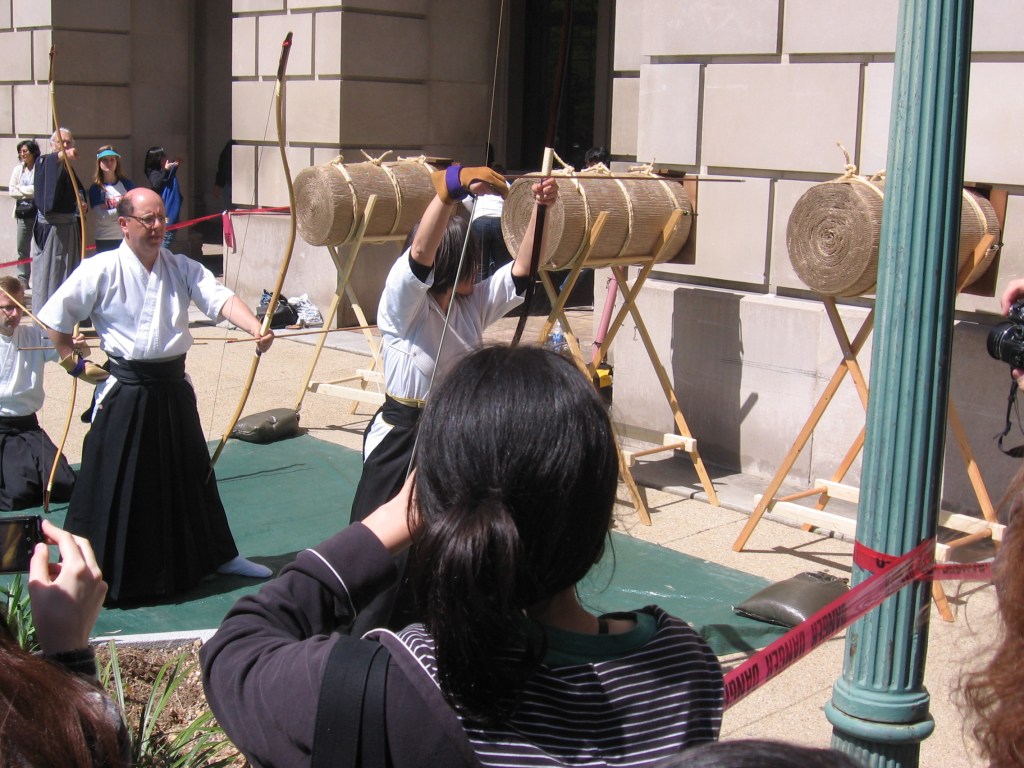
Now of course if seeing the Great Wall of China in person is on your list the likelihood of you seeing it elsewhere is quite slim. However, there are things about China that you could experience in your area. For instance, each year Philadelphia (in my backyard of Pennsylvania) hosts a phenomenal Chinese festival showcasing authentic Chinese culture and heritage, music, art, cuisine, language, and people. I had the opportunity of seeing a Chinese art installment at a university while visiting friends in Michigan and the Detroit Institute of Art has an entire section devoted to China allowing me to see both modern and classical eras of Chinese art. I have had the great pleasure of experiencing the culture of China though the likelihood of me going there is quite slim as there are other places that I have prioritized above China on my list of places to go. In Washington, they hold an annual Cherry Blossom Festival which showcases Japanese Culture. Despite being on nearly the other side of the world, a quick car ride and the right timing is all I need to enjoy authentic Asian culture.

Archery Demonstration at Japanese Culture Festival in Washington D.C.

The point is not to knock traveling. There is certainly a place for it. The point is that we do not need to travel far to start checking things off our list and live in the spirit of adventure we long for. Most of us do not have jobs which afford us the means to travel as often as we like or experience the things we want to experience whilst traveling. We are not travel bloggers, social media influencers or possessors of rich spouses who can send us off on holiday whenever the mood strikes us. We are middle class or poor who yearn to go on our own adventures, to see and experience the wide world. I hope that my simple record of my adventures closer to home (and a few abroad) will encourage you to embrace the spirit of adventure, to get creative with your bucket list and develop a better self-understanding of what you truly want out of life to live it to its fullest right where you are.