Forging Axes & Sibling Bonds!

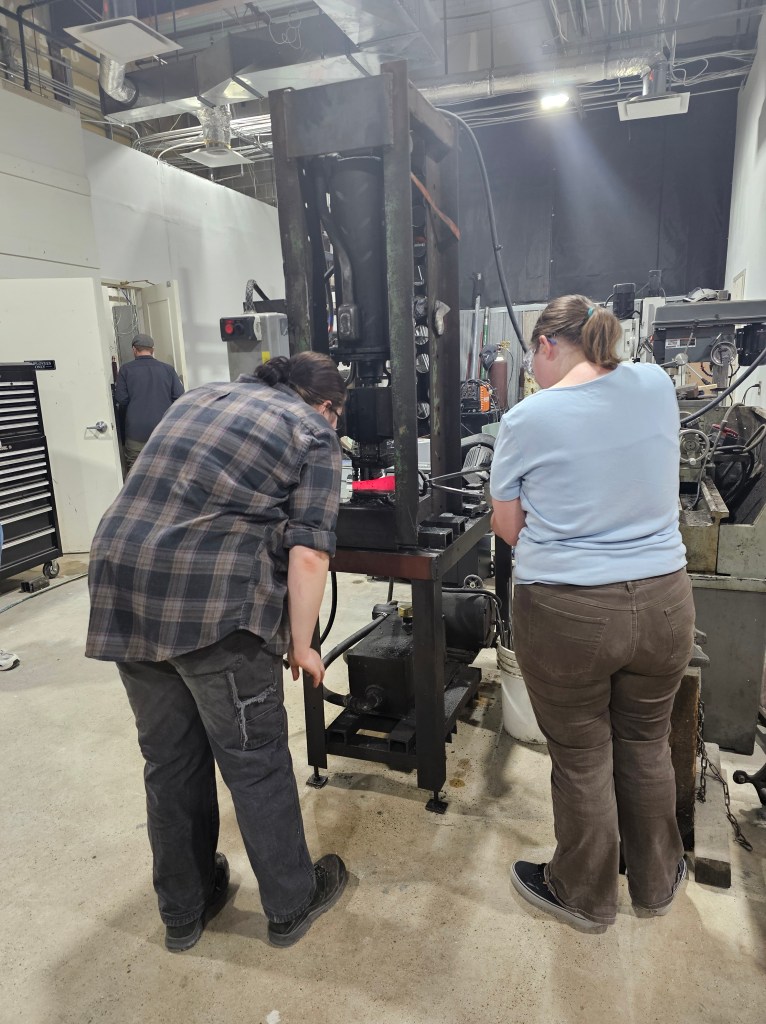
As an avid fantasy reader, blacksmithing has always carried a bit of an allure. So when I was invited to attend a birthday party with my sister at the Drunken Smithy, I naturally acquiesced and trekked with her on a cold’s winter day to get warmed up by the forge. To say I was excited is an under-exaggeration. What could be more exciting than combining some of my favorite things, sharp objects, fire and hitting things? 

I was stoked to put my muscles to the test hammering out molten hot metal and shaping it to my will. I do work out and I always enjoy using my muscles for something other than merely moving weights up and down semi-pointlessly. It makes all those hours spent sweating worth it when I can use them competently to accomplish my goals independently. 

Forging weapons is an ancient human art. In fact the very materials that we humans used for weapons give rise to the delineation of pre-historical epochs Stone Age (stone weapons and tools – though this is such a long period of time it’s now broken down into palaeolithic, mesolithic and neolithic), Copper Age (copper weapons), Bronze Age (bronze weapons), and Iron Age. There is evidence that we humans have been using metals for over 40,000 years with the discovery of gold in some Spanish caves dating back to the neolithic era. The oldest known culture which utilized smelting was located in Serbia in the 6th millennium BC. Many places say that it originated there, but I allow for the possibility that there is an even older, yet undiscovered culture which may go back even further either in the same area of the world or perhaps, another part. 
It is this very long and ancient history that has always captured my imagination when reading about blacksmithing or other metallurgical crafts. In a way, it is the magic of our world. We take two lumps of unrefined metal and somehow through fire and our own sheer will manage to craft it into something truly useful. It was this craft that gave the rise to empires and civilizations. Advance knowledge or lack thereof could topple a once mighty kingdom or stop an invading horde. I was always fascinated by how different styles of weaponry and fighting arose in different parts of the world and how their strengths and weaknesses interacted with the styles of other cultures to rise to power or fall into ruin. 

There is reading about something and then there is doing something. I am someone who relishes doing, even if it’s only a small taste of the activity as it gives me a more intimate understanding of what I’m reading or studying. Being able to physically see how the metal really does slowly flow when it’s heated up and to feel the feedback of my strikes against the anvil through my arm really made it a visceral connection to all the things I’d learned. Abstract concepts became cemented in firm reality. Also, it’s just really fun to hit stuff. 

The gentlemen of the Drunken Smithy were excellent teachers. They gave general guidance to the whole group and then one on one assistance as we needed it. They listened to your goals and vision first, to try and give you enough information to go in the direction you desired without holding your hand or doing it for you. They provided just enough scaffolding for us as students of the craft to keep us engaged and excited without feeling overwhelmed. 

They did this by first limiting the range of options we could choose from keeping the initial lessons fairly simple, throwing axes or knives. Each of those options came with a pre-cut piece of metal which meant it shortened the process of crafting considerably. We would not be melting down the metals, mixing them and then shaping our weapons from a hard lump. That would be one too advanced for beginners and two take way too long for a single afternoon. 

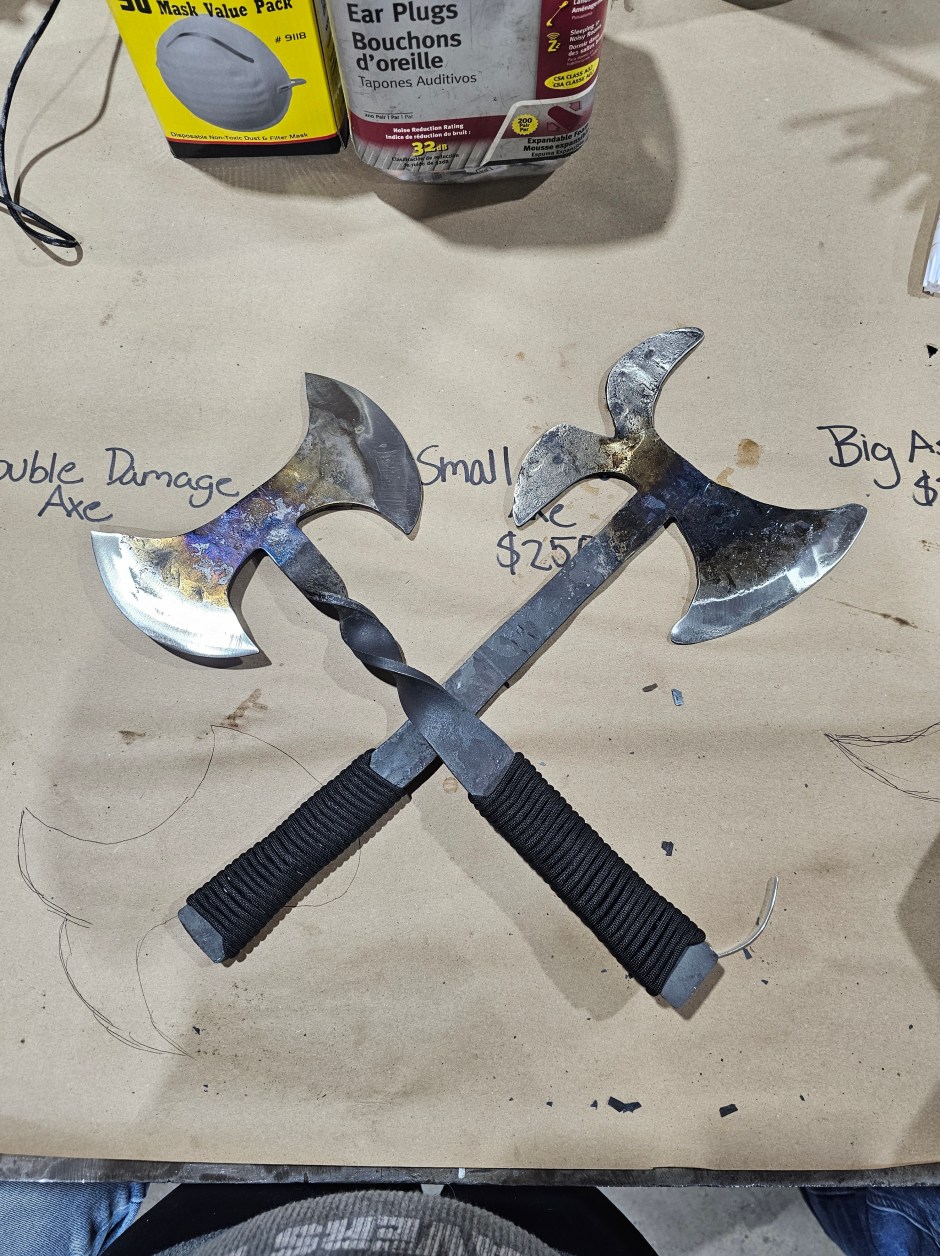
I picked a throwing ax, because I am a Viking at heart, and my sister picked the knife. As the one who always has to go slightly off the beaten path, I naturally added a little bit of flair to my ax by splitting butt into two artfully curled pieces. I was informed this was a little more of an advanced technique but rather than discourage me from my vision, they supported me by spending a little more time one on one with me to help me see it through. 

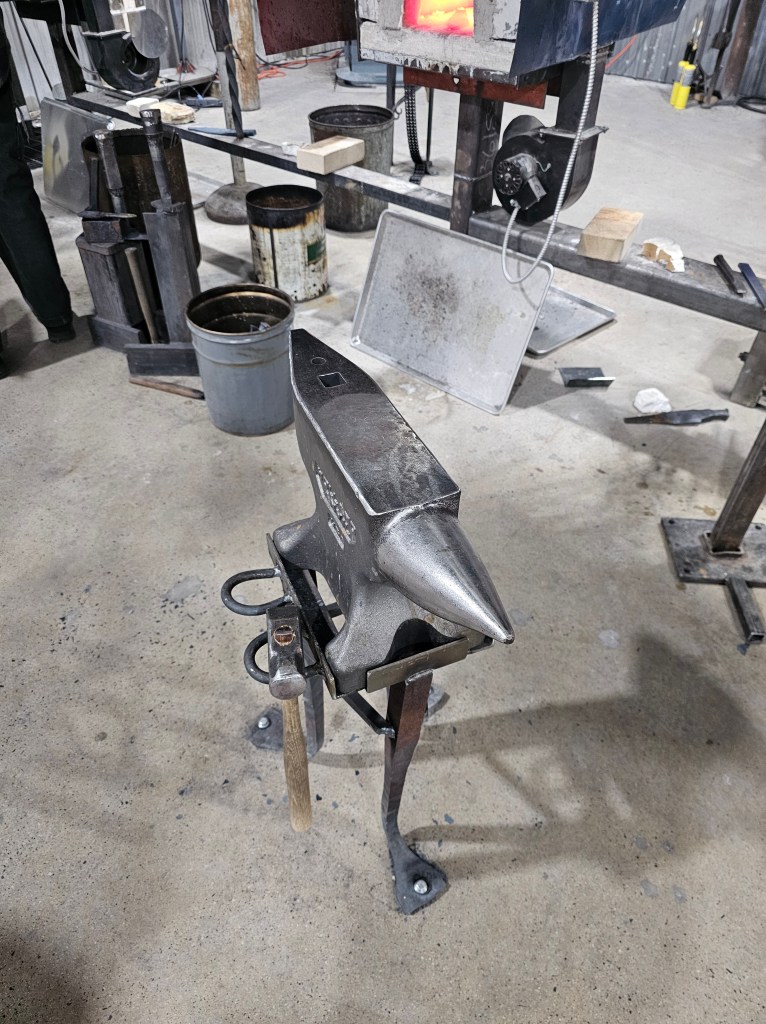
After picking out our templates, we set to work by first making them extremely hot. We did this by placing them inside the forge which is about 1,800 degrees fahrenheit and waited until the metal looked red. Once they were red, we pulled them out with tongs and took them to the anvil. The anvil is a peculiar shape, but each part is useful in creating the different desired shapes of the various tools and weapons a smith may desire to create. The act of hammering causes the metal to flow in a desired direction and shape in the process of “drawing out” the metal. In my case, rather than only focusing on the blade of the ax, I also focused on the butt of the ax. In order to achieve the desired shape, the butt had to be split. They did this by first cutting a small piece of the metal out and then helping me drive down the split. I then drew the metal out in two different directions giving it a distinctive shape. 
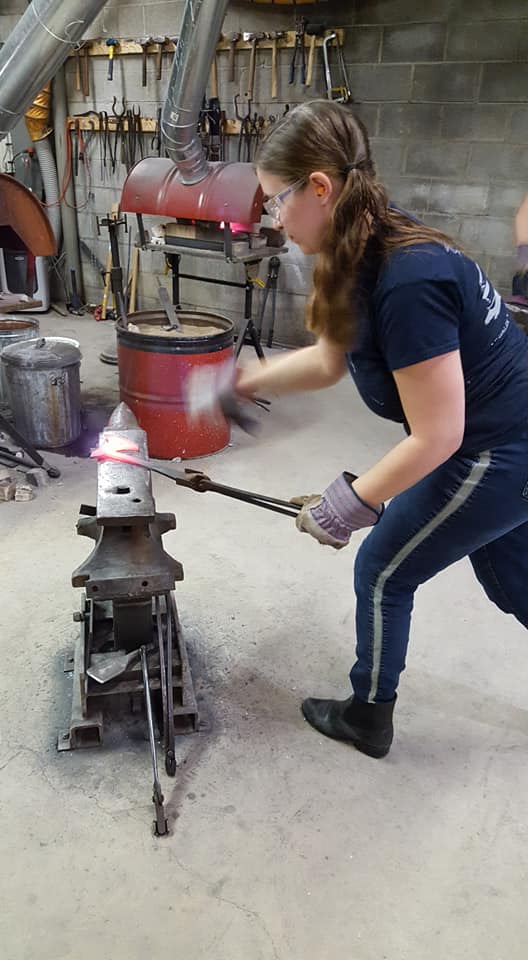
What I appreciated about the process was they consistently told us that it was when we felt the blade had reached a desired shape that it was done. They gave praise and constructive feedback about how a given shape may affect the weapon’s performance, but never dissuaded people from what they were doing or trying to achieve. If we were happy with it, they were happy with it. 

After we got our weapons into the general desired shape, we left them all to cool off in sand. As they were cooling, our gracious hosts offered us snacks including sausage that we could roast near the forge. They also allowed us free reign of their drinks which included some delicious cider. If you are a vegetarian, vegan or do not eat pork products you may wish to bring something along as the primary source of protein was sausage.  

After a quick snack, we then went to the sanding machines to further refine and grind down the rougher parts. Once sanded, we dipped them in some sort of chemical that I don’t really remember what they said it was (oil?) to give them a characteristic black color rather than the gray of stainless steel. Then we put the final touches on our work by sharpening the edges into a true blade worthy of the shield wall! 

The day could not have been complete, without some ax throwing. It is a bit trickier than you’d think because the ax has to hit the target bladeside up in order to stick otherwise it bounces harmlessly off. We had a glorious time trying to hit the target and make it stick. My sister was a little better at it than myself, but in my next attempt at ax throwing, I not only hit the target, I managed a bullseye (more on that later). 

Satisfied with our weapons, we got back into our car and the first thing we said was “We have to take Josh!” (our brother). It took almost five years (thanks COVID), but we did return to the forge with our brother and forged again. The smithy has moved to a bigger location and has another expansion in the works. Once again, my sister chose a knife, but a bigger one. I chose an ax (but a bigger one) and my brother also chose an ax. We truly enjoyed both experiences and look forward to returning to the forge for another time. Who says Bucket List items can’t be done more than once? 
How can you forge your own weapon?

If you’re in the south-central PA area then the Drunken Smithy is the best choice. There are blacksmiths throughout the United States, some of them may offer classes like this one. Depending on how hands-on they want to be, the classes may range from a half day (like this one) or several days, if they are trying to give you more of the process. If you want a more intensive course, then your local college, trade school or arts centers may offer an introductory course. Artist Blacksmith Association of North America may be a good online resource to find blacksmiths in your area. 

Be on the lookout for demonstrations and ask the person where they got their start or if they know of any instructors who may be interested in teaching. One of the great things about artisans is that they desire to keep their craft alive especially in this age of technology when crafts are in danger of dying out, so many are very eager to find and direct students to keep the craft alive.

Completed: Feb. 2019 & May 2024 

Miles from home:  23

Cost: Ranges depending on the project and type of class. The Drunken Smithy has weapons ranging from $150 – $375, but they have other options such as rings and flowers which are about $50. 

My siblings and I opted for a more expensive experience. We were able to do this in part because the following month the sister outing was much cheaper. 
Christkindlmarkt: A 700 Year Old German Tradition 

Since the 1300’s small pop-up markets have been part of the Christmas season in Europe. These small December markets intended to allow people to stock up on meat and other necessities at the beginning of the winter season. These markets grew overtime to allow toy makers, confectioners and other craftsmen to set up stalls under the name “Saint Nicholas market”. They also began to sell roasted chestnuts, nuts and almonds. This tradition spread throughout the German Speaking world. It was later renamed Christkindlmark during the Reformation and the tradition continues to this day. 

Each December stalls are set up to showcase various wares for either a few days or for weeks depending on the event. Along with the wares, food vendors come out to sell traditional foods like currywurst, potato pancakes, gulasch, sauerkraut and of course Gluhwein (a mulled red wine). Those stalwart enough to brave the cold can enjoy pursuing these outdoor markets by the light of twinkling lights. 

So popular and beloved are these markets, that there are entire river cruises devoted to taking tourists along the Rhein to visit them during the Christmas season. These visitors bring back tales of the delicious food, sparkling lights and of course carefully crafted wares. After seeing photos of these places, one might begin to think that the magic of the season is best found abroad and start to dream of flying over to the old country. However, dear reader, as you have no doubt already guessed, these coveted markets are not only found across the vast expanse of ocean but rather can be found right here in the United States. Like their European counterparts, there are the larger and more famous Christkindlmarkts, such as the ones found in Grand Rapids Michigan or Bethlehem Pennsylvania. However, just as there are smaller markets in the smaller towns of Germany, there are smaller markets here in the United States. 

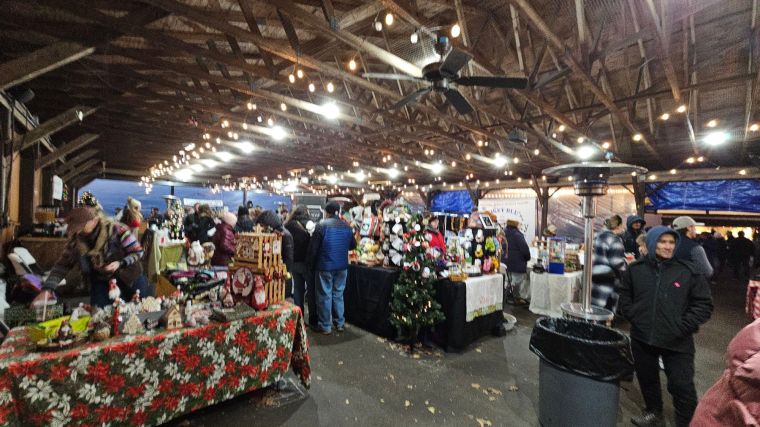
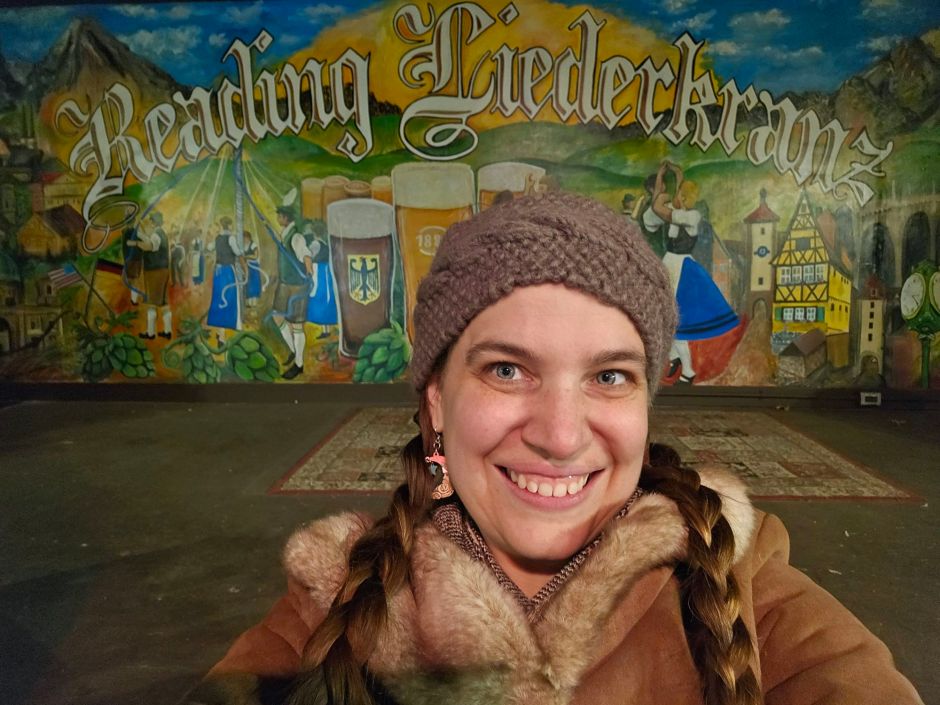
So it was early in the evening that I set out with my work partner, Nicole, to visit the Reading Liederkranz Christkindlmarkt. We choose that time because the market would just be getting dark and the lights would really pop against the darkness of the sky. The city of Reading is situated along the Blue Mountain Ridge of the Appalachian Mountains and so part of our journey included going up the side of the ridge overlooking the city. As we climbed above the urban center, the city gave way to suburban areas covered with trees, reminding us both of our time in Marburg, Germany. Up, up, up we went, passing houses that vaguely resembled German architecture and it was if we had been transported across the sea. Suddenly on our right the forest gave way to a small piece of Germany, the Reading Liederkranz. 

For those not in the know a Liederkranz is a German singing and cultural society which was established to promote and perpetuate German singing, dancing, music, language, foreign exchange and culture. Branches of Liederkranz can be found throughout the United States with many of them established in the mid to late 1800’s. There does not appear to be one overarching society which oversees all the branches, but rather each branch is independent of the others. Like many branches, the Reading Liederkranz hosts various german festivals throughout the year to mirror the ones in Germany. So, just like their German counterparts the Christkindlmarkt of the Reading Liederkranz occurs for a few short days during the Christmas season with stalls set up outside for customers to shop for unique gifts for their loved ones.

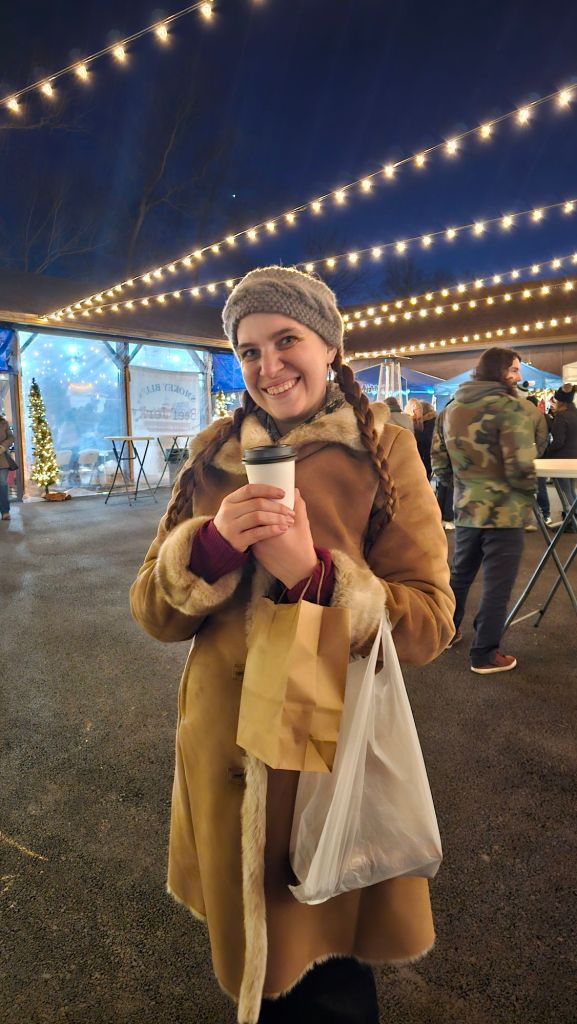
In addition to unique gifts, some of them imported from Germany and Austria, they offered traditional German food that can be found at the markets. I naturally had to buy some choosing to partake in the Currywurst, and potato pancakes. I was a little disappointed that the potato pancakes did not come with the traditional applesauce but instead came with sourcream. It is possible that they were simply sold out of the applesauce. I noted there were some items crossed off the menu as no longer available. As it was cold, I could not pass up the opportunity to sip on some warm Gluhwein. Gluhwein is a mulled red wine served at almost every Christkindlmarkt and I highly recommend it as a part of your Christmas tradition. 

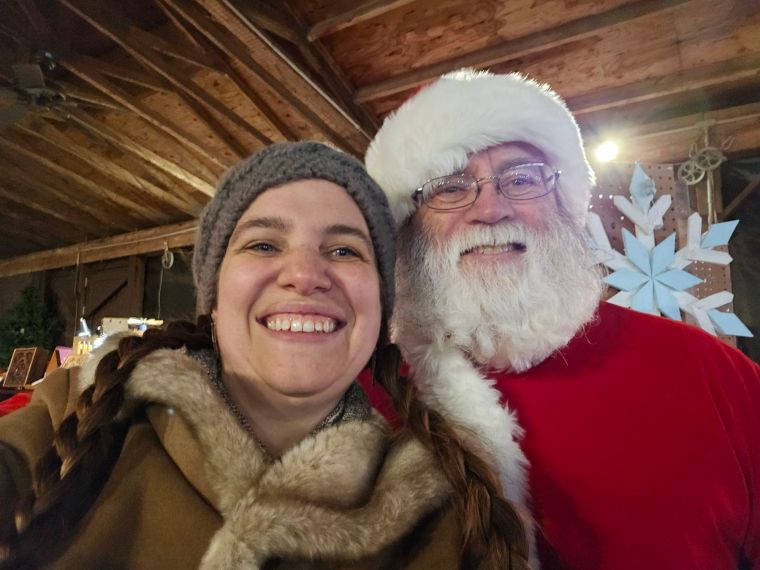
Not every stand was exclusively German, many of the stands featured local artisans and craftsmen selling their wares. I managed to find a few treasures while I was there for both my loved ones and myself. I picked up a few business cards for later reference. I met Santa Claus giving out Candy Canes and hopefully made it to the nice list (fingers crossed). Nicole found a book that she promised I could borrow from her later and her own gifts.We enjoyed looking at the different wares and meeting the sellers which is not something one can often do these days when looking online or shopping at a big box store.  

It was not a huge Christkindlmarkt, certainly not like the larger one in Bethlehem, PA which mirrors more closely those larger markets of Vienna and Munich and is open from Mid November through late December Friday through Sunday. It’s a sprawling market of hundreds of stalls, dozens of food vendors, authentic German artists, ice skating, St. Nicholas, music and more. It’s known as one of the top holiday markets in the world rivaling its European counterparts. 

However, as I have said in other places, I’m not a huge fan of crowds and sometimes it’s better to enjoy something on a smaller, more intimate scale. After all, the towns of Germany often have their own smaller celebrations and what could be more authentic than a homegrown festival? So I spent about an hour or so wandering bundled up against the cold, sipping my Gluhwein and enjoying the piece of Germany they’ve carved out on the side of the mountain. I will certainly have to see what other festivals they bring across the ocean for us to enjoy here in the states. It may not have been perfectly authentic after all, I didn’t have to stumble through my half forgotten German to order my food, but to two people who lived in Germany it certainly got our stamp of approval. Just proving once again that one doesn’t need to book a ticket to see the world, sometimes the world comes for a visit in a nearby town. 

How can you visit a German Christkindlmarkt?

The first step is to obviously wait for the right time of the year, it is after all a Christmas Market. Most of them take place between Thanksgiving and Christmas with a few occurring earlier in November. The smaller ones often only occur on one weekend with the larger markets spanning the entire season. There are of course the more famous ones such as the one in Bethlehem but there are smaller ones like the one I went to in Reading, PA and the one in Lancaster, PA (which I am told has even better food). 

Travel websites are a useful tool to get a start as they will often name the “best” ones. Keep in mind these “best” are subjective and will be prone to more tourists and crowds. If you’re looking for a smaller, more intimate version, then google searching Christkindlmarkt or Weihnachtsmarkt (another name for these markets) may yield some good results. As always, I keep an eye out on my Facebook events page. I haven’t found other social media formats that so easily showcase events in my area. 

Completed: December 2024

Cost: $30 for admission and food 

Miles from home: 30 miles

Below is a small list of Christkindlmarkts in the United States. It is by no means a complete list but it is a good place to start especially if you’re in these areas. The dates vary each year and there is often a ticket price associated with entry.  

Arlington, TX Texas Christkindl Market

Atlanta, GA Atlanta Christkindl Market

Augusta, NJ German Christmas Market of NJ

Baltimore, MD Christmas Village in Baltimore

Belleville, IL Belleville Christkindlmarkt

Bethlehem, PA Christkindlmarkt Bethlehem

Cambria, CA Cambria Christmas Market

Canandaigua, NY Canandaigua Christkindl Market

Carlinville, IL Carlinville Christmas Market

Carmel, IN Carmel Christkindlmarkt

Charlotte, NC Charlotte Christkindlmarkt

Chicago, IL Chicago Christkindlmarkt

Chicago, IL Christkindlmarkt Wrigleyville

Cincinnati, OH Germania Christkindlmarkt

Dayton, OH Dayton Liederkranz Turner Christkindlmarkt

Denver, CO Denver Christkindlmarkt

Des Moines, IA Christkindlmarket Des Moines

Elkhart Lake, WI Old World Christmas Market

Ferdinand, IN Ferdinand Christkindlmarkt

Frankenmuth, MI Frankenmuth Christkindlmarkt

Georgetown, CO Georgetown Christmas Market

Harmony, PA Harmony Museum WeihnachtsMarkt

Helen, GA Helen Christkindlmarkt

Holland, MI Holland Kerstmarkt

Lake Worth, FL The American-German Club of the Palm Beaches Christkindlmarkt Leavenworth, WA Leavenworth Christkindlmarkt

Mifflinburg, PA Mifflinburg Christkindl Market

Minneapolis, MN Holidazzle

Mountain View, CA German Holiday Market

Nevada City, CA Nevada City Victorian Christmas

New Orleans, LA New Orleans Deutsches Haus Christmas Market

New York, NY Bank of America Winter Village at Bryant Park

New York, NY Union Square Holiday Market

New York, NY Columbus Circle Holiday Market

Oconomowoc, WI German Christmas Market of Oconomowoc

Philadelphia, PA Christmas Village in Philadelphia

Pittsburgh, PA Peoples Gas Holiday Market

Poughkeepsie, NY Germania Club of Poughkeepsie Christkindlmarkt

Reading, PA Reading Liederkranz Christkindlmarkt

San Francisco, CA The Great Dickens Christmas Fair & Victorian Holiday Party

Solvang, CA Solvang Julefest

St Paul, MN St Paul European Christmas Market

Tomball, TX Tomball German Christmas Market

Tulsa, OK German American Society of Tulsa Christkindlmarkt

Washington DC DowntownDC Holiday Market

Koizer’s Christmas Village: Let There Be Light! 

It seems almost impossible to think about Christmas without thinking about lights. In Western culture almost no other holiday is so linked with light, which is appropriate considering it is celebrated at the darkest time of the year (for those of us in the Northern hemisphere). There’s just something so mesmerizing about small points of light holding back the dark. They always bring a smile to my face. I especially enjoy seeing larger displays where people can showcase their creativity and transform an ordinary place into something extraordinary, and Koizar’s Christmas village is exactly that sort of place!  

Since 1948, the Spring Lake Dairy Farm has been delighting people. Originally, a display created for the enjoyment of his wife Grace and their four children, it quickly expanded front he original house and barn. People soon began to flock every year to see the display at the locally named “Christmas House.” Eventually, Koziar began to admit visitors while still operating the dairy farm. Overtime, the dairy farm and even the house were abandoned to the ever expanding light displays.  For over 75 years, the farm has been literally lighting up the night as the lights can be seen from miles around. It has even been named Best Outdoor Christmas Display in the World by Display World magazine (according to Wikipedia anyways).  

It takes approximately 90 minutes to walk through the many displays which run the gambit of themes from beloved classic tales like the Nutcracker to Bible scenes from displays showing Christmas traditions around the world to prehistoric dinosaurs. There were plenty of places for photo ops, tucked in various places and with such frequency most of them were without long lines. There are panoramas, a kissing bridge, gift shops and snack shops. One can warm up with a hot beverage like apple cider or hot chocolate while munching on popcorn or chocolate chip cookies. There is one place which serves more substantial food such as pizza and burgers. It is almost entirely outside, so dressing warmly was a must for this particular outing. 

How does one capture in writing what 8 acres of over a million lights looks like in simple words? Even the pictures I share here, dear reader, are only the smallest snippets of the sheer magnitude of that many lights. Each area held a new delight and theme, some had seamless and natural transitions, others were abrupt and almost disjointed side by side. 

What most delighted me was how simple and even outdated everything was. There were wooden decorations clearly from the 60’s and 70’s. There were handmade items which had been lovingly repainted over the years. It was in stark contrast to so many of the other light displays that one could go see, because it felt organic and human. It was clearly a labor of love untaken over decades. There were many store bought displays but they were interspersed with homemade characters and storyboards. It was simultaneously a display of Christmas lights and a museum of decorations over the decades. One of my favorites was the Wild West section with the christmas buffalo. There’s even a whole section featuring a model train. Despite being a professionally run tourist attraction, it still felt like a display cobbled together by your overly enthusiastic neighbors, perfectly capturing the nostalgia of seeing Christmas lights.  

My sister and I ambled through the lights, taking time to soak in the array of themes. We stopped to study the displays, finding small touches which brought us smiles of delight, like the angel fawn near a nativity or the zoo train with the tigers. We stopped to enjoy hot apple cider and churros. I also bought a pair of gloves having realized I accidently left mine at home. There were only a few places where we could slip into to escape the biting cold of the evening, but we were lucky that it wasn’t too cold. Eventually we ended up passing through a large garage which proudly displayed the history of the village before going into the final gift shop. We left fully satisfied and well in the Christmas spirit. 

How can you see amazing displays of Christmas Lights?

Luckily, this is something that you can see almost anywhere during the Christmas season and there is almost always a place nearby with overly enthusiastic neighbors. Some may be drive through places, others may be like Koziar Christmas Village where you can walk. It depends on whether you wish a slow meandering stroll in the cold where you can stop and really take in each display or if you wish to remain warm in your car. There may be ones that are put on by professionals such as Candy Lane at Hershey Park or family affairs with all their quirks like Kozier’s Christmas Village. You can also find a local neighborhood and walk around to see everyone’s displays. In the last few years, my home town has been holding a contest which has helped to revitalize people’s interests in putting up lights. You could even start a contest in your hometown if you’re feeling particularly entrepreneurial. 

Completed: December 2023

Cost: $13 per person (It would have been an extra five dollars to attend on a weekend or the week of christmas)

Miles from home: 26 miles

Visiting History: Gettysburg Battlefield

The battle of Gettysburg was one of the defining moments of American history. The Union’s victory over the Confederate army was the turning point in the Civil War, leading to the restoration of the union and ensuring the end of slavery. The battle took place over the course of three days from July 1st to July 3rd, almost coinciding with our nation’s 86th birthday. It was also one of the bloodiest most devastating battles in our history. 

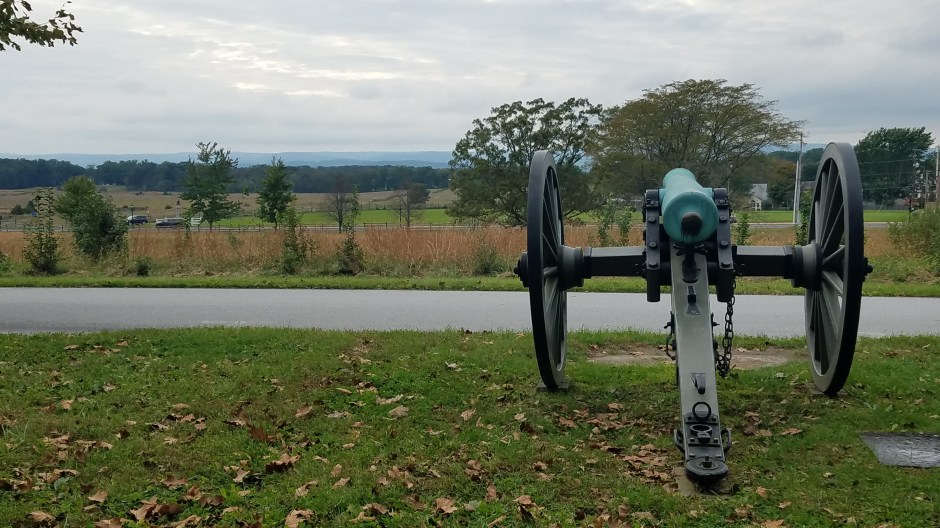
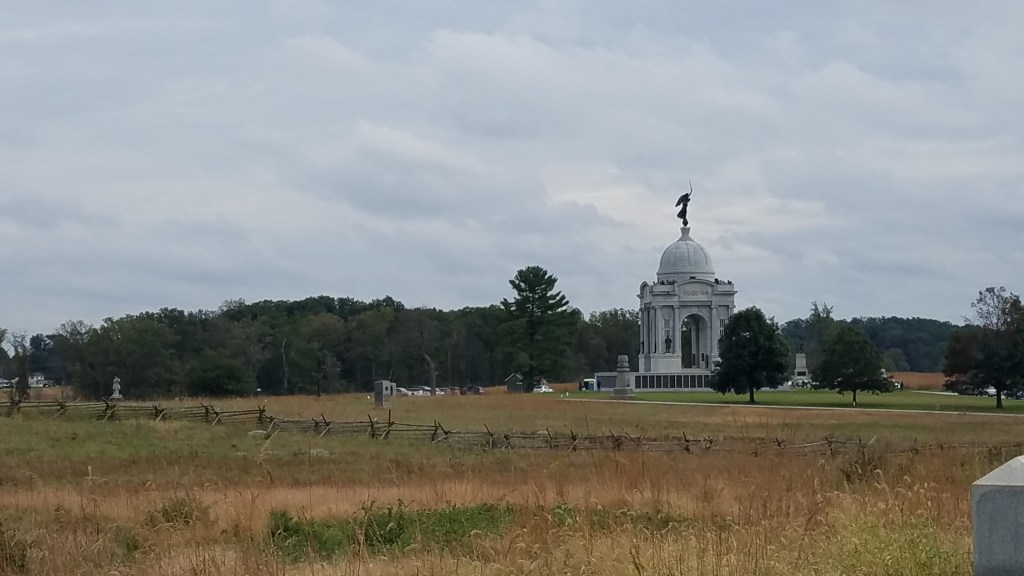
Visiting the site of this place can be a bit surreal. Today, the fields lay semi-empty. The dead have been given proper burial. The gunfire has long since ceased and it only returns for reenactments and salutes to honor the fallen. To the educated eye one can still see the evidence of the battle and how the lay of the land was shaped by it and helped to shape the battle itself. For example, one can still see clearly how the Union’s superior position of the high ground helped them win despite having less troops. 

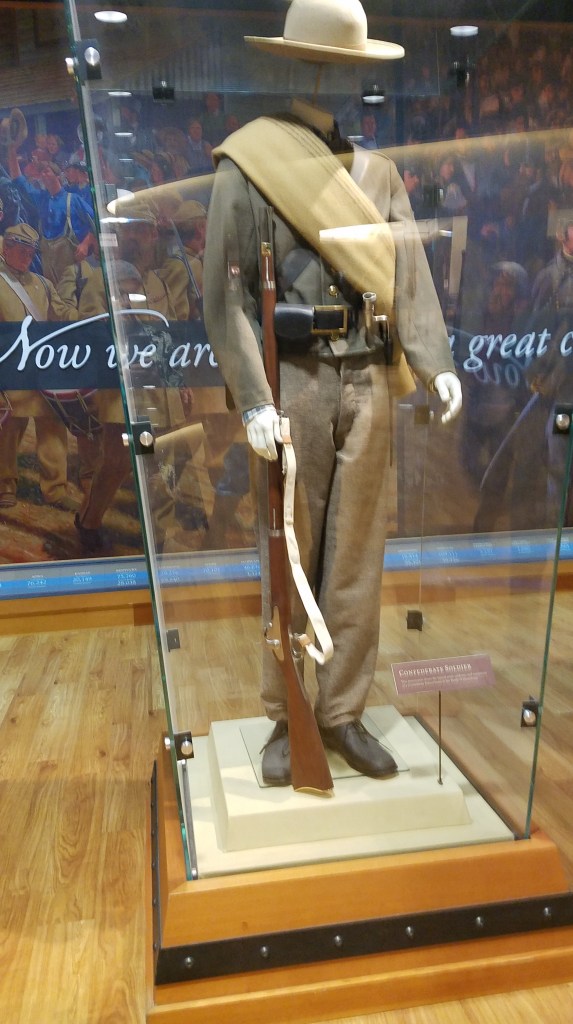
 It is now home to many monuments to the fallen from all over the states. Naturally, the Pennsylvania monument is absolutely massive, but others are smaller. Some are dedicated to large groups, but then there are more specific battalions and legions remembered. It is easy to forget that each of the men who perished on the field had a name, a story and purpose to be there. It is not easy to take up arms against one’s own countrymen. 

In the surrounding town, they offer various walking tours highlighting moments of history. They talk about the miracle that only one civilian died in the fighting, they point out bullet holes. What is really striking though is the sheer amount of death the residents saw, the description of pools of blood from the surgeries and piles of limbs that had been hacked off to try to save lives. They describe the stench that lingered for weeks in the hot summer. They whisper of ghosts still lingering on over a century later. If one believes in such things. 

Still in among the ghost stories, there is real history being remembered. There was a high cost to pay to preserve our country more than the cost to form it originally. It answered the question of whether we truly were a nation of freedom for all or only for some. A question that will need to be periodically asked and answered as we continue to navigate conflicting rights and values. It is a place that when visited demands at least some reflection of the cost that had to be paid for today’s America. 

Despite growing up relatively close to it, I had not really visited the battlefield until I was an adult. The annual classroom field trip that year had been replaced with a trip to Philadelphia to see the visiting display of the Russian Tsars. When my family did finally visit, I was a teenager and the thought of tramping about a field in the heat of summer with my father was unappealing, and I opted to go elsewhere with my mom and let my brother and father walk about the fields. So in the fall of 2018, I finally went with my boyfriend to see where it all happened, put history in perspective and learn more about this monumental event in our nation’s history. 

I can’t say that I necessarily learned anything new about the battle that I hadn’t already heard in the classroom or seen in documentaries, but what I did know was brought to life by seeing the physical artifacts from the battle and hearing the intimate stories of the people who were there both solider and civilian on both sides of the war. There’s something to be said about seeing and interacting with physical objects that allows our minds to form a more emotional connection with the knowledge or at least enhance our knowledge through other senses. 

It is always strange to visit the site where tragedy took place and one must acknowledge the Civil War was tragic. It was tragic for a nation to be ripped apart and that the effects of that can still be seen over a hundred years later. It is also tragic it took a civil war to confer the basic human right of freedom from slavery to all living under our nation’s flag. On one hand, it is a place of history that should be remembered and respected, a place where people died to give other people freedom. On the other hand, it’s a site of enjoyment and relaxation. People come to visit on their vacations and for a day off of school. They enact the battle for entertainment, as well as to keep the stories alive. Children run through the fields laughing and playing around the cannons. Tourists take goofy pictures in front of memorials. For me the juxtaposition of both is important, because in some ways it means healing has taken place and is a testament to the resilience of people and our nation. 

How can you add this to your own bucket list?

Unfortunately, this is one of those things that cannot be substituted easily if going to the actual Battlefield of Gettysburg is on your list. It’s in PA and unless you’re nearby, it won’t be cheap or easy to get here. In which case, may I recommend google flight tracker and hotels.com? This may be an instance of the principle of the item rather than the item itself. The principle behind visiting Gettysburg was to see an important site of our nation’s history that helped shape our identity and defined us. If you live in the south, there are many other Civil War battlefields that you can visit. If you live in the North East, especially in New England, then you can visit many sites from the Revolutionary War. In the South West, you have the Mexican-American War. California was home to the gold rush as well as the Japanese Internment Camps and the Watts-Riots. The Midwest is of course home to the west itself and the expansion of white settlers into the territories. I highly recommend seeing what is near your hometown. You may be surprised to find your seemingly insignificant part of the country actually helped shape us in the amazing country that it is today.

Completed: 2018

Miles from home: 75

Cost: Free to visit the Battlefield, Visitor’s Center. Museum is $15, Museum+ Film is $21 

Murder?! At the Mount Hope Estate!

I have been remiss, dear reader, in neglecting to tell the dastardly tale of the real beginning of my sister dates. Yes, technically, we did do the chocolate walk in October a few months before the night of the ‘incident”, but it was that very night that the idea itself took off and we determined to make it a monthly outing. 

It began of course with an invitation to dinner at the Mount Hope Estate, which the original mansion being built in early 1800’s and later additions in the late 1800’s makes it a unique blend of Federalist and Victorian styles. How apropos when considering the events of the night. At first, my sister lamented being unable to attend without a second guest, what would people say to show up to an event sans escort, but to go with a different gentleman would be quite out of the question for a married woman, such as herself. It of course fell to her sister to chaperone, or rather she could use the excuse to chaperone me her unmarried sister for a bit of fun together.  

Now any true society dinner begins with the mingling of the guests to share juicy gossip and tales of one another. Our hosts that night were no different, slipping tantalizing details of the other guests. And such scheming amongst each other as I never did before see. Perhaps, my friends are above such petty squabbles, or perhaps they are simply better at disguising their nefarious ways. Either way, keep your secrets to yourself lest you become the subject of such gossip! 

Having thoroughly enjoyed mingling, slowly sipping on wine and engorged ourselves on the latest potential scandals, we were called to be seated four our four course meal. The food was as delightful as the entertainment! A feast for both the eyes and the mouth! My sister and I compared notes from our careful study of the key players for the night. We sensed a plot afoot and we would not be caught out unawares. 

Well, we certainly were right in our suspicions for shortly after dinner, came the cries of murder! But who had done it and why? My sister and I only needed to give one another a short nod before jumping into the adventure to help solve the mystery! Naturally, we had to launch an investigation of our own, questioning the key players and making careful observations of the crime scene. Having made our careful inquiries we were certain we knew the culprit! Alas, we were fooled! ‘Tis a good thing, she and I were not official investigators or else an innocent would be locked up and the foul murderer would have escaped! 

As it turns out, the play rotates who “done it” so that even if friends share the experience with one another or social media, the night is not entirely spoiled ahead of time. A clever idea on the part of the organizers of the play. Our play was set in the 1940’s, so I donned an outfit to reflect the late 30’s/early 40’s to really help me “get into it”. It really is up to you how much to “lean into” the character of the night. 

I’ve done other dinner plays where the play happens around you as part of the process of dinner. While they were enjoyable, the added element of being able to get up to interact with the players as if you were actually part of the story was what elevated the whole experience. Additionally, the backdrop of a murder mystery in the midst of a Victorian mansion was an added bonus, few places can boast of. The mansion is not located among the bustling cities, but rather out in the countryside, surrounded by the fields of grapes for the winery which only added to the more gothic elements of the mystery. And did I mention the food? Mount Hope outdid itself with the food. That alone was worth the ticket price!  

So how can you find a murder mystery dinner?

I would suggest starting with google or facebook events to see what places in your area may periodically host one. If you have more than one option then, consider other “enhancements” to the experience. Do you have the option for a gothic Victorian mansion like myself? I certainly recommend thinking through the setting of your play. Is there a time of year that more suits you for mystery and fun, like in October or in the darkness of winter? You can also often see hints of the plot and setting that might strike your fancy more than another. 

I certainly encourage you to dress up a little, take on a “part” yourself and have a bit of fun with it. Obviously, don’t be an obnoxious audience member and try to be part of the play itself. Don’t go in stealing all the attention and confusing the other audience members who can’t tell if  you’re supposed to be part of the theater trope or not. However, a little more immersion can make your evening more magical.

Completed: March 2017

Miles from home: 11 

Cost: $60 per person  

Livin’ In an Amish Paradise: Hometown Pride

It can be quite easy to forget that wherever you live, someone dreams of visiting. Maybe not your particular town or neighborhood, but certainly places nearby. I once worked with a young woman whose dream was to move to South Dakota much to my bewilderment and last time I spoke with her, she was absolutely loving her decision. I used to dream of going to the west to see the Rocky Mountains or the west coast. Others apparently dream of coming to my part of the country to see the Amish. 

I remember when I was seeking inspiration for my bucket list and I stumbled across one that included visiting Lancaster County. I knew growing up that I lived in a tourist destination and that people came here, but it wasn’t until I saw it on someone’s bucket list that it truly sunk in that the place I was constantly trying to escape from, other people wanted to come to and it was a big deal to do so. 

I started exploring what made Lancaster so unique and special that made it a destination worthy of someone’s list. What I discovered is that it actually is a special place with its own subculture and quirks that make it so charming to outsiders. I began to appreciate what was in front of me, enjoying the rolling farmlands near my house, seeing beauty in the corn and wheat fields, savoring the seasonal changes and stopping to admire the farm animals frolicing in their pens. I learned the ubiquitous fruit stands and farmers markets scattered throughout the county were rare treats elsewhere. It’s home to America’s Coolest Small Town 2016, Lititz, and recently two of America’s best buffets, Shady Maple and Miller’s Smorgasbord. 

Is it still Coolest Small Town in America? Maybe, maybe not – but it is pretty awesome.

In addition to all things Amish, we boast a rich art scene with its many art galleries and Lancaster’s School of the Arts. We’re home to the Fulton Theater as well as Sight & Sound and American Music Theater. We still preserve many of the folk arts here which can be found at many shops in the tourist areas. However, if you want a more hands-on experience, there are tons of workshops in the area through PA’s Artisans Guild which helps keep these crafts going. 

We have street fairs throughout the fall as well as craft fairs in the spring and late summer. We host farms shows and even have tractor square dancing! Although, don’t ask me about it, I had no idea that was a thing until my early 30s. 

The truth is, I am now grateful to be living here whereas before I was always looking to escape to far flung places instead of realizing what I had in my own backyard. It would be easy to dismiss my small town as boring and “uninteresting”, looking to the bigger cities or tropical islands of the caribbean. I can make every day moments bucket list worthy. Instead of being annoyed when I am driving and I come across a farmer helping his flock across the road, I take the time to savor what I’m seeing. It’s actually quite pastoral and idyllic to watch. I get excited when I hear the tell-tale clop of hooves on the road signaling the approach of a horse and buggy. I take time to stop at the stalls along the road rather than continuing to drive on. 

Sheep! I love seeing the little lambs in the spring time.

My everyday life is another person’s vacation. Sure it’s easy when you’re on a vacation to enjoy the mundane as extraordinary. On a vacation you aren’t worried about the everyday stresses of life like getting to work on time, picking up the groceries, rushing home to the wife and kids, so lingering at a farmer’s market is a luxury the tourists have that I don’t have. When you’re on vacation, you aren’t quite as pressed for time, you can linger and savor what you’re experiencing. Your worries take a backseat to the present moment. Without the worry of time and everyday responsibilities, it’s easy to mistake a foreign place as better than our own homes. I think that’s why some people will regret moving to a place they loved to vacation in, because the reality of everyday life doesn’t match the rosy picture they had as a tourist. We can apply the opposite approach to our homes, realizing that we can recreate those feelings for ourselves at home with the right approach. 

How can you cultivate hometown pride?

The first is to take the message of this post to heart. Somebody wants to come to your area and visit and that someone is willing to pay money, perhaps not an insignificant amount to do it. It’s so easy to miss the life that’s in front of us when we spend our lives looking ahead to the future, to excitement and adventure, scrolling on our phones while life passes us by. Your adventure is right out your front door! 

The trick is to stop taking your surroundings for granted, to ground yourself in the moment and be mindful about your sensory experience. Instead of rushing into the farmer’s stand grabbing my groceries and leaving as quickly as possible. I will try and make time to pursue the produce, carefully examine the baked goods and give into temptation with the local honey. Last time, I even purchased a cool meadow mint tea in a glass bottle. For those of you not in the know, Lancaster has a unique meadow mint tea that the Amish make and it is a summer treat for the locals. Rather than drinking it down quickly, I slowly sipped it, letting it dance upon my tongue just like I used to do as a child. Did I still have to return back to my housework and garden? Yes, but for about ten minutes, I let all the stress melt into the background and took in my hometown with an outsider’s eyes.

Completed: Around 2017

Miles from home: 0

Cost: Free 

Stables near my home, I pass it almost every week. I finally took the time to pull over an appreciate the sight.

Kayaking 1,000 Years to the Past

Slowly, slowly he worked stone against stone chiseling out a dimed sized impression. The sun marched its way across the sky as he worked each part of the snake. An hour’s work would only yield four and he had so many to go. Still in this sacred place of sun, earth, water and sky where the underworld opened to the deep below, he kept to his work. One piece among a dozen others each marking the important spiritual events of his people. As the sun kissed the rock on the fall equinox lined up perfectly with the head of the man’s snake, he smiled.  The stories of these drawings the life, spirit and blood of his people, a testament to their presence which would continue to echo for a thousand years and more. A thousand years later, though lost to time after the conquest of the Susquehannocks and the colonization of the Europeans, they are not forgotten but remembered simply as the Safe Harbor tribe. 

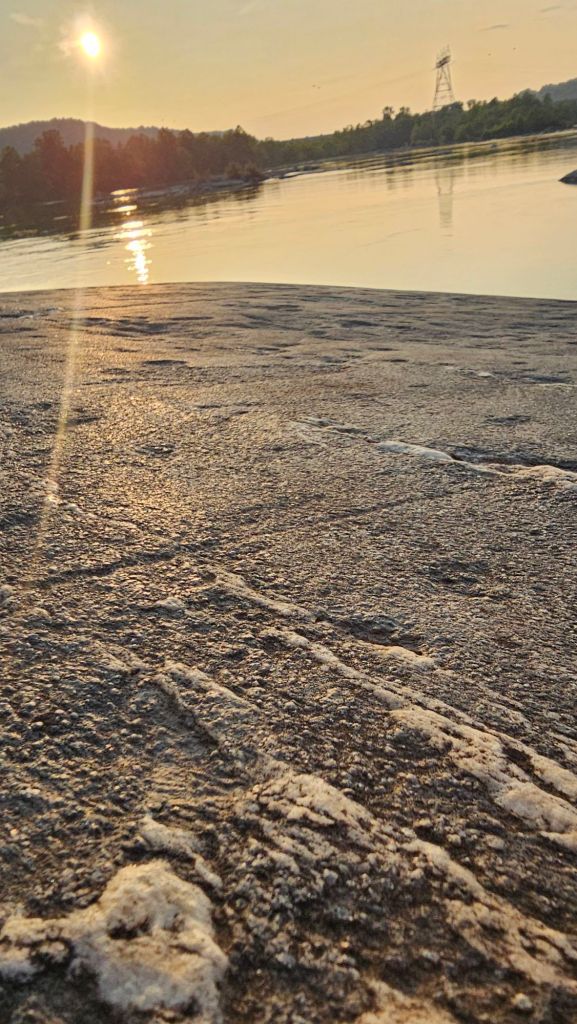
To stand on the Little Indian Rock and Big Indian Rock is to be transported back in time. On either side of the river the trees still stand tall and proud and to the west, not even the telephone lines can break the illusion that one is seeing the forest as it has been for a thousand years. Though truthfully the dam has raised the water levels significantly and the river has eroded the shore line. Still one can see why they felt this place was special. With the thickness of the forest the sky would have been often blocked out from view under the canopy of leaves. The wide river would have opened up to the glittering cosmos even as the deep crevasses beckoned to the underworld below. The jutting rock up out of the water would have been a place of earth within water. A place of earth, water, sky and the underworld colliding where the river goes from a soft, lazy merading flow to rushing current as it suddenly drops. 

Big Indian Rock seemed to have been used primarily for social purposes with its markings for hunting, directions and even a helpful gps tag noting that it is a two day’s walk to the mouth of the river. There is evidence of camp fires perhaps for when they wished to view the night sky. Despite its size the petroglyphs are mainly concentrated in the cardinal directions. Little Indian Rock seems to have primarily been used for spiritual purposes having several Thunderbirds and snakes which line up with the spring and summer equinoxes. There are several which seem to depict the mystical Wendigo and even a Misiginebig. 

One of the largest collections of petroglyphs east of the Mississippi. In this picture you can see a Thunderbird and the mysterious water serpant.

Graffiti dots the rest of the rock from the various visitors over the years primarily from the 1800’s until about the 1980’s when the rediscovery of the petroglyphs and their significance put a halt to any additional markings. Not through any sort of ordinance, but through education and the respect that education has bred through the local populace who still kayak and fish around the rocks. Despite its historical significance and being home to what is considered the greatest collections of petroglyphs east of the Mississippi there is no official protection for either Big or Little Indian Rock, no barriers preventing anyone from clamoring up the rocks to see them. The location of this ancient art is perhaps the best protection that can be offered: a wall of water separates it from the land on either side requiring a boat to gain access and most mischief makers are easily deterred by the strenuous physical exercise required to obtain access. 

At first, one could easily miss the ancient markings as no more than strange impressions in the rock. It takes a sharp eye to spot them, they are most easily seen at sunrise and sunset when the angle of the light allows them to stand out in sharp contrast. Which is why on a late August evening, my sister and I set out with a small tour group in kayaks to the two islands. I was a little nervous having grown up hearing the dangers of the river especially around the dams which so easily can sweep a person down into their churning depths never to be recovered as their body remains trapped within. However, we were a safe distance from the dam and our guides delayed our departure twice due to unsafe river conditions, so I trusted them to take us out. We donned our life jackets and were given a quick overview of kayaking. My sister and I were the only two non-experienced kayakers as the other members of the tour had brought their own kayaks. 

With little ceremony, we hauled our small vessels to the launch site and were quickly swept up in the quick current of the conestoga river rushing to meet the Susquehanna. At first, I paid little heed to my natural surroundings focusing primarily on learning how to steer and maneuver the kayak. There were a few run ins with others but we laughed it off with some pirate jokes. One of our guides rushed to the front of the group where the other stayed in the back to assist any stragglers. We were assured that if we needed a tow back they would assist to ensure we all made it back safely. Being a novice, I was not very good at reading the river and got swept up a few times in quick, churning currents which swirled my vessel around. After a few moments of panic and fruitless fighting, anxious that I would be swept away from the group and lost down river, I regained my footing (so to speak) and allowed myself to literally go with the flow. I was able to maneuver my kayak behind some rocks which broke up the flow long enough for me to jet across to rejoin the group of boats. Having conquered my first challenge, I felt much more confident in my ability to traverse the waterway, though I was certainly not ready for a solo venture. 

Not being quite so nervous about the river, I was able to start to take in my surroundings and really enjoy the experience of the kayak gliding across the surface as my paddle dipped into water. Overhead birds circled and cried to one another. The trees on either side of the river blocked out signs of civilization, the illusion only broken by the distant sounds of traffic and the dam nearby. However, with the dam behind me it was easy to get lost in it. Occasionally, I would place my paddle across the kayak to simply float and breathe. I could see why so many people will spend their weekends out on the water leaving behind the sometimes suffocating atmosphere of the urban environment for the open expanse. 

We first visited Big Indian Rock where we were shown the petroglyphs and given some education on the people who once made them. Though we no longer know their name they are thought to have been part of the Algonquin people who were known for their making of petroglyphs; other artifacts that have been found in the area also point to cultural similarities with other known Algonquins. We were given a brief overview of native beliefs when he showed us a thunderbird. The one on Big Indian Rock is a rarity for its depiction of feathers on the wings. It is uncertain what the significance of the feathers were. We then clamored down the rock back to our kayaks to go back up the river to Little Indian Rock. We were warned to stay away from the poison oak. Having had poison ivy earlier in the summer, I was quite motivated to stay away. 

I was absolutely amazed by the incredible amount of petroglyphs concentrated on Little Indian Rock, a feast, a mythical serpent creature, snakes marking the passage of the sun, deer prints, footprints, bear paws, thunderbirds, animals that could be beavers or otters and more. It was such a plethora of art made meticulously over hundreds of hours. Each dime sized impression took over twenty minutes to make leaving little doubt that it was done with intention rather than something a few bored teens may have completed. It seemed that all too soon we had to leave this magical place, but the announcements coming from the dam warned us that it would soon be time to get off the river and the setting sun threatened us with coming darkness. As a novice kayaker I did not wish to embark on my first night adventure. 

The trip back was considerably more effort than going down as the primary task was steering the kayak with the current. The trip back was against so it required us to hug the shore of the larger island in the middle for a significant portion where the current was slower. I made the mistake of trying to jut across too soon which left me fighting the current. I strained my muscles forcing them to conquer the river’s strength with my own and was quite grateful I had been working out using a sledgehammer to mimic kayaking throughout the summer. My sister required some assistance and was towed part way for the trip back. Primarily to help her navigate the river and not get caught as I was in the stronger currents which threatened to push me back. Despite a novice’s mistake, I was able to overcome and make it back on my own, my arms happily exhausted but not overdone.

The sun had not yet completed its journey to the underworld and we were happy to have made it back. We helped haul the kayaks back up the shore to the grass and thanked our guides for the lovely evening and assistance in getting back. 

How Can You Kayak or See Petroglyphs?

This was definitely one of those “bang for your bucks” kind of trips in that it crossed two things off my list at the same time: petroglyphs and kayaking. I had been kayaking as a child, but it was only on a small lake at summer camp and I wanted a real experience. Renting a kayak would have been pretty easy, but given the dangers of the river nearby, I wasn’t comfortable exploring on my own. Just two weeks before, two people perished in the aftermath of the flooding from the hurricane, and others had to be rescued. The river can be quite dangerous under certain conditions and had it not been for the guide shouting some advice to get out of the churning current, I may have ended up many miles downriver. I recommend that while you can easily purchase or rent a kayak, you ensure you have completed any necessary licensing requirements for boating and you have done the necessary research to ensure you understand the dangers of any particular river. 

As for the petroglyphs, they are found throughout the United States and even the world. They range in ages from 1,000 to 40,000. Some can be found still in the native surroundings like the petroglyphs on Big and Little Indian Rock whereas others have been removed and placed in museums or have had barriers built around them to protect them from harm. It really depends on what you consider “good enough”. For most people, I imagine seeing them in a museum is perfectly fine. For me, it was important to view a set in their original surroundings. For instance, it was really cool to see how close the sun aligned with the snake marking the fall solstice which was only a month away when this trip was untaken. There were footprints on the rocks and we stood close by them wondering what they marked and whether we were supposed to look out and see something important. Has anyone looked to see if they align with any star signs? All of these questions can only be asked and answered if they remain where they were untouched. Unfortunately, leaving them untouched also means risking them to the elements and potential vandalism. 

I found out about these petroglyphs several years ago and was very disappointed to see that they were nearly inaccessible for someone without access to the water via boat or kayak. I had almost resigned myself to not being able to see them, until a post on Facebook caught my eye, Lancaster Uncharted was hosting kayaking tours to them. It was unfortunate that because of an earlier trip I took that year, I was unable to afford to go that summer, but I marked my calendar for the following spring when I was sure tickets would go on sale and sure enough was able to snag them in May for August of the same year. There are many sites dedicated to the location of various petroglyphs and tours to go see them. As always, I encourage you to decide what suits you. Remember it’s not about replicating my adventures as they are merely to inspire you with the possibilities that are out there! After all, what is available in my backyard may not be in yours, but that’s what makes these adventures so fun and unique! Go forth and explore dear reader one never knows when and where one might find a portal to 1,000 years in the past.

Completed: Aug 23, 2024

Cost: $115 per person

Miles from home: 20 (plus another 1/2 mile of kayaking down the river)

Falling into Autumn: Appreciating the Changing Seasons

I love fall, the cooler days after the scorching heat of summer, the changing leaves, the cozy sweaters and warm drinks. I love the stormy days and misty mornings. I love the way the world seems to nestle down for the coming winter. 

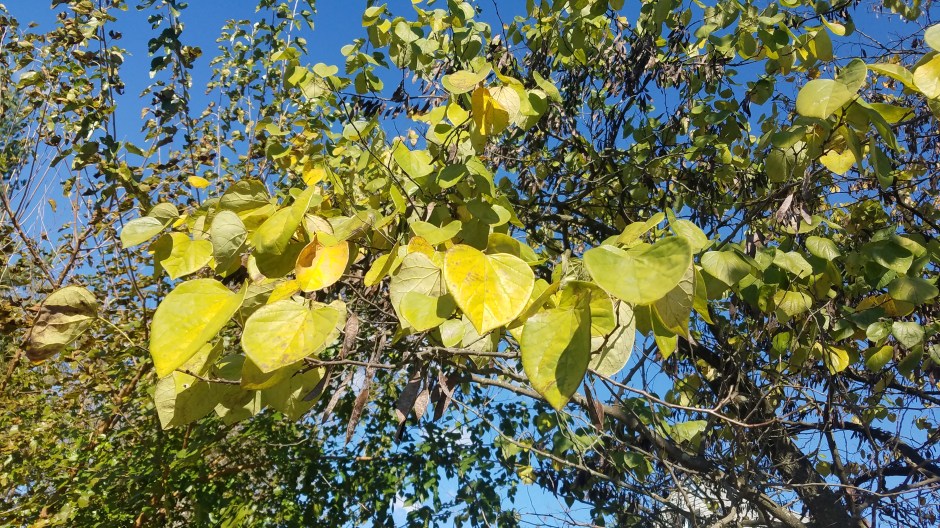
One might wonder at something as mundane as a seasonal change being included on a bucket list. But then, dear reader, if you’ve read my other posts here then you already know my answer. If you have not, the answer is simple, because one ought to embrace the joy of living where one is at. One ought to remember that wherever one is, someone somewhere elsewhere dreams about the very place you find yourself. Think of all the millions of people who never get to experience the wonder of fall! Consider all the people who never get to see the leaves of their trees turn to brillant shades of yellow, orange and red. Throughout the tropical regions of the world, there are people who dream of witnessing the changing seasons, who find the vibrant colors of fall as enchanting as a tropical beach. There are even people in the United States who have never really experienced all four seasons as we do in the northern parts. 

When was the last time you joyfully walked through them, crunching gleefully as you marched through them? Perhaps, you were a young child and no longer given over to such frivolous and silly things. I implore you dear reader, abandon your adult self with all its imposed rules of oughts and shoulds. Indeed embrace the fall with a child-like enthusiasm and wonder. See the season with the eyes of someone who has never seen this particular form of natural magic. 

It was with this sort of attitude, that on my birthday I embarked to a nearby nature preserve to drink in the pleasure of the late fall. Trees typically peak about a week or two before my birthday meaning that there are often more leaves on the ground than in the trees and the forest isn’t quite as majestically dressed. The air is also usually a bit chillier requiring extra layers. That day I donned a hat, a warm caplet and fingerless gloves which would keep my fingers free for the task at hand. 

I took a few moments to simply breathe in the crisp morning air savoring the flavor of the forest on the cusp of winter before venturing forth onto the path. I listened carefully to the sounds of the woods around me, the water gurgling in a nearby stream and the way the leaves rustled underfoot. I then drank in full the sights of the forest enjoying the brilliant color of the trees in their glory. With a child’s enthusiasm, I trounced through the woods at times kicking up the leaves, at other times standing quietly to simply enjoy the sights, smells and sounds. There were few others out on the trail that morning, but mostly I was alone with the forest. 

I could not say just how long I was out there, but I walked quite a ways basking in nature’s glory before making the determination to go back. It was one the way back that I indulged in another child’s game, collecting leaves of various colors and forms. I made a bit of a game with it, sometimes exchanging a leaf that I had already picked up for one on the ground to make sure I did not become over burdened with them. With my collection well in hand, I headed back to my car quite content with my birthday treat to myself, a quiet morning fully immersed in the glory of autumn. It was something so incredibly simple, yet I enjoyed as much as an afternoon at a spa. I try to spend at least one day in the fall to really appreciate the season as if I were one of those tourists who traveled hundreds of miles on a carefully planned trip just to see the leaves. I am frequently amazed by the beauty that my home brings each year.

How to experience the beauty of fall?

If you live in the northern climes, I recommend tracking the peaking of the leaves in your local area and then planning a morning or afternoon out around that time to really enjoy the outdoors. Keep in mind that fall can be a rainy time of year, so being flexible is key. Luckily, it costs almost nothing to get out to the woods and go on a hike. 

There are many other ways to enjoy fall like visiting a pumpkin patch, corn mazes, apple picking and more, but this activity is all about the leaves. You could go a step further and use the leaves for art projects. I used mine just as table decorations for a few days. 

If you don’t live in a place where there is a dramatic shift of the seasons, embrace the cycles of the year wherever you may be. The subtler nature of the changes can be just as rewarding as the dramatic shift. Perhaps, there are certain flowers in bloom in the traditional autumn season that you can stop and appreciate. Appreciate the migration of birds who have come down to your warmer home to escape the coming cold of winter. Paying attention and celebrating nature throughout the year is a rewarding experience. We so often neglect the world around us as uninteresting and miss the magic that is occurring all around us instead looking to other people’s backyards for wonder and inspiration. Find the wonder in your natural environment.

Completed: November 2021

Cost: Free (maybe a few dollars in gas)

Miles from home: 6 miles

Getting Lost in a Corn Maze

In late summer of 2020, the world was still reeling from COVID. Depending on where you were in the world, you were still subjected to lockdowns and restrictions of movement or gatherings. In my own state, there were restrictions on gatherings well into 2022. I have written earlier how those of us with intrepid spirits were not daunted by restrictions on traveling further afield when it came to living life. As it turns out, myself and my co-workers did not need to look any further than the local corn fields for fun. 

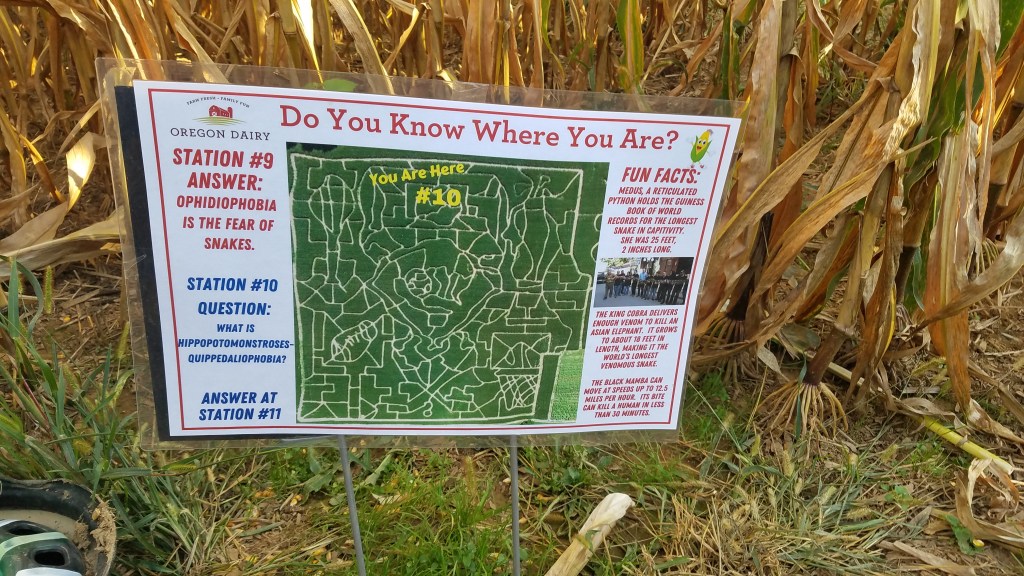
After the lockdowns, my co-workers and I made a concerted effort to plan things to do together as a team after work hours once a month. It not only was helpful for team building and morale but also our mental health as it gave us the opportunity to go out and have fun. As social workers dedicated to helping the homeless this was a particularly stressful time and it was important to foster connection with others as part of resilient coping strategies. One of the activities we chose was a corn maze. In part because some of us had never done them before and we also had a corn maze aficionado in our office. After some debate on which one would be the best to introduce us to, we settled on Oregon Dairy’s. We decided on a smaller, more beginner friendly one rather than the one at Cherry Crest Adventure Farm.

Now as with everything in 2020, what could go wrong, did. In a completely on brand 2020 accident, the GPS system which helped the farmers cut the design for the maze failed dramatically and cut the maze in a completely wobbly way. Unfortunately, while yes, it will grow back there was no way for the corn to grow back in time to for a re-do. However, I don’t think this deterred anyone from enjoying the maze because like myself were so amused by it and thought it made the experience even better. 

Now, I will be the first one to admit that going through a corn maze was not my idea of a good time. Being allergic to dust, pollen and bees spending time out in a dusty corn field with the pollen floating through the air and bees potentially buzzing in from nearby fields had placed this activity firmly on the “things I’d rather not” list. However, seeing Melissa’s enthusiasm for it peaked my interest. We were also going later in the season when the corn was no longer an attractor of pollinators meaning that bees and pollen were at a minimum. Given the amount of foot traffic it would see, the dust would be pounded firmly into the ground rather than in the air. 

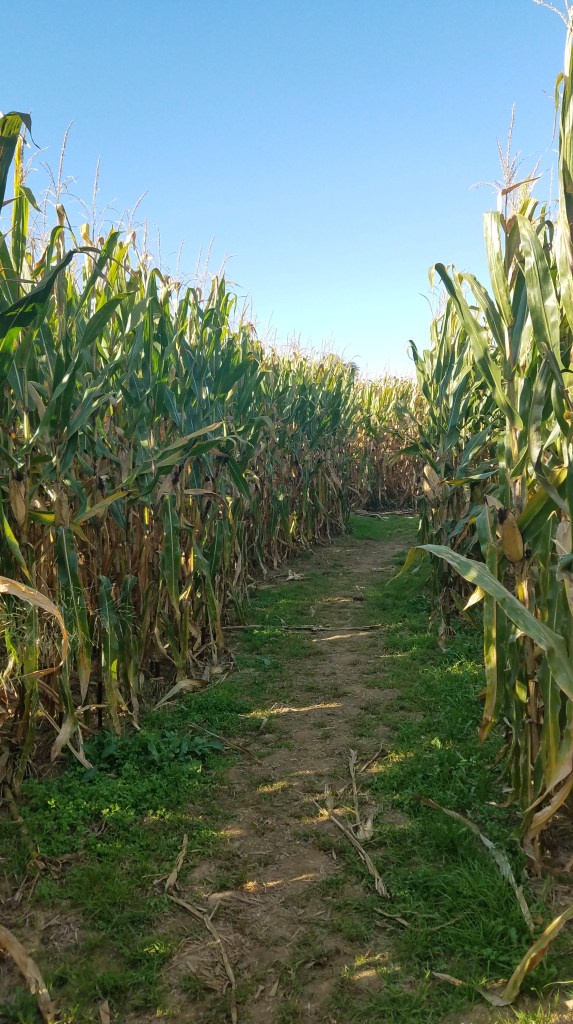
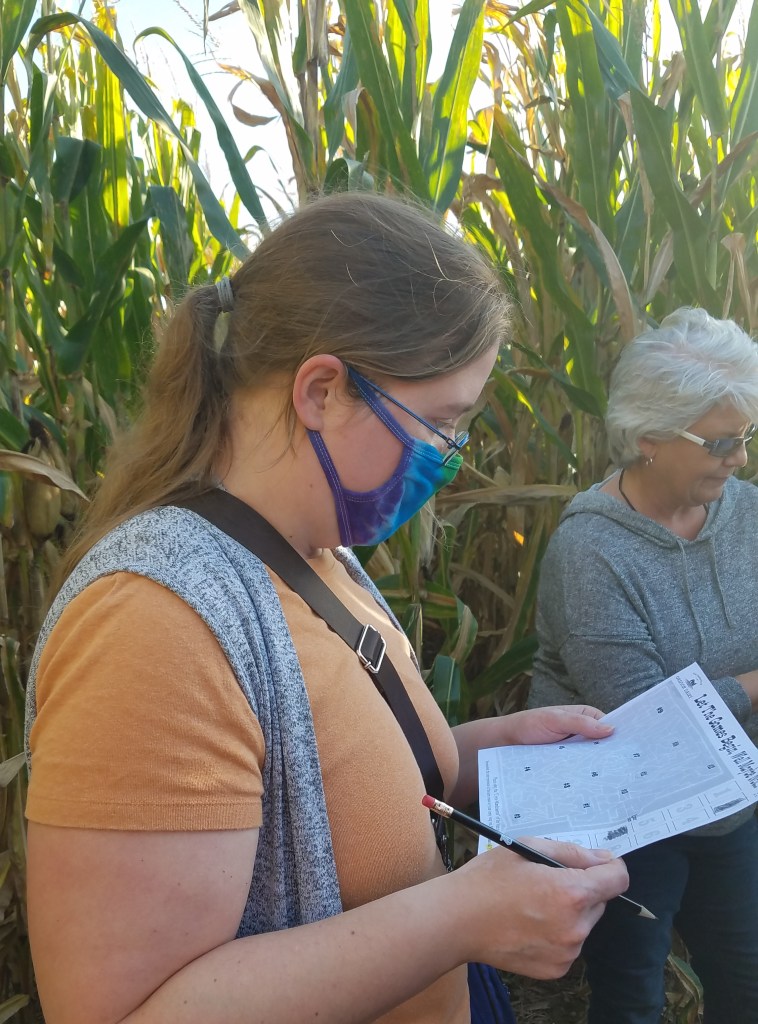
In Lancaster county, there are plenty of corn fields to see, so the point of going to a corn maze isn’t to look at a field of corn, but rather the experience of getting lost together. What’s quite comical is that when you have the map in your hand standing outside the entrance, it looks quite easy, a casual stroll even. Oh, how wrong you would be. The maze quickly becomes disorienting, especially a maze that is as zig-zaggy as that one. Having no real straight lines it was almost impossible to tell if you had turned a corner or merely curved with the path. The corn was too tall to get a good bearing on anything. And of course being corn, it all looked exactly the same, even if you could peek through to the other side. 

You think you know where you are and then you turn a corner only to be faced with unexpected options, this isn’t where you’re supposed to be. The simple, easy maze has transformed into a dizzying labyrinth of twists and turns. If you’re not careful, you may lose sight of your companions turning this group adventure into an unexpected solo adventure. You may call out to them but they’re gone. Or perhaps you hear each other but cannot figure out how to get back on the same path. So tread carefully and do not wander too far from your friends. 

No one was really sure how long we walked or how far. We did manage to find markers which were various points that we were supposed to find and mark off in order to “complete” the maze. They helped to orient us to where we were and help keep us on track. As with any group of activity, it was all about communication and collaboration. 

Some of us took a more backseat approach, content to let the others lead rather than become overly focused on the goal. I purposefully avoided trying to take charge as there were already several chiefs taking the lead and I had played enough videogames to know that I am terrible at reading maps and knowing where I am. Though, I have gotten better at it since 2020. I enjoyed the time wandering aimlessly trying to figure out where we were and where we were going. In the age of GPS, google maps it is so rare to be truly lost and having to use what few tools you have available to answer those basic questions. It felt like a small adventure, even though there were plenty of people to help you get out of the maze if you were truly lost. 

We found about half the markers before we decided that it was beginning to get late and it was time to go home. Many of them had young children and those without children, had pets who were waiting at home for their dinner and evening snuggles. I would love to try to finish a corn maze in the future as I truly did find it enjoyable. So not only did I get to try something new, but also I got to re-evaluate an activity I previously thought would not be for me. 

I encourage you dear reader to reconsider your own “I’d really rather not” lists. Often the barriers to new and potentially exciting things are only in your mind. With careful planning as to when we went, most of my concerns for why the journey would be anything but enjoyable for me were laid to rest. 

How can you experience getting lost in a corn maze?

Mazes have been part of human cultures for thousands of years. They crop up in stories like the labyrinth and the minotaur and there is a reference to one in ancient Egypt by the writer Herodotus. In more recent history, hedge mazes were a popular form of entertainment found in gardens of the elite such as the ones at the Palace of Versailles or Hampton Court Palace. Today, corn mazes are the hedge mazes of the people. 

The first corn mazes started cropping up (pun intended) in my home state of Pennsylvania. The very first one was in the neighboring county of Lebanon in 1993 by Earl Beal. It was inspired by his father’s work on mazes at a local amusement park and the idea quickly spread across America to other farming communities. Now they are found all over the country where farmers make their living. 

I do recommend not going for the “biggest” corn mazes if you’ve never done one before or don’t have the best sense of direction. As I said, the maps are deceptively simple, because once inside you will get turned around pretty easily. Try some of the smaller ones, you will have just as much fun and feel a sense of accomplishment when you’re able to complete most if not all of the maze. This helps to ensure you have a good time as it gives you an attainable goal for a novice. It’s important with our bucket list to keep ourselves in a place where we are being stretched without being overwhelmed.

The Curious Case of the Gettysburg Ghosts: A Walking Tour of One of the Country’s Most Haunted Cities

There’s something mysterious about the late fall, when darkness creeps over the earth stealing away precious daylight hours and the earth loses its color. Once familiar trees transform into shadowy forms at twilight, their fingers reaching out to the unwary traveler. The comforting sounds of animals scurrying about take on a more sinister tone and even the wind begins to moan hauntingly. Is it any wonder that such a time of year made many believe that the veil between worlds was thin and gave rise to the spooky season we know and love so well?

It’s a time of year when many travelers flock to the former places of death in hopes of encountering a being from beyond. Certain places are known to be more haunted than others and few other places top Gettysburg, Pennsylvania on the list of most haunted places frequently earning the 3rd or 4th spot. The majority of these restless dead are thought to come from the decisive battle of Gettysburg, one of the deadliest battles in our nation’s history and is considered by many to be the definitive turning point in the civil war. Over 51,000 soldiers perished and many more were injured. 

Being both curious to learn more about the history of Gettysburg and to get ourselves in the spirit of the season, my sister and I embarked on an evening stroll to suspend belief for an hour or two and perhaps, catch a glimpse of a specter. Given the town’s reputation for its hauntings and that it goes all out with Halloween decorations, it is decidedly recommended to arrive early for a walking tour because parking was rather difficult to find as hundreds of spooky enthusiastics milled about also hoping for a ghost sighting. With a little trouble, we made it to the appointed meeting spot which was difficult to spot as it was an unassuming door for the Museum of Haunted Objects.  

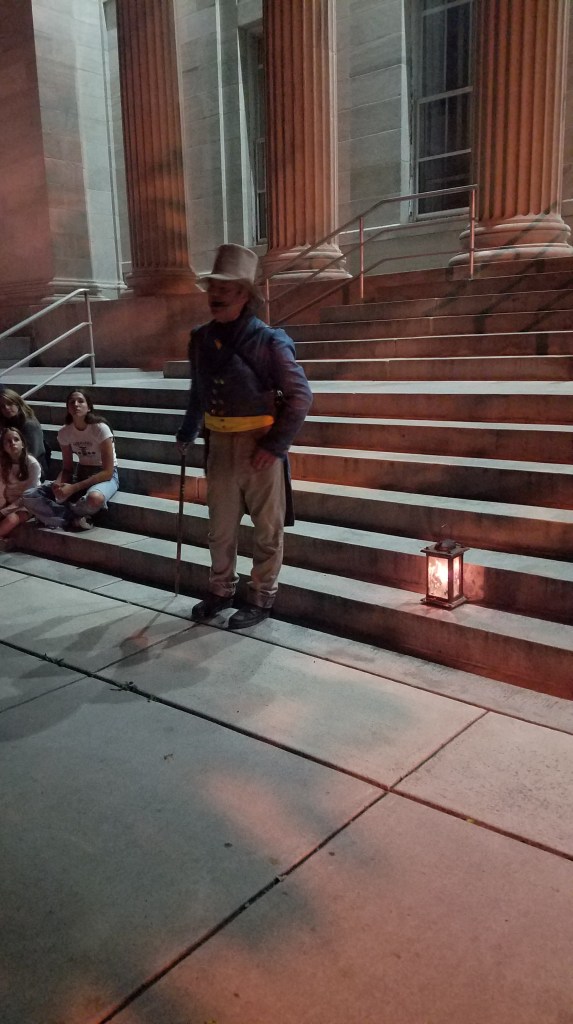
Our guide was a jovial man dressed in the manner of an 1860’s gentleman, complete with top hat, lantern and walking cane. He explained that the reason for the number of hauntings was due primarily to the unburied and still restless ghosts of the Confederate Army. He explained that in the aftermath of the battle, the town and surrounding countryside were overwhelmed with the corpses of the dead. The stench lingered for months as they struggled to lay to rest the dead. It seems almost a natural reaction in the face of so many that the dead of one’s enemies were more hastily buried with little honor or respect. Many of the townsfolk wanted to move on from the aftermath of the battle, to forget the horrors from the streams of blood and piles of amputated limbs littering the outside of the former field hospitals. Unfortunately, the dead not properly put to rest lingered on a constant reminder of the horrors of those three days. 

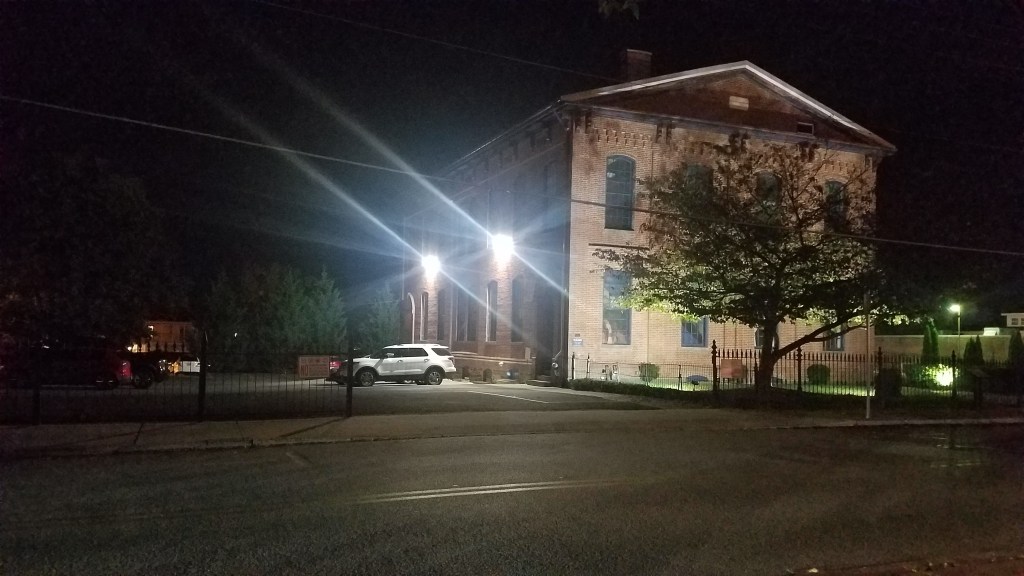
We actually began our tour at a curious place, the local high school where in the course of an expansion several confederate soldiers were uncovered. It was strange to think that hauntings were so common in this area that one may go to school directly next to ghosts especially when reflecting on all the late night music practices I attended. Having set the tone as being a town so haunted ghost sightings are your local high school are hardly something to comment on as out of the ordinary, we set off to learn more directly about the different places and their stories. It also gave credence to the theory that the hauntings were a result of restless Confederate soldiers in need of peace. Because after the discovery of the Confederate soldiers, they were buried properly and the reported hauntings ceased. 

But not all hauntings can be explained by disrespect for the dead. Ms. Jennie Wade was the only civilian to die during the intense fighting – a rather shocking fact when one considers the numbers lost to the fighting. Jennie had come to support her sister Georgia who had just given birth along with her mother and her brother. She was mixing dough for biscuits when a stray bullet passed through two doors before hitting her in the back. Though certainly given a proper burial by her family, it does seem she remained to haunt the home due to unfinished business – she never got married. Unlike many ghost stories, ending in misfortune, it seems that  Ms. Jennie is a generous spirit rather than a malicious one as she is said to help single ladies who visit her home. Just place your finger on the interior door bullet hole and you shall receive a marriage proposal within the year. One does hope that she is able to find rest after granting happiness to so many others.

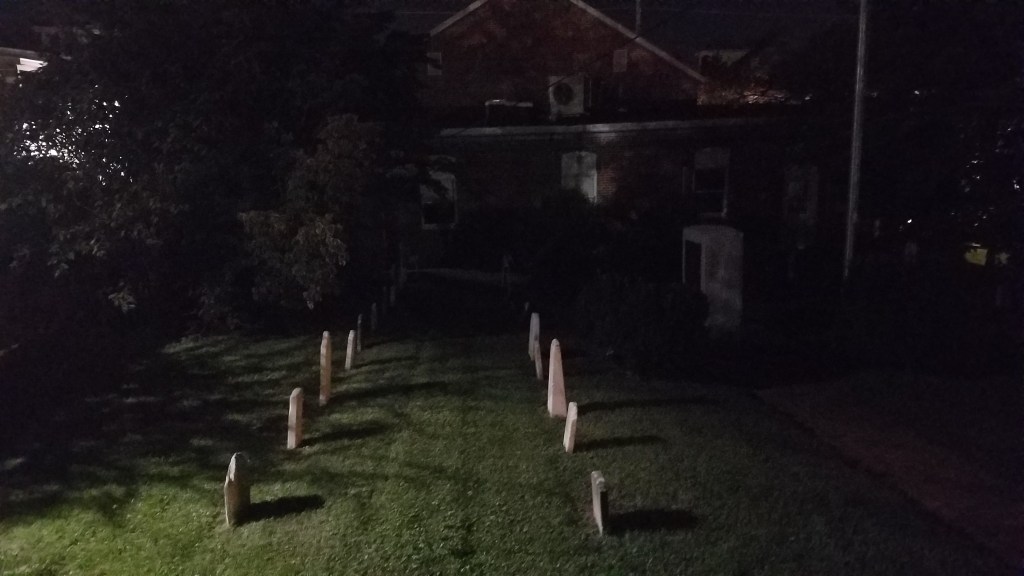
Graves behind the orphanage

We heard other stories of haunting in the area including the orphanage where the guide told us a rather chilling story of children inviting others to join in a game of ring-around-the-rosie much to the dismay of the adults. Interestingly enough the orphanage itself was not directly connected to the battle but rather its aftermath. With so many lost in the war, many children found themselves without a caregiver which led to the founding of a new orphanage in Gettysburg under Ms. Philinda Humiston. Initially, the orphans were well cared for until a new Headmistress took the reins of power, Ms. Rosa Carmichael. Ms. Rosa is reported to have locked a four year old boy in an outhouse in the bitter cold of December, keeping others in chains, sometimes in vats of water where they risked drowning and beaten them. There were several children who were missing and never found. Visitors to the orphanage are said to hear the clanking of chains and the cries and laughter of children. Some report to have seen the visage of the evil head mistress. It seems a bit macabre to me that people will pay for a chance to interact with the lost children of the orphanage and such a cruel creature. It is not the stories of ghost which haunt, but of the cruelty of people.

However, it was not the stories of ghosts that haunted me (pun intended), but rather the description of the carnage of the field hospitals and the battles. It was not just death which turned this quiet town into a horror show, but also the number of amputations. The guide described how there were so many body parts that they began to simply toss them outside the window of the hospital, piling up limbs, that doctors and nurses waded through blood trying to help the wounded and dying. At one place a group of captive soldiers being held in a basement had blood raining down on them through the floorboards. Whether one believes in ghost stories or not the reality of the battle could not be downplayed. I think in our modern era it’s easy to forget the real horrors of war being so far removed from it as we often are. 

What I found most interesting about the tour was seeing the battle from the perspective of the townsfolk and how it affected them many generations after. It is what still defines the town to this day. When many people were frolicking about in their costumes, giggling at the sightings of ghosts and enjoying a festival atmosphere, one must wonder how we arrived at this point. Almost a hundred and fifty years ago nearly 50,000 people perished in a war to decide the fate of America. The town was washed in the blood of patriots fighting for freedom. Doctors and nurses frantically rushed to save lives, hacking off limb after limb in a desperate attempt to mitigate the damage. After the armies left, it was the townsfolk who were left to pick up the pieces and bury the dead. Perhaps, there is something to be said that an experience so horrific can be transformed into an evening of lighthearted fun, traversing the streets by candlelight as the guide does his best to both educate and scare you. Perhaps, it is an indictment of a culture so indifferent to real human suffering that it seeks to capitalize on it. Perhaps, it is a coping mechanism of a place so scared by the horrors witnessed both in those three days and in the years after, that we can hardly blame them for embracing the kitsch nature of the spooky season to transform it into a more palatable form. 

Regardless, it was an intriguing evening of history and even anthropological musings on the response to collective trauma. Though those musings were from my own internal observations than anything the guide said. I found the guide to be quite informative and an avid storyteller who was quite capable of raising goosebumps as he relayed the tales of the ghosts who stalked the streets at night. 

Our guide looks almost ghostly in this picture!

How can you go on a haunted tour?

There are many towns and cities throughout America that have reported hauntings from Gettysburg, PA to Savannah, Ga, from Salem, MA to Portland, OR, from Chicago, IL to Sante Fe, NM and everywhere in between. My own hometown gives a ghost tour each fall! You can usually find them being advertised from Mid-September through early November. There are places that will offer ghost tours throughout the year. 

Whether you believe in ghosts or not, I certainly recommend them for the history as they often give a different perspective than other walking tours. Often, they showcase the lives of ordinary people like Jennie Wade who only wished to help her sister and had dreams of getting married or they help us remember the victims, like the orphans who suffered at the hands of Ms. Rosa. They can be nights of fun and even frivolity, but at their core, they are stories to remember the darker parts of our collective past, even if they’re presented in more palatable forms. Nevertheless, they are stories worth remembering. 

Completed: October 2021

Cost: $35 each

Miles from home: 63 miles