One thing that I love about my Bucket List is that I’m almost always trying new things. I recently read somewhere that research indicates that when we focus solely on the interests we’re already interested about we can miss out on entirely undiscovered aspects of ourselves. We may limit ourselves artificially without even knowing it. We may love art and never take up a paint brush or admire finely made clothes and never consider sewing.
I never thought I’d enjoy a videogame but I certainly enjoy playing World of Warcraft (I’m a nerd deal with it). I wouldn’t have thought I’d like D’n’D but as it turns out, I do enjoy collaborative storytelling. I’ve discovered I draw the line at larping which was a surprise because I would have thought I’d love dressing up and acting out the story like D’n’D after enjoying D’n’D, going to the Renaissance Faire, acting, etc., but absolutely not for me. My sister is afraid of heights but I have discovered a thrill for them. I’ve learned I like hacking down trees and the physical labor of gardening. I don’t have the patience for a lot of crafts, but I love trying to hone my skills on the violin.
We don’t even need to do them well. We can do something poorly, in fact it’s almost better to do something poorly at first. After all, if we’re good at it then we think that we have a “knack” for it and then when we inevitably come up against a hurtle, we lack the skills we need to overcome. Sometimes just doing something for the sheer thrill of doing it is the best way to learn. When we have fun we aren’t focused so much on doing it perfectly as enjoying ourselves. We’re no longer motivated by outside rewards and people pushing us to do it. We are competing against ourselves, learning our way of doing things and probably becoming better than we would have if it just came easy.
I think it’s good to explore new things that we may have dismissed when we were younger or just missed out on. I remember thinking that learning to ride a horse wasn’t something I could do, but then I spoke with a work colleague who was taking lessons bi-weekly. Another work colleague had joined a small college’s orchestra after taking up the violin again post-high school which in part inspired me to take up the instrument once again. It’s caused me to re-evaluate what I can do as an adult and that maybe I didn’t actually miss out on opportunities or that I could return to things that I did as a child. As it turned out the only person keeping the doors shut to possibilities was me.
I’ve also been pushed to try things I wouldn’t have previously thought to try like Eco-dying, water tubing, and zip-lining. I find myself saying “sure why not” when presented with new adventures and raising my hand to volunteer at public events because “why not”? It was that attitude that pushed me to rent a car in Britain. Before, I’m not sure that I would have had the confidence to drive on the opposite side of the road because I’m dyslexic and ADHD with poor spatial awareness and their roads are tiny. Now granted I didn’t just hop in a car and drive out of London. I knew I was going to be jet lagged, without sleep for over 24 hours (I don’t sleep in planes I have insomnia, it’s a whole thing) and so even driving under normal circumstances would not be advisable let alone in another country, on the opposite side of the road. However, I was undaunted by the idea in part because I am already in the habit of getting outside my comfort zone.
And this is sort of a life hack. When we push ourselves, we feed our confidence and our feelings of competence. Which you may think, “wait, didn’t she just say that some of the stuff she was bad at? So how does it help her feel competent?” Yes! Here’s the awesome, amazing thing, it didn’t kill me! It didn’t end me and in fact, I embraced being bad at it at first because I’ve learned to enjoy the process of mastering something. It’s about learning and growing your inner self not just checking boxes and doing something for an afternoon before swiftly moving on to the next thing. I feel more competent to try things and look foolish even in front of others. I am conquering anxiety and loving it!
We are wired for growth, not stagnation. We are meant to go, explore and conquer. Too many times we assume that we will stay the same person that we are today until we die, that we’ve already completed our growth. However, that’s not the case and studies show that its the people who don’t stop growing that live longer, healthier, happier lives. So what are you waiting for? Go out and try that new thing!
It is easy dear reader to compare ourselves to others especially since others splash their lives up on social media for all to see. Granted, they are curated versions of themselves, but it’s so difficult to remember that. We see people more successful, more well traveled, in the perfect job, having the perfect relationship, enjoying their children, wearing the latest fashion, doing whatever it is we wish we were doing. The algorithm is merciless in that it shows us that which we engage with and of course we are going to engage in the very things we long to have and thus the viscous cycle.
In focusing so much on all the things we do not have, we lose sight of the things we have. We are lost in the mire of have not. Not only that but it robs us of the joy of the things we previously had. How often have we finally received that which we asked for, full of joy and wonder only for a few months later to be grumbling about it?
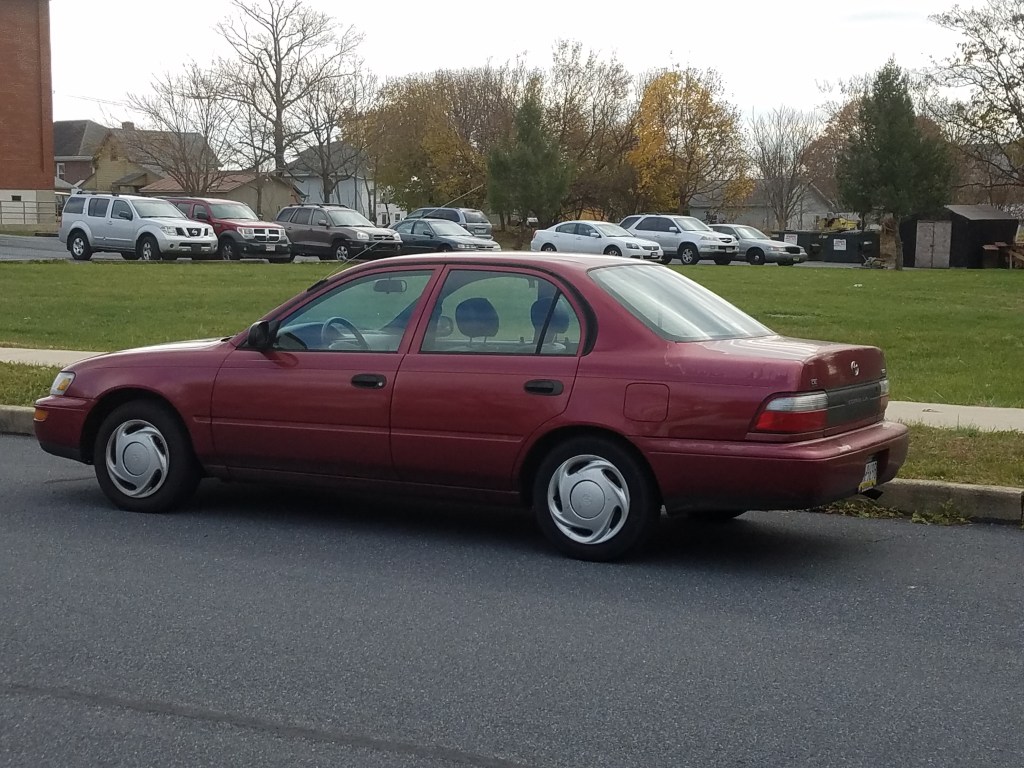
When I received a rather cheap car that had been through a hailstorm and was close to 20 years old, I was incredibly grateful and amazed at my luck. After all, having not had a car before, having any car was a dream. However, it wasn’t long before the twinges of comparison started. It was by no means a looker in the car department with its dents, faded color and sagging cloth. It was clearly old and not only that but also dented from the hailstorm. When I was interning for an organization whose donors were from the higher echelons of society, I was embarrassed by it. Where was my joy? Where was my gratitude? And frankly, why did I care what they thought?
We pray for a house and then grumble that it doesn’t have a living room and a family room after visiting our aunt’s house. We pay for new floors and then wish we had paid for a vacation instead when we see our friend’s Instagram photos. We give our boyfriend the cold shoulder when Jill from accounting flashes her new engagement ring. We force a smile when our sister announces her second pregnancy and then go home to cry. Our best friend gets a promotion at work and we feel that we’ve fallen behind now. We scroll online and see a headline of a 26 year old retiring using the Fire Method or a list of 30 millionaires under 30 when our 40th birthday looms ever closer. We forget what we have when we start focusing on others. Their blessings become our lack.
Do not get me wrong, ambition and wanting more can be great things. After all, it’s drive and ambition that has put a man on the moon, given us electricity, discovered antibiotics, written symphonies and painted masterpieces. Without it we wouldn’t have our modern world. Competition can also be a good thing when you have someone to push against and with, you both can end up going further than if you were by yourself. However, when that comparison of value and worth starts to creep in, we lose. Part of the problem is that there is always someone above us on the ladder of life and we tend to look ahead of us rather than behind us.
When you move to a nicer neighborhood that you’ve dreamed of being able to be in, after a few months you start seeing the cracks in the sidewalk, the unkempt garden (sorry, neighbors I don’t use herbicides, it’s more a habitat for pollinators) and soon the next neighborhood looks much better. Each house is detached with a garage and clearly has plenty of space each surrounded by a nice neat fence. If you do manage to move then you start eyeing the one where everyone has a 3 to 5 door garage, the houses are more accurately described as mansions with private pools and there’s even a gate to keep out the riff raff. We are so prone to eye the next rung up to strive for what we do not have that we become burdened by ambition creating our own gilded cages of dissatisfaction and envy.
No matter how much we get, how far we go, how much we achieve, it will never be enough so long as we keep comparing ourselves to others because we can never win. The happiest people I know are the ones who live simply unburdened by things, pretenses and social status. They’re the ones who live in the woods or cultivate a small garden in the midst of their urban center. They snuggle cats and walk their dogs. They form genuine connections with others.
Not only does comparison rob us of our joy, but also it robs us of shared joy with others and the connections those shared joys can form. Rather than celebrating those we care most about and instead those moments are like small thorns twisting in our hearts poisoning our spirit. It also poisons our relationships causing a rift to form as you turn away. You begin to question your value and what you bring to the relationship. Perhaps, they sense your distance and wonder at your less than enthusiastic response to their news. They may attribute it to jealousy rather than feelings of inadequacy which can erode the foundations of your relationship.
It robs them of their joy as well. Have you ever gotten great news and when you shared it with someone you got a less than enthusiastic response? What about one that sucks the joy right out of you, leaving you with guilt or remorse? Yes, there are certain circumstances where two people cannot have the same thing, two friends may enter a contest knowing that if one wins the other will lose, but often that’s not the case. If my friend gets a promotion and I respond making it about me and my lack of one, I’ve just diminished her joy instead of amplifying it.
This isn’t to say that you can’t feel how you feel. After all, when you have worked really hard to get somewhere only to see someone else seemingly skate on by to the top, it can be incredibly frustrating and disheartening. You absolutely should let yourself feel those feelings in order to process them. I never recommend suppression and pretending. You can be joyful for another’s triumph while holding your own pain. That’s why I speak about joy rather than happiness. I don’t want to be happy, I want to be joyful.
However, bitterness against your circumstances, the world and even those you care about can set in. Usually, it’s not about the not having, it’s about what the not having means, that you’re less than everyone else. You’re not your job title, your social status, your income bracket, your marital status or any of the world’s measures for worth and value. Focusing on what brings you joy and bringing beauty, kindness, compassion, hope and love to the world are far more worthy pursuits than keeping up with the Joneses. Besides, why do we care what they think? If they look down on you for not having a brand new car or being able to go on a vacation in Belize every summer, that speaks to the low level of their character not yours.
When we stop worrying about what others think and embrace ourselves fully we find joy. When we stop comparing ourselves to everyone around us and “above” us, we find that we are enough just as we are. You are enough, dear reader.
It was a warm summer evening, when my sister and I embarked on a journey to the far east or rather to partake in some food and traditions imported from Asia to the United States. This particular evening, we were attended a Water Lantern Festival. One of the amazing things about America is our immigrant roots, welcoming people from across the globe. These people come and bring with them their culture, traditions, beliefs, music and cuisines. It is what makes America a rich, cultural tapestry of endless variety.
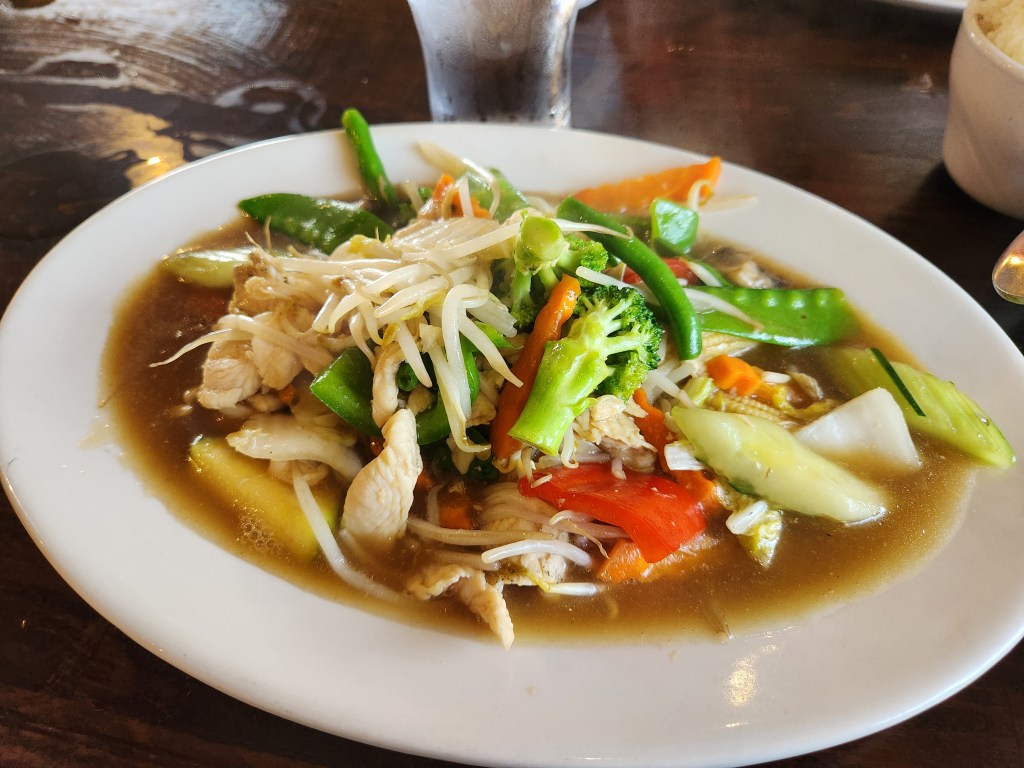
We began our journey by stopping at a Thai restaurant which is owned and operated by Thai people. I always get excited when I can stop at places owned by people who intimately understand the cuisine they are cooking, whether that be because they are originally from there, have family originally from there or spent enough time in careful study to obtain a level of mastery in the authentic way the cuisine ought to be prepared. As someone who doesn’t necessarily have the money to hop on a plane to experience authentic Thai food, I appreciated the opportunity and the culinary skill of the chef. Dinner was a delicious red curry, since I cannot resist a menu item with Thai Basil and my sister had their drunken noodles of which I stole a few bites.
After dinner, we headed over to Harrisburg to the Italian garden where the Water Lantern Fest would be held. The Italian garden is beautiful in its own right, but it was extra festive for the fest and the weather proved to be perfect. It wasn’t too hot, nor was it chilly. The blue sky was clear overhead and it promised to be a lovely evening. It took us a little time to locate the actual stand to obtain the water lanterns as the park was open for all to enjoy. We did eventually find the true “entrance” to the fest by asking some people for directions and headed up the hill to obtain our goodie bags and lanterns. After claiming our prizes, we walked around the end of the manmade lake to find a good spot under the shade of a tree.
I had attended a lantern fest before, where you release lanterns into the sky which took on a more party atmosphere for the people attending with music and bounce houses, bonfires and food trucks. This one had most of those things tucked away from the main event so that you could still enjoy vendors, food and other activities, but it did not distract from what you were there to do. Nor was the crowd quite as big as at the Lantern Fest which was just as well, since I tend to favor smaller events to the massive crowds. What I enjoyed about this one was the more subdued and even reflective atmosphere. Flags proudly proclaimed things like gratitude, healing, love and connection, encouraging you to reflect rather than party. The crowd was fairly quiet with many people conversing with their heads together, smiling and laughing. The goodie bag even included conversation cards with prompts to start deeper discussions with the people you were with in order to foster deeper connections. My sister and I were delighted by these and have taken them out at other occasions and have found them to be great at prompting conversations.
The kit for the lantern included a wooden base, a lantern which could be written upon and a small led candle to turn on and place in the lantern. We noted that most of the lantern components could be reused, recycled or easily be broken down in the environment. Being a manmade lake, the lanterns were in no danger of polluting local waterways or interfering with native wildlife. In addition, the event organizer One World proudly supports water.org. Water.org is an organization which focuses on increasing global access to safe drinking water. They include an informational pamphlet and easy options to donate to raise money to support this cause. I love it when an event is able to go beyond just an enjoyable evening and helps to provide a positive impact.
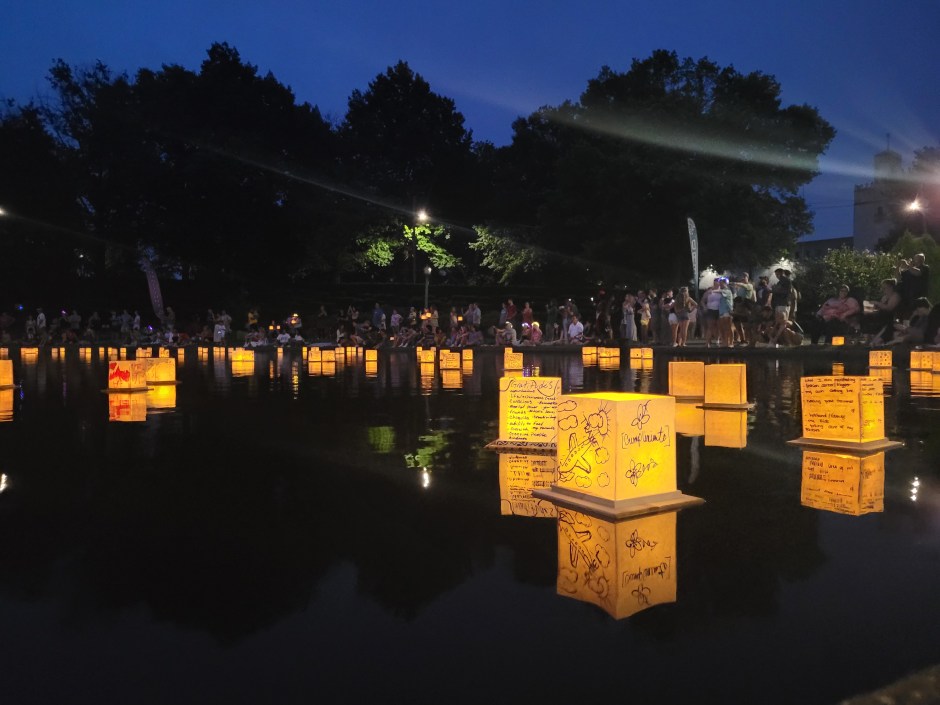
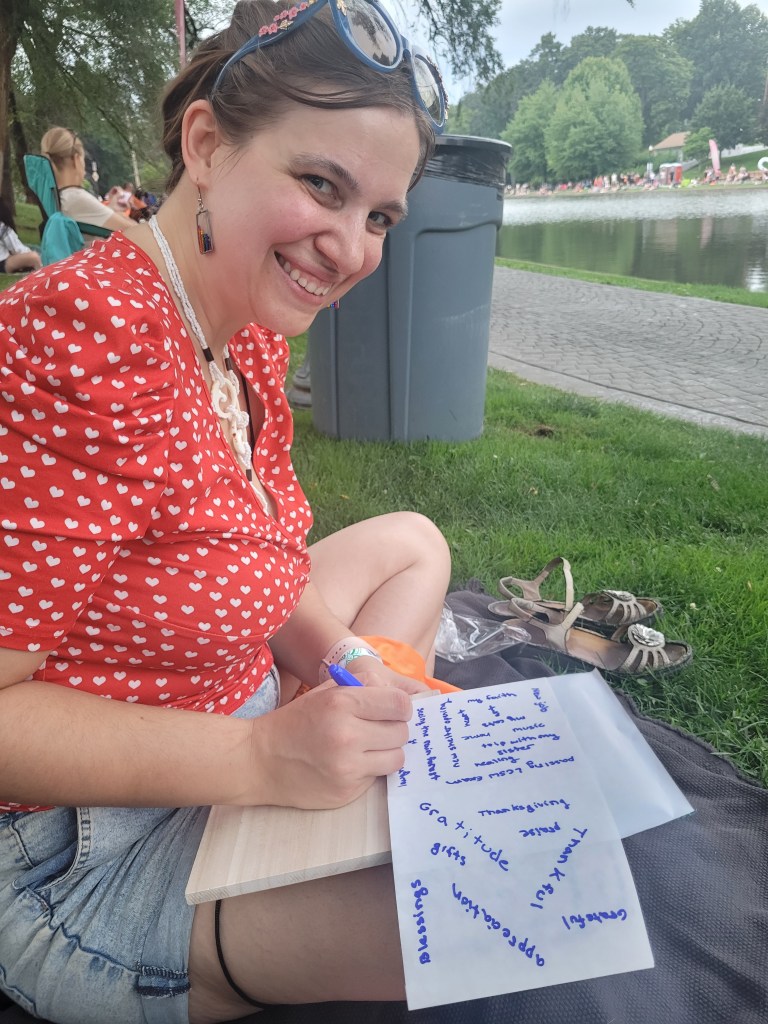
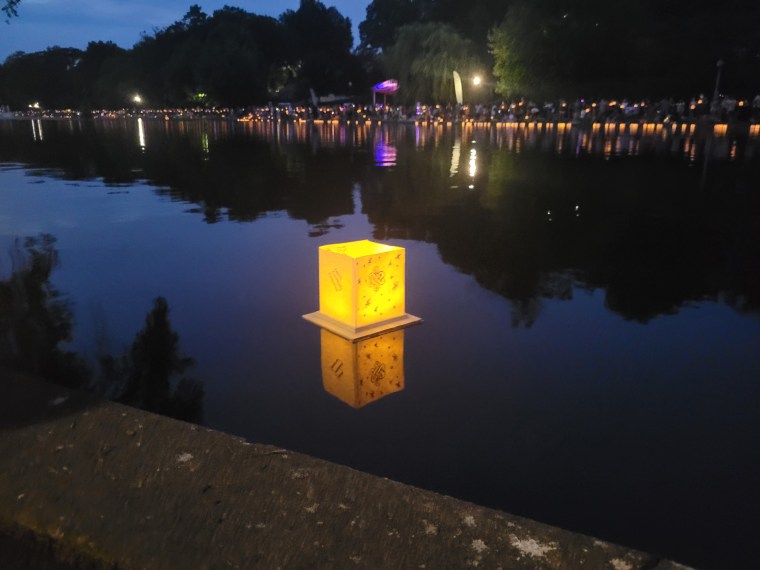
I decorated my lantern with things that I was grateful for and my sister decorated hers with art including a celtic knot and a flowers. Once the sun slipped beneath the horizon, they asked us to gather around the edges of the lake and to pause for reflection. Then they invited us to release our lanterns to allow them to float upon the water. One by one, they spread out, glittering together like stars. As I stepped back to take in the sight, I was able to let out a deep sigh of contentment. Naturally, we snapped a few photos, but mostly my sister and I just walked along the path enjoying the sight and quietly conversing.
It should be noted that while my dinner was still firmly rooted in its culture of origin, the Water Lantern Fest was less so. Water Lamps originated in India and spread throughout Asia most likely through Buddhist diffusion. They appear in many festivals and have many meanings ranging from worshiping gods, praying for a good marriage, welcoming happiness, guiding the spirits of the departed or welcoming happiness. In Vietnam, there is a town which releases them quite frequently. In China, they are released throughout the year. In Japan, they usually release them to help guide the souls of the dead to the spirit world and allows for reflection for lost loved ones. Sometimes, things are lost in translation especially as it gets diffused across different cultures as it has in Asia since they have a lot of different meanings all over the continent.
Still, despite being a bit unmoored from its roots, it still felt as if it were in the spirit of the original customs. Where other events encourage a sort of frantic, frenanic frenzy of activity, this festival invited you to slow down, to pause and reflect. It encouraged building relationships between people and being more mindful of your surroundings. They also allowed people to come up to a microphone and share their stories. Some people shared their loss, others shared their victories, whereas others shared gratitude. There were lanterns that people dedicated to their loved ones. In a sense, the festival was a melting pot of the many traditions associated with water lanterns from Asia and transforming into something uniquely American. It certainly was not an authentic experience, but it falls under my “good enough” category.
How can you experience a Water Lantern Fest?
The best way is to go to their website WaterLanternFestival.com and click on your state to see when they might be coming to you. I encourage you to buy tickets early since they increase in price as the date approaches.
However, there is nothing to stop you from ordering some lanterns and LED candles and hosting your own smaller version with a group of friends. Although, it doesn’t quite hold a candle (pun intended) to seeing a few hundred floating all together, their reflections shimmering in the darkness of the water. It is also important to note that there may be local ordinances preventing such an activity and you would need to ensure proper clean up. After all, we want to keep our local environments beautiful so we can continue to enjoy it for years to come.
Completed: July 15, 2023
Cost: $36 per person (was advertised as $27 but there were vendor fees)
In my last post, I referenced how living one’s best life is in part living a life with purpose or a life in which one applies ones talents in support of a calling to serve others. I went on to wax poetic about the first of three parts, mostly about talents and how to cultivate them. In this post, I shall attempt to unpack the second part of that statement, mainly one’s calling. This is probably the trickiest part of the whole thing. The first part is rather simple, just consider your interests and start to develop them, they’ll become skills and later talents. Yes, there is a certain difficulty in the discipline required to do that, but in general one is not sitting around with no idea of what one’s own interests are. The third part is also fairly easy, find other people, utilize said skills/talents to assist them.
So what is a calling? How would we even know what it looks like? What does it mean? I am no philosopher and certainly lack the wisdom of the sages to give a definitive answer. Still, if one seeks enlightenment then one must learn to wrestle with such questions and start to consider the answers for oneself and not merely rely on the elders who have come before to answer for us. We are not here to merely echo the philosophers that came before otherwise we would have been satisfied with the answers of Plato and Socretes and Descartes and Vonnegut would have needed to occupy themselves with other diversions. So that is what I shall do here and perhaps, dear reader, you shall wrestle with this question yourself. I certainly hope so, otherwise how shall I become wiser if no one challenges me – I digress.
So first what is a calling? Often people will feel a strong desire towards a certain profession or job that feels fulfilling. Passion + meaning = calling. However, I question the idea that it should be connected with a particular profession. At risk of coming off conceited or judgemental, I doubt that most people would consider being a garbage man or grocery work a calling. Do not mistake, dear reader, the statement for condescension. It takes little stretch of the imagination to see how vital these roles are, but our society does not hold such roles in high regards despite their inherent importance. When the pandemic shut down much of the world, it was not the garbage collectors and grocery workers who stayed home. Yet, I doubt that many of those in those positions would say that such a profession is their calling even though these are vital to the functioning of society. Those jobs are meaningful in that they help others, but few people are passionate about them.
Contrarywise, many people in higher paying and higher status jobs lack both passion and meaning. They may push papers around a desk, crunch numbers and complete tasks for the corporate overlords. Many may not even really understand why their position is vital to the company, some may even struggle to articulate what precisely they do when their friends and families ask. If their job disappeared tomorrow would it have a negative impact on society? Would others miss it? Would they even notice it’s passing? When mass layoffs occurred in the tech sector, were many of us concerned about it? Did any of us outside the industry truly worry that vital goods and services would be disrupted? That isn’t to diminish the pain of those who were part of that, it is merely to illustrate that those jobs most likely do not have much meaning associated with them as it requires the stretch of the imagination to consider how they are all that helpful to society as a whole.
In fact, there’s an anthropologist who theorizes that up to 40% of our jobs are “bullshit” jobs or a job that is so completely pointless, unnecessary, the person doing it can’t justify its existence. These are jobs usually taken up by meetings and emails and are so bogged down in paperwork that one is left wondering if you’re doing anything other than existing. Elon Musk fired 90% of people at twitter and it had almost zero impact on the service it provided. Do you see the danger in tying a calling to one’s profession? These jobs are still important, some are quite meaningful if not readily recognized and others lack passion and meaning are nonetheless important in other ways. I won’t go too far down the rabbit trail of the sheer amount of job bloat in corporate America. It is only that there are very few professions that will allow a person to pursue a passion and have meaning.
For most of human history, one’s profession was the way to keep a roof overhead, food in one’s stomach and clothes on one’s back. It truly wasn’t until much more recently that we started hearing the message that we should follow our dreams and surely good things would follow. Most of my generation grew up on stories admonishing us that happiness was to be found in pursuing jobs that were our “calling” and the reality came crashing down on us. While others may waggle their fingers at us for pursuing “underwater basket weaving” as majors, who was it that told us we not only could by offering it to us in the first place as a legitimate major but encouraged us that we should do it from our earliest years? I know I certainly grew up on stories that one should follow one’s passions as the path to happiness. A lovely notion perhaps for a different time.
As with many ideals our society pushes, we must free ourselves of the shackles that bind us to them. Our calling need not be our job – a good thing too, considering the constraints upon us otherwise. That isn’t to say that one cannot find a profession that exactly matches one’s calling, simply that it isn’t necessary. Your job does not have to be your calling or even your passion. It’s nice when that happens and there are a few lucky people who “never have to work” because they love what they do so much. If you are one of them, I raise a glass to your good fortune friend! However, there will always be people who are needed to complete the passionless work – whether that be the necessary paper pushing bureaucrats who shuffle the necessary government forms about or the oil rig workers who risk life and limb to ensure we have the necessary fuel for our modern world. It is a rare person indeed who finds either one of those to be their passion.
Now that we’ve dispensed, such a silly notion that our calling must directly lead to our job, we discover that there is in fact quite a wide range of things we could do in those hours not spent on the job. Your job could help fund your passion or otherwise help connect you with the right resources be they monetary or social to pursue them. So long as whatever you do arises from things that you are truly passionate about and works towards the benefit of others. Perhaps, you have a strong talent for sports and take up coaching youth soccer in your hometown. Perhaps, you have strong feelings about conservation and turn your efforts to going to your town meetings to make your voice heard or you go around collecting signatures on a petition.
You may not even quite know yet how to figure out which one of your many passions to pursue. There are a myriad of things to be passionate about, music, art, sports, politics, the environment, trees, air quality, public health, homelessness, the law, philosophy, teaching, psychology, and well, pretty much anything in existence. I am rather passionate about cats myself, but are they my calling? I have adopted several of them and care for them, they certainly enrich my life, but I don’t know that I’d call it a calling. I don’t feel called to be a pet parent. I merely enjoy being one. A calling is the match of your deepest passions and beliefs with the deep needs of the world around you.
It can take many years to discover one’s true calling or path and one must be willing to pivot with new information. Most people simply do not have the necessary introspection or knowledge base at 18 or 19 to decide what their calling truly is. Most have some inkling of interests if no actual skill set or talent and they certainly don’t know enough to be truly passionate about anything. If you, dear reader, are of the younger sort, put down your pitch fork before you angrily respond to the above statement in the comments. There is simply far too much to know about the world in order for you not to go down some well-meaning and perhaps misguided path. There is some evidence to suggest that you don’t really have a good idea of your true calling until you’re about 40 years old. Which is honestly a bit of a relief for those of us who are younger than that. You may dear reader, be breathing a sigh of relief – “Oh good, I’m not supposed to have it figured out yet”. Perhaps, I really am meant to open up that cat cafe and spending my days with my feline friends is actually my calling after all!
I encourage you dear reader to take some time to journal and explore your passions. Think about the things you used to enjoy or were once interested in before the world got in the way and told you it was dumb or not valuable. Perhaps, your calling lurks in there. Consider what you enjoyed when you were quite small. Think about your heroes and people you really admired. I find that a lot of good things comes from journaling, especially when you let go and just let the thoughts come forth. It’s like your subconscious builds a bridge to your unconscious and everything just sort of flows out. You may be quite shocked at what you put to page once you let it go.
The key is not to let whatever you think your calling is become part of your ego. Don’t get too attached to any one path or idea because it will change and evolve. After all, I just said that one’s job is probably not one’s calling. Money is necessary to do things like eat and have a roof over your head. And the expression of ones calling can take many forms. A person whose calling is working with the youth may become a teacher, a coach, a youth pastor, a therapist who specializes in children, a volunteer for big brothers, big sisters, a mentor, a foster parent or something else not listed here. However, if one is too stuck on a singular idea or path you may miss the boat entirely. If you think that you must be a teacher because you feel called to prepare the next generation and you objectively suck at teaching larger groups of students, you will be miserable and your students won’t get your gifting. If you instead volunteer for big brothers, big sisters after becoming an accountant, you will find that your gift is working as a mentor for disadvantaged youth and perhaps tutoring them in math thus helping shape their futures in a much more meaningful and powerful way.
I’m not exactly sure if this post is all that useful, since finding one’s calling is rather tricky. I only hope that I have helped dispel some of the misconceptions that people have around their calling to help free you to be a bit more creative and open to the possibilities of how it might manifest itself. Truth be told, I’m still working out exactly what my calling is, but I keep getting closer with each trial and error that I make and with each new experience that I have. After all, part of my bucket list is to help me explore and get to know myself better.
We often hear or even say the phrase “living my best life”, but what does it actually mean? Is it being able to reach your goals? To live a full life? What is a full life? In general when we use say look at this person living their best life, we usually see someone who has fully embraced being themselves without caring what others think. But how do we even know that they really are living their best life? What does a “best life” even entail? It probably does and should look different for different people. What makes my life “best” isn’t what will make your life “best”. There are, of course, guiding principles. After all, this whole blog is in part to help people live better lives. For most people a best life is one that comes from connection to others and a sense of meaning or purpose without worrying too much about the judgment of people.
There are a myriad of ways to arrive at those two things. I have seen lists of anywhere from 6 items to 30 items of how to arrive at a “best life” or to live a fuller one. Some of these lists even conflict with each other like focusing on yourself and your own personal growth yet being “other” centered. If you grew up in the Christian community you may have been told that JOY comes by putting Jesus first, others second and yourself last. All well and good, until you stop caring for yourself at all and forgetting that you can’t help other people if you haven’t been taking care of yourself first. On the other hand, always putting yourself first is obviously narcissistic and self-ish, certainly not the way to form meaningful connections to others. How to reconcile the two conflicting sides?
This post isn’t necessarily to tell you how to arrive at those two things, more to get you to try and think about what might help you get there. As illustrated above, there are people for whom the advice of putting yourself first is absolutely necessary! I talk about boundaries and self-care in other posts precisely because putting my own needs last was something I struggled with leading to burn out, resentment and bitterness. Not things that helped my relationships.
However, there are certainly many people who need to be told to put others at the center and to focus on getting out of their own world and be more mindful about how their actions affect others. The character of Ebenezer Scrooge in Charles Dickens’ A Christmas Carol certainly needed that lesson lest he find himself cast into hell for his self-centeredness. All things in moderation I suppose.
For some people living their best life may be learning to let go of stress and worries, for other people it may be that they need to worry about the future a little more. You may need to learn to stop caring so much about what others think or you may want to consider others opinions a little more. The path to a “best life” is one that is always evolving and changing. Each person is an individual and what their best life looks like is going to be different.
One of the best ways to achieve a best life is through self-reflection.
After all, how do we know what we need to learn and how do we know when we’re being ourselves if we don’t take time to self-reflect? One way to really get to know ourselves is to “talk to ourselves”, not in the crazy person sort of way, but through journaling. I often find myself surprised by some of the things that come out of my own journaling where I let the flow of the subconscious go where it will. I may look for various prompts to consider to help jump start my self-exploration. There are also journals out there geared to specific topics or goals. For journaling to be truly effective requires us to be really honest with ourselves willing to face possibly ugly truths.
Journaling can also help us explore our relationships to help us determine if we are truly connected to others. In learning more about ourselves, would we be able to share these insights with those closest to us? Do we have people who we can truly express ourselves and be vulnerable with? True connection to others means that you can be authentically yourself. After all, some of the loneliest people on the planet are those who are extremely popular. Why? Because in pursuing being liked by everyone, they are too afraid to show their real selves lest they be rejected. The hard truth is that you won’t be everyone’s cup of tea, but you have a choice to make, be your authentic self to have real connection with others or disguise yourself and be alone.
This can be extremely difficult because it requires us to live without fear of the judgment of others, which is the main reason so many of us choose to live inauthentic lives and to settle for relationships that are shallow. However, this is a key piece of living our best lives. As I said at the beginning of this post, when we say “look at this person living their best life” it’s often said as a form of respect for someone who clearly doesn’t give a “f” what others think. They’re the people walking down the street dressed outrageously. The people dancing in the street to a musician. The ones who call you darling as they don a hat before splashing in a fountain. They laugh too loud, love too deeply, hear poetry in the rain and see works of art in the swirling of leaves in the wind. They may also be the ones who aren’t afraid to piss people off with how they view the world, unafraid to speak up and speak out. However they live, they are authentically and unapologetically themselves.
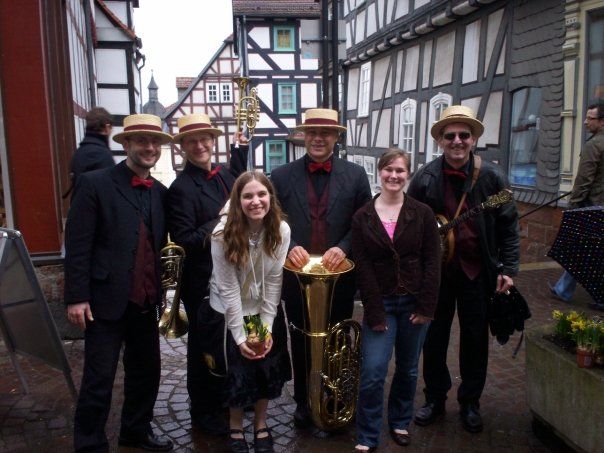
I danced for these street musicians as if no one was watching!
Living authentically isn’t being a jerk about it though. These are people who don’t care if they tick people off but they don’t purposefully go out of their way to do so. It isn’t about being mean. It’s about respectfully disagreeing and holding themselves apart from the judgment of others. It’s more of a live and let live attitude. Like okay, you don’t like that I live my life this way, but it’s no skin off your nose and I don’t have to listen to your criticisms about it if they aren’t constructive or useful. Someone living their best life knows that bees don’t argue with flies that honey is better than crap.
Another benefit to journaling is it can allow us to consider another aspect to a best life, living with purpose. I’m not here to tell you what a purposeful life is or is not. Each of us has a calling. Each of us has a gift or talent. I can’t tell you what those are because I’m not you. In general, a purposeful life involves leaving the world a better place, and helping others. Some people may have very obvious purposes like teachers, nurses and EMT workers. Teaching the next generation, healing the sick and protecting others are all very obviously meaningful things to do based on the values of our society.
However, almost any job can be infused with meaning when placed into a larger context of helping others. Nor does your purpose have to be tied to your job. I once interned for a group of businessmen who invested money. They were quite good at it, but rather than simply take all the money for profit, they used it to open an orphanage in Africa. This orphanage did not stop assistance at the age of 18, but rather continued to invest in the children, helping them obtain higher education. The children were able to start businesses in their local community and become leaders thus laying a firm foundation for independence in the region. Their calling was to help disadvantaged children and to grow a community in Africa even though their jobs had almost nothing to do directly with this calling. Your talents and your calling may be seemingly disparate things that nonetheless are yours.
There are, afterall, lots of ways to leave the world a better place.Talents don’t have to be utilized in a specific way. Your job doesn’t have to exactly match your calling. It’s certainly easy when the two directly align, but sometimes they may seem completely disconnected. You also don’t have to have your calling address every ill in the world to leave it a better place. Some people’s calling is to focus on the environment, others may have a calling to help sick children. Both are worthy callings that do not negate the other nor is one automatically better than the other. There are unfortunately a lot of problems in the world and there’s just no way for each of us to address all of them all at once. That isn’t to say don’t do what you can for the problems of the world, do the part you can. Your calling is the thing you focus on.
The point is for you to determine for yourself what your talents are and how to apply them to your specific calling. I will probably write a more extensive post on a purposeful life, but as I said earlier this post is more to help you start to consider what a best life is and how you might start to consider what your best life looks like. To be honest, I’m still figuring it out. One of the reasons I have a bucket list is to try new things, complete new challenges, to grow, and learn more about myself.
So what are you waiting for? Go forth, dear reader, and start living your authentic best life!
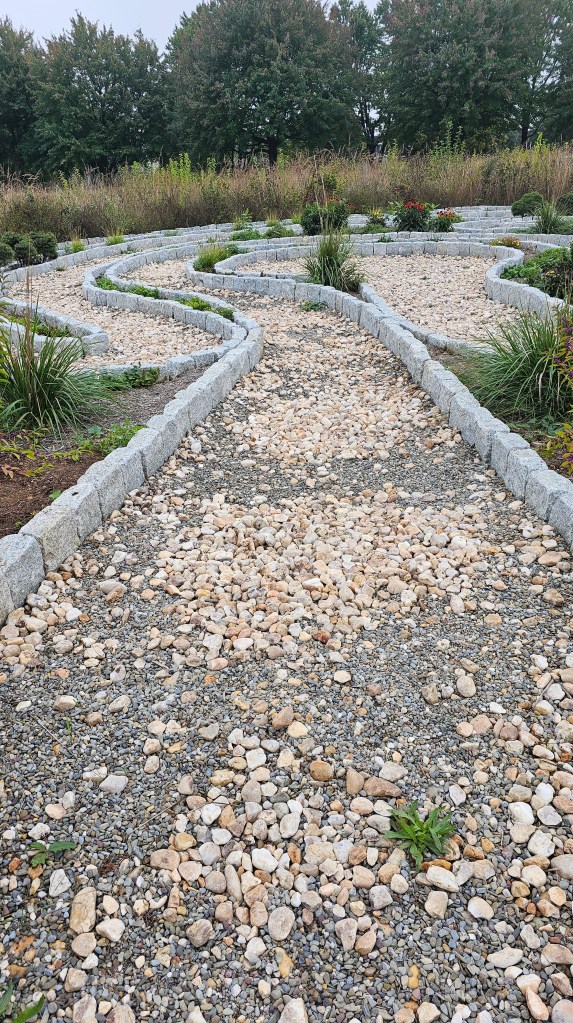
Unlike a maze, a labyrinth does not have many branching paths intent to challenge one’s navigational skills, but instead is one single path leading to the center. It is intended to symbolize a meditative spiritual journey without the possibility of becoming lost. There is one entry point and one endpoint, the only exit is to follow that path in reverse.
Labyrinths have been used by the Christian faith since at least the 300’s and it gained popularity in the 600’s as a substitute for pilgrimage to the Holy lands after the Muslim conquest. In the faith, the labyrinth represents ones journey with God, as one arrives at the center one is entering arrives to be with God in perfect union. When one leaves, one has left a holy place to go back into the world. The practice is intended to be one of quiet contemplation and meditation, to pray and commune with God. It is a different form of worship as most often other forms are very stagnant in terms of physical movement. You sit at church to hear the preacher speak, you may stand up to sing and more modern churches may have people wave their arms in the air, but for the most part the movement is very limited. In this way, your whole body is part of the worship, the act of walking becomes part of the prayer.
Many labyrinths are outside allowing creation to return to its intended purpose of being our Cathedrals and places of worship. It returns us in a sense to the garden paradise and thus reinforces the journey back to God which the labyrinth intends to mimic. The ordinary act of walking in nature becomes transcendent.
The path that leads us back to God is not a straightforward path. It winds around at times seemingly moving us farther away from our goal, turning us away from it even though that is the only way to move towards it. To take that next step is an act of bold faith and trust that the path will lead where it is meant to be. In some labyrinths the path just before the final journey to the center takes us to the farthest point as it winds us all the way out and around before finally turning to the goal.
Life can often seem that way as well. It can seem that we are being led down paths away from our goals or that we are farther away from what we are striving for than when we started. We may be tempted to turn back and try to go another way, only to discover there is no other way. We may find ourselves frustrated by the seeming lack of progress and give into the despair of hopelessness. The only way is forward, to trust the path and take that step of faith.
As one walks the path of a labyrinth, one may notice weeds or patches of clovers popping up depending on how vigilant the groundskeepers are. Then again what is truly a weed in a garden devoted to God? Is it not his creation that has been sent there? The judgments of the world hold little sway there, perhaps they serve as a reminder that the flaws and shortcomings we see in ourselves are gifts from the creator. The obstacles in the path are not obstacles at all but blessings.
It was on a cool October morning, when the land was covered in fog that I embarked on my own prayer journey at a local church. I had read about prayer labyrinths and their meditative uses for quiet reflection and solace. As I was going to be in town on other business, I decided on a whim to drive a little out of my way and go in search of it. The labyrinth was tucked away behind the church in the wildflowers. Although being October, most of the flowers had lost their luster as they prepared for winter. The field itself was devoid of the bright hues one associates with flower fields; instead the plants had been transformed into dark sentinels to stand watch through the darkest months.
At the entrance, I placed my phone and car keys to the side in order to devote myself fully to the practice intended by the architects of the labyrinth. Pausing at the front, I took three deep breaths to ground myself and be fully present in the moment. Then I began to walk and prayed. I wound around the path allowing it to twist and turn as it would taking in the few still blooming flowers which dotted the inside. As I approached the center, I paused knowing that in the next moment I would be stepping into the inner sanctuary. I then stepped into the middle and rested in the presence. My journey out was slightly different than my journey in as I softly hummed hymns to myself. Perhaps, I was taking the joy of heaven with me in the form of music and song.
Once I returned to my phone, I did pick it up for purposes of documenting in pictures the labyrinth in part to be able to return mentally to that place once more. In part to be able to share the experience with you dear readers with hopes that you will be encouraged to go on your own meditation journey. Still, on my second journey inward, I found myself still meditating and reflecting as if the design itself instills the mindset. It was on this second journey that I considered the imagery that labyrinth invokes. It was during that time that I reflected that at the point where I was seeming farthest away was actually when i was closest, even though when I first entered the center appeared to be just within reach. It was in taking pictures, that I reflected on the apparent weeds and wondered if I could call them weeds since they were in a sense planted by God. If God could have weeds in his Holy place then surely they are not weeds at all and if I saw them as weeds was I not looking with the world’s eyes? What did I see in my own life as weeds? When did I think that I was far from my goals when they were just within reach if only I kept going? What might I see if I looked at my own life as a labyrinth?
On my way back to my car and out of the wild flowers, a butterfly came floating by my face, twirling around me and floating above. Was it a sign that the prayers asked would be answered? Was it a message of hope? Perhaps. Perhaps it was just a butterfly. Still, I shall take comfort in it for whatever may come in the next days. I shall remember the lessons of the labyrinth and sing the hymns of faith and thanksgiving.
How can you experience a labyrinth?
First dear reader, you need not be of the Christian faith or of any faith to enjoy the benefits of a prayer labyrinth. Many are simply called mediation gardens and even those without a faith find benefit to walking in them. The practice of meditative walking still helps people connect with their bodies, commune with nature, alleviates stress, supports their minds and improves over all well-being. You may find yourself making similar reflections as I did that life has its many twists and turns. You may reflect that the only way is to move forward and trust that you will obtain the goals you are reaching for. You may ask yourself if the flaws you observe are truly flaws or simply the way you’ve been trained to see them. Perhaps, you will leave as I did with a slightly different outlook than when you entered.
Labyrinths can be found all over, at churches, hospitals and other public spaces. Some people have created them in their own backyard. Each one has a unique design and some are much bigger than the one I visited on a misty morning. It may be difficult to find as they are not always advertised and some are not necessarily open to the public. However, I found that with careful research I was able to locate one not 10 minutes from my house. I encourage you dear reader to visit a labyrinth. I think you will find the experience is worthy of your time.
If you don’t have access to one, then a meditative walk could help you achieve a similar affect. After all it’s about getting a similar result from a given experience. As always, dear reader, we needed do the exact thing to achieve the same or even better results.
The title of this post comes from one of my favorite Bible verses and is in part the inspiration for this blog. This blog is intended to encourage you to live to invest in your mental health, stop chasing the false narratives of consumerism, over consumption and influencers and to live your best life. So what is a more appropriate Bucket List item than to encourage others? After all, when we build others up, we also build ourselves.
There’s an interesting story about a farmer who won the farm show every year for his amazing crops. What puzzled people was that he would take the seeds from his award winning produce and share them with his neighbors. When asked why, he said that by having superior crops nearby it helped enhance his own with cross pollination. In other words, helping others, helped him. Which is something that really resonates with me. As someone in the social services field, I want to help create a better world not only for the people I am helping but also because it will help create a better world for me.
In early 2021, with the ongoing pandemic, I watched mental health illness and a general sense of hopelessness grow in my community. It was as if in the midst of all the lockdowns, anxiety, stress a darkness was descending everywhere. Social media, which was already not the greatest place to spend your time, had become a toxic cesspool of hatred and vitriol as everyone struggled to cope. I don’t know all my neighbors, their struggles or what is going on in their lives, but I knew that at least some of them probably needed a pick me up. I knew I certainly could have benefited from it. So, I rolled up my proverbial sleeves and made a plan to bring some light in the middle of all these shadows.
I counted up the houses in my neighborhood and procured a small gift for each of them. In this case, it was a small make-up kit which I found at a greatly reduced price from Nordstrom. As my neighborhood is only about 10 or so houses, it was relatively inexpensive to include a small token along with the note. I then wrote a note to each of them offering encouragement and hope. Mostly something along the lines that we’re all going through a rough time and that I hope this small gift would bring them some joy.
I waited until the middle of the week when I knew most would be away as evidenced by the lack of cars in driveways and then launched my plan. Which really consistent of walking around for maybe 5 minutes leaving the gift at each doorstep. It was hardly mission impossible. There was nothing connecting it back to me, no name or indication as to whom it came from, that was never the point. The point was of course to be anonymous to simply offer a point of light in the darkness.
I do not know if anyone ever connected it back to me, no one has ever acknowledged the gesture, but what I do know is that it seemed to strengthen the ties in the neighborhood. I had noticed over the course of the pandemic that people had withdrawn back into their houses. They stopped chatting and waving. They didn’t go out of their way to be helpful to one another as we once did. For a year, we’d all be holding one another at arm’s length and it seemed difficult to breakdown the barrier. After that simple gift, I noticed they started reaching out to one another more and to strengthen the ties of the small community.
When we are kind to others, it spread kindness. However, often when we are kind it begins a reciprocal relationship that does not necessarily spread outward from the dyad. When we are kind to strangers or anonymously, that kindness is amplified to beyond ourselves. I loved seeing how the one small act prompted other small acts even if it just helped change the vibe of the neighborhood to a place where we do reach out rather than withdraw.
I’ve written in another post about community resilience like when the water main broke in my town and shut down main street or when a hurricane caused the annual art show to be canceled. A few people stood up and said, we will make a difference, we will encourage one another. Then the community rallied behind it. I’ve driven past signs on people’s mailboxes that say “You are awesome” and it brought a smile to my face. I’ve walked into the bathroom to see written on the mirror “You are loved” and my day brightened.
We never know what doing something for a stranger may do for them. However, there are many stories about how something as small as a smile can stop a suicide or help someone make a decision to turn their life around. Perhaps, all I did was make people smile, perhaps it saved a life. The point is to be the light that we wish to see in the world and the best thing about the activity was that it took almost no time at all. Kindness often does not. What it takes is noticing a potential need and responding to it, letting someone know that they are seen and that they matter. You don’t need to necessarily get it perfect. After all, my neighbors may not have needed the make-up the point was to let them know that someone cares about them.
Not every item on a BucketList is about enriching your own life. Afterall, here at Budget Bliss Bucket List, we want to pursue a life well lived and that means enriching other people’s lives as well. We become the best versions of ourselves when we practice generosity and gratitude. Chasing an influencer life for likes and attention, doesn’t leave us with meaning. Going on a vacation is fun, pampering yourself at the spa is important for self-care, but we miss something important when we don’t forget to give back.
I shall have to write a post about one’s wellness wheel, but the idea is that we have to make sure that we’re living a life in balance, filling each part of our wheel to be in balance. When one part of our wheel is “flat” the wheel doesn’t turn and we usually feel like we’re off, possibly stressed or even burned out. Making sure to take time to include items like this helps keep our wheel turning smoothly.
It’s easy! Count up your neighbor’s houses and write notes of encouragement. Then when the timing is right, drop them off. The alternative is to leave them around your community for strangers to find. You can even sneak around at night with chalk and write notes on the sidewalk for people to see. It takes almost no time at all and no money. Which is why this is a perfect budget friendly item to include on your list.
Completed: 2021
Cost: $10 per household but it can be practically free
I’ve written before that we often have to pick and choose our battles when it comes to living out our values as almost nothing we can do in this modern world exempts us from harming others, short of going completely off grid and homesteading out in the middle of the wilderness surviving on nothing but what you create yourself. However, even those intrepid homesteaders buy some of their things at least to get started, so they still participate even if they say otherwise because without a village full of specialized craftsmen how could they not? Even the fact that they can live peacefully on their land free from marauding warbands is because they are surrounded by a modern society with an active army and local law enforcement agencies.Plus the tax man always comes in one form or another and if they’re youtubing their experience guess what they’re participating in?
The truth is we have to accept that we cannot make perfectly ethical choices that always align with our values. We have to pick and choose our battles and make compromises. I value the environment, but I have gone on cruises with my mother. Which is arguably one of the worst choices when it comes to environmentalism. Unfortunately, I’ve found that cruising is one of the friendliest travel options for someone with chronic health conditions if you want to see multiple countries and a bit more of the world. She worked very hard as my mom and practically killed herself to provide for me a modicum of middle class lifestyle growing up and to support me as best she could through college, a job that while it required a college degree paid me less than 20,000 a year, and grad school. She gave up her dreams of travel to give me a good life, so I help make her bucket list happen. The best way to do that has been cruising once every three to four years.
The two values that conflict are the environment and family. In general, my family lives in a very environmentally friendly way. We reduce our energy consumption as much as possible, avoid purchasing new items preferring thrift shops, ebay and Facebook marketplace. We buy “ugly” produce and check the quick sale items to reduce food waste. As one can see in the rest of this blog, in general we avoid travel to far flung places. I try to garden with native plants or at least plants that are non-invasive and friendly to my local area. I’ve planted a number of trees which all contribute to the environment. Even our toilet paper and tissues are made from bamboo to try and reduce the waste. However, every three to four years we do go on a trip that is truthfully bad for the environment. Is it better than the person who takes a week trip to various foreign countries around the world once a year? It’s probably on par to be honest.
It could be easy to start trying to calculate carbon “credits” to “off-set” the indulgence, which isn’t really the point of our daily lifestyle choices. If you indulge occasionally in fast fashion you may try to justify it with all the second hand purchases you’ve made. It may be a logical fallacy to say “well I can be ‘bad’ in this one instance because I’m so good all the other times.” We see this when people decide to go off their diets, or buy something from a place they know has a terrible reputation for how they treat their employees. It can be easy to judge people (or ourselves) who do make these compromises negatively. However, we all do it and we all make judgments about what compromises we’re willing to make when our values conflict or our budgets come up against certain realities of life.
It may not even be about having different values but how we rank our values in a given situation. Would I much rather purchase all my clothing from etsy shops supporting American small businesses? Absolutely. Do I have the money to do so? Absolutely not. Clothing is expensive to make at $15 to $20 an hour for a living wage. It’s even more expensive if you want them to use material that is also American made; perhaps you want it to be of all natural fibers and dyes from an organic cotton farm here on US soil using only the best sustainable, environmentally friendly practices.
I’m someone blogging about living her best life on a salary that is less than the median income. I don’t have that sort of cash, despite my greatest wishes otherwise. Almost none of us do and sometimes despite your best efforts you can’t find what you need at the thrift store given that it’s based on donations. I’m lucky in that I wear pretty common sizes but even then I can’t always find what I need and I’m forced to go to a regular store to purchase something new and not sustainably made, free from exploitative labor practices.
The overarching value is reduction of waste, but it sometimes conflicts with what I may feel I need. Like when I needed to go to the gala as part of a fundraising event as part of my job and I didn’t have a dress for the occasion. I wasn’t spending over $100 on a dress for my non-profit job. I also wasn’t buying a used prom dress from my local thrift shop to do it because I don’t want to look like I’m 15 instead of over 30. I placed the value of helping raise money for a good cause over my usual value of reducing consumption of goods.
The point of this post is to simply have you begin to reflect on how you personally navigate your values and to recognize that sometimes it’s not about being a hypocrite but rather having two conflicting values where you make a decision about which one to value more given your own limited resources whether that be time, money or energy. It’s not about telling you what to do but to get you to pause and reflect on how you may be navigating these conflicts without putting much thought into it leading to negative judgements of yourself and perhaps even others. This is a time to practice some self-compassion as well as compassion for the choices that others are making. It’s easy to throw stones in glass houses, but one really shouldn’t. It’s a kinder gentler approach to living out values
You can be more mindful about the decisions you are making to more align your actions with the things you actually care about. This allows us to create more meaningful and impactful lives that bring us joy. This also causes reflection about what we might be doing that doesn’t align and to ask, is there a different way to achieve the same ends without as extreme of a compromise? I like quality clothing that will last years not months, so I may go to ebay and try to find used designer clothing for a steal. Goodbye fast fashion, hello sustainability that isn’t breaking the bank. If I decide to go on a cruise because I want to be able to travel places with my mother and help her obtain her dreams, is there a line that is a little better for the environment than the rest? Is there one that also treats their staff well? What about the excursions it offers? Even something as simple as purchasing biodegradable paper plates if I decide I want to have a picnic with my sister in the park.
I’m always asking, is there a way I can do this better to fit my values? I am also willing to revisit previous decisions. I may say that upon further reflection that it was a compromise I shouldn’t have made. I can’t change the past, but I can move forward with making a different decision moving forward. Perhaps, I am at a different place where I have more freedom to choose. When I was purchasing my car there wasn’t really a hybrid with four wheel drive in my price range. I had to determine which was more important to me: the safety of having four wheel drive in a job that required me to drive in bad weather or a hybrid that was better for the environment considering the amount of driving I was doing. At the time, I chose safety, because I like living and couldn’t afford to become disabled from a catastrophic accident. As I begin to consider purchasing another car, my driving needs have changed so I will more likely choose a hybrid. Additionally, there are now more options which combine hybrid technology with all wheel drive.
We won’t always be able to live out our lives in perfect harmony with our values. We will have to pick and choose. We should be asking ourselves which values are in competition with one another and weigh the impact of those choices against the conflicting values. Sometimes one value will win out over another value. The ranking can vary from decision to decision. We should be willing to recognize when there is conflict to allow for self-reflection and arrive at the best decision for ourselves while owning that we are making a choice that conflicts with the values we have.
As it is Christmas Eve, that means that in only one week’s time, the New Year shall be upon us. After the Christmas festivities, carols, feasting, presents, and pageants, our attention shall turn to reflection of the year previous and to the year ahead. If you are like most people, dear reader, as always, you started the year with the best of intentions. You resolved to lose weight, write that novel, go on that vacation, finally get married, pay off that debt and others I haven’t named here.
Like most other people your resolution probably quickly faded. The habit you were trying to set didn’t quite “stick”. You may have faced a set back like an unexpected health issue preventing you from going to the gym every day or the time you set aside to work out got eaten up by staying late at work or if we’re honest, you were probably too exhausted and burned out to keep it up every single day. Then the feeling of failure crept in, negative self-judgments and justifications as to why you just can’t follow through with your plans followed quickly by negative coping usually in the form of doom scrolling through feeds you don’t even actually like and binge watching objectively terrible shows on whatever streaming services you happen to have.
Now, I could parrot the many articles as to why it is so difficult to keep resolutions. Yes, we often aim too high and bite off more than we can chew. The common advice is to set smaller more obtainable goals along the way like if we want to learn a new language, to devote 5 minutes a day to learn a word of phrase (that won’t work to help you learn a new language that’s terrible advice!). We’re extoled to consider the why we want to change. The experts will remind us of the adage that the pain of not changing has to be greater than the pain of changing for us to really change. Therefore, we must consider the greater purpose to our goals! Which is true to some extent – but I digress. I have yet to see these well meaning advice columns actually help.
However, there is one very clever YouTuber CGP Grey who introduced me to a new and novel approach to New Year’s Resolutions. Now, some of you may already be familiar with his work. If you’re someone who likes history, flags and other niche esoteric topics and have not yet discovered this gem of the internet, now you have and you’re welcome – but I digress again.
He suggests that we throw out the SMART Goal version of resolutions (Specific, Measurable, Achievable, Realistic, Time-bound) and instead introduce ourselves to a general theme. A SMART Goal may be I will reach A2 in Spanish by the end of the year; instead I might say “Year of Spanish”. It’s broad because it’s supposed to be. After all the point of most resolutions is that you’re trying to improve yourself in some manner so exact milestones don’t matter so long as the trend is positive you’re still reaching the goal. Even just stopping a negative trend can be a positive or decelerating one is still improvement. Maybe you didn’t lose weight, but you stopped gaining weight. Maybe you didn’t put on muscle mass, but you created a work out habit.
With a theme you’re focused less on the “big SMART goals” and mostly just focused on any small, positive changes you can make towards your theme. Your life is full of small branching decisions that allow you to have more, less or the same of the things you want. If your theme is Spanish and you find yourself standing in line, rather than scrolling on Instagram you pull out your phone and start learning Spanish words.
As Grey describes it, your theme becomes a friendly little bot pushing you in small moments towards your theme and a good theme can’t really fail because those small changes will start to add up. It’s a matter of picking large enough themes, to move your life in a positive direction that can encompass a myriad of ways to get there. Let’s say you want to lose weight, maybe your theme could instead be “Year of Health”. Your friendly little bot may nudge you towards eating healthier. However, you find that you struggle to make good choices with your eating habits but instead start walking every day, you are still on theme. Maybe you were thinking of going to the gym, instead of that gym member ship, your bot nudges you to buy those weights and you start doing some light exercise at home.
After all, we can’t plan for the future. If the resolution is I will lose x amount of weight by the end of the year and then you become ill, you may not be able to lose weight, heck your only goal may simply to be improve your health at all. If your theme was say health, then you haven’t failed because it wasn’t about the weight it was just making small choices in each moment towards the theme of health. Having a theme allows you to pivot with the hills and dales of life, a theme is adaptable. Maybe you started off trying to memorize different Spanish words and found that learning a word a day didn’t actually help you speak to your Spanish speaking co-worker. However, after a few stumbling interactions, she agrees to have lunch with you each day and starts to teach you – you haven’t failed because you stopped memorizing words. In fact that would be one of the best ways to learn!
By keeping yourself “on theme” you will begin to notice all the different choices that you make each day either towards the theme or away from the theme. This gets you to reflect on how you think which changes how you think. Instead of experiencing yet another failure of not meeting goals of your past self, you are free to experience the successes of the person you are in this moment and free to set down the path for your future self. Often what we envision the theme of the year to mean in January isn’t as we envision it in December, which is beautiful! According to CGP Grey, Themes should be broad, directional and resonant. It’s about building a life you want to live – which incidentally is exactly what this blog is about. Helping people life exceptional lives.
CGP Grey breaks down “Building A Life You Want to Live” into Themes, which goes into systems to build up those themes, to targets for creating those systems, targets which may or may not get you there and small actions you take to hit those targets. Consider learning a language. An action I may do is practicing Spanish on Duolingo everyday. A target may be “get through 1 unit each week” a system may be that I need to practice for 30 minutes after dinner each day. This encompasses a theme of language learning which helps me build a life in which I can converse in Spanish with relative ease. It’s in those in between steps targets and systems that our resolutions fall apart. We think we need to take the life we want and break it down into small bite size chunks. Instead, with a theme we allow the targets and systems to arise more organically from the actions we can reasonably take towards the theme.
Finally, CGP Grey encourages us to consider that a year is a long time but a season is a very nice chunk of time, not so long as to slip away from us but also not so short as to be unreasonable. As we just hit the Winter Solstice, perhaps you would consider Winter of Order to try and become more organized. As nature changes reminding you of passage of time, it can help keep you “on theme”. So over this next week, I encourage you dear reader to consider a theme instead of a resolution.
I think one of the reasons everything seems so much better on a vacation is because we’re able to leave behind the worries, stresses, and responsibilities of everyday life. IWhen I do go on vacation, not only do I leave it behind, I almost always have a “flex” day for when I return, I make sure all bills are paid up early and I make sure my house is spotless before I go. This means that I don’t have to worry about returning to housework, everything is paid for and I still have an extra day where I’m not working. I have an entire day to prepare to “return” to the mundanity of life with all the worries, stresses and responsibilities of everyday life. It also means that I don’t have to begin to prepare to return until after the vacation is completely over thus “protecting” the vacation mindset. Another protection I give myself is having things fairly planned out, with room to change them if the need arises, but having done most of the decision making beforehand means that not even the worry of a decision can possibly bother me.
Sidenote: The flex day is usually spent snuggling my pets who missed me and ensures that I meet their emotional needs after being separated from me. It’s like a whole bonus vacation day and I love absolutely it.
Cat snuggles! My biggest problem is my lap is too small for all my cats!
Because we’re able to “set aside” our “real” lives while away, it means that we are much more able to focus on what’s happening to really enjoy what’s happening in the present and savor those moments. Vacations just feel more fun even if we’re doing an activity that we could arguably do at home.
Consider going to the beach or the lake. A day at the beach or lake nearby is lovely, but what about say going on a cruise and picking a day at a tropical beach. Objectively, a beach is a beach. Sand, check. Water check. Waves check. Yet, in comparison to my last day at the beach on the Atlantic coast vs my day at the beach on my cruise. The cruise one stands out as better. Why? Both trips, I spent time swimming in the water and then laid out under some shade to read my book. Perhaps it was less crowded, but I went to a less crowded beach before. Perhaps, it’s because I didn’t have to lug my chairs and towels. Maybe? Or perhaps it was the mindset I was in. I was mindful to be in the present. It seemed better because I was more relaxed and worry free. I simply was in the moment. All I was concerned about was the beautiful weather, the feel of sand between my toes and the gentle lapping of the waves as I sipped a drink and read. I was in my body in a way that I wasn’t really before.
I would hazard a guess that was the biggest difference, not the location, not the fact that I was on a cruise or whatever else, but my mindset. If I went away for a vacation and life followed me there, I probably would be miserable and perhaps, vow to never visit that location again having associated it with a terrible experience. No wonder we’re all looking to escape to far flung places rather than living where we’re at.
One doesn’t need to be on vacation to enjoy delicious food that with good presentation
So how does one cultivate a vacation mindset while doing things at home, perhaps on the weekend, a single day off or on an evening out? First, you must create some boundaries around those activities. For me, I may schedule a preparation evening the day before. One where I do a more thorough cleaning of the house or at least make sure it’s well straightened up so that when I leave to go do what I want to do, a bunch of housework isn’t lingering behind in my mind’s eye. I may look ahead of upcoming responsibilities such as bills or projects I need to get done and try to get as many of them done beforehand. My alternative is to have on my calendar a block of time dedicated to those activities. I find that when I block out time to get a task done, the stress associated with it diminishes greatly. Mostly because my brain is able to accept it will get done and then not worry about it. It also means disconnecting, airplane mode can be your friend or if you’re too afraid of that because you have children at home and you want to make sure you’re available in an emergency, setting your phone to “Do not Disturb” where you can still get phone calls in an absolute emergency. All of these things help me set a boundary to keep the outside world out of my leisure activities.
By setting a boundary with the rest of the world, it’s much easier to cultivate mindfulness. What do I mean by mindfulness? I mean being fully present in the moment, being aware of the physical realm around you and your own body. One could call it being grounded in your current reality without being distracted by things in the past and the future. This allows you to turn the mundane into something extraordinary. Consider a trip to the farmer’s market. Apparently, this fairly ordinary thing here in Lancaster is a coveted activity by many a tourist and don’t get me started on the “farm to table experience” that people pay an arm and a leg for or as I call it Wednesday night’s dinner.
When I go shopping, I am on a mission. I get in and out as quickly as possible, I have a list, I know where the items are at and I don’t want to spend a single moment lingering. I am busy and I have things to do. A tourist on the other hand, linger. They pick up the fruit and smell it. They admire the textures and colors of the different vegetables. They see the display baskets as quaint, harkening back to the days when all our food was sold in little markets and stands such as this one. They admire the baked goods, mouths almost watering in anticipation. They strike up a conversation with the farmer behind the counter asking curious questions. For them, this is their bucket list experience. For me it’s grocery shopping. The same place, the same activity, two completely different experiences.
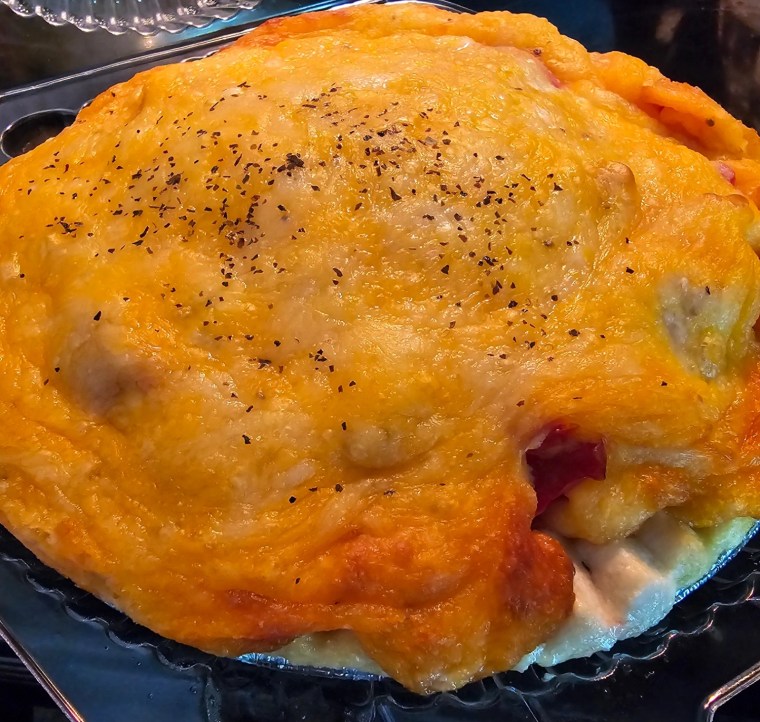
A delicious tomato pie from a local farmer! Truly a farm to table experience.
What might I find if I scheduled some extra time in my busy schedule to meander through the aisles? What delights might my eyes see? What smells might make my own mouth water if only I would pay attention? If one can turn grocery shopping into a bucket list experience, what might happen if when one goes to an event like a festival, concert or museum one cultivates this same mindset? As for Wednesday night’s dinner, a trip to Root’s Farmers Market on Tuesday can yield a farm to table experience without the price tag. Buy direct from the farmer at their stand to make in your own kitchen.
If you take time to cultivate moments to be on vacation, even for an afternoon, you will find you are more refreshed and better equipped for the daily inconveniences and stresses of life. It is different than escaping into your phone which is merely a distraction and often fuels negative feelings about yourself. Unless you’ve carefully trained the Instagram algorithm to only show you cat videos – which I have intentionally from day one – scrolling on social media will not help you feel better. Being mindful connects you back to your body, relaxes you and allows you to cultivate moments of joy and gratitude even for simple things like a bushel of tomatoes.
It isn’t about what you’re doing, but how you’re doing it. We can create amazing moments in the ordinary if we only open our eyes to see what a wonderful world we live in.