No one ever wins the game, “what could have been”, but we all play it to our own demerament. The game “what could have been” is when we sit and think about the path not taken. The “one who got away”, the degree not pursued, the job offer you didn’t take, the house you didn’t buy or the trip you didn’t go on. It is usually when we are sitting in regret for not taking that path and say “if only I had….” Indeed, if only you had and then life would be wonderful! That, dear reader, is the dangerous and poisonous trap.
You see when we play this game, we only ever present ourselves with the idealized version of events had we only made a different choice. I should probably write a post later about the choices we make since I keep saying it, but life is full of choices and saying yes to one thing means no to others. We choose to give up something to take a given path, often more than one thing. If we pursue a higher degree we may land our dream job and make lots of money, we may also find ourselves drowning in student debt working at McDonald’s. Rarely do we consider the second part when playing “what could have been.” We only think of the best possible outcome of the path not taken, dreaming that if we had just done something slightly different we would have a life that frankly was probably never in the cards to begin with.
I had a wonderful co-worker who was quite talented in the social services field. She was arguably better than most people with their master’s given the amount of additional training and experience she had. Unfortunately, without that degree her job prospects were limited and her salary was less than it should have been for what she brought to the table. It was to her deep regret that she did not finish school. However, she shared that she had in part chosen not to pursue a career in order to support her husband’s children in their blended family. They needed additional support and because of her pouring herself into them, they turned out wonderfully. They are successful young men and women who love and adore her.
I reassured her that at the time of the decision she could have no idea that the job market would be so demanding of a higher degree and that she made the best possible decision for her and her family in those moments. I told her that she has no idea the positive impact that her presence in the family brought and what horrible things may have happened if she pursued her higher education which would have required her to sacrifice the extra time and attention she gave those children. I told her she has no idea if the gamble would have paid off or if she would have been stuck with debt or how it would have impacted the dynamics of the home. Perhaps, those children would have gotten into drugs or joined a gang without her love, care and support (a possibility in the city she lived in). Would she be sitting in an office today, wishing she had made a different choice and cursing herself for not staying home?
Much like in the movie it’s a Wonderful Life, we have no idea how the choices we make effect the world around us and how without those choices the world may actually be far darker.
That “dream” home may have been a money pit or a financial stressor that ruined you. That vacation you didn’t go on, maybe would have been the place of a freak accident that left you without a leg. That job that you didn’t take may have been the most toxic work environment that you ever experienced. Yes, it may have led to a magical land of happiness, but look around you, do you know anyone who is truly happy? If so, then I will ask you to look closer at them, are they happy because of a dream life or for some other reason? The Kardarasians are arguably one of the most successful families in America and I don’t need to watch their show to know they are miserable. They spend their lives creating endless drama for our entertainment and that sounds like a gilded hell. How many celebrities have completed suicide or turned to drugs to numb their pain? How many people regret getting married? How many single people long for it?
You accomplish nothing sitting up and thinking up a fantasy life for paths not taken. It only leads to regret for a life that you do not have and for one that may have never existed no matter what choices you made. You cannot change the path that has already been taken. The only possible way is forward to make the best choices you can in the moment with the information that you have. Living our best lives means living this life and making this one the best one we can with the tools at our disposal not trying to live a life that can never be. Do not play what could have been, dear reader, for it is a game you will never win.
I think one of the reasons everything seems so much better on a vacation is because we’re able to leave behind the worries, stresses, and responsibilities of everyday life. IWhen I do go on vacation, not only do I leave it behind, I almost always have a “flex” day for when I return, I make sure all bills are paid up early and I make sure my house is spotless before I go. This means that I don’t have to worry about returning to housework, everything is paid for and I still have an extra day where I’m not working. I have an entire day to prepare to “return” to the mundanity of life with all the worries, stresses and responsibilities of everyday life. It also means that I don’t have to begin to prepare to return until after the vacation is completely over thus “protecting” the vacation mindset. Another protection I give myself is having things fairly planned out, with room to change them if the need arises, but having done most of the decision making beforehand means that not even the worry of a decision can possibly bother me.
Sidenote: The flex day is usually spent snuggling my pets who missed me and ensures that I meet their emotional needs after being separated from me. It’s like a whole bonus vacation day and I love absolutely it.
Cat snuggles at the end of a vacation away is the purrrrrfect welcome home
Because we’re able to “set aside” our “real” lives while away, it means that we are much more able to focus on what’s happening to really enjoy what’s happening in the present and savor those moments. Vacations just feel more fun even if we’re doing an activity that we could arguably do at home.
Consider going to the beach or the lake. A day at the beach or lake nearby is lovely, but what about say going on a cruise and picking a day at a tropical beach. Objectively, a beach is a beach. Sand, check. Water check. Waves check. Yet, in comparison to my last day at the beach on the Atlantic coast vs my day at the beach on my cruise. The cruise one stands out as better. Why? Both trips, I spent time swimming in the water and then laid out under some shade to read my book. Perhaps it was less crowded, but I went to a less crowded beach before. Perhaps, it’s because I didn’t have to lug my chairs and towels. Maybe? Or perhaps it was the mindset I was in. I was mindful to be in the present. It seemed better because I was more relaxed and worry free. I simply was in the moment. All I was concerned about was the beautiful weather, the feel of sand between my toes and the gentle lapping of the waves as I sipped a drink and read. I was in my body in a way that I wasn’t really before.
I would hazard a guess that was the biggest difference, not the location, not the fact that I was on a cruise or whatever else, but my mindset. If I went away for a vacation and life followed me there, I probably would be miserable and perhaps, vow to never visit that location again having associated it with a terrible experience. No wonder we’re all looking to escape to far flung places rather than living where we’re at.
So how does one cultivate a vacation mindset while doing things at home, perhaps on the weekend, a single day off or on an evening out? First, you must create some boundaries around those activities. For me, I may schedule a preparation evening the day before. One where I do a more thorough cleaning of the house or at least make sure it’s well straightened up so that when I leave to go do what I want to do, a bunch of housework isn’t lingering behind in my mind’s eye. I may look ahead of upcoming responsibilities such as bills or projects I need to get done and try to get as many of them done beforehand. My alternative is to have on my calendar a block of time dedicated to those activities. I find that when I block out time to get a task done, the stress associated with it diminishes greatly. Mostly because my brain is able to accept it will get done and then not worry about it. It also means disconnecting, airplane mode can be your friend or if you’re too afraid of that because you have children at home and you want to make sure you’re available in an emergency, setting your phone to “Do not Disturb” where you can still get phone calls in an absolute emergency. All of these things help me set a boundary to keep the outside world out of my leisure activities.
By setting a boundary with the rest of the world, it’s much easier to cultivate mindfulness. What do I mean by mindfulness? I mean being fully present in the moment, being aware of the physical realm around you and your own body. One could call it being grounded in your current reality without being distracted by things in the past and the future. This allows you to turn the mundane into something extraordinary. Consider a trip to the farmer’s market. Apparently, this fairly ordinary thing here in Lancaster is a coveted activity by many a tourist and don’t get me started on the “farm to table experience” that people pay an arm and a leg for or as I call it Wednesday night’s dinner.
When I go shopping, I am on a mission. I get in and out as quickly as possible, I have a list, I know where the items are at and I don’t want to spend a single moment lingering. I am busy and I have things to do. A tourist on the other hand, linger. They pick up the fruit and smell it. They admire the textures and colors of the different vegetables. They see the display baskets as quaint, harkening back to the days when all our food was sold in little markets and stands such as this one. They admire the baked goods, mouths almost watering in anticipation. They strike up a conversation with the farmer behind the counter asking curious questions. For them, this is their bucket list experience. For me it’s grocery shopping. The same place, the same activity, two completely different experiences.
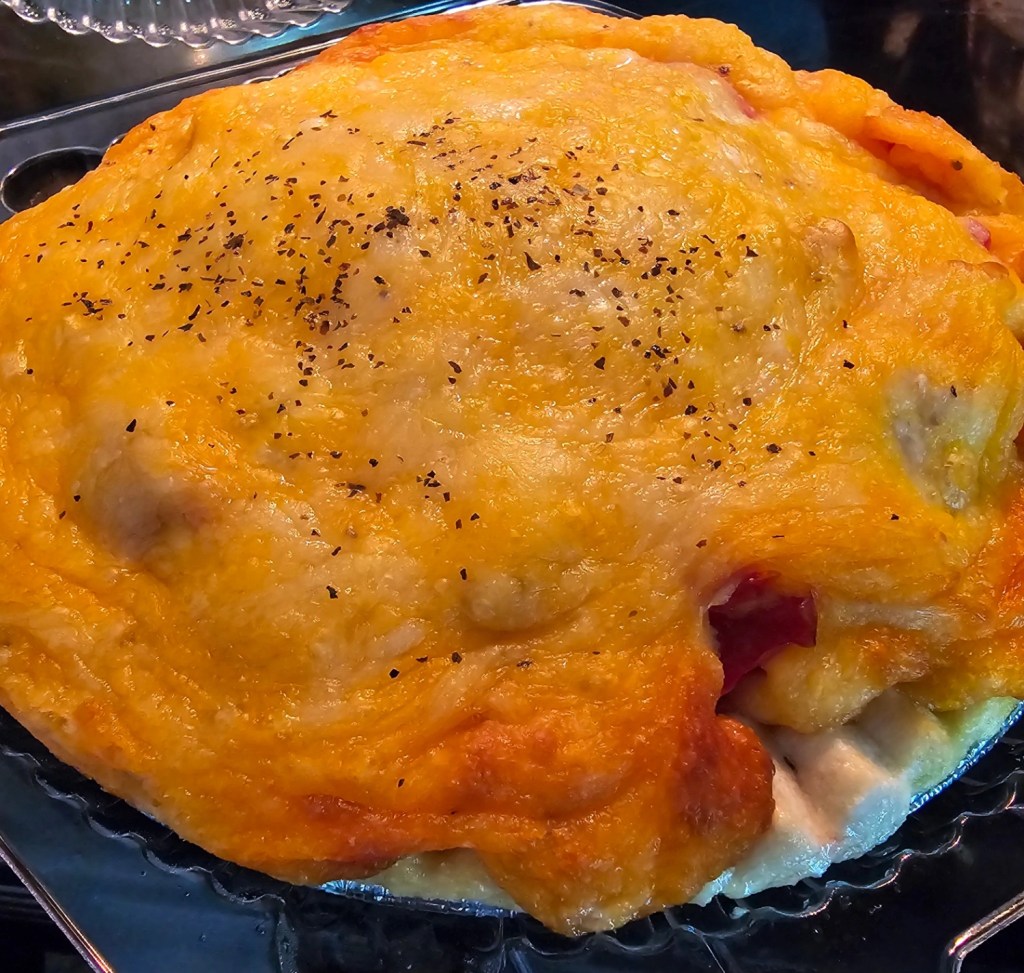
My farm to table dinner: tomato pie
What might I find if I scheduled some extra time in my busy schedule to meander through the aisles? What delights might my eyes see? What smells might make my own mouth water if only I would pay attention? If one can turn grocery shopping into a bucket list experience, what might happen if when one goes to an event like a festival, concert or museum one cultivates this same mindset? As for Wednesday night’s dinner, a trip to Root’s Farmers Market on Tuesday can yield a farm to table experience without the price tag. Buy direct from the farmer at their stand to make in your own kitchen.
If you take time to cultivate moments to be on vacation, even for an afternoon, you will find you are more refreshed and better equipped for the daily inconveniences and stresses of life. It is different than escaping into your phone which is merely a distraction and often fuels negative feelings about yourself. Unless you’ve carefully trained the instagram algorithm to only show you cat videos – which I have intentionally from day one – scrolling on social media will not help you feel better. Being mindful connects you back to your body, relaxes you and allows you to cultivate moments of joy and gratitude even for simple things like a bushel of tomatoes.
It isn’t about what you’re doing, but how you’re doing it. We can create amazing moments in the ordinary if we only open our eyes to see what a wonderful world we live in.
It started off as an exercise during the season of Lent. Rather than giving up something, I would post for forty days one thing that I was grateful for. Sometimes, it was small things like my morning coffee or the joke someone told at work, other times it was big things like having a house and a job. I enjoyed it so much that I kept it up for nearly 3 years as a daily practice.
It did not transform my life per say. It did not lead me to riches or status or really much of anything “big”, at least not visually. Instead the practice brought me peace and joy. It is, perhaps, the reason, I started focusing on all my small outings with my friends and family as moments worthy of a bucket list. You can see throughout my posts expressions of gratitude towards challenges, hardship and loss. You may see it in how I now look with child-like wonder at the ordinary going-ons around me. It is not as one might suppose naivety about the world, but of this secret practice.
I have a naturally optimistic outlook, though where I got it from, remains a mystery as I come from a family of pessimists. For me even an empty glass is not truly empty or even a bad thing, why an empty glass may be better than a glass half full because now I get to choose what to fill it with like water or wine or healthy herbal infusion. An empty glass is full of potential!
I am known for my ability to “reframe” as my fellow therapists call it or the ability to look at a seemingly negative circumstance and see the positives in it. It is not a pollyanna approach where you place the “at least” game and border on toxic positivity. The reframe is about seeking opportunities in the situation to help you pivot in a positive direction rather than dwelling on the negatives. The job that did not work out is an opportunity for a different one. The break up, while heart wrenching, is a time for you to focus on your own growth and perhaps even find yourself again.
I find it is much easier to get into this growth mindset when I’ve been practicing gratitude on a daily basis. It is a semi-unconscious catalog of all the tools in your belt to handle situations. I have on any given day various coping skills and things that help me feel better. I remember people that I can tap to help me in tough situations and developed skills that let me overcome obstacles. It stretches my mind for creative thinking and problem solving. In practicing daily gratitude you begin to seek out more and more opportunities in almost any frustrating circumstances.
Anticipating an increased commute due to construction? Instead of grumbling, What books might you finally tackle on audiobook during that commute? Perhaps, you will even find yourself slipping into the slower lane because you really want to finish that chapter. Maybe you can use the time to listen to a podcast, or finally learn Spanish in the car with listening exercises. I have crossed off many books off my reading list with my car ride, because I was grateful for my commute. Do not think that I have mixed up the order of that previous sentence. I was indeed first grateful for my commute and then I began to use it for a positive thing. That is right, I was thankful for a hardship and then it became an opportunity.
An unexpected obstacle in my daily commute
My praise does not always have to start with something that seems positive. I have learned to be thankful even in the difficult moments so that they can be transformed. It is not an easy practice; I am not always successful, and I don’t recommend you start there. One must walk first and then run. Instead, start where I began, finding at least one positive thing each day to be happy about. The way your cat greeted you at the door. The smell of rain after a storm. The return of the spring flowers. A good night’s sleep. I recommend keeping yourself accountable with posts or a note in your calendar. You will find at first that some days it seems like you have a million things to be happy about and other days, you cannot think of one single thing. Go for low hanging fruit on those days, the roof over your head, the clothes on your back, the bed you can sleep in.
After a few months, you will probably begin to experience the same peace and joy for your daily life that I began to have. It is not always the easiest thing and there are times when periods of melancholy set in, but this practice has helped me through even the toughest of times. It has transformed my outlook towards the dales of life and even let me start to see that I really am living an amazing life. I’m sure you are as well if you just stop to see it.
Oh dear, failure! Is there anything else American culture is more allergic to? Failure is such a part of life and yet we do almost everything we can to avoid it. I am certainly not immune to the fear of it. Do not get me wrong, dear reader, I fancy myself better than most at facing it, but there are still many times that I do not try for fear of it. While it may be tempting to present myself as a paragon on this blog, I am, alas, human rather than a demi-goddess. Shocking, I know, but it’s the truth! So, I will not lie to you and say that I have conquered this particular truth despite my best efforts.
Why do we fear failure so much? Not even failure, but even small mistakes? We live in fear of the judgments, the reprimands and the consequences of our mistakes. We worry about it negatively reflecting on us and what others might think or say. We worry that we might suffer terrible consequences if these failures should come to light. Worse, we may work to hide them and cover them up rather than owning them and taking responsibility. We may try to pass them off as someone’s mistake. We may try to downplay or minimize. There are many unhealthy ways to handle failure, because we fear the consequences so much rather than embracing failure as part of the process to become better versions of ourselves.
I cannot promise that you will not get reprimanded, embarrassed or made to feel less than for mistakes. One of the reasons we fear making them is precisely because that is what so often happens. I will not sugar coat this reality, messing up sucks and sometimes the consequences really suck. What I can promise you is that if you don’t let yourself mess up even in the face of potential negative consequences, you will never move forward and you will continue to be stuck. Messing up is how we learn. It is part of the process of getting better. The entire world of science is based on a series of failures leading to success. Negative data is still data! Edison tried hundreds of ways to make the lightbulb work. Even good ideas may fail initially, it took almost 10 years for sliced bread to catch on and now we say the phrase “the best idea since sliced bread”!
If we spend our time in fear of failure, we will never try and if we never try, we will never succeed. It is easy to watch people performing at their highest level on television without considering all the many times they must have failed to achieve that skill. We don’t see the number of times a gymnast has fallen or how many times a violinist struggled on a particular musical phrase. We don’t taste the botched dishes from the five star chef or the barely recognizable drawings of an artist. So when we try our hand at something, how quickly do we throw in the towel when it is less than perfect? How many things have we lost to ourselves pursuing perfection rather than joy?
The trick is not to dwell on the mistakes. Hence, the second part of this truth, moving on and learning. One should not forget and move on, or we will of course be doomed to keep repeating the mistake which is no fun. One should remember, learn and move on. Now most people would stop here and let the post stand, but I find that they are missing one of the most important steps of the whole process. How to effectively analyze so that one can learn without rumination.
I like to start with a strengths based approach. Studies indicate that when we focus on and cultivate our strengths rather than merely working to overcome weakness, that we make much faster progress. Therefore, I encourage you dear reader to first consider what went well or what was going well. If we get 48 of 50 questions right, should you really dwell overly much on the 2 questions you got wrong? One might end up spending so much time studying on the small section one struggled with in the unit leading up to the final exam, one ends up bombing the final because one didn’t review the other material! Ask, what did you do that helped you achieve as much as you did then, keep doing that!
Then ask yourself what did not go well and begin to brainstorm solutions. Perhaps, it was lack of sleep. Perhaps it was an ineffective method for tracking your tasks. Perhaps, it was looking at the wrong line in the spreadsheet. I often like to try and “mechanize” my approach to fixing mistakes. As a dyslexic, I know I will always struggle with reading spreadsheets unless I use the very simple fix of highlighting every other line in a given color. So, my spreadsheets utilize that method to help me track things effectively. As someone with ADHD, I have routines and develop “self-checks” to keep me on track. I set boundaries with interruptions, even small ones, when I am in the middle of a task because I know how easily I can “lose” a task near its completion. It will be 90% done, someone will ask me to do something else and it will stay 90% done for weeks if I am not careful to say “let me write that down on this to do list and I will get to it in just a few minutes.” this step allows you to plan for and prevent future mistakes.
This is also a time to practice self-compassion to observe without judgment, accepting that you are in fact, human. It is not a time for self-pity or excuse making because taking responsibility for the mistake is part of this process. However, forgiveness of the mistake is important to be able to move forward. I always find it much easier to practice this step after steps 1 and 2. When I can see what I did well and have a feasible plan to move forward the stress and worry that comes from the mistake almost seems to melt away. This is the step that helps us move on.
Sometimes, you do need to add the extra apology step depending on the mistake that you made. An apology should include an admission of harm caused by your actions, whether intentional or not without blame on the other person. If they contributed to the issue it is on them to take ownership of their part when it’s their time to apologize to you. If you’re apologizing to them this is their time to get an apology, not yours, yours will come. It should be followed up with your plan to make amends and you should seek their input for this plan to move forward. Remember it’s not just about the “thing” that went wrong, it’s also about repairing the relationship, helping the other person feel heard, understood and cared for. What makes you feel better about a situation, may not make them feel better about the situation. Once the plan is agreed upon, you need to follow through with that plan for repairing the relationship.
You will mess up, but messing up is a gift. A gift to learn and grow to be the best versions of ourselves and live our best life.
For those of us “type A” personalities, the planners, the cautious and the dare-I-admit somewhat controlling personality types, we like to be prepared. I am the sort of person who you want on a vacation because if something happens I will usually be whipping out the solution to the problem from my bag. Wine spill? Tide pen. Hangnail? Why of course, I brought nail clippers. Bug bite? I have just the thing that pulls out the venom or “juice” that causes the sting/itch. Don’t worry about your hair, I put extra pins in mine just for this occasion! I am the person not with a Plan B but Plans B through Z. Or at least I was.
Through all my careful planning and preparing there is always some unplanned event. I was the coordinator of a homeless shelter tasked in part with developing our policies and procedures. I had developed a plan for everything. Earthquakes, fires, floods, drug overdose. Or so I thought. I had nothing in the book for a pandemic. The ONE thing that I had not planned for happened. So I had to develop my plan on the fly, in face of ever changing regulations, restrictions and recommendations throughout COVID. None of us had planned for COVID, yet we somehow got through it. Perhaps, not unscathed, but hopefully more resilient than before in the face of uncertainty to handle whatever it is life decides to throw at us. I certainly grew from the experience.
You can still see where his eye was infected.
On the opposite end of the spectrum, there are things life gives us that are wonderful surprises that we cannot prepare for. I certainly was not prepared to adopt a stray, near death’s door, kitten and nurse him back to health. Luke was and continues to be one of the very best surprises that life gave me. One might think one is prepared for a pet, but I assure you no matter how many you’ve had before the next one is always its own set of special surprises. I imagine it is much like with children, each sibling is a unique challenge unto themselves.
It is a good thing that life carries with it surprises that you cannot readily respond to without a little growth or creative thinking. It is in these moments of challenge that we are stretched into stronger and (hopefully) better versions of ourselves. Consider what might happen if we could simply prepare for everything life is going to throw at us. How might that affect our development? Would we learn humility? Would we be resilient? Would we think creatively? Would we feel empathy for others when they are struggling to overcome their own challenges? Would we be able to help them? From my own observations, individuals who have not been adequately challenged and overly protected from the surprises of life seem to struggle in these areas. They are disconnected from reality without experiencing the full wealth of life. We have the biggest opportunities for growth in the things we couldn’t prepare for.
These challenges can be gifts! Contrasting experiences help highlight one another much like how two characters act as foils to one another in order for a reader to fully understand both. I ask you to consider, dear reader, how much sweeter is the view from a mountain top that you struggled to see versus one that you did not? It might seem nice to simply drive your car up and look at the view, but I can almost promise you the person who hiked the whole thing is probably enjoying it more. Without the challenge you may be missing more than half the experience and certainly none of the triumph.
These are gifts not only for your own personal growth, but also for the opportunities they present. In those times, you may discover your best friend or gain a new skill that lands you your dream job. You may get to live out a bucket list experience or finally get that break you’ve been needing. If we are constantly grasping at control we miss the opportunities around us, focusing on the negative instead of what might be. We close ourselves off to the possibilities continuing to ram our heads against a wall that will not break completely missing the door that has been opened instead.
In fact we may hurt ourselves most when we refuse to let go of control. How many times have we been told to relax when getting a shot because it hurts more when we’re tensed up? Life is often the same way. When we are tense and controlling, life hits a lot harder than when we are relaxed and go with the flow of things. In that flow state, we are willing and open to trying new things, to look for windows rather than doors, to see beauty where others only see ash, to believe in what might yet be without being too attached to any one thing.
This “harsh” truth is once again a blessing in disguise. It encourages us to let go of all the things we cannot control and to focus on what we can control, ourselves. Preparing for everything is exactly trying to control everything. So often we plan to free ourselves of worry, but we fail to see the burden we take up instead. Do you think about the sheer amount of mental weight you place on controlling everything? If you control everything, then everything that goes wrong is your fault! That is certainly a weighty responsibility to carry about. What about all the extra effort you place to prepare for things that never happen? How much time is stolen from you? Consider my own tendency to overprepare. Do you have any idea how heavy all my extra stuff becomes when I go out places? My bag is bigger than everyone else’s and heavier. Almost no one offers to carry it (precisely because it’s heavy) but they certainly don’t mind asking me for help. They all get to walk around free from care because I’m carrying the burden of their worries. Granted, my sister is also a planner and so we take turns carrying the bag, but other than her, it is a rare person indeed who offers.
I have also gotten better about over packing and overplanning saying instead that I have some extra cash and we’ll be near a store if something happens for most of our day trips opting instead to merely go with the flow. The freedom of this cannot be understated. Instead of focusing on all that can go wrong, I look forward to the event. Instead of endlessly checking the weather leading up to it, I just wait until the morning of to make any decisions. I plan for what I’d like to happen without closing myself off to new possibilities – more than often better possibilities.
This principle can be applied to the small things like a day out to the larger challenges like a pandemic. Let go of the burden of control and take up the freedom of the flow. Embrace the challenges as the opportunities they are! Yes, they often suck in the moment, but looking back you will be amazed at yourself for getting through!
What an extraordinary thought! How many times have we thought to ourselves that something simply couldn’t be done only to learn later that it was actually super easy, barely an inconvenience, had we simply approached it with a different mindset? We so often falsely limit ourselves with thoughts of how things ought to be done or should be done or even can be done. We allow fear of failure or being told “no” to dissuade us from trying or asking. We choose safety and comfort over risk.
It is not wrong to feel these things! There are reasons we have been told that things ought to be done a certain way. There is merit in collective wisdom. There is also merit in challenging the collective wisdom as our culture evolves and changes. Ways of doing things that once worked may no longer work in today’s world.
We are right to fear rejection. No one likes feeling rejected, especially when you have already faced so much in life, as you may have dear reader. When you make a request or reach out, it is with an earnest desire and hope for assistance or a chance. If that request is denied, we have to experience hope dashed upon the rocks. After feeling that so many times, it is difficult to muster up the courage to go once more upon the breach.
Taking risks is, well, risky. If we have a family to support or are struggling to get by it can be quite difficult to take those first steps. Not only that, but also you must have the necessary physical, mental and emotional energy to pour into the venture. We may hear of these many rags to riches stories, and may be inspired to go out and try. However, the long term success of a business is rather bleak. In the first five years, 45% will fail. By the 10th year, 65% fail and by the 15th year, 75% of businesses close. Is it any wonder so many choose to stay in the confines of other people’s businesses, suffering in less than optimal work conditions? Easy to say no risk, no reward, but if the risk is your housing, safety and security? Our world seems almost made to keep us ground down and distracted rather than having the freedom to thrive as individuals.
That is why this truth can seem harsh. Because it is asking us to fight against so much of what we’ve been taught and to make some difficult choices. I just gave you, dear reader, some very good reasons to keep your limitations and your feet on the ground. One can almost hear the Disney montage queuing up in the background about following your dreams, seeking adventure and believing in magic. Inspiring to be sure, but your pragmatic self is certain to reassert itself with all its very sensible objections and limitations. So what is one to do?
It is important to recognize what limits you have imposed to assess them. That is what makes this truth so freeing. Rather than being mindless slaves to the restrictions, we get to decide if those restrictions are in fact truthful and challenge them a bit. Perhaps, even become a bit playful with the challenge.
Consider my approach to the possibility of being told no in response to a request. It is actually quite simple, I do not go in with actual hope of a “yes”. I go into expecting a no. Why then do I bother asking? Because, dear reader, it is always a no, until you ask! Therein lies the secret! Asking only allows the possibility of a no becoming a yes and what a delightful surprise the yes becomes! What is more, I get a positive answer much more than one might think! Or perhaps it is a psychological trick of merely focusing on the positive results and forming a bias in that direction, but it’s a helpful one so I’m not overly concerned about it. The limit was the fear of the no and the rejection, but then I realized that I was already living in the no. I was rejecting myself on behalf of others and not even offering them the chance to alter the self-imposed limitation. What a freeing realization that was.
You may feel you do not have the skills to land a job when looking through the qualifications. Did you know that many people land jobs even if they don’t hit every tick-mark on the list? Did you know that sometimes you can land a job with just a cold call? I recently decided to make a career move, called up an old boss about whether they had a potential position open at her current company. They ended up creating a position for me and hired me on. I could have easily looked at her current company and saw they were not hiring for what I was looking for and left it at that. My attitude towards “no” is what helped me reach out and ask.
What other limitations might be holding you back from living your best life? It doesn’t have to be a career. It could be hobbies you want to take up. Do you want to sing? It takes time and practice but 15 minutes a day can make a huge difference. Everyone has to start somewhere. It’s not like you’re auditioning for America’s Got Talent! There’s even some cool apps that help you find the right pitch and intonation for your voice range. Are there places you want to go or things you’d like to experience? You can read lots of posts from me here where I don’t travel far to do the things I want to do. When one stops to consider it, this whole blog is about challenging the limitation that in order to fully live you have to spend tons of money and travel the world!
Do I still live with some self-limiting beliefs? Of course! We all do. There are ones that for the moment I am willing to sit in. I recognize that they are limiting and I’m not ready to take on the risk or challenge that removing them would require. That doesn’t mean that I will always keep them. Life is about risks, but we also need to seriously assess them and whether we’re ready to take those next steps. The point isn’t to remove them all but to assess them and then actively choose them if they are right for us at the time. We also may have to make some difficult choices and pay a price that we’re not okay with paying in order to move forward.
It’s like the difference between free climbing a cliff and climbing with ropes. It is much safer to climb with ropes and you should absolutely not attempt a free climb until you have some experience. However, the idea that you could never do a free climb is a limiting belief and I am certain there is a much greater sense of thrill and accomplishment for those who do free climb. The point is rather than allowing ourselves to remain forever tethered, we get to work towards being ready, to choose to let go and climb freely. Once we do that, we really can conquer mountains.
I absolutely love this truth. For some, dear reader, this may seem a bit scary even mean. However, consider this from another angle, if you are not responsible for your own happiness who is? The answer of course is other people. Other people whom you cannot control and who may not have your own interests and needs in mind, let alone your happiness. And if they’re responsible for your happiness, does that make you responsible for theirs? Does that mean that you are expected to sacrifice yourself to their whims and desires in order to make them happy? How can you possibly be expected to know what will make them happy?
We humans are such fickle creatures and are almost never really satisfied. How can we all collectively be responsible for other people’s happiness and never our own? This constant cycle of pleasing people without thought to our own happiness can only leave us all miserable and unhappy. How freeing is it to say that “I am responsible for my happiness and you are responsible for yours”?
It is a reclamation of our own autonomy and choice. It frees us of the shackles of other people’s actions and reliance on them to do the “right thing” and allows us to fully stand in our own power. There are countless stories of human resilience, where people in terrible conditions were still able to choose not happiness but deep abiding joy. These are people who fully embraced their own power and would not allow their joy to be robbed by their oppressors or abusers. It was a way to take back what power they could to refuse to allow a prison to be one.
It is not easy to choose joy. It is not easy to be positive in the face of terrible circumstances and sometimes we do need to “sit in the suck”. I’m not an advocate of toxic positivity, because I don’t believe in suppressing negative emotions. I also don’t believe in feeding negative emotions. There is a time and place to process what’s going on, but not to swim in it, ‘till your fingers get all pruny. Acknowledge the “suck”, say it stinks, allow yourself to feel the unfairness, the injustice and general stink of whatever the situation is. Then cultivate your choices and possible responses.
This entire blog is devoted to a positive response of “the suck”. I did not have the time, energy and resources to live out a certain lifestyle. I could have easily gotten stuck in a negative mindset that I would never get to do the things I dreamed about doing. That I would continue to wish my life away and watch the years tick by until I was too old and sick to even enjoy the things even if I finally managed to save up the money to go do them. It would have been easy to shake my fist at a system that prevents so many people from making positive steps forward with stagnant wages, inflation and other social ills and give up. Instead, I looked around at what I could do instead. The answer was, I could do a lot. As it turns out, it allowed me to live out my values better than the original plan.
I did not have to rely on anyone to change the system. I simply went off and started making different choices. I choose to reevaluate my local community and see it in a new light. I choose to find happiness in the little things, seeing even small moments as things worthy of a bucket list. I will most likely write a post at a later date and time about cultivating daily gratitude, because that is what has helped to cultivate my happiness the most. I choose joy and I choose to be responsible for my own happiness. What a wonderful and freeing feeling that has been.
I recently came across a post on facebook that really resonated with me, but perhaps not in the way it was meant.
Five Harsh Truths About Life:
1. You are responsible for your own happiness.
2. The majority of your limits are self-imposed.
3. You can never fully prepare for everything life will throw at you.
4. You will mess up. The best thing you can do is learn from it and move on.
5. Your loved ones will not be around forever.
Although, I don’t know that I would call them harsh, in fact I would say these are freeing truths. In my next five posts, I will be diving into each of these truths to show you how awesome each one is and how these can free you to live your best life.
“There is no trouble so great or grave that cannot be diminished by a nice cup of tea.”. – Bernard-Paul Heroux.
When I was about five years old, I was obsessed with tea parties. I was first introduced to them through my mother’s own passion. She would take us to the local herb shop and the tea shop nearby to purchase quality tea and scones. At home, the water would be boiled and poured into a china pot, a timer set for the proper amount of time for brewing and then carefully poured out into the cups. It was during this time that she imparted to me the rules of tea, how to hold the cup, what order the tea should be poured out to each guest, the polite amount of sugar to add, when to add milk, how to stir it without making a ruckus. I learned the difference between afternoon tea and high tea (it’s not the same thing), that one eats the savory first then the sweets and exactly how one eats a scone properly (by breaking it apart into small bits).
Over tea, she taught me about Victorian England and the antiques that decorated our house. She was quite fond of the late Victorian era, and I developed the same fondness. As part of my education, she bought me a tea book for my birthday. I was elated (yes, I was a strange child, I grew up to be a strange adult and I’m okay with this fact). I flipped through the pages and discovered an entirely new sort of tea, the Japanese Tea Ceremony. The book did not go into it overly much but it did allude to the sorts of things one might encounter, the special Macha tea, the whisk and the sweet that they might serve. In combination with my discovery of the Karate Kid, my love of Japanese culture was solidified and later reinforced with my introduction into anime (which I won’t get into here, other than Princess Mononoke was a definitive experience of my childhood).
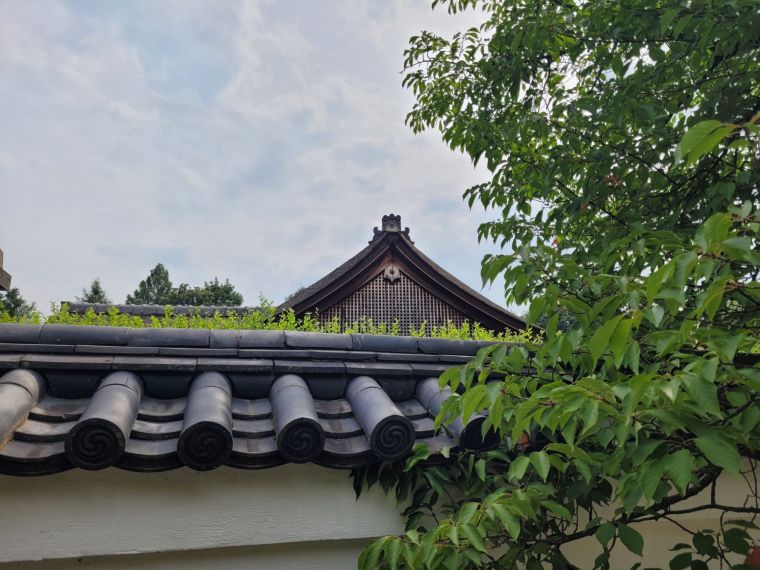
Ever since my discovery of the Japanese Tea Ceremony and all things Japan, I had wanted to experience it for myself. I got the chance in the summer of 2021, when I took the hour drive out to Shofuso Japanese Cultural Center. The house was designed by Junzo Yoshimura as a 17th century style home. It was built in Japan in 1953 utilizing traditional techniques and then shipped to New York as part of the Museum of Modern art. It found its home, however, in West Fairmount Park in 1958 where it has graced the greater Philadelphia area ever since nestled in a beautiful Japanese Garden. It includes a pond garden with a waterfall, island, koi fish, traditional tea house and bathhouse.
Walking through its gates, one could easily forget that one has not in fact hopped on a plane to the middle of Japan. Every corner of the building is a beautiful work of art, carefully tended and maintained. What delighted me was the dedication to keeping the building authentically Japanese. Unlike in America when something like a floorboard has some sort of damage or rot, the Japanese do not uproot the whole floorboard and replace it. Instead they cut around the damaged section and then fill it in like a puzzle piece. There was a sort of beauty in keeping the story of time rather than a focus on perfection. Flaws were a natural outgrowth of a house in use and there was a sort of artistry in the repair.
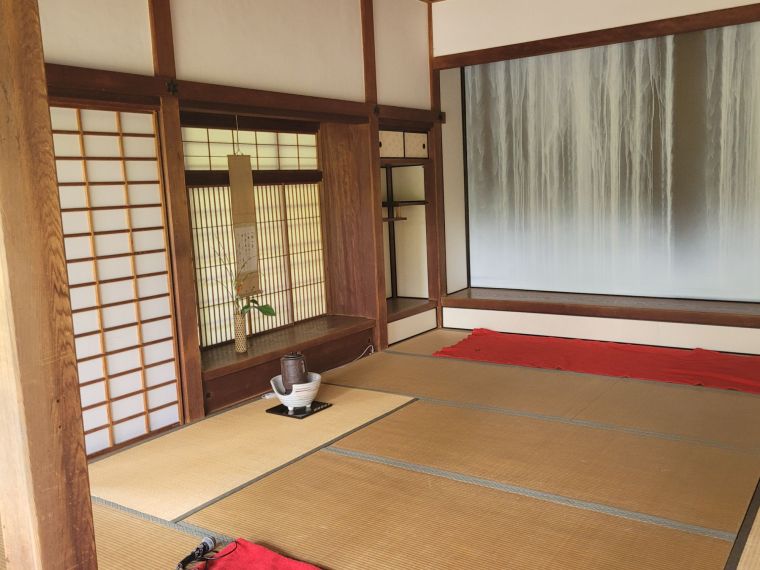
Men and women in kimonos graciously answered questions about the house and pointed out its secrets. They informed us that the murals of the house were donated by an artist in 2007 and were inspired by the waterfalls. They told us about the hinoki bark root (the only one outside of Japan) and how it took 1.4 million dollars to repair it back in 1999. They were excellent hosts whose presence engendered a sort of respectful quiet in the guests. It is not that we did not speak, only more in hushed whispers as to not disturb the peaceful atmosphere. It is a house that invites calm reflection and relaxation rather than exuberant outbursts.
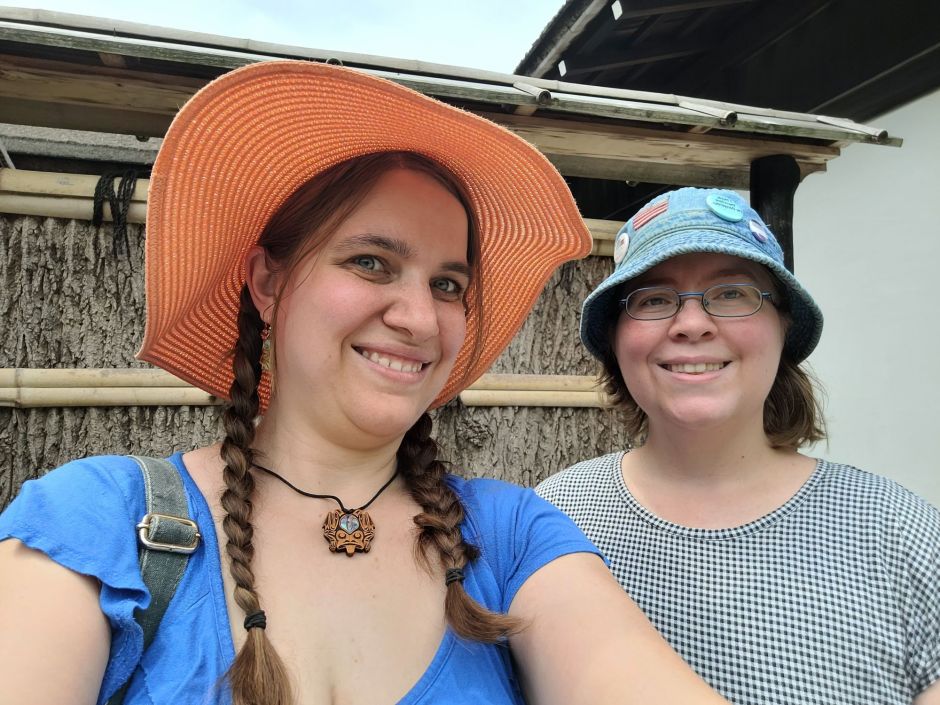
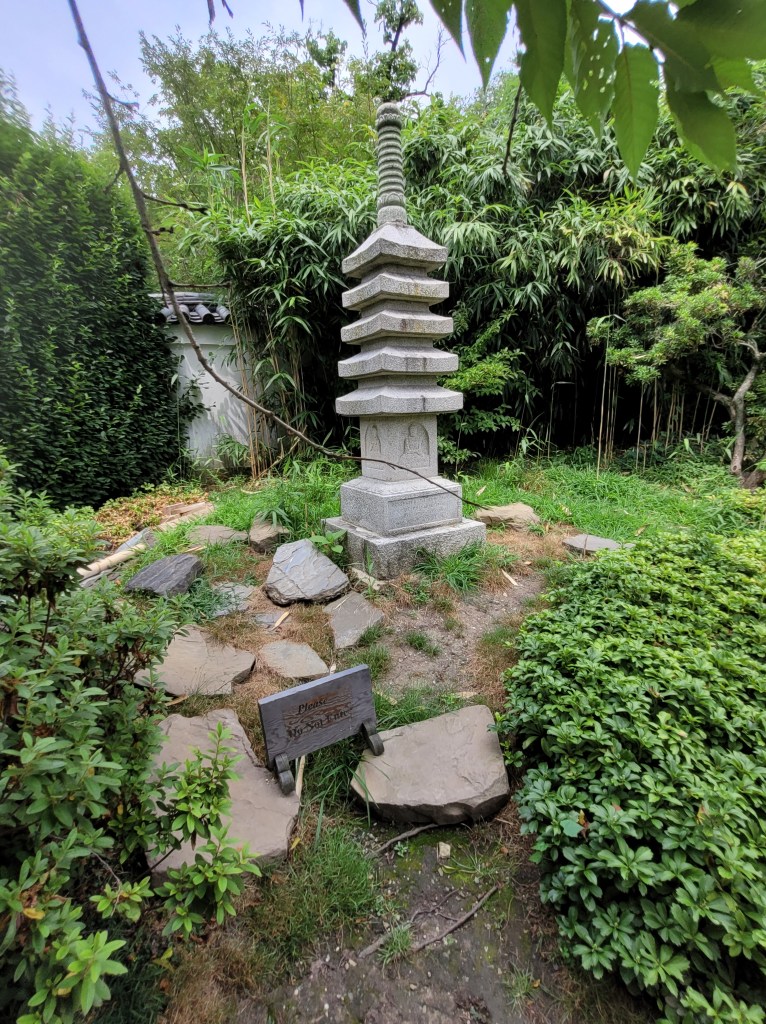
In the heat of the summer, my sister and I explored the small garden which encircles the house. We took a moment to pause by the Buddha statue, littered with small offerings and tucked away among the bamboo. We sat in quiet reflection watching the lazy circles of the koi fish which were only interrupted when a tourist decided to feed them. The noise of the nearby city melted away and one could almost believe that we had stepped through a portal to the other side of the world.
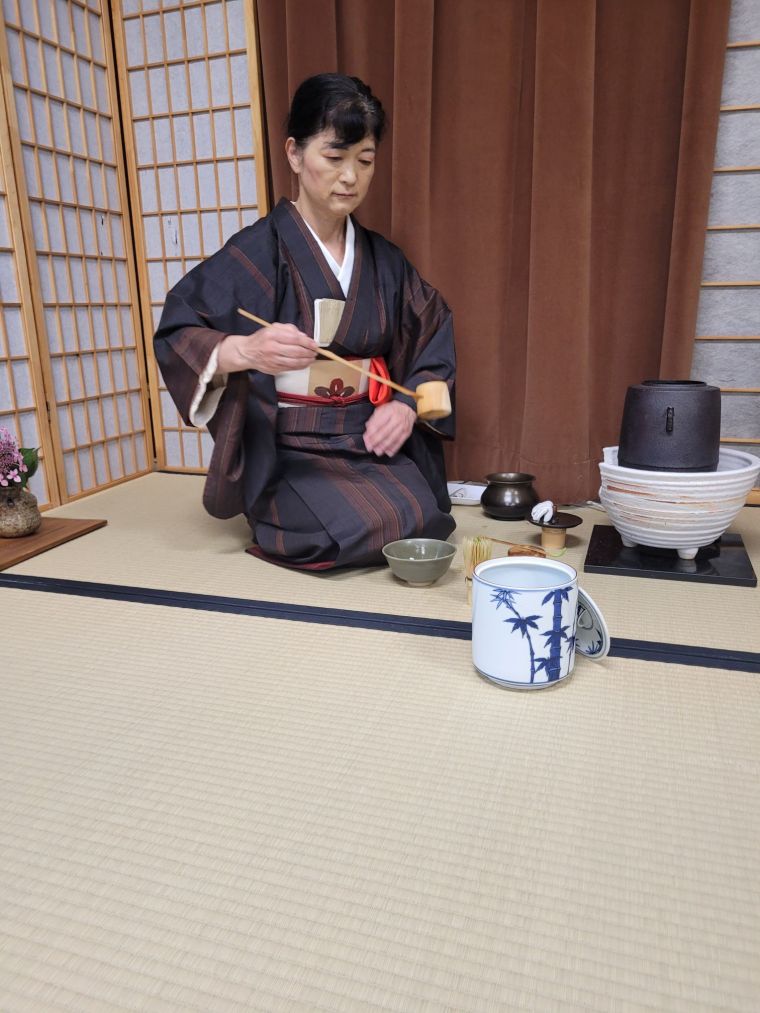
Soon we were invited to sit for tea. A woman dressed in a beautiful kimono came out to prepare the tea for us. While she began to prepare the tea. The male host graciously explained the “ceremony” as not a ceremony but more a set of expectations of manners that one should adhere to when invited to a formal tea in Japan. I suppose in truth, it was no more a “ceremony” than a proper English tea though perhaps the rules were a bit more structured to give the illusion of ceremony or ritual. One could make arguments either way – but he was speaking as a Japanese person and he indicated that it wasn’t a ceremony persay, so I am going to believe him as the expert in his own culture.
We were instructed that we would be expected to admire the carefully chosen decorations such as the scroll. He explained the symbolism of the arrangement of the flower. As the woman began to prepare the tea he explained the different instruments and tools that she was using the small white cloth, the bamboo whisk, the scoop, tea powder and the metal pot to heat the water.
First, the hostess brings in all the tools necessary for the tea preparation and then begins cleansing the utensils. Then she carefully places in the powder and hot water into the cup and whisks it expertly into a perfectly foamed tea. The cups of tea were passed around to the various guests and our male host continued his lesson.
We were instructed in how to pick up our cups, turn it the proper 90 degrees and to take slow sips. He explained that we would be expected to admire the craftsmanship of the cups and to express appreciation for everything the host had done for us.
The tea made from the matcha powder had almost a soft, velvety texture in my mouth. It was a bit more potent than a typical green tea, but lacked the harsh bitterness that the black teas can have. Despite the heat of the day the hot tea was refreshing. I enjoyed the texture of the cup in my hand and took in the smell of the tea.
We were also given a sweet to enjoy along with the tea. I felt quite terrible as the host had gone through great trouble to prepare the sweets and it had a jello like substance to it. Unfortunately, I have a sensory issue with jello as it makes me gag. I graciously accepted it and forced it down as I did not wish to offend her by refusing. However, I may still have offended her with my face. It did taste delicious, it was the texture of the jello that made it difficult to swallow.
Despite my potential faux-pas, it was a delightful time and dream come true and the following year, I was surprised to find myself once again at a Japanese Tea Ceremony. This time armed with previous knowledge and in a more intimate though less peaceful setting.
Each year, there is an annual tea festival in my state. As previously stated, I am a bit obsessed with tea. Together my sister, myself and my mom journeyed to a small town only an hour and a half away from home to a cozy tea shop tucked away along the main street. Behind the unassuming little tea house is a beautiful hidden garden which is where the highlights of the festival take place. Unfortunately for us, the day was quite wet, necessitating for much of the festival to be moved to the inside of a nearby church. This meant that the church basement was crowded, loud and somewhat uncomfortable.
So it may surprise you to hear that within the noise and the crowd, I stumbled across an oasis of peace and zen, a small tea ceremony. A woman sat on the stage, her small tea house set up and invited you to sit. My sister and I eagerly took our seats in anticipation having so thoroughly enjoyed our last tea ceremony and my mother followed close behind. With a small polite bow and a tiny smile tugging on the woman’s lips, the ceremony began. Do not ask me what magic spell the woman wove, I only know that under her expert care, the crowd disappeared from my mind. For a small window of time, we were transported out of the world and into a quiet pocket of serenity. We took our time sipping the tea and making conversation. As expected, my sister and I expressed admiration for the cups and remarked on her beautiful display. We enjoyed the sweet treat offered (thankfully nothing gelatin, so I did not have to repeat my unfortunate behavior of last time!) We complimented her and thanked her for her time and consideration both verbally and with a small donation to help support the tea house in Philadelphia. All too soon, we found ourselves back in the crowded basement, but I shall always remember the spell that such skill can weave. That is after all part of the point of the tea ceremony, to approach the act of drinking tea with a mindfulness; to transform the mundane into an extraordinary art that allows the participants to enter into a calm space. Tea, dear reader, really can be magic.
How can you participate in a tea ceremony?
If you live within a reasonable distance to Philadelphia, then you can buy tickets to the Shofu Teahouse and for an additional cost, participate in their tea ceremony. You can also check out the PA Tea Festival as the teahouse typically sends a representative to perform small ceremonies for the guests of the festival.
If not, then google is as always, your friend. See if there are any Japanese cultural clubs or organizations in your area. They may offer classes or demonstrations to the public.
A word of caution, do not join a cultural organization only to check off something off your list; someone else’s culture is not your personal playground. As with any cross-cultural experience it should be done with genuine curiosity and humility. The tea ceremonies I attended were extended by invitation to the general public. I did my best to participate with respect and to be a student of their culture.
We live in a right now world. We have amazon next day delivery. We have Netflix to stream movies directly to us. We can download our videogames off steam. Instantly find the answer using google. There are few things in life that we have to wait for which fuels our desire for instant gratification. Even a lot of our bucket list items are intended for an afternoon or a week. We spent the week backpacking through a European country, cross it off the list. It may have required some forethought and planning, but it was still done relatively quickly. But what about those things that require a long time, like learning a language or losing a lot weight? How about mastering a skill like blacksmithing or an instrument?
Learn German in 90 days! As someone who took it for 8 years of her life and spent 5 months in the country speaking it, the book is a failure. It wasn’t even useful as a review of the language after not speaking it for nearly 10 years. Get massive biceps gains in just one day with this crazy method! I had nothing to lose but a day, my biceps were sore. They did not grow massively, I assure you. Fad diets and diet pills are probably the worst of these items because not only do they not work in the long run, they can be incredibly damaging. They do not help you keep the weight off and may impact your health in the long term to make managing weight even more difficult than before.
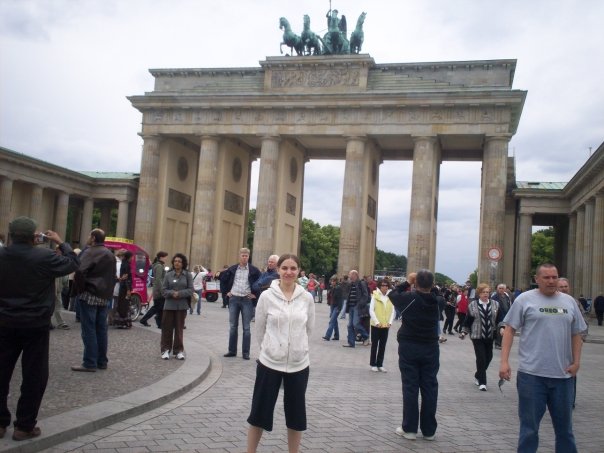
At the Brandenburg Gate in Berlin. Learning German wasn’t done in a day, but years.
Some of our goals and experiences are going to be things we have to do for the long haul. You want to learn a skill and not just try a skill, you’re going to have to put in the time, effort and sometimes expense to do so. I could do the free version of duolingo but after 5 mistakes, I would either have to wait hours for the hearts to recharge or purchase more hearts. I may as well pay for the monthly plan to help me achieve my language learning goals as I am reviewing German and learning Spanish. I’ve been at it for almost a year now and my German is almost back to where it was at the end of college, and my Spanish is still very basic. Granted, I only spend about 15 minutes a day on either language so because I don’t put in my time, my results aren’t as fast.
If I truly wanted to learn how to forge weapons, I would need to go weekly to the forge, buy my own steel and work hard to develop the skills necessary to make beautiful weapons. Heck if I really wanted to learn how to do it, I would learn smelting as well to master the entire process. Not only would this require time, it would require me to sacrifice other things as well. One can either be a jack of all trades or a master of one. If I spent my time at the forge, I probably wouldn’t have time to devote to my violin. My choosing the violin, I am saying no to many other activities that might fill my time. I’m not drawing or taking photographs. I’m not learning computer programming. Pursuits that I have at times toyed with but ultimately did not devote myself to.
Sometimes we dabble in things, we may for instance take a six of twelve week course in photography or ceramics. We may take a single lesson in glassblowing or falconry. We know that these things will not confer onto us any modicum of true skill, but the taste is enough to satisfy. These are another form of “good enough” which I discussed in another post.
However, for something we truly want to master. It requires something we have seemingly precious little of, time. One cannot become fluent in a language with a workshop or a twelve week class. It took me nearly eight years to become conversational in German and that was with semi-daily practice as I took it in both High School and college. It became quite stagnant with disuse. For one to be able to say one is fluent in a language it requires daily practice and use or else the most you will be able to say is that at one time you were fluent, but no longer. Oh it comes back quickly enough when you’re thrown in a situation requiring the language, but you are clumsy and stupid with it, the rules have gotten all muddled up in your brain and really why did the ancients insist on such an obtuse grammatical rule as changing the article based on the case? Why can’t the German “the” be, “Der, die, das, den, dem, or des”?
Taking a glass blowing class: To become proficient would takes weeks, to master would take years.
I encourage you to be judicious with the things you pick and not to overindulge in your ideas of what could be. I devote myself to just a few daily pursuits because frankly, I am a busy person. I haven’t the time to do much else. I have carefully chosen a few things that I want to do well that speak to me personally more than other activities and rarely skip on doing them. Attempting to cram in more items would mean not doing any of them all that well and I may as well not bother with more than the occasional workshop or short course on the subject.
Now dear reader, you will not be able to become a multilingual, black belt in karate, computer engineer, doctor, guitar player, chess grandmaster, and astronaut, not unless you suddenly come into a lot of wealth and find yourself with both the time, discipline, coaches and tutors to achieve such a thing. Even then I would imagine, it would take a good ten years or so to achieve any of that. If you are not willing to put in the time and effort, it would be best to eliminate the mastery of the thing and go with simply trying the thing instead. There is nothing wrong with that and no shame in the decision. Some people are meant to be jacks-of-all-trades and masters-of-none and there are those who are meant to master one thing and be amazing at it. This is what you must consider dear reader. There are things that you want to accomplish that will not be done on a weekend or in two or three months. They may be life long pursuits that require daily practice to truly achieve the things you want to achieve with them. They will require you to give up other items in order to make room for them. By all means pick that which gives you joy and makes your heart sing. The journey will be long, frustrating and trying, but the reward will be sweet.
















 Budget Bliss: Bucket List