Why even have a bucket list at all? Carpe Diem!

Some people may rightly wonder, why have a “bucket list”? After all a bucket list is all the things you want to do before you “kick the bucket” (die) and unless you’re actively dying, why bother? Don’t you have your whole life ahead of you? Some may think it even arrogant or foolhardy to bother focusing on all these things instead of what’s right in front of them, the job, the house/apartment, the family, etc. You may even be accused of living a “check the box life” of only doing things on your bucket list to “check them off” instead of experiencing them or as social currency badges “look at me, I’m so cool!”. Others may look at it as a hedonistic form of self-aggrandizement. That certainly can be the case if a bucket list isn’t approached correctly. However, it isn’t about the thing itself, but rather how you use it.

Pulling from positive psychology, it’s about trying to make life memorable and perhaps, even meaningful. In fact, some experts theorize that without peaks (i.e. “grand” events) our memories are fuzzy messes. There’s some research to suggest that accomplishing bucket list items helps set memories. Most adults have pretty good memories of their childhood and early adulthood. Those times are often marked by clear beginnings and endings, the start of school, the field trips, the graduations. Once adult life hits and it’s the same day in day out stuff, you begin to find yourself losing track of the years. It goes by in a flash, ten years feel life five. It isn’t just that it’s a smaller percentage of your life. There’s something to suggest that when you were younger there were lots of new and novel things going on to make time “stand out” without novel “adventures” your adult life is just a smear of work with the occasional night out. Since beginning my bucket list journey, time has gotten back some of its meaning.

A Bucket List also just keeps life exciting, after all who would want to live a life without some peaks? It helps bring a sense of fulfillment, gratitude and awe about the world. Keeping an adventurous spirit can lead to all sorts of wonderful experiences. It can also get you out of a “slump”. If my only “bucket list” item was to go to Iceland and see the Northern Lights, I might overlook all the amazing experiences I was having right here and be perhaps a bit depressed by not accomplishing this life long goal. By looking around me for fun experiences right nearby, I have had so many amazing days and done so many cool things that I would have never done otherwise. I still have my bigger items, but I’m not longing for something that might never come. Instead, I’m living right now.

Photo by Suzy Hazelwood on Pexels.com

Bucket lists can help set goals which can motivate us to accomplish things and when goals are specific they are the most motivating. These are specific, concrete goals and by having a bucket list there semi-looming the background it can motivate you to actually go forth and conquer! A bucket list inherently reminds you that your life is short, shouldn’t you be going and making the most of it? A budget bucket list approach reminds you that life is short, shouldn’t you be looking around yourself to live right now instead of once every three to four years for maybe a week if you’re lucky? 

Bucket lists can be useful on your journey of self-discovery, to assess values and understand what you truly want out of life. Henry Theoreau encourages us to suck the marrow from life and to live deliberately. A bucket list can help you reflect on what that means for you on an individual basis. How will you live deliberately? What will give you joy? What things are important to you? How do you want to spend your time? Scrolling on a phone, looking at all these people “living” as they sell you stuff  you don’t even use because you’re spending all your time on a phone? Seriously, what’s the point of even having a house if your world is a couch and a screen? My bucket list are things that are meaningful to me, that reflect my interests and personality. I spend my free time on the things that matter: my cats, my dog, my books, my violin, my garden, my friends, my family and the adventures big or small with those that I love and care about. 

Now, this other piece, I will say with a BIG grain of salt as I’m not, as of this writing, totally “sold” on the idea. However, there is this theory that has been making the rounds for almost a century (perhaps longer) called “The Law of Attraction”. Its most basic premise is that like attracts like. Good vibes lead to good things, bad vibes lead to negative outcomes. So if you want to be rich, you have to put yourself in a “rich” state to “attract” wealth. Often people will use things like vision boards, gratitude journals, and positive affirmations in a bid to have the universe respond in a miraculous way to help them obtain the things they are trying to attract. They will also try and look for positives in a given situation, identify negative thinking and work to reframe events in a positive way. That is the most basic explanation and if you think this is a completely looney idea, you’re not the only one. 

Photo by Matheus Bertelli on Pexels.com

Surprisingly, many successful people from past presidents, to movie stars, to silicone valley entrepreneurs all swear by this “law”. These are smart, successful people not some guy living in a garage with a tinfoil hat against the alien invasion. There is even some limited support of the theory in things like positive psychology. We know that visualization of goals helps increase performance. Many top athletes will visualize their games ahead of time and see positive results. So there does seem to be some truth to the idea. If we consider that luck is opportunity + preparation, then we can see how something like the law of attraction may be useful, even if it’s not actually “attracting” anything. 

Consider the following, someone who buys into the law of attraction wants to become a professional football player. He may practice extra hard, he may visualize his plays and he is on the lookout for potential opportunities. He may hear through the grapevine that a recruiter is coming to the second half of a game, in part because he’s paying attention. He speaks with the coach to make sure he gets a chance to play on the field during the time the recruiter will be there. He gets recruited and the rest is history. Did he attract it? Or was it something else? After all we tend to notice opportunities when we’re focused on finding them. If he hadn’t been so focused on his dream, maybe he wouldn’t have heard about the opportunity. If he hadn’t been prepared, maybe he wouldn’t have been able to make use of that opportunity. I’m sure there are many star athletes out there who are never discovered despite their visualizations and affirmations, but then again maybe they ended up using those same talents in other areas that ended up being far more rewarding than a football career.

Listening to the stories of those who believe in it, it seems hard to deny that there is something to it because they have so many “manifestations” come true for them. Personally, I’m not sure that I believe I can just get the universe to give me stuff because I’m vibing good vibes. After all, there is such a thing as a bias against negative data. We hear about 100 people being successful with the law of attraction and think there’s something to it but never hear about the 10,000 people who’ve tried it and found nothing. Regardless, I do believe in preparation and opportunity, as that is how I get most of my bucket items done. I’ve listed out the things I want to do and then I go looking for cool events nearby, creating opportunities for myself. Some people may say that I’ve “attracted” a lot of things through the law of attraction. I might say that I just kept an eye out and that keeping a bucket list keeps me motivated to keep looking. 

Either way, the principles of the law of attraction aren’t bad things to do and I don’t think they cause any harm. Call it a wager, I’m wagering that it works because if it does awesome! If it doesn’t, I haven’t lost anything by practicing gratitude, looking for the positives in a negative situation, reframing negative experiences and creating vision boards of what I want my life to look like. Positive psychology says all of these things are healthy and can improve mental health. Utilizing the bucket list can help you with these things such as cultivating gratitude for all the things you have experienced with a reverse bucket list or reframing a negative experience of missing out on a total solar eclipse in 2017 as a good thing because it meant that I ended up going to Vermont in 2024 and had an amazing experience! 
Photo by James Wheeler on Pexels.com

Lastly, whether I have a terminal disease or not, I am getting older and I won’t be around forever. My mother became disabled at 46, she’s had twenty surgeries in twenty years, she now lives with me because she can’t live on her own. Several years ago, she had bilateral clots in her lungs and she almost died. She worked herself into sickness and almost to death. Because she was living to work, she didn’t get to really do the things she wanted to do in life. Do not mistake me, she worked really hard to provide me a good life. Now, I try to help her live her own bucket list items as her health allows – in fact, most of my current long distance travel is to check things off her list. It’s the biggest reason that I go on cruises; it’s a way for her to be able to travel because they’re much more accessible for her.

Unfortunately, many of her health problems are genetic and her family has a history of illness. This means I have a high likelihood of developing similar health issues. It’s not a given, as I’m doing my best to stay healthy with diet and exercise. But I’m aware that I may very well end up with chronic illnesses that prevent me from doing as much as I would like. We never know what the future holds, we don’t know when we’re going to “kick the bucket”. I aim to live deliberately, to suck deep from the marrow of life, right where I am. Carpe diem! 
Spontaneous Experiences are Buried Treasure!

There are some things in life one cannot plan for, but when opportunity comes knocking one has to be ready to follow the white rabbit and see how far into wonderland the journey will take you. This is a short story about how I once found buried treasure. 

It was my senior year of college when one of our friends who graduated the year before decided to come back to campus for a visit. She introduced us to a new idea, geocaching. She explained the concept was that someone would put out gps coordinates of a container that participants would seek out in order to exchange goods, usually trinkets and the like. The containers had a log that one would record one’s name. One of the caches she was seeking out had a location somewhere on our campus. I wasn’t quite sure about the entire process, but it seemed like an interesting idea. Being the naturally, adventurous types myself, my roommate Ray and Laura set out to look for the cache. Keep in mind this was back in 2009 when many of us didn’t have smartphones with gps capabilities. We had a printed out map with coordinates and gumption. 

Soon we found ourselves out in the trails of our campus, looking through the undergrowth of the deciduous forest. You may think that I exaggerate when I speak about my college having a forest or trails, but the truth is, Messiah College (now Messiah University) had a rather large undeveloped section of campus called the “back 40”. It was always one of my favorite places to visit during my time there. Despite having walked on the trails many times, I had not ventured off the trails before that day; mostly because of my run in with a snake my first week on campus, but that day was not a day for cowards! Victory to the brave! 

I distinctly remember crunching through underbrush, keeping an eye out for poison ivy and snakes. I wasn’t sure what I was looking for or how I’d know if I found it, but I was determined to help my friend on her small expedition. It was around an old wooden bridge that we discovered not what we were looking for, but rather an old tin can that had been hammered shut. We checked the map and the coordinates, the tin was decidedly not the cache in question. At first, we sort of dismissed it and continued our search but to no avail. Intrigued by our discovery, though disappointed that we had not been successful in finding the cache, we headed back to our campus apartment.

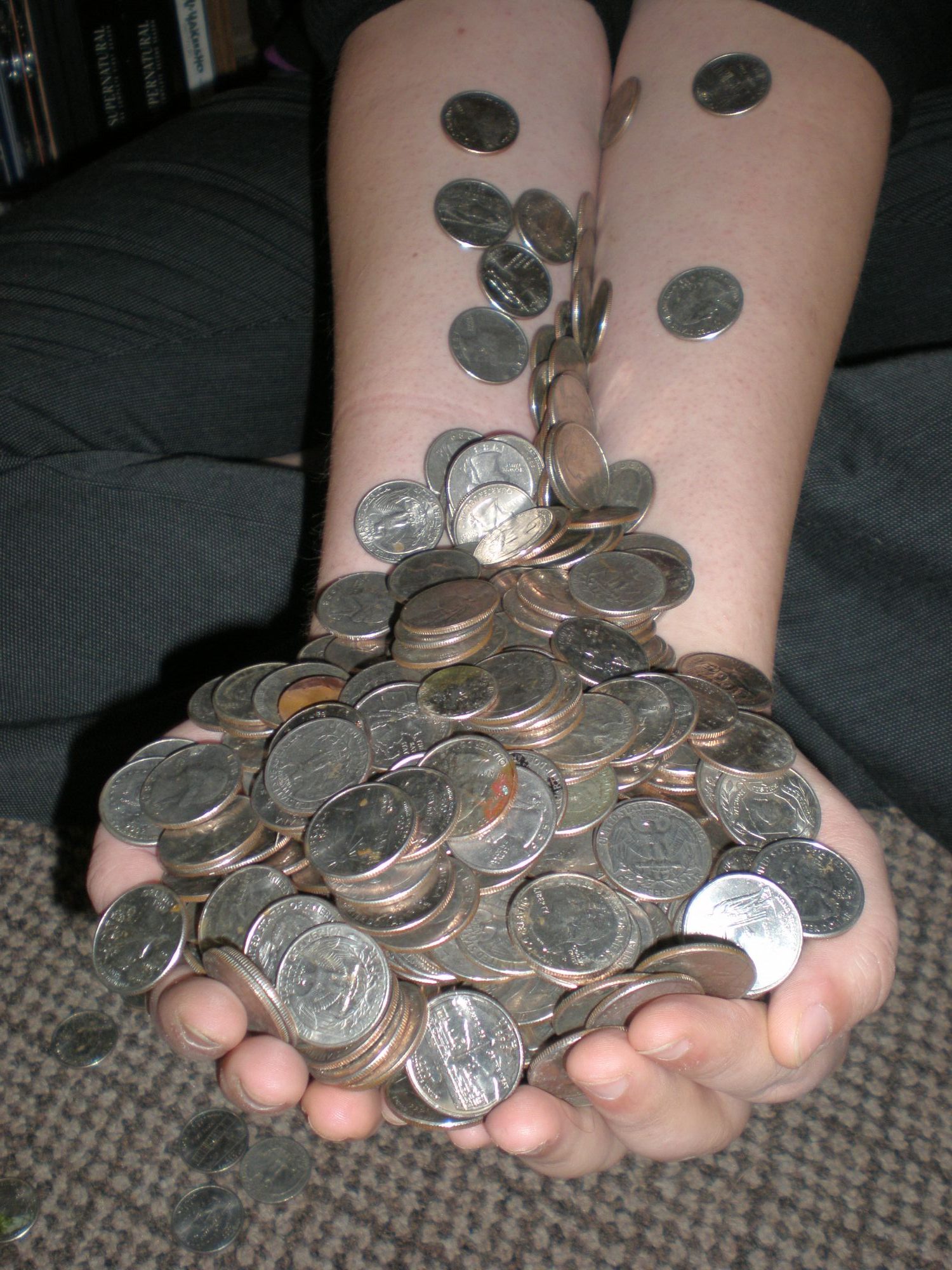
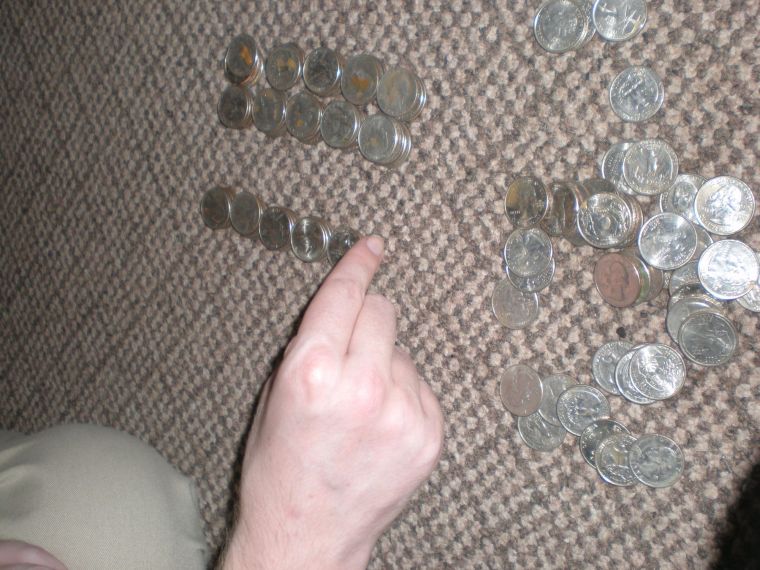
It took quite a bit of doing, but eventually we were able to pry open the can to reveal a mud filled container of something. We dumped out the contents and were surprised to find it had been filled with quarters. We immediately began counting out piles of 4 and then stacking the piles up 10 at a time. We quickly discovered we had found over $100. Buried treasure! 

I had not set out that morning to find treasure, it was a spontaneous adventure untaken on a whim. Nor was it an especially long adventure, but it was memorable. And yes, I understand that $100 is not exactly buried treasure, certainly not in today’s economy, but to three poor college students it certainly felt like treasure.  

How can you find buried treasure?

I cannot promise that you’ll find treasure if you decide to go geocaching, but there are plenty of aps out there that will allow you to participate.  

To embody the principle of this particular post, embrace spontaneity. Go on that silly adventure with your friend, you never know where it will lead or what you will find. I have lots of stories that begin with an invitation to something unexpected. I have yet to regret saying yes. Having a list and making plans is all well and good, but one should not be so bore-sighted on the current goals that one is not open to opportunities that arise. Sure you might not have $100 at the end of the day, but you will have memories made with someone dear to you which is worth far more. 

Completed: 2009

Miles from home: 0 (when counting campus as the home point)

Cost: Free

Unique Items onto Yourself

Now there are some experiences that for you are bucket list items that others may scoff at as being worthy of gracing such a list. Their reactions may be from a misunderstanding of the significance of the experience whether historically, culturally or personally or borne out of some ignorance on their part as to the value of such an activity. 

Take video games for example. Already some of  you are rolling  your eyes and dismissing the whole example – bear with me gentle readers! Video games have been considered a lesser art and base activity for many years. People scoff at the idea of e-sports as being a legitimate activity. I would say that those who are rolling your eyes have not taken a closer look at the industry or the history of other previously derided activities. 

Years ago actors and actresses were considered little better than prostitutes yet now the are celebrated for their artistic talent and skill. They hold some of the highest social status in our society which is quite the reversal. We view the cinema now as being worthy of being carefully critiqued, as equal to opera in sophistication and artistry. We may consider that some films are as important to see as some books are to read. I daresay that we will soon be considering certain video games equal in value to any great opera, play, symphony or film.

Photo by Heiner on Pexels.com

Certain sports used to be considered reserved for the lower classes mostly the competitive sports whereas the more non-competitive activities such as music and dance were reserved for the upper class. The upper class certainly had semi-competitive sports like hunting and shooting, but you’ll note that they were with few exceptions non-contact sports. After all, we wouldn’t want young Archibald the Third to get a broken nose, think of how he’d look when he presents himself to his majesty! We wouldn’t want him to look like a common thug! However, now we push our children into these contact sports and laud lofty goals of scholarships and going professional. 

These examples are to help make my point that for you, as an individual, there may be things on your list of things to achieve or experience which our culture may not value or encourage us to do. No one needs to understand your obsession with knitting and how for you a certain project may be your magnum opus. Celebrate it! Add it to your list! Maybe you want to make Challenger tier in League of Legends. Being as only .0024% of players reach Challenger, that certainly would be like making the Olympics. You don’t need to justify to anyone the amount of skill, dedication and knowledge it would take to achieve that. People who scoff at that may as well scoff at a Chess Grandmaster. Learning a programming language is just as worthy as learning a spoken language. The same can be said of creating an entire conlang.

Photo by Anton Porsche on Pexels.com

The items for you don’t even need to be that big of a deal, they could just be things you want to do for fun. Not everything on your list needs to be elevated or lofty, some things could be small or even a bit silly. For example, I would very much like to see a drive-in movie. I love nostalgic things and experiencing pieces of the past as it enriches my understanding of historical events and cultures. It’s a fun diversion and would certainly be a different way to see a film. This certainly isn’t everyone’s cup of tea, but it is mine so it’s on my list and it isn’t something I would think would grace many other people’s list.

The point is not to be afraid to celebrate your personal achievements loudly and proudly. These achievements don’t have to be meaningful to anyone else but yourself. Part of living your best life is to do it in a way that is authentic to yourself without allowing other people’s negative judgements hold you back from pursuing activities that are meaningful to you. After all, the only person who is living your life is you!

Japanese Tea Ceremony

“There is no trouble so great or grave that cannot be diminished by a nice cup of tea.”. – Bernard-Paul Heroux. 

When I was about five years old, I was obsessed with tea parties. I was first introduced to them through my mother’s own passion. She would take us to the local herb shop and the tea shop nearby to purchase quality tea and scones. At home, the water would be boiled and poured into a china pot, a timer set for the proper amount of time for brewing and then carefully poured out into the cups. It was during this time that she imparted to me the rules of tea, how to hold the cup, what order the tea should be poured out to each guest, the polite amount of sugar to add, when to add milk, how to stir it without making a ruckus. I learned the difference between afternoon tea and high tea (it’s not the same thing), that one eats the savory first then the sweets and exactly how one eats a scone properly (by breaking it apart into small bits). 

Over tea, she taught me about Victorian England and the antiques that decorated our house. She was quite fond of the late Victorian era, and I developed the same fondness. As part of my education, she bought me a tea book for my birthday. I was elated (yes, I was a strange child, I grew up to be a strange adult and I’m okay with this fact). I flipped through the pages and discovered an entirely new sort of tea, the Japanese Tea Ceremony. The book did not go into it overly much but it did allude to the sorts of things one might encounter, the special Macha tea, the whisk and the sweet that they might serve. In combination with my discovery of the Karate Kid, my love of Japanese culture was solidified and later reinforced with my introduction into anime (which I won’t get into here, other than Princess Mononoke was a definitive experience of my childhood). 

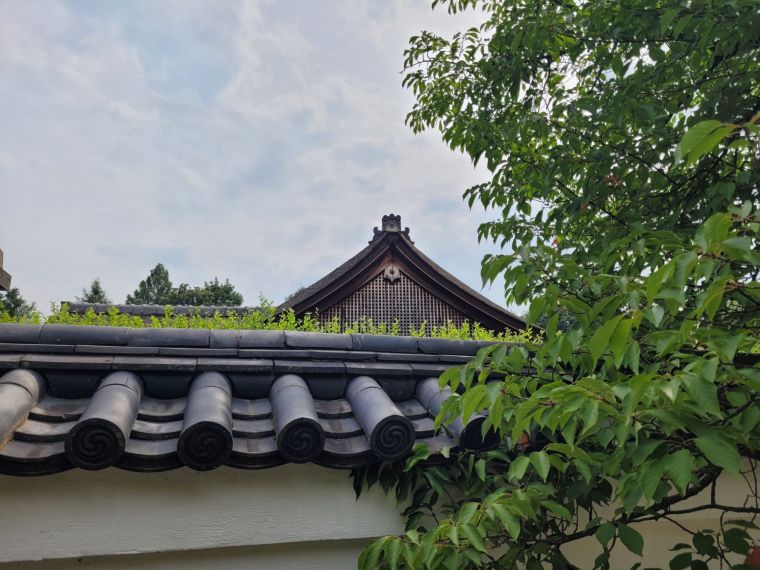
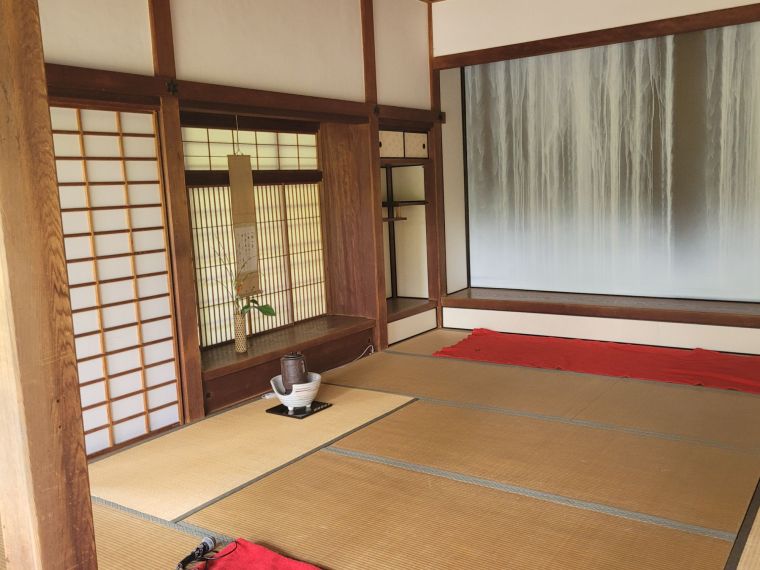
Ever since my discovery of the Japanese Tea Ceremony and all things Japan, I had wanted to experience it for myself. I got the chance in the summer of 2021, when I took the hour drive out to Shofuso Japanese Cultural Center.  The house was designed by Junzo Yoshimura as a 17th century style home. It was built in Japan in 1953 utilizing traditional techniques and then shipped to New York as part of the Museum of Modern art. It found its home, however, in West Fairmount Park in 1958 where it has graced the greater Philadelphia area ever since nestled in a beautiful Japanese Garden. It includes a pond garden with a waterfall, island, koi fish, traditional tea house and bathhouse.  

Walking through its gates, one could easily forget that one has not in fact hopped on a plane to the middle of Japan. Every corner of the building is a beautiful work of art, carefully tended and maintained. What delighted me was the dedication to keeping the building authentically Japanese. Unlike in America when something like a floorboard has some sort of damage or rot, the Japanese do not uproot the whole floorboard and replace it. Instead they cut around the damaged section and then fill it in like a puzzle piece. There was a sort of beauty in keeping the story of time rather than a focus on perfection. Flaws were a natural outgrowth of a house in use and there was a sort of artistry in the repair. 

Men and women in kimonos graciously answered questions about the house and pointed out its secrets. They informed us that the murals of the house were donated by an artist in 2007 and were inspired by the waterfalls. They told us about the hinoki bark root (the only one outside of Japan) and how it took 1.4 million dollars to repair it back in 1999. They were excellent hosts whose presence engendered a sort of respectful quiet in the guests. It is not that we did not speak, only more in hushed whispers as to not disturb the peaceful atmosphere. It is a house that invites calm reflection and relaxation rather than exuberant outbursts. 

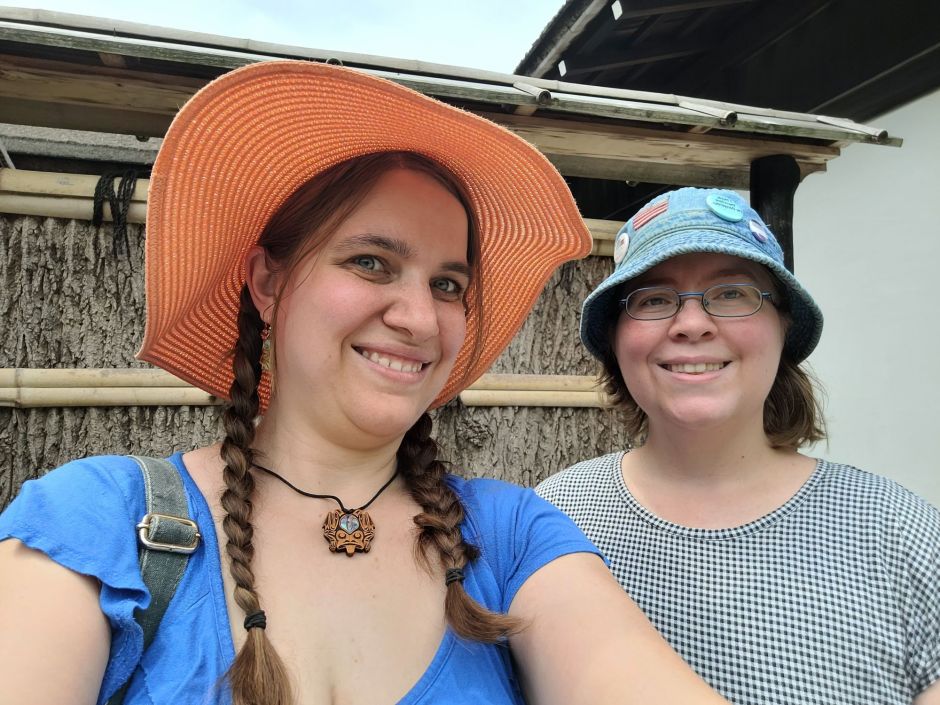
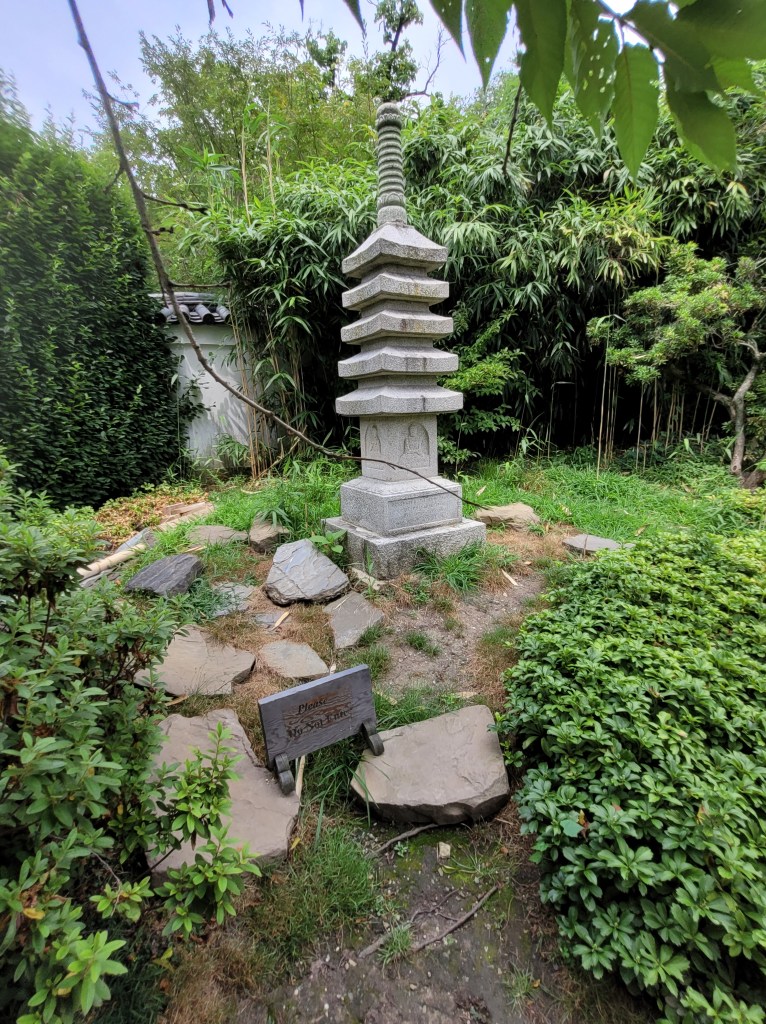
In the heat of the summer, my sister and I explored the small garden which encircles the house. We took a moment to pause by the Buddha statue, littered with small offerings and tucked away among the bamboo. We sat in quiet reflection watching the lazy circles of the koi fish which were only interrupted when a tourist decided to feed them. The noise of the nearby city melted away and one could almost believe that we had stepped through a portal to the other side of the world. 

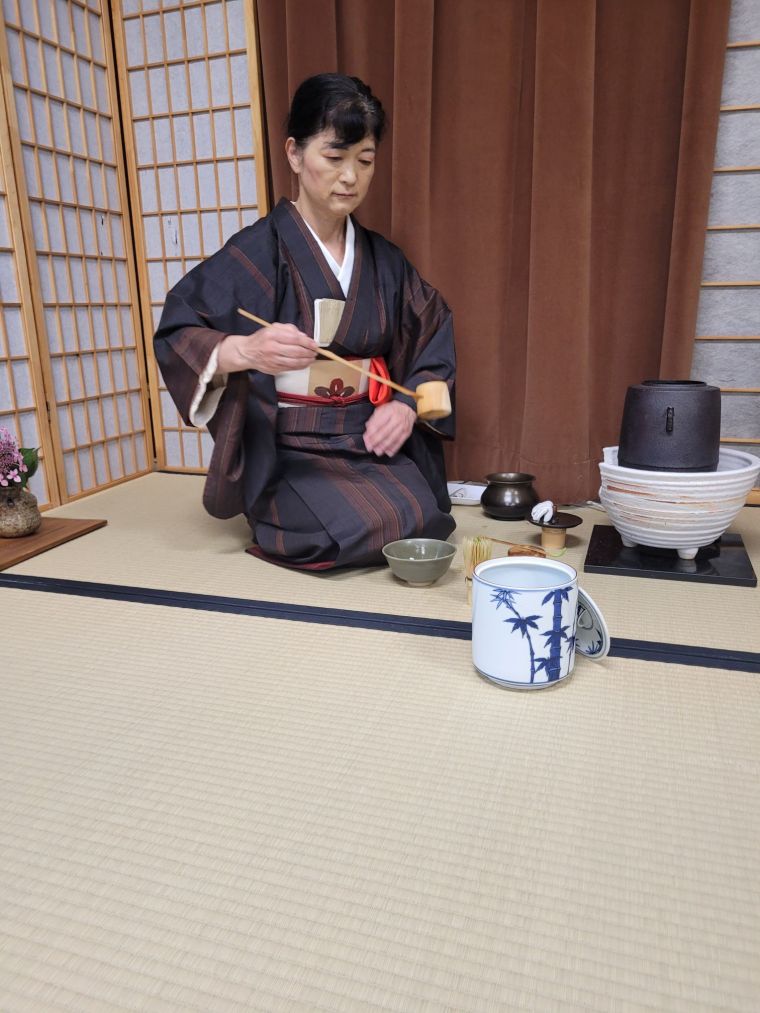
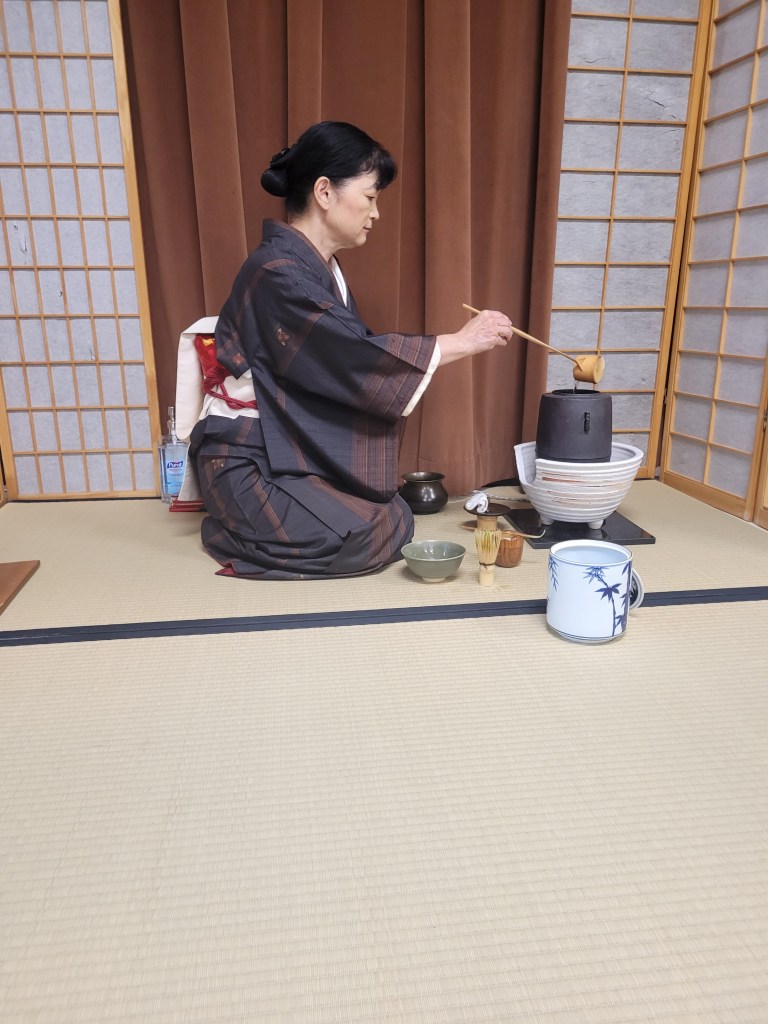
Soon we were invited to sit for tea. A woman dressed in a beautiful kimono came out to prepare the tea for us. While she began to prepare the tea. The male host graciously explained the “ceremony” as not a ceremony but more a set of expectations of manners that one should adhere to when invited to a formal tea in Japan. I suppose in truth, it was no more a “ceremony” than a proper English tea though perhaps the rules were a bit more structured to give the illusion of ceremony or ritual. One could make arguments either way – but he was speaking as a Japanese person and he indicated that it wasn’t a ceremony persay, so I am going to believe him as the expert in his own culture. 

We were instructed that we would be expected to admire the carefully chosen decorations such as the scroll. He explained the symbolism of the arrangement of the flower. As the woman began to prepare the tea he explained the different instruments and tools that she was using the small white cloth, the bamboo whisk, the scoop, tea powder and the metal pot to heat the water. 

First, the hostess brings in all the tools necessary for the tea preparation and then begins cleansing the utensils. Then she carefully places in the powder and hot water into the cup and whisks it expertly into a perfectly foamed tea. The cups of tea were passed around to the various guests and our male host continued his lesson. 

We were instructed in how to pick up our cups, turn it the proper 90 degrees and to take slow sips. He explained that we would be expected to admire the craftsmanship of the cups and to express appreciation for everything the host had done for us.

The tea made from the matcha powder had almost a soft, velvety texture in my mouth. It was a bit more potent than a typical green tea, but lacked the harsh bitterness that the black teas can have. Despite the heat of the day the hot tea was refreshing. I enjoyed the texture of the cup in my hand and took in the smell of the tea. 

We were also given a sweet to enjoy along with the tea. I felt quite terrible as the host had gone through great trouble to prepare the sweets and it had a jello like substance to it. Unfortunately, I have a sensory issue with jello as it makes me gag. I graciously accepted it and forced it down as I did not wish to offend her by refusing. However, I may still have offended her with my face. It did taste delicious, it was the texture of the jello that made it difficult to swallow. 

Despite my potential faux-pas, it was a delightful time and dream come true and the following year, I was surprised to find myself once again at a Japanese Tea Ceremony. This time armed with previous knowledge and in a more intimate though less peaceful setting. 

Each year, there is an annual tea festival in my state. As previously stated, I am a bit obsessed with tea. Together my sister, myself and my mom journeyed to a small town only an hour and a half away from home to a cozy tea shop tucked away along the main street. Behind the unassuming little tea house is a beautiful hidden garden which is where the highlights of the festival take place. Unfortunately for us, the day was quite wet, necessitating for much of the festival to be moved to the inside of a nearby church. This meant that the church basement was crowded, loud and somewhat uncomfortable. 

So it may surprise you to hear that within the noise and the crowd, I stumbled across an oasis of peace and zen, a small tea ceremony. A woman sat on the stage, her small tea house set up and invited you to sit. My sister and I eagerly took our seats in anticipation having so thoroughly enjoyed our last tea ceremony and my mother followed close behind. With a small polite bow and a tiny smile tugging on the woman’s lips, the ceremony began. Do not ask me what magic spell the woman wove, I only know that under her expert care, the crowd disappeared from my mind. For a small window of time, we were transported out of the world and into a quiet pocket of serenity. We took our time sipping the tea and making conversation. As expected, my sister and I expressed admiration for the cups and remarked on her beautiful display. We enjoyed the sweet treat offered (thankfully nothing gelatin, so I did not have to repeat my unfortunate behavior of last time!) We complimented her and thanked her for her time and consideration both verbally and with a small donation to help support the tea house in Philadelphia. All too soon, we found ourselves back in the crowded basement, but I shall always remember the spell that such skill can weave. That is after all part of the point of the tea ceremony, to approach the act of drinking tea with a mindfulness; to transform the mundane into an extraordinary art that allows the participants to enter into a calm space. Tea, dear reader, really can be magic. 

How can you participate in a tea ceremony?

If you live within a reasonable distance to Philadelphia, then you can buy tickets to the Shofu Teahouse and for an additional cost, participate in their tea ceremony. You can also check out the PA Tea Festival as the teahouse typically sends a representative to perform small ceremonies for the guests of the festival. 

If not, then google is as always, your friend. See if there are any Japanese cultural clubs or organizations in your area. They may offer classes or demonstrations to the public.

A word of caution, do not join a cultural organization only to check off something off your list; someone else’s culture is not your personal playground. As with any cross-cultural experience it should be done with genuine curiosity and humility. The tea ceremonies I attended were extended by invitation to the general public. I did my best to participate with respect and to be a student of their culture.   

The Long Haul 

We live in a right now world. We have amazon next day delivery. We have Netflix to stream movies directly to us. We can download our videogames off steam. Instantly find the answer using google. There are few things in life that we have to wait for which fuels our desire for instant gratification. Even a lot of our bucket list items are intended for an afternoon or a week. We spent the week backpacking through a European country, cross it off the list. It may have required some forethought and planning, but it was still done relatively quickly. But what about those things that require a long time, like learning a language or losing a lot weight? How about mastering a skill like blacksmithing or an instrument?

Learn German in 90 days! As someone who took it for 8 years of her life and spent 5 months in the country speaking it, the book is a failure. It wasn’t even useful as a review of the language after not speaking it for nearly 10 years. Get massive biceps gains in just one day with this crazy method! I had nothing to lose but a day, my biceps were sore. They did not grow massively, I assure you. Fad diets and diet pills are probably the worst of these items because not only do they not work in the long run, they can be incredibly damaging. They do not help you keep the weight off and may impact your health in the long term to make managing weight even more difficult than before. 

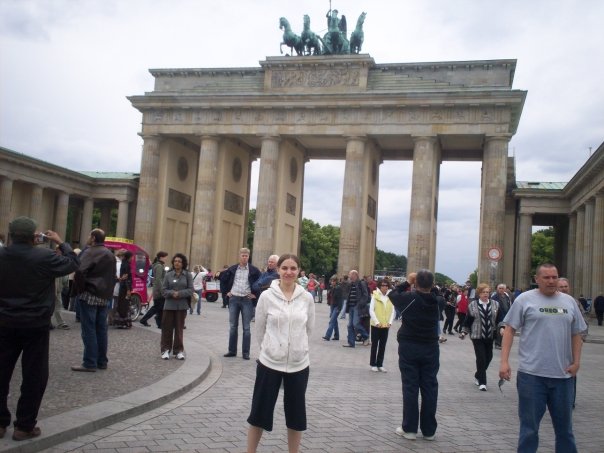
At the Brandenburg Gate in Berlin. Learning German wasn’t done in a day, but years.

Some of our goals and experiences are going to be things we have to do for the long haul. You want to learn a skill and not just try a skill, you’re going to have to put in the time, effort and sometimes expense to do so. I could do the free version of duolingo but after 5 mistakes, I would either have to wait hours for the hearts to recharge or purchase more hearts. I may as well pay for the monthly plan to help me achieve my language learning goals as I am reviewing German and learning Spanish. I’ve been at it for almost a year now and my German is almost back to where it was at the end of college, and my Spanish is still very basic. Granted, I only spend about 15 minutes a day on either language so because I don’t put in my time, my results aren’t as fast.

If I truly wanted to learn how to forge weapons, I would need to go weekly to the forge, buy my own steel and work hard to develop the skills necessary to make beautiful weapons. Heck if I really wanted to learn how to do it, I would learn smelting as well to master the entire process. Not only would this require time, it would require me to sacrifice other things as well. One can either be a jack of all trades or a master of one. If I spent my time at the forge, I probably wouldn’t have time to devote to my violin. My choosing the violin, I am saying no to many other activities that might fill my time. I’m not drawing or taking photographs. I’m not learning computer programming. Pursuits that I have at times toyed with but ultimately did not devote myself to. 

Sometimes we dabble in things, we may for instance take a six of twelve week course in photography or ceramics. We may take a single lesson in glassblowing or falconry. We know that these things will not confer onto us any modicum of true skill, but the taste is enough to satisfy. These are another form of “good enough” which I discussed in another post. 

However, for something we truly want to master. It requires something we have seemingly precious little of, time. One cannot become fluent in a language with a workshop or a twelve week class. It took me nearly eight years to become conversational in German and that was with semi-daily practice as I took it in both High School and college. It became quite stagnant with disuse. For one to be able to say one is fluent in a language it requires daily practice and use or else the most you will be able to say is that at one time you were fluent, but no longer. Oh it comes back quickly enough when you’re thrown in a situation requiring the language, but you are clumsy and stupid with it, the rules have gotten all muddled up in your brain and really why did the ancients insist on such an obtuse grammatical rule as changing the article based on the case? Why can’t the German “the” be, “Der, die, das, den, dem, or des”?

Taking a glass blowing class: To become proficient would takes weeks, to master would take years.

I encourage you to be judicious with the things you pick and not to overindulge in your ideas of what could be. I devote myself to just a few daily pursuits because frankly, I am a busy person. I haven’t the time to do much else. I have carefully chosen a few things that I want to do well that speak to me personally more than other activities and rarely skip on doing them. Attempting to cram in more items would mean not doing any of them all that well and I may as well not bother with more than the occasional workshop or short course on the subject. 

Now dear reader, you will not be able to become a multilingual, black belt in karate, computer engineer, doctor, guitar player, chess grandmaster, and astronaut, not unless you suddenly come into a lot of wealth and find yourself with both the time, discipline, coaches and tutors to achieve such a thing. Even then I would imagine, it would take a good ten years or so to achieve any of that. If you are not willing to put in the time and effort, it would be best to eliminate the mastery of the thing and go with simply trying the thing instead. There is nothing wrong with that and no shame in the decision. Some people are meant to be jacks-of-all-trades and masters-of-none and there are those who are meant to master one thing and be amazing at it. This is what you must consider dear reader. There are things that you want to accomplish that will not be done on a weekend or in two or three months. They may be life long pursuits that require daily practice to truly achieve the things you want to achieve with them. They will require you to give up other items in order to make room for them. By all means pick that which gives you joy and makes your heart sing. The journey will be long, frustrating and trying, but the reward will be sweet. 

Learn an Instrument: Rediscovering a Passion

One of the definitive moments in my life is sitting on the couch staring at my mother’s boombox in absolute rapture as Pacabel’s Canon in D played. I was in love. It was without a doubt one of the most beautiful things I had ever heard, the violin. It was not simply an instrument, oh no, this was the very voice of my being. If I lose my ability to speak, let me only speak in notes and songs. If someone gave me a choice between becoming deaf or blind, I would pick blindness every time, do not deny me music, it is the very sustenance of my soul. 

I unfortunately would have to wait several years before being offered the opportunity to play, but in 3rd grade our school offered us music lessons. I was absolutely elated to be able to pick the violin. I would have no other instruments. But oh, how I struggled to master it. The violin is a very easy instrument in principle. After all, how hard can it be? You have four strings, you press down your fingers to shorten said strings in order to achieve the different notes and to produce the sound you move a bow across. Other instruments require learning combinations of key presses to produce the sounds and controlling your breath to go up and down octaves. Surely those are much harder to master. 

It is in fact considered one of the most difficult instruments to learn. In part because it is such an easy thing in principle it lends itself to having a wide variety of producible sounds and variations of intonation. Additionally, it has no guides; each note (with exception of the open strings) must be produced flawlessly with little more than muscle memory and your ear to guide you as you slide your hand up and down the neck of the violin.  The spacing between your fingers varies depending on the “position” you’re in, the higher the position the closer you must space your fingers to produce the correct notes in tune. You are constantly adjusting with little more than a prayer. 

There are no words to describe the thrill of playing with mastery, effortlessly hitting the notes, cheekily moving your bow in just the right way to go from quiet to loud, hitting the bow catch to enhance the power behind the stroke, connecting the notes together in a slur or punctuating them with a staccato. The violin may be one of the most challenging, but it is also one of the most rewarding because it allows you to have so much expression and creativity with the interpretation of a piece of music. 

This isn’t to knock other instruments or to write a post about the superiority of one instrument over the other. For me, the violin is the best instrument it speaks to me in a way no other instrument or creative expression can. Which is really what this bucket list item is for me. It’s about utilizing the violin to express myself in an entirely new way. Playing is a simple joy. 

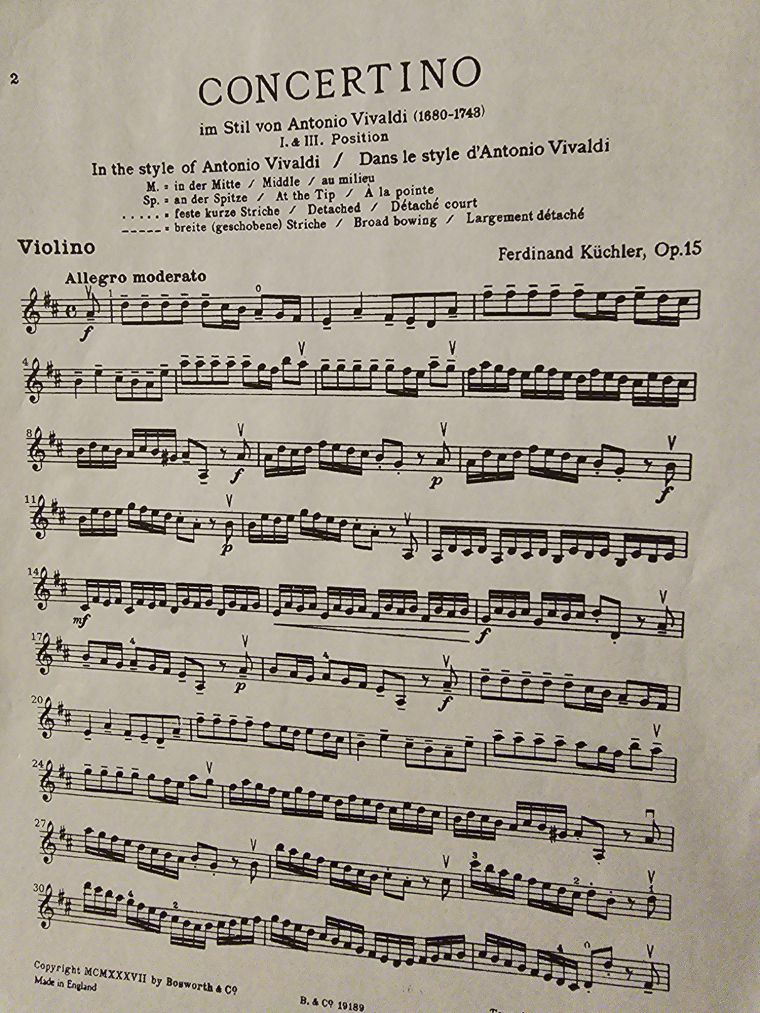
My collection of intermediate pieces that I have chosen to master over the next year or so

Sadly this was not always the case. I loved the violin and my parents knew this, so they encouraged me to pursue a potential music career. For reasons, I will not fully explain; I ended up with PTSD and unfortunately a secondary anxiety disorder. This greatly negatively impacted my ability to play. From a psychological perspective, my voice was silenced. I tried to hold on to it but the more I fought to keep my voice the worse it got and the worse my playing got. After high school, having failed my auditions for acceptance into a music program, I put the violin away. I kept telling myself that it was only temporary and I would practice again soon. It wasn’t until nearly 17 years later that I picked it back up again. 

I can’t say exactly what makes it different this time, only that I am playing 100% for myself. It isn’t to perform or to achieve anything. It was remembering why I loved playing in the first place, to reclaim that joy rather than focusing on achievement. Not having that pressure to compete has made going back to music like falling in love all over again. I think sometimes when we start to push ourselves into making our passions a profession or career or business it robs us of that joy. I probably wouldn’t have lost my music for 17 years if my violin playing had only been for joy as it is now. Granted the PTSD and secondary anxiety didn’t help but I wouldn’t have felt anxious about my playing if the playing had only been for its own sake and not my entire future. 

I cannot describe in words what it feels like to play now. Only that it feels like coming home. I approach it with a child’s enthusiasm and uncritical spirit. Mistakes are not a death sentence but a whimsical learning opportunity. I don’t mind people listening to my practice sessions, let them listen! I am in my own world once my boy hits the strings and I am in love with the violin once again. I almost never go a day without playing. It sustains me as much as food or water. A life without music was a life without color.  

Revisiting a piece I had mastered in middle school.

 I could have checked off “learn and instrument” from my reverse bucket list and continued to allow my violin to languish in the closet, but I didn’t because this wasn’t about learning to play an instrument, it was about rediscovering something that was lost and reclaiming it as my own. I wonder dear reader what creative outlets have you lost over the years? What passions have lain fallow under the guise of failure and self-doubt? What have you stopped doing because you weren’t “good enough”? What might happen if you picked it back up again? Would you rediscover a childlike wonder? Would you find yourself itching to get back to it after work? Would you find yourself refreshed in a way you haven’t been in a long time, like a desert after a rainstorm? Remember this isn’t to “turn your passion into a career”, so often that mindset was the very thing that turned you off your passion to begin with. Dear reader, you need not justify all that you do, sometimes you just love something; it brings you joy and that is the only justification that you need to pursue it 

How can you rekindle your lost passions?

If you’re like me, you may find your instrument hidden away in a closet somewhere only in need of a little TLC to get started once again. Perhaps, it requires a trip to the art store. Maybe you need to reach out to an intramural sports team.  Whatever it is, chances are you already know how to get back into it,  you just need to take the steps to do it. Even something like dance can be done by just clearing a little space in a room. After several months of play, I invested in new strings. After several more months, I am in search of a violin teacher to help coach me further.

Good Enough

There are many experiences that absolutely require “authenticity”. They require the larger cultural context of a given region, country, ethnicity, culture, etc. to be the genuine item. There are many others that don’t require much more than themselves. These are the “good enough” items that clear the bar of the Bucket List without the rest of trappings of a given thing (often those trappings require you to hop on a plane and go to a different country). 

I often work backwards to my “good enoughs”. I may find myself dreaming of going to Japan. I may picture walking through a traditional Japanese house, enjoying a tea ceremony, taking in a Japanese garden, visiting one of their Buddhist temples, strolling through the bamboo, seeing the cherry blossoms, eating their street food, and seeing demonstrations of their weaponry and armor. Upon reflection, I realized I could do almost all of these things here in America. I was able to go to the Japanese Gardens with the tea house and enjoy a tea ceremony. I went down to the annual cherry blossom festival in D.C. and enjoyed street food, weapons demonstrations, music, fashion and more. These are my “good enoughs”. I didn’t need to go to Japan in order to say that I experienced the genuine item, because I found them here.

By thinking about a given Bucket List place and considering what I wanted to get out of a trip there, I was able to then build up a list of things to find nearby. I really want to see the lavender fields in France. I found a lavender field within driving distance to go visit, the same with the sunflower fields of Italy and grape stomping. Some things may be more accessible than you might imagine. I have been consistently surprised at what’s in my own backyard and what I could potentially do.

What makes a genuine item, “genuine”? It is often up to our own ideas and definitions. There may be people who say that unless I strolled through the crowded streets of Tokyo and ordered a ramen bowl from a street vendor in Japanese, I didn’t have the real Japanese experience. Perhaps, but I tend to feel that such a view comes from self-important snobs trying to aggrandize their own experiences at the expense of trying to cheapen the experiences of others. Don’t fall for the lie that the only “genuine”, “authentic” thing has to be done in the context of the “homeland” or that the necessary cultural context to appreciate them can only be achieved in a certain location. 

When visiting the rainforest in Costa Rica, they took us into a butterfly house. The butterfly house in Hershey is just as lovely and just as amazing. Unless you are a butterfly expert, you aren’t going to notice that the ones in Hershey, PA are a mix of various tropical butterflies vs. the 100% butterflies exclusively from Costa Rica and frankly, does it matter? Don’t let your friend who is a butterfly expert ruin it for you by telling you how this species would just never be seen in the wild with this other species. It was still amazing to see the butterfly house in the rainforest, but I could have skipped the butterfly house and been perfectly fine. I did go on a small hike through the rainforest after the butterfly house to see a waterfall. For me hiking through the rainforest isn’t something that can be re-created in America. For someone else, maybe the fake rainforest at Disney World is good enough. 

It is up to you to make the decision about what constitutes as “good enough”. If it met the desired outcome of what you wanted then it is good enough and no one gets to decide what that is other than you. You are a unique individual with unique reasons for wanting to have an item on your list. What might be good enough for you isn’t good enough for someone else, but they don’t get to dictate that to you and you don’t get to dictate that to them. 

I have had a tea ceremony at the Japanese Gardens and also in the crowded, noisy basement of a church during a tea festival. Surprisingly, I enjoyed the second more because it was a more intimate affair. It speaks to her skill as a hostess that I do not really remember the crowd or the noise, only the calm and meditative nature of the ceremony. She created a space of serenity among chaos. The noise seemed to melt away as we conversed and made light conversation. I can still taste the tea on my tongue even now. Given that if I did go to Japan and schedule a tea ceremony to achieve the same level of intimacy I would have to pay a fairly high premium. For me, that is good enough and if/when I go to Japan a tea ceremony isn’t something that is going to be on my must do list. That isn’t to say I wouldn’t do one, just it’s not on my list of musts and can be sacrificed to allow me to do something else. 

In fact after meeting so many “good enough”s you may find that certain places begin to lose their appeal. For example, I have been to so many museums with egyptian artifacts that honestly, Egypt isn’t that high on my list of places to go. I would rather see the Mayan pyramids to see pyramids. When I was younger, I had a much stronger desire to see Egypt because what I really wanted to see was the artifacts. However, despite checking off so many things on my Japan list, I still want to go to Japan. For some places, my good enoughs have only enhanced my desire to go whereas for others the desire has decreased. 

Dancing with Wolves

We humans seem to have a love-hate relationship with wolves. In fairy tales and folklore, wolves are often seen as evil. It was after all the big, bad wolf that ate Little Red Riding Hood and blew down the houses of the three little pigs. Two wolves will herald the apocalypse in Norse Mythology. They were hunted to almost extinction because of their “threat” to farmers and people. Up until more recent times when every supernatural being got a sexy makeover, werewolves were considered hideous monsters. 

Yet, we know that man’s best friend came from a wolf or shared a common ancestor to the wolf. There are also folktales and myths of good wolves. The founders of Rome were raised by a she-wolf.  In Egypt, it was a wolf that separated the heavens and the earth and protected the pharaoh and his army. The Wolf-Kamey of Japan protects people from disease and other disasters. Wolves are totem animals, spirit guides and more. 

Though to be honest many of the apex predators enjoy a similar treatment, bears, tigers, lions and crocodiles to name a few. Most of these are both revered and feared subjected to various treatments depending on the prevailing thought of the day. Unfortunately, for many of these creatures the previous thought was destruction and in some areas continues to be.  Wolves have spent many years on the endangered species list with many of them disappearing from areas they had previously reigned for thousands of years occupying only 10% of their previous range. Their return to places like Yellowstone were hailed across the nation as a huge win for conservation efforts. Their return actually demonstrated how critical they are to other species as their arrival helped support plant life, birds, and other mammals. There is no substitute for an ecosystem’s apex predator. 

One of the larger packs at the sanctuary

With education public support has slowly grown over the years for wolves and with that support people’s love of them. Unfortunately, this has led to some negative consequences for some individual wolves. For some insane, unbeknownst reason, people think that they should keep wolves as pets. They also think that for things like tigers, but I digress. Wild animals are wild animals and are not like your dog. Sadly, this means that they are often mishandled and ill treated. However, because of their intense interaction with humans this also means they are unsuitable to return to the wild. 

This is where the PA Wolf Sanctuary comes in. For over 40 years, they have provided a home for wolves and wolf-dog hybrids where these beautiful creatures can live out their days in an environment suited to their needs with people who understand and can properly care for them. In order to support the care of their over 50 wolves, they offer educational tours where you can get close to the wolves, hear their stories and learn about these amazing animals. 

I first visited the sanctuary in college with my now ex-boyfriend. The tour was a small intimate affair of only a handful of people. This allowed us to linger near the wolves and really take them in. It’s hard to describe these majestic creatures in words. They are clearly very intelligent and inquisitive. They watch you with a certain intensity with eyes ranging in color from golden yellow to deep amber. The pack moves together with grace and purpose. You find yourself holding your breath as you take them in and then, the spell is broken and they remind you that they can be big, lovable goofs. 

My sister and I embarking on an early November excursion to see the wolves in their glory!

Your face cracks into a smile and then a delighted laugh at their antics as they play with one another. You watch them splay out their front paws, their faces low to the ground in the universal “play bow”, much like your own dog at home. They wrestle and chase one another with the elders nearby to supervise. 

The juxtaposition of their graceful, majestic selves and clown hints at their complex personalities and individuality. They become more than just a “wolf” they become Freya, Odin, Scandal, Kodie and Rumor. You fall in love with them as you hear their stories and you connect with them through the fence. Spending time with them is truly an honor and you leave even more committed to their preservation because it’s not just about fighting to save the “wolves” but wolves like Violet, Fenrir and Vivian Laurel of the Serenity Pack. They are truly ambassadors of their species. 

I had the pleasure of visiting again years later with my sister during one of their full moon fundraisers. What I hadn’t expected was the sheer explosion of popularity in the interim of my first full moon tour and my much more recent tour. What had been a small affair of perhaps a dozen people had exploded to be hundreds. The place was absolutely packed with people and cars. I was understandably a little disappointed by the large crowd. When one is expecting a quiet evening, it can be a bit shocking. 

However, it is important to adjust one’s expectations when confronted with reality and not allow such things to ruin your fun. There are times when the unexpected can truly make an experience extraordinary. This was not the case this time, but we got to see the wolves at a time of day when they are most active. In being mindful to be flexible and maneuverable with regards to our expectations, we were still able to have a wonderful evening. 

Some of them came really close to visit us, you could almost forget they’re wild animals

How can you visit wolves?

There are not many dedicated wolf only sanctuaries throughout the country, but there are plenty of zoos and other wildlife encounters that feature them. The biggest drawback to this option will of course be the lack of dedicated guides for the wolves that you see and of course seeing fewer of them. However, you can still get up close to these beautiful animals and learn about their species. Check the calendar to see if there are any dedicated programs for wolves specifically at your local zoo or other wildlife encounters. As with any activity involving animals, it is important to do research into the entity beforehand to ensure you aren’t unintentionally contributing to animal abuse. The Wolf Sanctuary is a well respected institution and known for its extraordinary care of the wolves.  

Completed: 2007

Miles from home: 8.2

Cost: Guided tour $25/Private tour $45 

Some suggestions for Wolf Sanctuaries throughout the United States: 

Apex Protection Project in California

Wolf Mountain Sanctuary California

Seacrest Wolf Preserve Florida

Wolf Creek Habitat Indiana

Predators of the Heart Washington

Howling Acres Wolf Spirit Arkansas

W.O.L.F. Sanctuary Colorado

Run With Wolves Maine

Endangered Wolf Center Missouri

Howling Woods Farm New Jersey

My Pack of Wolves Ohio 

Saint Frances Wolf Sanctuary Texas

“Canned” Vacations

When I was studying abroad, I took advantage of the fact that I was nearby many of my Bucket List places, Germany, France, Ireland, Italy, Austria, all places I got to go, and places I didn’t get to go Morocco, Turkey, Budapest, England, Scandinavia and Spain. Being a poor college student, I didn’t have the money for expensive tours or guides. Plus being new to traveling, I had this weird idea that going with a tour or guide would be getting a “canned” experience rather than an “authentic”, “genuine” encounter with the locale. 

I enjoyed exploring the city on foot, going down weird alley-ways, getting a little lost, speaking with locals, trying hole in the wall shops and restaurants, all on my own terms and my own timeline. That is how I ended up getting an invite to a hole in the wall club in the middle of Paris. It was doing that that I ended up spending an afternoon in Austria with a travel journalist writing about Mozart’s and Beethovan’s homes. It was how I ended up getting tickets to a sold out show for A Midsummer’s Night’s Dream after chasing a man dressed up in Shakespearean garb through the streets of Dublin. However, there were certainly things I missed, important sites I could have visited had I been with a guide to point them out to me. I went on a Trolley Tour of Salem and was reminded that the archaeological site is actually in the next town over. I would have missed the highlight of my Salem trip without the guide. 

Without a guide, I was free to explore the unknown

That isn’t to say that having freedom by not going on a guided trip to a given place is without its own merits. Not being beholden to staying with a group allowed me to decide how much time I really wanted to spend looking at the Mona Lisa (it’s really not that impressive, sorry). It also allowed me to be spontaneous with regards to what I wanted to look at. I distinctly remember asking someone if the Unicorn Tapestries were actually in Paris as I had never thought to see exactly where in France they were housed. Probably because I never thought I’d get to France; I went to Paris on a whim, so researching beforehand wasn’t something I had done. Needless to say I raced across the city to see them – after all, how could I not see my favorite animal? I remember sitting for almost an hour just looking at the intricate details of them, marveling at the craftsmanship and recalling the imagery and symbolism that has been woven into them. Could you imagine how you would feel, if you were on a tour and learned something that was on your list was in the same place only to be told “sorry the tour doesn’t include that”? I would have spent years in regret and I am glad that I had that sort of freedom. 

It is nice to not have to be beholden to a clock of having to be somewhere at a certain time. The world is your oyster! For some people the idea of having to constantly watch the clock is stressful and stifling. It takes a mental load to worry about a tour time and it can rob you of those moments because instead of fully taking something in, you’re trying to calculate how much time you have until the appointed hour. 

However, there is a place for the “canned” vacation. First, let us not fool ourselves if you spent time looking at the online lists of must do’s and see’s, or find yourself clinging to a guidebook, you are on a canned vacation. Oh it’s a loose one to be certain, but the main criticism is that “you’re just doing the tourist crap”. Well, first, duh I am a tourist and I didn’t come all this way to see a bunch of random crap I can see back home. Another criticism is that you aren’t engaging with the people. I have yet to meet a guide that wasn’t of the people. I usually try to spend time talking and engaging with the guides which was just as enjoyable as simply stopping and trying to talk with the locals. Bonus, the guides at least will be polite to you, whereas the locals are sometimes less than friendly, especially in the places with too much tourism. The guides usually contain knowledge not in a guidebook or online review. I found the experience to be incredibly authentic because of what I put into it and did not find my experience was less for using a guide. 

Our wonderful guide in Columbia

When booking a tour through the cruise line, I was paying for the convenience of not having to book a tour myself ensuring they were safe, reputable and would ensure returning to the ship on time. I could have booked other tours that were perhaps a bit more intimate, but I didn’t find that booking tours independently saved me money or gave me a more personalized experience than through the ship. So regardless of whether the tour was through the ship or something you booked yourself, you are getting a similar experience. 

I said earlier in this post that having a tour booked can be stressful because of having to watch the clock. For me, I found it to be less stressful, specifically on the cruise line. The reason being is that all I had to do was show up in the morning or afternoon at the appointed hour, usually after breakfast and then everything else was taken care of. I didn’t need to worry about the logistics of traveling to and from the site or getting tickets to the facility. All I needed to do was sit back, relax and enjoy myself. It was relaxing getting on board and having everything already figured out, all the decisions were made and I didn’t have to make any major decisions during my trip.

Without a tour guide I would have completely missed the highlight of my Salem trip!

Decision fatigue is a real thing and to be free of it for a week or two was amazing. In comparison to my non-canned trips, my canned trips were more relaxing. That isn’t to say that non-canned trips were less fun or enjoyable, just that they were more stressful and less rejuvenating. I still worried about the times attractions were opened, when tours were going, and navigating public transit schedules. At times, I found myself watching the clock more on my non-canned adventures than my canned ones. 

At the end of the day, I simply did not find that much difference in terms of what I could get out of a “canned” vacation vs. one that wasn’t “canned”. I enjoyed both approaches to traveling. Both give a quality experience and both carry a risk of missing out on something. Without a guide or someone to show me where to go, I may leave a place before realizing I could have checked off something on my list. However, there is also a chance of being “teethered” to a tour group where one can’t be spontaneous. There is a greater sense of adventure by being on your own and challenging yourself to navigate a new place without much help, bonus points for a country where you don’t speak the language and relying on public transit, like my trip to Paris. One of my favorite memories is getting lost in Paris’ red light district. There’s a lot of personal growth to having this experience because you learn just how independent and self-reliant you can be as you creatively solve the problems that naturally arise from this approach. 

Nothing like getting off at the wrong plaza!

With a tour, it is less stressful, but it isn’t quite as exciting as it lacks the possibilities of what might be. It is very rare to have impromptu misadventures on a canned vacation. At times it is frustrating to find yourself chained to a group. Although truthfully, there’s really nothing to stop you from breaking away from your tour and going it alone. I once was on a tour with my study abroad group when suddenly one of the girls, Jewel, breaks away from our group, hops on the back of a motorcycle and drives off into the night with nary a word of explanation. We shouted after her, but to no avail. She didn’t return to our hotel room until the next morning. As it turns out, she saw an old friend and decided to ditch us and see where the night would take her. I certainly applaud her sense of adventure! Though, I probably would have at least said something to the rest of the group rather than cause worry. So you see, you aren’t in a jail, you can leave the “canned” vacation any time you want. It may incur additional expenses and you may “miss out” on something, but you’re not actually beholden to the group. As Jewel demonstrated, they can’t stop you, just hop on that motorcycle and go!

Archeology: An exploration of history

A lost tomb, the discovery of an ancient tome, or perhaps the unveiling of a city lost to time remembered only in whispered rumor. In the hot sands of the desert, one man’s quest to discover these lost treasures will bring him glory and riches beyond imagining. He slowly brushes away the sands to reveal a puzzle. With baited breath, he presses various stone pieces into place. A slow groan builds as ancient mechanisms shift into place after thousands of years. The door opens, light pouring into the long forgotten room now glittering with gold. At least, that is often the popular imagery of archeology in movies. The truth is a bit less dramatic, but can be just as exciting! At least, to us nerds.  

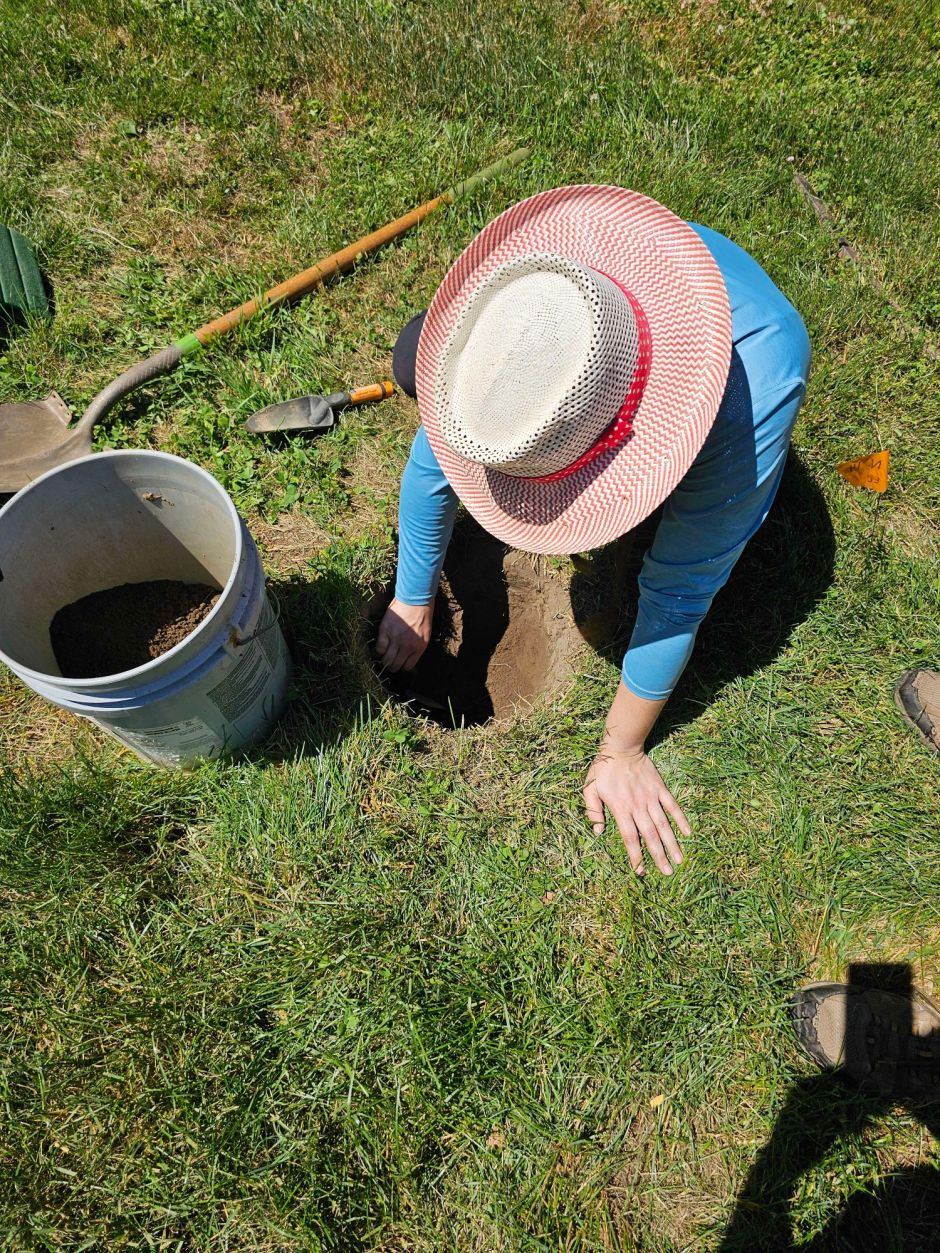
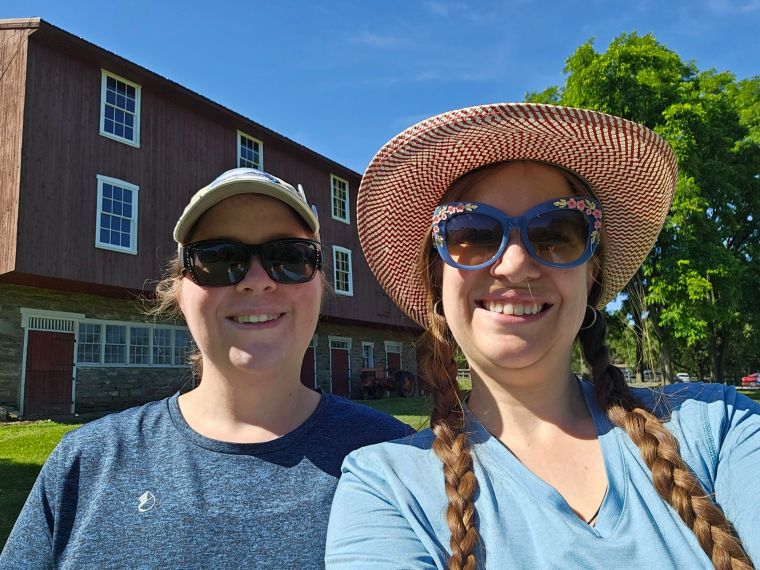
On a warm day in June, I and my sister embarked to discover our own time lost civilization. Using a technique popular among professionals although less glamorous than Hollywood, I assisted in uncovering the boundaries of a people almost forgotten. We drove out to the Blue Rock Heritage Center to meet with Paul Nevin as leading authority on the local pre-columbian peoples of my area. Together we and two other volunteers laid out a grid of 100 feet by 50 feet to conduct a survey. At every intersection of 10 feet, we dug a small circular hole down to the depth of a plow (about 12 inches) to discern where the greatest concentration of artifacts were. 

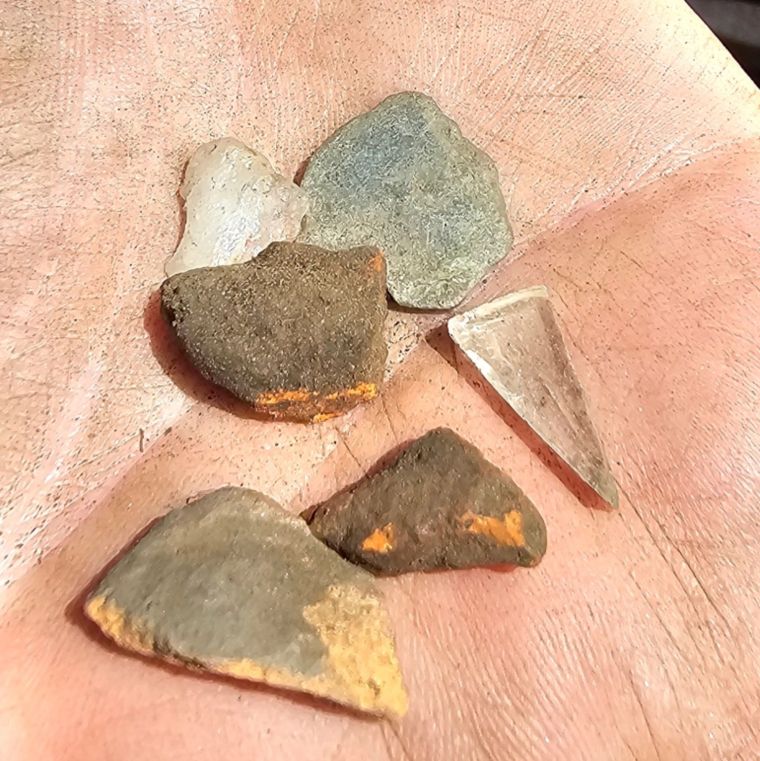
You will be forgiven dear reader if you are picturing the same sort of artifacts displayed in the museums throughout the globe. Beautifully crafted pots, towering statutory, elegantly carved facades of stone all almost perfectly preserved just waiting to be uncovered. You may want to re-evaluate your expectations before embarking on such a journey, for ours was to discover tiny fragments of flint produced during the manufacturing of arrowheads or pieces of broken pottery. You see, the survey was conducted in the top of the soil only about a foot or so down, which is about the depth of a plow. Obviously, if the area has been ploughed many times over there years, anything worth finding has now been shattered into tiny pieces. It was tedious, but rewarding work. 

My sister and I assisted in shifting through layers of dirt trying to locate evidence of a semi-forgotten culture. Most of what we found were pieces of brick from the farmhouse and “diagnostic glass” (also from the farm house). While, intriguing in their own right, they were not from the era Mr. Nevin was primarily interested in. He was primarily interested in pre-columbian cultures rather than the intervening years. However, he did not dismiss the fragments outright as trash, but rather had us carefully bag up the remains for later analysis. After all, just because he wasn’t very interested in that time period doesn’t mean that the time period is of no value for study.

Each bag was carefully labeled to correspond with the location that was surveyed. The archeologist would later assess where the highest concentration of artifacts were found in order to discern where a larger dig should be conducted. This method is rarely seen in documentaries but is utilized the world over. I often wondered how did they know where to dig, how did they find that tomb, or that village. My question was never answered to satisfaction when watching various films; it often seemed that they just stumbled upon these sites like some sort of game of chance. The answer was in this or other methods of survey. In short, simple data collection and analysis. Too boring to make most television shows, but vital to my own understanding of the craft. 

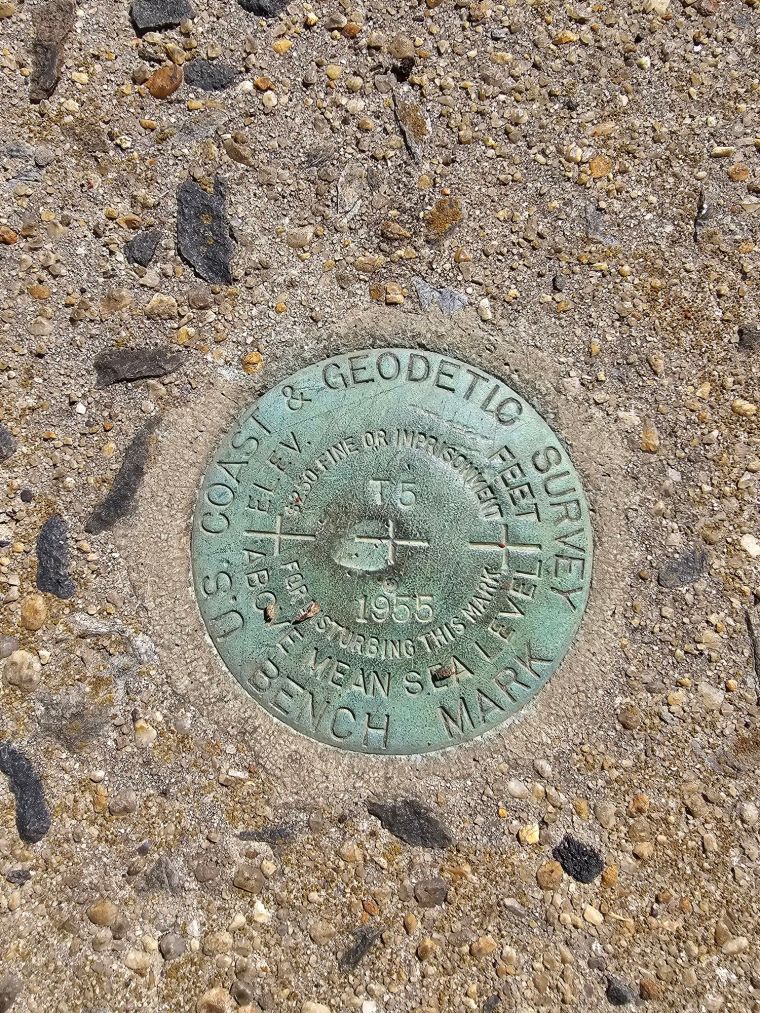
Most of what we found would be considered negative data. In other words, we didn’t find anything where we dug that was of interest to Mr. Nevin. I believe my sister and I surprised him in our enthusiasm for negative data but for us the treasure was in experiencing the technique and hearing the explanation for how a dig is done much more so than any treasure we may have found. Mr. Nevin explained that many years ago a site survey was conducted to determine there was a site of interest, but that the boundaries had not been recorded. Therefore, it fell to us to make that determination for purposes of a larger dig later. The medallion recording a geodetic survey in the 1950’s was considered the 0,0 point for purposes of the survey and it was primarily conducted along the north, east quadrant of the the 0,0 point. Hence, the designation of N (for north) and E for (east) for the different places we dug. 

Even though we did not find much in the way of positive data, the other pair found several different shards from flint making. Prior to digging in, Nevin showed us several examples from previous surveys of what we were looking for, pottery shards, arrowheads and flint. He seemed somewhat apologetic that we did not find anything in our own adventures, but we reassured him that “no” data was still data worth finding. Afterall, that was the whole point of the survey as most points were not expected to yield much since the area utilized was likely to be small. 

It was not the most exciting morning, if one expected to find troves of artifacts. However, it will remain a highlight of my life, because I have always wanted to participate in a dig. I value the pursuit of knowledge and the preservation of culture. Had I thought it would be a less competitive field of study, I would have happily embarked on a journey to become an archeologist. There are times when I regret not pursuing archeology as career, as it continues to remain a passion of mine.

Mr. Nevin’s own journey was not typical of most experts. He did not go to school, but was rather an enthusiast of Native American culture, traveling around the country to sacred sites. Approximately, forty years ago, he began his own study and documentation of the little known and scarcely studied petroglyphs of the Susquehanna River. Safe Harbor is home to the highest concentration of petroglyphs this side of the Mississippi River. The act of creating petroglyphs was a sacred practice. Creating them demanded a significant investment of time and energy. And to carve capriciously on the bosom of Mother Earth would be to desecrate her. Petroglyphs are not prehistoric graffiti. They are messages left by the Ancestors to be “read” by those who would come in the future. 

Though, we were not looking at petroglyphs which were intended to be read, we were looking at the messages left from those gone before. What sort of lives did they live? What did they do on a day to day basis? What was important to them? Even things we did not think could be felt hundreds of years later could still be discerned by an expert eye. For example, the use of wood can still be seen in the analysis of the soil and used to map out where a house used to sit. These are the questions we set out to answer. I hope to get an invite to Mr. Nevin’s larger excavation once he determines where the former site lies. 

One thing that impressed me about Mr. Nevin was his reasoning for picking the petroglyphs as his area of study. He said that he did not enjoy taking artifacts away from sacred spaces and with the petroglyphs one cannot take those away (at least not easily). His interest stemmed from a deep respect and desire to preserve rather than to exploit. It is these same values that I have in my own drive to explore that which has been semi-forgotten. I want to assist in the preservation of culture and the re-discovery of a people, to help them have a voice even if they no longer exist. I am curious to understand how we know what we know about ancient cultures and to experience the process of discovery for myself. It was truly a glorious morning and I look forward to participating in further digs. 

How can you participate in a dig?

Most people when they think of archeological digs, picture going to far flung places like Greece or Egypt. They forget that while those places have been popularized in our public imagination, there are many other places where ancient people existed. Native American people have lived in various places throughout the United States. Most likely you live near an archeological site and don’t even realize it. The trick of course is finding the people who are conducting the digs. 

How I found mine was I simply googled archeology sites in my home state and stumbled upon the Pennsylvania Archeological Association. My nearest chapter was based primarily out of a neighboring county. For fifteen dollars, I was able to join in order to be invited to participate in one of their digs. Naturally, I submitted the application for both myself and my sister. Upon our acceptance into the association, I reached out to Mr. Nevin to sign up for the dig. 

There are plenty of places which you can travel to and volunteer for a several days or even a week to help in a dig. Those are a bit more expensive than fifteen dollars each. My recommendation is to keep an eye out for your local archeology chapters or even local universities. Many colleges and universities have archeology and anthropology majors who may be leading various studies nearby. You could also be like Nevin and simply find a site worth studying and preserving that no one else is currently doing. He does not have a formal degree but through his own passion has become the expert on the local tribes. 

If you cannot, or do not have the inclination to shift through tons of dirt looking for tiny fragments of ancient trash, you could do something else that reflects the value of cultural preservation. Perhaps visit a museum or donate to a cause. Maybe you want to learn a craft from a given culture that is dying out to work to preserve it or record a language before it dies. Maybe participate in an anthropological study instead. Whatever it is explore your area and see what is out there, you may be surprised.