Ah, social media. A window to the wider world, filled with sweeping drone shots, glamorous airport lounges, perfect sunsets. A bastion of lies and filtered falsehoods.
I particularly love the “expectation vs. reality” videos: serene music turning to off-key chaos as the camera pans from a peaceful mountaintop to the hordes of tourists swarming the same spot. A perfect reminder that what’s posted is rarely what’s actually experienced.
Most social media travel stars wake up at 4 a.m. to beat the crowds and capture that “authentic” moment. What they don’t show? The sweaty hikes, the blistered feet, the questionable toilets, the stress, the transit delays, and the minor existential crises that often come free with your ticket.
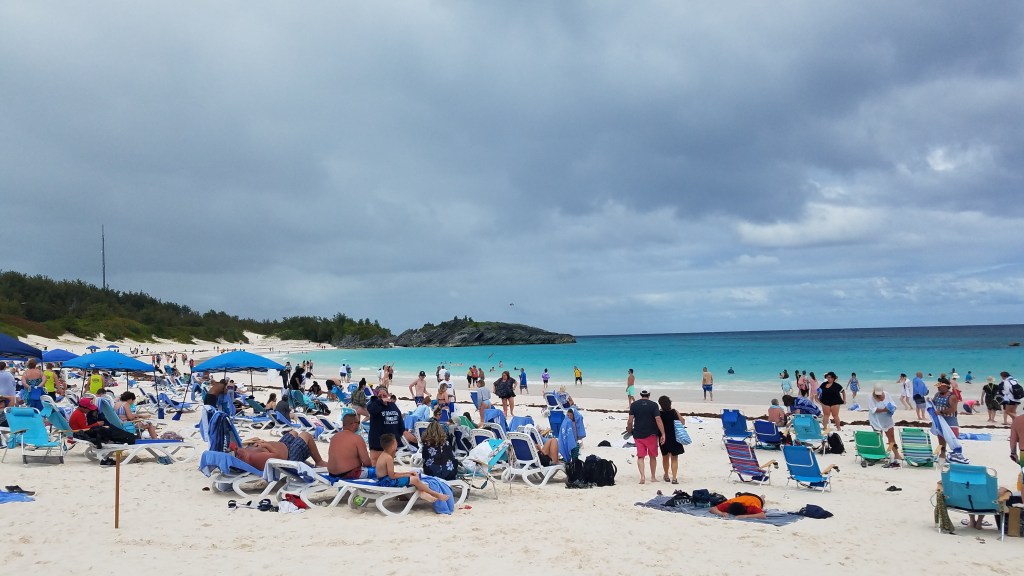
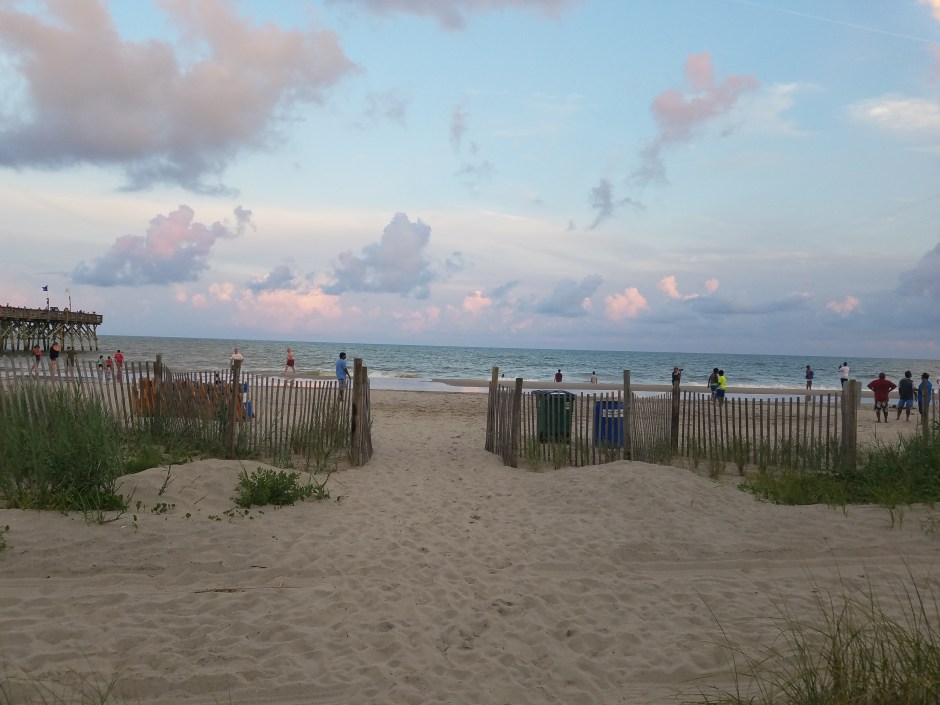
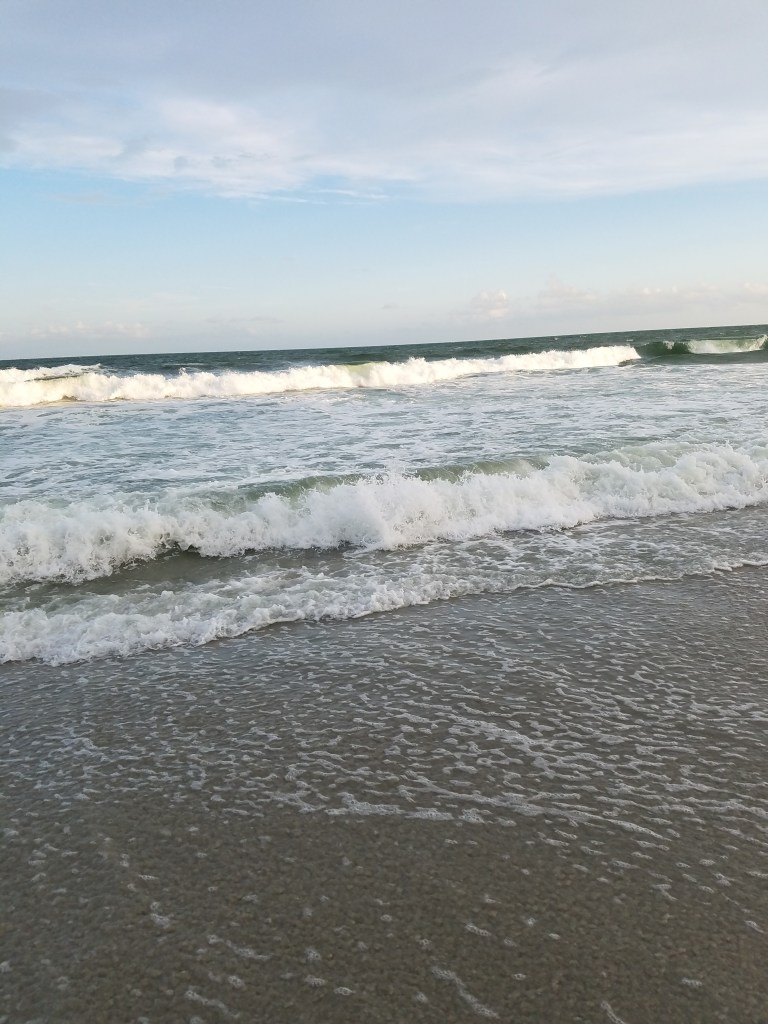
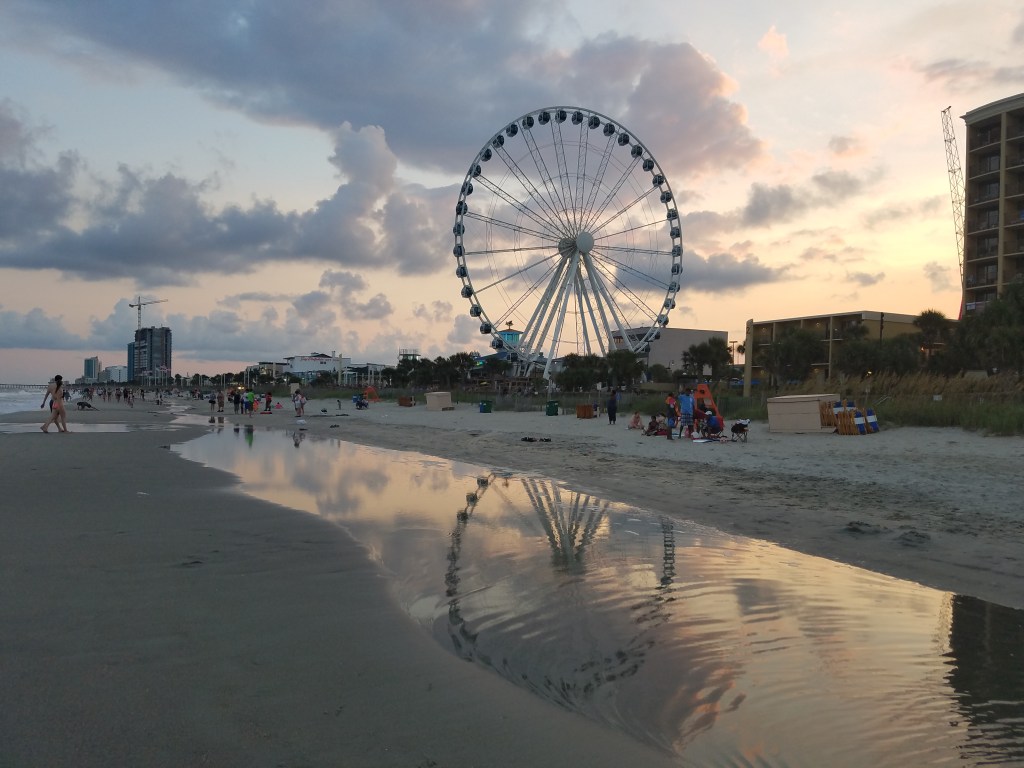
A crowded beach on the pink sands of Bermuda.
Let’s be honest, travel isn’t always glamorous. Plane rides can feel like being packed into a flying sardine tin. That dreamy Airbnb may smell like artificial lavender death. And the less we say about the bathroom situation in some places, the better. Seriously, though.
Even the photos lie. Take the pyramids, for example; they’re usually depicted as isolated wonders in the desert. In reality? Turn around and there’s the city of Cairo, complete with a McDonald’s. The rainbow hills of Peru? Instagram makes them look like Lisa Frank threw up on the Andes. In person, they’re fascinating but much more subdued.
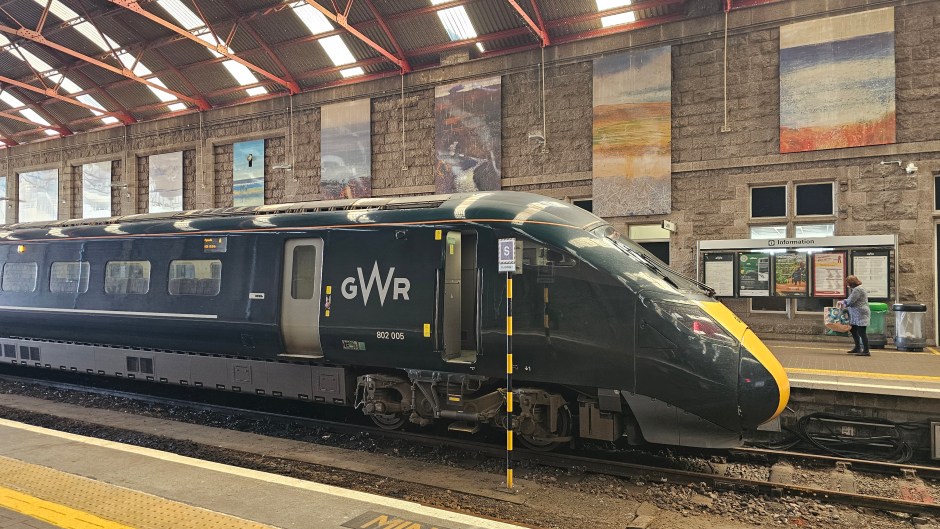
And even when something is worth the hype, there are still snags. During my trip to England, I didn’t plan for a closed castle (thanks, high winds) or a GPS signal that vanished the minute I needed it. I didn’t expect public transit to lack accessibility for my mom, or for delays with the trains. My trip was amazing and beautiful; it was everything I would have hoped for, but there were still moments that kind of sucked.
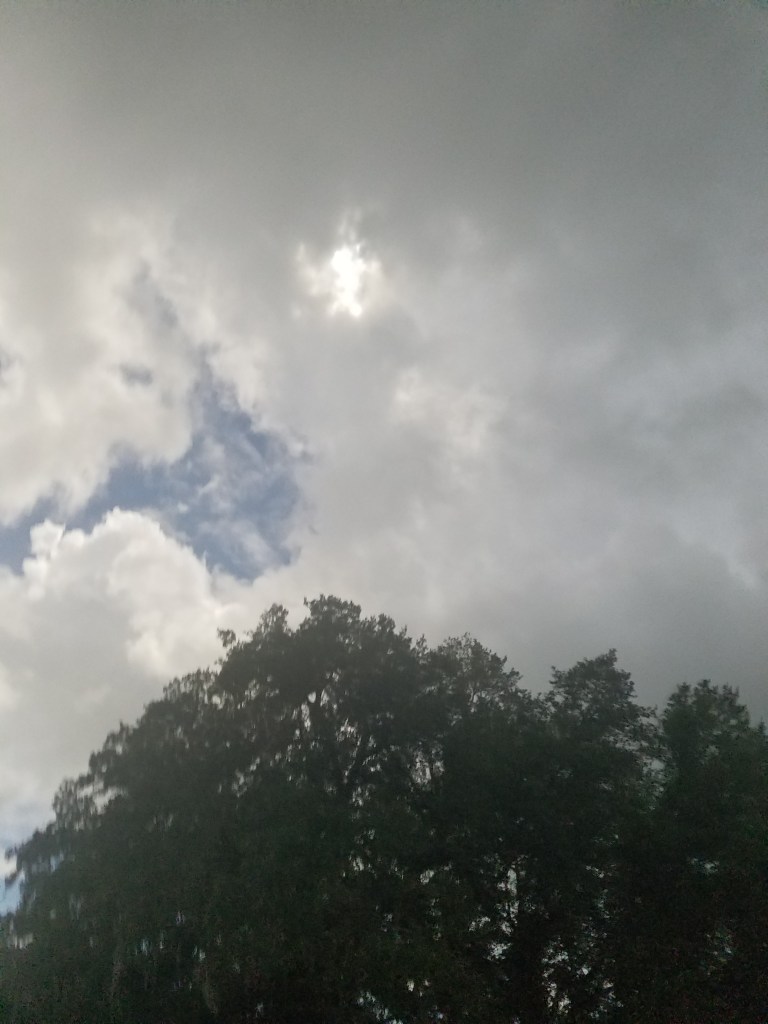
2017 Solar Eclipse
The 2017 solar eclipse? Cloud cover rolled in exactly at totality after I waited sweating in the southern heat for hours! Nature has a sense of humor.
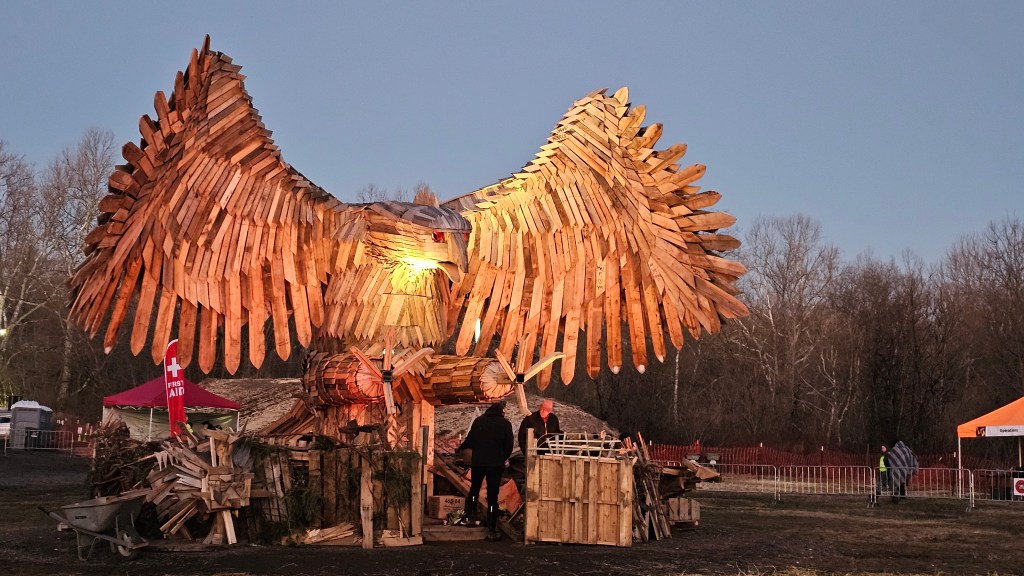
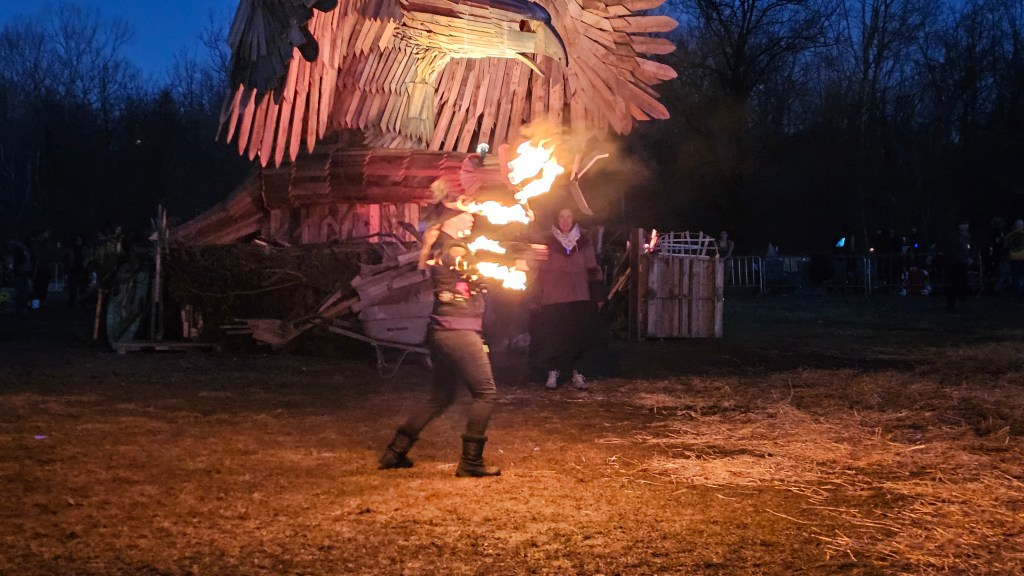
Closer to home, even my local excursions are rarely perfect. The Firebird Festival? Visually stunning, yes, but also freezing cold and delayed by 30 minutes. My toes were plotting a rebellion as soon as they were thawed. The Tea Festival? Lovely, but forced into a crowded church basement by rain. Less “royal tea” and more “steamy sardine can.” That long-awaited hot air balloon ride? Grounded due to “iffy conditions” on what looked like a perfectly fine day. Perhaps, the balloon was sick.
And yet, those imperfect moments are the ones that stick. They’re the ones you tell stories about. They’re the quirks that make a trip memorable instead of just photogenic.
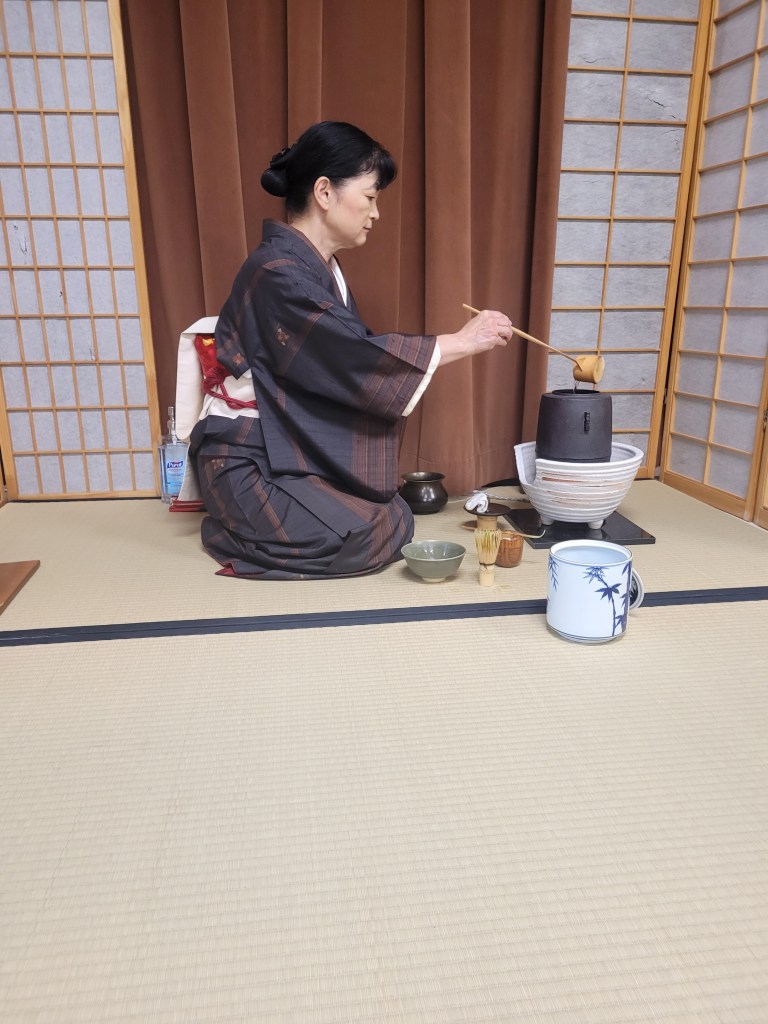
An intimate Japanese Tea Ceremony
When the Firebird crowd chanted “Light the bird!” in shared frostbitten frustration, I joined in. It was hilarious. When the rain forced us indoors at the tea festival, I ended up experiencing an intimate Japanese tea ceremony I otherwise would’ve missed. The cancelled balloon ride meant exploring a unique Star Barn one of the last in the nation. And a delayed train led me to a delightful conversation with fellow travelers about the cultural quirks of the U.S. and the U.K., a highlight of that entire trip. Getting lost in Washington D.C. led to snagging the last tour of the Congressional Building.
Setbacks create space for serendipity. They force us to slow down, reframe, or reroute, and in doing so, they give us something richer than a postcard-perfect moment. They give us stories, growth, and sometimes even stronger relationships.
That attitude—embracing the obstacle—has completely transformed how I travel. My sister and I started tackling trips together we never thought we could. Our bond has grown deeper because of the messiness, not despite it. I’ve even expanded my circle because of the chance encounters that travel disasters can bring.
Dear reader, today is the day that my home country celebrates its independence! Our festivities may vary from cookouts to parades to poolside parties to relaxing in the woods, but almost everyone celebrates with fireworks. It’s practically a patriotic requirement. So it seems appropriate to reminisce about some of my favorite firework experiences, both from this time of year and from unexpected corners of the world.
Let’s begin where traditions run deep: the annual Fourth of July celebration at Lititz Springs Park. Nestled in one of America’s oldest and most charming small towns, this celebration is one of the longest-running Independence Day events in the country. The entire town rolls out the proverbial red, white, and blue carpet. There’s a lively parade, complete with waving kids, twirling batons, and the obligatory fire engine sirens. In the park, music drifts through the air, mingling with the scent of funnel cakes, roasted corn, and sunscreen. The spring-fed stream is transformed into a glowing ribbon of light, lined with thousands of floating candles. Wooden swans from the 1950s, elegant, slightly weathered, and endlessly photogenic, glide across the water like time travelers from a more genteel age. And of course, there’s the Queen of Candles pageant, which, in a uniquely Lititz twist, has historically filled the role of prom queen, hence the local high school doesn’t crown one separately. As dusk settles in and fireflies join the fun, the evening culminates in a firework display that lights up the night sky, echoes through the nearby hills and can be seen throughout the surrounding area.
But that’s not the only show in town. Just a few miles away, another local tradition offers a decidedly more dramatic flair, complete with orchestras and cannon fire. Yes, dear reader, you read that correctly: cannon fire. In a neighboring park, an open-air concert features a full symphony performing patriotic and classical pieces. Families sprawl out on blankets, picnics are enjoyed, and toddlers chase bubbles while the sun slowly dips below the treetops. As the orchestra swells into the iconic strains of the 1812 Overture, a real, honest-to-goodness cannon is wheeled out. At the appointed moment, BOOM! The shockwave hits your chest, toddlers jump, and somewhere a dog begins howling in protest. Then of course the second one rings out in time with the music just as Pyotr Ilyich Tchaikovsky intended! And then, fireworks! Bright, bursting blooms cascading overhead in a breathtaking finale that leaves your ears ringing and your soul strangely soothed.
Not all firework memories come with stars and stripes. In the summer of 2009, I found myself studying abroad in Marburg, Germany. As July 4th approached, I was surprised by a small, sentimental wave of homesickness. Normally, I wasn’t one for the massive crowds that accompany large celebrations (after all, humanity is best enjoyed in moderation), but the quiet sense of cultural ritual was something I missed. I was preparing myself for a solo evening of wistful nostalgia, perhaps consoled with chocolate. Instead, I learned that Marburg hosts its own festival around the same time of year. I joined the locals for ice cream by the Lahn River, enjoyed a leisurely boat ride beneath the canopy of summer trees, and danced (awkwardly) to rock music echoing through the cobbled streets. As night fell, fireworks erupted in a brilliant display over the 13th-century Landgrave Castle. Watching colors explode above a medieval fortress while nestled in the Oberstadt (Marburg’s charming old town) felt like stepping into a fairytale. It was a reminder that celebration and beauty know no borders.
And then there are the fireworks that set the global standard: Disney. If America had a national fireworks team, Disney would be it. Their shows are not just displays; they are full-blown productions of light, music, narration, lasers, and occasional pyrotechnic sorcery the likes that only Disney’s mouse are capable of! I’ve had the pleasure of witnessing them both at Epcot and Magic Kingdom. At Epcot, it wasn’t just nostalgia that hit me, but personal pride, my high school marching band once choreographed an entire halftime show to the music of “Reflections of Earth.” Seeing it performed live, as fireworks danced to familiar melodies, was a surreal and deeply satisfying moment, especially since that was the show that landed us 7th at our Championships. At Magic Kingdom, the fireworks soar above Cinderella’s Castle like Tinkerbell’s own personal art project. The crowd gasps, the music swells, and even the most stoic adults find themselves grinning like five-year-olds in awe of the magic.
Fireworks are more than just explosions in the sky. They are shared moments of awe, connection, and celebration, tiny temporary galaxies that remind us, if only for a moment, to look up and be amazed.
So, dear reader, how might you best enjoy your own firework festivities?
I needn’t tell you were to find fireworks as displays abound, especially at this time of year. However, whether you’re lighting your own sparklers in the backyard or attending a grand symphonic spectacular complete with live cannon fire (as one should), a little preparation turns a chaotic scramble into a delightful experience. Here are some practical tips to help you enjoy the show like the seasoned firework connoisseur I know you are (or could be):
1. Stake Out Your Spot Early Fireworks wait for no one, and neither do the best viewing spots. Arrive at least an hour before dusk if you’re heading to a public park or festival. Bonus points if you bring a blanket and a foldable chair, doubly so if the chair has a cupholder.
2. Embrace the Picnic Mentality Don’t rely on concession stands unless you love $8 hot dogs and unidentifiable cheese. Pack your own snacks, fruit, cheese, a cheeky beverage (where legal), and something sweet for the grand finale. A thermos of hot cocoa for chilly nights or a chilled lemonade for sweltering ones makes all the difference.
3. Dress for the Elements Check the weather, then dress for being outside twice as long as you think. Mosquitos? Bring bug spray. Chilly breeze? Bring a wrap. Possibly raining? Ponchos over umbrellas, they’re less stabby in a crowd. Sensible shoes are your friend. You will be walking in the dark, on grass. Heels are for fantasy novels and indoor galas.
4. Think Like a Scout: Be Prepared Wet wipes, tissues, and a flashlight app will instantly make you the MVP of your group. And for those with sensitive ears (or children in possession of them), ear protection can turn terror into delight.
5. Make It a Whole Evening Fireworks are the climax, not the whole story. Bring a book, a deck of cards, or engage in the ancient art of people-watching. Let the pre-show ambiance become part of the memory.
6. Be Kind to the Creatures If you’re a pet parent, please remember that Fido is not a fan of fireworks. Leave him safely at home with a white noise machine and his favorite toy. Fireworks are for humans and ducks that didn’t get the memo to migrate.
7. Take It All In: With Your Eyeballs I say this with love: put your phone down. Snap one or two photos if you must, then actually watch the show. Fireworks are about the experience, the sound rumbling in your chest, the heat of the crowd, the oohs and aahs, and your iPhone will never do it justice.
In the end, whether you’re watching from a blanket in a quiet town park, a crowded theme park plaza, or your own backyard with sparklers and a playlist of John Philip Sousa, the magic is the same. For a few brief moments, we all look up at the same sky, eyes wide, hearts light, reminded of wonder.
Completed: multiple times in childhood
Cost: Ranges from Free to $164 (Epcot day pass circa 2025)
Miles from home: 0 (hometown) to 4,000 (Marburg, Germany)
Share your own adventures with me on Instagram! Just tag BudgetBucketList!
I believe, dear reader, that I have already espoused my love and adoration for tea. I love the aroma of it wafting up from a warm cup in my hand. The first sip as it hit my tongue in an explosion of flavor. The way it moves the warmth down my throat and into my stomach. I love how well it pairs with little sandwiches. I love scones topped with clotted cream and curd. I love the frilly lace and fussy accouterments. I love the various honeys I can add for a hint of flavor from orange to lavender to raw to clover. I love adding cream. I love adding milk to chai. I will drink it hot or cold, in the morning, afternoon or late at night. I’ve enjoyed it at my desk at work and as high tea in a parlor. So it should come as no surprise that I jumped at the chance to go to a festival devoted to this beverage.
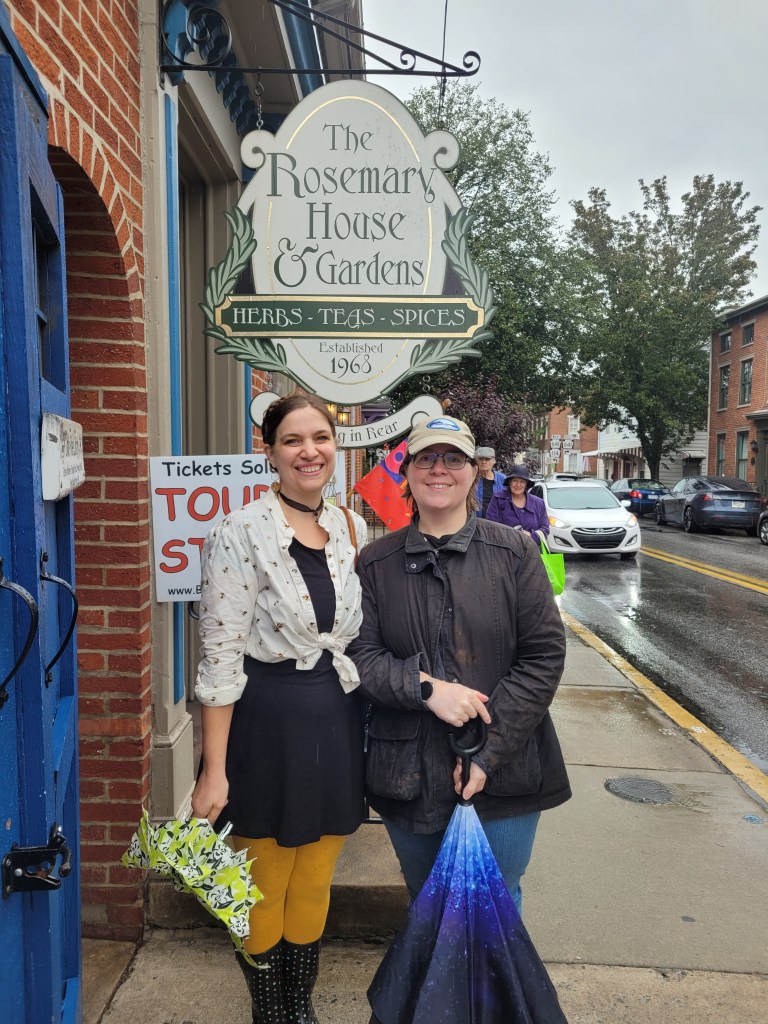
Our hosts for the Tea Festival are the ladies of The Rosemary House & Gardens. The shop is tucked in a small corner of Mechanicsburg, PA. It’s unassuming front hides an almost enchanted shop and herb garden. From the first moment, you walk in the door you know you are in someplace particularly special. The gentle smell of herbs instantly calms you as you take in the plethora of items adorning every corner of the shop. Everywhere you look merchandise is displayed on every available surface. It ranges from teas, to herbs, to honeys, to curds, to teapots, to fairies, to charms, to books and more. One could easily be mistaken into thinking one had stumbled into a fairy tale with the two older ladies carefully tending to the customers.
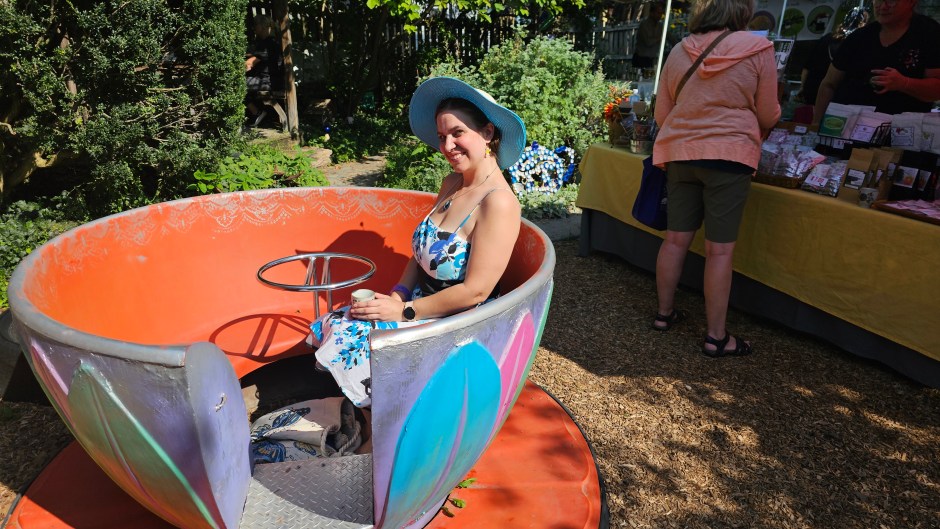
Being situated in an old house, the shop consists of two main rooms, the front and the back. The back leads out to a garden as delightful as the shop itself. The well worn paths lead visitors through the herb beds which continue to delight both the eyes and the nose. The garden is a delight to wander through as every single bed contains a surprise. One may spot a small turtle statue or be delighted by a miniature table and chairs (surely left for the visiting fae-folk). A visitor may see a sign welcoming said fair folk as well as a tower of teapots reaching for the sky. There is also no shortage of seating from the gazebo, to the benches, to a giant tea-cup from a carnival ride. The house is worth a visit even on days when a dozen or more vendors have not journeyed to grace it with their presence.
After paying for our tickets at the shop’s counter, my sister and I slipped onto the porch where we collected a small tea cup, a bag, a tea magazine and a schedule of the day’s events. The cup was to be used for sampling the teas offered at the various vendors – which is of course the main reason we journeyed an hour from home to the festival. There was a woman offering tea ceremonies in the garden, but we opted to skip it this year as we attended one at the festival the year before and attended one at the Japanese Gardens just outside of Philadelphia. Instead, my sister selected “A Dark History of Tea” from the lectures that were offered, noted the times and determined that we would start at the front and make our way back through.
Our first destination did not actually have any tea samples, but rather was a creative display of artwork on tea bags of all things. I was amazed at the variety of pictures she was able to create incorporating the tea bags into the paintings. I was so smitten with them, my sister ended up buying one as a birthday present.
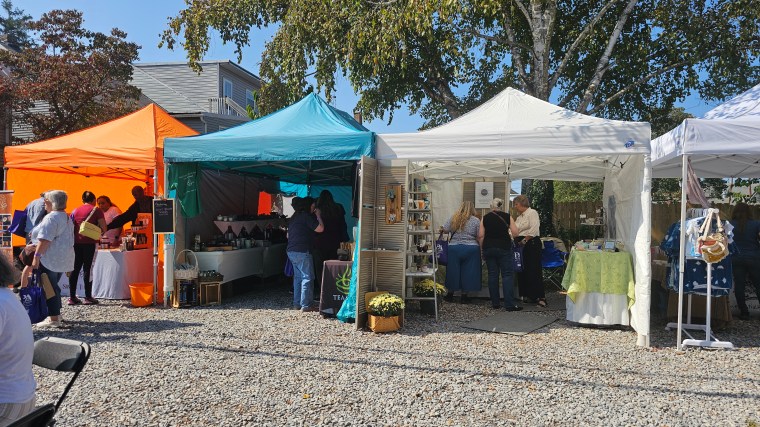
We then got to the highlight of the festival, the tea tasting. Each vendor had a variety of samples to showcase some of their best teas. The first one we had was a very smooth oolong tea from Taiwan that was a delight for the tongue. We then took turns smelling different teas and sipping on more. We sampled teas from Napal, Hawaii, Africa, China and beyond. There were herbal teas, white teas, black teas and green teas. There were teas that were pure and teas that had herbal additions like the lemon butterscotch teas. There was a chocolate vendor for tea and chocolate pairings. I purchased various teas for my later personal use.
We did attend the lecture on the dark history of tea and its connection to prostitution, opium, smuggling, poisoning, and slavery. It was a fascinating look at the history of international trade, commerce and greed. It was also a sad reflection that despite efforts at reform for the past 300 years, many of the problems that were prominent throughout the 1700’s, 1800’s and 1900’s are still going on today, if in different forms. The lecture did not get into how the issues in the tea industry can be seen in the fashion and chocolate industries, but my sister and I discussed it at lunch later. One of the things I enjoyed about the tea festival was that many of the vendors were from the countries that the teas were from. We were often speaking with direct representatives of the farmers rather than a corporate sales person several steps removed from the growing and processing of the product. We felt fairly confident that our teas were ethically sourced and free of adulterations and unhealthy additives.
After a few hours of sipping teas and wandering around the festival, the caffeine did start to get to me. I was surprised because I am such a huge tea drinker even at home, but I typically do a cold brew which tends to have less caffeine. So my advice dear reader is to bring some snacks along to help with all the tea that you will be drinking, because after three hours of sipping on the delicious beverage, I was quite jittery. With our stash of tea fully replenished for the coming winter months, my sister and I made our way back into the shop for some final purchases. We then wandered back to the car to decide where we wanted to eat. After consulting google, we realized there was a Japanese place not a five minute’s walk from her car, so we left a few of our items behind and journeyed to the former bank now turned restaurant.
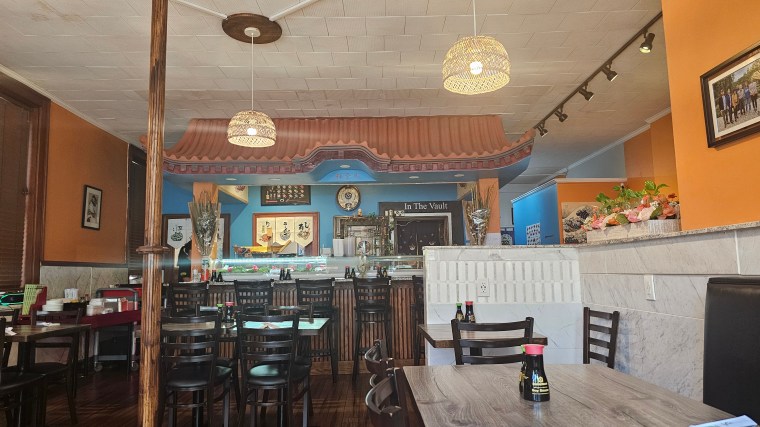
If you happen to be in Mechanicsburg, dear reader, I recommend Kanagawa. It was a quiet, intimate place with polite and friendly staff who were attentive and conscientious. My sister and I choose the small plate of salmon teriyaki with extra vegetables. The vegetables were cooked to perfection with just the right amount of sauce. They were a nice variety of zucchini, onions, mushrooms, and broccoli. The salmon was delectable, practically melting in your mouth with every bite. My sister and I split the fried cheese cake, which was a rare treat for us both. It was a mouth watering delight that must be tasted to be properly appreciated. The outside was perfectly crunchy with just the right amount of chocolate sauce which covered the delicious inside. It was the perfect ending to the day.
How can you attend a tea festival?
I am not entirely certain that tea festivals are exceedingly popular, but that is not to say that they don’t exist in your area. They certainly could! However, there are many popular festivals devoted to different foods and drinks. There may be a beer festival or a wine festival. In my area, I have seen a bacon festival being advertised which may be difficult to convince my non-pork eating sister to attend. If you’re passionate about a particular food or just enjoy eating, then go. You will discover all sorts of flavors you’ve never dreamed of. You may learn new culinary skills or interesting history you never knew about. It could deeper your appreciation for how we obtain our food and how to make more ethical decisions about your purchases. You may discover that you actually like certain foods you always hated. You could be introduced to different cultures or ways of thinking about the foods you eat. Either way, I highly recommend adding culinary adventures to your list. After all, we have to consume food every day just to survive, why not expand your pallet, widen your horizons and explore the world with a different sense than we usually think to use.
Completed: Fall 2023
Cost: $10 per person for tickets and much more for all the tea I bought, which we won’t talk about here. I was weak and the tea was so delicious! In my defense I have like so much tea now, it will last me months.
I am, as of this writing, recently returned from a trip to Merry Ol’ England after finding myself with the unexpected invitation to join a family friend, Shelia, at her long term rental in the beautiful Penzance area of Cornwall. The previously unaffordable trip of plane tickets, lodging, food and sightseeing, suddenly became much more affordable with her willingness to host myself and my mom for over a week. Naturally, I did not let such an opportunity slip through my fingers as England was home to one of my top Bucket List items, Stonehenge.
Now, my non-American readers may be a bit perplexed at my excitement of going to Penzance when Stonehenge is a good four hours away. You may very well think, it’s so far, you couldn’t possibly add that on to your trip! First, dear reader, you underestimate the American enthusiasm for driving. After all, the road trip is a quintessential American experience! Besides lacking any sort of reasonable public transit, driving is just what we do and if you’re like me who drives for a living (at the time of this writing) spending several hours in the car is nothing. I had a co-worker who regularly thought nothing of driving 8 hours every other weekend up to New England to help take care of her ailing mother. Americans love driving.
Second, given that in order to have the opportunity to see Stonehenge again I would need to take another 6 hour flight after needing to take up an additional 2 to 3 hours just to get onto the flight after arriving at the airport after a 2 hour drive to the airport, and another 2 hours driving from London to Stonehenge, I think I can afford the day trip back and forth when considering the time and money it would cost to do at a later date. It was this cost analysis that really tipped the scales in favor of renting a car and visiting this site. As I am always reminding you, dear reader, that when one travels one ought to maximize the opportunity in order to get the most bang for your buck. We are, as much as it pains us all to admit, on a budget and when’s the next time we’re gonna be able to hop a plane to England from America? Exactly.
After determining that in addition to Stonehenge there were sites scattered about Cornwall that were simply too inconvenient to get to via bus (why they don’t go to the neolithic sites like the Merry Maidens or the Cuny Village is beyond me) and given that taking multiple taxis in a day would prove to be quite expensive to do multiple trips to various places around Cornwall in one day, renting a car ended for the week ended up being the optimal solution of almost $175 in savings when I broke down the costs. Plus, I didn’t have to wait around for rides or worry about meeting my taxi driver at a designated pre-booked time. Once again, my cost benefit analysis kicked in and it tipped it in favor of car rental as much as I prefer relying on public transit.
Now, the best laid plans of mice and men will go astray. In this case, the hiccup I encountered was my phone’s gps. Despite paying for the ability to roam and setting it up ahead of time, when I arrived in England my phone refused to connect and kept telling me that I needed to turn on international data. I would go into the phone settings to see that it was indeed turned on and got a text message from my provider stating that it was turned on. We tried several different work-arounds suggested by the internet once I got to my friend’s place and was able to connect to her internet but nothing worked. Luckily, Sheila allowed us to use her phone for the day to get around. With the crisis adverted, we set out in the wee hours of the morning to make it for our 10 am admission time.
I had downloaded music to my phone for us to jam to and decided to put my newfound mastery of the British road system to the test. I had (smartly in my estimation) scheduled Stonehenge for the middle of the week in order to give me two full days of test driving on the opposite side of the road in more rural areas before trying to go to more populated and congested places. I actually took to it quite well and credit my dyslexia for being an advantage as I really could hardly tell the difference. I just kept the steering wheel in the middle and followed the visuals provided by the gps rather than following her left or right turns since I can’t do that anyways. So, cross off driving on the opposite side of the road as a bonus!
The way up to Stonehenge was relatively uneventful and I got to really take in the rolling English countryside. The morning started out with classic English weather of rain. However, by the time we reached our destination the rain had cleared leaving a mostly overcast sky that threatened sunshine.
Now to say that I was excited to see this legendary place, is bit of an understatement. Of all the monuments and sights in this world, Stonehenge is without a doubt one of my top destinations and probably one of the first places I ever truly longed to visit. I was fascinated by the ancient world of Great Britain and Ireland, obsessed with learning about them even though I could (when I was younger) find very little about it. It was this blank hole of questions that burned into my mind, what were they like, why did they build this, how did they build it, what spiritual meaning did it have, how did it connect to other sites and on and on these questions plagued me. I loved the theories, no matter how crazy or outlandish they were. And what I love is that we’re still uncovering things about it, only just last year they did yet another study of the stones and discovered that they come from all over indicating that this may have been a unifying project to unite the island.How does that fit with other archaeological evidence for the rest of Britain? There’s just so much we don’t know.
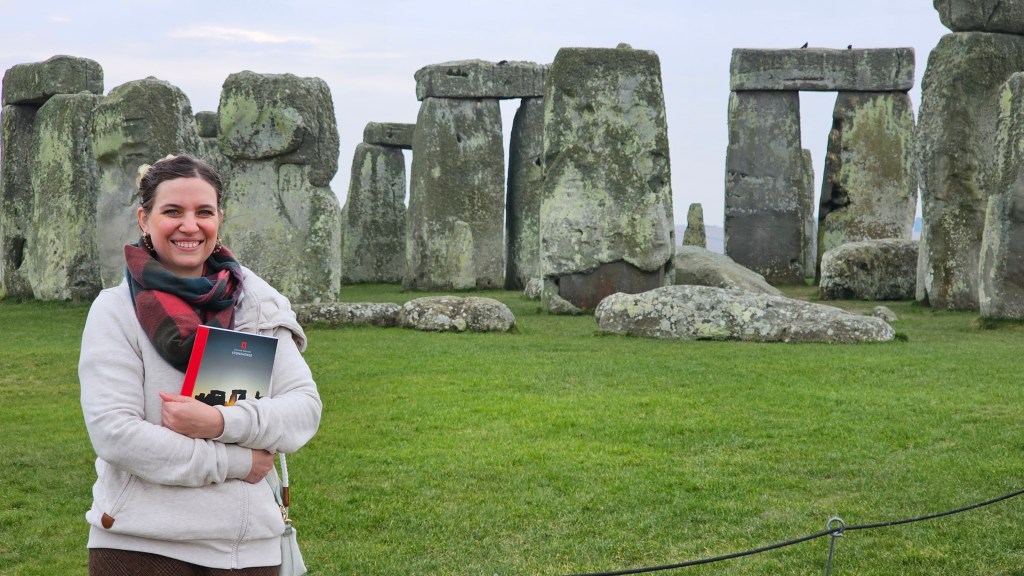
Stonehenge is over 5,000 years old and is the largest neolithic monument in Britain. There is evidence of important structures and even other henges prior to the building of Stonehenge in the general area marking it as an important or prominent site in the stone age. Some of those sites are from 8000 BC You may be forgiven dear reader for thinking it’s just a stone circle, as impressive as that may be; it actually sits upon an earther work with a marked avenue leading up to it. A “heel stone’ marks the alignment with the summer solstice. This avenue and stone is the reason we can say it aligns with solstice and not some other random astrological event. It is also not just one stone circle but two concentric circles and other stone pieces to create a masterpiece of that era.
I am standing by the “heel stone” which marks the line of the summer solstice
It took over 1,500 years to complete in four different stages. The first stage was in 3100 BC, the second stage occurred in 2500 BC; the third took place 150 years later and the final stage occurred in 1,500 BC. This is when the stones were rearranged into their iconic horseshoe shape. There were about 60 stones originally, but sadly many are broken or even missing today. Despite the presence of human remains, it is not believed to have been a burial site but that these remains were utilized in religious ritual. Although if you read other people’s opinions they’ll tell you that it was a burial site. See? So much mystery!
It was being armed with this knowledge (and much more, but I shalln’t bore you with all the details), that I practically squealed in sheer anticipation more than once as we approached. I was finally actually there, instead of seeing it on a screen or in a book. There was equal parts excitement and awe as we drew closer. The thing about the site is it is actually located in an almost surreal location because one expects that it would be in an area relatively built up. However, it is just out in the middle of nowhere surrounded by sheep and farmer’s fields. Yet, it fits exactly in the landscape that one finds it in because thousands of years ago the builders may have had sheep. For all we know sheep have been hanging out near those stones this entire time.
I loved being able to closely study the stones, to see how they may have been joined together by the knobs at the top of some of them and to picture how it may have once been so many years ago. I marveled at the craftsmanship that must have taken to hew rock into rough formations of giant blocks and to lift them up atop each other.
What was particularly nice was that I went at the slower time of the year for England, choosing to go right before spring at the end of winter, so it was relatively uncrowded. I didn’t have to fight to look at it and I was even able to snag pictures without people in them. Most pictures contained very few people. This also meant that I was able to really focus on what I was seeing without having to worry about what everyone else was doing around me. After my first circle around the stones snapping lots of pictures, I put my phone away and made another loop so that I would be able to just enjoy the place taking in the sight and locking it in my memory. Too often we are so busy “documenting” our experiences we forget to actually experience them. I was determined to not make that mistake.
After spending nearly two hours at Stonehenge, we journeyed back on the bus to the visitor center for a quick bite to eat before departing. There was a reconstructed Stoneage village that I took a brief detour in. But having been in the ancient village of Carn Euny the day before (another post on that later), I didn’t spend very long. They also had a small museum of the artefacts found in and around Stonehenge which is very informative if you haven’t spent a lot of time studying the site.
How to visit Stonehenge (and other suggested sites):
I’ll not insult you with instructions on how to get to England. However, it is important to know Stonehenge is located about 2 hours south of London making it a fairly easy trip for most people who are intended to tour the country. It is a far less easy trip if you’re flying into Scotland. My American readers may be forgiven for underestimating the size of Great Britain as it is about a 7 hour drive between the two and while we do love driving that is a bit of a haul even for us unless it’s part of an entire road trip especially since most of us only have two weeks of vacation a year.
However upon arrival, you have two options to see the actual site. Option 1: Is paying the admission ticket (and parking) to Stonehenge which grants you access to the bus transfer over, the reconstructed village and museum. The main advantages to this option is the bus transfer if you’re with someone with mobility issues and the ability to walk around the entire site to see it from all angles.
Option 2: Is parking a little away from the site and accessing the footpath which traverses right next to the walkway in front of Stonehenge. It does require a bit of a hike to get from where you can park the car and Stonehenge. The path isn’t well maintained, in part because while the English have the right to roam on the ancient footpaths, the right to roam doesn’t necessarily convey the promise that someone will be maintaining those footpaths. It also only allows you to really see the front, but it is the best and most famous vantage point. If you go during the peak season you’ll probably be disappointed by the sheer number of people blocking your view and any pictures you’ll want to take. If you go during the non peak season you will probably be able to get a decent view and maybe a few pictures with only a few people milling around in the background. It honestly depends on your priorities.
My wonderful and amazing mum!
For me, I was traveling with my mom, who doesn’t have the best health and needed the extra support with mobility. I also wanted to be able to get as close as I was permitted. There was an option to get there at 8 am, pay a lot of extra money and be able to go into the circle at sunrise, but I would have needed to leave by like 3:30 am, wake up at like 2:30 am which would have meant no sleep for me and I didn’t want to be driving that long on no sleep as driving without sleep is akin to driving drunk. I wanted to see Stonehenge, not die in a car accident on the way there. Remember we want to check off our bucket list, not hurry the bucket along.
Now, you may be thinking that there is absolutely no way that I could possibly write a list of “good enoughs” when comparing them to Stonehenge, but it entirely depends on you as an individual. For me, Stonehenge has been a top priority since childhood, so when given the opportunity I jumped on it. However, there are many Neolithic sites and Neolithic stone circles scattered not only across Britain and Europe but also throughout the world and you may be closer to them than you think. Granted there aren’t many that are quite as old as Stonehenge but there are many that are within the 3,000 – 1,000 range.
If you don’t care much about the size of the stone circles, Britain, Ireland, and Brittany (France) has over 1,300 circles. Many are quite impressive in their own way. They are also less visited and often allow you to be able to go right up to them without needing to pay for tickets or have them roped off, meaning you don’t have to fight with crowds, you can actually touch them and you can enjoy them more as they were intended, as places of spiritual connection, celebration and reflection.
The Merry Maidens of Cornwall!
Stone circles aren’t just found in Europe. There are stone circles in Australia which are sacred to the Aboriginal peoples like the stone arrangements in Victoria at Carisbrook. You may also be surprised to find out that Japan has stone circles from the late Jomon period located in the northern region. Like Stonehenge the Japanese Stone circles contain an inner and outer ring which is aligned with solstices. Even the states has its own stone circle in Wyoming called the Medicine wheel. There are other less famous circles hidden in Nebraska’s Sandhills and Bluemont Virginia.
If you don’t really care what formation a neolithic site takes, then the world is truly your oyster because scattered throughout the globe are sites from ancient pre-civilization peoples. Ohio is famous for its Great Snake Mound as well as the Newark Earthworks. White Sands New Mexico has footprints from over 20,000 years ago – take that Stonehenge! Colorado is home to the Cliff Palace located in Mesa Verde National Park. New Mexico has its own cliff dwellings as well as Aztec ruins. The small island of Malta has Megalithic temples. Ireland is home to Newgrange. One of the oldest known megaliths in the world, Gobekli Tepe, can be found in Turkey. Spain is home to the Dolmen Menga. India has its own dolmens in Marayoor Munnar and I could go on. As you can see dear reader the world is awash with ancient monuments if you know where to look. You may very well be shocked at how close you are to one. So don’t feel the need to put Stonehenge on your list of “must-do’s” if you haven’t already developed an obsession like me, but if you happen to find yourself in England the it is decidedly something I would recommend you make part of your trip.
Cost: $50*
* give or take with the exchange rate, going during non-peak season for a “super saver” discount and pre-booking online for an additional 15% discount and then accounting for the gas to arrive there from the rental.
Miles from home: 2,000
Miles from rental: 200 miles
Cost accounting for plane tickets, etc.: $150*
* You may wonder how I arrived at this number, it’s simple, I took the total cost of my travel (planes, buses, taxis, etc.) and then counted up all the places I checked off my list as a result of traveling to England, divided the total cost of travel by the number of places I got to go to arrive at about $100 per place. As it turns out England has a lot of places and experiences that are on my list which is why it was a top place to visit. I made certain to check off that list to maximize the money I was spending.Using this basic formula is something you can do when deciding where to go and what to do in order to maximize your travels. Yes, the upfront overall cost is quite high, but when considering how many things you can do at once, it may be worth the cost.
Ah, summer. What springs to mind when we think of those blazing hot days and long evenings? Cookouts and water games, people gathered round, laughing gaily as dogs drift in and among the crowd, children playing lawn games? The reality is that, sadly, summer is spent far too often on our phones. Even when out and about, they are an ever-present distraction. Speaking with strangers is practically taboo, lest you disrupt their very important text conversation or latest social media doom-scrolling venture. There are few sanctuaries of the bygone eras where summer meant a blissful abandonment of the world for nature and all her bountiful glory.
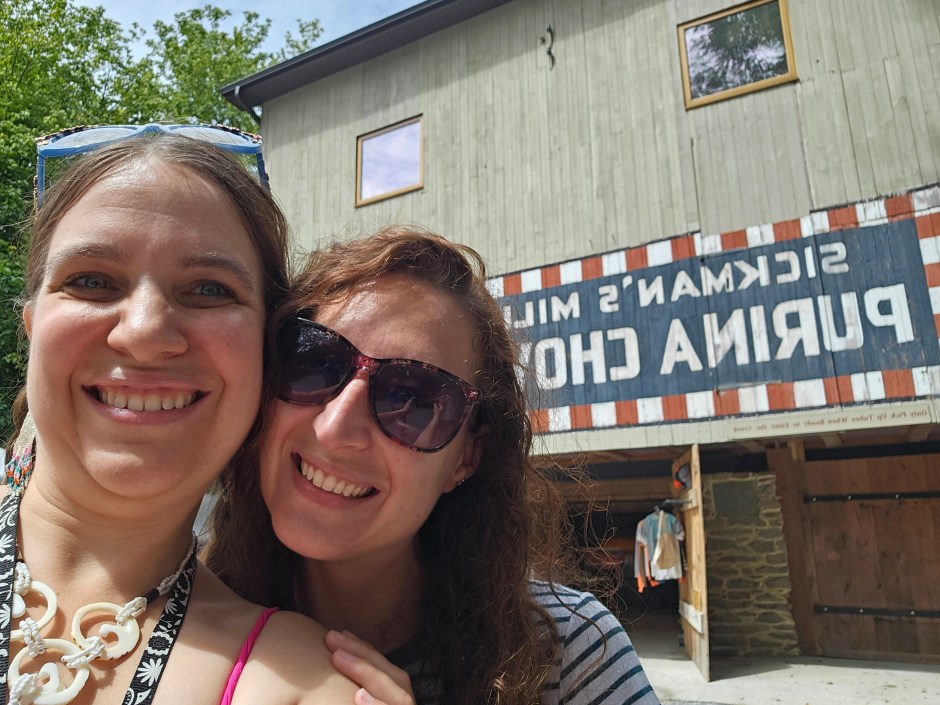
It was one such sanctuary that I happened upon on a summer morning—not entirely by accident, as I had made plans to go—but I was surprised to discover that Sickman’s Mill was such a place. Nestled in the southern part of Lancaster County, it doesn’t have the best reception, and lacking any Wi-Fi, one is forced, as their sign proudly declares, to pretend it’s 1969 and talk to other people. I found the bartenders friendly and hospitable, eager to make me feel welcome to a party I didn’t know I’d been invited to as I awaited my friend Kayla’s arrival. They assured me that despite the weather forecast for potential showers, I would still be able to participate in the not-quite-forgotten summer tradition of tubing down a river.
Almost as soon as there were rubber inner tubes leftover from tires, there have been people putting tubs in rivers and floating down them. What could be a more relaxing way to beat the summer heat? After a trip down the Pequea Creek, I’m not sure I can answer that question. It was the perfect panacea for the blistering heat of the season.
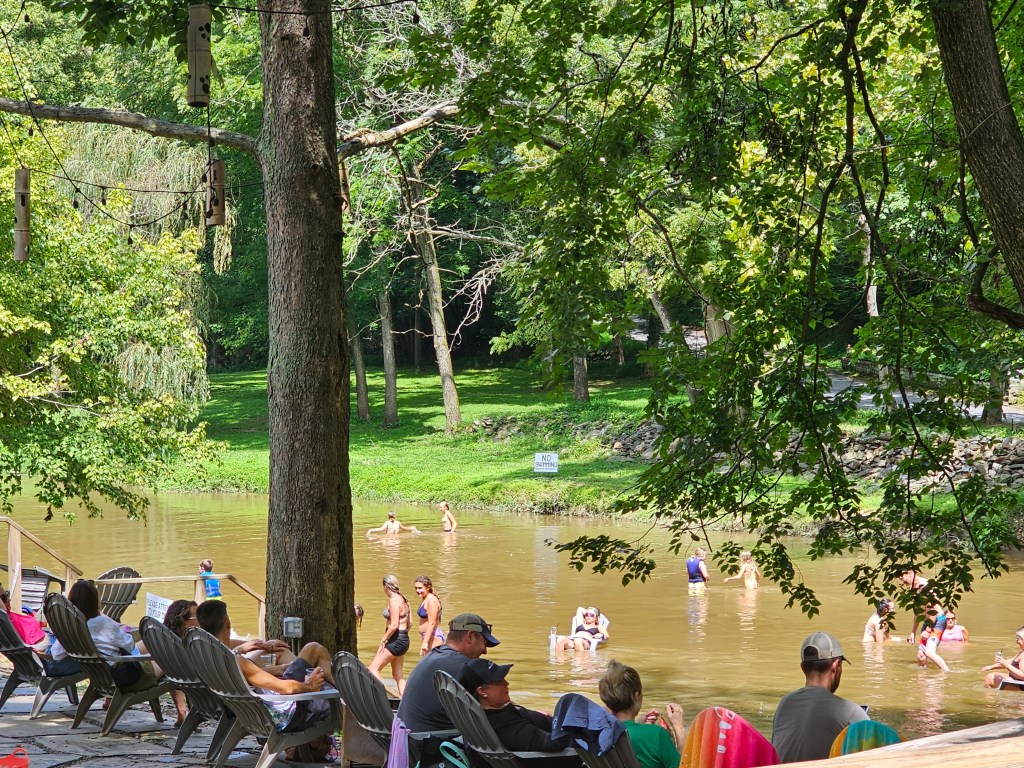
The rain from the night before had raised the creek’s levels and left the morning quite comfortable. The clouds that had threatened thunderstorms gave way to beautiful blue skies, allowing dappled rays of sunlight to stream down through the trees. The crowds had not yet arrived, leaving the creek mostly to ourselves to enjoy the sounds of nature all around us. Occasionally, we were treated to faster-moving sections as the water flowed rapidly over a series of rocks. The only main concern was the occasional felled tree that created unexpected obstacles, but aside from those minor disruptions, it was a beautifully relaxing trip.
The entire route took us about an hour to complete, as the creek was moving more rapidly that morning due to the recent rainfall. It can take up to two hours when the water is slower. We were directed by a polite young man to get out of our tubes and climb the convenient stairs to await a bus that would transport us back to the mill. We didn’t need to wait long before it came lumbering up the lane, and after another group disembarked from the creek to board, we were on our way. It was a short but delightful ride through the countryside.
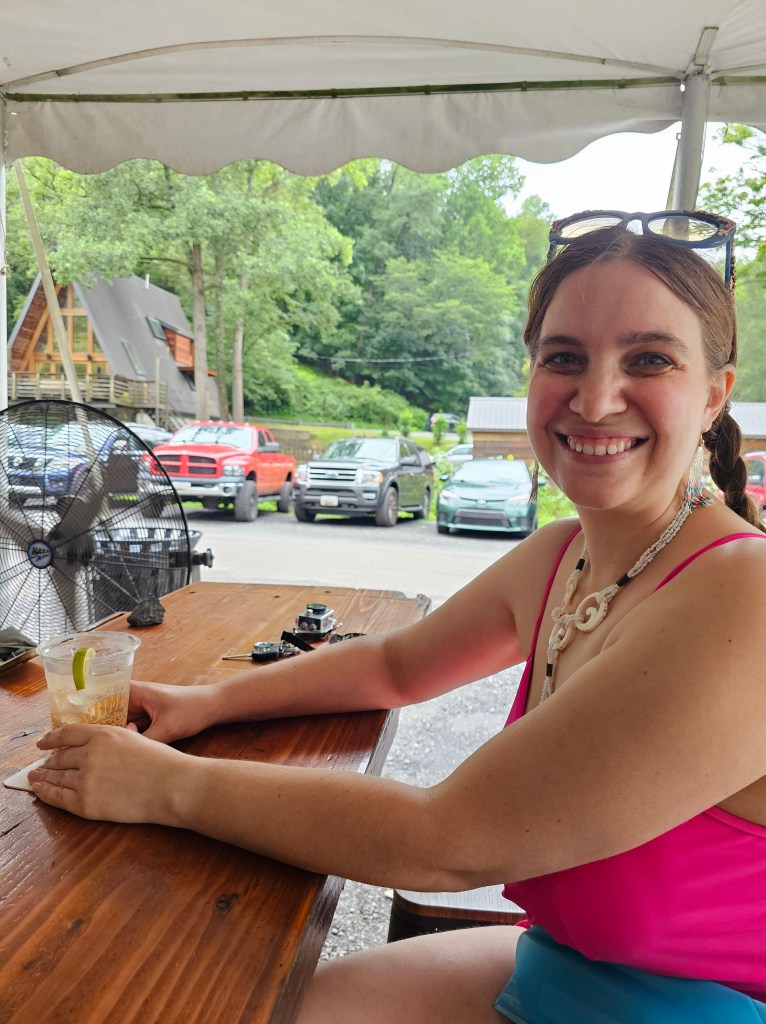
The old mill itself was not open for exploration, but they more than made up for it with the bar affectionately named Jimmy’s Place after the family’s dog. Naturally, Kayla and I tried the Jimmy Juice—all four flavors. She had the Pineapple and Cranberry, whereas I enjoyed an Orange and a Ginger. Our favorites were the Pineapple and the Ginger, and we were able to take a four-pack home to share. For food, we went only a few feet away from the bar to Mama T’s. I learned the name is a bit of a joke, as Mama T is by all accounts a terrible cook. Don’t worry—the food was quite delicious and includes vegetarian options. Prices ranged from $5 for a slice of sourdough pizza to the more expensive Mama T Burger at $14. The portion sizes were as generous as the people serving us.
When we returned to the mill, we were surprised to see that the sleepy bar had transformed into an impromptu party. Dogs ran among the people and splashed into the creek with their owners. Some had taken chairs to sit directly in the creek while sipping on the infamous Jimmy Juice, a vodka-based cocktail. Children and adults played lawn games together, and everywhere I looked, people were actually talking to each other instead of scrolling on their phones. It felt as if I had indeed been transported back to 1969. I even had the distinct pleasure of meeting Mama T, who had just landed from Ireland.
It would seem that while the mill has taken on many purposes in its 250-plus years of existence, it remains timeless. One certainly feels as if time simply melts away. Hours and minutes blend together as the party stretches into the afternoon. You forget to check the time, and text messages go unanswered—if they even get through the spotty reception. It is a place to forget the modern world and embrace the echoes of summers past. Though I wouldn’t have thought it all that different from a lazy river at an amusement park, there was something special about tubing down a real river in the middle of the woods. It may be a relic of an era now gone, but it remains a time-honored tradition. As long as there are tubes and rivers, people will continue to float down them.
How can you go tubing?
Luckily, the United States is dotted with rivers, and if nothing else, you can probably find one nearby to float down—provided you have a tube. It’s recommended to bring a friend along and park your cars in two different places unless you find a spot like Sickman’s Mill where you can rent a tube and catch a bus ride back. It’s a bit more adventurous doing it yourself. Though I must confess, as someone with a poor sense of direction, I’d likely miss the designated pickup spot, drift miles downriver, and end up hopelessly lost.
If you don’t want to go the DIY route, finding a place like Sickman’s is usually as simple as Googling “water tubing.” There are plenty of places that offer this kind of summer activity. I can’t promise they’ll all have the same family cookout atmosphere, but the river experience will be similar. I do think there’s something magical about finding a place where cell service isn’t great and Wi-Fi isn’t available. It encourages people to put their phones away and genuinely engage with each other.
Completed: August 2024 Cost: $25 for tubing ($40 additional for drinks and food) Miles from home: 20 Potentially time warped: 55 years into the past
For the past twenty years a mysterious sight has unfolded in the midst of the winter’s cold. A community builds a giant wooden bird and then sets it on fire much to the delight of the spectators. And, dear reader, it is as awesome as it sounds.
The Firebird Festival, was a dream of a Henrik Stubbe Teglbjaerg, an immigrant from Denmark who has resided in the States since the late 1980’s. He, with four other Phoenixville residents, came up with the idea, in part inspired by similar festivals of Europe where they build things and set it on fire. When he first arrived Phoenixville was a dreary little town. However, it started to revive itself, opening up a theater, art galleries, coffee house and it was as if there was a rebirth, a town rising up out of the ashes. So what could be a more perfect fit than to celebrate with the symbol of rebirth and the town’s own namesake?
What is more is that each year, the ashes from the burned phoenix are taken and made into clay birds which are then placed inside the wooden bird. When set on fire, the wooden structure acts as a kiln, firing the birds and thus completing the cycle of last year’s bird when they are transformed into decorative pottery.
What started as a small 150 person event has grown into a 20,000 person festival. Complete with food trucks, fire dancers, a parade, live music, and various wares for sale. It is a celebration of the town and the arts. But rather than relying on fancy performance artists most of the event is volunteer and community run which only speaks to the strength and spirit of the community, despite the growing size of the festival they have protected its heart as a grassroots events that remains untainted by the scale of the crowd.
Most years, this event takes place in December just as the northern hemisphere enters its darkest stage and the year is coming to a close. However due to an unusually dry spell, the 2024 Firebird Festival was delayed as having a 20 foot wooden set aflame near exceedingly dry forest isn’t exactly the safest idea. Remember dear reader, as much as we all desire to check off our lists we want to make sure we live to check off the rest of our lists when doing so.
This misfortune of weather was my opportunity. For you see, my sister and I typically celebrate the holiday season each year with our extended family on the second weekend of December. It so happens that the Firebird Festival also happens on that same weekend meaning that we are always previously engaged as the annual Holiday Feast has been a set date since before I was born. So when the organizers moved the Firebird Festival to the first weekend in February it became the must do event of the winter season.
The new date was also fortuitous as it coincided with an ancient celebration of spring’s light returning. The ancient Celtic holiday of Imbolc was associated with the Celtic Goddess Brigid, the guardian of Hearth and Flame, a perfect pairing for the new date. The ancient holiday was a time of purification, renewal and preparation for the change in season. Fire rituals which honored the returning sun were frequently integrated into the Imbolc celebrations. It was celebrations like these which inspired the Firebird Festival in the first place making the new date perfect.
As it happened, it was one of the coldest nights of the winter as arctic wind was carried down from the north freezing all that it touched with its icy fingers. Only a few days before the weather had been warm thawing out the ground and making it moist and muddy. Posts about the event warned celebrants of the potential for treacherous conditions on the field as the mud became slick and icy.
My sister and I did our best to buddle up in preparation for the cold. I fared a bit better than her having a coat that mimicked a fur one, leather gloves lined with kashmir, thick socks and shoes with thick soles to keep out the cold. She had a rather old coat that she put several layers on beneath but the wind still managed to cut through the fabric and whisk away what warmth she had. As the Germans say “there is no bad weather, only bad clothing” and this was a prime example. I stayed pretty toasty throughout the evening but my poor sister struggled. Worry not, I often acted as a wind break once the crowd gathered.
The festival occurs in two different places, the field where the bird is and downtown Phoenixville where most of the art events occur. After looking at the events and options, we determined that we wouldn’t arrive at 4 pm when the event started but rather closer to 5:30 pm to find parking, walk down to the field. That gave us about 21/2 – 2 hours before the bird was scheduled to be lit at 8 and the fire dancers would start their own performances around 6 (something else I’ve been wanting to see as part of my BucketList, maybe I’ll have to add Fire Dancing to the list now that I know I can volunteer to be one!)
We followed the instructions for parking and managed to snag a great spot that was near enough to the field to make an easy walk in and out. It was a place that opened for parking after the official event time, I assume in part to help manage crowds. This made it a breeze to get to the Veterans Memorial Park where we were greeted by friendly volunteers who directed us into the event. They had buckets to collect donations which went to supporting it. When we got there we were a little surprised as the lackluster crowd as it seemed only a hundred people were milling about. There were a few food trucks and some tents set up. The band wasn’t playing yet and the sun was only just starting to set. We milled around looking at the different options and then decided to watch the Fire Dancers. We saw some people had chairs set up right at the center of the staging area but other than directly in front, the area was clear. We picked a spot to the left to watch and decided we’d take turns running to the food trucks.

It felt a little paranoid to hold our spots when there were so few people, but as it turned out this was a crucial strategy because it seemed that within 15 minutes the crowd had tripled in size and the entire perimeter of the bird was lined with spectators enthralled by the fire dancers. Just as twilight fell, the arrived each with a unique costume and different types of instruments to move the flames about. They juggled, they moved around balls of fire, they twirled long lances and staves, they mimicked a bird with wing-like props, they used hoops of fire to make large circles. One wore a plaque mask, another looked like she came from the assassin’s creed, there were knights with shields and spears, there was a woman in a leopard catsuit. Some of the volunteers were better than others but all of them were mesmerizing in their own way as in the background a band played music.
By the time the sky had gone dark, the crowd had ballooned behind us and we had to jostle our way to back to each other when we went for warm drinks or snacks. We nibbled on delicious food from a truck and sipped on warm apple cider available for purchase from some enthusiastic teens manning a volunteer tent. It seemed a little pricey for warm cider but the proceeds went to support the event and as it didn’t have an entry fee I was happy to pay a little more. The cider warmed my hands which had gotten cold from taking pictures of the fire dancers.
As the appointed hour grew near, the crowd and the cold intensified. However, it was all great fun as we stood there making friends with the people behind us, chatting and laughing. We helped them hold a spot for their friend when she slipped out. Then around 7:45 the parade arrived. Headed by a giant pheonix of paper mache and cloth, the parade was host to more costumed revelers adorned with lights who danced to the beat of drums. Around the bird they circled to the cheers of the onlookers as the crowd only grew more excited in anticipation of the main event.
Unfortunately, there seemed to be a bit of a delay as 8 pm came and went. Then 8:05, then 8:10, then 8:15, by the time 8:20 rolled around there were chants of “light the bird” which would be taken up and then die down after a minute or so. This went on for another 10 or 15 minutes until finally the torch bearers chosen by lottery were assembled and permitted to put torch to wood. At first, the flames barely licked up the wooden structure. It seemed as if the wind would snuff out the small fires struggling to find purchase against such icy conditions. How could such small flames survive? Would we be disappointed?
No, the flames did not die. They continued their merry dance along the wooden structure, flickering brightly in the night. While it was a nice sight to see, it was hardly worth the nearly 3 hours in the freezing cold, perhaps we should pack it in, my sister suggested. I told her that I wanted to spend a little bit longer because we had been there so long and I wanted to enjoy it regardless. Then suddenly, conflagration! The whole thing was alight, the phoenix was finally truly lit. The heat pushed back the cold becoming almost more than we could bear even so far way. I pushed my hands out towards it drinking in the sudden heat. It was a glorious sight to behold as it was truly worthy of its name.It really did look like a mythical creature crackling in the cold night with the promise of the summer’s sun. We stood there enthralled by it, saying goodbye to the old and welcoming the new.
How can you experience a Firebird Festival?
Obviously if you don’t live near Phoenixville attending this event won’t be cheap or easy and while it is certainly something I recommend if you’re in the area, it isn’t something I would plan an entire vacation around. However, there are lots of different local traditions and festivals throughout the country with their own unique and special. Florida is home to an Underwater Music Festival, New Mexico has one dedicated to UFOs, Ohio is obsessed with Duck Tape and Washington State hosts a Kite Festival and there are many more. With some searching, you’re almost certain to find a quirky festival near you. Many of these festivals take place in the Spring and Summer months so now is the perfect time to look around your wider area for fun and interesting events.
What’s awesome is that the story of the Firebird Festival demonstrates that it only takes a few people gathering together to make something amazing. It started off as 4 friends getting together, building a small phoenix and setting it alight for 150 people. It has ballooned into an event that attracts thousands each winter. Your own event doesn’t have to be this “big thing” and there’s nothing to stop you from starting your own tradition! Don’t worry about a 20 year commitment though, as once it takes off there will be people to pass the torch to (pun very much intended).
Small disclaimer:
Technically, there are things that can stop you from starting your own tradition. Local ordinances may prohibit you from doing certain activities like setting things on fire and I really don’t recommend that you do that if you live out in places that a prone to wildfires. I don’t want this blog to be in the news because after reading this, you decided to start your own firebird festival and set the state of California on fire. So as always check your local ordinances and use common sense before trying something you read online.
As my original intended post ended up being far too long, I had to break it down into several different ones. Since the original post was titled “Trains, planes and Automobiles”, it seems to make sense that I shall be covering tips for planes next. In a previous post, I discussed luggage and maximizing space with tricks of layering, additional pockets, etc. So I will not insult you gentle reader by repeating myself as I am certain you are capable of remembering previously presented information. Nor will I go into how to snag cheap flights as I have already covered that in other posts, although only briefly. I may eventually make a dedicated post for how to get cheap tickets when traveling, but this post isn’t that. Mostly, this will cover how to help make your plane experience as pleasant as possible because let’s face it, unless you’re flying first class, flying is pretty miserable.
One of the easiest ways to make your flight more pleasant is by having the right seat. There are many different considerations for optimal seat position. Some people love to be at the window (like me), others swear by the aisle seat because it gives them a place to stretch their legs. On some planes there are aisle seats that have no seats in front of them as they make the transition from economy plus to economy, so if you’re looking to maximize leg room, there are two aisle seats on the plane with lots of extra space. However, if you cannot snag those positions then you’ll want either a bulkhead or exit row seat. If you can look at the plane you’ll be flying on ahead of time (information that should have been available at time of booking), you’ll already know which rows those are.
Some people want to sit in the “safest” seat which surprisingly is a middle seat in the back of the plane as those have the highest survival rates in the event of a crash. The other upside to the back of the plane is this is where you’re most likely to have an empty seat next to you since most people don’t want to sit in the back. After all the back of the plane is where you’ll experience the most turbulence and have the longest disembark time. This is also where one of the on-flight kitchens is located meaning that there will be increased noise. You will also have more noise at the very front of the plane for the same reason.
Sometimes you can pick your seat the same day as you book your flight without paying a fee to do so, but most of the time you have to wait until 24 hours in advance to “check-in” in order to avoid paying a fee. Some airlines are starting to charge you even during the 24 hour window, as always do your research when comparing prices. If traveling internationally be sure to have your passport waiting with you so you don’t waste precious time looking for your passport trying to snag your preferred seat. Check out other blogs for the specific airline or airplane you’re traveling with to see if there’s any tips for optimal seating. If you’re traveling on an overnight flight, you may want to double check the location of the bathroom if you’re a light sleeper to avoid being disturbed or if you’re someone who needs to go frequently, be sure to snag that aisle seat near by.
Extra tip: Many people will rush the bathroom right after take off, after meal times and right before landing. Set an alarm for about 2 hours before landing on long haul flights to avoid the rush.
Once you have your seat selected, the next step is to time your arrival at the airport. Many first time flyers make the mistake of thinking the time of their flight is the last possible minute they can board the plane. This isn’t the case. Make sure that when you do your online check in you take a moment to check your ticket. Often they will have two other times listed, the time that you have to have cleared security by and the time the doors to the plane will close. Just because you’ve cleared security doesn’t mean that they’ll hold the plane while you shop or finish a meal. Make sure you allow an hour to make it through security, so whatever time it says try to arrive at least an hour ahead of time. If you’re parking in a long term economy lot, add an extra 15-20 minutes to locate a parking spot, get to a bus stop and take the bus to the correct terminal. Make sure you take a picture of where you parked and what bus stop you were picked up at. Depending on typical traffic for the airport you’re going to, add extra time to your commute and check online for tips of frequent travelers in and out of your airport to see if there is anything you should know. I usually try to add at least 30 extra minutes to my commute into Philadelphia and an extra 60 minutes if traveling during rush hour.
To help make security easy, try and have all your paperwork in an easy to locate place. Wear shoes that are easy to slip on and off (not every airport makes you take off your shoes anymore as it depends on their machines and the thickness of your soles). Have your clear bag of toiletries on top of any luggage you’re bringing through security (like with your shoes not every airport makes you take it out of your bag, but some still do so it’s better to be prepared). If wearing layers try to make sure you can slip your layers on and off without much fuss. The less you have to take off and out, the easier and less stressful this process is. The key is of course to follow the verbal directions of the security people, don’t try to be smart or funny with them, even if you’re the most hilarious person at the airport that day. If you’re unsure of a directive just ask politely for clarification. If you think for any reason that you may need extra assistance with a disability, contact the airport ahead of time to discuss and make sure to clarify with them their recommendations on additional time needed to get through security with assistance. I personally recommend at least an extra hour if you’re going to need assistance as a wheelchair may not be available right when you arrive, they may be short staffed or assisting other customers. Most airlines subcontract this out and the airline you booked with may have little control over these personnel.
I usually don’t get pulled aside at security but here are the three reasons I have been patted down before or searched. The first was a big surprise. I’m an avid reader and apparently the way my rather thick book was packed triggered off the alarm bells as a potential bomb. e. To avoid this, I now only use my e-reader or smaller, shorter books. The second reason is that I have really thick, long hair so when I wore it in a single braid down my back, that triggered a check. To avoid that happening again, I now wear it in two braids. The third was sweat on my back. I was just anxious that I was forgetting something important and it was clawing at the back of my mind the whole drive to the airport – as it turns out, I had forgotten to pack my hairbrush, so nothing that couldn’t be rectified upon arrival but it did trigger a search. As you can see, you can get pulled aside for a search for seemingly no reason, honestly a book, my hair and a sweaty back? The last one was slightly embarrassing, but what can I say, sweating is a natural human reaction to stress and flying can be a stressful thing. To avoid this, take deep breathes and wear breathable clothing.
Now there are many things that one can do to make the flight more comfortable. The first thing I do, is make sure I have something to block out noise and typically carry two ways to do this. The first is my earbuds, the second is a headwrap with bluetooth speakers that I can also use as a sleep mask. I really like the headwrap with bluetooth speakers because I don’t have to worry about my earbuds falling out and they’re super compact to pack. Other people swear by noise cancelling headphones, I don’t like this option because it means that I may miss important announcements, but for other people they’re a must have on a flight.
The second thing I do is to have a variety of ways to entertain myself. I load up on my e-reader and pack a small book that I can read in the event I run out of battery. I also carry a small activity book with puzzles or other games to keep me entertained. My phone has a few apps that can be used offline, along with lots of music. Most long haul flights do include headphones to allow you access to inflight movies and other entertainment, but not every airline will do this so you may want to pack ones that can use a headphone jack rather than a USB. It’s rare that I find myself watching an inflight movie, so I tend to skip packing headphones. I do, however, always carry a portable charger since I can’t guarantee that a charging station will be available or that it will have the right plug. A lot of airlines are getting better about this but in economy class there is often only two plugs per three passengers, so rather than chance ending up in the news over a charging station, I just have my own.
Prior to boarding I try and go for a brief walk just to get my legs moving and blood pumping. Usually this walk consists of going to the bathroom one last time. I also try and dress in at least two layers because I am almost never comfortable on a plane, I am either freezing cold or dying from heat. Having a layer ensures that I comfortable. The same can be said for shoes that can easily be slipped off and exchanged for slippers (remember most people do not want your bare feet out and about, it’s considered rude and there are airlines that are starting to crack down on bare feet, slippered feet however is usually acceptable). Make sure to put your shoes back on if you’re walking about the plane for sanitary reasons.
Make sure to pack a portable water bottle and some snacks. Once you’re through security, you can fill up your water bottle at the many water fountains to help keep yourself hydrated as travel can and does take a lot out of you. I also like to pack snacks. While most airlines do offer snacks and even meals there’s no promise that you’ll like them or that you will get them. On a recent long haul flight, we were supposed to end the flight with a snack. However, several of the flight staff suddenly came down with an illness mid-flight so for safety reasons they did not feed us. So with my snacks, I always pack and use hand sanitizer and sanitizing wipes. I don’t know about the other passengers on my flight, but I do know that I managed to avoid contracting the illness. Additionally, in an effort to save money some airlines have stopped including meals and now require you to pay for them. They may require you to use their app in order to make inflight purchases rather than accepting cash or credit card in flight.
Along with hand sanitizer, I will usually pack a few things to help keep me feeling fresh. As I shared earlier, flying can be stressful and when we are stressed, we sweat. Having a few baby wipes, moistures and even travel toothbrushes can help you feel, look and smell your best.
Now there are people who swear by travel pillows. Personally, I never use them. I don’t sleep on planes, I never could and often the long haul flights do offer small travel pillows and blankets anyways. But that doesn’t mean you shouldn’t if you’re the sort of person who can sleep anywhere (first stop and post in the comments below your secrets, I wish to learn oh wise one!). If you are someone who plans on sleeping, don’t sleep during take off or landing as it apparently negatively impacts your ears ability to regulate their air pressure. Not having ever slept on plane, I cannot comment to the validity of this rumor, but I’ve seen this advice in several places. Travel pillows may also be helpful for people with back or neck pain as planes aren’t known for their superior lubar support. However, if you’re not one of those people then a travel pillow becomes an unnecessary burden and I wholly recommend skipping it.
This last one should seem obvious but it always surprises me how few people do it, I see them popping up and down all flight getting their stuff. Keep your airplane essentials in one place and I recommend that be in your personal item. There is no promise that your luggage will end up in the overhead compartment above you. You may end up having it in an entire other section of the plane, or checked in at the gate for various reasons. I often will pack my personal item with all the things I may want on the plane: e-reader, portable charger, activity book, notebook, earbuds, snacks, etc. Within my personal item, these things are often packed in smaller bags which makes it really easy to just reach in and find what I want quickly. I have a collection of small purses because I either have a massive purse with everything in it or a tiny purse that literally holds my phone, my wallet, my keys and maybe a tube of lipstick. The purses are so useful for organizing my luggage and then I have cute handbags for all my outings on my trips, fashion meets practicality, a win for all.
There are certainly other tips that people may recommend and I encourage you to go out and see what other passengers have done to make flights more comfortable. As with all tips and tricks, consider whether they will work for you. As I said earlier, I don’t bother with travel pillows, I don’t ever seem to use them and always regret packing them, but for many people they are essential and worth the extra hassle they cause. You may also read tips and tricks that other passengers won’t appreciate so if it seems a little odd, you may want to check the comment section or the rest of the internet to see if you’re breaking unspoken plane etiquette which could land you in hot water with your fellow passengers. While it may be your “right” to do something, you do increase your chances of ending up in a mid-flight brawl if you ignore plane etiquette, so I encourage you to be polite.
Keep in mind the airline industry is always evolving. Airlines are cracking down on what people can carry on a plane. They’re no longer allowing a free pass on things like pillows and blankets but rather counting those as your personal item. Always, always, check the airline’s website for the most up to date rules and if you’re looking at a blog for luggage “hacks” to avoid fees, make sure you check to see when it was published because the tricks may no longer apply.
And buses! And taxis! And other forms of transportation! I kept the title short because it was more catchy, but truthfully there are many different ways for humans to get around, but not all of them are a straightforward as one might think. Despite me trying to keep it brief, it ended up being a rather long post so I’m splitting it up.
I shall begin by giving an overview of most public transit systems, how to read their schedules and their routes since most Americans haven’t used public transit much in their lives if ever. A byproduct of the post-WW II infrastructure bills was an increase of car usage and a decline of public transit. I won’t go into all the politics involved or discuss the lobbies by the car manufactures because it’s not exactly relevant here, but it’s a fascinating history that is well worth the investigation for my more academically mined readers. As politics and history aren’t exactly within the scope of this blog, we shall simply acknowledge the reality that in America the car is king and so many haven’t had much experience with public transit.
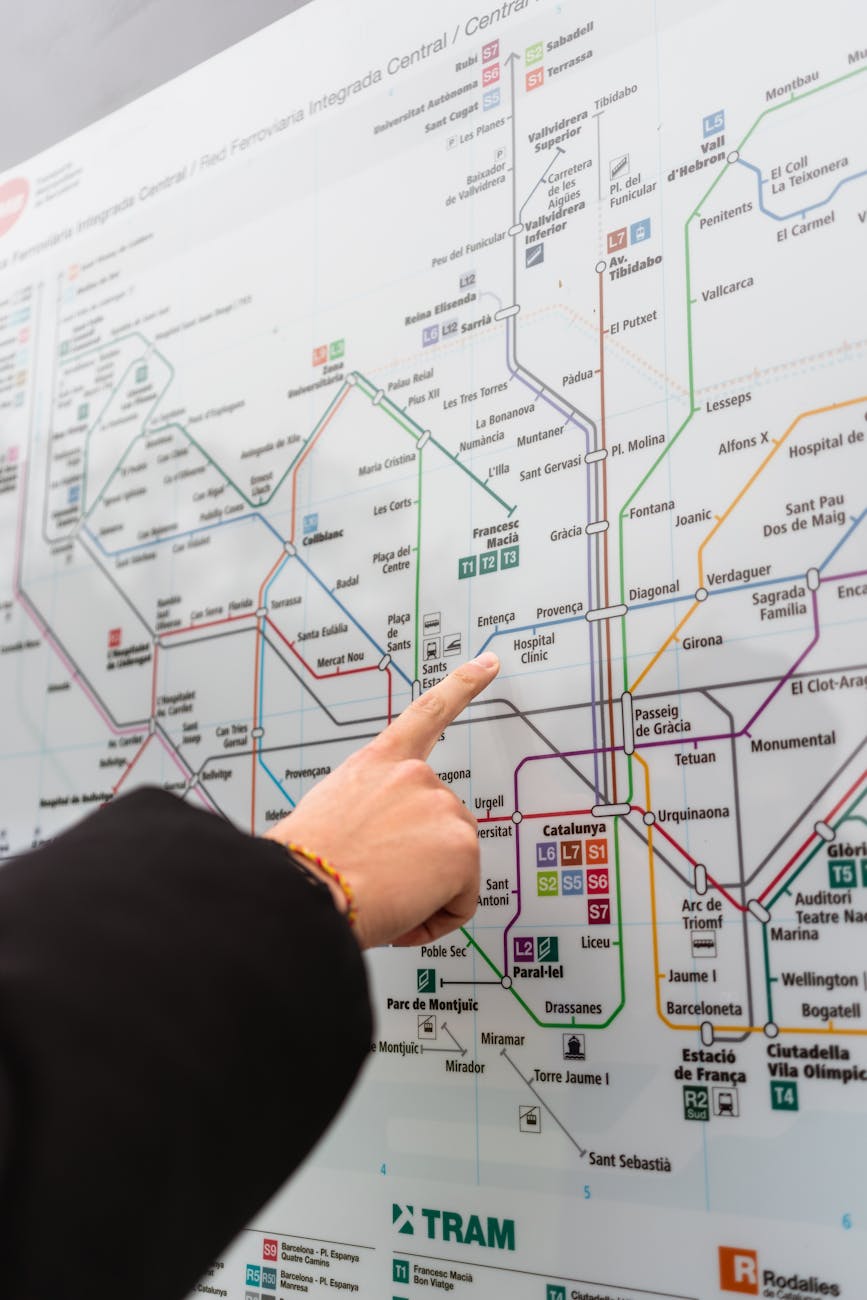
We’ll start with subway and train maps for most cities. They can be a bit deceptive in that the inventor of this system made them for ease of reading for stops and connections not to show how far apart those stops and connections were nor all the twists and turns of how to get there in reference to any specific direction. Just because it reads left to right doesn’t mean that a line is going precisely east to west, it could go in a general northeast to southwest direction or a northwest to southeast direction. Nor are the stations in a precise line, they may be quite staggered all over the city but be represented in a straight line. Once you understand that, it becomes much easier to understand what you’re looking at and to connect a city map to a subway map. It’s actually quite intuitive once you understand that.
Most subway and train platforms will show you which side leads to which direction. Many subways will have signs that start at the station you are at and show you all the stops until the line terminates in one direction and then have another sign that shows you all the stops until the line terminates in the other direction with helpful arrows pointing to which side of the platform corresponds to which part of the line. It’s actually rather intuitive. Now occasionally a line will branch further down or a platform will service multiple lines. To eliminate the guess work, simply look at the electronic signage typically above the platform that will usually display something helpful like “train to X stop in y minutes” (usually where the line will terminate), look at the list of stops on the sign and you can easily see which train is coming in. You will notice that I also added that these signs will often have the number of minutes you’ll be waiting. For most subways, the lines run every 10 or so minutes so there’s no need to rush to try and catch a subway car since they run quite frequently.
Once you’re on the subway or train, there is usually electronic signage indicating what stop is coming next. If not, then there is usually an announcement that comes on and you’ll often see signage outside the windows as you’re coming into a station to indicate where you are. Typically, all three indicators are present, which makes it quite easy to know what stop you’re arriving in.
Now to figure out which stop you need, you’ll often have to consult a city map for the various landmarks you wish to see and then look to see what the nearest station will be. You may need to transfer to different lines depending on your stay. You should also make sure you know how late various lines run as not every line may run 24 hours a day and you should be certain to check their websites for the most accurate and up-to-date information. Don’t assume because your friend did it a month ago that it hasn’t changed. Staffing shortages and weather can cause last minute issues. You don’t want to be caught in the middle of the night in the pouring rain miles from your hotel.
The subway is my favorite public transit because of its ease of use and simplicity. Most subways will pop you out within a five to ten minute walk of most landmarks and many subways have helpful signage pointing you in the general direction of those landmarks. I do recommend purchasing those city maps at local stations rather than simply relying on your phone as the maps are made for tourists. They often have the lists of the most popular sites along with an indicator of where on the map they are which can help you plan your trip, cluster sights together and potentially discover lesser known attractions that are tucked alongside bigger ones. These maps can also indicate lesser known entrances for popular destinations to help avoid crowds. For example did you know the Louvre has several entrances and you can avoid longer lines by using them rather than the main one?
You may need to purchase a subway card, tickets or simply use your credit card to tap and go. Every city is different so look up what you’ll need before you go. Some cities even have specific apps for their public transit system which can be quite helpful when trying to figure out routes. While google maps may be helpful, it won’t necessarily show you which stops are handicapped accessible if you’re traveling with someone who has limited mobility, their app will.
Now, I’m not as much of a fan as the bus, but I will say that they do tend to help close the gaps of the subway stations, especially when not every subway is handicapped accessible and in many of the smaller towns and villages the bus is your only option. I have not found the bus system to be as straight forward and easy to read as the subway nor are the systems employed by the various cities as universal as the subway. I have found that once you master the subway system in one city, it translates exceedingly well to other cities. Not so with the buses. The bus stops don’t always post bus schedules, they don’t always indicate where the bus is going, you may not realize that multiple lines stop at the same place. Often the maps provided will show where each line goes and won’t give you a nice neat way of seeing connecting lines like a subway. Now, this isn’t the case for every city, some are really good, others not so much. So make sure you research before you go and try to have a good idea of how to get around with the bus system before arriving at your destination. Just like with the subway system paying for the ride will be dependent on the city you’re using so be ready to purchase a card, ticket or to tap your credit/debit card. Just know that if you choose to tap your credit/debit card you may incur overseas processing fees depending on the type of card you have, so check with your bank prior to your travels and see if you qualify for a card that will forgo those fees.
Additionally, there are different sorts of buses, the buses within a city and the buses that traverse between major hubs. Buses within cities tend to follow similar rules as the subway. The buses between cities and major hubs may include things like a hold below for your luggage. These also tend to be a little more comfortable than the usual city bus as they’re made for longer trips. These buses have less stops but travel further. Be sure to bring both card and cash with you for the trip as sometimes they will only take one or the other depending on where you’re traveling.
In some cities, there is even a public boating system that will ferry you down the main river going through the city. Be sure to check out that potential if visiting a place with a larger river running through it like London.
Now if you’re traveling a longer distance, you may find yourself opting to travel by train usually because the airport isn’t the same place as your destination. Much like every other mode of public transit, it can vary vastly by country and even region as you may have a regional rail that you take, a national rail or a combination of the two. Typically taking a regional rail will mean more stops and thus slower whereas a national rail will be faster with fewer stops. Train stations can serve both national and regional rails. Regional rails tend to be cheaper than national, so when you’re booking tickets be certain to compare. Yes, the regional rail may be vastly cheaper, but you may lose an entire day of travel on a train rather than half a day if you take the national.
I advise purchasing tickets ahead of time as same day tickets tend to be more expensive. Now there are some systems in which different windows of time prior to the travel date affects the price of the ticket, so it may actually be better to wait a week or two for the optimal time when making your purchases. Some countries have rail passes which may be better to purchase. It is sometimes better to purchase your tickets directly through the rail system other times a 3rd party website can help you get the best deal by splitting the ticket for you. A split ticket, is when you pay for a ticket to a city between your start and end point and then pay for another ticket from that city to your end point which can save you money depending on how the fares work out.
Now this can be a bit of a trick as some train systems have windows of time where train tickets are cheaper, and same day tickets are usually the most expensive, so it’s better to purchase tickets in advance. This can be tricky if you’re unsure of the timing for flights, arrival and customs. However, this stress can be alleviated by purchasing flex-time tickets if they’re available for that train system. Flex-time tickets is fairly self-explanatory, it allows you to “flex” the time you take the train, so if your flight is delayed or your luggage took forever to arrive at the carousel, you needn’t worry about missing your train, as you can catch the next one, they are a more expensive option, but it’s still less expensive than purchasing a same day ticket or having to purchase multiple. Sometimes peace of mind is worth the extra cash. Many rail systems allow you to reserve your seats. If you’re someone prone to motion sickness, be certain to get a seat facing the front of the train. Personally, I like getting a seat with a table so I can spread out, work on a puzzle book, read, journal and relax. It also gives me a nice place to rest my head comfortably.
The best way to know what to do is to research the country’s train system that you’re going to since every rail system is going to be different, but there are usually ways to save money when taking the train with some foresight and careful planning.
As a native of Pennsylvania, I am relatively close to the coast meaning that a trip to the beach can be an easy day trip. It’s about 2 to 3 hours away depending on whether I want to enjoy a direct ocean front of the Jersey shore or a salt-water bay in Delaware and traffic. This means that I grew up going to the beach, not every summer but with enough frequency for it to seem like a fairly common experience.
However, if you dear reader have never been to the ocean it’s rather difficult to explain in words the sheer vastness that one is faced with when standing upon the shore. Yes, I have certainly spent time on the shore of a lake and enjoyed swimming in them, but most of them do not hold the same awe as the ocean. The sound of the water echoes miles inland. The power of the waves striking the shore push and pull you alternatively, sometimes rushing in with such force it pushes you forward or even down beneath the surface. Sometimes the pull of the water is just as powerful, ripping you from the safety of the shallow water, dragging you out towards the depths, in the infamous rip tides. To stand at the shoreline of the ocean is to stand at the precipice of nature’s power.
The only other body of water that held the same primal awe for me, was Lake Superior when the strength of the November winds proved too treacherous for even the most stalwart of ships to traverse. Perhaps, the Great Lakes are the only bodies of water to truly rival the ocean in terms of power and danger.
Yet, despite the sheer awesome force that is the ocean, even with its dangers lurking just below the surface, a day at the beach is one that I look forward to. I have many fond memories of being packed up into the car and driven to the beaches of Delaware or New Jersey. The water is not the crystal blue featured on postcards from the topics, but instead may range in color from gray, to navy, to even a sort of olive green depending on the weather and time of year.
I have spent many long hours diving into the waves, letting them take me as they will either towards or away from the shore. I have pushed and challenged myself against the ocean’s might fighting both against its power. There was something satisfying in defying the fury of the waves. It was also just plain fun to let myself be battered about, the thrill of the sheer force behind the ebb and flow of the ocean’s waves. I have tried my hand at bodyboarding to some success, but, as of this writing, I’ve never gotten to surfboard – it’s on the list.
When I was not deep in the waters, I would walk along the shore line enjoying the playful echoes of the more powerful wave which swirled about my ankles bringing in and revealing seashells. When one would catch my eye, I’d bend down and pick them up admiring the jewels of the sea. Although, I encourage you dear reader to leave the shells be or at least only take the choicest ones for I have since learned that our obsession with shell collection has had a detrimental effect on the shoreline. It is far better to take pictures and leave the shells behind or only take a very few if you absolutely must.
I have certainly taken the time to build sandcastles and make sculptures from the sand. I have enjoyed the boardwalks snacking on popcorn, devouring ice cream and taking in the ongoing carnival just off the shore. Although, one of my favorite activities is honestly, taking a low sitting chair, positioning myself in among the waves and reading a good book. I love listening to the sound of the waves as I read and to feel the gentle caress of the waves against my legs.
As an adult, I will typically spend the morning wading in the shallows and swimming in the deeper waters until the sun begins to beat down oppressively. After enjoying a picnic of whatever food I’ve packed, I pull out my book position myself in the water and start to read under the shade of my umbrella. After an hour or so, I will go for a long stroll along the shore line, keeping my path to where the sand and water meet, splashing in the waves as they swirl about my ankels, scouring the landscape for the choicest of shells until I begin to tire. When I return to my umbrella, I read more and then it’s back into the water I go. I may keep up the pattern of reading and swimming for several more hours until the sun begins to get low in the sky and I know that I should probably head home. A handful of times, I have stayed long enough to witness a sunset and linger until it was dark. That was usually when I was spending more than a day.
I have gotten the chance to enjoy beaches in various parts of the world, the north Atlantic, the Mediterranean and the Caribbean. I had spent a week in Rome and so one of the days, I decided to take the train over to the Mediterranean with my friend Erica and her friend Danielle. The three of us happened to make fast friends with two other American families who were also visiting Rome with their children. As it turned out they were two military families who took it upon themselves to ensure that the three young American women were taken care of. The three groups took turns watching one another’s items which allowed us to fully enjoy the ocean even with the advisory in place to be careful in the water. The men ensured that we were watched and safe the entire time. I am truly grateful to those service members who saw our protection as an extension of their duties even when not on official military business. The beaches of Rome were not all that different than the beaches of North America. The ocean’s color was almost the same and it carried similar risks.
The beaches of the caribbean were similar but in many ways different. The biggest difference was of course the color. The water was crystal clear allowing me to see the tiny fish swimming in the shallows. Farther out the color was a bright, blue rather than the grayish tones of the north. The waves were gentle, almost lapping against the shoreline rather than crashing into it. Of course, the vegetarian was also different. The northern climates is populated with shrubs and tall grasses jutting out of the sand, whereas the southern climates enjoyed towering palm trees which provided shade against the harsh sun. I would not say it was necessarily better or even vastly different, but it was a gentler experience. I can certainly understand the appeal of the calm, crystal clear waters.
Perhaps, it is my own more gothic nature, that I find myself drawn more to the wild oceans of the north over the calmer, gentler seas of the south. Give me the rough, rugged and untamed seas with their biting winds and frigid, gray waters. I do so enjoy a dark sky and a cool ocean as the perfect backdrop. Fall is probably one of my favorite times to visit, when the crowds of summer have dissipated and the weather starts to have a bit of a bite to it. I don’t mind needing a blanket to curl up under against the winds. I also enjoy the early spring, when the sea is still wild from the winter and the water carries winter’s sharp sting. Whatever the time of year or the weather, I do simply enjoy the ocean. A day on its shore is always relaxing and a bit exciting.
How can you enjoy a day at the beach?
Obviously, if you are along the coast line, spending a day at the beach is relatively easy. Many public beaches are free or have only a minimal fee for parking. As hard as it is for me to believe, I have met people who despite living within a 2 to 3 hour drive of the coast have never been. By all means if you do live within a day’s drive, take some time to enjoy the coastline. As I wrote above, the shore does not even need to be enjoyed during the peak season. I found my favorite times to go were in the spring and fall during the off season when the crowds were lessened. If you go in the fall, the water will most likely still be warm from the summer, but the colder water can be exhilarating in its own right.
If you are not near the coast line, there are of course lakes for you to visit. Although, I will say a day at a lake is quite different than a day at the shore with few exceptions. However, it is not so different that you cannot enjoy similar activities. Each person is different and may find different thresholds for meaningful differences than I do. To me at a certain point, a beach is a beach whether that is in the North Atlantic or Caribbean. To others, there may be such a vast difference between the two kinds of beaches as to warrant the necessity of visiting one or the other. It was my general feeling that at a certain point a beach is a beach which led me not to want to spend too many days at tropical beaches when in the Caribbean and South America. As it turns out, I am actually more fond of northern beaches anyways. I absolutely loved the beach in Cornwall and it was in the middle of February when we went.
As always, beauty is in the eye of the beholder. You, dear reader, may decide that a day at the lake is equal to a day at the beach. You may also decide that you want to check off tropical beach rather than any old beach. To that, I say, tack on a beach day to a trip if you can. If like me when staying in Rome, you’re spending a week somewhere and you can easily access a beach, then take the time to visit the shore. I do not regret spending the day in the Mediterranean. It was a lovely day to relax and recover from trekking all over the city.
Completed: childhood
Cost: Gas money and a packed picnic ($100)
Miles from home: Nearest 135 miles to nearest beach (approximately 3 hours)
The title is a slight exaggeration, but I think the comparison is apt. After all, in three of the world’s major monotheistic religions, paradise is a garden.
So, what exactly is a botanical garden? Aside from being a beautiful place to wander around in quiet contemplation, botanical gardens are gardens with a documented collection of plants for the purposes of scientific research, education, conservation and display. They feature the botanical names of the plants. Hence the name botanical garden – not necessarily the cleverest of names, but it certainly gets the job done.
Some of my earliest memories consist of gardening. Lacking cable, one of my favorite pastimes was actually watching “The Digging Show” or my parents gardening. I loved spending time among the plants and the flowers learning their names, cataloging their color, inhaling their scents and at times nibbling upon them. I quite enjoyed the various herbs and was quite familiar with which ones were safe for me to consume and which ones were best avoided. I spent many hours going to various nurseries. As my parents shopped, they became my playgrounds. Not that I disturbed the merchandise (I had been taught to look not to touch), but I still explored, searching out new plants and finding the statutory and other garden decor scattered about. Our garden was huge and well known in the neighborhood as one of the best. We even had a photographer request to come and take photographs of our garden.
It should come as no surprise then, that I love going to botanical gardens to stroll among the flowers and greenery. Each one is so different which only serves to highlight the vast biodiversity of our planet where no two gardens are alike. Some focus on specific areas while others span ecosystems throughout the planet. No matter what I always find a bit of wonder in them as I am taken in by the majestic blooms and vibrant hues of the leaves. I’ve seen giant lilly pads and a huge array of orchids. I have been overpowered by the sweet scent of roses and delighted by the scent of apple blossoms.
The architecture of these gardens are often a highlight as well featuring delicate archways and imposing pillars. Many of the gardens have various fountains and waterways snaking through them. They may even have plunging waterfalls. Longwood Gardens in particular is known for its spectacular water show which is predominately displayed in the center of the gardens. However, it is also home to more humble buildings, small wooden cottages or small towers tucked away in forested areas. To traverse the gardens is to move from landscape to landscape each with its own unique take on what makes a garden. There are times when the juxtaposition of the two can almost seem jarring as one moves from one area to the next as if the doorways themselves are portals to between worlds.
Each world is a delight to the senses and one hardly notices the passage of time or the encroaching heat of a warm day or the way the chill of a winter begins to seep its way into your bones on those cooler days. In all seasons, the gardens offer something new as they are always changing with the pattern of the year. It means there is never a bad time to visit and one can visit quite often as there is always a shift. What was in bloom only a few weeks ago may have faded and a new plant has come to take its turn in the spotlight. The gardens can be enjoyed both in quiet solitude or with a group of friends.
I find that day among the plants and flowers is as refreshing as a day at the spa. A connection to nature is an important part of mental health. Time outdoors helps to reduce stress and anxiety. Fresh air is also correlated with increased physical health. Exposure to nature is associated with better cognitive function. Certainly spending time in such oxygen rich environments is good for your lungs when we spend so much of our time inside. So yes, it can certainly feel like one has discovered a small slice of paradise when visiting as the stress of the outside world begins to melt away. I certainly envision heaven as a botanical garden, populated with cats of course, with ready access to a vast library of books and tea.
How can you visit your own slice of paradise?
Luckily, botanical gardens are found throughout the country and indeed the world, so finding one should be relatively simple. I recommend wearing comfortable walking shoes and to pick a day when the weather is particularly good. You will most likely want to bring some water as they are often deceptive in size – they are always bigger than you anticipate. Armed with proper hydration and shoes, you will ensure that your beautiful garden experience doesn’t become hellish.
Completed: First completed in childhood in a visit to Longwood Gardens
Cost: $32 per person (can vary depending on time of year)
Miles from home: 45 miles from home
I have also visited other gardens throughout the country as I am always up for visiting a garden.