Travel Tips: Trains, planes and Automobiles Part 2

As my original intended post ended up being far too long, I had to break it down into several different ones. Since the original post was titled “Trains, planes and Automobiles”, it seems to make sense that I shall be covering tips for planes next. In a previous post, I discussed luggage and maximizing space with tricks of layering, additional pockets, etc. So I will not insult you gentle reader by repeating myself as I am certain you are capable of remembering previously presented information. Nor will I go into how to snag cheap flights as I have already covered that in other posts, although only briefly. I may eventually make a dedicated post for how to get cheap tickets when traveling, but this post isn’t that. Mostly, this will cover how to help make your plane experience as pleasant as possible because let’s face it, unless you’re flying first class, flying is pretty miserable.

One of the easiest ways to make your flight more pleasant is by having the right seat. There are many different considerations for optimal seat position. Some people love to be at the window (like me), others swear by the aisle seat because it gives them a place to stretch their legs. On some planes there are aisle seats that have no seats in front of them as they make the transition from economy plus to economy, so if you’re looking to maximize leg room, there are two aisle seats on the plane with lots of extra space. However, if you cannot snag those positions then you’ll want either a bulkhead or exit row seat. If you can look at the plane you’ll be flying on ahead of time (information that should have been available at time of booking), you’ll already know which rows those are.

Some people want to sit in the “safest” seat  which surprisingly is a middle seat in the back of the plane as those have the highest survival rates in the event of a crash. The other upside to the back of the plane is this is where you’re most likely to have an empty seat next to you since most people don’t want to sit in the back. After all the back of the plane is where you’ll experience the most turbulence and have the longest disembark time. This is also where one of the on-flight kitchens is located meaning that there will be increased noise. You will also have more noise at the very front of the plane for the same reason.

Sometimes you can pick your seat the same day as you book your flight without paying a fee to do so, but most of the time you have to wait until 24 hours in advance to “check-in” in order to avoid paying a fee. Some airlines are starting to charge you even during the 24 hour window, as always do your research when comparing prices. If traveling internationally be sure to have your passport waiting with you so you don’t waste precious time looking for your passport trying to snag your preferred seat. Check out other blogs for the specific airline or airplane you’re traveling with to see if there’s any tips for optimal seating. If you’re traveling on an overnight flight, you may want to double check the location of the bathroom if you’re a light sleeper to avoid being disturbed or if you’re someone who needs to go frequently, be sure to snag that aisle seat near by.

Extra tip: Many people will rush the bathroom right after take off, after meal times and right before landing. Set an alarm for about 2 hours before landing on long haul flights to avoid the rush.

Once you have your seat selected, the next step is to time your arrival at the airport. Many first time flyers make the mistake of thinking the time of their flight is the last possible minute they can board the plane. This isn’t the case. Make sure that when you do your online check in you take a moment to check your ticket. Often they will have two other times listed, the time that you have to have cleared security by and the time the doors to the plane will close. Just because you’ve cleared security doesn’t mean that they’ll hold the plane while you shop or finish a meal. Make sure you allow an hour to make it through security, so whatever time it says try to arrive at least an hour ahead of time. If you’re parking in a long term economy lot, add an extra 15-20 minutes to locate a parking spot, get to a bus stop and take the bus to the correct terminal. Make sure you take a picture of where you parked and what bus stop you were picked up at. Depending on typical traffic for the airport you’re going to, add extra time to your commute and check online for tips of frequent travelers in and out of your airport to see if there is anything you should know. I usually try to add at least 30 extra minutes to my commute into Philadelphia and an extra 60 minutes if traveling during rush hour.

To help make security easy, try and have all your paperwork in an easy to locate place. Wear shoes that are easy to slip on and off (not every airport makes you take off your shoes anymore as it depends on their machines and the thickness of your soles). Have your clear bag of toiletries on top of any luggage you’re bringing through security (like with your shoes not every airport makes you take it out of your bag, but some still do so it’s better to be prepared). If wearing layers try to make sure you can slip your layers on and off without much fuss. The less you have to take off and out, the easier and less stressful this process is. The key is of course to follow the verbal directions of the security people, don’t try to be smart or funny with them, even if you’re the most hilarious person at the airport that day. If you’re unsure of a directive just ask politely for clarification. If you think for any reason that you may need extra assistance with a disability, contact the airport ahead of time to discuss and make sure to clarify with them their recommendations on additional time needed to get through security with assistance. I personally recommend at least an extra hour if you’re going to need assistance as a wheelchair may not be available right when you arrive, they may be short staffed or assisting other customers. Most airlines subcontract this out and the airline you booked with may have little control over these personnel.

I usually don’t get pulled aside at security but here are the three reasons I have been patted down before or searched. The first was a big surprise. I’m an avid reader and apparently the way my rather thick book was packed triggered off the alarm bells as a potential bomb. e. To avoid this, I now only use my e-reader or smaller, shorter books. The second reason is that I have really thick, long hair so when I wore it in a single braid down my back, that triggered a check. To avoid that happening again, I now wear it in two braids. The third was sweat on my back. I was just anxious that I was forgetting something important and it was clawing at the back of my mind the whole drive to the airport – as it turns out, I had forgotten to pack my hairbrush, so nothing that couldn’t be rectified upon arrival but it did trigger a search. As you can see, you can get pulled aside for a search for seemingly no reason, honestly a book, my hair and a sweaty back? The last one was slightly embarrassing, but what can I say, sweating is a natural human reaction to stress and flying can be a stressful thing. To avoid this, take deep breathes and wear breathable clothing.

Now there are many things that one can do to make the flight more comfortable. The first thing I do, is make sure I have something to block out noise and typically carry two ways to do this. The first is my earbuds, the second is a headwrap with bluetooth speakers that I can also use as a sleep mask. I really like the headwrap with bluetooth speakers because I don’t have to worry about my earbuds falling out and they’re super compact to pack. Other people swear by noise cancelling headphones, I don’t like this option because it means that I may miss important announcements, but for other people they’re a must have on a flight.

The second thing I do is to have a variety of ways to entertain myself. I load up on my e-reader and pack a small book that I can read in the event I run out of battery. I also carry a small activity book with puzzles or other games to keep me entertained. My phone has a few apps that can be used offline, along with lots of music. Most long haul flights do include headphones to allow you access to inflight movies and other entertainment, but not every airline will do this so you may want to pack ones that can use a headphone jack rather than a USB. It’s rare that I find myself watching an inflight movie, so I tend to skip packing headphones. I do, however, always carry a portable charger since I can’t guarantee that a charging station will be available or that it will have the right plug. A lot of airlines are getting better about this but in economy class there is often only two plugs per three passengers, so rather than chance ending up in the news over a charging station, I just have my own.

Prior to boarding I try and go for a brief walk just to get my legs moving and blood pumping. Usually this walk consists of going to the bathroom one last time. I also try and dress in at least two layers because I am almost never comfortable on a plane, I am either freezing cold or dying from heat. Having a layer ensures that I comfortable. The same can be said for shoes that can easily be slipped off and exchanged for slippers (remember most people do not want your bare feet out and about, it’s considered rude and there are airlines that are starting to crack down on bare feet, slippered feet however is usually acceptable). Make sure to put your shoes back on if you’re walking about the plane for sanitary reasons. 

Make sure to pack a portable water bottle and some snacks. Once you’re through security, you can fill up your water bottle at the many water fountains to help keep yourself hydrated as travel can and does take a lot out of you. I also like to pack snacks. While most airlines do offer snacks and even meals there’s no promise that you’ll like them or that you will get them. On a recent long haul flight, we were supposed to end the flight with a snack. However, several of the flight staff suddenly came down with an illness mid-flight so for safety reasons they did not feed us. So with my snacks, I always pack and use hand sanitizer and sanitizing wipes. I don’t know about the other passengers on my flight, but I do know that I managed to avoid contracting the illness. Additionally, in an effort to save money some airlines have stopped including meals and now require you to pay for them. They may require you to use their app in order to make inflight purchases rather than accepting cash or credit card in flight.

Along with hand sanitizer, I will usually pack a few things to help keep me feeling fresh. As I shared earlier, flying can be stressful and when we are stressed, we sweat. Having a few baby wipes, moistures and even travel toothbrushes can help you feel, look and smell your best. 

Now there are people who swear by travel pillows. Personally, I never use them. I don’t sleep on planes, I never could and often the long haul flights do offer small travel pillows and blankets anyways. But that doesn’t mean you shouldn’t if you’re the sort of person who can sleep anywhere (first stop and post in the comments below your secrets, I wish to learn oh wise one!). If you are someone who plans on sleeping, don’t sleep during take off or landing as it apparently negatively impacts your ears ability to regulate their air pressure. Not having ever slept on plane, I cannot comment to the validity of this rumor, but I’ve seen this advice in several places. Travel pillows may also be helpful for people with back or neck pain as planes aren’t known for their superior lubar support. However, if you’re not one of those people then a travel pillow becomes an unnecessary burden and I wholly recommend skipping it.

This last one should seem obvious but it always surprises me how few people do it, I see them popping up and down all flight getting their stuff. Keep your airplane essentials in one place and I recommend that be in your personal item. There is no promise that your luggage will end up in the overhead compartment above you. You may end up having it in an entire other section of the plane, or checked in at the gate for various reasons. I often will pack my personal item with all the things I may want on the plane: e-reader, portable charger, activity book, notebook, earbuds, snacks, etc. Within my personal item, these things are often packed in smaller bags which makes it really easy to just reach in and find what I want quickly. I have a collection of small purses because I either have a massive purse with everything in it or a tiny purse that literally holds my phone, my wallet, my keys and maybe a tube of lipstick. The purses are so useful for organizing my luggage and then I have cute handbags for all my outings on my trips, fashion meets practicality, a win for all. 

There are certainly other tips that people may recommend and I encourage you to go out and see what other passengers have done to make flights more comfortable. As with all tips and tricks, consider whether they will work for you. As I said earlier, I don’t bother with travel pillows, I don’t ever seem to use them and always regret packing them, but for many people they are essential and worth the extra hassle they cause. You may also read tips and tricks that other passengers won’t appreciate so if it seems a little odd, you may want to check the comment section or the rest of the internet to see if you’re breaking unspoken plane etiquette which could land you in hot water with your fellow passengers. While it may be your “right” to do something, you do increase your chances of ending up in a mid-flight brawl if you ignore plane etiquette, so I encourage you to be polite.

Keep in mind the airline industry is always evolving. Airlines are cracking down on what people can carry on a plane. They’re no longer allowing a free pass on things like pillows and blankets but rather counting those as your personal item. Always, always, check the airline’s website for the most up to date rules and if you’re looking at a blog for luggage “hacks” to avoid fees, make sure you check to see when it was published because the tricks may no longer apply.

Travel Tips: Trains, Planes and Automobiles Part 1

And buses! And taxis! And other forms of transportation! I kept the title short because it was more catchy, but truthfully there are many different ways for humans to get around, but not all of them are a straightforward as one might think. Despite me trying to keep it brief, it ended up being a rather long post so I’m splitting it up.

I shall begin by giving an overview of most public transit systems, how to read their schedules and their routes since most Americans haven’t used public transit much in their lives if ever. A byproduct of the post-WW II infrastructure bills was an increase of car usage and a decline of public transit. I won’t go into all the politics involved or discuss the lobbies by the car manufactures because it’s not exactly relevant here, but it’s a fascinating history that is well worth the investigation for my more academically mined readers. As politics and history aren’t exactly within the scope of this blog, we shall simply acknowledge the reality that in America the car is king and so many haven’t had much experience with public transit. 

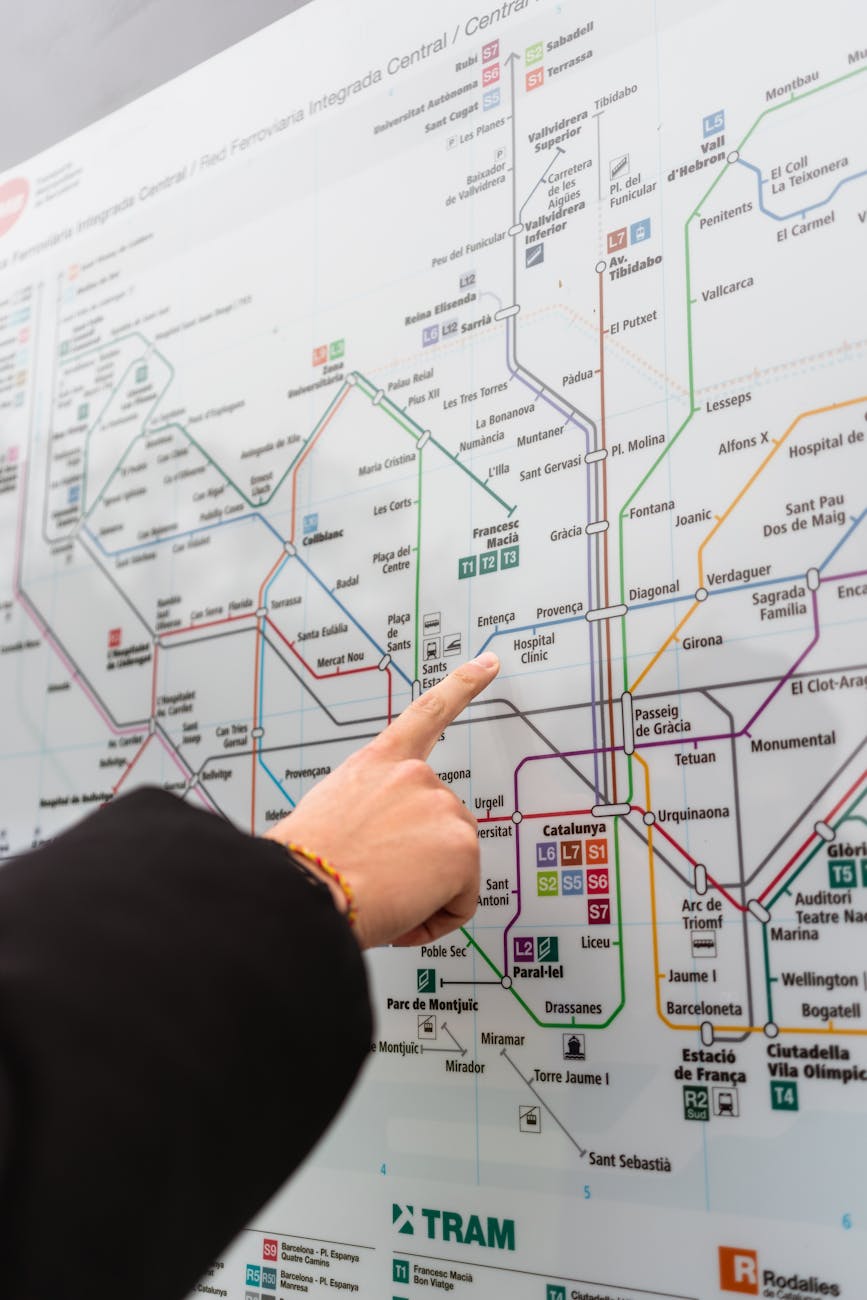
We’ll start with subway and train maps for most cities. They can be a bit deceptive in that the inventor of this system made them for ease of reading for stops and connections not to show how far apart those stops and connections were nor all the twists and turns of how to get there in reference to any specific direction. Just because it reads left to right doesn’t mean that a line is going precisely east to west, it could go in a general northeast to southwest direction or a northwest to southeast direction. Nor are the stations in a precise line, they may be quite staggered all over the city but be represented in a straight line.  Once you understand that, it becomes much easier to understand what you’re looking at and to connect a city map to a subway map. It’s actually quite intuitive once you understand that.

Photo by Enric Cruz Lu00f3pez on Pexels.com

Most subway and train platforms will show you which side leads to which direction. Many subways will have signs that start at the station you are at and show you all the stops until the line terminates in one direction and then have another sign that shows you all the stops until the line terminates in the other direction with helpful arrows pointing to which side of the platform corresponds to which part of the line. It’s actually rather intuitive. Now occasionally a line will branch further down or a platform will service multiple lines. To eliminate the guess work, simply look at the electronic signage typically above the platform that will usually display something helpful like “train to X stop in y minutes” (usually where the line will terminate), look at the list of stops on the sign and you can easily see which train is coming in. You will notice that I also added that these signs will often have the number of minutes you’ll be waiting. For most subways, the lines run every 10 or so minutes so there’s no need to rush to try and catch a subway car since they run quite frequently.

Once you’re on the subway or train, there is usually electronic signage indicating what stop is coming next. If not, then there is usually an announcement that comes on and you’ll often see signage outside the windows as you’re coming into a station to indicate where you are. Typically, all three indicators are present, which makes it quite easy to know what stop you’re arriving in. 

Now to figure out which stop you need, you’ll often have to consult a city map for the various landmarks you wish to see and then look to see what the nearest station will be. You may need to transfer to different lines depending on your stay. You should also make sure you know how late various lines run as not every line may run 24 hours a day and you should be certain to check their websites for the most accurate and up-to-date information. Don’t assume because your friend did it a month ago that it hasn’t changed. Staffing shortages and weather can cause last minute issues. You don’t want to be caught in the middle of the night in the pouring rain miles from your hotel. 

The subway is my favorite public transit because of its ease of use and simplicity. Most subways will pop you out within a five to ten minute walk of most landmarks and many subways have helpful signage pointing you in the general direction of those landmarks. I do recommend purchasing those city maps at local stations rather than simply relying on your phone as the maps are made for tourists. They often have the lists of the most popular sites along with an indicator of where on the map they are which can help you plan your trip, cluster sights together and potentially discover lesser known attractions that are tucked alongside bigger ones. These maps can also indicate lesser known entrances for popular destinations to help avoid crowds. For example did you know the Louvre has several entrances and you can avoid longer lines by using them rather than the main one?  

You may need to purchase a subway card, tickets or simply use your credit card to tap and go. Every city is different so look up what you’ll need before you go. Some cities even have specific apps for their public transit system which can be quite helpful when trying to figure out routes. While google maps may be helpful, it won’t necessarily show you which stops are handicapped accessible if you’re traveling with someone who has limited mobility, their app will.

Now, I’m not as much of a fan as the bus, but I will say that they do tend to help close the gaps of the subway stations, especially when not every subway is handicapped accessible and in many of the smaller towns and villages the bus is your only option. I have not found the bus system to be as straight forward and easy to read as the subway nor are the systems employed by the various cities as universal as the subway. I have found that once you master the subway system in one city, it translates exceedingly well to other cities. Not so with the buses. The bus stops don’t always post bus schedules, they don’t always indicate where the bus is going, you may not realize that multiple lines stop at the same place. Often the maps provided will show where each line goes and won’t give you a nice neat way of seeing connecting lines like a subway. Now, this isn’t the case for every city, some are really good, others not so much. So make sure you research before you go and try to have a good idea of how to get around with the bus system before arriving at your destination. Just like with the subway system paying for the ride will be dependent on the city you’re using so be ready to purchase a card, ticket or to tap your credit/debit card. Just know that if you choose to tap your credit/debit card you may incur overseas processing fees depending on the type of card you have, so check with your bank prior to your travels and see if you qualify for a card that will forgo those fees.

Additionally, there are different sorts of buses, the buses within a city and the buses that traverse between major hubs. Buses within cities tend to follow similar rules as the subway. The buses between cities and major hubs may include things like a hold below for your luggage. These also tend to be a little more comfortable than the usual city bus as they’re made for longer trips. These buses have less stops but travel further. Be sure to bring both card and cash with you for the trip as sometimes they will only take one or the other depending on where you’re traveling.
In some cities, there is even a public boating system that will ferry you down the main river going through the city. Be sure to check out that potential if visiting a place with a larger river running through it like London. 

Now if you’re traveling a longer distance, you may find yourself opting to travel by train usually because the airport isn’t the same place as your destination. Much like every other mode of public transit, it can vary vastly by country and even region as you may have a regional rail that you take, a national rail or a combination of the two. Typically taking a regional rail will mean more stops and thus slower whereas a national rail will be faster with fewer stops. Train stations can serve both national and regional rails. Regional rails tend to be cheaper than national, so when you’re booking tickets be certain to compare. Yes, the regional rail may be vastly cheaper, but you may lose an entire day of travel on a train rather than half a day if you take the national.

I advise purchasing tickets ahead of time as same day tickets tend to be more expensive. Now there are some systems in which different windows of time prior to the travel date affects the price of the ticket, so it may actually be better to wait a week or two for the optimal time when making your purchases. Some countries have rail passes which may be better to purchase. It is sometimes better to purchase your tickets directly through the rail system other times a 3rd party website can help you get the best deal by splitting the ticket for you. A split ticket, is when you pay for a ticket to a city between your start and end point and then pay for another ticket from that city to your end point which can save you money depending on how the fares work out.

Now this can be a bit of a trick as some train systems have windows of time where train tickets are cheaper, and same day tickets are usually the most expensive, so it’s better to purchase tickets in advance. This can be tricky if you’re unsure of the timing for flights, arrival and customs. However, this stress can be alleviated by purchasing flex-time tickets if they’re available for that train system. Flex-time tickets is fairly self-explanatory, it allows you to “flex” the time you take the train, so if your flight is delayed or your luggage took forever to arrive at the carousel, you needn’t worry about missing your train, as you can catch the next one, they are a more expensive option, but it’s still less expensive than purchasing a same day ticket or having to purchase multiple. Sometimes peace of mind is worth the extra cash. Many rail systems allow you to reserve your seats. If you’re someone prone to motion sickness, be certain to get a seat facing the front of the train. Personally, I like getting a seat with a table so I can spread out, work on a puzzle book, read, journal and relax. It also gives me a nice place to rest my head comfortably.

The best way to know what to do is to research the country’s train system that you’re going to since every rail system is going to be different, but there are usually ways to save money when taking the train with some foresight and careful planning.

Water Lantern: A Festival of Reflection 

It was a warm summer evening, when my sister and I embarked on a journey to the far east or rather to partake in some food and traditions imported from Asia to the United States. This particular evening, we were attended a Water Lantern Festival. One of the amazing things about America is our immigrant roots, welcoming people from across the globe. These people come and bring with them their culture, traditions, beliefs, music and cuisines. It is what makes America a rich, cultural tapestry of endless variety.

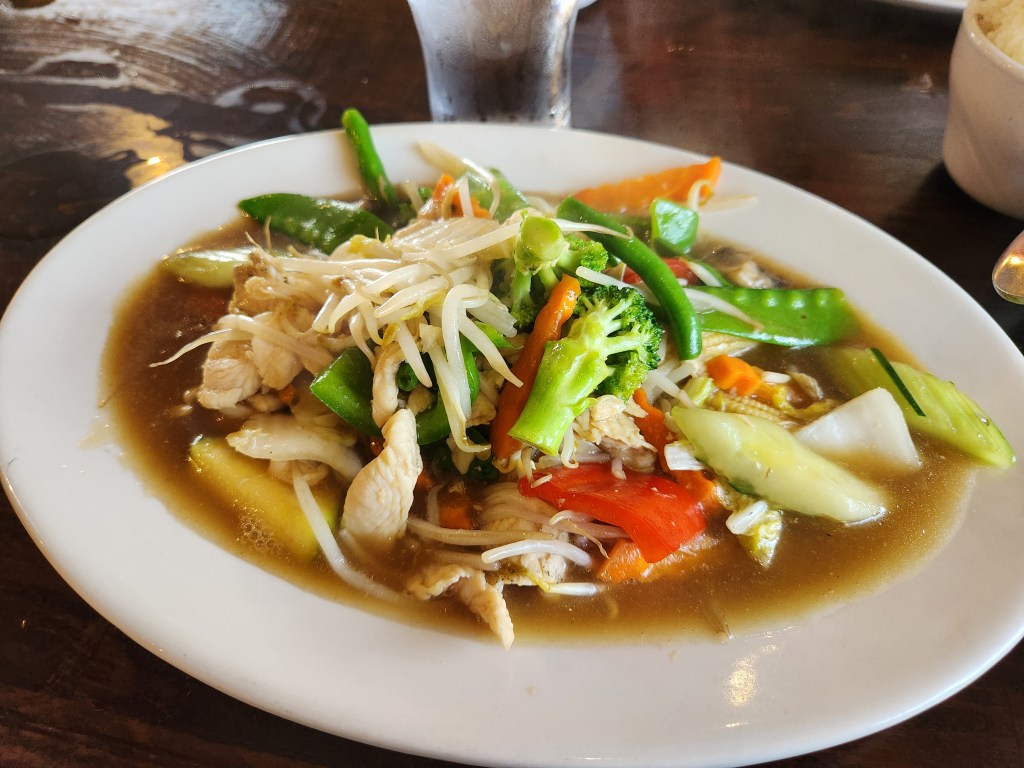
We began our journey by stopping at a Thai restaurant which is owned and operated by Thai people. I always get excited when I can stop at places owned by people who intimately understand the cuisine they are cooking, whether that be because they are originally from there, have family originally from there or spent enough time in careful study to obtain a level of mastery in the authentic way the cuisine ought to be prepared. As someone who doesn’t necessarily have the money to hop on a plane to experience authentic Thai food, I appreciated the opportunity and the culinary skill of the chef. Dinner was a delicious red curry, since I cannot resist a menu item with Thai Basil and my sister had their drunken noodles of which I stole a few bites. 

After dinner, we headed over to Harrisburg to the Italian garden where the Water Lantern Fest would be held. The Italian garden is beautiful in its own right, but it was extra festive for the fest and the weather proved to be perfect. It wasn’t too hot, nor was it chilly. The blue sky was clear overhead and it promised to be a lovely evening. It took us a little time to locate the actual stand to obtain the water lanterns as the park was open for all to enjoy. We did eventually find the true “entrance” to the fest by asking some people for directions and headed up the hill to obtain our goodie bags and lanterns. After claiming our prizes, we walked around the end of the manmade lake to find a good spot under the shade of a tree. 

I had attended a lantern fest before, where you release lanterns into the sky which took on a more party atmosphere for the people attending with music and bounce houses, bonfires and food trucks. This one had most of those things tucked away from the main event so that you could still enjoy vendors, food and other activities, but it did not distract from what you were there to do.  Nor was the crowd quite as big as at the Lantern Fest which was just as well, since I tend to favor smaller events to the massive crowds. What I enjoyed about this one was the more subdued and even reflective atmosphere. Flags proudly proclaimed things like gratitude, healing, love and connection, encouraging you to reflect rather than party. The crowd was fairly quiet with many people conversing with their heads together, smiling and laughing. The goodie bag even included conversation cards with prompts to start deeper discussions with the people you were with in order to foster deeper connections. My sister and I were delighted by these and have taken them out at other occasions and have found them to be great at prompting conversations. 

The kit for the lantern included a wooden base, a lantern which could be written upon and a small led candle to turn on and place in the lantern. We noted that most of the lantern components could be reused, recycled or easily be broken down in the environment. Being a manmade lake, the lanterns were in no danger of polluting local waterways or interfering with native wildlife. In addition, the event organizer One World proudly supports water.org. Water.org is an organization which focuses on increasing global access to safe drinking water. They include an informational pamphlet and easy options to donate to raise money to support this cause. I love it when an event is able to go beyond just an enjoyable evening and helps to provide a positive impact.

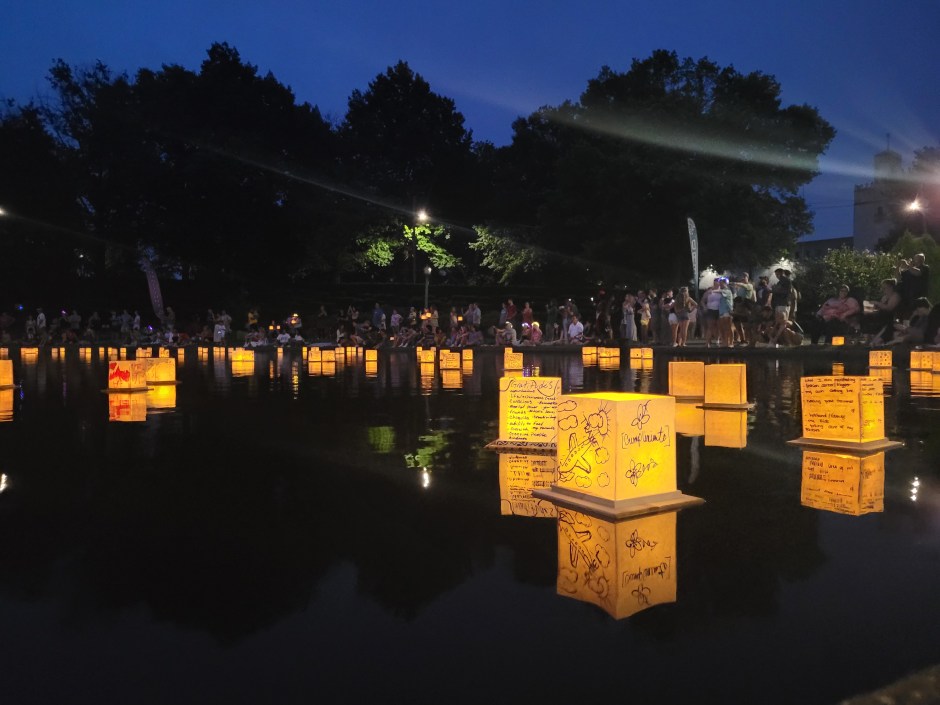
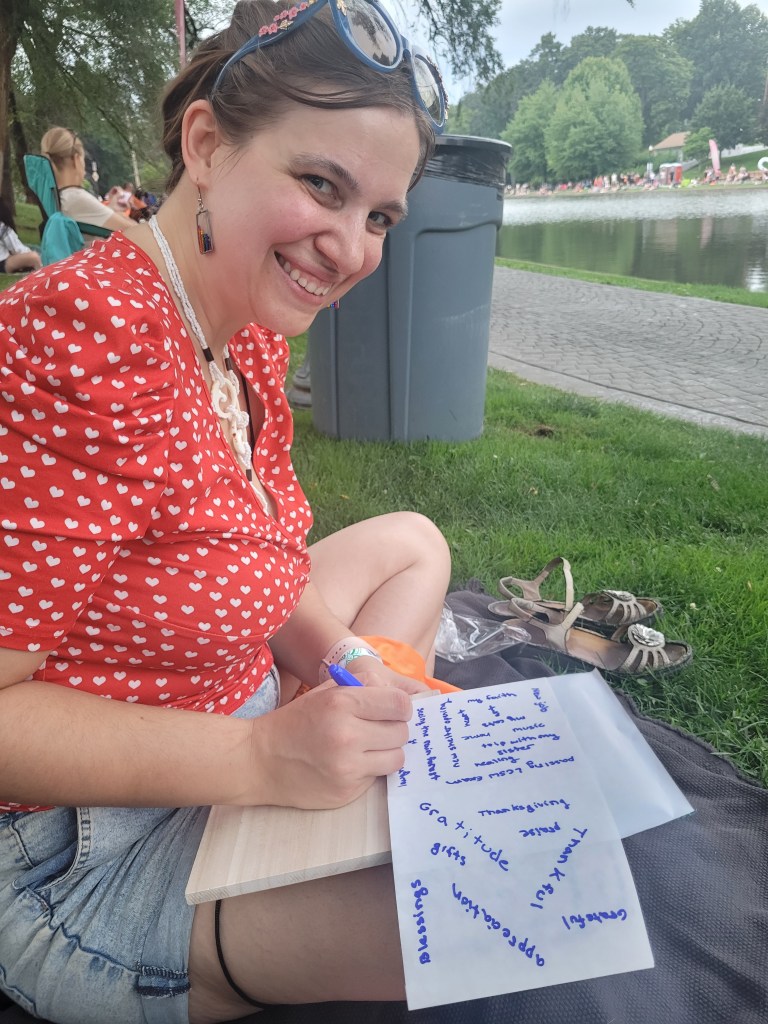
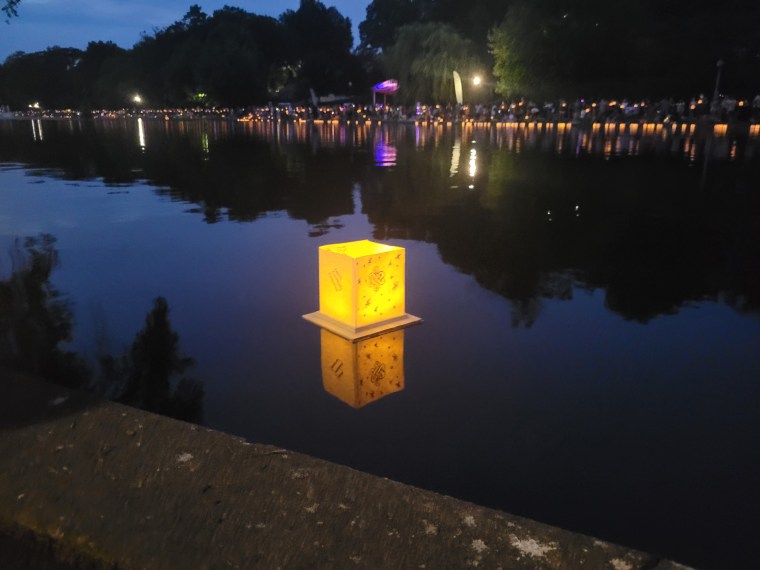
I decorated my lantern with things that I was grateful for and my sister decorated hers with art including a celtic knot and a flowers. Once the sun slipped beneath the horizon, they asked us to gather around the edges of the lake and to pause for reflection. Then they invited us to release our lanterns to allow them to float upon the water. One by one, they spread out, glittering together like stars. As I stepped back to take in the sight, I was able to let out a deep sigh of contentment. Naturally, we snapped a few photos, but mostly my sister and I just walked along the path enjoying the sight and quietly conversing. 

It should be noted that while my dinner was still firmly rooted in its culture of origin, the Water Lantern Fest was less so. Water Lamps originated in India and spread throughout Asia most likely through Buddhist diffusion. They appear in many festivals and have many meanings ranging from worshiping gods, praying for a good marriage, welcoming happiness, guiding the spirits of the departed or welcoming happiness. In Vietnam, there is a town which releases them quite frequently. In China, they are released throughout the year. In Japan, they usually release them to help guide the souls of the dead to the spirit world and allows for reflection for lost loved ones. Sometimes, things are lost in translation especially as it gets diffused across different cultures as it has in Asia since they have a lot of different meanings all over the continent.

Still, despite being a bit unmoored from its roots, it still felt as if it were in the spirit of the original customs. Where other events encourage a sort of frantic, frenanic frenzy of activity, this festival invited you to slow down, to pause and reflect. It encouraged building relationships between people and being more mindful of your surroundings. They also allowed people to come up to a microphone and share their stories. Some people shared their loss, others shared their victories, whereas others shared gratitude. There were lanterns that people dedicated to their loved ones. In a sense, the festival was a melting pot of the many traditions associated with water lanterns from Asia and transforming into something uniquely American. It certainly was not an authentic experience, but it falls under my “good enough” category. 

How can you experience a Water Lantern Fest?

The best way is to go to their website WaterLanternFestival.com and click on your state to see when they might be coming to you. I encourage you to buy tickets early since they increase in price as the date approaches. 

However, there is nothing to stop you from ordering some lanterns and LED candles and hosting your own smaller version with a group of friends. Although, it doesn’t quite hold a candle (pun intended) to seeing a few hundred floating all together, their reflections shimmering in the darkness of the water. It is also important to note that there may be local ordinances preventing such an activity and you would need to ensure proper clean up. After all, we want to keep our local environments beautiful so we can continue to enjoy it for years to come.

Completed: July 15, 2023

Cost: $36 per person (was advertised as $27 but there were vendor fees)

Miles from home: 45 

Travel Tips: The Art of the Deal

To continue on my tips for traveling, we’re going to talk about deals, their pros, cons, constraints and other considerations. Because we’ve all seen those travel blogs and social media posts promising cheap travel or insider tips and it can be tempting to jump on what seems to be an offer you can’t refuse, but there can be pitfalls that even the savviest person may find themselves prey to.. Here’s my tips on how to help you find good deals and how I keep costs down when I travel. After all this is a budget bucket list blog and I hope to show you how to live a life full of adventure without having to go into debt to do it.  

In a previous post, I discussed a form of reverse travel planning of considering all your constraints ahead of time and then picking your destination. There are some people who will do a form of reverse travel by first picking the time they want to travel and then just look for deals to any destination and go based on that. I had a work colleague who took off for three weeks every summer and would travel for about one to two of those weeks being highly flexible with the dates and going to wherever was cheapest during that time. She enjoyed using Kayak to help her find those deals and then usually backpacked her way around a given country. There are many other websites and social media pages devoted to helping people find cheap flights and accommodations. Some people swear by hello going and others will literally troll websites for mistake deals and price track. If you aren’t too picky about where you’re going, these are great resources and can help you cross off your bucket list for less than you’d ever imagine. 

Photo by Pixabay on Pexels.com

Checking out a cruise line for last minute deals for cruises departing in only a few weeks or even days, could yield fantastic savings. I remember seeing a cruise to Iceland and the British Isles for two weeks for about $700 a person for a balcony suite. Booking it in advance would have been about $2,000 or more. So if you don’t much care where you go, then finding a destination at the last minute could open up a world of possibilities.  

However, there are some considerations before grabbing your credit card and jumping on cheap fares. As previously discussed, one may find that you’ll be traveling to the destination when the weather is terrible for what you want to do. If you planned on going hiking in the mountains of Colorado, going in January might prove difficult given the snow cover, but if you want to go skiing then it’s probably the perfect time to go! The other consideration is the cost of the other parts of the vacation. The flight might be cheap but the accommodations are astronomical or it’s a flight to the middle of nowhere and it will cost you an arm and a leg to get to the actual place you want to go. Perhaps as with Rayanair the flight is cheap but it’s out of an airport that isn’t easily accessible necessitating extra travel time. It may be during a big festival that closes down the sites you want to visit or if you’re relying on public transit, there’s been a series of strikes over the past several months with no end in sight. It’s important to research the destination first before hitting that payment button. 

While a cruise may seem like a surefire way to ensure that you will go to a destination during a prime time to visit, if you were hoping to join the excursions you’ll probably find them booked up meaning that you’ll be running an increased risk of being left behind. Be certain to plan plenty of extra time to return to the ship as you’ll be exploring the ports on your own. 

Now before you resign yourself to only traveling during peak seasons, the off season can have its charm and with some careful timing, it may be the perfect time to go. Consider Cornwall in the UK. Its off season is the winter, many attractions are shut down, the weather isn’t the greatest, and the beaches are home to freezing waters. One may think me insane for having traveled towards the end of February. However, my visit coincided with the Half-term break for school children. This meant that attractions typically closed for the winter were open to welcome parents and children looking to pass the time. Ticket prices were still lower than during peak season, saving me money for sight-seeing. Additionally, the crowds were much lower than during the peak season because most of the people visiting were locals rather than throngs of foreign visitors. 

Photo by Rachel Claire on Pexels.com

The wonderful part of Cornwall is that the weather is actually fairly stable throughout the year so even though the summer is better weather, with the exception of one day, the weather was actually quite nice. Yes, it had frequent cloud cover, but the clouds are what help keep the climate so stable. I avoided crowds, had cheaper tickets and was still able to access everything I wanted to see by timing my visit with half-term. So before crossing off a destination because it’s not the “best time” to visit, take the time to investigate why. If you’re not someone who wants to lounge about on the beach but rather want to take in the local culture, see their museums and visit religious sites then perhaps a trip during the rainy season won’t be so bad, so long as you don’t time it with the peak of the rainy season. 

Personally, a beach is a beach, so I see little reason to travel far just to lounge about when I have plenty of beaches nearby my home, but to each their own. I’m not here to judge, I’ll be a bit quizzical about it, but if you’re on the beach it means you aren’t crowding my museums or historic sites so by all means kick back and relax! 

There are other tricks to keeping costs down. One of my favorite tricks comes from my time as a student studying abroad. Rather than paying to eat out for every meal, I would go to the local grocery store to pick up bread, meat and cheese. I could pack these in my backpack as I ran about a city which gave me extra time to sightsee and saved me a lot of money. For the cost of one meal out, I was able to eat two to three meals. It can certainly be fun to sample the local cuisine and to enjoy a hot meal, but if one is trying to keep a lower budget then this is a great way to do it. Of course before traveling ensure you’re done your research into what food items are generally safe to purchase for example fresh fruit may not always be safe unless you peel them or wash them yourself. One should always be mindful about the potential for food borne illnesses. 

Another way I kept costs down while traveling was making liberal use of public transportation. It can be a bit tricky to use, but I will cover that in a later post. If you’re traveling to a major city the chances are pretty good that you’ll have access to half decent public transit to most major tourist destinations. I especially liked the transportation in Rome because the subway system was marked with pictures of the popular attractions making it a breeze to navigate. 

Photo by Paul IJsendoorn on Pexels.com

When it comes to accommodations, there are ways to keep the costs down. As with everything, do your research. In the United States, many national and state parks have affordable cabins to camp in. Although they may not be more than a roof over your head with limited access to toilets, electricity and running water, so double check what sort of site you’re booking and be sure to do it in advance since they’ve become quite popular in recent years. Perhaps the country you’re visiting has a similar system. 

In many European countries, youth hostels are the cheapest places to stay. The trick with them is to try and find ones in the safer part of the city and to pay a little bit more for your own private room rather than more open areas as there are some safety concerns with using them. There are some social media groups for people to house sit or even pet sit in various cities. Some groups will do house exchanges among members where they come to your house and you go to theirs. I shouldn’t have to outline the risks to these particular ventures such as people stealing from you, abusing your pets, accusing you of stealing or damage to the home, getting to the destination and finding out they were dishonest about their housing, stalking, etc. That isn’t to say staying at a regular hotel doesn’t have risks, but in general they are less risky than going to a stranger’s house from the internet. However, this is one way to get cheap accommodations. 

You can also use tools to price track or even do it yourself. I found that for Norwegian Cruise Line for whatever reason booking 5 to 6 months out from the fall season yielded the best price (this may have changed). If you’re someone who is just starting to save up money and it’s going to take you several years then it might be a good idea to start tracking the prices of flights and accommodations for where you want to go. You can see when a company typically offers their best sales and adjust your plans accordingly. 

One other trick is using your connections. My recent trip to the United Kingdom was only possible because I was invited to stay for free at a friend’s long term rental. That saved me about a third of the cost of the overall trip, turning it from unaffordable to affordable. My trip to Colorado and Montana was made possible by staying with some distant relatives (my mother’s uncle and cousins). My trip to Vermont was with a friend of my mom’s and while we were up North, we spent some time in the Boston area with another family friend. Be sure that if you’ve been invited to stay, you extend an invitation to your own area. I am sure after reading my blog, you have lots of ideas of fun things to do in your area to make their trip truly memorable.

Another way to use your connections is inviting them along. A hotel room split among several people can drastically reduce the cost (just ensure you know how many guests a room can accommodate and watch out for charges for extra guests). When traveling to Michigan solo, it made more sense to fly since the cost of gas and tolls was almost as expensive and it was significantly more time. However, when traveling with a companion suddenly my cost was halved and I had someone to switch off driving, which made driving the much more affordable option. My friend worked for a rental car company and so by traveling with her we were able to save on a rental car when I was going down to North Carolina. Another friend’s parents had a timeshare and we were able to use it for a hotel. 

As you can see there are many ways to help keep the costs of travel down with some creativity and flexibility. 

Ocean Dreams

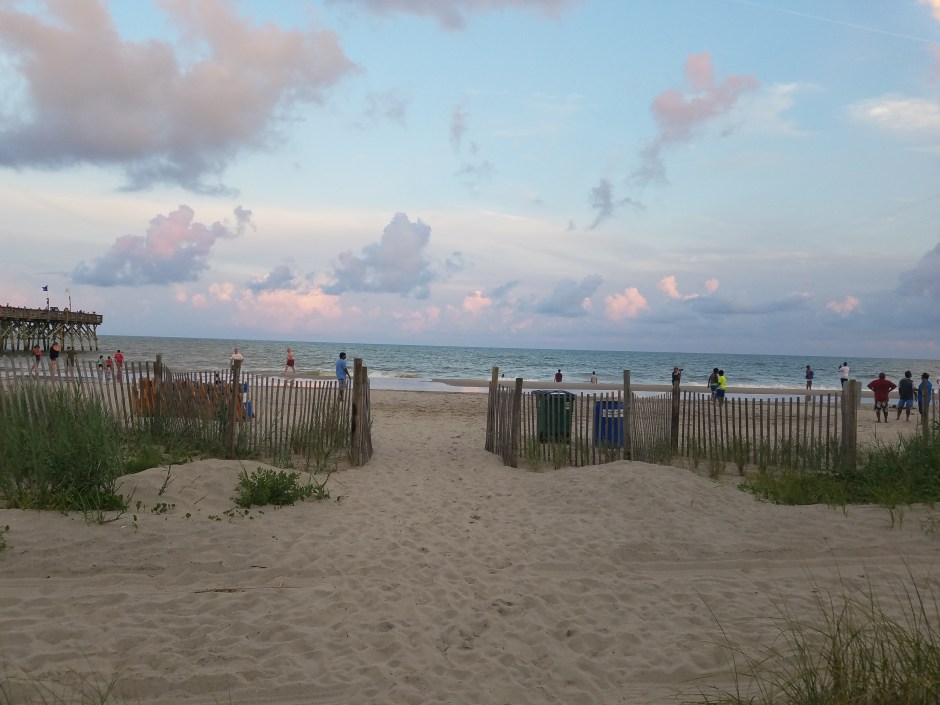
As a native of Pennsylvania, I am relatively close to the coast meaning that a trip to the beach can be an easy day trip. It’s about 2 to 3 hours away depending on whether I want to enjoy a direct ocean front of the Jersey shore or a salt-water bay in Delaware and traffic. This means that I grew up going to the beach, not every summer but with enough frequency for it to seem like a fairly common experience. 

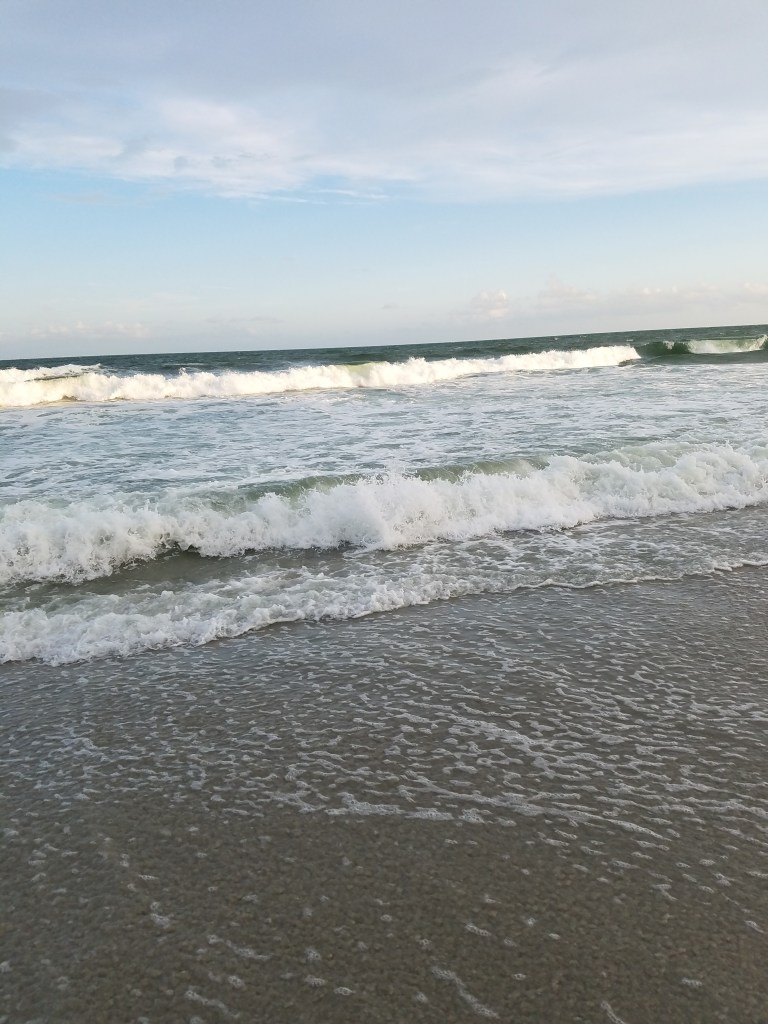
However, if you dear reader have never been to the ocean it’s rather difficult to explain in words the sheer vastness that one is faced with when standing upon the shore. Yes, I have certainly spent time on the shore of a lake and enjoyed swimming in them, but most of them do not hold the same awe as the ocean. The sound of the water echoes miles inland. The power of the waves striking the shore push and pull you alternatively, sometimes rushing in with such force it pushes you forward or even down beneath the surface. Sometimes the pull of the water is just as powerful, ripping you from the safety of the shallow water, dragging you out towards the depths, in the infamous rip tides. To stand at the shoreline of the ocean is to stand at the precipice of nature’s power. 

The only other body of water that held the same primal awe for me, was Lake Superior when the strength of the November winds proved too treacherous for even the most stalwart of ships to traverse. Perhaps, the Great Lakes are the only bodies of water to truly rival the ocean in terms of power and danger. 

Yet, despite the sheer awesome force that is the ocean, even with its dangers lurking just below the surface, a day at the beach is one that I look forward to. I have many fond memories of being packed up into the car and driven to the beaches of Delaware or New Jersey. The water is not the crystal blue featured on postcards from the topics, but instead may range in color from gray, to navy, to even a sort of olive green depending on the weather and time of year. 

I have spent many long hours diving into the waves, letting them take me as they will either towards or away from the shore. I have pushed and challenged myself against the ocean’s might fighting both against its power. There was something satisfying in defying the fury of the waves. It was also just plain fun to let myself be battered about, the thrill of the sheer force behind the ebb and flow of the ocean’s waves. I have tried my hand at bodyboarding to some success, but, as of this writing, I’ve never gotten to surfboard – it’s on the list.

When I was not deep in the waters, I would walk along the shore line enjoying the playful echoes of the more powerful wave which swirled about my ankles bringing in and revealing seashells. When one would catch my eye, I’d bend down and pick them up admiring the jewels of the sea. Although, I encourage you dear reader to leave the shells be or at least only take the choicest ones for I have since learned that our obsession with shell collection has had a detrimental effect on the shoreline. It is far better to take pictures and leave the shells behind or only take a very few if you absolutely must.  

I have certainly taken the time to build sandcastles and make sculptures from the sand. I have enjoyed the boardwalks snacking on popcorn, devouring ice cream and taking in the ongoing carnival just off the shore. Although, one of my favorite activities is honestly, taking a low sitting chair, positioning myself in among the waves and reading a good book. I love listening to the sound of the waves as I read and to feel the gentle caress of the waves against my legs. 

As an adult, I will typically spend the morning wading in the shallows and swimming in the deeper waters until the sun begins to beat down oppressively. After enjoying a picnic of whatever food I’ve packed, I pull out my book position myself in the water and start to read under the shade of my umbrella. After an hour or so, I will go for a long stroll along the shore line, keeping my path to where the sand and water meet, splashing in the waves as they swirl about my ankels, scouring the landscape for the choicest of shells until I begin to tire. When I return to my umbrella, I read more and then it’s back into the water I go. I may keep up the pattern of reading and swimming for several more hours until the sun begins to get low in the sky and I know that I should probably head home. A handful of times, I have stayed long enough to witness a sunset and linger until it was dark. That was usually when I was spending more than a day. 

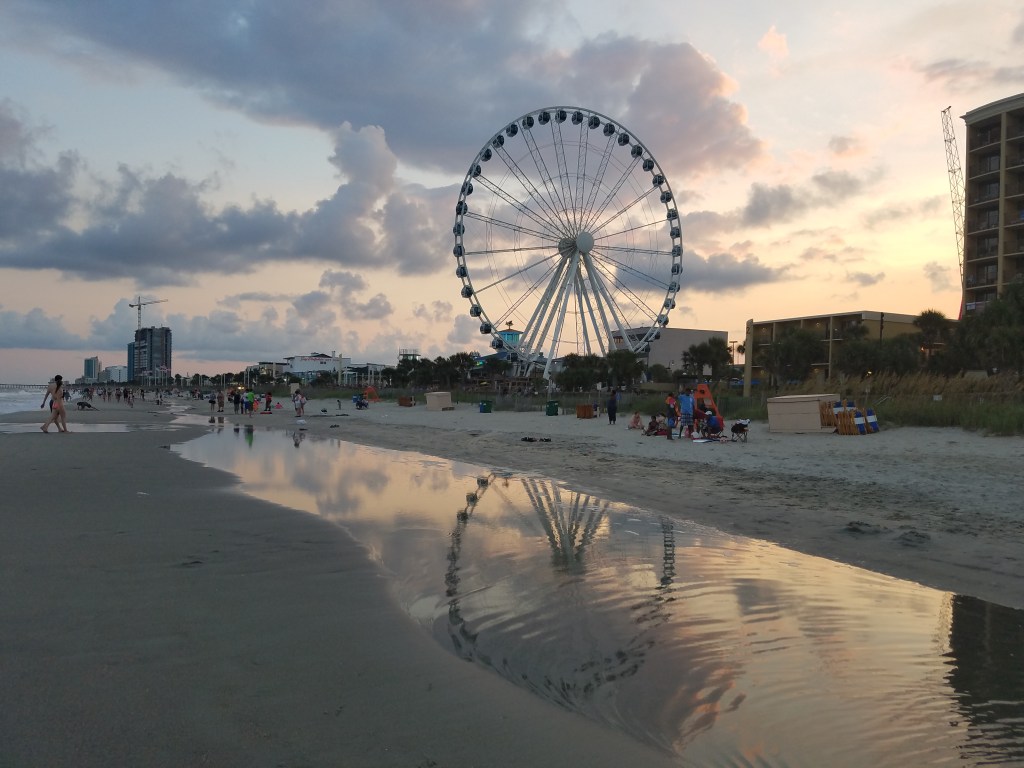
I have gotten the chance to enjoy beaches in various parts of the world, the north Atlantic, the Mediterranean and the Caribbean. I had spent a week in Rome and so one of the days, I decided to take the train over to the Mediterranean with my friend Erica and her friend Danielle. The three of us happened to make fast friends with two other American families who were also visiting Rome with their children. As it turned out they were two military families who took it upon themselves to ensure that the three young American women were taken care of. The three groups took turns watching one another’s items which allowed us to fully enjoy the ocean even with the advisory in place to be careful in the water. The men ensured that we were watched and safe the entire time. I am truly grateful to those service members who saw our protection as an extension of their duties even when not on official military business. The beaches of Rome were not all that different than the beaches of North America. The ocean’s color was almost the same and it carried similar risks. 

The beaches of the caribbean were similar but in many ways different. The biggest difference was of course the color. The water was crystal clear allowing me to see the tiny fish swimming in the shallows. Farther out the color was a bright, blue rather than the grayish tones of the north. The waves were gentle, almost lapping against the shoreline rather than crashing into it. Of course, the vegetarian was also different. The northern climates is populated with shrubs and tall grasses jutting out of the sand, whereas the southern climates enjoyed towering palm trees which provided shade against the harsh sun. I would not say it was necessarily better or even vastly different, but it was a gentler experience. I can certainly understand the appeal of the calm, crystal clear waters. 

Perhaps, it is my own more gothic nature, that I find myself drawn more to the wild oceans of the north over the calmer, gentler seas of the south. Give me the rough, rugged and untamed seas with their biting winds and frigid, gray waters. I do so enjoy a dark sky and a cool ocean as the perfect backdrop. Fall is probably one of my favorite times to visit, when the crowds of summer have dissipated and the weather starts to have a bit of a bite to it. I don’t mind needing a blanket to curl up under against the winds. I also enjoy the early spring, when the sea is still wild from the winter and the water carries winter’s sharp sting. Whatever the time of year or the weather, I do simply enjoy the ocean. A day on its shore is always relaxing and a bit exciting. 

How can you enjoy a day at the beach?

Obviously, if you are along the coast line, spending a day at the beach is relatively easy. Many public beaches are free or have only a minimal fee for parking. As hard as it is for me to believe, I have met people who despite living within a 2 to 3 hour drive of the coast have never been. By all means if you do live within a day’s drive, take some time to enjoy the coastline. As I wrote above, the shore does not even need to be enjoyed during the peak season. I found my favorite times to go were in the spring and fall during the off season when the crowds were lessened. If you go in the fall, the water will most likely still be warm from the summer, but the colder water can be exhilarating in its own right. 

If you are not near the coast line, there are of course lakes for you to visit. Although, I will say a day at a lake is quite different than a day at the shore with few exceptions. However, it is not so different that you cannot enjoy similar activities. Each person is different and may find different thresholds for meaningful differences than I do. To me at a certain point, a beach is a beach whether that is in the North Atlantic or Caribbean. To others, there may be such a vast difference between the two kinds of beaches as to warrant the necessity of visiting one or the other. It was my general feeling that at a certain point a beach is a beach which led me not to want to spend too many days at tropical beaches when in the Caribbean and South America. As it turns out, I am actually more fond of northern beaches anyways. I absolutely loved the beach in Cornwall and it was in the middle of February when we went.

As always, beauty is in the eye of the beholder. You, dear reader, may decide that a day at the lake is equal to a day at the beach. You may also decide that you want to check off tropical beach rather than any old beach. To that, I say, tack on a beach day to a trip if you can. If like me when staying in Rome, you’re spending a week somewhere and you can easily access a beach, then take the time to visit the shore. I do not regret spending the day in the Mediterranean. It was a lovely day to relax and recover from trekking all over the city. 

Completed: childhood 

Cost: Gas money and a packed picnic ($100) 

Miles from home: Nearest 135 miles to nearest beach (approximately 3 hours)

Did I visit a Botanical Garden or Paradise?

The title is a slight exaggeration, but I think the comparison is apt. After all, in three of the world’s major monotheistic religions, paradise is a garden. 

So, what exactly is a botanical garden? Aside from being a beautiful place to wander around in quiet contemplation, botanical gardens are gardens with a documented collection of plants for the purposes of scientific research, education, conservation and display. They feature the botanical names of the plants. Hence the name botanical garden – not necessarily the cleverest of names, but it certainly gets the job done. 

Some of my earliest memories consist of gardening. Lacking cable, one of my favorite pastimes was actually watching “The Digging Show” or my parents gardening. I loved spending time among the plants and the flowers learning their names, cataloging their color, inhaling their scents and at times nibbling upon them. I quite enjoyed the various herbs and was quite familiar with which ones were safe for me to consume and which ones were best avoided. I spent many hours going to various nurseries. As my parents shopped, they became my playgrounds. Not that I disturbed the merchandise (I had been taught to look not to touch), but I still explored, searching out new plants and finding the statutory and other garden decor scattered about. Our garden was huge and well known in the neighborhood as one of the best. We even had a photographer request to come and take photographs of our garden. 

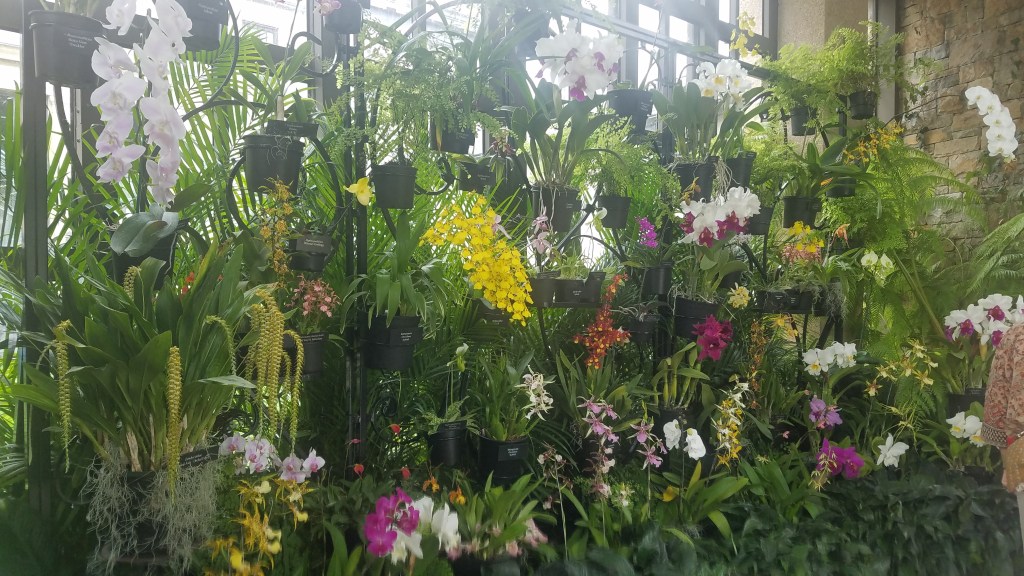
It should come as no surprise then, that I love going to botanical gardens to stroll among the flowers and greenery. Each one is so different which only serves to highlight the vast biodiversity of our planet where no two gardens are alike. Some focus on specific areas while others span ecosystems throughout the planet. No matter what I always find a bit of wonder in them as I am taken in by the majestic blooms and vibrant hues of the leaves. I’ve seen giant lilly pads and a huge array of orchids. I have been overpowered by the sweet scent of roses and delighted by the scent of apple blossoms.

The architecture of these gardens are often a highlight as well featuring delicate archways and imposing pillars. Many of the gardens have various fountains and waterways snaking through them. They may even have plunging waterfalls. Longwood Gardens in particular is known for its spectacular water show which is predominately displayed in the center of the gardens. However, it is also home to more humble buildings, small wooden cottages or small towers tucked away in forested areas.  To traverse the gardens is to move from landscape to landscape each with its own unique take on what makes a garden. There are times when the juxtaposition of the two can almost seem jarring as one moves from one area to the next as if the doorways themselves are portals to between worlds. 

Each world is a delight to the senses and one hardly notices the passage of time or the encroaching heat of a warm day or the way the chill of a winter begins to seep its way into your bones on those cooler days. In all seasons, the gardens offer something new as they are always changing with the pattern of the year. It means there is never a bad time to visit and one can visit quite often as there is always a shift. What was in bloom only a few weeks ago may have faded and a new plant has come to take its turn in the spotlight. The gardens can be enjoyed both in quiet solitude or with a group of friends. 

I find that day among the plants and flowers is as refreshing as a day at the spa. A connection to nature is an important part of mental health. Time outdoors helps to reduce stress and anxiety. Fresh air is also correlated with increased physical health. Exposure to nature is associated with better cognitive function. Certainly spending time in such oxygen rich environments is good for your lungs when we spend so much of our time inside. So yes, it can certainly feel like one has discovered a small slice of paradise when visiting as the stress of the outside world begins to melt away. I certainly envision heaven as a botanical garden, populated with cats of course, with ready access to a vast library of books and tea. 

How can you visit your own slice of paradise?

Luckily, botanical gardens are found throughout the country and indeed the world, so finding one should be relatively simple. I recommend wearing comfortable walking shoes and to pick a day when the weather is particularly good. You will most likely want to bring some water as they are often deceptive in size – they are always bigger than you anticipate. Armed with proper hydration and shoes, you will ensure that your beautiful garden experience doesn’t become hellish. 

Completed: First completed in childhood in a visit to Longwood Gardens

Cost: $32 per person (can vary depending on time of year)

Miles from home: 45 miles from home

I have also visited other gardens throughout the country as I am always up for visiting a garden.

How To Cultivate Opportunities

At the end of most of my posts, I will write a little “How You Can” section so that if something I have done peaks your interest, you have a starting point. However, one may very well wonder how I’ve gathered this information in the first place. After all, how did I discover the Wolf Sanctuary or the Firebird Festival or the Wine and Cheese Tasting on the Train? How have I cultivated opportunities for myself to check off my list or to add new things? 

Simply put, I have a few go-to places for inspiration that I regularly check and encourage you, dear reader, to do the same. The first is Onlyinyourstate or atlas obscura to discover unique things that are in my area. Now, Onlyinyourstate isn’t exactly the most accurate name, after all there are many states that share common experiences, it would be more aptly named “collection of cool things to see and do in your state” – that is understandably less catchy, but some of us are sticklers for accuracy. The website is semi-easy to navigate. You click on your state and it brings up a long list of various posts of interesting sights to see and things to do. What makes it difficult is many posts are repetitive, and some of the listed items have closed or are no longer available to the public. 

Since at this point, they’ve pretty much covered most of the things to do, newer posts just tend to rehash what has already been written about but as new things do get added occasionally, one still has to sift through to find the gems. Atlasobscura is similar in both scope and difficulty of use. There are other websites that are similar, such as PAbucklist.com, but I have yet to find one that organizes itself really well. I review these sites maybe once every 6-12 months. Despite their difficulty in use, I still recommend visiting at least once, especially if you are at the start of your Bucket List journey. They not only can help you discover how to check off your list, but also can open your eyes to new and novel possibilities you’ve never even thought of before. 

One of my biggest go-to’s is Facebook Events which I will typically review once to twice a month as it is being continually updated. It’s where I’ve discovered most of my events, festivals and workshops.On almost any given week, I could log on and find something that would interest me for the upcoming weekend and many of the events are relatively cheap or free. It’s become one of the main things I use Facebook for. That’s how I found out about the Christkindlmarkt and Eco-dying. I pay attention to my local newspaper as well checking out announcements from my community which the Facebook algorithm may have missed. 

I also keep a running list of the museums, colleges, universities and theaters in the area making sure to check at the beginning of each season. Depending on the venue, most of the time this means the beginning of the year in January or in July.  That’s how I discovered the Da Vinci Exhibit at the Reading Museum and the performance of Drum Tao at Millersville University. Even smaller universities and colleges can have amazing events and opportunities. In 2016, my small Christian College hosted a presidential debate for the DNC primaries between Obama and Clinton. I have often been surprised at what a small venue can pull off and because of their smaller size many of their events are more intimate affairs. So don’t write off your own smaller venues just yet, dear reader. 

Consider other attractions in your area: aquariums, zoos, community centers and even parks may play host to your dreams. Longs Park in Lancaster City has a summer music series that has brought some serious talent to its small stage for free, opening the opportunity for many to enjoy live concerts and other performances. It was the stage that introduced me to Shakespeare as a child. You will be surprised at the wide variety of opportunities these places offer and often for free or greatly reduced cost. 

Photo by Pixabay on Pexels.com

There is also a simple google search. I will do this for things that may take a little creativity or require me to go a little farther afield than my typical roaming grounds. For example, I read about grape stomping in Italy. It seemed like it would be a fun thing to try. I hadn’t seen it on any previous intel missions to my usual corners of the internet, so I did what any good millennial would do, I went to google to start to see if there were any wineries nearby that would indulge in this ancient tradition. As it turns out there is one in the neighboring state of New Jersey. 

Once I discover a place in a reasonable vicinity (typically no more than 2 hours away unless I really want to make a day of it), I will make a note on my list for future reference. I won’t necessarily rush to go do it just that moment, but I will keep the information tucked away until I have need of it or for when the time is right. Perhaps, if I find myself making plans and I will be in the area anyways then I will tack on my item to the trip. I may also make specific plans to complete the item but cross reference my list to see if there are any other items that may be nearby. I am after all all about being efficient with my time and resources. 

The final way is that my friends and family know that I am always on the hunt for new and novel things to try, so word of mouth goes a long way. When they see something cool that they know I might like to try, they tell me or even better invite me to join them! 

As you can see, dear reader, I am not someone who sits around waiting for good things to come to her. Sometimes the fates need a little nudge. It’s about keeping your eyes and ears open, seeking opportunities and being mindful of what might be around the corner. It doesn’t mean that I can necessarily jump at every opportunity that comes my way or thing that I discover, I have (as of this writing) yet to go indoor skydiving, learn to pole dance, spend time at the alpaca farm, learn a signature dish from a cook or go grape stomping. However, I have pretty good leads on where I might do those things. Which is half the fun! I always have a list of potential adventures I could go on. There’s almost always something new around the corner waiting for me to discover and with only one glaring exception are all within a hour’s drive from my house (most are within 30 minutes). Who needs to dream of escaping your corner of the world to far flung places when it’s so full of excitement? 

Baldwin’s Bookstore: Beautiful Books! 

Book lovers know the allure of bookstores and libraries. There’s something about walking into these sanctuaries of knowledge and stories. The distinct smell of the books, the quiet atmosphere that is seldom found in other public spaces, the aesthetic symmetry of rows and rows of carefully shelved worlds. The promise that an entire universe may be unlocked with just the turn of a page. The stories almost seem to whisper an invitation and your fingers start to itch with an eagerness to begin the search. So many dance partners want to fill your card and it is almost dizzying. 

There is even something extra special about a bookstore that offers a little more. Beautiful bookstores, charming bookstores, the ones with cats and tea, the ones with stacks upon stacks of books. Ones that even use books as structures like the book tunnel in L.A.’s famous Last Bookstore. Baldwin’s bookstore is just the sort of bookstore for booklovers. Named one of the most beautiful Bookstores in America, this hidden treasure of Chester County can be easily overlooked if one is not careful. 

Seriously, you can drive right by it and not even notice that you’ve passed it as outside it is an unassuming stone barn. One would never guess that it houses 5 stories of books and has a sizeable collection of rare and antique books. As it is primarily a used bookstore, it is always a treasure hunt and one never knows what one will find tucked away on the shelves. It is so large and extensive that it has a map for visitors at the front and even with the map, one can find oneself semi-lost among the stacks of books. 

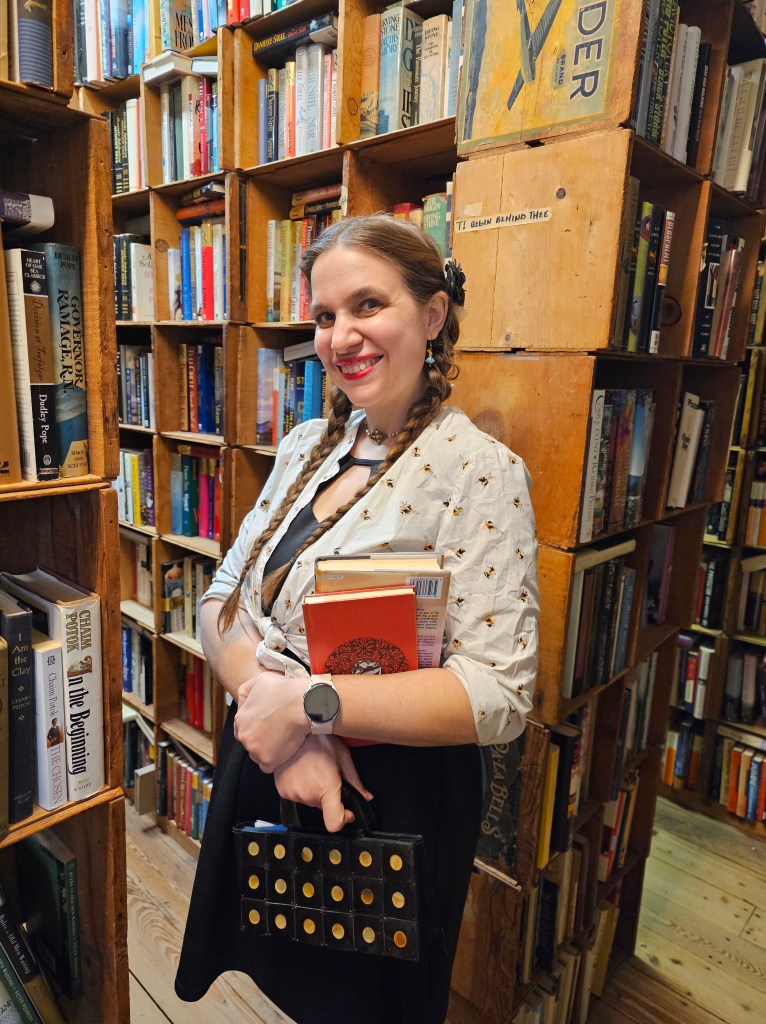
A quirk of the bookstore is that many of the shelves are not shelves at all, but rather nailed together crates. This charming store invites you to venture up stairs to ever higher levels. Tucked around every corner are chairs, some more enticing than others, for you to sit and read to your heart’s content. It would be easy to spend hours if not days inside the store. 

My sister and I ventured forth on a cold’s winter’s day after grabbing breakfast together at a coffee shop near my house. We had saved this particular outing for the colder months as we are not overly fond of extreme hot or cold weather. It is always good to have a few indoor activities in your back pocket for those times when it is simply too miserable to spend much time outdoors. 

Upon entering the store, we were greeted by a delightful display of older and rare books. We breathed in deep, savoring the familiar smell of books. The older gentleman behind the front desk said good morning and inquired as to whether it was our first time to the store. He showed up the map and politely explained the general layout of the store and encouraged us to peak in the backroom which housed a few artifacts from when this barn was also a home. After the short orientation, we began our exploration of the store. 

We carefully meandered through the rows of books of over 300,000 books, stopping to peruse for overlooked gems. One of the gems was the map of Philadelphia from over 100 years ago displayed on a table (not for sale). Both my sister and I adore old maps, so it was an unexpected treat to be able to sit and study it before continuing our book adventure. 

One thing of note for the taller readers, there are numerous signs to “duck” when going up and down the stairs, so be wary when transitioning between floors. Despite being in a barn, most of the areas were quite comfortable with only one or two places lacking in proper insulation for the temperature to be comfortable. We did stop to take a few pictures of ourselves in the books. 

It was easy to see why it was named one of the loveliest bookstores both inside and out. The original stone building was built in 1822 and the rustic shelving and floors only add to its charm. Sadly, I did not spy any of the rumored cats said to be residing in the barn. It is possible they were sleeping in a corner somewhere or perhaps they were no longer in residence.

My sister and I found a few treasures and made our way down the steps to the front of the building for our purchases. Satisfied with our treasure hunt, we went home to enjoy our books. I am certain that I will make the journey again for another visit. After all, with an ever changing inventory there is certain to be other diamonds in the rough to find in the future. 

How can you visit a beautiful bookstore?

Bookstores abound and business is booming. Something good that came out of the pandemic was the increased demand for real things, real recommendations from real people. We’re wired for community and connection, something that a digital reality can’t really replicate (though they do try). Not only are books a form of entertainment, but also people are forming communities around books. Bookstores are also one of the few places that seemed to sell a variety of board and card games aimed at adults. Bookstores have become hubs of community and connection. 

Going to Indie and used bookstores like Baldwin’s is often a treat not only for finding books but also for the atmosphere they provide. I encourage you to seek out the hole in the wall places. They don’t necessarily have to make a list of “most beautiful” because with all the hundreds of bookstores, how could a writer of a popular magazine or blog really know if they missed yours? And besides beauty is in the eye of the beholder. 

The Magic of Eco-Dyes: Eucalyptus Magic

For well over 5,000 years humans have been dyeing fabrics and advanced with the techniques for spinning and weaving. Plants such as madder, ford and bearberry were particularly prized for their bright colors. Over time, other plants became popular for their colors such as woad, saffron, kermes, mallow, turmeric, walnut and even juniper. The colors that they could produce ranged across the entire spectrum, although none were as vibrant as the synthetic dyes we use today. 

Given such a long history, I was surprised to learn that Eco-dyeing was a relatively new invention in the 1990’s by an Australian textile artist India Flint. The act itself is so simplistic and produces such a lovely delicate pattern one would have thought it was one of the earliest methods. Perhaps, it was and there just isn’t enough evidence left for us to discern. It is also possible that there were others before India who were using the method, but they just did not popularize it as she did. 

Eco-dyeing is very simple, as it combines two steps of the dyeing process into one. Rather than first boiling the plants to extract the dye and then adding the fabric to the boiling water to dye the fabric one seamless color, the extraction of the pigment and the application to the fabric is the same step. This produces the wonderful patterns of plants on the fabric to create a delicate web of colors and shapes. This process is known as a form of contact dye meaning the dye is transferred from the leaves directly to the fabric. 

However, while it is very simple in concept, I still desired to try my hand at it under the tutelage of an expert. Additionally, the class doubled as a birthday gift to my mom as a mother-daughter outing. I signed us up at the PA Guild of Craftsmen which incidentally was celebrating 80 years of preserving the crafts. The guild serves to promote, educate, support and encourage the craftsmen of Pennsylvania. Through their work many artists have discovered their passions, developed their talents and made a living. 

On an unusually warm October morning, we headed into the small city of Lancaster where the guild was located. As it was still fairly early the streets were still quiet which made finding parking in the garage a breeze. We took an easy stroll about a block to the location taking a note of the local eateries and shops for when the class had its break. There were instructions of how to enter the building before the Guild’s Shop opened which were easy to see and follow. Once we entered, there were lots of people who were helpful in pointing us up the stairs and down through the first room back to our classroom where we met Carol Reed, our wonderful and knowledgeable instructor. 

Carol explained a short history of eco-dyeing and laid out the general flow of the class, first we would lay out the plants, then we would wrap them around the dowel, tie them neatly, plop them in some water, wait about 2 hours and then have the “Great Unveiling”. Carol explained that we would be using Eucalyptus which could produce a color of pinkish-orange akin to salmon, a softer pink, a lighter green or a darker almost purplish green. The color was affected by different things such as the age of the eucalyptus, how long the leaves were left to boil, how tightly the leaves were pressed into the fabric, how hot the water got and how much iron water was in the water. While this is a process that could use just plain water, the iron water helps the dye adhere to the fabric and gives it some added texture and depth. 

Utilizing her expertise, she was able to give us instructions to try and get the best results for what we desired. She explained that the outside pieces would be darker so if we wanted the darker section in the middle we should roll our scarves around the dowel in a different way. She told us which parts would transfer well, telling us that the very small, delicate leaves at the end would not transfer. She explained whether the way we were layering the leaves would end up looking lovely or like a weird blotch. She helped guide us as to when we had too many leaves or too few and how far out to go on the edges. She helped us wrap them with string and explained how the string patterns would turn up like small streaks on the outside edge. 

I did not try to produce any sort of pattern, preferring to fully embrace the nature of the process as organic and natural. I cut down my long stems, having been advised that the stems would not roll well and then arranged the pieces across the scarf to mimic fallen branches and leaves scattered across the ground. I was careful not to add too many layers to avoid having ugly blotches on my scarf. I paid heed to the adage that less was more, knowing that the scarf would be folded over so the dye would be layered over the scarf. With the help of my mother I carefully wound the fabric tightly around the dowel as Carol had explained that the better the contact, the better the dye would be. I tied the string taut around the bundle securing the whole thing and then made a note of what mine looked like since Carol warned us not to put our bundles in until we could compare to discern whose was whose. 

Once everyone had their bundles ready we put them in their designated pots and took a break since we would need to wait close to an hour and a half for the dye to really seep out of the leaves and onto the fabric. We were advised eucalyptus was a particularly hardly leaf which required a longer dyeing time. Carol told us that we could use a myriad of other plants for the same process, but we would find that much less time would be needed. We were also advised that if we did leave more delicate plants in that they would turn to mush and be much more difficult to get off the fabric when the dying process was over. Carol shared that the eucalyptus leaves would just fall off, but other leaves she usually has to carefully remove. 

Having previously scouted out the area on our way in, my mom and I made our way just across the street to the Onion Cafe. It was a curious blend of American and Korean food where bowls of Ramen were offered beside burgers and fries. There were one or two “fusion” items mostly consisting of the addition of kimchi to the American options. However, as I was feeling a little 

under the weather, I opted for a spicy Ramen, figuring a hot, spicy soup was the perfect panacea for what might be ailing me. My intuition was correct, as the Ramen was perfect and I felt much better afterwards. 

We then strolled through the shops. Our favorite was a vintage clothing store,that was sadly going out of business. However, this meant they were running a clearance sale resulting in some steep discounts on our purchases, two hats (one bonus hat pin), a pair of fingerless gloves and a linen top. We then headed back to the guild for the “grand reveal”. 

To say that I was delighted by the outcome is an understatement. I absolutely loved how my scarf turned out. Mine had transformed into soft, delicate pinks, mixed with light green hues which gradually turned into darker greens and purples. The leaves scattered across the fabric had left the impression of a field or forest of plants. The rest of the group oo’d and aw’d when they first saw it as mine was the first to be unwrapped. The others went shortly after. Despite having followed the same process, boiling in the same pots, the results ran the gambit of colors and patterns. It was so interesting and even Carol couldn’t quite explain why one person’s turned out to be a vibrant orange and another person’s stayed almost completely green. 

We were told to rinse our scarves out until the water ran clear and allow them to cure for a few days before washing or wearing them to allow the color to fully set. We were told that the colors may brighten as it dried. We thanked our instructor, packed up the scarves in small plastic bags and headed home with our prizes. 

I think what I really enjoyed about the whole process was how natural it all way from the silk fabric to the dye that only came from the leaves of the plant, to the patterns that were transferred to the fabric to even the simple ingredients of water and iron water (made from rusted nails, water and vinegar).

We are so disconnected from the process of what we wear and often what we wear is synthetic which utilizes process that are harmful to our environment and ultimately ourselves. This was a way to really connect to a tradition that, as I said, goes back thousands of years, even if it’s using a very modern technique. It was simple and elegant leading to beautiful results. 

How can you make your own eco-dyed scarf?

You can, like me, find a class nearby which offers a lesson in the technique which not only teaches you the basics but also gives you access to an expert to help guide you in learning the smaller nuances of the craft. I find such experiences worthwhile and helps to enhance any first endeavor into a craft. I also like supporting local artisans, by helping them I continue to have access to specially made objects which enrich my life and my home. My local economy improves and I help preserve this precious piece of human culture for the future. 

However, not everyone has access to craftsmen and women. However, these sorts of classes are increasing in popularity as many people are realizing that they’ve lost something by going completely digital. They want to feel physical objects, interact with their environment and embrace life. Plus studies have shown that engaging in activities of creation is good for our mental wellbeing, it reminds us that we aren’t helpless and capable of great things. 

Still, you may find, dear reader, that you are unable to locate an instructor for your dyeing needs. Do not despair, as I have told you the principles of the task are quite simple and through some experimentation you are surely to get results you are happy with. I will say that it is recommended not to use the same pot for dyeing as you do for cooking. Luckily cheap pots can be found at a local thrift store. Silk scarves can be found at dharmatrading.com and the eucalyptus can be found at your local flower shop or even some chain grocery stores. Iron water is easily made with some rusty nails, water and vinegar and you’re off! More explicit instructions can of course be found online. 

You may find that you truly enjoy the process of making eco-dyed fabrics and a new hobby as been discovered. I will say the temptation to make more is certainly there, but I shalln’t give in to the temptation as I don’t know that I have space in my life right now for another hobby. Mostly my storage spades for the supplies. Perhaps one day, dear reader. 

Completed: October 2024

Cost: $80 for the class (materials cost included) 

Miles from home: 12 

Encourage One Another & Build One Another Up

The title of this post comes from one of my favorite Bible verses and is in part the inspiration for this blog. This blog is intended to encourage you to live to invest in your mental health, stop chasing the false narratives of consumerism, over consumption and influencers and to live your best life. So what is a more appropriate Bucket List item than to encourage others? After all, when we build others up, we also build ourselves. 

There’s an interesting story about a farmer who won the farm show every year for his amazing crops. What puzzled people was that he would take the seeds from his award winning produce and share them with his neighbors. When asked why, he said that by having superior crops nearby it helped enhance his own with cross pollination. In other words, helping others, helped him. Which is something that really resonates with me. As someone in the social services field, I want to help create a better world not only for the people I am helping but also because it will help create a better world for me. 

In early 2021, with the ongoing pandemic, I watched mental health illness and a general sense of hopelessness grow in my community. It was as if in the midst of all the lockdowns, anxiety, stress a darkness was descending everywhere. Social media, which was already not the greatest place to spend your time, had become a toxic cesspool of hatred and vitriol as everyone struggled to cope. I don’t know all my neighbors, their struggles or what is going on in their lives, but I knew that at least some of them probably needed a pick me up. I knew I certainly could have benefited from it. So, I rolled up my proverbial sleeves and made a plan to bring some light in the middle of all these shadows. 

Photo by Matej on Pexels.com

I counted up the houses in my neighborhood and procured a small gift for each of them. In this case, it was a small make-up kit which I found at a greatly reduced price from Nordstrom. As my neighborhood is only about 10 or so houses, it was relatively inexpensive to include a small token along with the note. I then wrote a note to each of them offering encouragement and hope. Mostly something along the lines that we’re all going through a rough time and that I hope this small gift would bring them some joy. 

I waited until the middle of the week when I knew most would be away as evidenced by the lack of cars in driveways and then launched my plan. Which really consistent of walking around for maybe 5 minutes leaving the gift at each doorstep. It was hardly mission impossible. There was nothing connecting it back to me, no name or indication as to whom it came from, that was never the point. The point was of course to be anonymous to simply offer a point of light in the darkness. 

I do not know if anyone ever connected it back to me, no one has ever acknowledged the gesture, but what I do know is that it seemed to strengthen the ties in the neighborhood. I had noticed over the course of the pandemic that people had withdrawn back into their houses. They stopped chatting and waving. They didn’t go out of their way to be helpful to one another as we once did. For a year, we’d all be holding one another at arm’s length and it seemed difficult to breakdown the barrier. After that simple gift, I noticed they started reaching out to one another more and to strengthen the ties of the small community. 

When we are kind to others, it spread kindness. However, often when we are kind it begins a reciprocal relationship that does not necessarily spread outward from the dyad. When we are kind to strangers or anonymously, that kindness is amplified to beyond ourselves. I loved seeing how the one small act prompted other small acts even if it just helped change the vibe of the neighborhood to a place where we do reach out rather than withdraw. 

I’ve written in another post about community resilience like when the water main broke in my town and shut down main street or when a hurricane caused the annual art show to be canceled. A few people stood up and said, we will make a difference, we will encourage one another. Then the community rallied behind it. I’ve driven past signs on people’s mailboxes that say “You are awesome” and it brought a smile to my face. I’ve walked into the bathroom to see written on the mirror “You are loved” and my day brightened.

Photo by Lisa Fotios on Pexels.com

We never know what doing something for a stranger may do for them. However, there are many stories about how something as small as a smile can stop a suicide or help someone make a decision to turn their life around. Perhaps, all I did was make people smile, perhaps it saved a life. The point is to be the light that we wish to see in the world and the best thing about the activity was that it took almost no time at all. Kindness often does not. What it takes is noticing a potential need and responding to it, letting someone know that they are seen and that they matter. You don’t need to necessarily get it perfect. After all, my neighbors may not have needed the make-up the point was to let them know that someone cares about them. 

Not every item on a BucketList is about enriching your own life. Afterall, here at Budget Bliss Bucket List, we want to pursue a life well lived and that means enriching other people’s lives as well. We become the best versions of ourselves when we practice generosity and gratitude. Chasing an influencer life for likes and attention, doesn’t leave us with meaning. Going on a vacation is fun, pampering yourself at the spa is important for self-care, but we miss something important when we don’t forget to give back. 

I shall have to write a post about one’s wellness wheel, but the idea is that we have to make sure that we’re living a life in balance, filling each part of our wheel to be in balance. When one part of our wheel is “flat” the wheel doesn’t turn and we usually feel like we’re off, possibly stressed or even burned out. Making sure to take time to include items like this helps keep our wheel turning smoothly. 

Photo by Dhivakaran S on Pexels.com

How can you be the light for others?

It’s easy! Count up your neighbor’s houses and write notes of encouragement. Then when the timing is right, drop them off. The alternative is to leave them around your community for strangers to find. You can even sneak around at night with chalk and write notes on the sidewalk for people to see. It takes almost no time at all and no money. Which is why this is a perfect budget friendly item to include on your list. 

Completed: 2021

Cost: $10 per household but it can be practically free

Miles from home: 0