It can be quite easy to forget that wherever you live, someone dreams of visiting. Maybe not your particular town or neighborhood, but certainly places nearby. I once worked with a young woman whose dream was to move to South Dakota much to my bewilderment and last time I spoke with her, she was absolutely loving her decision. I used to dream of going to the west to see the Rocky Mountains or the west coast. Others apparently dream of coming to my part of the country to see the Amish.
I remember when I was seeking inspiration for my bucket list and I stumbled across one that included visiting Lancaster County. I knew growing up that I lived in a tourist destination and that people came here, but it wasn’t until I saw it on someone’s bucket list that it truly sunk in that the place I was constantly trying to escape from, other people wanted to come to and it was a big deal to do so.
I started exploring what made Lancaster so unique and special that made it a destination worthy of someone’s list. What I discovered is that it actually is a special place with its own subculture and quirks that make it so charming to outsiders. I began to appreciate what was in front of me, enjoying the rolling farmlands near my house, seeing beauty in the corn and wheat fields, savoring the seasonal changes and stopping to admire the farm animals frolicing in their pens. I learned the ubiquitous fruit stands and farmers markets scattered throughout the county were rare treats elsewhere. It’s home to America’s Coolest Small Town 2016, Lititz, and recently two of America’s best buffets, Shady Maple and Miller’s Smorgasbord.
Is it still Coolest Small Town in America? Maybe, maybe not – but it is pretty awesome.
In addition to all things Amish, we boast a rich art scene with its many art galleries and Lancaster’s School of the Arts. We’re home to the Fulton Theater as well as Sight & Sound and American Music Theater. We still preserve many of the folk arts here which can be found at many shops in the tourist areas. However, if you want a more hands-on experience, there are tons of workshops in the area through PA’s Artisans Guild which helps keep these crafts going.
We have street fairs throughout the fall as well as craft fairs in the spring and late summer. We host farms shows and even have tractor square dancing! Although, don’t ask me about it, I had no idea that was a thing until my early 30s.
The truth is, I am now grateful to be living here whereas before I was always looking to escape to far flung places instead of realizing what I had in my own backyard. It would be easy to dismiss my small town as boring and “uninteresting”, looking to the bigger cities or tropical islands of the caribbean. I can make every day moments bucket list worthy. Instead of being annoyed when I am driving and I come across a farmer helping his flock across the road, I take the time to savor what I’m seeing. It’s actually quite pastoral and idyllic to watch. I get excited when I hear the tell-tale clop of hooves on the road signaling the approach of a horse and buggy. I take time to stop at the stalls along the road rather than continuing to drive on.
Sheep! I love seeing the little lambs in the spring time.
My everyday life is another person’s vacation. Sure it’s easy when you’re on a vacation to enjoy the mundane as extraordinary. On a vacation you aren’t worried about the everyday stresses of life like getting to work on time, picking up the groceries, rushing home to the wife and kids, so lingering at a farmer’s market is a luxury the tourists have that I don’t have. When you’re on vacation, you aren’t quite as pressed for time, you can linger and savor what you’re experiencing. Your worries take a backseat to the present moment. Without the worry of time and everyday responsibilities, it’s easy to mistake a foreign place as better than our own homes. I think that’s why some people will regret moving to a place they loved to vacation in, because the reality of everyday life doesn’t match the rosy picture they had as a tourist. We can apply the opposite approach to our homes, realizing that we can recreate those feelings for ourselves at home with the right approach.
How can you cultivate hometown pride?
The first is to take the message of this post to heart. Somebody wants to come to your area and visit and that someone is willing to pay money, perhaps not an insignificant amount to do it. It’s so easy to miss the life that’s in front of us when we spend our lives looking ahead to the future, to excitement and adventure, scrolling on our phones while life passes us by. Your adventure is right out your front door!
The trick is to stop taking your surroundings for granted, to ground yourself in the moment and be mindful about your sensory experience. Instead of rushing into the farmer’s stand grabbing my groceries and leaving as quickly as possible. I will try and make time to pursue the produce, carefully examine the baked goods and give into temptation with the local honey. Last time, I even purchased a cool meadow mint tea in a glass bottle. For those of you not in the know, Lancaster has a unique meadow mint tea that the Amish make and it is a summer treat for the locals. Rather than drinking it down quickly, I slowly sipped it, letting it dance upon my tongue just like I used to do as a child. Did I still have to return back to my housework and garden? Yes, but for about ten minutes, I let all the stress melt into the background and took in my hometown with an outsider’s eyes.
Completed: Around 2017
Miles from home: 0
Cost: Free
Stables near my home, I pass it almost every week. I finally took the time to pull over an appreciate the sight.
It has been noted by my fellow therapists that I am exceptionally good at what is called “reframing” or the practice of looking at a seemingly negative circumstance and seeing the positives in it. Even something like a loss may be reframed in a positive light despite the pain of the loss.
A forest fire is painful, but necessary for the life cycle of the forest. Loss in life is the same. The part that burned will take years, even decades to recover and the marks of the fire do remain even centuries later, else we would not find it in the records of the forest. However, without the fire new growth could not happen and the forest would ultimately suffer.
Consider the loss of a relationship after a break up. This could be a very good thing. After all, we only have so much time to cultivate and grow our relationships with other people. On average, we can really only maintain about 200 relationships, if someone leaves, what a delightful opportunity this could be! You may spend your energy elsewhere, growing deeper more meaningful relationships with those you already spend time with or it leaves you open to a new one. It is not to devalue the relationship that you had or have, people are not cogwheels easily replaced. We should also not adopt an attitude of not valuing relationships at all, having deep and meaningful relationships are important to our mental health and well-being. It is to say that we should mourn the loss and allow ourselves the opportunity to grow.
The reframe is not about finding a silver lining or putting a false positive “spin” on the facts. It is about not dwelling and getting ourselves mired in the muck. We are like cameras shifting our focus from the foreground where all the action is to the background where the action is about to happen. So often you’ll be watching a movie with a battle scene and right before the reinforcements arrive, the scene shifts to a blurry hill and then just as the cavalry crests the hill, it comes sharply into frame. That’s the reframe! It’s about focusing on what is going well or what could go well rather than what is going wrong or about to go wrong.
The cynical reader will rightly be grumbling about now about how the calvary doesn’t always come and the loss of the relationship didn’t result in any positive outcomes. This is true dear reader! Life can often seem terribly unjust and it is one catastrophe after another! A silver lining person may say something trite about how you gained all this resilience and built all this character. Character is nice and all but it doesn’t keep a roof over my head or food in my belly – unless you’re an actor then I suppose that’s sort of the job.
My response to this is that it isn’t helpful to dwell on the negative. Absolutely, acknowledge it, process it, be emotionally honest about the problems and then shift your focus to a growth mindset. You should never try to invalidate or suppress your feelings because that leads to its own problems. It isn’t helpful to impose self-limiting beliefs when you’re already in a limiting situation. This isn’t about false hope. My reframes are often from a very pragmatic and practical mindset focusing on positive things and trying to build on those positive items because that is what works.
Reframing is always asking if there is another way to view this issue. It challenges the current thought process to consider if your view realistic, is it based on facts or feelings, what other theories could you come up with to explain this situation, is it as black and white as you may think it is and is your view out of habit or is there something there to support it? It’s about questioning the current narrative to one where you can take steps towards the things you want. When we reframe, we remove roadblocks that we don’t even realize we set up.
The earlier reframe about a loss relationship is a direct challenge to the idea that it was the ONLY quality relationship a person could have and that without that relationship the person would die alone. By looking at it as an opportunity to cultivate the current relationships or allow a new relationships the narrative shifts from one of hopelessness to one of hope, from one of being closed off to relationships to openness to them.
Reframing about opening ourselves up to different stories that allow us to shape more desirable endings. It empowers you to take those negative thoughts around a problem and transform them into potential solutions. We aren’t able to control very much in this crazy chaotic world that we live in, but we can control our thoughts and how to respond to all the craziness that happens. When we overly focus on the negative aspects of a given issue, we give those more power than they have a right to have. By working to reframe, we shift the power back to ourselves, and place ourselves in a position to pivot to the opportunities that the universe presents us with.
Slowly, slowly he worked stone against stone chiseling out a dimed sized impression. The sun marched its way across the sky as he worked each part of the snake. An hour’s work would only yield four and he had so many to go. Still in this sacred place of sun, earth, water and sky where the underworld opened to the deep below, he kept to his work. One piece among a dozen others each marking the important spiritual events of his people. As the sun kissed the rock on the fall equinox lined up perfectly with the head of the man’s snake, he smiled. The stories of these drawings the life, spirit and blood of his people, a testament to their presence which would continue to echo for a thousand years and more. A thousand years later, though lost to time after the conquest of the Susquehannocks and the colonization of the Europeans, they are not forgotten but remembered simply as the Safe Harbor tribe.
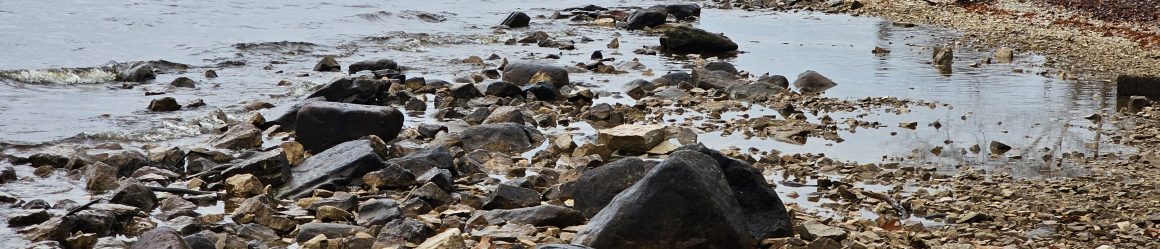
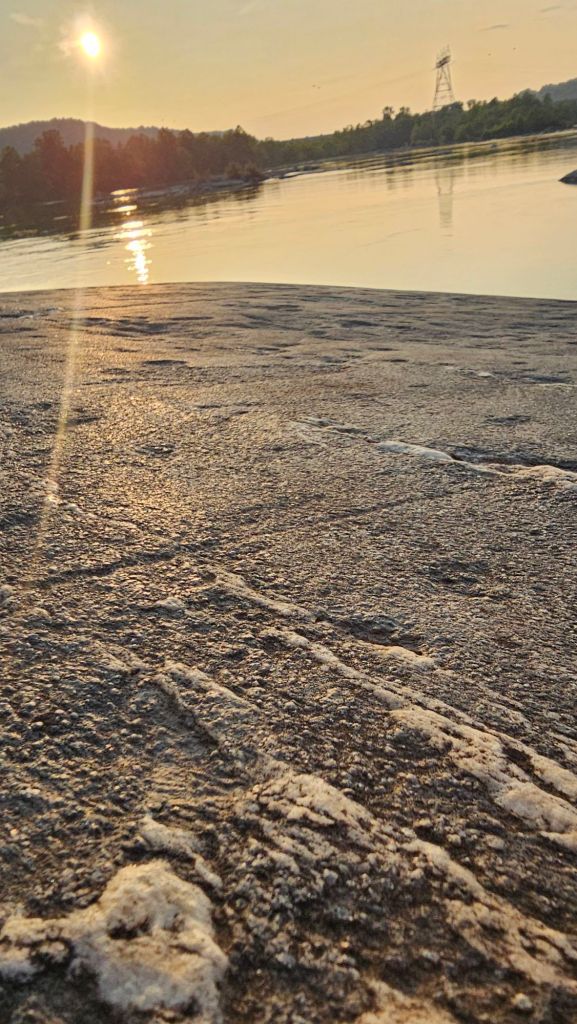
To stand on the Little Indian Rock and Big Indian Rock is to be transported back in time. On either side of the river the trees still stand tall and proud and to the west, not even the telephone lines can break the illusion that one is seeing the forest as it has been for a thousand years. Though truthfully the dam has raised the water levels significantly and the river has eroded the shore line. Still one can see why they felt this place was special. With the thickness of the forest the sky would have been often blocked out from view under the canopy of leaves. The wide river would have opened up to the glittering cosmos even as the deep crevasses beckoned to the underworld below. The jutting rock up out of the water would have been a place of earth within water. A place of earth, water, sky and the underworld colliding where the river goes from a soft, lazy merading flow to rushing current as it suddenly drops.
Big Indian Rock seemed to have been used primarily for social purposes with its markings for hunting, directions and even a helpful gps tag noting that it is a two day’s walk to the mouth of the river. There is evidence of camp fires perhaps for when they wished to view the night sky. Despite its size the petroglyphs are mainly concentrated in the cardinal directions. Little Indian Rock seems to have primarily been used for spiritual purposes having several Thunderbirds and snakes which line up with the spring and summer equinoxes. There are several which seem to depict the mystical Wendigo and even a Misiginebig.
One of the largest collections of petroglyphs east of the Mississippi. In this picture you can see a Thunderbird and the mysterious water serpant.
Graffiti dots the rest of the rock from the various visitors over the years primarily from the 1800’s until about the 1980’s when the rediscovery of the petroglyphs and their significance put a halt to any additional markings. Not through any sort of ordinance, but through education and the respect that education has bred through the local populace who still kayak and fish around the rocks. Despite its historical significance and being home to what is considered the greatest collections of petroglyphs east of the Mississippi there is no official protection for either Big or Little Indian Rock, no barriers preventing anyone from clamoring up the rocks to see them. The location of this ancient art is perhaps the best protection that can be offered: a wall of water separates it from the land on either side requiring a boat to gain access and most mischief makers are easily deterred by the strenuous physical exercise required to obtain access.
At first, one could easily miss the ancient markings as no more than strange impressions in the rock. It takes a sharp eye to spot them, they are most easily seen at sunrise and sunset when the angle of the light allows them to stand out in sharp contrast. Which is why on a late August evening, my sister and I set out with a small tour group in kayaks to the two islands. I was a little nervous having grown up hearing the dangers of the river especially around the dams which so easily can sweep a person down into their churning depths never to be recovered as their body remains trapped within. However, we were a safe distance from the dam and our guides delayed our departure twice due to unsafe river conditions, so I trusted them to take us out. We donned our life jackets and were given a quick overview of kayaking. My sister and I were the only two non-experienced kayakers as the other members of the tour had brought their own kayaks.
With little ceremony, we hauled our small vessels to the launch site and were quickly swept up in the quick current of the conestoga river rushing to meet the Susquehanna. At first, I paid little heed to my natural surroundings focusing primarily on learning how to steer and maneuver the kayak. There were a few run ins with others but we laughed it off with some pirate jokes. One of our guides rushed to the front of the group where the other stayed in the back to assist any stragglers. We were assured that if we needed a tow back they would assist to ensure we all made it back safely. Being a novice, I was not very good at reading the river and got swept up a few times in quick, churning currents which swirled my vessel around. After a few moments of panic and fruitless fighting, anxious that I would be swept away from the group and lost down river, I regained my footing (so to speak) and allowed myself to literally go with the flow. I was able to maneuver my kayak behind some rocks which broke up the flow long enough for me to jet across to rejoin the group of boats. Having conquered my first challenge, I felt much more confident in my ability to traverse the waterway, though I was certainly not ready for a solo venture.
Not being quite so nervous about the river, I was able to start to take in my surroundings and really enjoy the experience of the kayak gliding across the surface as my paddle dipped into water. Overhead birds circled and cried to one another. The trees on either side of the river blocked out signs of civilization, the illusion only broken by the distant sounds of traffic and the dam nearby. However, with the dam behind me it was easy to get lost in it. Occasionally, I would place my paddle across the kayak to simply float and breathe. I could see why so many people will spend their weekends out on the water leaving behind the sometimes suffocating atmosphere of the urban environment for the open expanse.
We first visited Big Indian Rock where we were shown the petroglyphs and given some education on the people who once made them. Though we no longer know their name they are thought to have been part of the Algonquin people who were known for their making of petroglyphs; other artifacts that have been found in the area also point to cultural similarities with other known Algonquins. We were given a brief overview of native beliefs when he showed us a thunderbird. The one on Big Indian Rock is a rarity for its depiction of feathers on the wings. It is uncertain what the significance of the feathers were. We then clamored down the rock back to our kayaks to go back up the river to Little Indian Rock. We were warned to stay away from the poison oak. Having had poison ivy earlier in the summer, I was quite motivated to stay away.
I was absolutely amazed by the incredible amount of petroglyphs concentrated on Little Indian Rock, a feast, a mythical serpent creature, snakes marking the passage of the sun, deer prints, footprints, bear paws, thunderbirds, animals that could be beavers or otters and more. It was such a plethora of art made meticulously over hundreds of hours. Each dime sized impression took over twenty minutes to make leaving little doubt that it was done with intention rather than something a few bored teens may have completed. It seemed that all too soon we had to leave this magical place, but the announcements coming from the dam warned us that it would soon be time to get off the river and the setting sun threatened us with coming darkness. As a novice kayaker I did not wish to embark on my first night adventure.
The trip back was considerably more effort than going down as the primary task was steering the kayak with the current. The trip back was against so it required us to hug the shore of the larger island in the middle for a significant portion where the current was slower. I made the mistake of trying to jut across too soon which left me fighting the current. I strained my muscles forcing them to conquer the river’s strength with my own and was quite grateful I had been working out using a sledgehammer to mimic kayaking throughout the summer. My sister required some assistance and was towed part way for the trip back. Primarily to help her navigate the river and not get caught as I was in the stronger currents which threatened to push me back. Despite a novice’s mistake, I was able to overcome and make it back on my own, my arms happily exhausted but not overdone.
The sun had not yet completed its journey to the underworld and we were happy to have made it back. We helped haul the kayaks back up the shore to the grass and thanked our guides for the lovely evening and assistance in getting back.
How Can You Kayak or See Petroglyphs?
This was definitely one of those “bang for your bucks” kind of trips in that it crossed two things off my list at the same time: petroglyphs and kayaking. I had been kayaking as a child, but it was only on a small lake at summer camp and I wanted a real experience. Renting a kayak would have been pretty easy, but given the dangers of the river nearby, I wasn’t comfortable exploring on my own. Just two weeks before, two people perished in the aftermath of the flooding from the hurricane, and others had to be rescued. The river can be quite dangerous under certain conditions and had it not been for the guide shouting some advice to get out of the churning current, I may have ended up many miles downriver. I recommend that while you can easily purchase or rent a kayak, you ensure you have completed any necessary licensing requirements for boating and you have done the necessary research to ensure you understand the dangers of any particular river.
As for the petroglyphs, they are found throughout the United States and even the world. They range in ages from 1,000 to 40,000. Some can be found still in the native surroundings like the petroglyphs on Big and Little Indian Rock whereas others have been removed and placed in museums or have had barriers built around them to protect them from harm. It really depends on what you consider “good enough”. For most people, I imagine seeing them in a museum is perfectly fine. For me, it was important to view a set in their original surroundings. For instance, it was really cool to see how close the sun aligned with the snake marking the fall solstice which was only a month away when this trip was untaken. There were footprints on the rocks and we stood close by them wondering what they marked and whether we were supposed to look out and see something important. Has anyone looked to see if they align with any star signs? All of these questions can only be asked and answered if they remain where they were untouched. Unfortunately, leaving them untouched also means risking them to the elements and potential vandalism.
I found out about these petroglyphs several years ago and was very disappointed to see that they were nearly inaccessible for someone without access to the water via boat or kayak. I had almost resigned myself to not being able to see them, until a post on Facebook caught my eye, Lancaster Uncharted was hosting kayaking tours to them. It was unfortunate that because of an earlier trip I took that year, I was unable to afford to go that summer, but I marked my calendar for the following spring when I was sure tickets would go on sale and sure enough was able to snag them in May for August of the same year. There are many sites dedicated to the location of various petroglyphs and tours to go see them. As always, I encourage you to decide what suits you. Remember it’s not about replicating my adventures as they are merely to inspire you with the possibilities that are out there! After all, what is available in my backyard may not be in yours, but that’s what makes these adventures so fun and unique! Go forth and explore dear reader one never knows when and where one might find a portal to 1,000 years in the past.
Completed: Aug 23, 2024
Cost: $115 per person
Miles from home: 20 (plus another 1/2 mile of kayaking down the river)
I have written earlier about the choices we make and that there is always a cost to be paid. I encourage you dear reader, not to be disheartened with this advice. It is not an admonishment to not do things. It is only a word of caution to walk through a given door with your eyes open and prepared for what the task ahead will ask of you.
Consider the high performing lawyer. She goes to school, gets into a prestigious practice, starts working very hard, makes partner, earns a lot of money, and works very long hours. Suddenly, one day she wakes up and realizes she has lost touch with her family, she have no real friends because the only people she interacts with are her fellow lawyers who are only out to compete with her, she has a beautiful apartment she never sees and decides to quit taking a much lower paying job so that she can actually have a life outside the office, maybe get married, and have a child.
If she chooses to get married, have a child and keep her career working 70 to 80 hours a week, who will raise that child? Certainly not her directly, but whatever hired help she has. What kind of relationship will she have with that child? It would be difficult to cultivate a close personal relationship with a child she barely sees, especially when she is probably missing out on all the important things to a child like dance recitals and birthday parties. This is not to judge someone who chooses this life, it’s just not the choice I would want to make. The good Lord knows I don’t want to be away from my cats that much, I imagine I will want to spend even more time with my own children. However, to each their own.
Now it is not always something as grand as career vs family when we make these choices. They can be small. We cannot be a master of all trades given our limited time and resources. Choosing to pursue one hobby will probably mean giving up another. If I choose to weight lift, I may not have time to learn how to paint. If I choose to play the violin, I probably won’t have time to learn to sew. If I spent all my time out of the house going places, I would not be able to have my cats. I am not saying that these are the only dichotomies. Rather a single yes to one thing closes the door on almost hundreds of others, but a choice must always be made. Even choosing not to choose is still a choice – often the worst option you can take as it almost always leads to less than optimal conditions.
A yes to learning German was a no to the other 7,000+ possible other languages. A yes to pursue psychology and social work, was a no to thousands of other career paths. The point of course is to consider what doors your “yes” is closing and what ones it is opening. As a goal oriented person, it can be easy to get “lost” in the pursuit of the goal. To blindly plough forward heedless of the destruction in your wake until you stand upon the mountain top to gaze upon a ruined domain.
How often did I find myself alienating my project partners blindly completing the project and “getting us the A” in school? I was often confused when they reacted badly to my process. We got it done didn’t we? Are you unhappy with our success? The goal was to get a good grade, mission accomplished. I did not know that there were other pieces of the project not on the rubric that I was supposed to learn like how to cooperate with people and cultivate working relationships. In my pursuit of the goal, I burned the relationships with my peers in school. In the pursuit of other goals, we may neglect relationships or lose sight of things that really matter.
What might we still be missing in the pursuit of our goals? That is not to say that we should not pursue those goals only to be cautious in the pursuit. When your life narrows down to a single goal or passion, be aware that chances are you are about to give up a lot of things. If you want to become a doctor, you will probably give up a lot of free time and sleep. Traveling the world may mean giving up secure roots and long term relationships. Becoming a star athlete will mean missing out on a lot of fun parties to train and compete. When picturing your best life what are the things that you most wish to preserve? What things do you want to accomplish and what do they require of you to do? Are there things you absolutely won’t give up? Are they worth holding onto even it means giving up on a dream?
Often what we feel will make us happy, money and fame leave us empty and unfulfilled. In chasing those dreams, we often damage the relationships that truly enrich us. That isn’t to say don’t pursue your dreams. There are plenty of worthy goals and dreams to pursue. Depending on your own internal value system what one person finds most important may not be the same for you. However, it’s important to reflect on what you really value before diving headlong in pursuit of a goal that doesn’t really align with who you are. It’s also important to not get too hung up on a singular path to achieve a goal. I wanted to help people live better lives. I’ve become a therapist, but if this blog takes off, maybe I’ll do this full time instead. Maybe, I’ll become a professor and teach. Maybe I’ll start a non-profit. I’m open to where God leads me to serve and I’ve been willing to forgo obtaining higher paying jobs to do so. If you feel the reward is worth the cost, by all means pay it, just reflect on what the costs may be before you agree to pay it.
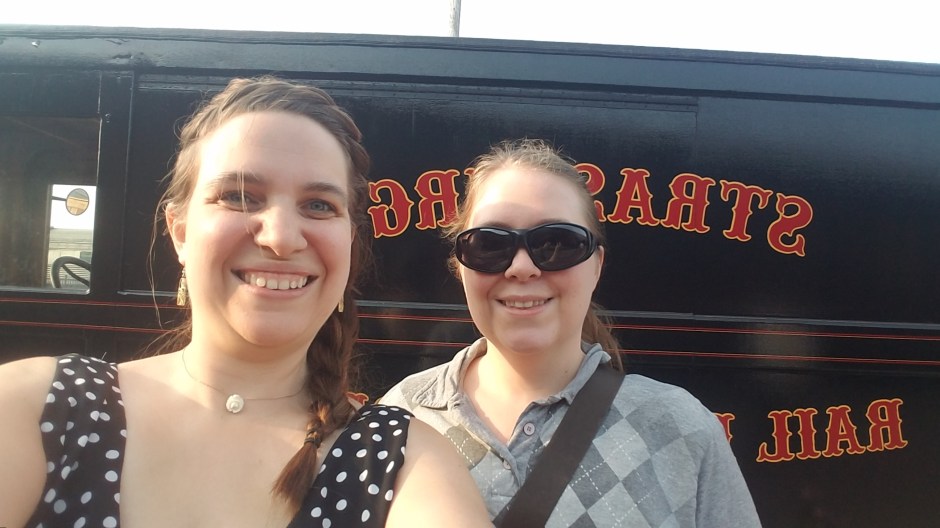
hat could possibly be more romantic than an antique train through the summer countryside, the cornfields lush and green, cows grazing in their pastures and the blue skies dotted with clouds? Other than including a companion known for her poise and stimulating conversation? Why a little wine, of course! And what could be a more perfect place for such an adventure than the oldest continuous railroad in the United States?
Built in the mid 1800’s, the Strasburg Rail line faithfully provided transportation to the residents of Lancaster county to ensure they stayed connected to the larger railroads. However, with the rise of the automobile and significant changes in rail usage, it had been reduced to the poorest and smallest railroads in the country. In order to save this piece of history, a group of railroad enthusiasts purchased the railroad and began to offer tourist excursion trips. Within three years, ridership had grown from 9,00 a year to 125,000. In order to keep up with customer demand the directors turned to the steam engine. Today, Strasburg offers visitors the opportunity to climb aboard a fully restored steam locomotive in a beautifully restored wooden railcar and gaze out at the lovely Lancaster County countryside.
While not train enthusiasts per say, my sister and I are history buffs who enjoy experiencing how life once was. What was impressive was not only were the trains historical, the railroad itself from the ticket booth to the staff were also historical. It felt like stepping into a history book where we could leave the hustle of modern life to embrace a slower time. We had arrived early so we were able to not only stake out our seats but also to explore the railcar a little. We loved the details that went into every inch of the car from the light fixtures to the woodwork. It is difficult to imagine such care and craftsmanship being put into our railcars or airplanes today. The environment of the old-fashioned railcar was warm and welcoming rather than the cold industrial experience public transit currently offers. I immediately relaxed into the comfortable leather seats settling in for my 45 minute ride.
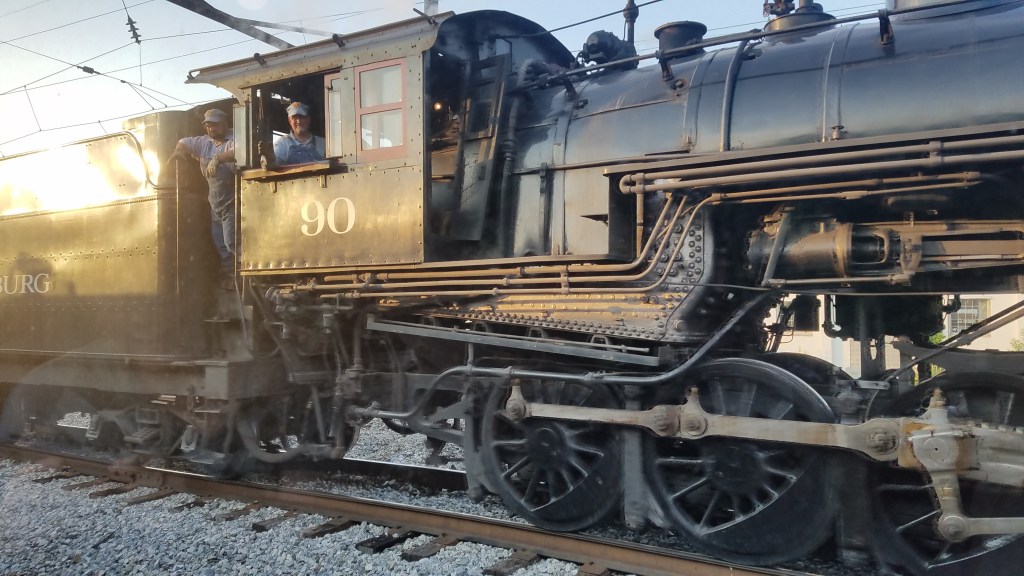
The steam locomotive, also called the Iron Horse, dominated the railways from the early 19th century through the middle of the 20th century. They were a vast improvement over the old system where horses were used to pull carts along rail tracks – hence their nickname. An early model was designed and constructed by John Fitch a steamboat pioneer in the United States in 1794, but it’s the United Kingdom that gets the credit for fully developing the idea and utilizing it for commercial use. They work by using steam to push the pistons of the engine up and down. That movement is converted into the back and forth motion of the wheels through a series of rods – piston rod to main rod, main rod to side rod, side rode to driving wheels. Through such a simple system the age of steam revolutionized the west.
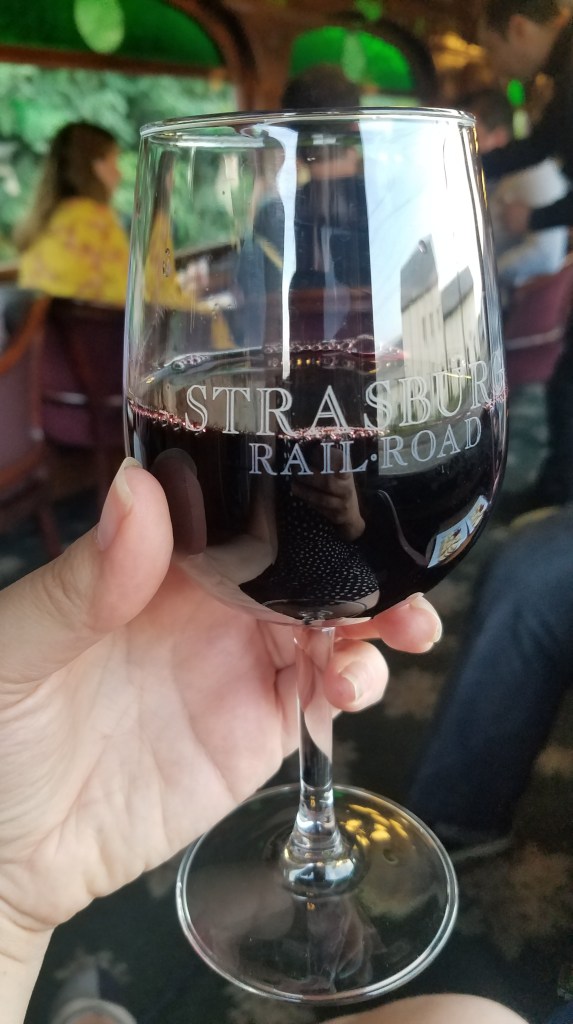
The staff, like the staff at the ticket booth, were dressed as they would have been in the 1800’s when the train was operating to connect passengers to the larger rail systems. They punched our tickets to get us started and gave a brief overview of the train. Then we began the wine tasting being offered two different whites and reds. From the four wines, we would be able to select one to enjoy a full glass. Naturally, I chose one of the reds and my sister, surprisingly, enjoyed the same one – she usually prefers the whites.
As we snacked on the offering of cheese, crackers and grapes, we gazed out at the rolling hills. The rail car shook rhythmically and under the murmur of conversations, one could hear the characteristic pattern of the steam engine chugging along. The sun began to set, changing the sky from a near perfect blue to a paler almost lavender hue. We sipped on the full bodied red, toasting to life and adventure. We were able to catch sight of another steam engine on the tracks and even snap a few pictures of it in action as it passed us by.
How forty five minutes manages to stretch out into what could have easily felt like two hours of relaxation can only be explained by the time machine that was the Strasburg Railroad. It seemed as if no time had passed since we started our journey and yet it also felt as if we had just spent hours traversing the fields. We disembarked fairly content with our adventure and with hopes to enjoy the other offerings that the railroad has to offer in the future. Though with an ever growing list of adventures to try, it may be a while until we are able to step back into the history books.
How can you experience a historic train ride?
Luckily, there are many places where you can experience a ride on a historic steam locomotive, from the line of Whitepass & Yukon in Alaska to the State Train Museum in Georgia. Many places can be found https://www.trainchasers.com/steamdirectory.html though if you don’t see your state listed, it’s not an exhaustive list. It’s just a very good starting point for where you might a locomotive near you. Unfortunately, for those of you living in the middle of the country, most of our rail lines have disappeared, so if this interests you, consider checking out if there are any historical railways near your next travel destination. Remember when we do travel, we want to try and make the most of our travels and explore things we don’t typically have access to. You may also see if there are other historic modes of transportation available to you such as a steamboat ride or early automobile. Perhaps, you can enjoy a steam engine in a train museum. Remember, it isn’t about doing the exact thing but looking at what it symbolizes and what sort of experience you desire to have.
Additionally, I cannot promise that any of these will offer a wine and cheese pairing, but each of them offer a unique experience from Murder Mystery theaters to sight-seeing to simply moving from one place to the next. On a historic train ride in Panama, we were treated to seeing the country from coast to coast, sampling coffee and being entertained with songs.
It started off as an exercise during the season of Lent. Rather than giving up something, I would post for forty days one thing that I was grateful for. Sometimes, it was small things like my morning coffee or the joke someone told at work, other times it was big things like having a house and a job. I enjoyed it so much that I kept it up for nearly 3 years as a daily practice.
It did not transform my life per say. It did not lead me to riches or status or really much of anything “big”, at least not visually. Instead the practice brought me peace and joy. It is, perhaps, the reason, I started focusing on all my small outings with my friends and family as moments worthy of a bucket list. You can see throughout my posts expressions of gratitude towards challenges, hardship and loss. You may see it in how I now look with child-like wonder at the ordinary going-ons around me. It is not as one might suppose naivety about the world, but of this secret practice.
I have a naturally optimistic outlook, though where I got it from, remains a mystery as I come from a family of pessimists. For me even an empty glass is not truly empty or even a bad thing, why an empty glass may be better than a glass half full because now I get to choose what to fill it with like water or wine or healthy herbal infusion. An empty glass is full of potential!
I am known for my ability to “reframe” as my fellow therapists call it or the ability to look at a seemingly negative circumstance and see the positives in it. It is not a pollyanna approach where you place the “at least” game and border on toxic positivity. The reframe is about seeking opportunities in the situation to help you pivot in a positive direction rather than dwelling on the negatives. The job that did not work out is an opportunity for a different one. The break up, while heart wrenching, is a time for you to focus on your own growth and perhaps even find yourself again.
I find it is much easier to get into this growth mindset when I’ve been practicing gratitude on a daily basis. It is a semi-unconscious catalog of all the tools in your belt to handle situations. I have on any given day various coping skills and things that help me feel better. I remember people that I can tap to help me in tough situations and developed skills that let me overcome obstacles. It stretches my mind for creative thinking and problem solving. In practicing daily gratitude you begin to seek out more and more opportunities in almost any frustrating circumstances.
Anticipating an increased commute due to construction? Instead of grumbling, What books might you finally tackle on audiobook during that commute? Perhaps, you will even find yourself slipping into the slower lane because you really want to finish that chapter. Maybe you can use the time to listen to a podcast, or finally learn Spanish in the car with listening exercises. I have crossed off many books off my reading list with my car ride, because I was grateful for my commute. Do not think that I have mixed up the order of that previous sentence. I was indeed first grateful for my commute and then I began to use it for a positive thing. That is right, I was thankful for a hardship and then it became an opportunity.
An unexpected obstacle in my daily commute
My praise does not always have to start with something that seems positive. I have learned to be thankful even in the difficult moments so that they can be transformed. It is not an easy practice; I am not always successful, and I don’t recommend you start there. One must walk first and then run. Instead, start where I began, finding at least one positive thing each day to be happy about. The way your cat greeted you at the door. The smell of rain after a storm. The return of the spring flowers. A good night’s sleep. I recommend keeping yourself accountable with posts or a note in your calendar. You will find at first that some days it seems like you have a million things to be happy about and other days, you cannot think of one single thing. Go for low hanging fruit on those days, the roof over your head, the clothes on your back, the bed you can sleep in.
After a few months, you will probably begin to experience the same peace and joy for your daily life that I began to have. It is not always the easiest thing and there are times when periods of melancholy set in, but this practice has helped me through even the toughest of times. It has transformed my outlook towards the dales of life and even let me start to see that I really am living an amazing life. I’m sure you are as well if you just stop to see it.
I love fall, the cooler days after the scorching heat of summer, the changing leaves, the cozy sweaters and warm drinks. I love the stormy days and misty mornings. I love the way the world seems to nestle down for the coming winter.
One might wonder at something as mundane as a seasonal change being included on a bucket list. But then, dear reader, if you’ve read my other posts here then you already know my answer. If you have not, the answer is simple, because one ought to embrace the joy of living where one is at. One ought to remember that wherever one is, someone somewhere elsewhere dreams about the very place you find yourself. Think of all the millions of people who never get to experience the wonder of fall! Consider all the people who never get to see the leaves of their trees turn to brillant shades of yellow, orange and red. Throughout the tropical regions of the world, there are people who dream of witnessing the changing seasons, who find the vibrant colors of fall as enchanting as a tropical beach. There are even people in the United States who have never really experienced all four seasons as we do in the northern parts.
When was the last time you joyfully walked through them, crunching gleefully as you marched through them? Perhaps, you were a young child and no longer given over to such frivolous and silly things. I implore you dear reader, abandon your adult self with all its imposed rules of oughts and shoulds. Indeed embrace the fall with a child-like enthusiasm and wonder. See the season with the eyes of someone who has never seen this particular form of natural magic.
It was with this sort of attitude, that on my birthday I embarked to a nearby nature preserve to drink in the pleasure of the late fall. Trees typically peak about a week or two before my birthday meaning that there are often more leaves on the ground than in the trees and the forest isn’t quite as majestically dressed. The air is also usually a bit chillier requiring extra layers. That day I donned a hat, a warm caplet and fingerless gloves which would keep my fingers free for the task at hand.
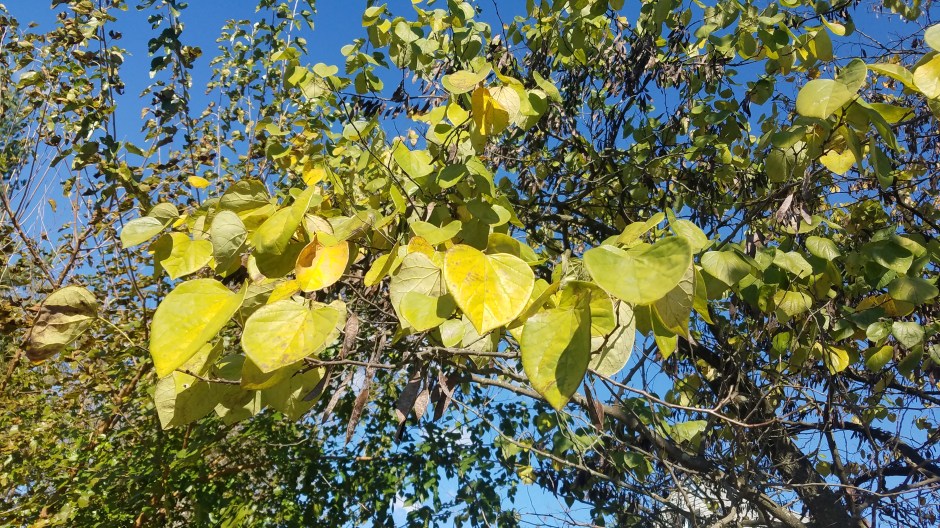
I took a few moments to simply breathe in the crisp morning air savoring the flavor of the forest on the cusp of winter before venturing forth onto the path. I listened carefully to the sounds of the woods around me, the water gurgling in a nearby stream and the way the leaves rustled underfoot. I then drank in full the sights of the forest enjoying the brilliant color of the trees in their glory. With a child’s enthusiasm, I trounced through the woods at times kicking up the leaves, at other times standing quietly to simply enjoy the sights, smells and sounds. There were few others out on the trail that morning, but mostly I was alone with the forest.
I could not say just how long I was out there, but I walked quite a ways basking in nature’s glory before making the determination to go back. It was one the way back that I indulged in another child’s game, collecting leaves of various colors and forms. I made a bit of a game with it, sometimes exchanging a leaf that I had already picked up for one on the ground to make sure I did not become over burdened with them. With my collection well in hand, I headed back to my car quite content with my birthday treat to myself, a quiet morning fully immersed in the glory of autumn. It was something so incredibly simple, yet I enjoyed as much as an afternoon at a spa. I try to spend at least one day in the fall to really appreciate the season as if I were one of those tourists who traveled hundreds of miles on a carefully planned trip just to see the leaves. I am frequently amazed by the beauty that my home brings each year.
How to experience the beauty of fall?
If you live in the northern climes, I recommend tracking the peaking of the leaves in your local area and then planning a morning or afternoon out around that time to really enjoy the outdoors. Keep in mind that fall can be a rainy time of year, so being flexible is key. Luckily, it costs almost nothing to get out to the woods and go on a hike.
There are many other ways to enjoy fall like visiting a pumpkin patch, corn mazes, apple picking and more, but this activity is all about the leaves. You could go a step further and use the leaves for art projects. I used mine just as table decorations for a few days.
If you don’t live in a place where there is a dramatic shift of the seasons, embrace the cycles of the year wherever you may be. The subtler nature of the changes can be just as rewarding as the dramatic shift. Perhaps, there are certain flowers in bloom in the traditional autumn season that you can stop and appreciate. Appreciate the migration of birds who have come down to your warmer home to escape the coming cold of winter. Paying attention and celebrating nature throughout the year is a rewarding experience. We so often neglect the world around us as uninteresting and miss the magic that is occurring all around us instead looking to other people’s backyards for wonder and inspiration. Find the wonder in your natural environment.
Growing up, there was a cross stitch that hung on the wall of our house. On it was an except from “A Song for the Seventh Child” and it ended with the following line “Cleaning and scrubbing can wait ‘till tomorrow, for children grow up as I’ve learned to my sorrow, so quiet down cobwebs and dust go to sleep, I’m rocking my baby ‘cause babies don’t keep.”
One might wonder why such a thing stayed with me all these years, not yet having children. However, I have almost always had a beloved cat or dog and they grow old as I’ve learned to my own sorrow. There are moments when the dishes sit undone because a cat is snuggling on my lap. In fact, when my sister lived with us there was an established rule that if a cat decided to sit on you, the other sister did the dishes. It might seem like a strange thing but both of us agreed that it was more important to spend the time giving love and attention to a creature who would only be with us a short time than to fuss over whose turn it was to wash dishes. What was more important?
If I can apply that to pets, how much more to people? Almost no one gets to the end of their lives thinking they should have worked more or spent more time at the office. So often the refrain is “I should have spent more time with my family and friends. I should have made time for my children when they needed me. I should have snuggled my puppy just a little while longer.” Nor do we know how much time we really have with anyone.
My sister hugging me at graduation; she made sure to be there for me.
I have been surprised by the number of classmates already lost to accidents and diseases even though I’m not yet 40. The expectation is that you won’t hear of loss so young and that you won’t face the news of their passing until you’re well into your 70’s or 80’s. Car accidents happen, cancer happens, life happens. I’ve shared my mother had a stroke at 46 and clots in both her lungs in her late 50’s. These are precious moments you won’t get back so choose how you spend them wisely!
Furthermore, it is important to make sure we are cultivating relationships with our loved ones. There are plenty of stories to illustrate that when you do not prioritize your loved ones, your loved ones will find people who do. You may find yourself having built a beautiful life of loneliness without those you care about. How empty it must be to work so hard and sacrifice so much only to have accidentally sacrificed the thing you were working so hard to provide for? In the pursuit of a goal, you may lose contact with friends and family, over time they may simply conclude that you do not care about them, unless you make the time to be there. Be careful about what you give up when chasing a dream even if the dream is for a good reason.
There are times when I do consider pursuing higher things, pushing myself further, adding yet another hobby or taking on yet another responsibility. But then I consider what I would give up. The time I would miss out on spending with my friends, my family and yes, my cats. When such thoughts tempt me, I make a nice cup of tea, lay on my bed to have my cats nestle next to me and settle in for an afternoon of reading and snuggles. I have yet to regret a day spent with cats or those I love dearly.
In late summer of 2020, the world was still reeling from COVID. Depending on where you were in the world, you were still subjected to lockdowns and restrictions of movement or gatherings. In my own state, there were restrictions on gatherings well into 2022. I have written earlier how those of us with intrepid spirits were not daunted by restrictions on traveling further afield when it came to living life. As it turns out, myself and my co-workers did not need to look any further than the local corn fields for fun.
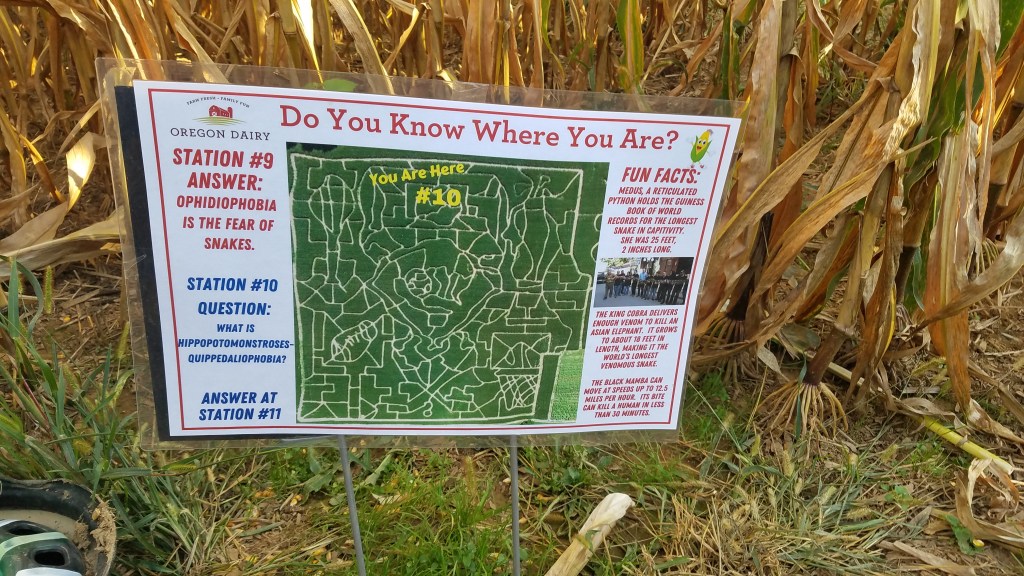
After the lockdowns, my co-workers and I made a concerted effort to plan things to do together as a team after work hours once a month. It not only was helpful for team building and morale but also our mental health as it gave us the opportunity to go out and have fun. As social workers dedicated to helping the homeless this was a particularly stressful time and it was important to foster connection with others as part of resilient coping strategies. One of the activities we chose was a corn maze. In part because some of us had never done them before and we also had a corn maze aficionado in our office. After some debate on which one would be the best to introduce us to, we settled on Oregon Dairy’s. We decided on a smaller, more beginner friendly one rather than the one at Cherry Crest Adventure Farm.
Now as with everything in 2020, what could go wrong, did. In a completely on brand 2020 accident, the GPS system which helped the farmers cut the design for the maze failed dramatically and cut the maze in a completely wobbly way. Unfortunately, while yes, it will grow back there was no way for the corn to grow back in time to for a re-do. However, I don’t think this deterred anyone from enjoying the maze because like myself were so amused by it and thought it made the experience even better.
Now, I will be the first one to admit that going through a corn maze was not my idea of a good time. Being allergic to dust, pollen and bees spending time out in a dusty corn field with the pollen floating through the air and bees potentially buzzing in from nearby fields had placed this activity firmly on the “things I’d rather not” list. However, seeing Melissa’s enthusiasm for it peaked my interest. We were also going later in the season when the corn was no longer an attractor of pollinators meaning that bees and pollen were at a minimum. Given the amount of foot traffic it would see, the dust would be pounded firmly into the ground rather than in the air.
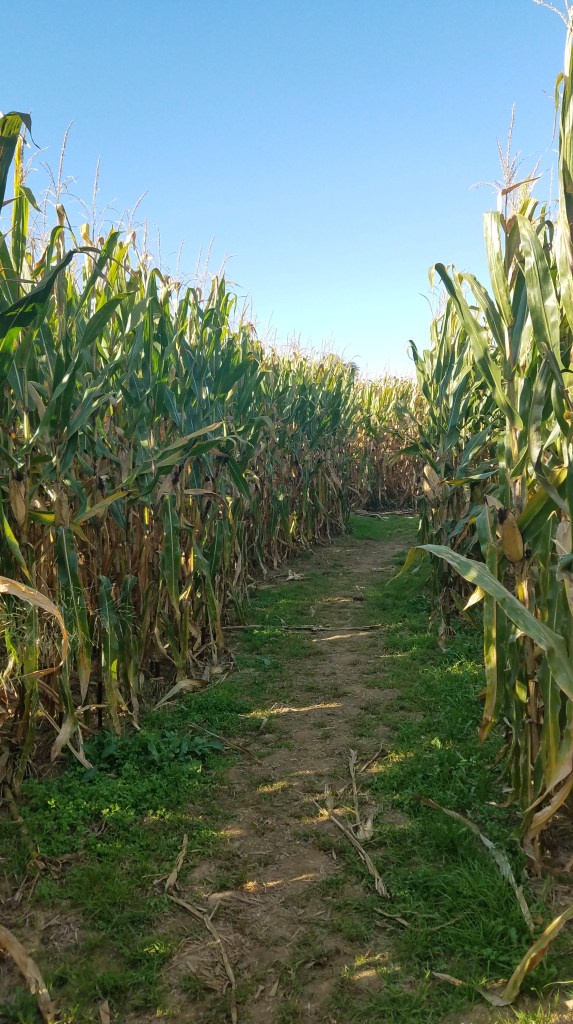
In Lancaster county, there are plenty of corn fields to see, so the point of going to a corn maze isn’t to look at a field of corn, but rather the experience of getting lost together. What’s quite comical is that when you have the map in your hand standing outside the entrance, it looks quite easy, a casual stroll even. Oh, how wrong you would be. The maze quickly becomes disorienting, especially a maze that is as zig-zaggy as that one. Having no real straight lines it was almost impossible to tell if you had turned a corner or merely curved with the path. The corn was too tall to get a good bearing on anything. And of course being corn, it all looked exactly the same, even if you could peek through to the other side.
You think you know where you are and then you turn a corner only to be faced with unexpected options, this isn’t where you’re supposed to be. The simple, easy maze has transformed into a dizzying labyrinth of twists and turns. If you’re not careful, you may lose sight of your companions turning this group adventure into an unexpected solo adventure. You may call out to them but they’re gone. Or perhaps you hear each other but cannot figure out how to get back on the same path. So tread carefully and do not wander too far from your friends.
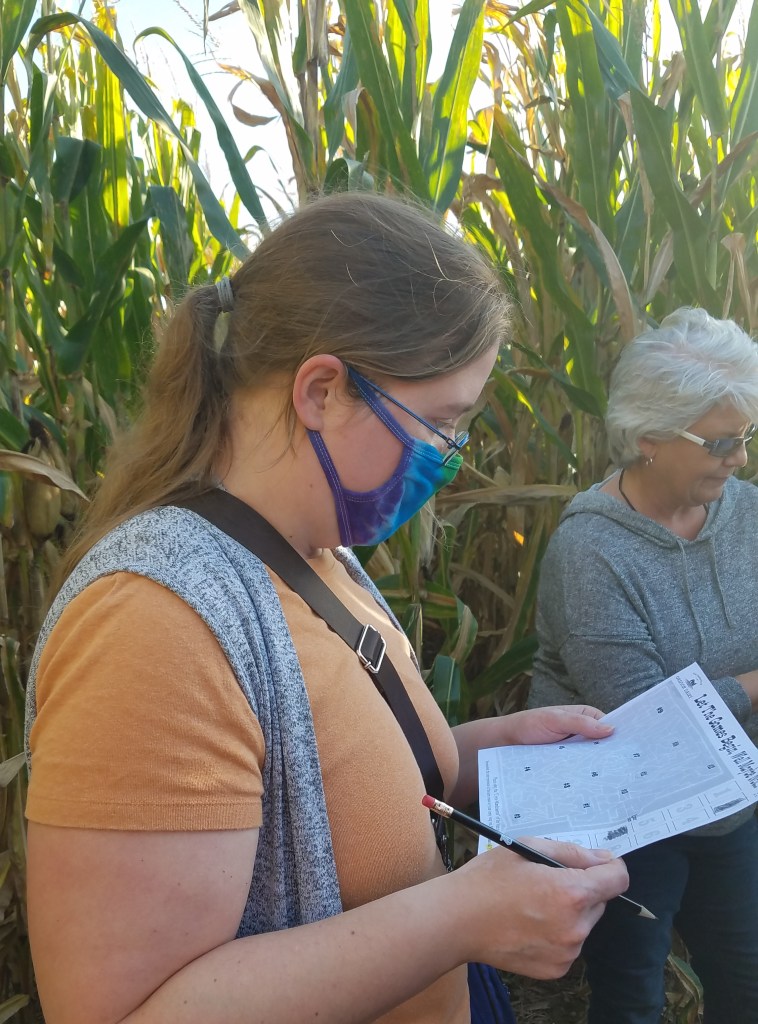
No one was really sure how long we walked or how far. We did manage to find markers which were various points that we were supposed to find and mark off in order to “complete” the maze. They helped to orient us to where we were and help keep us on track. As with any group of activity, it was all about communication and collaboration.
Some of us took a more backseat approach, content to let the others lead rather than become overly focused on the goal. I purposefully avoided trying to take charge as there were already several chiefs taking the lead and I had played enough videogames to know that I am terrible at reading maps and knowing where I am. Though, I have gotten better at it since 2020. I enjoyed the time wandering aimlessly trying to figure out where we were and where we were going. In the age of GPS, google maps it is so rare to be truly lost and having to use what few tools you have available to answer those basic questions. It felt like a small adventure, even though there were plenty of people to help you get out of the maze if you were truly lost.
We found about half the markers before we decided that it was beginning to get late and it was time to go home. Many of them had young children and those without children, had pets who were waiting at home for their dinner and evening snuggles. I would love to try to finish a corn maze in the future as I truly did find it enjoyable. So not only did I get to try something new, but also I got to re-evaluate an activity I previously thought would not be for me.
I encourage you dear reader to reconsider your own “I’d really rather not” lists. Often the barriers to new and potentially exciting things are only in your mind. With careful planning as to when we went, most of my concerns for why the journey would be anything but enjoyable for me were laid to rest.
How can you experience getting lost in a corn maze?
Mazes have been part of human cultures for thousands of years. They crop up in stories like the labyrinth and the minotaur and there is a reference to one in ancient Egypt by the writer Herodotus. In more recent history, hedge mazes were a popular form of entertainment found in gardens of the elite such as the ones at the Palace of Versailles or Hampton Court Palace. Today, corn mazes are the hedge mazes of the people.
The first corn mazes started cropping up (pun intended) in my home state of Pennsylvania. The very first one was in the neighboring county of Lebanon in 1993 by Earl Beal. It was inspired by his father’s work on mazes at a local amusement park and the idea quickly spread across America to other farming communities. Now they are found all over the country where farmers make their living.
I do recommend not going for the “biggest” corn mazes if you’ve never done one before or don’t have the best sense of direction. As I said, the maps are deceptively simple, because once inside you will get turned around pretty easily. Try some of the smaller ones, you will have just as much fun and feel a sense of accomplishment when you’re able to complete most if not all of the maze. This helps to ensure you have a good time as it gives you an attainable goal for a novice. It’s important with our bucket list to keep ourselves in a place where we are being stretched without being overwhelmed.
Oh dear, failure! Is there anything else American culture is more allergic to? Failure is such a part of life and yet we do almost everything we can to avoid it. I am certainly not immune to the fear of it. Do not get me wrong, dear reader, I fancy myself better than most at facing it, but there are still many times that I do not try for fear of it. While it may be tempting to present myself as a paragon on this blog, I am, alas, human rather than a demi-goddess. Shocking, I know, but it’s the truth! So, I will not lie to you and say that I have conquered this particular truth despite my best efforts.
Why do we fear failure so much? Not even failure, but even small mistakes? We live in fear of the judgments, the reprimands and the consequences of our mistakes. We worry about it negatively reflecting on us and what others might think or say. We worry that we might suffer terrible consequences if these failures should come to light. Worse, we may work to hide them and cover them up rather than owning them and taking responsibility. We may try to pass them off as someone’s mistake. We may try to downplay or minimize. There are many unhealthy ways to handle failure, because we fear the consequences so much rather than embracing failure as part of the process to become better versions of ourselves.
I cannot promise that you will not get reprimanded, embarrassed or made to feel less than for mistakes. One of the reasons we fear making them is precisely because that is what so often happens. I will not sugar coat this reality, messing up sucks and sometimes the consequences really suck. What I can promise you is that if you don’t let yourself mess up even in the face of potential negative consequences, you will never move forward and you will continue to be stuck. Messing up is how we learn. It is part of the process of getting better. The entire world of science is based on a series of failures leading to success. Negative data is still data! Edison tried hundreds of ways to make the lightbulb work. Even good ideas may fail initially, it took almost 10 years for sliced bread to catch on and now we say the phrase “the best idea since sliced bread”!
If we spend our time in fear of failure, we will never try and if we never try, we will never succeed. It is easy to watch people performing at their highest level on television without considering all the many times they must have failed to achieve that skill. We don’t see the number of times a gymnast has fallen or how many times a violinist struggled on a particular musical phrase. We don’t taste the botched dishes from the five star chef or the barely recognizable drawings of an artist. So when we try our hand at something, how quickly do we throw in the towel when it is less than perfect? How many things have we lost to ourselves pursuing perfection rather than joy?
The trick is not to dwell on the mistakes. Hence, the second part of this truth, moving on and learning. One should not forget and move on, or we will of course be doomed to keep repeating the mistake which is no fun. One should remember, learn and move on. Now most people would stop here and let the post stand, but I find that they are missing one of the most important steps of the whole process. How to effectively analyze so that one can learn without rumination.
I like to start with a strengths based approach. Studies indicate that when we focus on and cultivate our strengths rather than merely working to overcome weakness, that we make much faster progress. Therefore, I encourage you dear reader to first consider what went well or what was going well. If we get 48 of 50 questions right, should you really dwell overly much on the 2 questions you got wrong? One might end up spending so much time studying on the small section one struggled with in the unit leading up to the final exam, one ends up bombing the final because one didn’t review the other material! Ask, what did you do that helped you achieve as much as you did then, keep doing that!
Then ask yourself what did not go well and begin to brainstorm solutions. Perhaps, it was lack of sleep. Perhaps it was an ineffective method for tracking your tasks. Perhaps, it was looking at the wrong line in the spreadsheet. I often like to try and “mechanize” my approach to fixing mistakes. As a dyslexic, I know I will always struggle with reading spreadsheets unless I use the very simple fix of highlighting every other line in a given color. So, my spreadsheets utilize that method to help me track things effectively. As someone with ADHD, I have routines and develop “self-checks” to keep me on track. I set boundaries with interruptions, even small ones, when I am in the middle of a task because I know how easily I can “lose” a task near its completion. It will be 90% done, someone will ask me to do something else and it will stay 90% done for weeks if I am not careful to say “let me write that down on this to do list and I will get to it in just a few minutes.” this step allows you to plan for and prevent future mistakes.
This is also a time to practice self-compassion to observe without judgment, accepting that you are in fact, human. It is not a time for self-pity or excuse making because taking responsibility for the mistake is part of this process. However, forgiveness of the mistake is important to be able to move forward. I always find it much easier to practice this step after steps 1 and 2. When I can see what I did well and have a feasible plan to move forward the stress and worry that comes from the mistake almost seems to melt away. This is the step that helps us move on.
Sometimes, you do need to add the extra apology step depending on the mistake that you made. An apology should include an admission of harm caused by your actions, whether intentional or not without blame on the other person. If they contributed to the issue it is on them to take ownership of their part when it’s their time to apologize to you. If you’re apologizing to them this is their time to get an apology, not yours, yours will come. It should be followed up with your plan to make amends and you should seek their input for this plan to move forward. Remember it’s not just about the “thing” that went wrong, it’s also about repairing the relationship, helping the other person feel heard, understood and cared for. What makes you feel better about a situation, may not make them feel better about the situation. Once the plan is agreed upon, you need to follow through with that plan for repairing the relationship.
You will mess up, but messing up is a gift. A gift to learn and grow to be the best versions of ourselves and live our best life.

















 Budget Bliss: Bucket List