
If you’re on a budget, the answer could very well be “no, not really.” But fear not, my fiscally responsible friend! I’ve got a bag of tricks to help stave off boredom without emptying your pocketbook. Whether your vibe is books, movies, games, or local adventures, there’s always a fun, frugal version to explore.
Let’s start with the screen-sized elephant in the room: entertainment subscriptions. Cable? Extinct. Like a fossilized VHS, it’s long gone in my world. Streaming? It gets a seat at the table, but only as a guest, not a live-in family member. I rotate subscriptions the way fashionistas rotate seasonal wardrobes. Netflix one month, Hulu the next, and maybe Disney+ when I’m in the mood for animated nostalgia or intergalactic drama. This way, I avoid both boredom and ballooning bills. Pro tip: brands have no feelings, and loyalty won’t earn you discounts so play hard to get. They often toss free trials or discounts your way just to lure you back. Works like a charm.
YouTube also fills in the gaps with everything from quirky documentaries to cozy cottagecore vlogs. Admittedly, the recent AI invasion is a bit much, but with some creative searching, there are still gems to be found.
Gaming on a budget? Don’t let the $80 price tags on new Triple-A titles scare you. Steam is a wonderland of indie games, charming, innovative, and often under $20. Many are just as satisfying (if not more so) than their big-budget cousins. Your local library might surprise you too, offering games for various consoles. And don’t forget secondhand marketplaces, because gently loved games still spark joy.
Speaking of libraries, they’ve fully stepped into the digital age. Between the Libby app, Project Gutenberg, and Librivox, you can have books (ebooks, audiobooks, classics) all for free, 24/7. Libraries are no longer just for the Dewey Decimal devotees; many offer board games, workshops, and community events like Dungeons & Dragons or Magic: The Gathering nights. If Magic’s your thing, I recommend building your own Commander decks; they’re easier on the budget and still a blast to play.
Now let’s talk about the ultimate budget hack: borrowing. Not just from libraries, but from your friends, family, and community. Swap DVDs, music, books, board games, video games, you name it. Not only does it cut down costs, it gives you access to a curated collection based on people who know you. You might even discover a new favorite hobby through someone else’s obsession. Gather your friends and family for game nights.
And don’t sleep on your local area! Free events, museum days, neighborhood festivals, and nature trails are often just a quick search away. Parks, gardens, and hiking paths offer a change of scenery (and pace) without a price tag. You may be shocked at the fun things you discover that are close by and completely free! Apps like Meetup can connect you to like-minded folks for everything from book clubs to language exchanges to “bring your own blanket” picnics. Socializing doesn’t have to cost more than a smile and a snack.
Some libraries even offer museum and state park passes, yes, you read that right. Free access to enriching experiences, courtesy of your dusty old library card. And you all thought libraries only offered books.
Alright gentle reader, technically, it was a bay and not a sea. However, I did get to hoist the sails and attempt to steer the ship. Yes, technically it was a boat; although I”m not sure I know the difference if we’re being honest. Regardless of the pesky nomenclature, I provided an excellent afternoon tea out on a large body of water in a sailing vessel of some sort. Additionally, I made sure to be properly attired for a day’s outing on the water. With the help of a well placed hat pin not even the wind could dissuade me from my determination to have a little extra flare. After all, where would we be as a society if we allowed ourselves to descend into the mundane and boring, especially when it comes to fashion?
In the midst of COVID, with everything shut down and limitations on movement and gathering, the small but scrappy non-profit I worked for decided to offer its employees a day out with one of our board members, Peggy, on her private boat. To say that I was excited is truly an understatement. It was once again, one of those Bucket List Items that I had mentally placed under “most likely not happening any time soon” as I thought it would cost a lot of money to go. This might be the reason I was a little over the top, but honestly that’s part of who I am. I’m the woman who will put together an entire costume or outfit for even the most slightly themed party or obscure holiday.
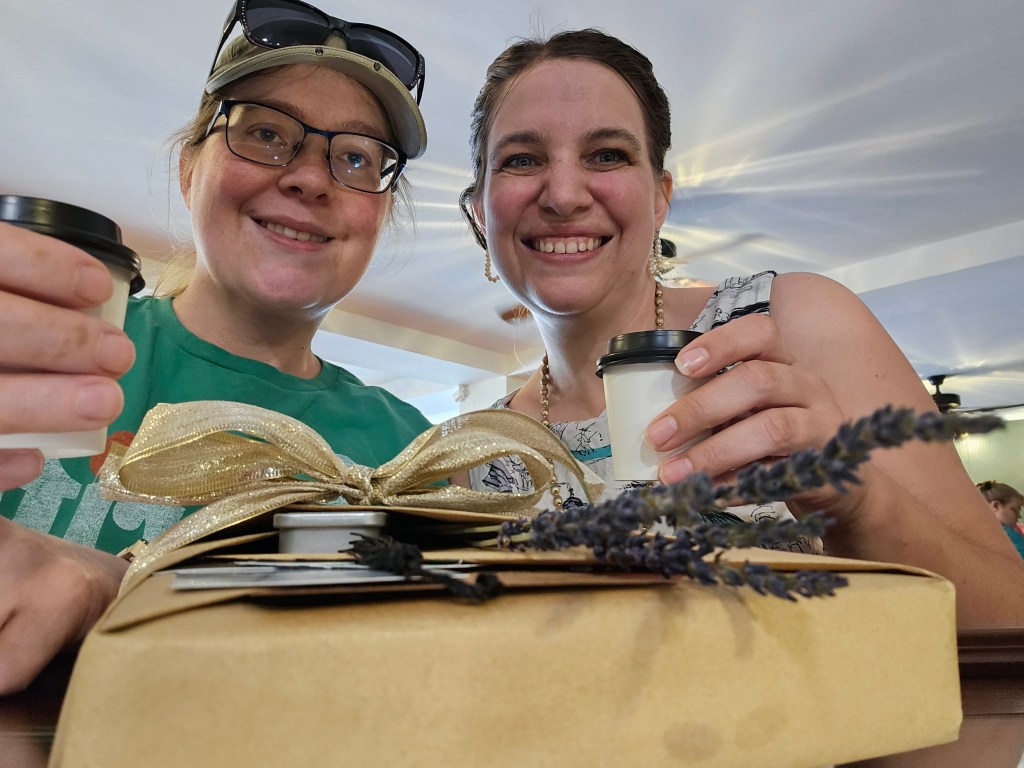
It was truly the morale boost that we needed. To avoid a disruption of vital client services and given the size of the boat, we divided ourselves into two teams which would go on two different days. We also divided up bringing food and other snacks to share. I led the way with letting them all know that I was going to have us do a tea at sea, I would provide the sandwiches, the tea cups, scones and clotted cream. Was it the more costly and time consuming option? Yes, but I was going to take this opportunity that the universe presented me and make the absolute most of it. Before you question my judgement of bringing tea cups on board a ship, know I take quite good care of my china and wouldn’t subject them to the dangers of the open waters. I found these absolutely gorgeous paper cups online!
We loaded ourselves up early that morning, crammed into one of my co-worker’s vans like the start of some quiet, well-mannered heist armed with gps and good humor. I had chosen to go with the more reserved, soft-spoken of my co-workers. What can I say? They paired better with tea than with the loud, pirate-hearted group that went the day before, I am fairly certain they snuck booze despite the prohibition against it, like I said, pirates. Not that I couldn’t hang with both, I absolutely could. And the temptation to burst into sea shanties was quite real, I assure you.
As we drew closer to our destination, the world around us began to shift. The foliage thinned, and the trees gave way to the briny breath of the sea. The air changed too, tinged with salt and carried on a breeze that hinted at something just beyond the horizon. We heard the call of gulls before we even saw the water. Then suddenly, there it was—a small forest of masts rising from the docks like white trees, standing in quiet anticipation.
Waiting for us at the dock was our fearless leader and Executive Director, Deb, who waved us down with her signature confidence. She led us up the wooden planks to our boat, where we were introduced to our captain for the day, Peggy’s husband, Captain Bob.
I was surprised by the size of the boat as it was deceptively spacious, like a magician’s trick. Every inch of it had a purpose. Storage tucked into nooks, seating that converted, a compact bathroom that came with very specific instructions. Bob walked us through the essentials with the seasoned calm of someone who knew that one improperly flushed toilet could quite ruin the whole experience.
After a short safety overview, it was time to sail. Bob asked for volunteers, and I naturally stepped forward to hoist the sails. He called out instructions with the steady ease of a man who’s done this a thousand times, while Peggy provided cheerful backup support. I took hold of the rope with both hands to gleefully, heave ho and all that. The wind caught, the sails filled, and the boat surged forward with a kind of wild grace.
From that moment on, everything shifted into something more elemental. The boat leaned into the wind, the ropes pulled taut, and the world became motion and sound—the rush of air, the splash of spray, the low groan of wood and rope in motion. It felt like stepping out of the everyday and into something ancient.
Those brave enough made their way to the prow, legs dangling over the edge, laughing as waves splashed up to greet them. Time didn’t pass in hours out there. It passed in shadows, in sunlight shifting on the water, in bursts of laughter and long silences where we just watched the horizon breathe.
Then came the offer I hadn’t expected, Bob asked if anyone wanted to steer.
Of course, I wanted to steer the ship!
Taking the wheel was like grabbing hold of something alive. The boat didn’t just move; it responded. The wind pulled one way, the water pushed another, and the rudder spoke a language I didn’t quite know but instinctively wanted to understand. Every twitch of my hands echoed through the vessel. I had to fight the urge to overcorrect—big boat, big movements, right? Wrong. It was the subtle shifts that mattered. I wasn’t just steering a boat, I was holding a moment in my hands, trying not to crush it. I shall admit, I was not the best helmsman, but it wasn’t bad for a first go!
At lunchtime, I unveiled my small, slightly theatrical feast of tea sandwiches and scones. Though there was no clinking of teacups, people were quite amused by them. A delighted Peggy gasped when she spotted the clotted cream asking for where on earth I had found it; she hadn’t had clotted cream since she was in England years ago.
I smiled and told her, with all the drama she deserved, “The local grocery store.”
We laughed, we feasted, we sipped, and apart from poor Beth, who succumbed to a bit of seasickness, our tea at sea was a grand success.
The rest of the sail was a blend of freedom and focus, the hiss of waves, the sudden thrill of turning into the wind, the scent of salt and sun warming the deck. It was chaos and calm, all wrapped into one. I couldn’t have asked for a more perfect day for checking off my list. .
By late afternoon, we returned to the dock. We changed into swimsuits and slipped into the pool, letting the cool water wash away the heat of the day. We splashed and floated, reluctant to let the water go.
That evening, we gathered for dinner at a local seafood spot, the kind with fresh-caught fish, buttery hushpuppies, and that oh, so infamous, Maryland crab. I will say the crab practically demanded a moment of silence in appreciation. Luckily for the crab, eating is just about the only time I am quiet. And just when we thought the day had ended, someone suggested a detour when they spotted a sign for ice cream. Because some days deserve a sweet ending. And this one? This one absolutely did.
So how can you enjoy a sailing adventure?
I’ll admit, not everyone has a friend with a boat—or a boss generous enough to invite you aboard. But that doesn’t mean a day at sea is out of reach. You can always charter a boat for yourself and a few intrepid comrades. Prices can range from around $200 to upwards of $2000, depending on the type of vessel and the duration of your trip. That said, splitting the cost among your group makes it much more manageable. If you’re like me and pack your own feast, you can trim expenses even further. The boat we sailed on would’ve likely cost each of us about $50 to $75 had we booked it ourselves. Sure, we probably wouldn’t have been trusted to hoist the sails or steer, but with seven of us, the cost would have been quite reasonable.
This was one of those rare gifts from the universe, an unexpected adventure in the middle of a pandemic, at a time when most people could only dream of checking something off their list. I felt deeply grateful, especially after working so hard to help people who were experiencing homelessness with nowhere to go. Those long hours, with little reprieve and a general feeling of hopelessness at times to solve the problem can begin to wear on a person’s spirit. Sometimes, when you’re out there trying to do good, life surprises you with something beautiful in return.
So go ahead, pursue the good. You never know where it might take you, gentle reader.
Last week, I shared the basic premises of any budget, money in and money out and then focused on how to keep more of that money that comes in from going out. Which is easier said than done especially in this economy. However, I know that it can be done with careful planning and by looking at things that we can control to a degree. Now food is a fairly flexible area in our budgets, but it has quite a bit of pitfalls for the budget conscious. Between rising prices, forgotten leftovers, and the magnetic pull of takeout, things can spiral out of control fast. But eating well doesn’t have to come at the cost of your financial well-being. With a few intentional habits and some creative thinking, it’s entirely possible to enjoy nourishing meals without draining your wallet.
Now, I will say this before going further, that eating can be a form of entertainment and it is important to separate out your food budget from your entertainment budget. Eating out or buying fun and exotic food to try should be considered under a separate category. I certainly have enjoyed eating at special restaurants and trying new things like conch, escargot and kangaroo. However, none of those things came out of my food budget but instead came from the money I saved up for my various local adventures.
I grew up in a home where cooking was the norm and leftovers were just tomorrow’s dinner. That mindset stuck with me. These days, I still batch cook and freeze extras, brew my own coffee, and pack lunches small, consistent actions that chip away at grocery costs without compromising on flavor or nutrition.
Meal planning is part of my weekly rhythm, but I keep it flexible. I’ve learned the hard way that overly rigid plans invite burnout and wasted food. Instead, I use a loose framework, thinking ahead just enough to avoid duplicate ingredients or last-minute drive-thrus, but still leaving space to improvise.
When I go shopping, it’s a combination of a precision strike force and treasure hunt. I always enter the store with a shopping list to keep me focused, but I always make a beeline for the quick-sale sections and Flashfood. These are goldmines for deeply discounted perishables nearing their sell-by date. I stock up on meat, yogurt, or produce and freeze what I can’t use right away. Depending on what I find, my shopping list may drastically change to accomodate my discoveries. However, if you are new to cooking this strategy may not work for you. In which case still buy it but plan on freezing it until you can decide on what you will do with it. Just be certain you will use this food within a week or two. Food that molds, gets freezer burnt or otherwise spoils is money wasted not saved.
If you know when your store marks things down, you can shop smarter without sacrificing quality. Timing, as it turns out, can be as important as location. Personally, I find that showing up about one to two hours after the store opens gives me the largest selection of options.
I also will make semi-frequent trips to the local grocery outlets as they often sell “ugly” or surplus produce, misshapen tomatoes, slightly bruised apples, discolored pears, all for a fraction of the price. They may not win beauty contests but they still taste great. Besides, I’m certainly not having Gordon Ramsey over for dinner so I needn’t be too concerned after presentation.
I also take fully advantage of the produce stands for in-season fruits and vegetables. Not only are they fresher and more affordable, but also it supports the local economy.
The devil is in the details—and so are the savings.
Keep pantry staples visible: If you can’t see it, you’ll forget you have it—and rebuy it unnecessarily.
Our smaller fridge was a surprise win: With less space to lose leftovers in, we actually eat what we’ve made.
Clear bins help organize everything from canned beans to opened snack bags, keeping waste (and frustration) to a minimum.
Learn to get creative with leftovers: One of my mother’s great talents was pulling out several different leftovers and combining them into a new dish. Don’t be afraid to experiment, take time to read cooking blogs to learn how to combine flavors. I have shocked friends by being able to take a small amount of leftovers and stretch them with just a two or three ingredients into something completely new.
Smart Shopping Rules I Swear By
Some habits have become second nature. These are the rules that keep my grocery bills from creeping upward:
Always check the unit price. The bigger package isn’t always the better deal nor is the lowest price.
Buy in bulk only if it makes sense for your household. Wasted food is wasted money.
Use coupons, digital apps, and loyalty programs, but make sure you’re not buying things you wouldn’t normally use.
Know your store’s layout and markdown schedule. The more familiar you are, the less likely you are to impulse buy.
Never skip the day-old bread rack. Great for toast, croutons, or a cheap French toast brunch.
Staying on budget doesn’t mean sacrificing quality—or joy. With a few mindful shifts in how we shop, store, and prepare our food, it’s possible to eat well and still have money left over for the things that really matter.
Whether you’re cooking for one or feeding a family, remember: your food budget is a tool, not a constraint. When used wisely, it can help you feel both nourished and empowered.
Pennsylvania is known as the Keystone State in part because of its strategic position on the Eastern Seaboard. It sits at the heart of the action on the East Coast and, thanks to the Mississippi River, serves as a gateway to the West. This historic and geographical advantage means I have relatively easy access to some incredible places. By extension, when traveling exhibitions come to those places, it’s not a terrible imposition for me to make the trip. Cities like New York, Philadelphia, Washington D.C., Pittsburgh, and Baltimore are all within reasonable distance.
It was by leveraging this advantage that I was able to see the Darwin exhibition at the American Museum of Natural History in New York, the King Tut exhibition in Philadelphia, and the Russian Tsars exhibition in Delaware. I’m not sharing this to brag about my state but rather to point out that, depending on where you are, you may be closer to the action than you realize. There are often more opportunities in your area than meet the eye.
The Darwin exhibition offered a fascinating look at the scientist’s life, work, and impact. It even featured two Galápagos giant tortoises. Darwin was a keen observer of nature, and through those observations, he developed one of the most revolutionary theories in the history of biology. His theory of evolution has shaped everything from genetics and epidemiology to biodiversity and our understanding of the fossil record. Prior to Darwin, most people saw the natural world as static and unchanging since the moment of creation. Instead, he proposed a dynamic and interdependent system in which relationships and exchanges alter the inhabitants of the world, who in turn shape their environment.
One of my favorite stories is how he looked at an orchid and hypothesized the existence of an undiscovered insect capable of pollinating it. That insect was discovered forty years after his death. This exhibit was the perfect combination of science, history, and anthropology. It showed how discoveries ripple outward into society and helped me understand just how interconnected everything truly is. Is it any wonder that seeing Darwin’s journals, tools, and legacy made its way onto my Bucket List?
Not to be outdone by New York, Philadelphia often hosts exhibitions and installations that rival its northern neighbor. Just because it’s the Keystone State doesn’t mean it lets the other states have all the fun. In the winter of 2007, I braved a snowstorm to visit the exhibition Tutankhamun and the Golden Age of the Pharaohs at the Franklin Institute. The exhibition included fifty major objects from King Tut’s tomb—among them a vessel containing his mummified organs—and over seventy artifacts from the royalty of Egypt’s 18th Dynasty (1555 to 1305 BC), including a sarcophagus.
King Tut’s tomb was discovered in 1922, sparking a global fascination with ancient Egypt that still persists—my own obsession included. Many of these artifacts have rarely left Egypt, so I certainly wasn’t going to let a snowstorm stop me from seizing this rare opportunity. It was history made tangible, a brush with the ancient world that I’ll never forget.
In 1998, Delaware hosted the first major Tsarist exhibition, Nicholas and Alexandra, and I was lucky enough to see it on a fifth-grade field trip. It left a lasting impression on me. We had spent several weeks learning about Russia’s history leading up to the Bolshevik Revolution and the rise of the Communist Party. Featuring nearly 700 objects, it was one of the largest and most prestigious collections of Russian treasures ever to tour outside the country. Most of the items had never before left Russia.
Among the many items on display were the Coronation Egg, an imperial throne, court gowns and uniforms, a gilded state carriage, and artifacts from the Russian Orthodox Church. Even as a child, I was struck by the sheer opulence of the exhibit—particularly the Fabergé Egg, which felt all the more extravagant when considered against the suffering of the Russian people at the time. The experience helped solidify my understanding of the revolution and the dangers of unchecked power and inequality. I’ll avoid getting too political here, but suffice it to say, it made an impression.
Each of these exhibitions made my Bucket List for different reasons. Each one broadened my perspective, deepened my understanding, and shaped how I see the world. They weren’t just collections of artifacts; they were immersive experiences that gave context to history, society, culture, and their ongoing relevance today. Most importantly, they taught me that I don’t always need to travel far to experience the world. Sometimes, the world comes to me.
How Can You Experience Unique Exhibitions?
Start by identifying how far you’re willing to travel. Then make a list of major cities or cultural hubs within that radius—they’re your best bets for hosting large-scale or rare exhibitions. But don’t count out smaller museums, either.
Check their websites to find out when they release their exhibition calendars. I’ve found that many post their schedules for the coming year, although some are less predictable. Once you know when they update their schedules, you can simply mark your calendar to check back. If there’s no set schedule, just take note of when the current exhibition ends and plan to check again around that time.
If you’re searching for something specific—say, an artist or historical topic you love—an online search every six to eight months may yield results. Just be prepared to wait. Some exhibitions, like the Russian Tsars, are generational events.
Lastly, if you’re visiting a city you don’t often travel to, take a few minutes to see what exhibitions are currently on display. You never know what rare gem you might find. It’s easy to miss out by only checking travel sites when planning your trip.
Costs: Range in price from $15 – $25 for museum entrance
I am not, dear reader, a financial expert. I am a social worker by trade, so I certainly am not one to come for advice on lucrative careers. Despite my lauded profession for the good it does society, the electric company has yet to accept the goodwill that I have generated as a form of payment. Nor does the grocery store accept client hugs or testimonials – privacy laws notwithstanding.
However, as this is the Budget Bucket List, I do feel that it is high time that I address the elephant in the room of budgeting so that we can have the funds to check off our lists.
The most basic budget is essentially three steps. Track what’s going in, track what’s going out, and set your spending limits and savings goals. Easy peasy. What’s in is probably pretty easy, it’s your job. It’s adorable that all these financial websites talk about other sources of income as if we have multiple revenues, but we’re budget bucket listers. We either have one job or several part-time jobs just to get by. This isn’t 1960s where people could actually build wealth, this is the 2020’s where nearly 60% of people don’t make enough money to be considered middle class anymore.
The what’s going out part is a bit more tricky and this is probably where I have the most difficulty with financial websites because they will often put things under two categories “fixed and variable” and then act like the variables are in your control. Yes, gas is a variable expense but one cannot control the price of gas and at a certain point, the cost of gas is just what it costs me to go to work to earn the money I need to live. The fixed expenses are your housing, car, insurances, etc. Some utilities will be under this, but not all your utilities. The variable expenses are things like food, gas, entertainment and shopping.
So, how do I cut the costs of my variable expenses, even though at a certain point, you have to spend the money in order to exist and you don’t control the costs of things, especially in this economy. They may not be the most savvy tips in the world and they certainly won’t tell you how to build a stock portfolio, but in the next four posts I will share the things I do to keep the cost of existing down so I can afford the cost of actually living.
Utilities are one of those inescapable expenses—right up there with taxes and “unexpected” car repairs. Whether it’s keeping warm in winter or cool in the middle of a July heatwave, there’s always a baseline cost to existing indoors. While I can’t always control my energy rates, I can control how much energy I use. Here’s how I keep my bills manageable without turning my home into a tundra or a sweat lodge.
My home runs on electric heating and while we have the duct work to have central a/c, we have to rely on window units, so I’ve learned to get creative. In winter, I embrace layers, throw blankets, and hot tea. I also make sure to hang thick curtains. In summer, blackout curtains are my best friends—especially since my sun-blasted front windows face south. The bonus? Those same curtains help trap heat during colder months. Windows are, unfortunately a huge source for either gaining heat in the summer or losing heat in the winter.
Another thing, I really recommend for both winter and summer is to weather-proof your home as much as possible. You would be shocked at how much trouble a small draft at your front door can cause. A few years ago, I was able to upgrade my windows and doors which really helped reduce how much I was paying for heating and cooling because it meant I was able to keep the heat out in the summer and the cold out in the winter. The upgrades honestly paid for themselves in terms of energy savings over the course of a year.
Over time, we’ve also made several other changes that have really helped. As older appliances have needed replaced we’ve opted for energy-efficient ones. We also swapped out light bulbs. We turn off and unplug devices when not in use. We ditched the dryer in favor of hanging our clothes. We’re currently making the switch to more natural fabrics meaning we will need to wash our clothes less. All of this to be more sustainable, environmentally friendly and budget friendly.
In my state, we can shop around for electric providers. I always go for a fixed-rate plan at the lowest cost available. This also means that I don’t have to worry about my energy use during the day as variable rates can be effected by “peak times”. If you happen to have a variable rate, make sure you’re looking to see when it’s cheapest to run your appliances and adjust your usage accordingly. My utility company averages my bills over 12 months, which helps with budgeting, even if the number still feels annoyingly high some months. Comfort has its limits, but so does frugality.
Add heavy rugs and draft stoppers to block chilly breezes
Set your water heater to 120°F (no one likes scalding showers anyway)
Run dishwashers and laundry at night during off-peak hours (if you have a variable rate)
Wash clothes in cold water (your clothes will thank you)
Use a programmable thermostat.
The last will (hopefully) be my next home upgrade as currently, I have a very old thermostat system where I just turn a dial to turn the heat up or down. This means I am constantly having to turn the heat up and then turn the heat down depending on the weather and when I will be home. I can’t turn it off completely when I’m gone because I have pets, but I do try to turn it off for at least several hours every day during the winter. I am sure that just like my windows this upgrade will pay for itself in energy savings. Don’t be afraid of upfront costs if you know it will save you money over time.
I believe, dear reader, that I have already espoused my love and adoration for tea. I love the aroma of it wafting up from a warm cup in my hand. The first sip as it hit my tongue in an explosion of flavor. The way it moves the warmth down my throat and into my stomach. I love how well it pairs with little sandwiches. I love scones topped with clotted cream and curd. I love the frilly lace and fussy accouterments. I love the various honeys I can add for a hint of flavor from orange to lavender to raw to clover. I love adding cream. I love adding milk to chai. I will drink it hot or cold, in the morning, afternoon or late at night. I’ve enjoyed it at my desk at work and as high tea in a parlor. So it should come as no surprise that I jumped at the chance to go to a festival devoted to this beverage.
Our hosts for the Tea Festival are the ladies of The Rosemary House & Gardens. The shop is tucked in a small corner of Mechanicsburg, PA. It’s unassuming front hides an almost enchanted shop and herb garden. From the first moment, you walk in the door you know you are in someplace particularly special. The gentle smell of herbs instantly calms you as you take in the plethora of items adorning every corner of the shop. Everywhere you look merchandise is displayed on every available surface. It ranges from teas, to herbs, to honeys, to curds, to teapots, to fairies, to charms, to books and more. One could easily be mistaken into thinking one had stumbled into a fairy tale with the two older ladies carefully tending to the customers.
Being situated in an old house, the shop consists of two main rooms, the front and the back. The back leads out to a garden as delightful as the shop itself. The well worn paths lead visitors through the herb beds which continue to delight both the eyes and the nose. The garden is a delight to wander through as every single bed contains a surprise. One may spot a small turtle statue or be delighted by a miniature table and chairs (surely left for the visiting fae-folk). A visitor may see a sign welcoming said fair folk as well as a tower of teapots reaching for the sky. There is also no shortage of seating from the gazebo, to the benches, to a giant tea-cup from a carnival ride. The house is worth a visit even on days when a dozen or more vendors have not journeyed to grace it with their presence.
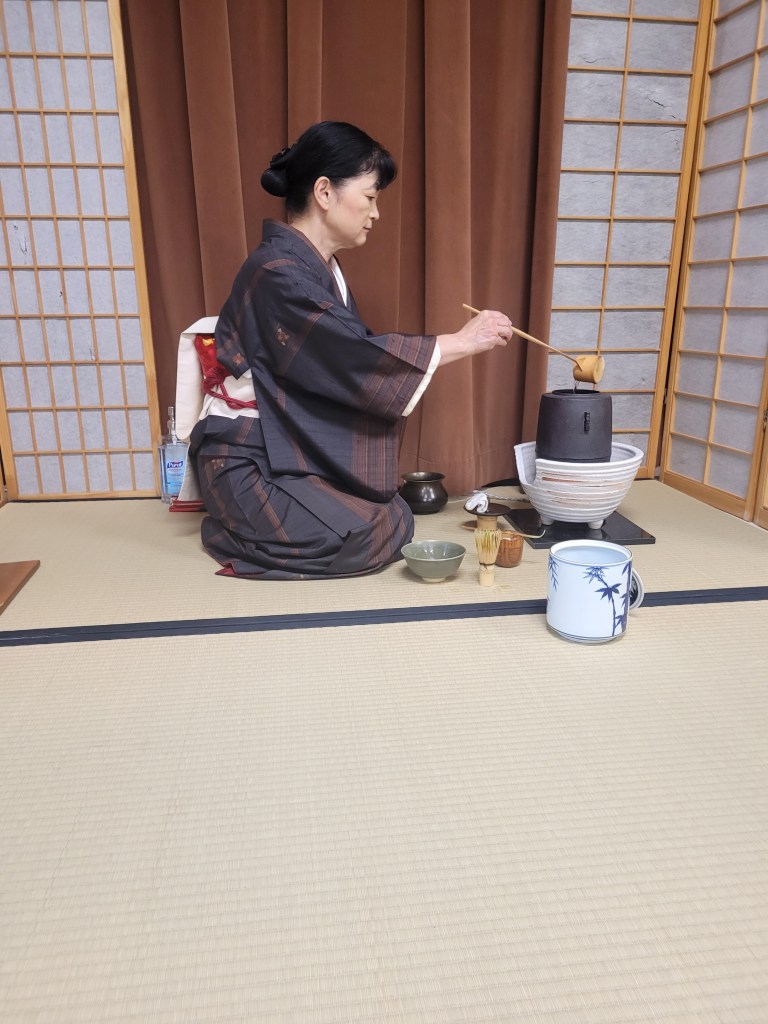
After paying for our tickets at the shop’s counter, my sister and I slipped onto the porch where we collected a small tea cup, a bag, a tea magazine and a schedule of the day’s events. The cup was to be used for sampling the teas offered at the various vendors – which is of course the main reason we journeyed an hour from home to the festival. There was a woman offering tea ceremonies in the garden, but we opted to skip it this year as we attended one at the festival the year before and attended one at the Japanese Gardens just outside of Philadelphia. Instead, my sister selected “A Dark History of Tea” from the lectures that were offered, noted the times and determined that we would start at the front and make our way back through.
Our first destination did not actually have any tea samples, but rather was a creative display of artwork on tea bags of all things. I was amazed at the variety of pictures she was able to create incorporating the tea bags into the paintings. I was so smitten with them, my sister ended up buying one as a birthday present.
We then got to the highlight of the festival, the tea tasting. Each vendor had a variety of samples to showcase some of their best teas. The first one we had was a very smooth oolong tea from Taiwan that was a delight for the tongue. We then took turns smelling different teas and sipping on more. We sampled teas from Napal, Hawaii, Africa, China and beyond. There were herbal teas, white teas, black teas and green teas. There were teas that were pure and teas that had herbal additions like the lemon butterscotch teas. There was a chocolate vendor for tea and chocolate pairings. I purchased various teas for my later personal use.
We did attend the lecture on the dark history of tea and its connection to prostitution, opium, smuggling, poisoning, and slavery. It was a fascinating look at the history of international trade, commerce and greed. It was also a sad reflection that despite efforts at reform for the past 300 years, many of the problems that were prominent throughout the 1700’s, 1800’s and 1900’s are still going on today, if in different forms. The lecture did not get into how the issues in the tea industry can be seen in the fashion and chocolate industries, but my sister and I discussed it at lunch later. One of the things I enjoyed about the tea festival was that many of the vendors were from the countries that the teas were from. We were often speaking with direct representatives of the farmers rather than a corporate sales person several steps removed from the growing and processing of the product. We felt fairly confident that our teas were ethically sourced and free of adulterations and unhealthy additives.
After a few hours of sipping teas and wandering around the festival, the caffeine did start to get to me. I was surprised because I am such a huge tea drinker even at home, but I typically do a cold brew which tends to have less caffeine. So my advice dear reader is to bring some snacks along to help with all the tea that you will be drinking, because after three hours of sipping on the delicious beverage, I was quite jittery. With our stash of tea fully replenished for the coming winter months, my sister and I made our way back into the shop for some final purchases. We then wandered back to the car to decide where we wanted to eat. After consulting google, we realized there was a Japanese place not a five minute’s walk from her car, so we left a few of our items behind and journeyed to the former bank now turned restaurant.
If you happen to be in Mechanicsburg, dear reader, I recommend Kanagawa. It was a quiet, intimate place with polite and friendly staff who were attentive and conscientious. My sister and I choose the small plate of salmon teriyaki with extra vegetables. The vegetables were cooked to perfection with just the right amount of sauce. They were a nice variety of zucchini, onions, mushrooms, and broccoli. The salmon was delectable, practically melting in your mouth with every bite. My sister and I split the fried cheese cake, which was a rare treat for us both. It was a mouth watering delight that must be tasted to be properly appreciated. The outside was perfectly crunchy with just the right amount of chocolate sauce which covered the delicious inside. It was the perfect ending to the day.
How can you attend a tea festival?
I am not entirely certain that tea festivals are exceedingly popular, but that is not to say that they don’t exist in your area. They certainly could! However, there are many popular festivals devoted to different foods and drinks. There may be a beer festival or a wine festival. In my area, I have seen a bacon festival being advertised which may be difficult to convince my non-pork eating sister to attend. If you’re passionate about a particular food or just enjoy eating, then go. You will discover all sorts of flavors you’ve never dreamed of. You may learn new culinary skills or interesting history you never knew about. It could deeper your appreciation for how we obtain our food and how to make more ethical decisions about your purchases. You may discover that you actually like certain foods you always hated. You could be introduced to different cultures or ways of thinking about the foods you eat. Either way, I highly recommend adding culinary adventures to your list. After all, we have to consume food every day just to survive, why not expand your pallet, widen your horizons and explore the world with a different sense than we usually think to use.
Completed: Fall 2023
Cost: $10 per person for tickets and much more for all the tea I bought, which we won’t talk about here. I was weak and the tea was so delicious! In my defense I have like so much tea now, it will last me months.
With summer fast approaching, many of us will find ourselves a little more social. The days are longer, the weather is warmer, and suddenly your calendar is filling up with invitations. Garden tea parties, picnics in the park, birthday celebrations at the lake, beach days, you name it, and someone is planning a soiree.
And yet… as the days creep closer, you start to dread the plans you already agreed to. You sigh the morning of the event, stare at your closet half-heartedly, and start crafting increasingly creative excuses in your head.
But why?
Maybe you forgot about that post I wrote on boundaries (tsk tsk) and said “yes” when you should have said “no.” Or maybe you genuinely thought you’d enjoy it, after all you want to spend more time connecting with others. You’ve read this wonderful blog encouraging you to get off your phone and into the world more, to drink richly from the marrow of life. It was actually quite exciting until you remembered who would be there. Ask yourself: are you about to spend time with people who energize and encourage you? Or with people who make you feel small, doubtful, and drained?
Spending time with the wrong crowd can take a real toll:
But the right people? They light a fire in you. They cheer you on, challenge you in healthy ways, and help you see the best version of yourself, even when you can’t or stubbornly won’t. When I make plans with people who lift me up, I’m counting down the days with excitement, not dread. I leave those hangouts feeling joyful, recharged, and more motivated than ever. Do not mistake my tea parties for merely places to spill the tea, it may also be the place to plan my next conquest!
My village doesn’t agree with me on everything, far from it. But they challenge me with kindness, although tinged with sarcasm and playful barbs to get me really thinking. I truly do enjoy the mental sparring matches that comes from a good debate! They point out gaps in my logic or offer new perspectives, not to tear me down, but to help me grow. Iron sharpens iron, as they say. And I do the same for them.
So yes, I consider the invite and the guest list. My time is precious, and I’d rather spend it watering relationships that nourish me than trying to revive ones that wilt my spirit.
It’s because of these people that I started working out. That I dove deeper into history. That I re-examined and reshaped long-held beliefs. That I went back to school, earned my LCSW, and am (hopefully soon) launching my own practice.
None of that would’ve happened if I’d kept company with people who doubted me or discouraged growth. Because while I do believe in spending time connecting with others and combating the loneliness epidemic, I want to make sure that I am spending my time wisely. After all, the loneliest people are usually the most popular as they are surrounded by the crowd of the wrong people. You will gain none of the benefits of spending time with others described in earlier post if you aren’t with people who build you up. Connection is more than just spending time with others, it’s about being in community with them. A community that thrives together and works towards the good of its members.
So as you fill your own social calendar this summer, ask yourself:
Do these people build me up—or tear me down?
If it’s the latter, it’s okay to politely decline. Protect your time. Spend it with people who inspire you, support your growth, and believe in the version of yourself you’re working toward. You deserve nothing less.
It may seem shocking to people who know me as a bit of a workaholic, but rest isn’t a reward. It’s not something we earn by slogging through long days, hitting every deadline, or checking every box. Rest is a fundamental human need. Still, how often do we hear ourselves or others say, “I’ll rest when I’m done,” or worse, “I can sleep when I’m dead”? An amusing turn of phrase to be sure, but there’s hard truth behind it and that truth often lands us squarely in the doctor’s office or emotionally drained on the bathroom floor.
Rest isn’t a luxury. It’s a lifeline.
This is hardly a new idea. In fact, it’s deeply rooted in the rhythms of life and spirituality. Two of the major monotheistic religions, Judaism and Christianity, place rest at the center of their practice. In both traditions, followers are instructed to rest every seven days, mirroring the divine pattern of creation. Jesus himself reminds us: “The Sabbath was made for man.” That is, we were created to rest. It is not merely permissible; it is essential.
Nature mirrors this cycle. Soil that lies fallow becomes fertile. Trees drop their leaves to rest in winter. Crops rotate and fields pause. So why do we, of all living things, believe that perpetual output makes us better?
Ironically, research shows the opposite: productivity increases when we work less, not more. Countries with shorter workweeks and more frequent breaks often report higher productivity, not lower. It’s not about working harder; it’s about working smarter and that includes knowing when to stop.
There was a video circulating online of two people racing to move bottles into a box. The first ran the length of the line, starting from the farthest bottle and working toward the closest. The second began with the closest bottles, exerting more effort up front. Though they both moved the same number of bottles, the first person conserved energy, maintained a steadier pace, and completed the task with less fatigue. The lesson? We aren’t machines. Even in short bursts, poor pacing exhausts us. Conserving energy through rest lets us go further.
Beyond productivity, rest is a matter of health. Chronic stress has been shown to reduce cognitive performance, compromise immune function, and even shrink parts of the brain related to memory and decision-making. One study found that high stress can drop your IQ by as much as 20 points in the moment. That’s not just inconvenient; it’s dangerous. When we’re running on fumes, we’re more likely to make poor decisions, lash out, or withdraw.
Here’s where things get even more interesting: when we rest, we’re not just recovering. We’re improving. Creativity increases. Problem-solving sharpens. Emotional regulation steadies. We return to ourselves.
I used to think I couldn’t rest until everything on my list was done. Laundry needed folding, emails needed replies, the garden needed weeding. There was always something. I would sit down, tea in hand, only to jump back up at the sight of a dusty shelf or an unchecked item on my to-do list. I felt guilty for resting. It felt lazy. But I’ve come to understand that rest itself is a task, one just as essential as any errand. If I only ever rested when the work was done, I’d never rest at all.
Now, I protect my rest. I schedule it, defend it, honor it. Just like I wouldn’t skip meals, I won’t skip rest. And something beautiful has happened: I’m more present. More focused. More me.
Practical Ways to Prioritize Rest
Schedule it. Treat rest like an appointment. Block it off.
Start small. Try a “mini-Sabbath”: 30 minutes of screen-free silence, a guilt-free nap, or a short walk with no destination.
Name your rest. Know what makes you feel restored—books, baths, hikes, baking, journaling, music.
Watch the guilt. If you feel it creeping in, treat it as a signal—not to push harder, but to ask yourself why rest feels wrong.
Other cultures have long understood this need. In Spain, the siesta remains a valued (if shrinking) tradition. In Japan, the concept of forest bathing walking quietly in the woods is seen as medicine. Scandinavians practice hygge, a cozy kind of restful living that celebrates softness and slowness. These aren’t lazy practices, they’re wise.
Rest also helps us manage crisis. When I’m in a high-stress period, family illness, professional setbacks, emotional upheaval, I know now that my first move isn’t to power through. It’s to pause. Even five minutes of stillness can reset my thinking, stop a spiral, and allow my rational brain to return. Otherwise, I’m just making tired decisions on a tired brain that will create more problems down the line.
Let me be clear: sometimes we do need to push through. Emergencies happen. Sacrifice is real. But those should be the exception, not the norm. If we consistently ignore our bodies and brains when they beg for rest, we won’t just burn out; we’ll break down.
We live in a culture that worships hustle and labels exhaustion as noble. It tells us to chase productivity like a prize. We see rest as a reward to be earned something we get only when everything else is perfect. But life doesn’t work that way. There’s always another errand. Another inbox. Another obligation.
So here’s your permission, if you needed it: you don’t have to finish everything to earn rest. You’re allowed to stop. You’re allowed to care for yourself not because you’ve done enough but because you are enough.
Rest isn’t about checking out. It’s about tuning in. It’s the quiet space where we meet ourselves again.
So kick up your heels, grab a cup of tea, find your favorite corner of the couch, and take the rest of the afternoon off. You’ve got nothing to prove. And everything to gain.
Reflection prompt: When was the last time you rested—not because you earned it, but because you needed it? What changed afterward?
In the world before COVID, there was a growing tradition in my local city. A secret, invitation only pop-up party to kick off the summer season. One could only be invited. There was no ticket payment system or special way to get in. You simply reached out to have your name on a list. Then the list for invitees was opened and you could sign up to go (at least that is what happened the year I went and my sister went). Those in the know, knew how to find their way to this not well advertised gem. I heard about it through the grapevine, whispers in the community of such an event and with a little investigation, I found it.
Despite the location of the event being a closely held secret, the theme of the party was not. Fete en Blanc or Party in White was a premier event. Everyone, dressed up in white, brought their own picnic, wine, tables, chairs and table decorations to create the signature party of the summer. Courtesy of our hosts, they provided the decorations and music. You found yourself seated in a long row next to neighboring tables and just enjoying the spectacle.
OLYMPUS DIGITAL CAMERA
Fete en Blanc is one of hundreds of white pop-up parties started in Paris in 1988. The theme has always been the same. No one knows where dinner will be until the last moment and everyone wears white. You bring your own table and chairs and until recently you provided your own food. The tradition has spread to hundreds of other cities around the world. Some of them do have a ticket fee. Some are more strict on what counts as white. Whereas many places will allow “pops” of color or off white, Philadelphia is a strict white only. It varies from place to place.
An army of volunteers helped to direct the crowd of people all overseen by an intrepid Master of Ceremonies to ensure all had a delightful time. The local park had been transformed into a magical world of floating spheres and twinkling lights. What made it special was precisely that it was not an event held only for those who could afford it. As tickets were free and by invite only, there was no monetary barrier to entry. As you were directed to sit wherever by the volunteers, one could easily find themselves shoulder to shoulder with Lancaster’s finest. Imagine what sort of friends one might make at such an event!
OLYMPUS DIGITAL CAMERA
My sister and I did not have a table, so we spread ourselves out near the bottom of a tree. We enjoyed a spread of white wine, white cheese, white grapes, cauliflower and light crackers. After all, a party in white ought to have white food. However, me being myself, I could not resist just a small “pop” of bright, pink color on my hat. I always did have to stand out in a crowd and besides, rules were made to be broken, darling! As we ate, a duo of drummers moved throughout the tables, their pops of color stark against the white of the crowd. Their enthusiasm was contagious and all to kick off the summer season!
After we ate, we meandered through the crowd taking in the different decorations that graced the tables. Those who were clearly experienced party goers had some truly elaborate displays in stark contrast to our simple set up. As the dusk settled, the atmosphere took on an almost dream-like quality. One could almost believe you had been transported into an in-between realm with the changing of the season. Was the veil between worlds just a little thin that night? Perhaps, it was the wine, perhaps it really was the magic of midsummer.
We did not stay long into the night, both of us had work in the morning. So we packed up our small picnic and made our way out of the dream and back into reality. We were unable to snag tickets the following year in 2017 and in 2018, we determined we wanted to focus on new experiences rather than repeating ones we already had. Sadly, 2019, seems to have been the last year for Fete en Blanc at least for the Lancaster area. Covid came in 2020 canceling any plans for the event and I have not seen its return since. I hope to see its return one day as it was a truly special thing for our community. Perhaps with the advent of my new job I may have extra time on my hands and it is something I could organize here in my local community. It might be something to add to my list – throw a giant party for my community? What do you think dear reader?
OLYMPUS DIGITAL CAMERA
How can you experience a Fete en Blanc?
Well, as I said, our own local White Party does not seem to have returned after COVID, so if you happen to be in my area you will have to look further afield. If you do manage to locate one, be rest assured it is a difficult event to get into as most are lottery based given the demand for attendance typically overtakes the capacity of the given venue. In Paris, over 13,000 people may attend and they still do not have enough spaces for all the people who wish to go. Paris has a waitlist of over a million people and is considered one of the most exclusive dinner parties in the world.
The copy-cats around the world are little different in terms of demand outpacing capacity. Almost all of them take place between May and September as a celebration of the summer and given that they occur all over the world, there is a very good chance you can find one in your area. Given the difficulty and exclusivity of such an event, you may dear reader feel a bit disheartened by the prospect of ever experiencing the spectacle yourself even if you are nearby.
Now, what have we learned in such situations? When one cannot do a specific item, one can examine the principles and values of the experience. That is not to discourage you from throwing your hat in the ring and trying to get a coveted spot, after all most of the time it is a matter of throwing your name on a list and hoping your name is drawn.
OLYMPUS DIGITAL CAMERA
In this case there are many festivals, events, parties and even secret going-ons that are occurring in your local community. One must merely be attuned to what might be happening around you. I found that the more I got out to do things the more things I found to do. Your friends and family start reaching out with cool ideas that might interest you for your next adventure. They start inviting you to things to do with them. Do you know the number of your friends and family who want to do things but have difficulty finding people to do things with? When you’re the person always going off and doing new things, you’re often the first person they call!
I was not looking to do this party, I heard about it, signed up and snagged a coveted spot! I encourage you dear reader to get out and do! Soon enough you’ll be hearing about all the secrets your community has been hiding right under your nose!
There is also another option. Given that all that is necessary is a venue, some music, white decor and a few friends, there is nothing to say that you can’t start your own Fete en Blanc tradition in your local community. Imagine being able to give a bucket list experience to not only yourself but your whole town as well? That’s how Lancaster got started and I hope to see its return soon.
Completed: June 2017
Miles from home: 11
Cost: Free Invite – $30 for dinner supplies, I already had an entirely white outfit from my wardrobe
This is a list of all the major cities that hosted a Fete en Blanc in 2018
We all have goals and if you’re reading this blog, you probably have a long list of them like me. Things you want to do, places you want to see, milestones you want to accomplish. Some of the items on the list are more just for fun or it seems like it would be a cool thing, some are things we really do want to do and a few of them are deep, burning desires. It’s those last ones that this post is for. After all one will not obtain goals simply by sitting around awaiting the golden opportunity. As in a previous post, sometimes fate needs a little nudge in the right direction. If one is going to achieve something truly worthwhile then it stands to reason that one will be putting a significant amount of effort into the cause.
Obtaining a goal is about clarity, focus and action. It’s those first two steps that often trip people up because before one acts one ought to take time to plan, right? Maybe not or at least not how most people plan. What if we stopped asking “How” and instead started to ask “What”?
I’m stealing this piece of advice from the business world for improving our lives and meeting our goals. It takes the classic approach of obtaining goals and turns it on its head. Most people set a goal then ask the next, seemingly logical question of, how am I going to achieve that? After all that’s the problem solving approach most of us were taught. You set a goal and make a plan which is always followed by “How am I going to do it”? However, that question is a trap! It’s a question designed to take you down a path that’s ineffective and frustrating, to get you bogged down in the details. You’re bound to get yourself so tied up in knots thinking of all the reasons you can’t achieve your goal and the seemingly insurmountable barriers that the question is bound to bring up. You lose your focus and start trying to break down the goal into other sub-goals to get around the barriers which only lead to more how questions. It can also get you lost in the illusion of taking the action of “planning” rather than the action of “doing”.
What skills and resources do I have to make it happen?
What resources do I have need?
What people should I connect with?
What will keep me motivated and inspired?
What will I do to celebrate the milestones?
What will I do when I’ve obtained this goal?
It’s about shifting you from thinking about a plan to actually doing the steps which will actually take you there. There isn’t time to worry about the barriers because you’re too busy ticking off your to-do list after answering those questions. It moves the goal from a what if to a when. In the immortal words of Zig Ziglar “when obstacles arise, you change your direction to reach your goal; you do not change your decision to get there”.
When I set out to start checking off my list, I didn’t really focus on the how. Had I done that, I probably wouldn’t have much checked off because I would have gotten caught up in all the barriers, the cost of travel, the distance, the time, the difficulties, etc. But because I’m not focused on the how, I’ve found that I am constantly finding and stumbling upon opportunities to complete my goals. When I decided to become a therapist, I didn’t worry about the exact how but rather the what college would I go to, what major, what jobs should I apply for? It also keeps you flexible to discover a different path to your goal that you may not have realized was there before. When becoming a therapist, I had a path that I thought I would need to follow, which was to get a PhD in psychology. Instead, I ended up with a LCSW, which was a much cheaper option. Had I been too focused on the how, I would have never strayed from the original “what” to a much better fit for my goal. I have a friend whose goal is to help people in a similar way and is in the process of becoming a Life Coach.
This simple but powerful change can help you go from merely goal setting to goal achievement.