I know, dear reader, this might be the last place you’d expect to find a defense of boredom. After all, many of you probably clicked here to escape boredom, not embrace it. I may even be digging my own blogging grave by suggesting you spend less time scrolling and more time staring at your ceiling. But this space was never meant to trap you for hours. Its intention has always been to help you live a fuller, more mindful life, without breaking the bank.
As someone with ADHD, the idea of boredom used to feel impossible. Tedium was my sworn enemy. Yet I’ve come to realize that boredom is a rare luxury these days. With our phones glued to our palms, we rarely get the stillness that allows us to simply be.
And here’s the secret: boredom isn’t the enemy. It’s the birthplace of philosophy, creativity, and growth.
Why We Need Boredom
When you’re left alone with your thoughts, they can be loud, uncomfortable, even overwhelming. But without that discomfort, how can you truly know yourself? When do you ever stop to ask:
Am I on the right path?
Are my relationships enriching or draining me?
What do I actually want out of this short, strange life?
Noise drowns out those questions. Silence, and yes, boredom, makes space for them. And while the answers might not always be pleasant, they’re necessary for meaningful growth. It’s only when we ask those questions that we begin to fully develop a meaningful life which according to some researchers may be the antidote for the crushing anxiety we’ve all been feeling. According to Harvard Professor Arthur Brooks, it is the lack of meaning that drives so much of our modern world’s anxiety and depression and boredom would be part of the cure!
Boredom also boosts creativity. When the mind wanders, it problem-solves. Einstein famously worked at the Swiss Patent Office for seven years, a job so dull it practically begs for daydreaming. Out of that monotony came some of the most groundbreaking ideas in physics. Imagine what we might uncover if we swapped YouTube shorts for a little mental white space. You may be quite shocked at what problems you solve whilst driving your car.
Finally, boredom sparks curiosity. That restless itch pushes us to seek out novelty, to wander past the familiar bend in the road. Dissatisfaction with the status quo has always been the engine of human progress. It’s what drove Columbus to set sail and spark the West’s discovery of the world. It’s what drove the Wright Brothers to the sky. It’s what made humanity ask “what is up there in the vast expanse above us?”
Some of my best ideas have come when I was bored. This very blog was born while I was gardening. Insights about my therapy clients have surfaced while I was elbow-deep in dishes. I’ve written entire stories in my head while waiting in line, or mulled over questions of faith while driving down long stretches of highway.
Boredom isn’t wasted time, it’s compost. Given space, it grows something new.
How to Reclaim It
So how do you let boredom back in? Start small.
Turn off your podcast or music while you drive or clean.
Try a tech-free meal and see what real conversation shows up.
Block out one phone-free evening a week.
Take breaks from social media, or better yet, set parental controls on yourself.
Use your phone’s Do Not Disturb mode generously (you can allow emergency calls to still come through).
Will it be fun at first? No. That’s the point. But over time, you’ll come to see boredom not as an absence but as an opening. I’ve even started protecting mine, because that mental wandering is often far richer than anything TikTok could offer.
I’m not sure if you’ve noticed, dear reader, but we’re in the thick of a technological revolution—what with artificial intelligence, immersive media, and smart devices popping up faster than I can finish my morning coffee. With every leap forward, the world reshapes itself: some innovations are delightful, others… decidedly less so.
But before you brace for a philosophical tirade, rest easy. This isn’t about the doom and gloom of progress. Today’s post is about something far more charming, and perhaps a bit science fiction, how technology is transforming the way we experience visual art, and how I got to see that transformation firsthand through the Immersive Van Gogh Experience.
For centuries, visual art has been something we look at, admired behind velvet ropes or under museum lighting. We view a painting, reflect on its symbolism, absorb its mood, and then move on. It’s typically a passive interaction, appreciated but always held at arm’s length.
Now, thanks to clever combinations of projection mapping, music, props, and sometimes even VR goggles, we can step into the world of a painting. These experiences dissolve the frame. The art swirls around us, alive with movement, sound, and color. It invites not just observation, but participation. We’re transported into a world shaped by brushstroke and emotion, where time bends and the impossible feels touchable. If you’re a fan of Star Trek it can feel as though the Holodeck isn’t far behind us – or would it be ahead of us?
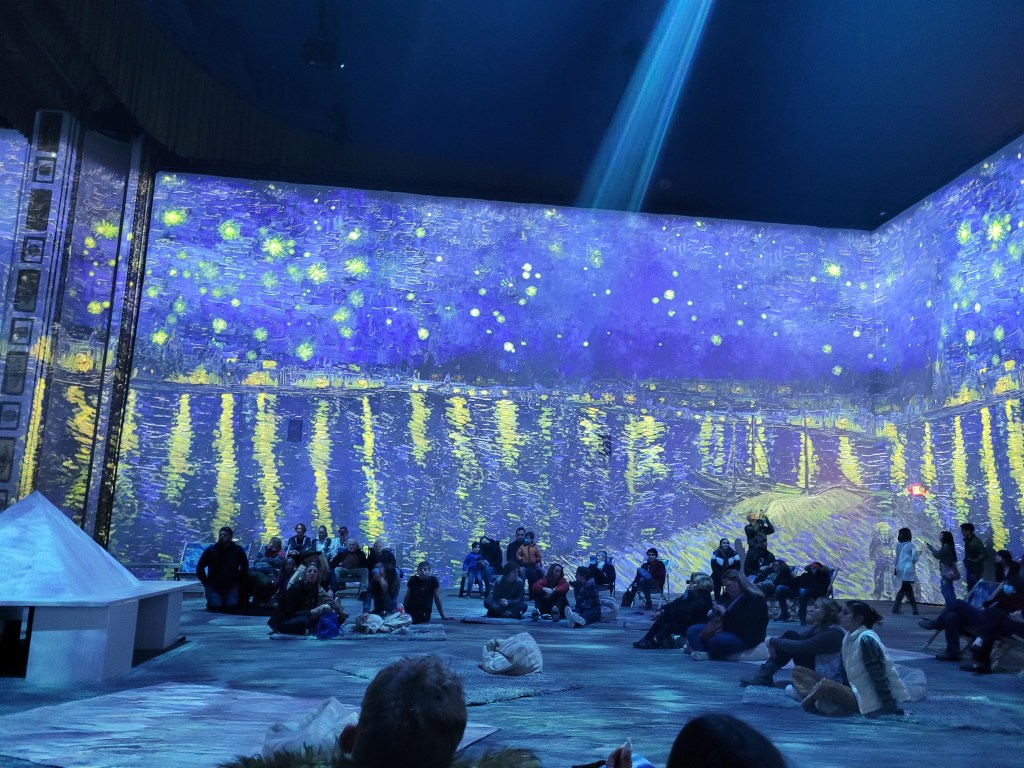
Such was my adventure on the outskirts of Philadelphia. I attended the Immersive Van Gogh Exhibit, where his iconic works leapt from flat canvas into full surround. It was a modest production by immersive art standards, but well worth the 50-minute drive. The exhibit unfolded in three rooms, beginning with a respectful introduction to the artist’s life: the genius, the grief, and the legacy.
Vincent Willem van Gogh, the Dutch Post-Impressionist painter, is now recognized as one of the most influential artists in Western history. He created over 2,000 works, 800 of which were oil paintings, many during the final two years of his life. Though immensely talented, he also struggled deeply with mental illness, most likely Bipolar Disorder, experiencing intense periods of depression and mania. He spent time in psychiatric hospitals, often neglected his health, and famously cut off part of his left ear after a dispute with a close friend.
I would be remiss if not highlighting the efforts of his sister-in-law. As It’s entirely possible the world would have forgotten him, had it not been for her, Johanna van Gogh-Bonger, who championed his work and preserved his letters after his death. Her tireless efforts not only shared his story but helped cement his artistic legacy. Too often we focus on the face and talent of a given operation without appreciating the supporting cast of characters. After all in any endeavor it takes a village to succeed.
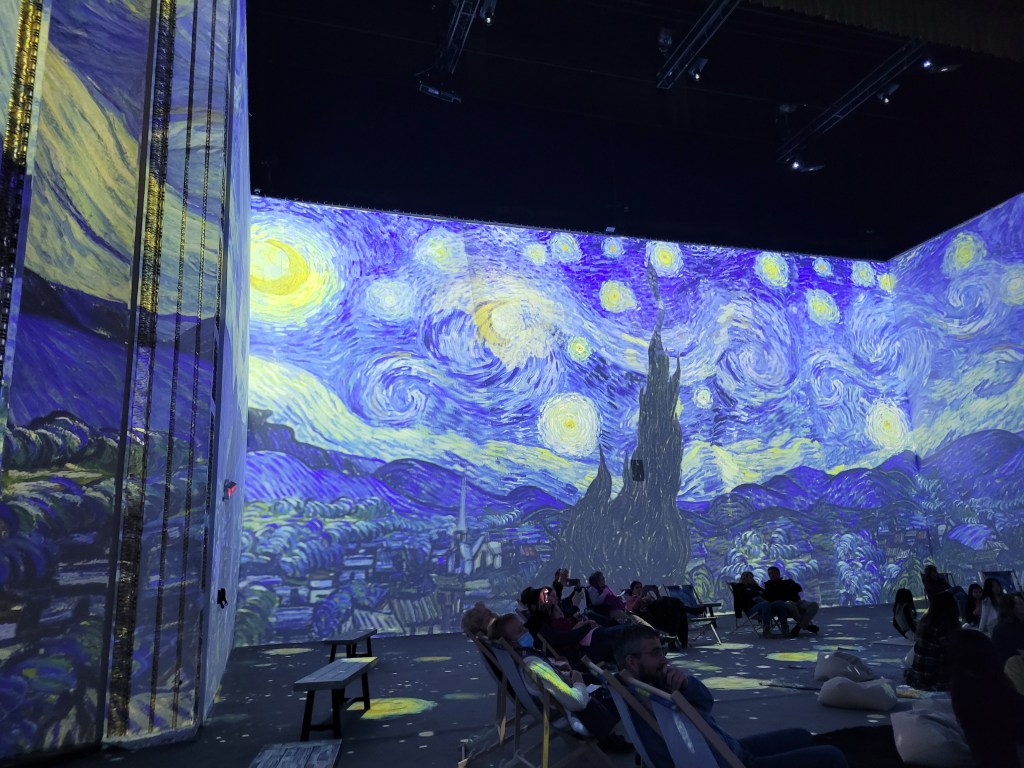
While the trope of the “tortured artist” is often romanticized, Van Gogh’s story has opened broader conversations about mental health, creativity, and resilience. Beyond the mythos, his art also sparked interest in unexpected fields, like fluid dynamics. Scientists have observed that Starry Night mirrors real-world mathematical models of turbulence, patterns that weren’t formally understood until decades after Van Gogh painted them. He may not have known the equations, but his brush captured the energy of the cosmos with stunning intuition.
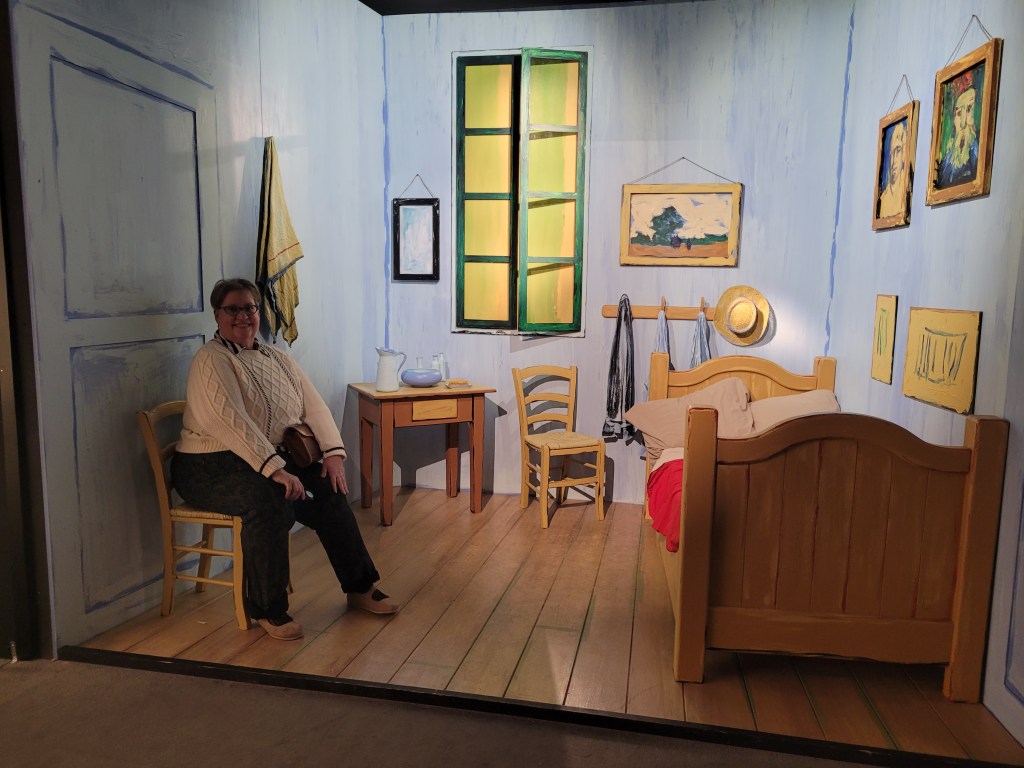
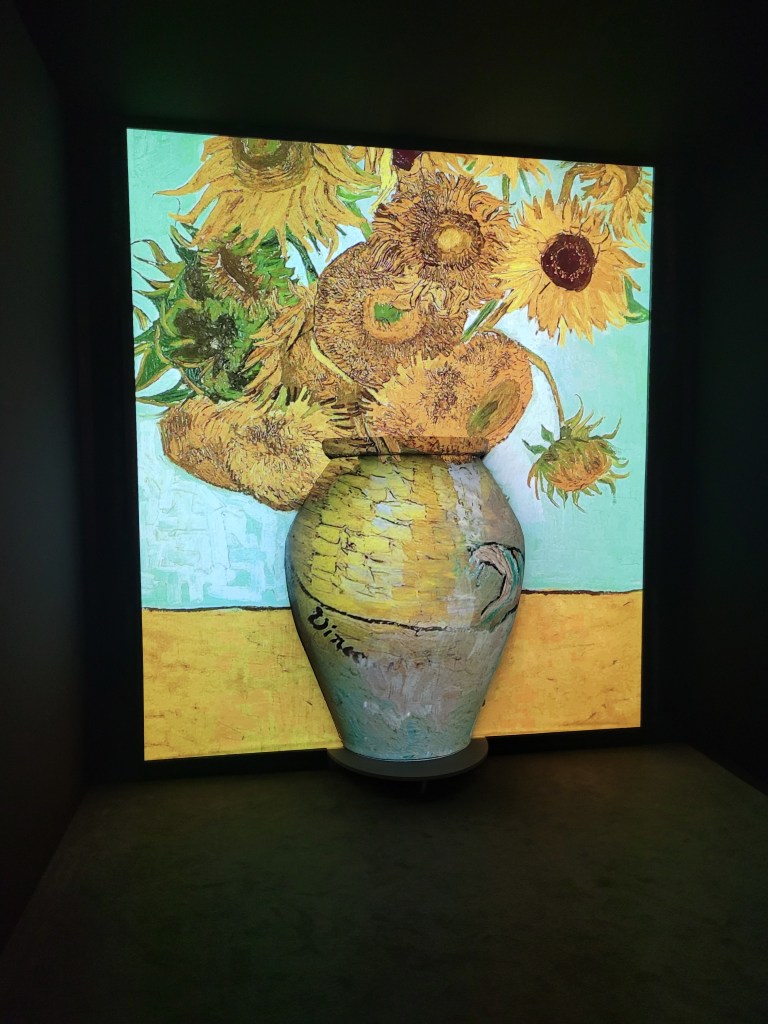
His story gently unfolded as I walked through the exhibit. I heard excerpts from his letters and watched his still-lifes float, twist, and evolve across the walls. One moment, I was standing in his bedroom; the next, sunflowers danced around me, filling the space with golden light. My favorite moment was in the largest room, reclining on a seat and watching Starry Night come to life, accompanied by music that echoed the emotion of each painting. I could’ve stayed there for hours, had my parking meter not rudely reminded me of the outside world.
There was something deeply calming about it all. The way the paintings moved, the soft narration, the glow of color, it felt like being wrapped in a blanket of light and sound. The only thing missing was a hot cup of tea to sip while I drifted through it all.
Eventually, I had to peel myself away from Van Gogh’s swirling skies and rejoin reality. I refilled the meter and met my traveling companion (my mom) in the gift shop to find a souvenir. She chose a beautiful necklace that still earns her compliments. I, ever the practical one, picked up a set of coasters, because if I must collect things, they might as well be useful. Additionally, if I must have things, they may as well be beautiful. A memento with function and a memory with purpose.
While technology certainly has its downsides, I’m genuinely excited to see how it will continue to open new windows into the past, especially when it’s done with care, creativity, and reverence. If we can blend art and innovation without losing the soul of either, I’d say that’s progress worth celebrating.
Finding Your Own Immersive Art Adventure
If your curiosity is piqued and you’re ready to step inside a painting (or at least escape your laundry pile for an afternoon), immersive art exhibits are popping up in cities all over the world. A quick search for “immersive art experience near me” or checking sites like Exhibit Listings, Eventbrite, and even local museum calendars can help you find upcoming shows. Popular exhibitions include Immersive Van Gogh, Monet: The Immersive Experience, and Frida Kahlo: Immersive Biography, among others. Many cities now have dedicated digital art spaces that rotate different artists throughout the year. Social media is also surprisingly helpful, follow local art museums, galleries, and pop-up exhibit pages to stay in the loop. And don’t be afraid to go solo! These exhibits are made to be experienced personally, and sometimes the quietest wanderings are the most rewarding.
Before we clutch our pearls at such a title, you must first indulge me in a bit of theatrical storytelling.
There was once a painting known to the art world but given little regard by the general public. Sure, some waxed poetic about it, but the intelligentsia has always been a bit eccentric in its proclamations of greatness. To anyone outside the art world, it was unremarkable. It may have hung in a museum, but no one would have gone out of their way to see it. Like so many other paintings in a gallery, it was forgettable, small, dark, and easy to overlook.
Then it was stolen.
No one knew how. One day, it was just gone. And suddenly, people noticed. For two years, the public speculated wildly. The fever-dream of mystery only grew with every twist. Perhaps absence does make the heart grow fonder, or at least more curious. While the intelligentsia is eccentric, the general public is fickle, like a cat who demands to be let out only to want back in the moment the door shuts.
When the painting was returned, it became a sensation. A must-see. A cultural event. And not just any painting – THE painting.
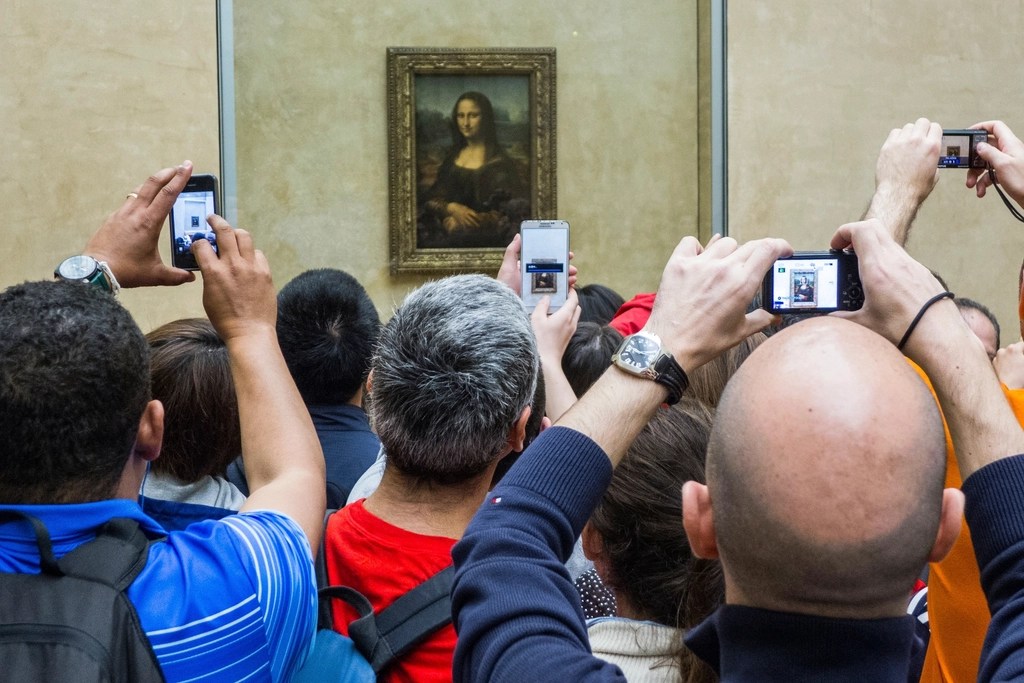
The painting in question? The Mona Lisa. The real reason it’s famous? The drama. The theft. The story. The hype.
Without that? It might still be hanging half-forgotten, quietly smirking at a handful of art students instead of hoarding crowds behind velvet ropes.
And that, dear reader, is what your bucket list might be made of: hype.
So many bucket list items are fueled not by intrinsic value, but by the frenzy that surrounds them. Don’t get me wrong, the Mona Lisa is a lovely painting, and Da Vinci was no slouch, but why that painting? Why not another of his works? Why not another artist entirely? Yes, yes, I am sure you’ll tell me all the reasons it’s such a great painting, a master piece of its time, blah, blah, blah., but there’s lots of great paintings you can’t name or even are aware of. The answer lies in marketing. In myth-making. In the way a compelling narrative shapes our desires
Travel magazines dazzle, influencers entice, advertisements whisper, “You must go here.” But what’s really behind that? How many times have you visited a place only to find it…underwhelming? A glorified photo op? Something that looks better on Instagram than it feels in person?
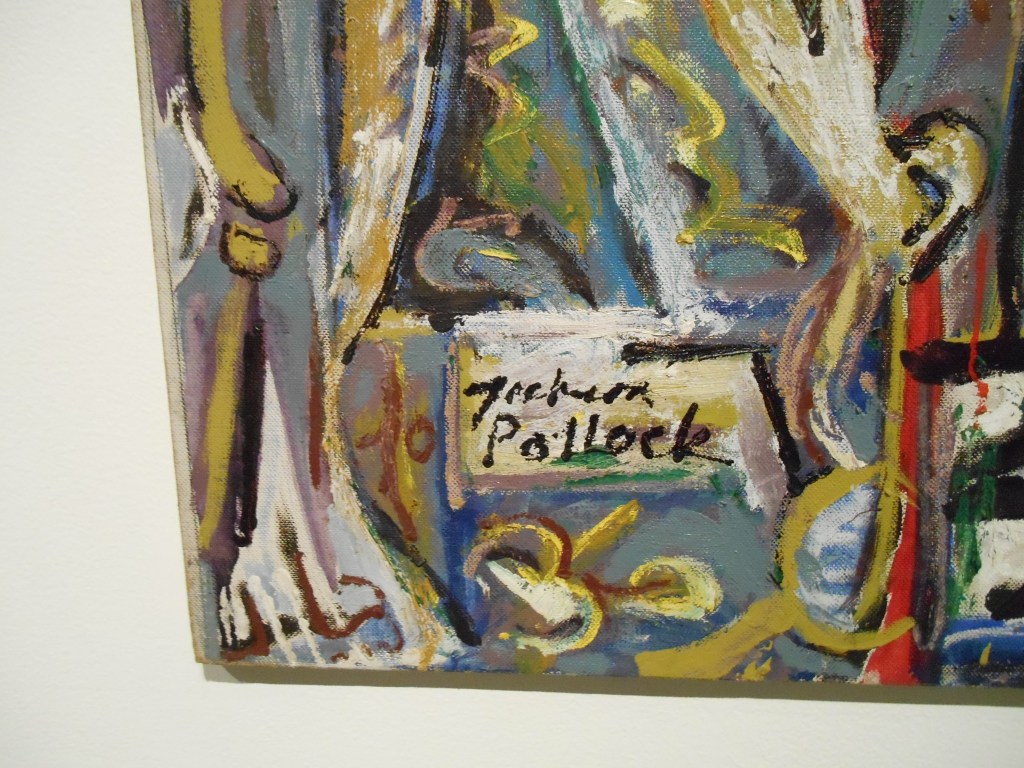
Perception shapes reality. And marketing shapes perception. Don’t believe me? Riddle me this, dear reader why do we consider Jackson Pollock a great artist? The CIA orchestrated the entire Art Movement of Abstract Expressionism’s rise to prominence, engineering hype around the artist Jackson Pollock by buying his paintings and creating a frenzy around the art movement through bought and paid for critics. It was for political reasons and to combat the dangers of Soviet Russia. However, until the CIA engineered the hype, it was mostly ignored and barely considered real art. After all, it looked like a five year old could have painted it.
Nor is the art world, the only place where bought and paid for critics shape our perceptions. There was an rather large controversy in the video game world of creators influencing magazines and reviewers to generate hype around game releases. Those travel influencers filling your feed are often being paid by travel magazines, hotels and even the local department of tourism to promote various locations and experiences.
Signature of Jackson Pollock on Pasiphaë (1943; Metropolitan Museum of Art) Ned Hartley – Own work
Let’s be clear: I’m not criticizing your personal travel goals. I’m encouraging you to interrogate them.
Are your bucket list items there because you want to experience them, or because someone told you they’re “must-see”? Would another location fulfill the same desire, perhaps with less hype and fewer crowds?
For instance: Why London? What do you actually want to see there? Do you even know the history behind the city’s major attractions? Could a neighboring town offer the same experience without the same price tag?
Yes, Stonehenge is cool. But have you heard of the Calanais Standing Stones in Scotland? Same vibe. Fewer tour buses. Also, older.
We should be asking ourselves:
Do I understand why this place matters?
Does it resonate with me personally?
I, for example, will probably never visit the Great Wall of China. It’s a feat of engineering, sure. But so was ancient Rome. And frankly, the Wall didn’t even fulfill its intended purpose, more a monument to hubris than a functional defense system. And trust, me there are plenty of monuments to hubris. There are other ancient walls, built with equal ingenuity, that never make the “Top 10 Things to See Before You Die” lists. Just because it’s the biggest, doesn’t mean it’s the best or even the most impressive.
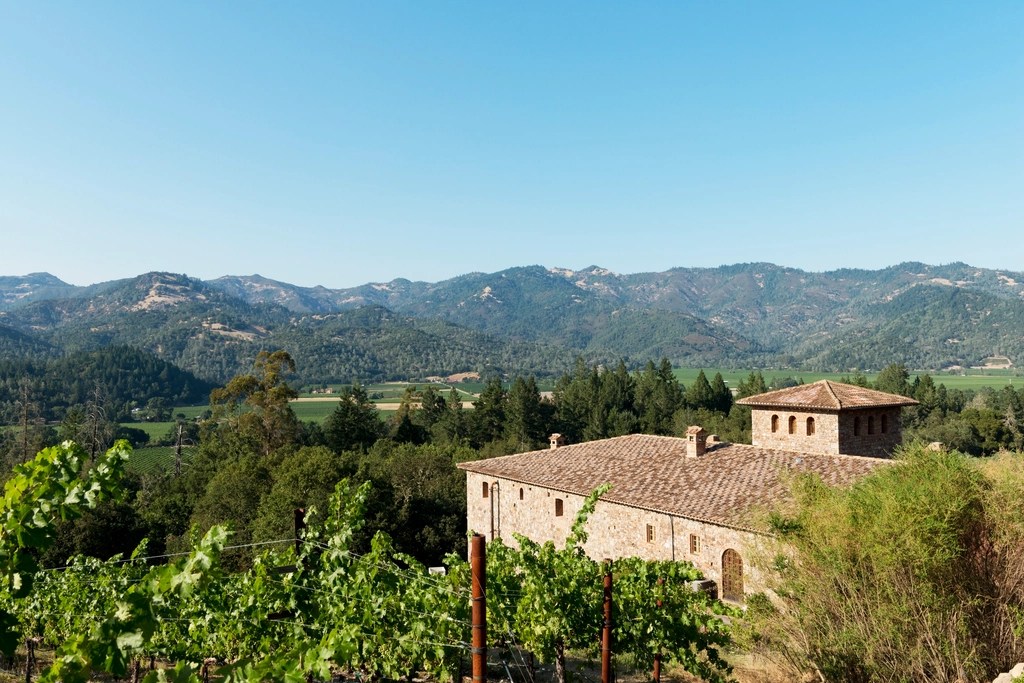
Take Napa Valley, for example, America’s answer to French wine country. It became famous after a 1976 wine tasting in which Napa wines beat out French ones and cementing its place in the wine world as one of the premier wine regions. But wine tasting is…flawed. Studies show judges rate wines inconsistently. Presentation plays an outsized role. In one study, the same wine earned wildly different scores when served in different bottles.
So why is Napa “the place” and not, say, the Finger Lakes or Walla Walla? Marketing. Perception. Hype. South-central Pennsylvania has lots of wineries that produce lots of delicious wines.
If we let others dictate what’s “best,” we surrender our own preferences to their story. But if we challenge that narrative, we open the door to a world of options.
Maybe that famed “must-see” destination isn’t any better than the quieter, lesser-known place next door. And that’s great news for the budget-conscious among us. It means you can experience something wonderful without the tourist trap markup, and maybe even get a more authentic experience while you’re at it.
More importantly, it means you’re not missing out.
So many bucket list items are inaccessible to people with normal jobs and normal paychecks. That doesn’t make your life less fulfilling. It just means your version of “extraordinary” isn’t dictated by a Top 10 list.
Why the Panama Canal and not the Welland Canal in Canada? They use the same technology. One just has better PR. Okay, yes, there are certain historical contexts which does make the Panama extremely significant, perhaps more so than Welland Canal. But could you honestly, tell me what those are without looking them up? I didn’t think so. Would you have done that research before booking your trip to Panama? Probably not.
If you told your friend you went to Welland, they might look at you funny. But unless they’re an engineering nerd (in which case, they’d love it), they probably can’t explain why Panama is “better.” They’re just repeating what they’ve heard.
To help you separate real desires from borrowed hype, ask yourself:
What is the historical or cultural significance of this place or experience?
Do I genuinely care about that significance?
Are there other options that fulfill the same interest or vibe?
If it’s “the best,” who decided that—and how subjective is that claim?
Is it overrun with tourists to the point of losing what made it special?
Are there similar or adjacent experiences nearby that are less crowded, more affordable, or more authentic?
Am I excited for this because it aligns with my values and interests, or because I saw an influencer do it?
Once you start asking these questions, you may find your list isn’t a map of your soul’s desires—but a collage of other people’s priorities.
The good news? You can scrap that list and make your own.
Because the best journeys aren’t built on hype, they’re built on what matters to you.
If a bottle of wine contains more philosophy than all the books in the world, then a barrel of freshly picked grapes awaiting their fate must contain all the mysteries of the ancients. Wine making has been a centuries-old tradition, originating over 8,000 years ago when the transformation of juice to wine was thought to be a divine mystery. Though the modern era has brought stainless steel presses and fermentation machines, it may have lost some of its ancient wisdom and mystery, rendering the process more mundane. Perhaps that’s why there’s such allure in the old ways, hand-picked grapes tossed into wooden barrels, squished by stomping feet, then carefully aged in wood to absorb its complex flavors over time.
The crushing releases the grape’s juice, allowing it to mix with the skins to absorb flavor, color, and tannins. Depending on the type of wine desired, the presence of stems or skins may be either vital or avoided. After the initial crushing, yeast is added; the juice is fermented, pressed, and finally aged. While details may vary, the process has remained largely unchanged for centuries.
Many were first introduced to grape stomping through the infamous I Love Lucy episode. For me, it was A Walk in the Clouds, the laughter, singing, and juice-splashing celebration enchanted me. It transformed wine into a celebration of life and love. Hollywood may have romanticized it, but wine itself is inherently romantic, so I can be forgiven my idealized vision of the process.
Determined to check off this long-standing bucket list item, I began searching for grape stomping opportunities. While I was certain a plane ticket to Portugal wouldn’t be necessary, I was surprised to discover just how few vineyards in my state actually offered it. Some festivals held stomping competitions, but alas, I lacked a team. And most options were three to four hours away, not exactly convenient for a quick outing. Perhaps, if I could make a weekend of it, but I was loathe to do an overnight.
Undeterred, I expanded my search. That’s how I found Four Sisters Winery, just across the Pennsylvania/New Jersey border, only two hours away. They offered barefoot grape stomping, wine tasting, and dinner. When I floated the idea to my sister, she declined, apparently, squishy, slimly, sticky grapes between the toes was not her idea of a good time. Which, fair. It’s not everyone’s glass of wine.
What is a bucketlister to do when one’s partner in crime is not up for the proposed heist? Would I need to shelve the idea? Remove it from possibility altogether? Fear not, dear reader, I had a backup adventurer: my mother. As fate would have it, she also had grape stomping on her bucket list. And thus, it became a perfect Mother’s Day gift.
We registered for the event on June 21st, a fine way to ring in the summer. With the heatwave beginning, we drove through picturesque farm hills dotted with vineyards, perfect for a potential wine-themed day trip. We used the time to chat and simply enjoy each other’s company.
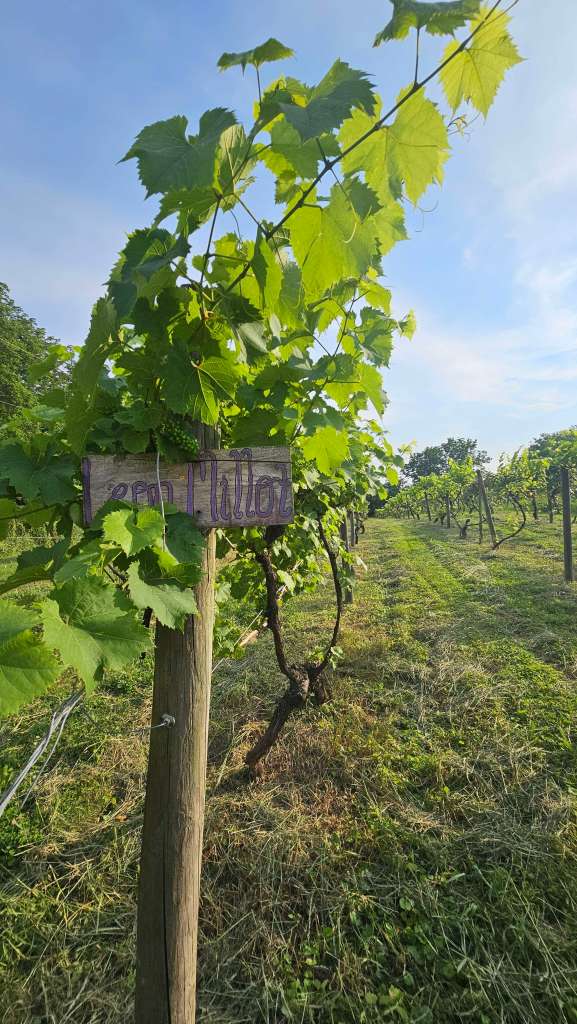
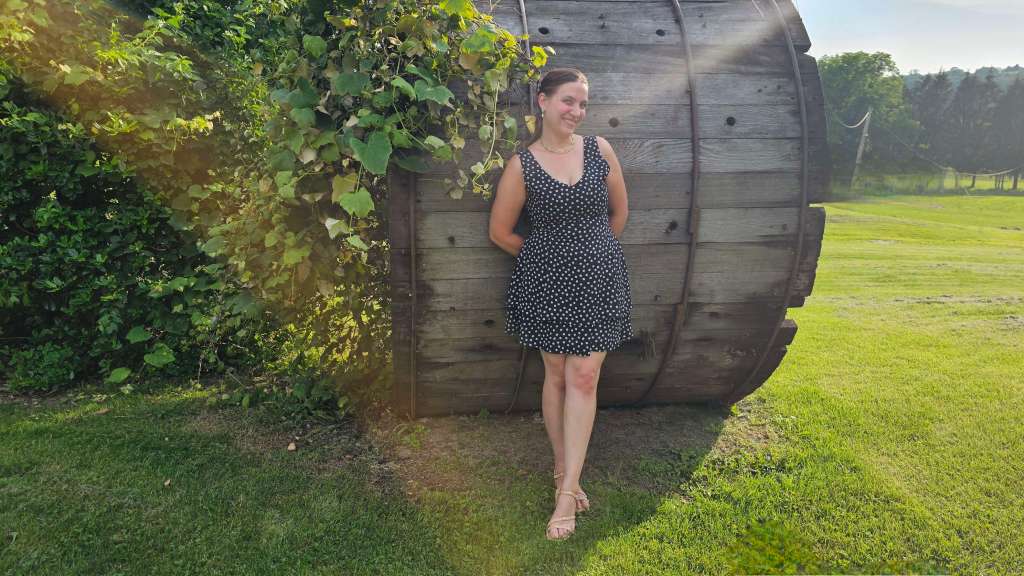
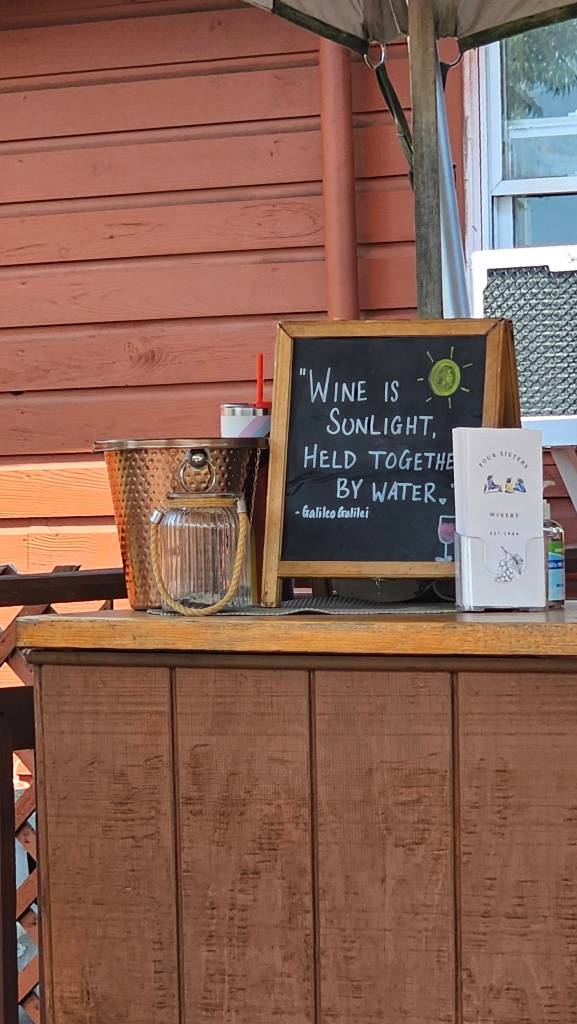
Four Sisters Winery was tucked among the trees with an unassuming sign and small shop. It belied the expansive four-acre vineyard boasting 19 varieties of grapes and three event spaces. We arrived early and relaxed under an awning listening to live music. The rustic benches and tables added to the atmosphere that they’ve clung to the older ways (although they probably have the modern machinery tucked away).
Once ushered into the event space, we were seated at a table with two other adult children treating their mothers and a pair of friends. It was delightful to make new acquaintances over the course of the evening.
Before the dinner commenced, we were given a short overview of the winery. The Four Sisters has been in operation for over 40 years, having begun by a farmer from Essex in 1984. His main focus was on vegetables but began to produce wine as a secondary revenue stream. It was such a success, the vineyard paid for all four sisters to go to college and obtain both their masters and PhD. However, it meant that none of the sisters were much interested in continuing to manage the vineyard and it was sold to the new owners a few years ago.
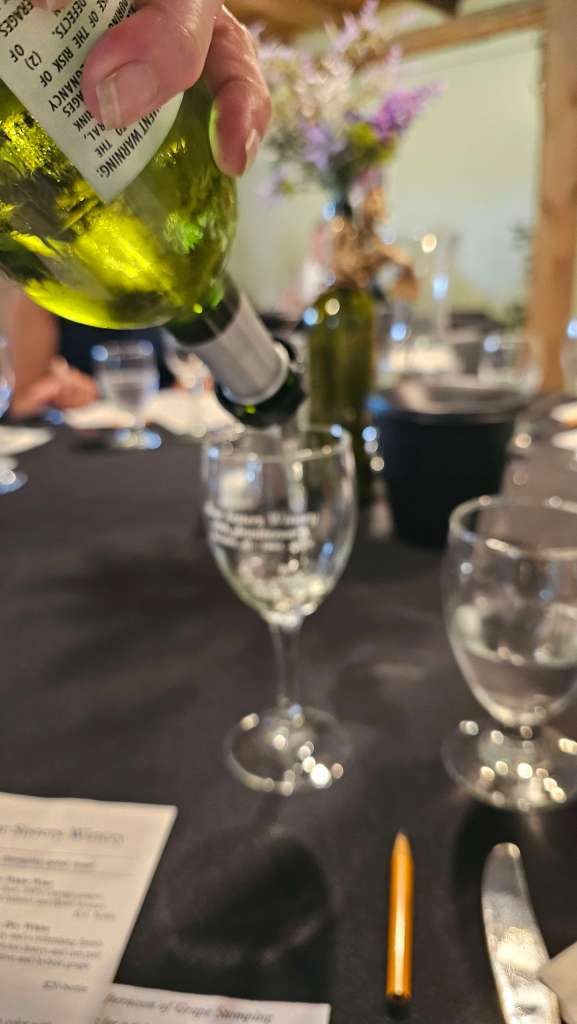
We tasted ten wines, ranging from whites to reds, dry to sweet. My preference leaned toward the reds and dry varieties, though a semi-dry called Cayuga stood out. We rated each wine, chatted about pairings, and judged grape varietals like seasoned sommeliers.
Dinner included a raspberry vinaigrette salad, parmesan chicken with pasta and seasonal vegetables, and a brownie for dessert. Dietary restrictions? Accommodated with grace. The vegan dessert of peaches and blueberries looked particularly delicious, a strong case for food envy.
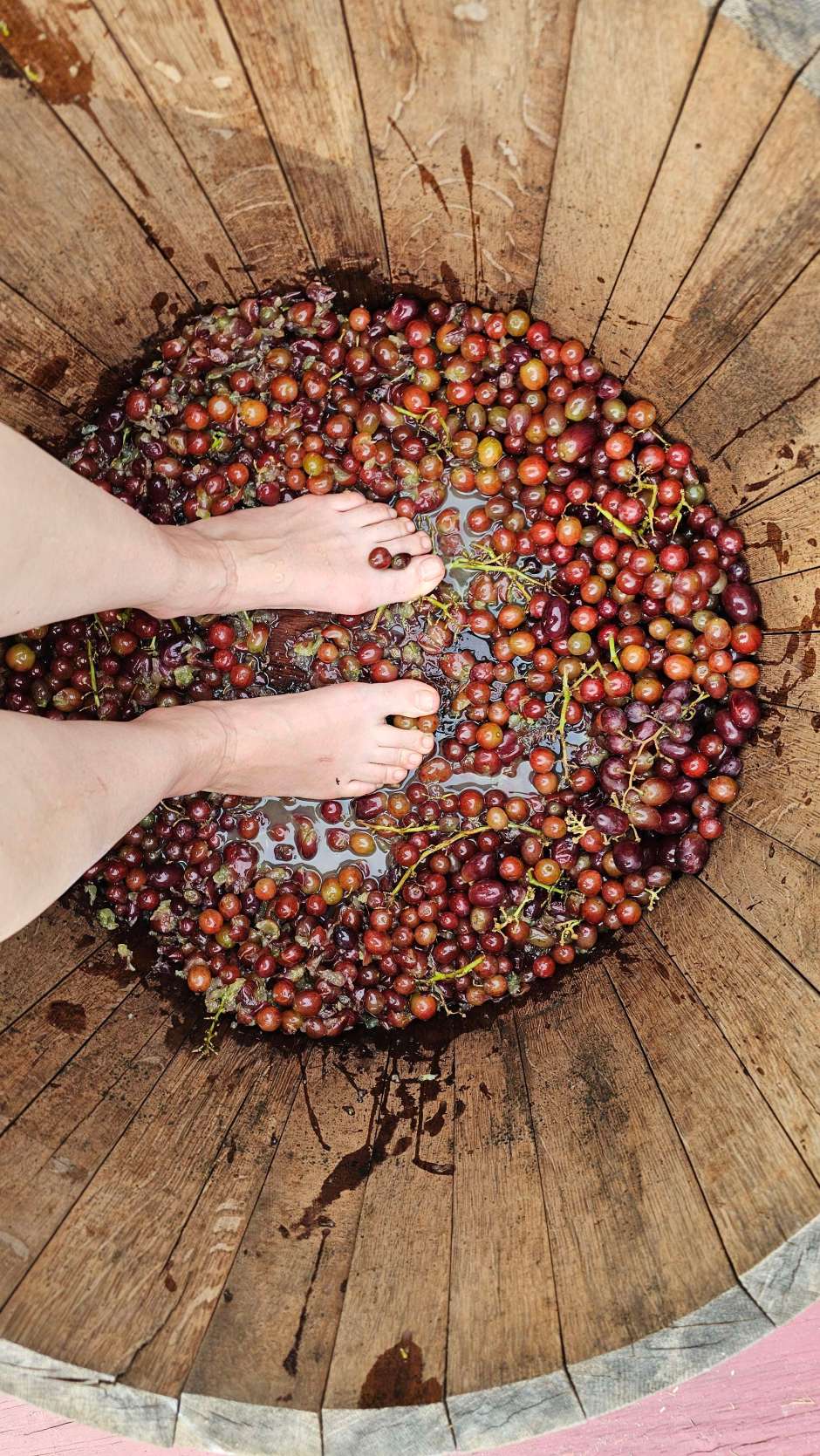
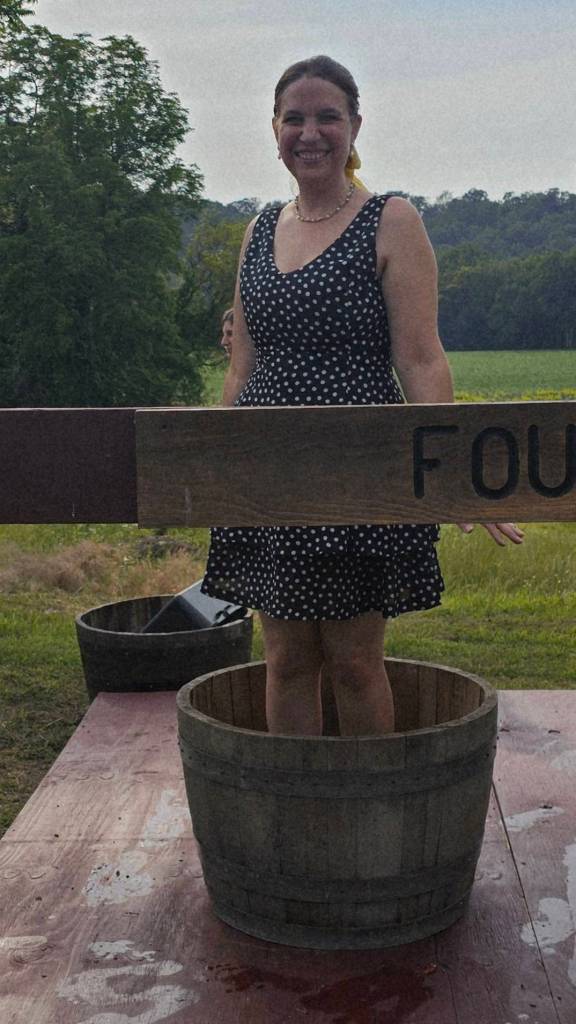
Then came the moment we’d been waiting for: the stomp. Three barrels were prepped for us to take turns. Slipping off my shoes, I stepped in. The sensation was surprising; the grapes rolled like a foot massage, slick and dense underfoot. They slipped around as I tried to crush them and the barrel became slick underneath me. Grapes are a bit more dense than one may imagine. The stems of the grapes added an extra texture which lightly scraped my feet. I could not help but remember the songs about crushing the grapes as I moved around in the small barrel. It was clumsy, slippery, and joyful. I paused for a photo, then climbed out to let others have their turn.
A rinse station awaited to wash off the sticky grape residue. I grabbed my complimentary wine glass, said my goodbyes, and my mother and I set off, bottles of our favorite wines in hand, winding our way home with laughter and plans for our next adventure.
Most of my escapades happen close to home, but sometimes a short road trip delivers a memory worth bottling. This one was certainly like walking among the clouds.
How can you have a stomping good time?
If you’re lucky, you may live near a winery offering grape stomping events. A quick Google search of local wineries or wine festivals may reveal hidden gems. If it requires a road trip, consider turning it into a full-day or weekend experience.
But for those far from the vines? Bring the stomp to you. Invite friends, fill a barrel with grapes, spin some music, open a few bottles, and get stomping. (Just don’t drink the juice!) When you’re done, convert the barrel into a flower planter or save it for your next party.
Whether we go to the adventure or bring the adventure to us, life tastes better when we take the time to stomp the grapes.
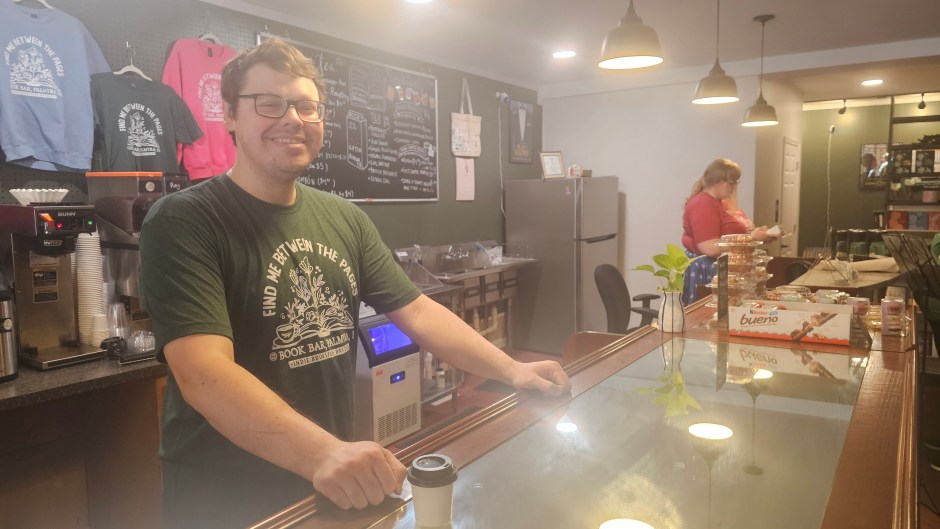
We were first introduced on Indie Book Day, with a subtle hint of mystery and the allure of suspense among the bookshelves of the BookBar. The bartender handed me a drink on the house with a wink and a smile. The aroma wafted up from the cup, promising a rare treat. With a slow sip, a burst of rich flavor exploded across my tongue, accenting the dark roast and chocolate with a lingering whisper of strawberry for a sweeter finish. It was with this drink in hand that I browsed the shelves in search of hidden treasures.
The aesthetic of the shop resembled an old private library in England with a slightly gothic bent: dark walls, rich old leather sofas, and trinkets more expected in a professor’s office than a place of capitalism. It all set the atmosphere of whispered stories on stormy nights. But indie bookstores are known for their peculiarities.
It was there that I was first introduced. Not directly, of course—nothing so uncouth. Our meeting was arranged through the usual channels: a third party carefully selecting options suited to a lady’s general tastes. The matchmaker, ever busy, offered a short meeting and a curated selection of potentials. Each came wrapped, labeled only by genre, with a few clues as to what might await.
I made my choice and a plan was hatched: a rendezvous, a park, a picnic, and of course, my blind date. My sister joined me, not as a chaperone, but with a date of her own. A married woman, you ask? Was I part of a scandal? Not when the blind date is with a book, dear reader!
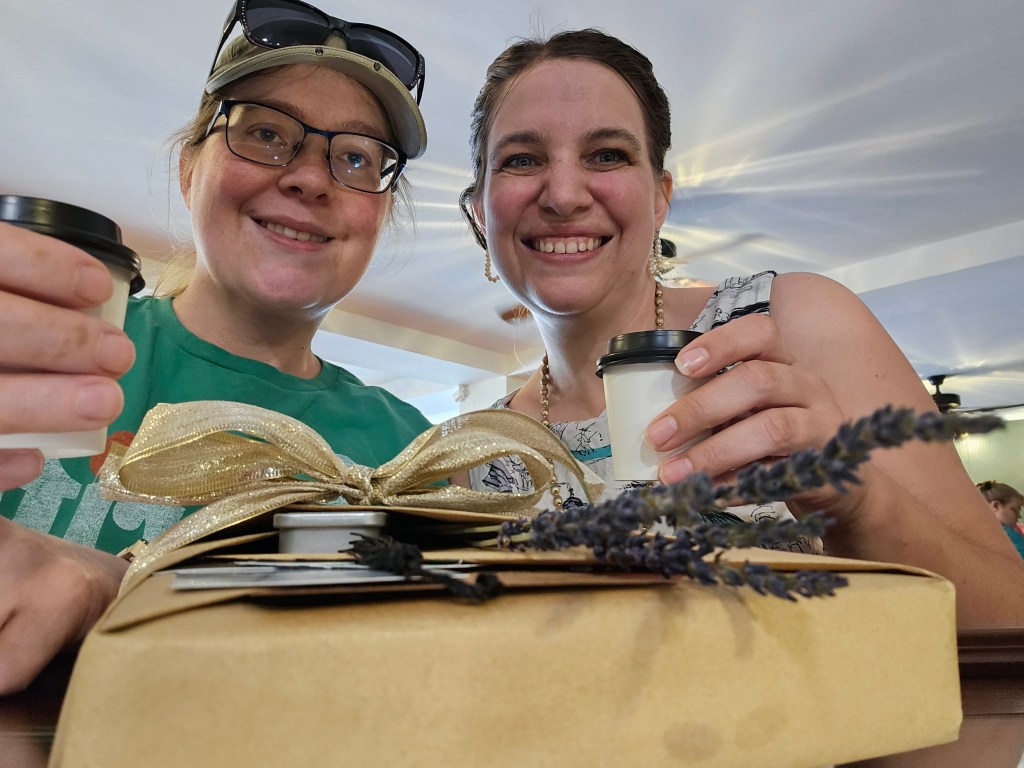
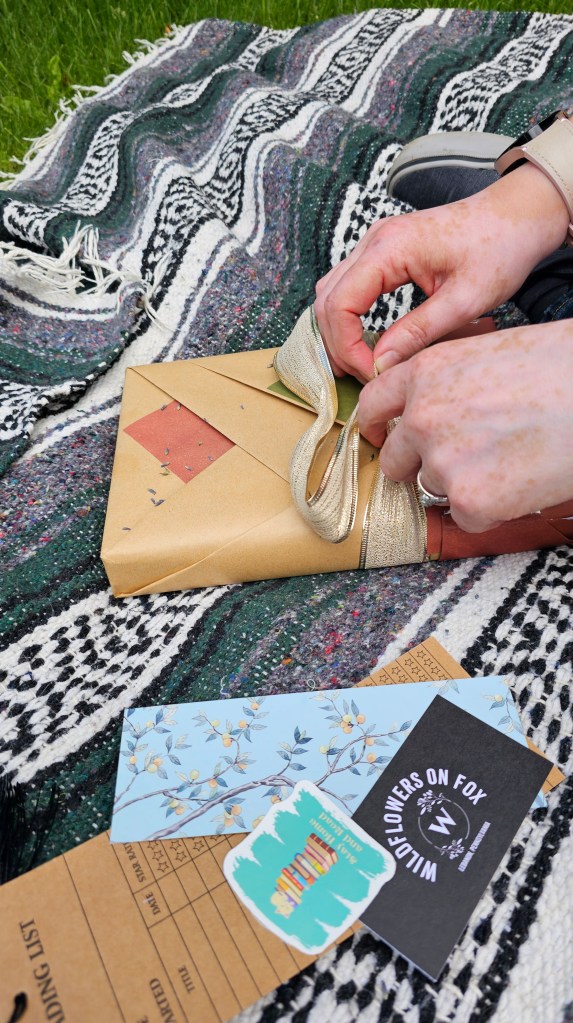
Yes, BookBar not only serves up delicious coffee and mocktails with a side of dark academia, but it also offers a unique reading experience designed to stretch your literary palate. Each mystery book is carefully wrapped with a genre label, accompanied by a few sprigs of lavender, a lip balm, bookmarks, and stickers—everything you need to charm a curious reader.
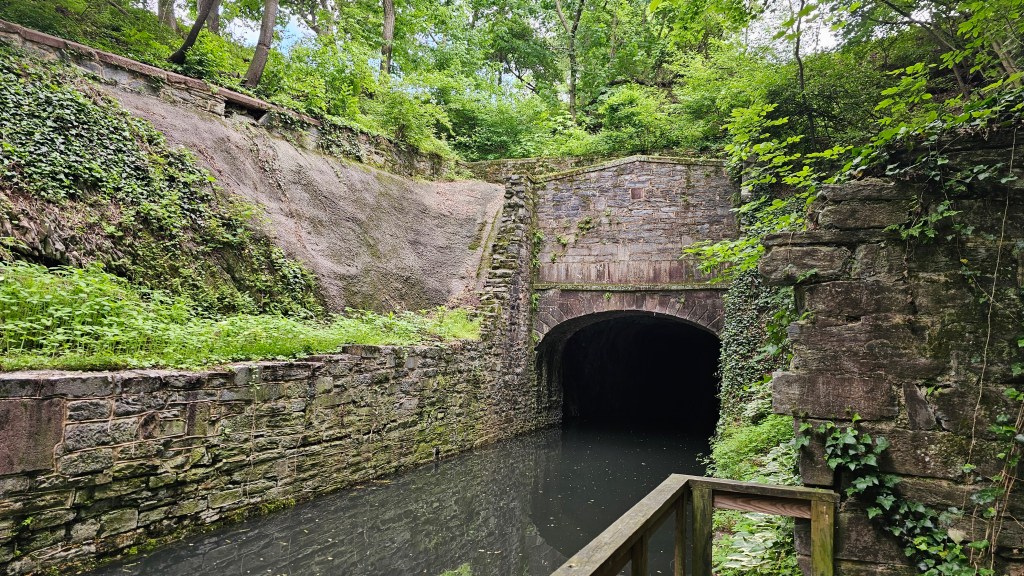
A few days before, we checked the weather and settled on a park near my sister’s home. To our delight, we discovered a local hidden gem: the oldest existing water transportation tunnel in the United States. Naturally, the history nerds in us were thrilled.
The canal’s beginnings date back to 1792, during George Washington’s administration, though financial troubles delayed its completion until 1828. This golden link of trade connected east and west, serving the expanding nation until 1881, when the Lebanon Valley Railroad rendered it obsolete.
Today, the remaining stretch is lovingly maintained by the Historical Society of Lebanon County. Only a small fraction of the canal remains, surrounded by parkland and dotted with plaques detailing the history and engineering marvels of the time. The park includes a pavilion, picnic benches, and a meandering path alongside the river. Every Sunday, they even offer boat tours through the tunnel—a dream for any history buff.
My sister and I spread out a picnic of crackers, cheese, and meats under a shady grove. We caught up on life as the breeze gently rustled the trees. The weather was cool for mid-May, but nearly perfect for reading. No harsh glare from the sun, no stifling heat—just peace and pages.
When we opened our blind date books, mine turned out to be a historical mystery thriller with a dash of time travel, set in Victorian Scotland. A surprisingly perfect pairing with our 19th-century setting! I found the forensic methods of the era fascinating, especially in contrast to modern crime-solving techniques. My sister’s book was a thriller translated from Ukrainian, and she was equally pleased with her pick. We agreed this date was well worth repeating.
After an hour of reading, we explored the rest of the park. What we found was a quiet oasis tucked away from the modern world. Birdsong echoed across the water, interrupted only by the occasional “plop” of frogs and fish. We climbed a small hill to better see the tunnel and read each historical plaque. A small bridge overlooked an old lock that once helped boats travel along the canal.
It wasn’t quite the Panama Canal we visited last spring, but it was still an impressive feat of engineering and a reminder of human perseverance. We couldn’t help but reflect on how far we’ve come—not just in terms of technology, but culture and society. What would the Irish laborers who built the canal think of the world today?
Want to Plan Your Own Literary Adventure?
You don’t need a fancy bookstore to enjoy the fun of a blind date with a book. Etsy has plenty of options, and you can always go with a DIY version. Take a friend or sibling to a bookstore, pick out books for one another, wrap them up, and head to your favorite park for a reading picnic.
Even cheaper? Just borrow something new from a friend’s bookshelf. My sister and I frequently swap books this way, and we’ve each discovered new favorite authors as a result.
To find local gems, try Google Maps with keywords like “historic site”, “attractions,” “museums” “hidden park,” or “walking trails.” Check the reviews on obscure places with 4.5+ stars but few reviews as these are often true gems. Believe it or not Reddit can be a source for ideas from locals that you won’t find on the travel sites. Try searching for hidden gems in your city or browse the local subreddits. I also recommend going to your local library and checking out the bulletin board. Some cities have bloggers devoted to uncovering local secrets—you might be surprised what you find just outside your front door.
The sun peeks through the curtains. The soft chirp of birds is among the first sounds I hear. I burrow deeper into the covers and pull my cat, Luke, in for extra snuggles. I linger in the warmth of the moment, the smell of breakfast floating through the air like a promise. It isn’t until Luke wiggles out of my arms, miffed and hungry, that I finally, reluctantly, stir.
And why should I hurry?
The day stretches out before me, gloriously unstructured. There is no checklist. No Zoom call. No tightly packed schedule to wrestle through. The world may be my oyster, but today, the only oyster I’ll be opening is a good book. This, my friend, is the gentle joy of going nowhere.
My life is full of small adventures. It’s rare for a month to pass without something noteworthy—an art fair, a botanical garden, a random road trip, or simply trying a new café across town. I like having something on the horizon. It gives shape to my days, stirs up my creativity, and helps keep the dull, dragging edge of burnout at bay.
But I’ve learned—sometimes the hard way—not to overdo it. Too much “doing” tips the scales into exhaustion. Even joy can become a chore when overscheduled. My bank account is certainly a grounding force in this, but honestly, the bigger issue is energy. Constant motion, even when enjoyable, can leave me depleted. It turns out that balance isn’t just a nice idea from a wellness podcast. It’s survival.
There’s a particular kind of luxury in staying home on purpose, not because I’m sick, not because I have chores to catch up on, but because I choose to. It’s an act of intentional stillness, of delighting in the familiar. Especially if, like me, you’ve curated your space into a personal sanctuary.
My home holds my books, my tea collection, my cats, my dog, my violin, and my garden. These are not filler items between “real” adventures. They are the adventure. These are things that remind me of who I am when no one else is watching. You may remember that many of these are on my Bucket List, and you’ll find I’m checking them off right from the comfort of my deck with a glass of wine in hand and a sunset to keep me company.
It’s a profoundly healing act to stay home and do…nothing.
In this quiet space, I can finally hear myself think. I’m not trying to wring productivity from every last second like water from a rock. I’m not chasing dopamine hits from Instagram-worthy moments. I’m just being. And in that being, I find presence. Spaciousness. Energy I didn’t know I had.
This is my rebellion against the hustle. A resistance to the noise that tells us we’re only valuable when in motion, only interesting if we’re checking off countries on a map.
Going nowhere lets you find your rhythm again. It allows you to ask, without the usual pressure, “What do I really want today?” And sometimes the answer is “absolutely nothing” in the most glorious way.
Too often, we assume the answers lie far away, on a beach in Bali, on a mountain in Switzerland, in a cottage somewhere in the Scottish Highlands. And yes, those places are beautiful. But they also come with traffic, airports, long lines, and stress. We swap one type of exhaustion for another and call it “escape.” I don’t know about you, but I often need to schedule a rest day just from traveling back from my vacation.
What if, instead of waiting for a two-week vacation to save us, we built tiny vacations into our lives regularly? What if “rest” wasn’t the reward for being good, but the foundation from which we move and make decisions?
We may simplify our lives, but have we simplified ourselves? It’s far easier to declutter your closet than to declutter your expectations. We’re so busy trying to escape our own lives, we forget that it’s possible to build one we don’t feel the need to escape from.
So today, I’m not checking in, checking bags, or checking my itinerary. I’m checking in with myself. I’m home, and that is not the consolation prize.
I believe it shall come as no surprise to you, dear reader, that I’ve long held a dream of visiting Japan and count myself as a bit of an otaku. I’ve imagined seeing Mt. Fuji rising above the mist, taking in the sights of Tokyo, enjoying the fashion, engaging in traditional dances, exploring vibrant festivals, wandering through a pagoda, pausing at a temple, sipping macha in a teahouse, visiting a cat café, contemplating nature in a garden and, of course, strolling beneath the cherry blossoms.
A few of these I’ve managed to do here in the States. Others remain only possibilities, others still achievable only if I someday find myself walking on Japanese soil.
Each spring, I see flowering trees dotting my neighborhood and lining the roads, and I sigh wistfully. They tease me with just a taste of what could be. My social media feeds fill with dreamy pictures from the far East (or perhaps more accurately, the West?). Japan’s landscape becomes a fleeting spectacle of pink and white blooms, a soft riot of ephemeral beauty.
This delicate flower, sakura, is more than just a seasonal joy. It is a cultural icon, deeply rooted in Japanese tradition and mythology. The goddess of blossoms and delicate matters is said to have nurtured the cherry trees. One beloved tale tells of Princess Sakura, cursed to bloom and wither like the trees she loved. Only a prince who could watch her fade without despair could break the spell. The blossoms have graced artwork for centuries, inspired poets, and appeared again and again in anime and manga as symbols of renewal and hope.
Is it any wonder, then, that I too have fallen in love with this flower?
So, each spring, I look longingly at the blooming trees and wish I could follow the blossoms across Japan, chasing their brief splendor up the country. Imagine my delight, then, when I discovered that a nearby town is home to a row of 150 cherry trees that burst into bloom each year. Naturally, I set out on a quiet morning to witness the display.
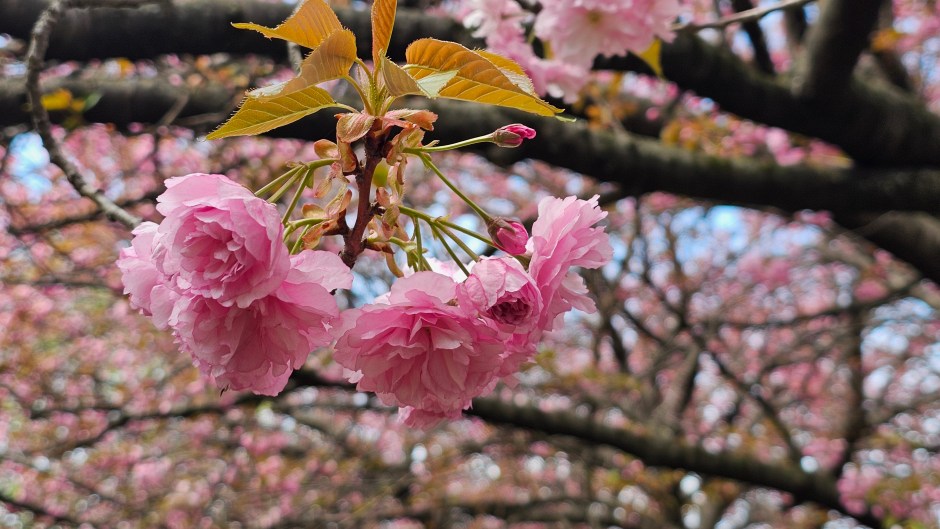
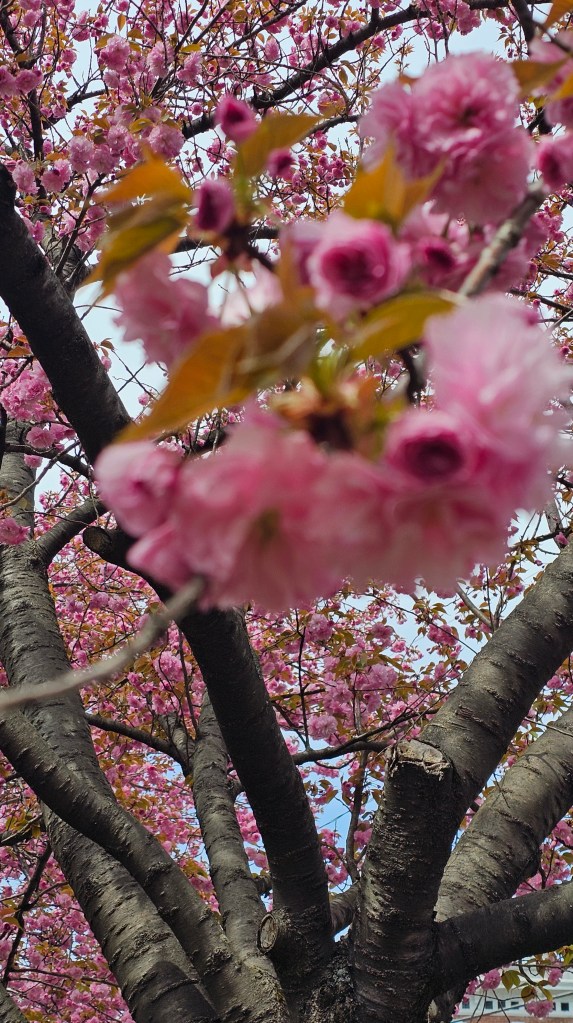
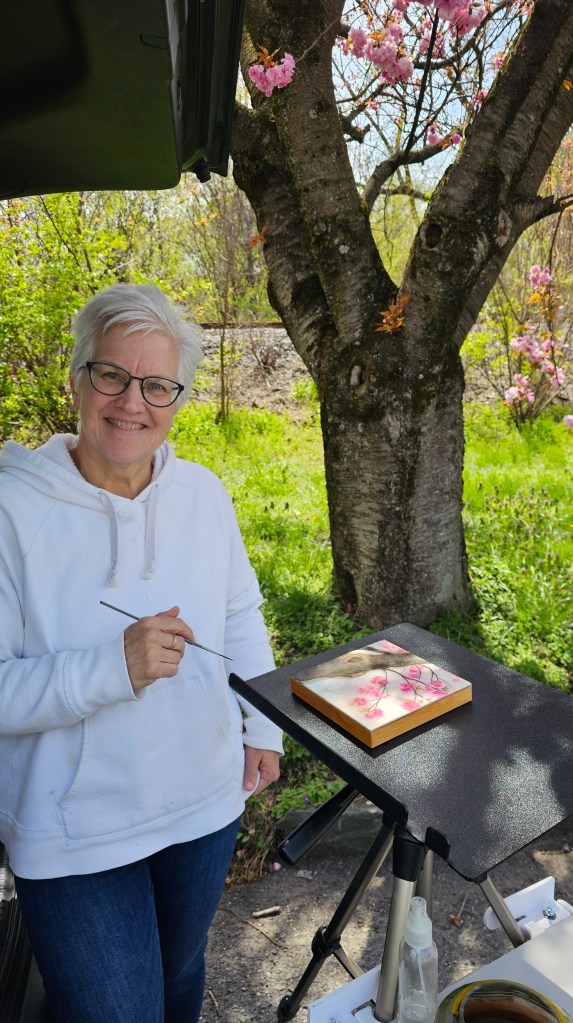
The trees stood in a stately row, forming a tunnel of soft pink. The delicate scent hung in the air, and a gentle breeze coaxed the blossoms into a graceful dance. Bicyclists glided past on the quiet street, and two painters sat capturing the season’s glory on canvas.
I wandered beneath the trees, breathing in the fragrance, taking photos to help preserve the memory. There was no formal path beneath them, just dark, soft earth that yielded slightly beneath my feet. The blossoms hadn’t yet begun to fall, though a few brave petals had already drifted to the ground, a gentle reminder that all too soon the branches would give way to summer’s green.
I was in good company as several painters were scattered along the row of trees. It was a delightful treat to be able to watch them capture the beauty of the trees extending it beyond the ephemeral spring season.
While it may not rival the landscapes of Japan, it was a small and beautiful taste of a dream. I’m glad I made the short journey to Marietta to witness their bloom, even if only for a moment.
How can you stroll beneath the cherry blossoms?
You may not need a passport or a plane ticket to find them. Sometimes, the dreams we tuck away for “someday” bloom quietly just down the road. Perhaps your local trees are smaller, or fewer, or missing the dramatic backdrop of a mountain temple, but their beauty is no less worthy of awe. A few trees in a quiet town, the whisper of petals in the breeze, and a moment stolen from the rush of life to simply stand and marvel, that, too, is magic.
So, dear reader, look around. Google may be your travel agent, but curiosity is your compass. The world, as it turns out, is blooming right outside your door.
Completed: 2025
Miles from home: 20
Cost: Free
Don’t forget to look around the rest of my Bucket List and Reverse Bucket List to get your curiosity going!
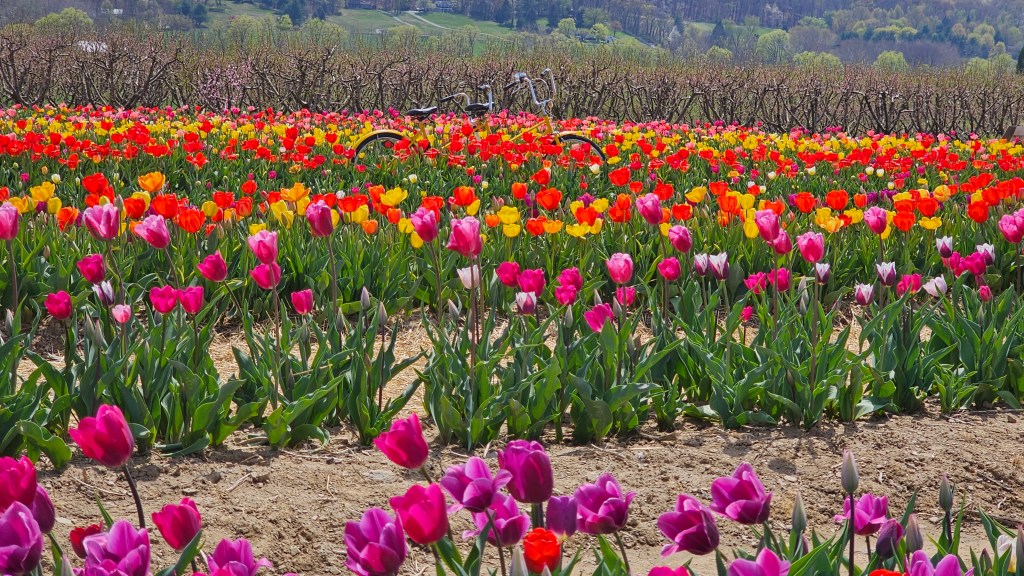
Tulips the early heralds of spring and the changing weather fill the hills with bright rows of color. Their hues stretch across the spectrum, from fiery red to deepest purple, and their petals are just as varied. They’re also famously tied to history’s first financial speculative bubble, a craze that plunged many Dutch citizens into ruin and left a lasting mark on market regulations. Still, despite that rocky past, the Dutch never forgot their love affair with the flower. Today, they remain a leading producer of tulip bulbs, and each spring, massive swaths of land transform into a living quilt of color as millions of flowers bloom.
I’ve always loved pictures of those majestic fields, windmills standing vigil over seas of blossoms. That said, my allergies would likely stage a protest in the Dutch countryside—and truthfully, the Netherlands doesn’t rank high on my list of must-see destinations. Maybe I’d go if the opportunity presented itself, but there’s no guarantee that it would align with the short-lived tulip season.
What’s a budget-minded girl to do? As it turns out, sometimes you stumble upon the perfect solution when you’re not even looking for it.
There are times when an answer appears to a question you didn’t even know you’d asked. I’ve certainly enjoyed pictures of Holland’s flower fields, but they never inspired the wistful longing other countries have stirred in me. So, I didn’t add them to my list, dismissing the idea out of hand. I try to keep my travel dreams at least somewhat realistic—or else the list would be three times as long. But let this be a lesson, dear reader: never dismiss a dream, no matter how small or unformed.
Though I never truly asked, the universe still answered with a humble billboard: “Tulip Field, Opening April 12th.” Tulip fields? In Pennsylvania? Perhaps I was too quick to rule out my floral fantasy.
April 12th turned out to be cold, wet, and rainy and not ideal for tiptoeing through anything. Besides, opening day crowds come with added chaos and, let’s be honest, possibly terrible music. Twangy Country or bouncy pop blasting over loudspeakers isn’t how I envision my contemplative flower field stroll. I checked my calendar for a better date, one early enough to catch peak bloom, but not a weekend (crowds again!) and ideally with cheaper tickets (this is a budget minded blog, after all).
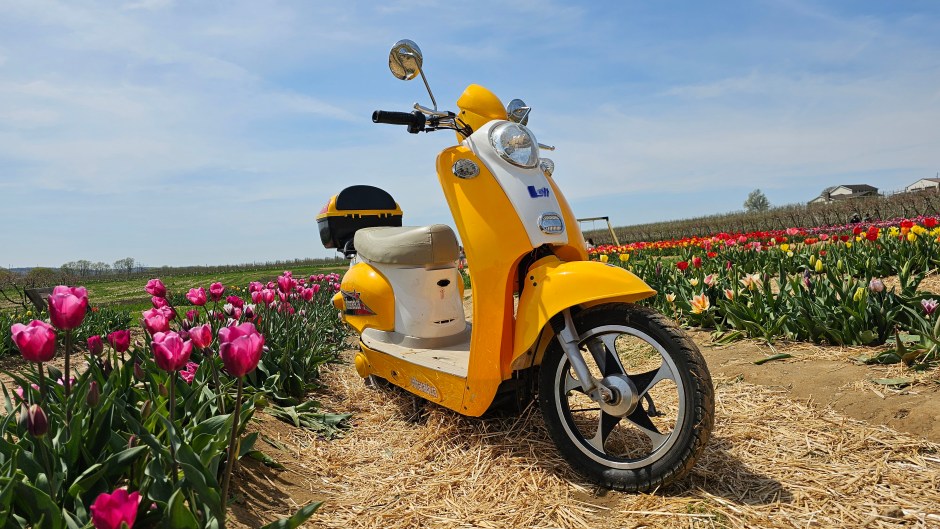
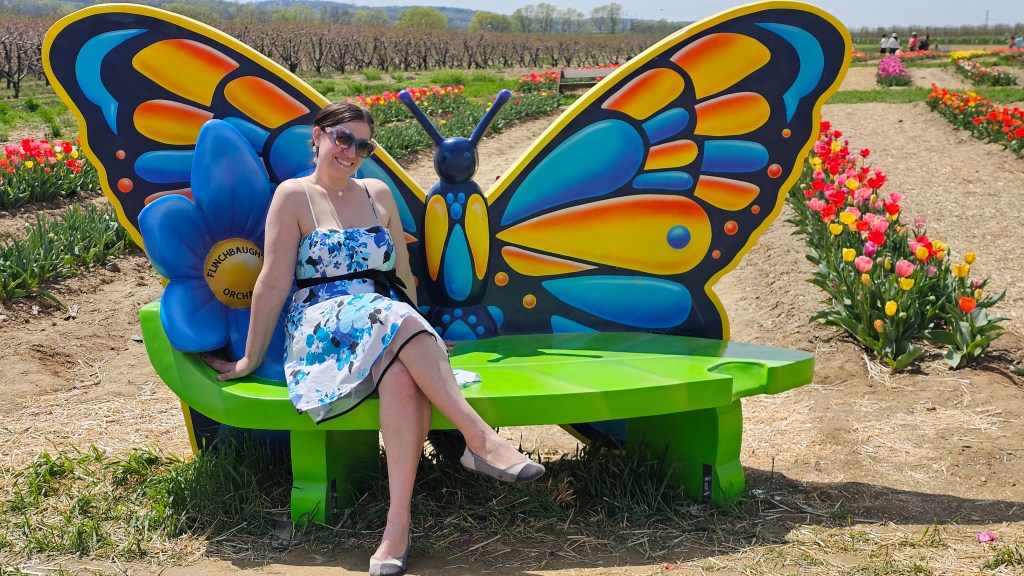
Less than a week later, on a balmy spring day, I made my way to Flaughbach’s Orchard. The temperature was a perfect 70°F (21°C), and a cheerful breeze danced among the tulips, gently teasing them as she passed. While it was a far cry from the sprawling Dutch fields of my imagination, it was a lovely scene in its own right. Had I been truly committed to a riot of color, I could’ve waited two more weeks and driven three hours north to Brown Hill Farms, where 500,000 tulips bloom across four acres.
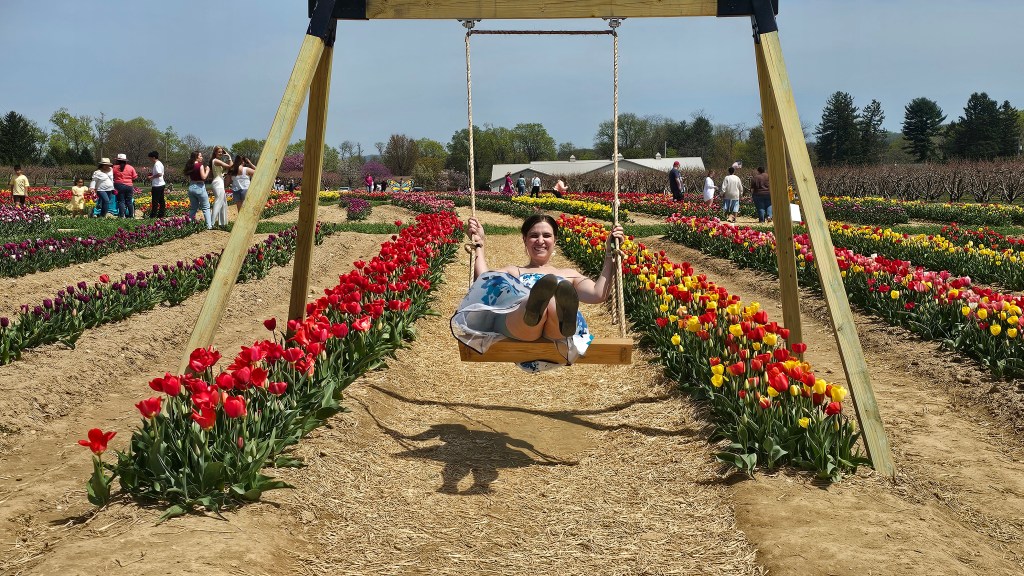
Upon arrival, I was handed a pair of shears and informed I could pick two flowers as part of my ticket (with the option to purchase more). But my goal wasn’t to build a bouquet, it was to bask in beauty. I wandered through neatly arranged rows of flowers, encountering charming photo ops along the way: antique bikes, vintage tractors, even a swing for a more whimsical touch. Naturally, I couldn’t resist snapping a few photos, but mostly, I just walked. The field reminded me of a stained-glass window or a floor made of colorful mosaic tiles.
Benches were thoughtfully scattered around the field, perfect for quiet contemplation. I loved feeling the warm sun on my face and the breeze on my skirt. I didn’t stay long, but long enough to enjoy the moment and properly welcome spring in all her glory.
Next year, I may make that pilgrimage north to see the larger fields that have enchanted me for so long. But maybe not. This experience might fall under my “good enough” category; it was joyful, beautiful, and deeply satisfying.
So, how can you tiptoe through the tulips?
You don’t need to wait for the universe to come knocking. Just open your browser and search for tulip fields near you. If you live in the South, it may be a bit trickier, but don’t lose hope. Pilot Point, Texas, and New Market, Alabama both boast quite respectable fields. Up North, there are plenty of spots to chase tulip season. Some may come in the form of botanical gardens; others, humble local farms like Flaughbach’s. Or you might go all in and visit Windmill Island Gardens in Holland, MI (with over four miles of tulips!), or top spots like Pella, Iowa; Woodburn, Oregon; Modesto, California; Mount Vernon, Washington; and Exeter, Rhode Island.
The lesson I learned? Don’t be so quick to downplay your dreams, even the small ones. I try to keep my “undone” list reasonable, and I often add to my “done” list as opportunities arise, especially if they’re spur-of-the-moment or just for fun. But this was something I truly wanted to do, and I’m glad the universe nudged me toward it.
So, I encourage you, dear reader: dream big. Write it all down. Ask for it. The blessing may find you anyway.
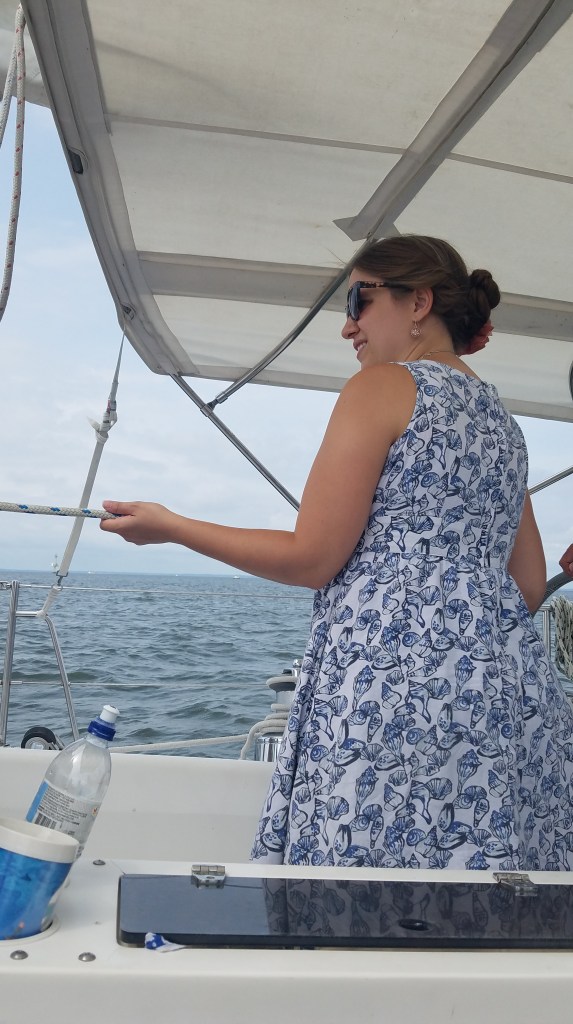
Alright gentle reader, technically, it was a bay and not a sea. However, I did get to hoist the sails and attempt to steer the ship. Yes, technically it was a boat; although I”m not sure I know the difference if we’re being honest. Regardless of the pesky nomenclature, I provided an excellent afternoon tea out on a large body of water in a sailing vessel of some sort. Additionally, I made sure to be properly attired for a day’s outing on the water. With the help of a well placed hat pin not even the wind could dissuade me from my determination to have a little extra flare. After all, where would we be as a society if we allowed ourselves to descend into the mundane and boring, especially when it comes to fashion?
In the midst of COVID, with everything shut down and limitations on movement and gathering, the small but scrappy non-profit I worked for decided to offer its employees a day out with one of our board members, Peggy, on her private boat. To say that I was excited is truly an understatement. It was once again, one of those Bucket List Items that I had mentally placed under “most likely not happening any time soon” as I thought it would cost a lot of money to go. This might be the reason I was a little over the top, but honestly that’s part of who I am. I’m the woman who will put together an entire costume or outfit for even the most slightly themed party or obscure holiday.
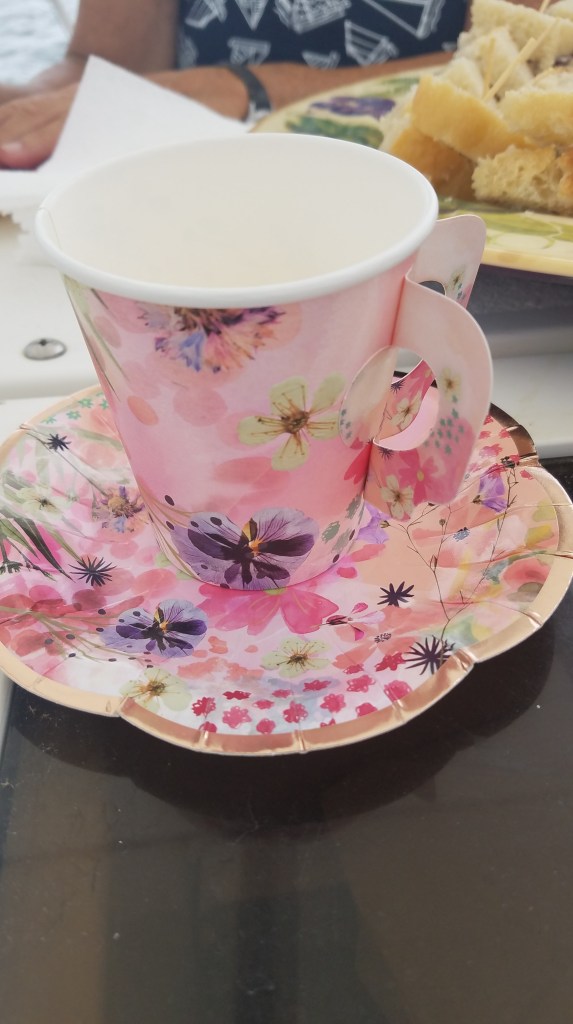
It was truly the morale boost that we needed. To avoid a disruption of vital client services and given the size of the boat, we divided ourselves into two teams which would go on two different days. We also divided up bringing food and other snacks to share. I led the way with letting them all know that I was going to have us do a tea at sea, I would provide the sandwiches, the tea cups, scones and clotted cream. Was it the more costly and time consuming option? Yes, but I was going to take this opportunity that the universe presented me and make the absolute most of it. Before you question my judgement of bringing tea cups on board a ship, know I take quite good care of my china and wouldn’t subject them to the dangers of the open waters. I found these absolutely gorgeous paper cups online!
We loaded ourselves up early that morning, crammed into one of my co-worker’s vans like the start of some quiet, well-mannered heist armed with gps and good humor. I had chosen to go with the more reserved, soft-spoken of my co-workers. What can I say? They paired better with tea than with the loud, pirate-hearted group that went the day before, I am fairly certain they snuck booze despite the prohibition against it, like I said, pirates. Not that I couldn’t hang with both, I absolutely could. And the temptation to burst into sea shanties was quite real, I assure you.
As we drew closer to our destination, the world around us began to shift. The foliage thinned, and the trees gave way to the briny breath of the sea. The air changed too, tinged with salt and carried on a breeze that hinted at something just beyond the horizon. We heard the call of gulls before we even saw the water. Then suddenly, there it was—a small forest of masts rising from the docks like white trees, standing in quiet anticipation.
Waiting for us at the dock was our fearless leader and Executive Director, Deb, who waved us down with her signature confidence. She led us up the wooden planks to our boat, where we were introduced to our captain for the day, Peggy’s husband, Captain Bob.
I was surprised by the size of the boat as it was deceptively spacious, like a magician’s trick. Every inch of it had a purpose. Storage tucked into nooks, seating that converted, a compact bathroom that came with very specific instructions. Bob walked us through the essentials with the seasoned calm of someone who knew that one improperly flushed toilet could quite ruin the whole experience.
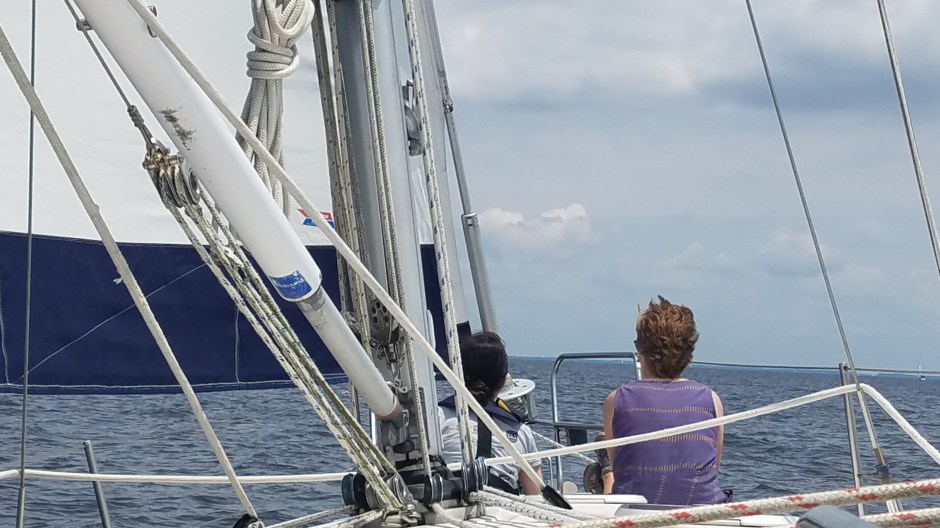
After a short safety overview, it was time to sail. Bob asked for volunteers, and I naturally stepped forward to hoist the sails. He called out instructions with the steady ease of a man who’s done this a thousand times, while Peggy provided cheerful backup support. I took hold of the rope with both hands to gleefully, heave ho and all that. The wind caught, the sails filled, and the boat surged forward with a kind of wild grace.
From that moment on, everything shifted into something more elemental. The boat leaned into the wind, the ropes pulled taut, and the world became motion and sound—the rush of air, the splash of spray, the low groan of wood and rope in motion. It felt like stepping out of the everyday and into something ancient.
Those brave enough made their way to the prow, legs dangling over the edge, laughing as waves splashed up to greet them. Time didn’t pass in hours out there. It passed in shadows, in sunlight shifting on the water, in bursts of laughter and long silences where we just watched the horizon breathe.
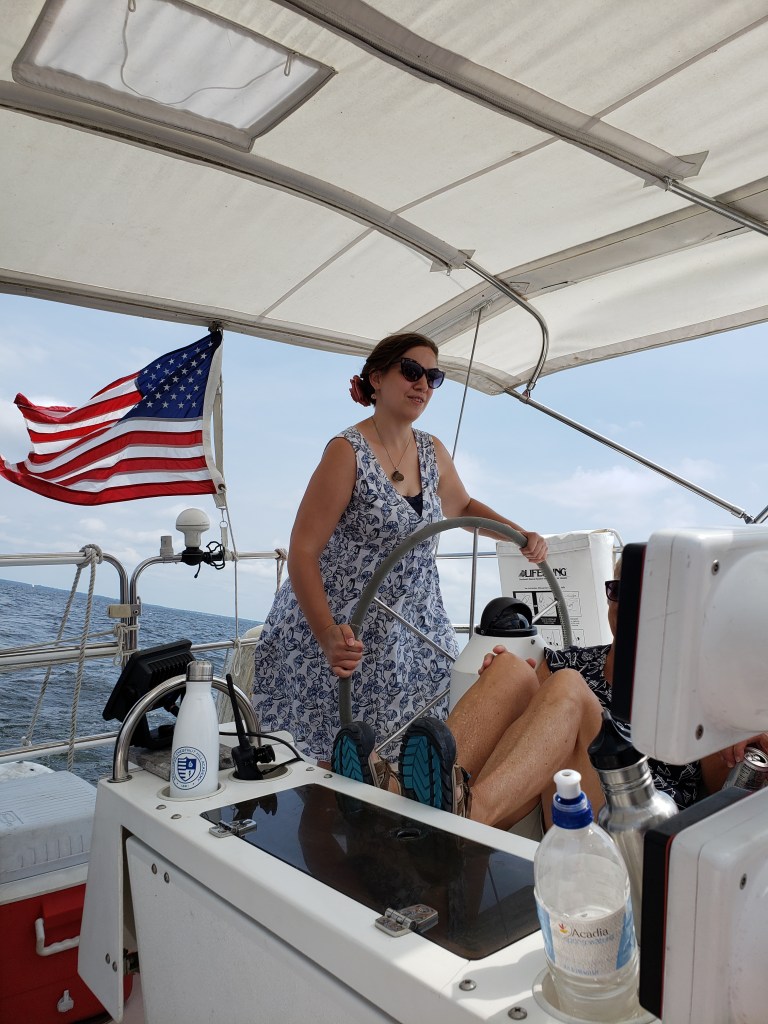
Then came the offer I hadn’t expected, Bob asked if anyone wanted to steer.
Of course, I wanted to steer the ship!
Taking the wheel was like grabbing hold of something alive. The boat didn’t just move; it responded. The wind pulled one way, the water pushed another, and the rudder spoke a language I didn’t quite know but instinctively wanted to understand. Every twitch of my hands echoed through the vessel. I had to fight the urge to overcorrect—big boat, big movements, right? Wrong. It was the subtle shifts that mattered. I wasn’t just steering a boat, I was holding a moment in my hands, trying not to crush it. I shall admit, I was not the best helmsman, but it wasn’t bad for a first go!
At lunchtime, I unveiled my small, slightly theatrical feast of tea sandwiches and scones. Though there was no clinking of teacups, people were quite amused by them. A delighted Peggy gasped when she spotted the clotted cream asking for where on earth I had found it; she hadn’t had clotted cream since she was in England years ago.
I smiled and told her, with all the drama she deserved, “The local grocery store.”
We laughed, we feasted, we sipped, and apart from poor Beth, who succumbed to a bit of seasickness, our tea at sea was a grand success.
The rest of the sail was a blend of freedom and focus, the hiss of waves, the sudden thrill of turning into the wind, the scent of salt and sun warming the deck. It was chaos and calm, all wrapped into one. I couldn’t have asked for a more perfect day for checking off my list. .
By late afternoon, we returned to the dock. We changed into swimsuits and slipped into the pool, letting the cool water wash away the heat of the day. We splashed and floated, reluctant to let the water go.
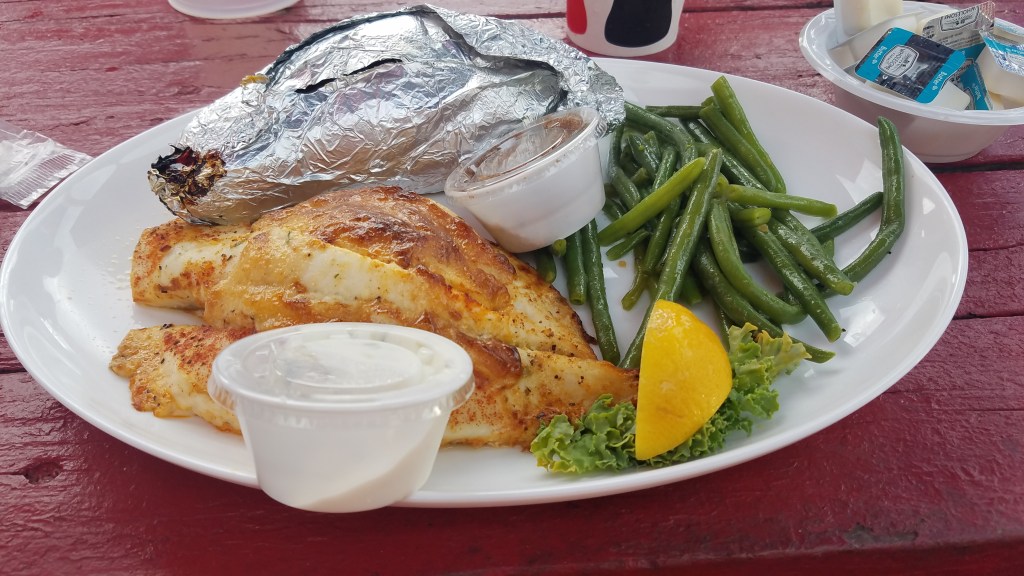
That evening, we gathered for dinner at a local seafood spot, the kind with fresh-caught fish, buttery hushpuppies, and that oh, so infamous, Maryland crab. I will say the crab practically demanded a moment of silence in appreciation. Luckily for the crab, eating is just about the only time I am quiet. And just when we thought the day had ended, someone suggested a detour when they spotted a sign for ice cream. Because some days deserve a sweet ending. And this one? This one absolutely did.
So how can you enjoy a sailing adventure?
I’ll admit, not everyone has a friend with a boat—or a boss generous enough to invite you aboard. But that doesn’t mean a day at sea is out of reach. You can always charter a boat for yourself and a few intrepid comrades. Prices can range from around $200 to upwards of $2000, depending on the type of vessel and the duration of your trip. That said, splitting the cost among your group makes it much more manageable. If you’re like me and pack your own feast, you can trim expenses even further. The boat we sailed on would’ve likely cost each of us about $50 to $75 had we booked it ourselves. Sure, we probably wouldn’t have been trusted to hoist the sails or steer, but with seven of us, the cost would have been quite reasonable.
This was one of those rare gifts from the universe, an unexpected adventure in the middle of a pandemic, at a time when most people could only dream of checking something off their list. I felt deeply grateful, especially after working so hard to help people who were experiencing homelessness with nowhere to go. Those long hours, with little reprieve and a general feeling of hopelessness at times to solve the problem can begin to wear on a person’s spirit. Sometimes, when you’re out there trying to do good, life surprises you with something beautiful in return.
So go ahead, pursue the good. You never know where it might take you, gentle reader.
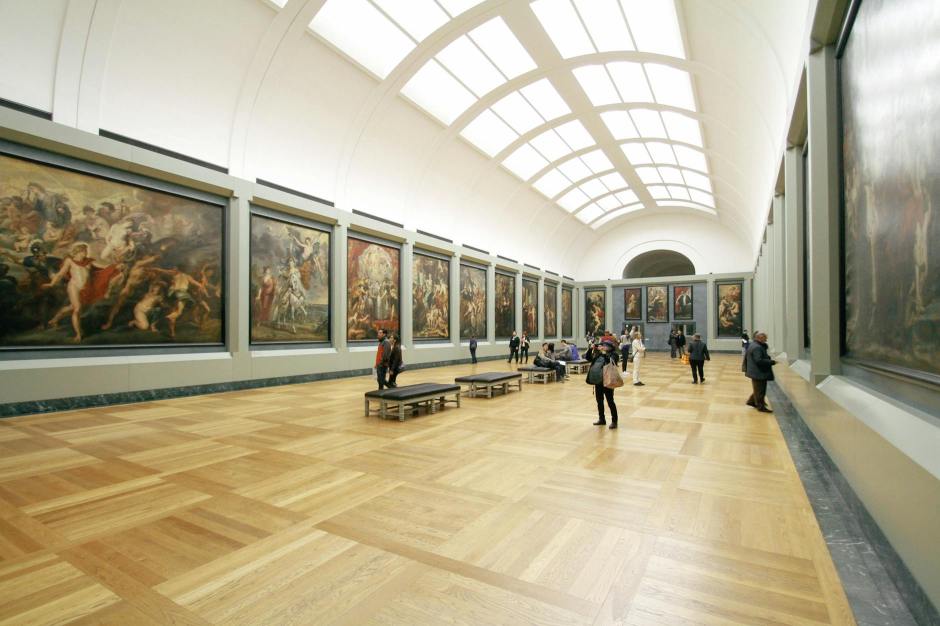
Pennsylvania is known as the Keystone State in part because of its strategic position on the Eastern Seaboard. It sits at the heart of the action on the East Coast and, thanks to the Mississippi River, serves as a gateway to the West. This historic and geographical advantage means I have relatively easy access to some incredible places. By extension, when traveling exhibitions come to those places, it’s not a terrible imposition for me to make the trip. Cities like New York, Philadelphia, Washington D.C., Pittsburgh, and Baltimore are all within reasonable distance.
It was by leveraging this advantage that I was able to see the Darwin exhibition at the American Museum of Natural History in New York, the King Tut exhibition in Philadelphia, and the Russian Tsars exhibition in Delaware. I’m not sharing this to brag about my state but rather to point out that, depending on where you are, you may be closer to the action than you realize. There are often more opportunities in your area than meet the eye.
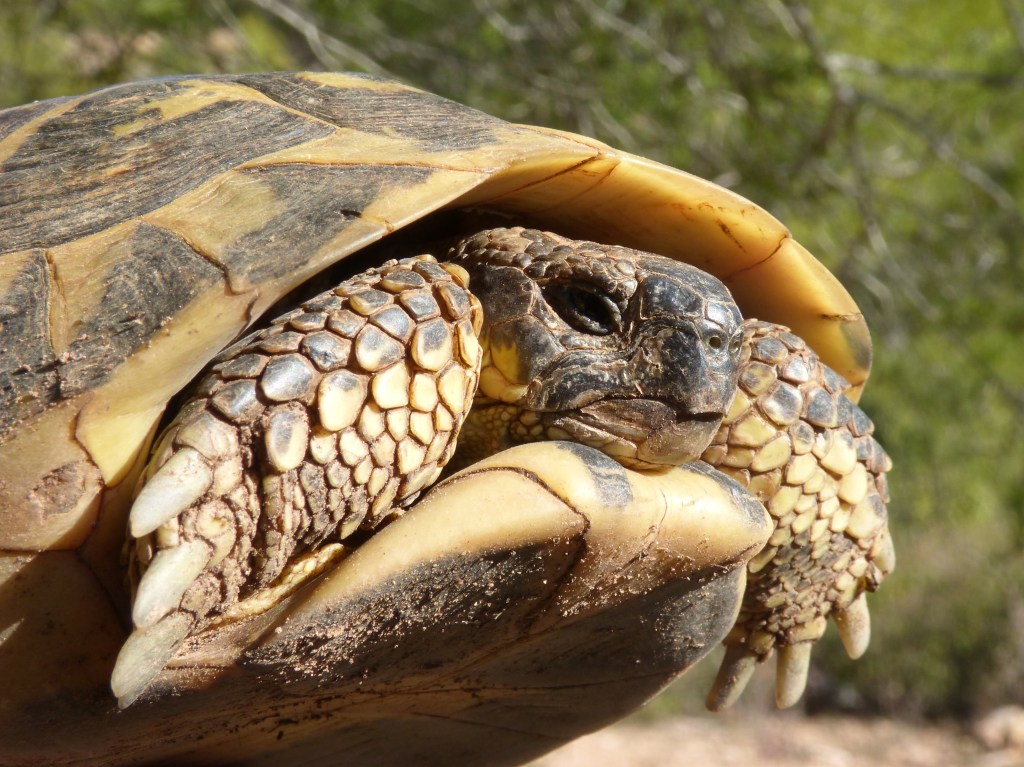
The Darwin exhibition offered a fascinating look at the scientist’s life, work, and impact. It even featured two Galápagos giant tortoises. Darwin was a keen observer of nature, and through those observations, he developed one of the most revolutionary theories in the history of biology. His theory of evolution has shaped everything from genetics and epidemiology to biodiversity and our understanding of the fossil record. Prior to Darwin, most people saw the natural world as static and unchanging since the moment of creation. Instead, he proposed a dynamic and interdependent system in which relationships and exchanges alter the inhabitants of the world, who in turn shape their environment.
One of my favorite stories is how he looked at an orchid and hypothesized the existence of an undiscovered insect capable of pollinating it. That insect was discovered forty years after his death. This exhibit was the perfect combination of science, history, and anthropology. It showed how discoveries ripple outward into society and helped me understand just how interconnected everything truly is. Is it any wonder that seeing Darwin’s journals, tools, and legacy made its way onto my Bucket List?
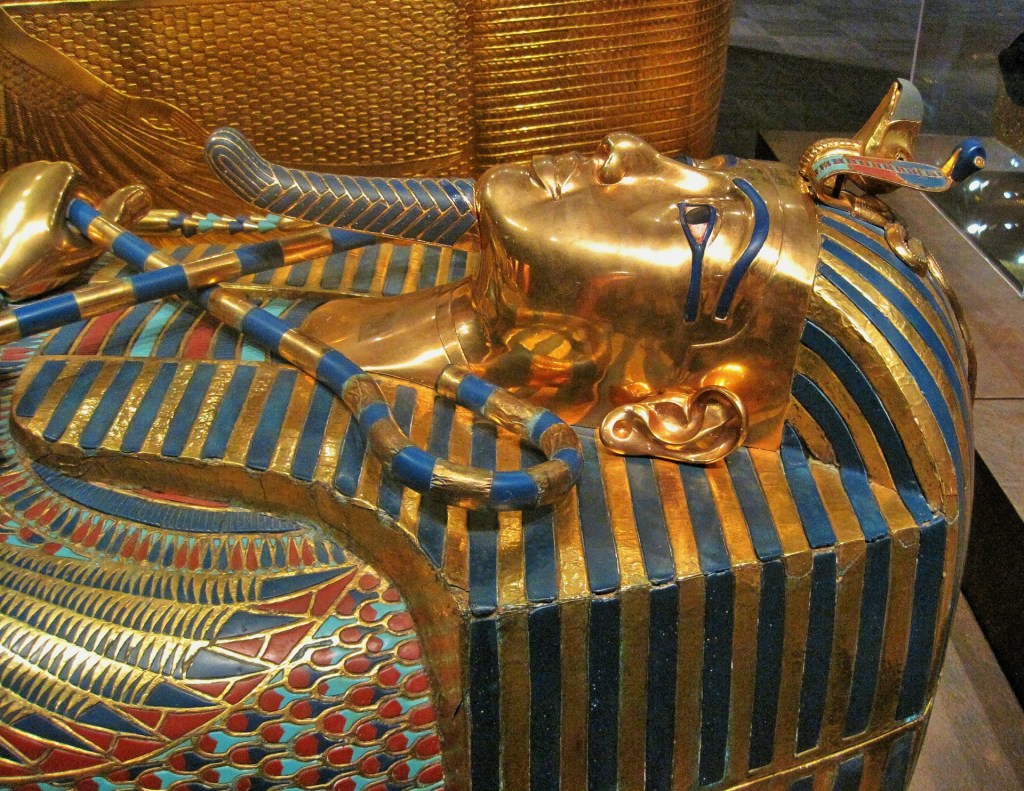
Not to be outdone by New York, Philadelphia often hosts exhibitions and installations that rival its northern neighbor. Just because it’s the Keystone State doesn’t mean it lets the other states have all the fun. In the winter of 2007, I braved a snowstorm to visit the exhibition Tutankhamun and the Golden Age of the Pharaohs at the Franklin Institute. The exhibition included fifty major objects from King Tut’s tomb—among them a vessel containing his mummified organs—and over seventy artifacts from the royalty of Egypt’s 18th Dynasty (1555 to 1305 BC), including a sarcophagus.
King Tut’s tomb was discovered in 1922, sparking a global fascination with ancient Egypt that still persists—my own obsession included. Many of these artifacts have rarely left Egypt, so I certainly wasn’t going to let a snowstorm stop me from seizing this rare opportunity. It was history made tangible, a brush with the ancient world that I’ll never forget.
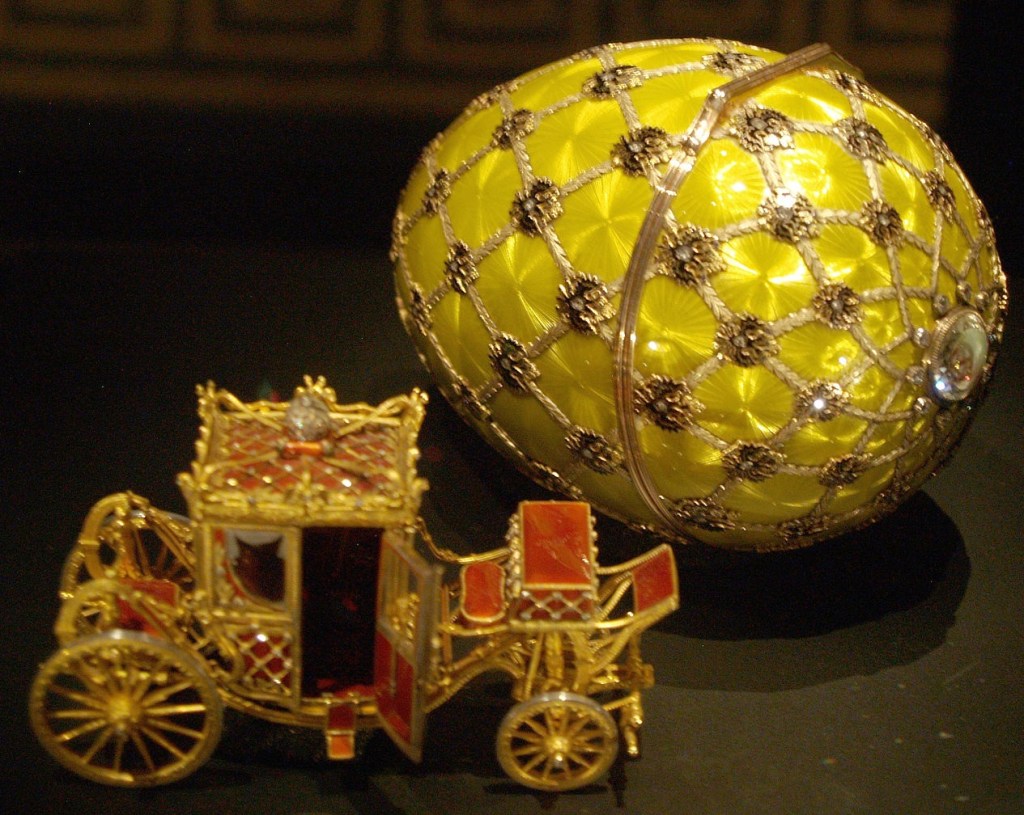
In 1998, Delaware hosted the first major Tsarist exhibition, Nicholas and Alexandra, and I was lucky enough to see it on a fifth-grade field trip. It left a lasting impression on me. We had spent several weeks learning about Russia’s history leading up to the Bolshevik Revolution and the rise of the Communist Party. Featuring nearly 700 objects, it was one of the largest and most prestigious collections of Russian treasures ever to tour outside the country. Most of the items had never before left Russia.
Among the many items on display were the Coronation Egg, an imperial throne, court gowns and uniforms, a gilded state carriage, and artifacts from the Russian Orthodox Church. Even as a child, I was struck by the sheer opulence of the exhibit—particularly the Fabergé Egg, which felt all the more extravagant when considered against the suffering of the Russian people at the time. The experience helped solidify my understanding of the revolution and the dangers of unchecked power and inequality. I’ll avoid getting too political here, but suffice it to say, it made an impression.
Each of these exhibitions made my Bucket List for different reasons. Each one broadened my perspective, deepened my understanding, and shaped how I see the world. They weren’t just collections of artifacts; they were immersive experiences that gave context to history, society, culture, and their ongoing relevance today. Most importantly, they taught me that I don’t always need to travel far to experience the world. Sometimes, the world comes to me.
How Can You Experience Unique Exhibitions?
Start by identifying how far you’re willing to travel. Then make a list of major cities or cultural hubs within that radius—they’re your best bets for hosting large-scale or rare exhibitions. But don’t count out smaller museums, either.
Check their websites to find out when they release their exhibition calendars. I’ve found that many post their schedules for the coming year, although some are less predictable. Once you know when they update their schedules, you can simply mark your calendar to check back. If there’s no set schedule, just take note of when the current exhibition ends and plan to check again around that time.
If you’re searching for something specific—say, an artist or historical topic you love—an online search every six to eight months may yield results. Just be prepared to wait. Some exhibitions, like the Russian Tsars, are generational events.
Lastly, if you’re visiting a city you don’t often travel to, take a few minutes to see what exhibitions are currently on display. You never know what rare gem you might find. It’s easy to miss out by only checking travel sites when planning your trip.
Costs: Range in price from $15 – $25 for museum entrance
Miles from home: Range from a 35 miles to 150
Completed: Childhood – College
The world may not always seem like it’s just outside your door step, but it really can be! Don’t believe me? Check out my Bucket List and Reverse Bucket List for stories both near and afar that are sure to challenge those preconceived notions of what is possible.




 Budget Bliss: Bucket List