Bonus Bucket List: Riding a Horse

Sometimes in the process of completing one bucket list item, you stumble upon another. I call these “bonus bucket list items”. They were not pre-planned or even hoped for, they are simply opportunities that present themselves and it is up to you to seize the moment. After all, have I not said we should make the most of our travels? These I call “bonus” items and they follow my principle of making the most out of the longer, further afield trips. There are times when travel becomes a necessity [see post], so it becomes important to consider what other items you can include. It isn’t about avoiding travel altogether, rather limiting travel. On my trip to see the eclipse in Vermont [see post], I stayed with a family friend who happened to have horses. 

I offered to assist her with their care having never had many close interactions with the noble creatures, despite growing up in a farming community. Truthfully, I have probably had more direct interactions with cows than horses, but I was an eager student. Shelia showed me the proper way to brush them and introduced me to each horse, telling me their stories. Each had come from an owner who had not understood their unique needs or read the signs of discomfort and pain resulting in them acting out.

The horses were a special breed, Icelandic, known for their smooth gait. Much like with dogs, it is important to understand what a breed is bred for. One would not expect a husky to do well at shepherding sheep nor would you want a border collie to pull a dog sled. Each breed was carefully curated for a specialized task, one the dog is a natural athlete at. There is an old saying that a fish will think itself stupid if its judged by its ability to climb a tree. Stoltur came from an owner who had tried to use him as an Olympic Dressage horse, something an Icelandic would not be good for as he was punished for his natural gait and motion. This meant that it was important for me to demonstrate first that I could be trusted with such a special set of horses before any overtures of riding could be made. Luckily, Sheila had already worked to restore trust between horses and man, so making friends with them was rather easy.

The three horses were gentle as lambs with me as I groomed them. Stoltur even began to engage in mutual grooming, nibbling ever so gently on my arm. In the crisp air of the early spring, the horses and I spoke to one another each learning the other’s cues. I would brush them and see how they reacted ensuring I first went to the head of the heard, Mjolner and worked my way down to Stoltur. The Icelandics are known for their gentleness and good tempers, and they were admirable hosts. I made fast friends with hay and treats hidden away in my jacket. I remembered the advice to hold out the treats on the palm of my hand, keeping my fingers straight to avoid any mishaps with teeth.

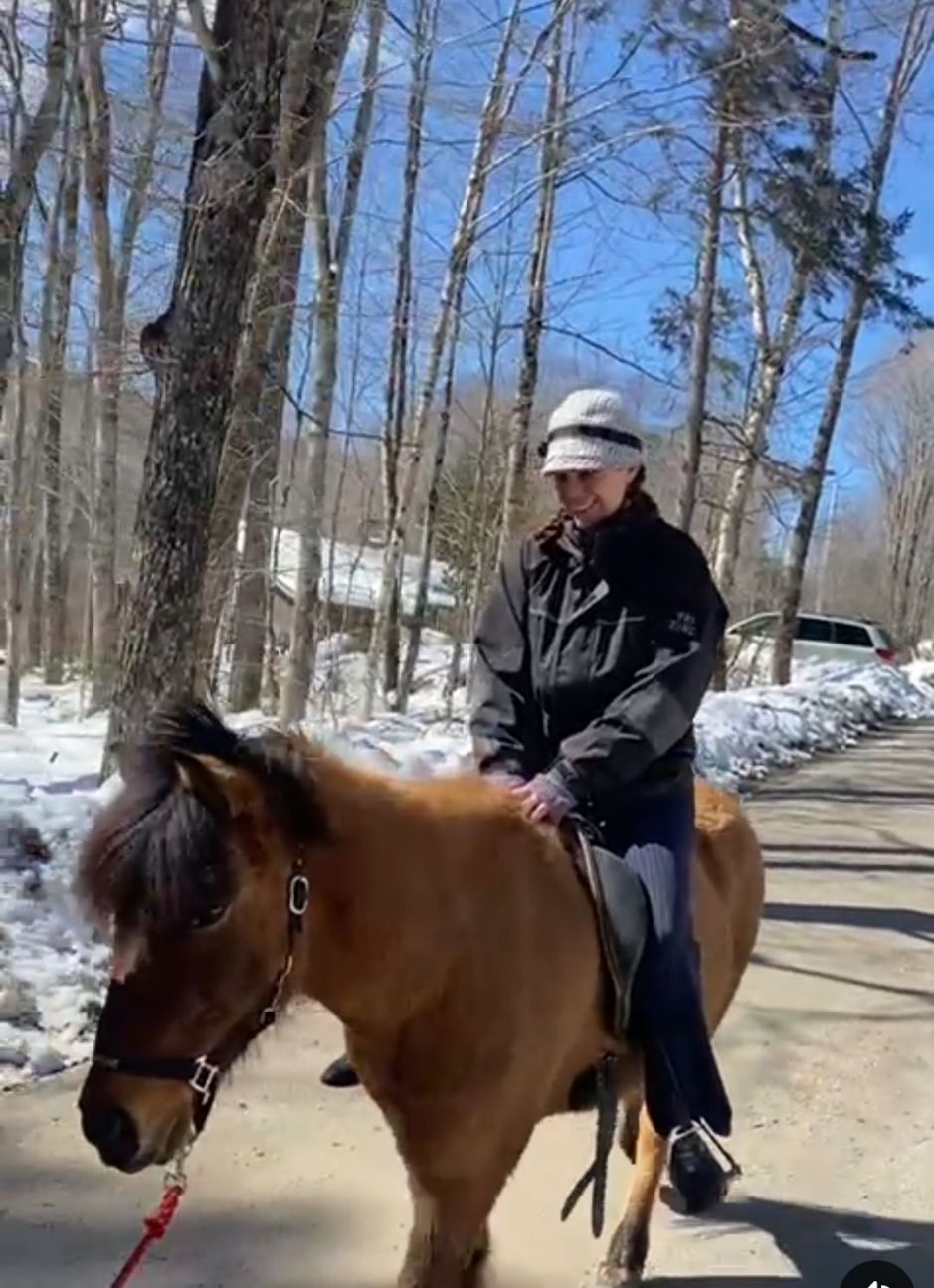
After spending some time getting properly introduced to one another. Sheila offered to let me ride one. I could barely contain my excitement as I enthusiastically said yes. She saddled them up and asked her son, Astri, to accompany us as lead. She assigned Stoltur to me as he was the best kind of horse for a beginner, forgiving of mistakes and of an easy temper. She choose to ride Gimli. She told me my only job was to keep my seat. I was given a vague idea of how to get up into the saddle, put my foot in the stirrup, grab the mane to help me up and hoist myself over. I did quite well. Sheila observed dryly that I was no couch potato. 

Riding a horse was rather a natural thing for me. The key of course was to keep my posture without being stiff. Having had six years of marching band in highschool, I was well acquainted with the idea of good posture without stiffness. It was a matter of feeling the rhythm of the horse and moving my hips with his movements. I found myself relaxing into the motion and adjusting as I needed to. She only needed to correct me once saying that I was slightly off balance to one side. 

It was magical riding a horse along a mountain trail. The soft sound of hooves against hard dirt. The way the world melted away. It was rather meditative. For once, I felt very much grounded in my own body as I am prone to being a bit air-headed. I had never been called a natural athlete before having always been clumsy, slow and generally the opposite of everything athletic, but when it came to horses, Sheila told me I was one. I suppose it makes me a bit like an Icelandic horse trying to do Dressage or a husky trying to herd sheep, without being given the right sort of task and the right sort of environment, I did spend my whole life thinking I was useless at anything athletic. 

I had not embarked to see an eclipse thinking I would be able to check off horseback riding from my list. Instead it was an opportunity that presented itself and I made every use of that chance. While I could book a horseback trail ride near my house, the experience of being able to connect with the horses first, to hear their stories and bond with them isn’t something that could be bought..

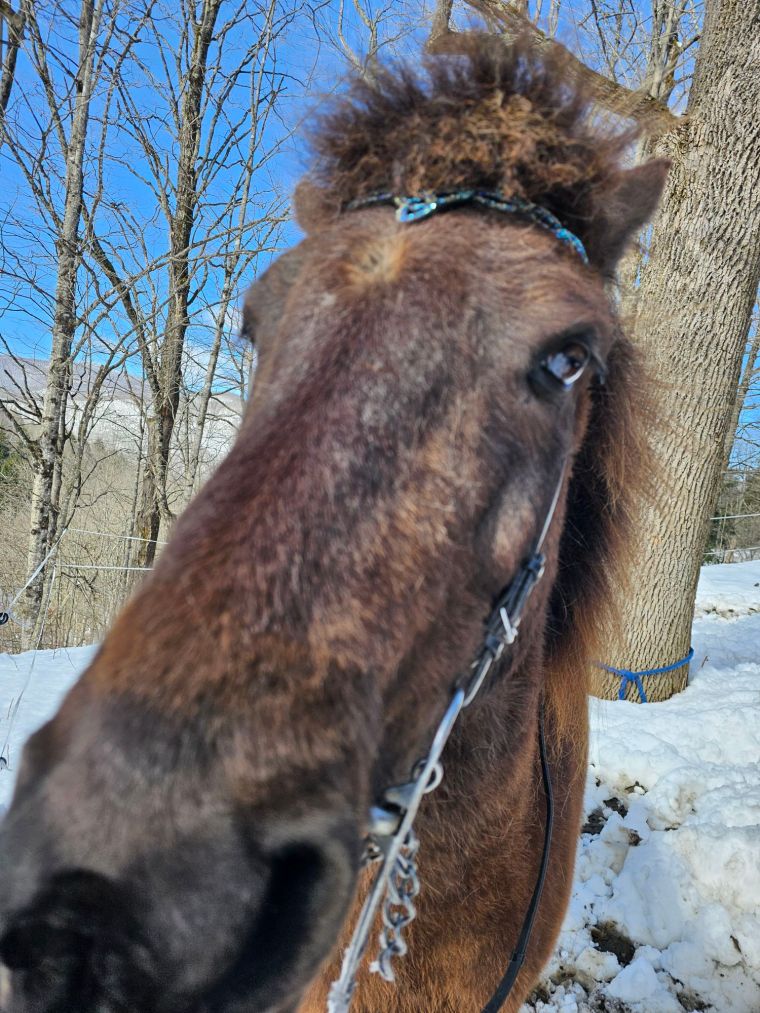
Gimili with his bling

One never knows what opportunities are lurking around the corner or what things could present themselves when venturing outside one’s door. It isn’t about forcing anything to happen, but rather cultivating genuine relationships. Sheila probably would not have allowed me the opportunity to ride her horses had I not demonstrated that I was someone who could be trusted with them. I demonstrated that I could listen to their cues and respond well to them. When Stoltur nibbled my arm, I could have easily freaked out or misunderstood. Instead, I backed off from grooming and observed him for any signs of irritation before proceeding any further. I checked in with her to ensure I was reading him correctly. She confirmed it was a good sign that I was doing well with him. It was a matter of giving him the respect he deserved and following her directive. One cannot approach a horse like a dog or a cat anymore than one can approach a cat like a dog. Each creature has its own way of communicating and engaging. It is up to us to follow the terms set by them. By fostering a good connection with her horses and her, it opened up the door for a magical experience. By cultivating authentic connection, all sorts of opportunities and horizons will become open to you. 

How can you experience horseback riding?

Now, it would be rare for you to meet a horse owner who can present you with the opportunity to ride a horse, like I did. However, there are many stables throughout the country which offer horseback rides or trail rides. A quick google search is all you need to get started and many of these are under $100. For a more intimate experience with a horse, you may want to sign up for a series of lessons. 

Completed: April 7, 2024

Miles from home: Bonus bucket list!

Cost: Free ($60 – $100 without a friendship discount)

Give Blood: From Reverse Bucket List

Much of what is on a bucket list may be considered a bit hedonistic. That is a criticism that some people have against them. To some people, it is a list of “empty pleasures”. Life should be spent bettering the world not chasing short term experiences you just check off a list. There may be some truth to those criticisms, but then again is it much worse than spending my days watching Netflix, scrolling through social media and spending all my money on amazon? The point of the list, for me at least, is to cultivate a sense of adventure, to explore the world, to experience life and learn about myself. It was about getting out of my house, away from the screens and living, to stop dreaming and start doing. It can in some ways be a form of self-expression. As someone whose daily profession is leaving the world a better place, having a bucket list is a form of self care. 

However, that doesn’t mean that I don’t still have goals that are altruistic in nature or have reflected on past actions on my reverse bucket list that fall under the category of “leaving the world a better place”. I’ve had experiences of volunteering and sacrificing part of myself for the benefit of others that have left a positive impact on me. It is part of my own self-expression and I feel it is important to include those experiences as part of a rich life.

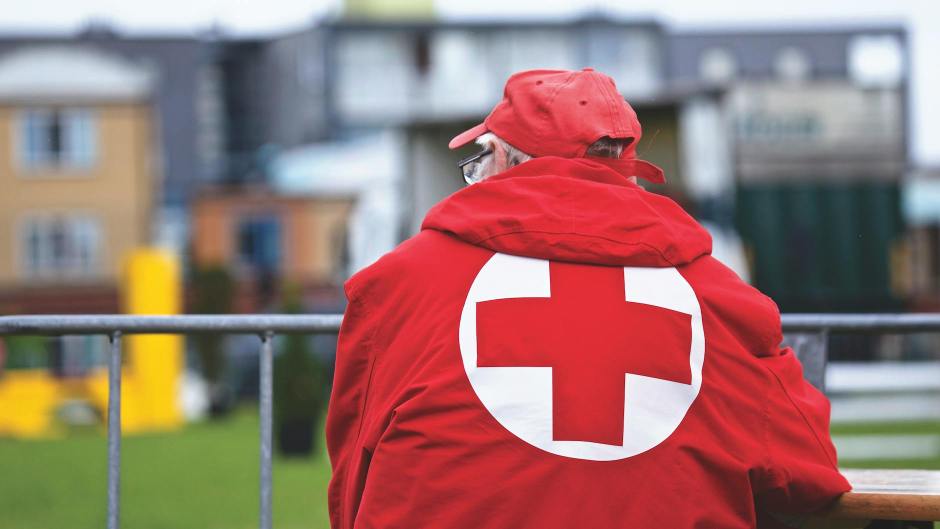
Photo by Julia M Cameron on Pexels.com

One of those altruistic goals was to give blood. As it turns out, I have a O+ blood type which, while it is one of the most common blood types, it is also a good donor blood type. Blood types come in A, B, AB, O and positive or negative so you can have AB+ or B- or in my case O+. The letters A and B indicate common antigens and O indicates the absence of either A or B, positive and negative indicate the presence of a common antigen or the absence of it. If you have the antigens you can receive blood without the antigen but if you don’t have the antigen you can’t receive blood that has it. Therefore, I can receive both O+ and O- but not any A, B or AB blood. 

It is hard to describe the importance of blood donations. I am a daughter of two nurses, so I grew up knowing how important blood is for modern medicine. Blood allows doctors to perform miracles, to complete life saving surgeries that would normally kill a patient because of the blood loss, to treat cancer, to stop someone from dying from traumatic injury and treat chronic illnesses. A pint of blood can mean the difference between life and death and it is important to have an ongoing fresh supply. 

So when my school held a blood drive in my senior year, I naturally signed up to participate. It was important to me to give back and as it turns out my family’s blood lacks other antigens than the positive. We also have “sticky” blood which makes it great for trauma victims since it helps with clotting. Even though I didn’t enjoy needles, I knew that I was making a difference when I laid down on the chair and presented my arm. It was such a small act of inconvenience for me, missing some class, a brief time of discomfort, but the impact of this life saving gift was more than worth it to me. Why wouldn’t I give up a few hours of my life to save someone else’s? 

Being a positive influence in the world doesn’t always need big gestures or major political movements, sometimes something little can have a large impact.  Full disclosure, I did faint when I gave blood for the first time. About 4% of people faint. It isn’t an indication of any sort of medical distress but rather a vagal nerve response. Unfortunately, I have had other medical issues over the years causing frequent issues of low iron levels which make it difficult to give blood. I hope to be able to give blood now that the underlying issue causing the frequent bouts of anemia has been addressed. 

How can you donate blood?

Only about 3% of people ever donate blood and the demand for blood never ceases. It is a vital resource that cannot be replicated through other means. As they say “when you give, other’s live”. I highly encourage you, dear reader, to consider giving blood. If you cannot give blood, then consider how else you might positively impact the world.

Luckily, giving blood is fairly easy. Just call up your local branch of the American Red Cross to find out when and where they’re having their next blood drive. 

Completed: First time donating blood Spring 2006

Miles from home: 4 miles

Cost: Free

Learn A Language: German

There are many reasons to learn a language and this is something I often see on people’s bucket list. However, unlike many of the bucket list items where it is easily checked off in an afternoon, this one takes time and dedication to achieve. I know there are many different ideas around what it means to learn a language. For some people unless you are able to carry out a completely fluent conversation, you did not learn a language. For others, they may say that being able to order food at a restaurant and make their most basic needs known is being fluent. There is an international standard for language learning which goes from A1 to C2 with most countries enforcing a B1 limit on new citizens. Hence the phrase “B1 and done”. It is also nebulous in that it is a skill that needs maintenance. 

I double majored in both psychology and German, but I used my psychology degree and not my German degree. I probably would have tested at a B1 or B2 at the time of my graduation, but I would currently test at an A2 level. When I first started reviewing German after a nearly ten year hiatus, I probably would have been at an A1, which demonstrates that if you don’t use it, you lose it. In the ten plus years between graduation and now, I had not used my German at all, which begs the question if in almost ten years I didn’t need it and even now don’t need it, why bother at all?

There are many reasons to learn a language that people quote, the most common, are probably B.S. for most people. How often do we encounter people from other places to establish cross-cultural friends, see a job that requires it or travel? Being a native English speaker I am blessed to know one of the most commonly spoken languages in the world, as such I have not had the difficulty of making cross-cultural friends. Over the years, I have connected with many individuals from Asia, China, South America, Africa and even the Caribbean. I’m on servers with people from all over the globe and we all speak English. 

Visiting Berlin during my semester abroad

Now some people will argue that by refusing to be monolingual and expecting the world to accommodate you, that people will find that interesting or commendable. I have had mixed reviews from non-English speakers. I have been berated for not learning their language. Surprisingly enough, I was in Germany for my semester abroad and the Spaniard in the class was telling me that I insulted him by not choosing to learn Spanish. I have also been told by Germans that I shouldn’t bother to learn German and my attempts to do so were offensive and basically unless I was already fluent not to bother them. These were not the most encouraging interactions in my language learning process. I have had other very positive experiences from people when I’ve worked to learn their language, just don’t expect the process to always yield positive results. 

 As for jobs, unless you are in a particular sector of the economy that will be sending people abroad or working with a particular population in the human services, chances are you will not be needing anything other than English. Travel, as I have noted on this blog before, is something that we don’t really engage with more than a week (if we’re lucky) each year. 

To be honest, everyone is going to come to this with their own reasons. They may be doing it for their job, for travel, to expand their mind – increase memory, creativity, attention span, and logical thinking – to get outside their own culture, to better understand languages as a whole, to improve their own native language skills, and for just plain fun. There are people who learn “fake” languages or Conlangs such as Klingon, Na’vi and Dothraki. The desire comes from wanting to fully immerse themselves in a fictionalized world and to connect with others, who like them, are obsessed with the fandom. Some people know every single fact about Taylor Swift’s life; others can hold conversations in High Valyrian. To each their own fandom! 

For my own part, I have wanted to learn another language ever since I was young. I felt it was another way to explore the world. To me culture and language were linked and to truly understand a place, I needed to speak the language of that place. I loved learning about other cultures and in particular Irish and German topped my list because that’s what my family is, a mixture of Scots-Irish and German. Our area is predominately of German descent and has many German cultural influences thanks to the strong Amish and Mennonite community here. It’s quite common for us to use German phrases in English such as “it’s all” in order to say “it’s all gone” or “throw me down a pair a socks” which harkens back to the use of German reflective verbs. These are things that are unique to our area not usually found in other places of the English speaking world. 

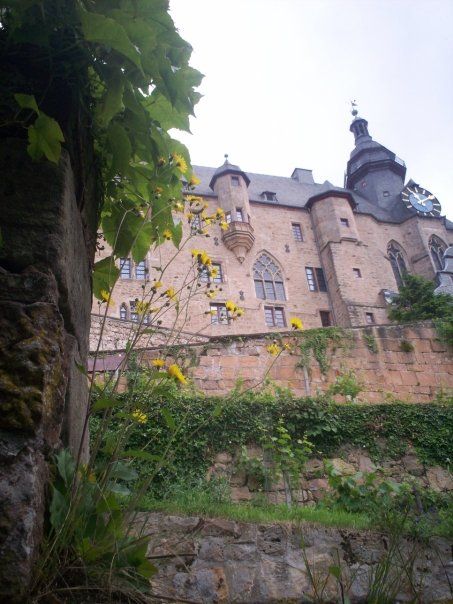
Marburg Castle, Germany

I originally tried French because of my desire to go into music and my mother really pushed for me to do French. Honestly, as a dyslexic, French is terrible. The spelling is an incomprehensible mess and I have no words. German on the other hand is actually pretty easy to spell as it is fairly consistent and logical. So in 9th grade, I made the switch to German and I’ve never looked back. Although, I am interested in learning French so long as I don’t ever have to spell anything in it.

It hasn’t always been fun. This isn’t an afternoon jaunt, this is a long slough of cognitive challenges and mind bending grammar, oblique turns of phrases and baffling cultural norms. People who gush about learning language as “fun” and “interesting” have obviously not had to spend hours trying to comprehend the ridiculousness of irregular verbs or trying to master der, die and das. A car could be der wagon or das auto, it’s a car, it should be the same gender but it’s not! There are legitimate historical reasons for this quirk, but I digress. Yet,  it was always worth it to me. 

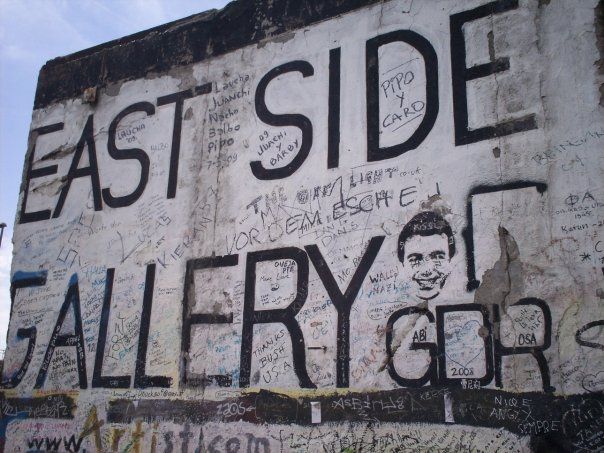
Berlin Wall

Does it help me connect with others? I don’t know that it has. I haven’t found it necessary to know anything other than English, because it is one of the most common secondary languages. Some people will claim that learning a language, especially as a native English speaker when you don’t have to, makes  you more interesting. 

I have had mixed reviews from non-English speakers. I have been berated for not learning their language. Surprisingly enough, I was in Germany for my semester abroad and the Spaniard in the class was telling me that I insulted him by not choosing to learn Spanish and that it was clearly the superior language. I wanted to tell him that I should be commended for learning anything at all when the whole world is geared towards me not learning. I have also been told by Germans that I shouldn’t bother to learn German and my attempts to do so were offensive. Basically unless I was already fluent, I had no right to speak to them, which was baffling because how was I supposed to become fluent if I didn’t try speaking with native speakers? These were not the most encouraging interactions in my language learning process. I have had other very positive experiences from people when I’ve worked to learn their language, just don’t expect the process to always yield positive results. 

However, it has been an incredibly rewarding journey to learn German and later on, Spanish. It did afford me a semester abroad which greatly expanded my horizons in the world. It has allowed me to make connections with people in my own travels that I would not otherwise be able to make. Twice, I have ended up befriending, even for an afternoon, small groups of German tourists who were delighted that I knew German. I have seen it build up connections between myself and my clients when I have spoken to them in Spanish and Haitian Creole. It hasn’t always been easy to master the languages. It has been confusing and frustrating especially when I know that I used to be able to communicate at a much higher level, but sadly time has eroded the skill. 

Stefi, the adorable German woman I met while visiting Boston

I also developed a greater appreciation for those who are coming to America who don’t know the language, the challenges they face when trying to navigate our systems and the requirements on them to know how to communicate. I understand the history of Germany from their perspective and how that history unfolded. It’s given me a deeper understanding of our own history as told from an outside perspective. In the simplest terms, learning a language has expanded my horizons in ways I didn’t know it would do. Oftentimes we travel to immerse ourselves in a place, but without the language, we only dip our toe in the waters, when we learn a language we can immerse ourselves deeply without ever having to leave the couch. When we do finally arrive at a place, it’s almost like being at the house of an old friend. It’s familiar and it just “fits”. For me, staying in Germany for five months was very much like staying at a friend’s house that I’ve visited many times before. It wasn’t home, but it very much could be. 

How can you learn a language?

Most of you aren’t going to be able to go to school and just join a class and college classes are extremely expensive and probably more time than you have. There are many books, computer programs and apps out there to use. I’ve used Duolingo myself and found it to be decent for reviewing my German, but not as good for learning my Spanish. The app designer himself said that he was more interested in “gamifying” language learning than being the most effective way to learn. His justification was that any learning is better than no learning and the best way to keep you learning was to focus on making it an addictive game you wanted to keep playing. There are lots of other apps available and don’t just pick the most popular because it might not be what you’re looking for. I haven’t really found other methods like books, flashcards or listening to be all that effective for me, but everyone is different, what works for me may be terrible for you. The great thing about today’s world is that it has never been easier to get access to information and tools for learning and most of it is fairly accessible. Rosetta Stone is famously good, but also famously expensive. Myself and my mom are both on the same family plan for duolingo at about $10 per month. 

Completed: Reached conversational in 2010 

Miles from home: Can be completed anywhere

Cost: On average $10 monthly subscription fee 

Sunflower Fields: Turn Towards the Light

“I don’t think there’s anything on this planet that more trumpets life that the sunflower. For me, that’s because of the reason behind its name. Not because it looks like the sun but because it follows the sun. During the course of the day, the head tracks the journey of the sun across the sky. A satellite dish for sunshine. Wherever light is, no matter how weak, these flowers will find it. And that’s such an admirable thing. And such a lesson in life.” – Tim Firth

I have always loved sunflowers, but after hearing that quote, I adored them. I loved that they followed the light even when the sun was hidden away. No matter how dark their world becomes they turn to the light. Isn’t that just what we humans fail to do so often when our lives become darkened? What a beautiful reminder and how special it is that they do so resemble the sun to give us some of the light they have taken into themselves? 

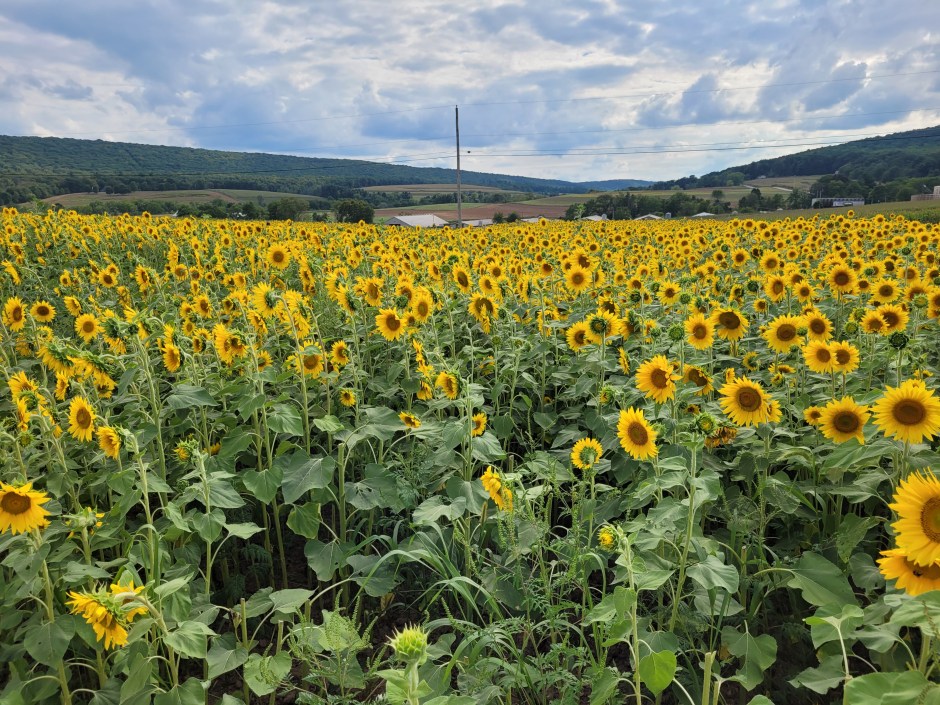
When one thinks of sunflower fields, one may think of the endless fields of Tuscany and forget to look in one’s own backyard. I will say that sunflower fields have been gaining popularity, at least in my area with farmers now taking time to plant fields for visitors to come and enjoy. Most will allow you to leave with a single memento of your visit. One flower to bring you sunshine. At Second Mountain, you are encouraged to bring as many containers as you can because for just a few dollars, you can pick as many sunflowers as you desire! And I did! 

My mother and I drove up at the very end of the sunflower season to catch the last blooms of the season. We had been carefully awaiting this for almost a year as we had learned of this hidden gem to the north of us from a work colleague shortly after the sunflower season had ended. Unfortunately, peak sunflower season is in August which usually has beastly weather of heat and humidity. Being as my mother is an asthmatic those two are not the greatest combination for her being able to enjoy the great outdoors. Being allergic to bees, it was important for me to avoid warmer days when they would be more active, so we carefully watched both their facebook page and the weather, hoping for just the right conditions. Finally, at the end of the season the weather was just right; we packed up our car with containers and made the hour-long drive up north. 

Even in their last days the fields were a glorious feast for the eyes. The vibrant flowers naturally were turned towards the evening sun. A rock cover band played in the background, which if you enjoy such things, I am certain it added to the enjoyment. Not being a fan of such things, I did not find it particularly enjoyable. I would have preferred a cello performance or swing band, but to each their own. I am not one to dictate to others what sort of music they can listen to or even if music should be playing. Just if you do visit a field with live music, bring your earbuds or headphones so that you can put on something you do enjoy if the music isn’t to your taste. Then again, even if there isn’t a live band, bring them anyway. It is good to have music close at hand to enhance an experience or help drown out unpleasant noise. The small crowd of people were taking photos and harvesting flowers. I took some time to photograph the sunflowers to help capture the glory of the fields, even the ones who were nearing the end of their life cycle.

Perhaps, I am a bit gothic in nature, but I always found the end of the growing season to be beautiful in its own right. There is a certain loveliness to the death of a flower; having lived brilliantly and gloriously, it now loses its color, going quietly into that good night to make way for the next season. There is a quiet stillness about it as it is no longer abuzz with visitors, often robbed of its seeds by birds or other creatures. It is only a shadow of itself, like an echo. What struck me as even in their last days, they still were turned faithfully to the sun, never losing the light. 

Turning back to the brighter field, I gathered up sunflowers in my arms until I could carry no more. Walking through the golden sea, with my arms filled with flowers felt almost surreal, as if I had entered a dream. The flowers stand proud as if they are sentinels of the very sun itself. Stray breezes wind their way through the fields causing some to break their vigil to dance, perhaps rebelliously, but more likely for the sheer joy of our closest star. 


Personally, I enjoyed the fields most when the band was quiet and I could simply enjoy the wonder of nature. To have time to disconnect from the world and tune into the natural world. It was almost transformative to be in their midst, laden with the flowers, as if I were about to become a nature spirit one with the fields. The quiet of the fields let me really listen to the ecosystem going on around me. The buzz of insects and the way the wind rustled through the flowers. Truly, a sunflower field is summer incarnate and I made certain to fill my car with lots of summer. 

While I admonish your dear reader to not live in regret, I do have a small regret from our trip. Not having more containers to bring even more sunflowers home! Part of the joy of our trip was having a house filled with sunflowers. Every corner of our living room boasted these bright blooms. It was like we had brought the sunflower fields home with us! They lasted for about a week and a half which more than made the trek worth it, even though there were closer fields nearby which were just as glorious to witness. 

How can you visit a sunflower field?

Unfortunately, most of the sunflower fields will not permit you to cut their flowers by the bucket full. So if you are looking for the ability to bring as much of summer home with you as possible, that may be a bit tricky or cost you quite a bit more than my $10 admission. However, there are plenty of places which offer sunflower fields to visit and photograph. Personally, the bigger the fields the better they are, but do not count out the smaller fields, for their charm. 

I encourage you to take your time when visiting. Don’t fill it up with endless photos but rather take moments to pause and drink in the moment. The blossoms of the sunflowers are the last hurrah of summer before the leaves begin to turn and fall all too quickly becomes winter. Bask in the warmth of the season, let it seep into your bones for you will need those memories when the wind roars and cuts through to your core. Enjoy the brightness of the yellow blossoms, because color will be slowly drained away after one last defiant show by the trees. Take the memories with you into the winter of life so that way when the darkness comes, you can recall the lessons of the sunflower and turn towards the light. 

Completed: Late Summer 2022

Miles from home: 45

Cost: $10

Making the Most of Your Travels

There are times when I do travel. At the time of this writing, I have gone on two cruises, spent a semester abroad, completed a mission trip and traveled a number of times over several states. I am not opposed to travel, though I have stated there are drawbacks to traveling especially when so many things may already be in your backyard if you just take the time to look. However, there may be things or experiences that just require travel. For example, I wanted to see a total solar eclipse. Not living in a place where that was happening in my lifetime, I was forced to travel. If you want to see the Great Wall of China you have to go to china.  

Given the drawbacks to travel, environmental impact, overtourism, money involved in traveling, participating in exploitative practices, etc. it is important to make the most of your travels when you travel to minimize these drawbacks. As with everything else, do your research and be picky. When I went on my two cruises it may have been tempting to lounge about on the many sandy beaches. However as someone who is only a two to three hour drive from the beach, that wasn’t an activity high on my list. I remember distinctly telling my travel companions that if we were going to sit around on a beach we may as well drive to Maryland or New Jersey and save ourselves the time and expense as honestly beaches are fairly universal. Sand? Check. Ocean? Check. Beach. If you, dear reader, are living in the midwestern part of the United States, including a beach day in your cruise makes sense, for those of us from the coasts, we probably should consider other options. 

Photo by Nathan Cowley on Pexels.com

Something I am mindful to do when traveling is to consider what are things that I simply cannot do in my own backyard? That isn’t to say that I refrain from doing anything that I can do in my own backyard, more that if given the choice of various activities, I will prioritize the ones that I cannot do or cannot do easily. When I went to Aruba, I opted to get on a submarine, as that wasn’t something I couldn’t easily do off the New Jersey shore. I saw the Panama Canal in Panama because it is a unique piece of engineering not replicated elsewhere in the world. I went to the Rain Forest in Costa Rica because like the Panama Canal, the rainforest simply can’t be replicated. That isn’t to say I didn’t go to the beach at all, I did pick one or two days that included the beach. It just wasn’t my first priority and the days I did go to the beach it was an add on to another excursion, like the caves in Curacao.

I was mindful when picking my itinerary to pick ones with the most places I wanted to experience or alternatively have excursions which include activities I want to experience. This can even stretch to smaller items. When departing from the New York port, I made sure to take time to get a good view of the Statue of Liberty when we left as I had never seen it. I took advantage of being at the equator in order to watch both a sunrise and sunset on the same day. In the north, I would have had to get up quite early to see a full sunrise and being as I am not a morning person, this would be difficult. Closer to the equator the sun rose and set at times more conducive to my schedule. These were small things, but I still got to enjoy them with just a little awareness of the opportunities around me.   

The cast from the play in Stephen’s Green. Discovered by chasing down the gentleman on the far right through the streets of Dublin

This is not the time to necessarily be pig-headed about your agenda or have an agenda so full you cannot be spontaneous. Some of my best experiences come from being spontaneous. That is how I got on a tour of the capitol building in Washington, scored tickets to the British Shakespeare’s performance of MidSummer Night’s Dream in Dublin, and the unicorn tapestries in Paris. Cultivating a spirit of openness and adventure. The best strategy is one that includes openness to pivot to new opportunities. 

The point is to be mindful about what you’re going to do and be mindful when you’re doing it. Don’t just travel to travel, use your time wisely. Thoreau told us to suck the marrow of life, suck the marrow from your trips! Consider carefully the itinerary of where you’re going, cast a wider net to capture the possibilities of the area, and be willing to indulge yourself on things that are inaccessible otherwise. 

If you do go on a cruise ship, check out all of its offerings. On my very first cruise, I discovered it had a thermal spa suite outfitted with lots of things I had never tried before a sauna, steam room and salt room. For a little bit extra, I was able to purchase a pass to access it and found that I spent at least an hour there every day. Considering the very large hot tub and fewer people with beautiful views, it was certainly worth it. I also discovered the ship had a ropes course with a zipline. On another ship, we tried go-cart racing. Something else, I had been itching to try. I loved it, my sister not so much – needless to say we scratched that off our list of sister dates to do. So check out your ship, your hotel or wherever you may be for cheap/free options. It wasn’t like I could really go anywhere else, I had already paid to be able to use it in my fare, so I may as well make use of them and cross those items off the list. Trips I took during my semester abroad to made the best use of my time in Germany. By venturing forth from Marburg I was able to see places I’ve always wanted to see like Dublin, Paris, Berlin, Vienna and Rome. With Ryanair most of those plane tickets were under $50 bucks. 

Be sure to check the dates of your trip for any special events that may be occurring in the area or be willing to adjust your dates if you discover there will be a special event in the area you want to go to. My trip to Dublin just happened to coincide with their Shakespeare Festival and a performance by the British Shakespeare Company. My trip to Vienna just happened to coincide with Monet’s Water Lilies being on exhibition at one of the many art museums. By paying attention to what was going on at a specific time, I was able to expand what I was able to do. Although contrary-wise, you may want to avoid going to places during certain times of the year. For example, avoid Disney World November through December, typically the park is open for almost 12 hours for you to enjoy. However, during the Christmas celebration, if you want to stay after dark you have to pay an extra $300 – $400 for a pass, that’s cutting your park time down by 5 to 6 hours unless you’re willing and able to pay an extra fee. Don’t go to Boston during the marathon in the spring if you want to avoid the crowds. Skip Florida’s beaches during spring break if you don’t want to be in an overcrowded place with a bunch of drunk, college students. Careful planning can help make or break your trip.

Photo by Vlad Alexandru Popa on Pexels.com

Try to add an extra day in order to add in something special. When leaving from the New York port, my family and I added an extra evening in New York to catch a Broadway musical, something my sister’s mother-in-law had never experienced and is on many people’s list. Yes, it was an extra expense but it would be more expensive to have to travel back up to New York just to see a show. When my sister went on her first cruise, she flew over a day early and enjoyed the sights of Barcelona, for a night at a hotel she was able to experience a whole city. Traveling is often one of the biggest expenses as well as your biggest carbon footprint, so by adding a little extra time, you can enjoy more. Good for your wallet and the earth! 

As budget conscious people, it is important to get the most “bang for your buck” as it were. That isn’t to say pack everything full and rush around so quick you can’t even take in what you’re seeing, it is only to make sure you’re taking full advantage of what is nearby to maximize your experience. With careful planning and a spirit of adventure, you can make the most of your more expensive and far ranging trips.  

Unique Items onto Yourself

Now there are some experiences that for you are bucket list items that others may scoff at as being worthy of gracing such a list. Their reactions may be from a misunderstanding of the significance of the experience whether historically, culturally or personally or borne out of some ignorance on their part as to the value of such an activity. 

Take video games for example. Already some of  you are rolling  your eyes and dismissing the whole example – bear with me gentle readers! Video games have been considered a lesser art and base activity for many years. People scoff at the idea of e-sports as being a legitimate activity. I would say that those who are rolling your eyes have not taken a closer look at the industry or the history of other previously derided activities. 

Years ago actors and actresses were considered little better than prostitutes yet now the are celebrated for their artistic talent and skill. They hold some of the highest social status in our society which is quite the reversal. We view the cinema now as being worthy of being carefully critiqued, as equal to opera in sophistication and artistry. We may consider that some films are as important to see as some books are to read. I daresay that we will soon be considering certain video games equal in value to any great opera, play, symphony or film.

Photo by Heiner on Pexels.com

Certain sports used to be considered reserved for the lower classes mostly the competitive sports whereas the more non-competitive activities such as music and dance were reserved for the upper class. The upper class certainly had semi-competitive sports like hunting and shooting, but you’ll note that they were with few exceptions non-contact sports. After all, we wouldn’t want young Archibald the Third to get a broken nose, think of how he’d look when he presents himself to his majesty! We wouldn’t want him to look like a common thug! However, now we push our children into these contact sports and laud lofty goals of scholarships and going professional. 

These examples are to help make my point that for you, as an individual, there may be things on your list of things to achieve or experience which our culture may not value or encourage us to do. No one needs to understand your obsession with knitting and how for you a certain project may be your magnum opus. Celebrate it! Add it to your list! Maybe you want to make Challenger tier in League of Legends. Being as only .0024% of players reach Challenger, that certainly would be like making the Olympics. You don’t need to justify to anyone the amount of skill, dedication and knowledge it would take to achieve that. People who scoff at that may as well scoff at a Chess Grandmaster. Learning a programming language is just as worthy as learning a spoken language. The same can be said of creating an entire conlang.

Photo by Anton Porsche on Pexels.com

The items for you don’t even need to be that big of a deal, they could just be things you want to do for fun. Not everything on your list needs to be elevated or lofty, some things could be small or even a bit silly. For example, I would very much like to see a drive-in movie. I love nostalgic things and experiencing pieces of the past as it enriches my understanding of historical events and cultures. It’s a fun diversion and would certainly be a different way to see a film. This certainly isn’t everyone’s cup of tea, but it is mine so it’s on my list and it isn’t something I would think would grace many other people’s list.

The point is not to be afraid to celebrate your personal achievements loudly and proudly. These achievements don’t have to be meaningful to anyone else but yourself. Part of living your best life is to do it in a way that is authentic to yourself without allowing other people’s negative judgements hold you back from pursuing activities that are meaningful to you. After all, the only person who is living your life is you!

Japanese Tea Ceremony

“There is no trouble so great or grave that cannot be diminished by a nice cup of tea.”. – Bernard-Paul Heroux. 

When I was about five years old, I was obsessed with tea parties. I was first introduced to them through my mother’s own passion. She would take us to the local herb shop and the tea shop nearby to purchase quality tea and scones. At home, the water would be boiled and poured into a china pot, a timer set for the proper amount of time for brewing and then carefully poured out into the cups. It was during this time that she imparted to me the rules of tea, how to hold the cup, what order the tea should be poured out to each guest, the polite amount of sugar to add, when to add milk, how to stir it without making a ruckus. I learned the difference between afternoon tea and high tea (it’s not the same thing), that one eats the savory first then the sweets and exactly how one eats a scone properly (by breaking it apart into small bits). 

Over tea, she taught me about Victorian England and the antiques that decorated our house. She was quite fond of the late Victorian era, and I developed the same fondness. As part of my education, she bought me a tea book for my birthday. I was elated (yes, I was a strange child, I grew up to be a strange adult and I’m okay with this fact). I flipped through the pages and discovered an entirely new sort of tea, the Japanese Tea Ceremony. The book did not go into it overly much but it did allude to the sorts of things one might encounter, the special Macha tea, the whisk and the sweet that they might serve. In combination with my discovery of the Karate Kid, my love of Japanese culture was solidified and later reinforced with my introduction into anime (which I won’t get into here, other than Princess Mononoke was a definitive experience of my childhood). 

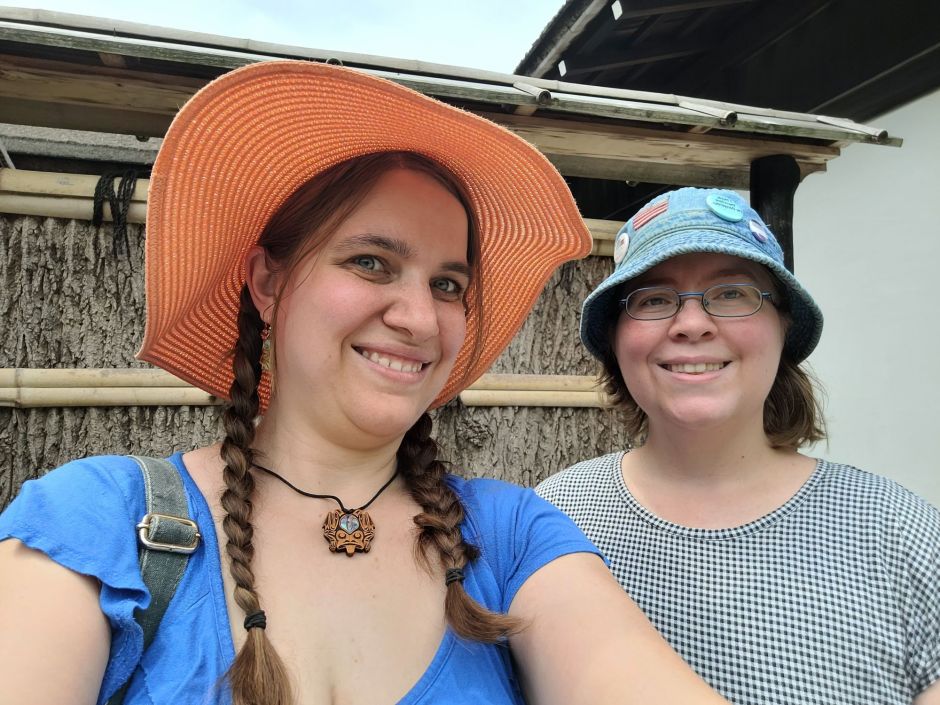
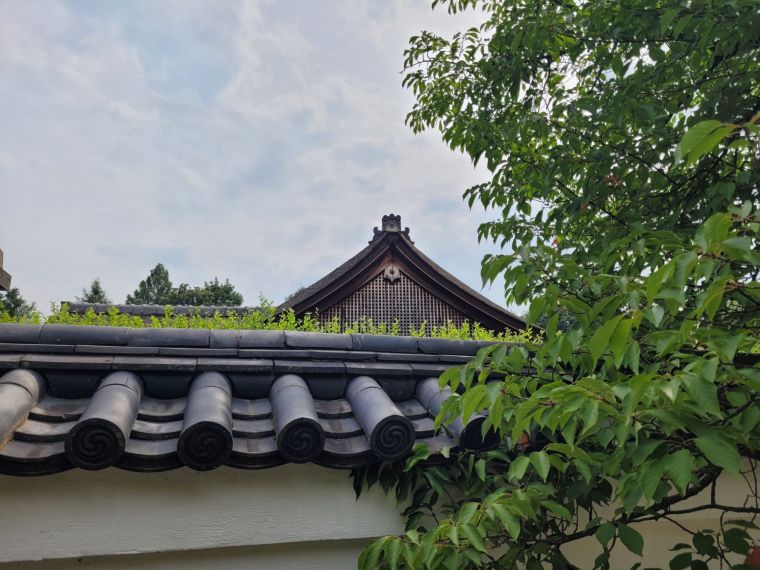
Ever since my discovery of the Japanese Tea Ceremony and all things Japan, I had wanted to experience it for myself. I got the chance in the summer of 2021, when I took the hour drive out to Shofuso Japanese Cultural Center.  The house was designed by Junzo Yoshimura as a 17th century style home. It was built in Japan in 1953 utilizing traditional techniques and then shipped to New York as part of the Museum of Modern art. It found its home, however, in West Fairmount Park in 1958 where it has graced the greater Philadelphia area ever since nestled in a beautiful Japanese Garden. It includes a pond garden with a waterfall, island, koi fish, traditional tea house and bathhouse.  

Walking through its gates, one could easily forget that one has not in fact hopped on a plane to the middle of Japan. Every corner of the building is a beautiful work of art, carefully tended and maintained. What delighted me was the dedication to keeping the building authentically Japanese. Unlike in America when something like a floorboard has some sort of damage or rot, the Japanese do not uproot the whole floorboard and replace it. Instead they cut around the damaged section and then fill it in like a puzzle piece. There was a sort of beauty in keeping the story of time rather than a focus on perfection. Flaws were a natural outgrowth of a house in use and there was a sort of artistry in the repair. 

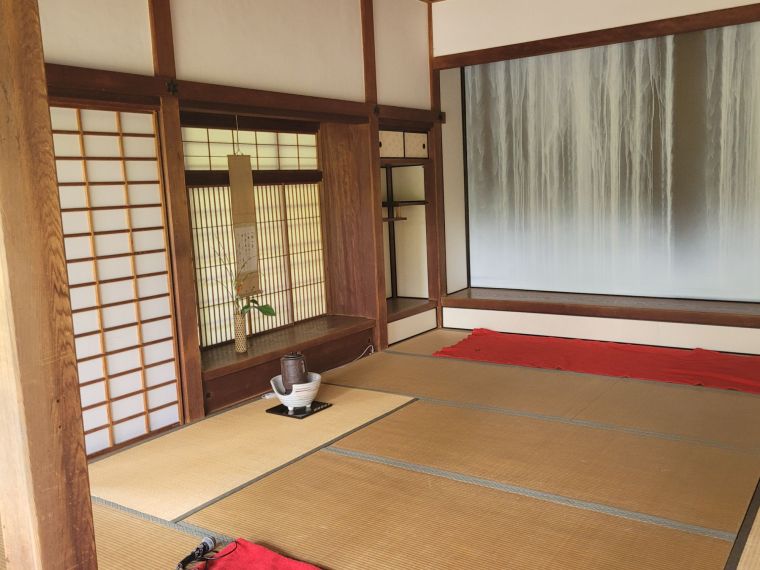
Men and women in kimonos graciously answered questions about the house and pointed out its secrets. They informed us that the murals of the house were donated by an artist in 2007 and were inspired by the waterfalls. They told us about the hinoki bark root (the only one outside of Japan) and how it took 1.4 million dollars to repair it back in 1999. They were excellent hosts whose presence engendered a sort of respectful quiet in the guests. It is not that we did not speak, only more in hushed whispers as to not disturb the peaceful atmosphere. It is a house that invites calm reflection and relaxation rather than exuberant outbursts. 

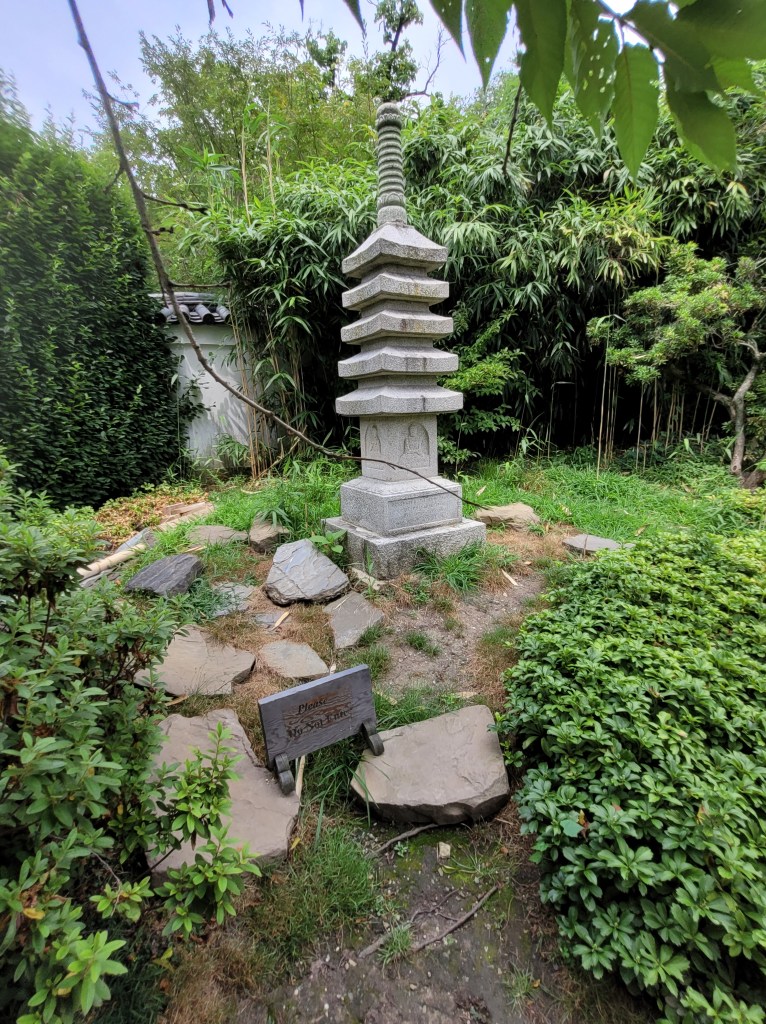
In the heat of the summer, my sister and I explored the small garden which encircles the house. We took a moment to pause by the Buddha statue, littered with small offerings and tucked away among the bamboo. We sat in quiet reflection watching the lazy circles of the koi fish which were only interrupted when a tourist decided to feed them. The noise of the nearby city melted away and one could almost believe that we had stepped through a portal to the other side of the world. 

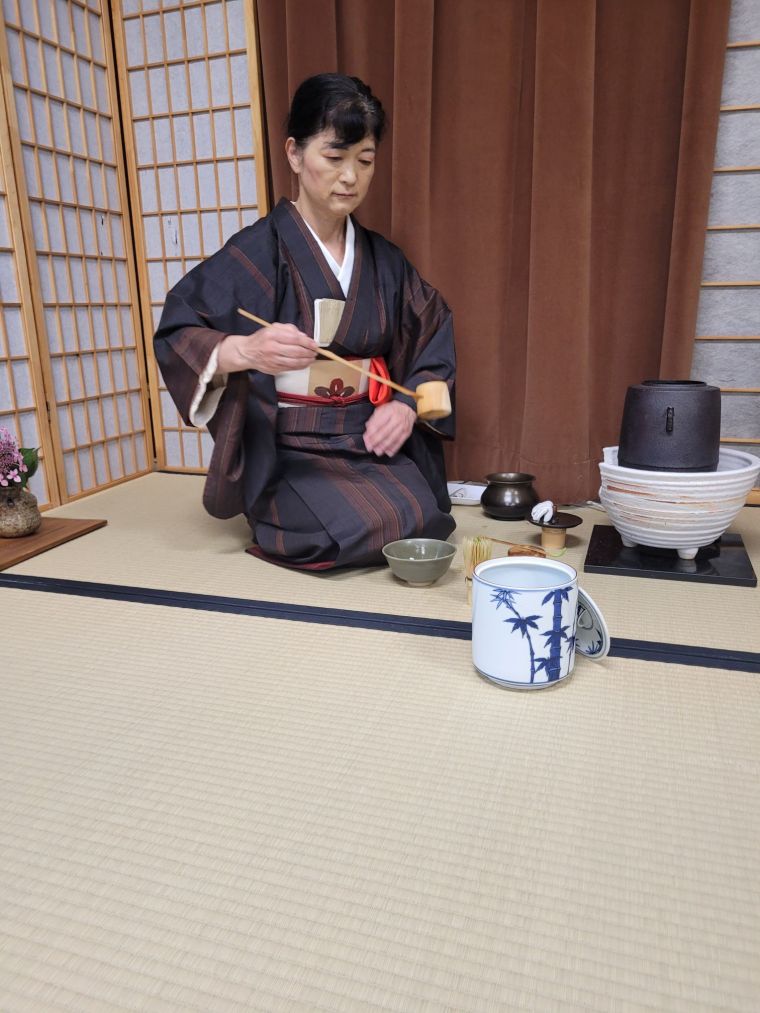
Soon we were invited to sit for tea. A woman dressed in a beautiful kimono came out to prepare the tea for us. While she began to prepare the tea. The male host graciously explained the “ceremony” as not a ceremony but more a set of expectations of manners that one should adhere to when invited to a formal tea in Japan. I suppose in truth, it was no more a “ceremony” than a proper English tea though perhaps the rules were a bit more structured to give the illusion of ceremony or ritual. One could make arguments either way – but he was speaking as a Japanese person and he indicated that it wasn’t a ceremony persay, so I am going to believe him as the expert in his own culture. 

We were instructed that we would be expected to admire the carefully chosen decorations such as the scroll. He explained the symbolism of the arrangement of the flower. As the woman began to prepare the tea he explained the different instruments and tools that she was using the small white cloth, the bamboo whisk, the scoop, tea powder and the metal pot to heat the water. 

First, the hostess brings in all the tools necessary for the tea preparation and then begins cleansing the utensils. Then she carefully places in the powder and hot water into the cup and whisks it expertly into a perfectly foamed tea. The cups of tea were passed around to the various guests and our male host continued his lesson. 

We were instructed in how to pick up our cups, turn it the proper 90 degrees and to take slow sips. He explained that we would be expected to admire the craftsmanship of the cups and to express appreciation for everything the host had done for us.

The tea made from the matcha powder had almost a soft, velvety texture in my mouth. It was a bit more potent than a typical green tea, but lacked the harsh bitterness that the black teas can have. Despite the heat of the day the hot tea was refreshing. I enjoyed the texture of the cup in my hand and took in the smell of the tea. 

We were also given a sweet to enjoy along with the tea. I felt quite terrible as the host had gone through great trouble to prepare the sweets and it had a jello like substance to it. Unfortunately, I have a sensory issue with jello as it makes me gag. I graciously accepted it and forced it down as I did not wish to offend her by refusing. However, I may still have offended her with my face. It did taste delicious, it was the texture of the jello that made it difficult to swallow. 

Despite my potential faux-pas, it was a delightful time and dream come true and the following year, I was surprised to find myself once again at a Japanese Tea Ceremony. This time armed with previous knowledge and in a more intimate though less peaceful setting. 

Each year, there is an annual tea festival in my state. As previously stated, I am a bit obsessed with tea. Together my sister, myself and my mom journeyed to a small town only an hour and a half away from home to a cozy tea shop tucked away along the main street. Behind the unassuming little tea house is a beautiful hidden garden which is where the highlights of the festival take place. Unfortunately for us, the day was quite wet, necessitating for much of the festival to be moved to the inside of a nearby church. This meant that the church basement was crowded, loud and somewhat uncomfortable. 

So it may surprise you to hear that within the noise and the crowd, I stumbled across an oasis of peace and zen, a small tea ceremony. A woman sat on the stage, her small tea house set up and invited you to sit. My sister and I eagerly took our seats in anticipation having so thoroughly enjoyed our last tea ceremony and my mother followed close behind. With a small polite bow and a tiny smile tugging on the woman’s lips, the ceremony began. Do not ask me what magic spell the woman wove, I only know that under her expert care, the crowd disappeared from my mind. For a small window of time, we were transported out of the world and into a quiet pocket of serenity. We took our time sipping the tea and making conversation. As expected, my sister and I expressed admiration for the cups and remarked on her beautiful display. We enjoyed the sweet treat offered (thankfully nothing gelatin, so I did not have to repeat my unfortunate behavior of last time!) We complimented her and thanked her for her time and consideration both verbally and with a small donation to help support the tea house in Philadelphia. All too soon, we found ourselves back in the crowded basement, but I shall always remember the spell that such skill can weave. That is after all part of the point of the tea ceremony, to approach the act of drinking tea with a mindfulness; to transform the mundane into an extraordinary art that allows the participants to enter into a calm space. Tea, dear reader, really can be magic. 

How can you participate in a tea ceremony?

If you live within a reasonable distance to Philadelphia, then you can buy tickets to the Shofu Teahouse and for an additional cost, participate in their tea ceremony. You can also check out the PA Tea Festival as the teahouse typically sends a representative to perform small ceremonies for the guests of the festival. 

If not, then google is as always, your friend. See if there are any Japanese cultural clubs or organizations in your area. They may offer classes or demonstrations to the public.

A word of caution, do not join a cultural organization only to check off something off your list; someone else’s culture is not your personal playground. As with any cross-cultural experience it should be done with genuine curiosity and humility. The tea ceremonies I attended were extended by invitation to the general public. I did my best to participate with respect and to be a student of their culture.   

The Long Haul 

We live in a right now world. We have amazon next day delivery. We have Netflix to stream movies directly to us. We can download our videogames off steam. Instantly find the answer using google. There are few things in life that we have to wait for which fuels our desire for instant gratification. Even a lot of our bucket list items are intended for an afternoon or a week. We spent the week backpacking through a European country, cross it off the list. It may have required some forethought and planning, but it was still done relatively quickly. But what about those things that require a long time, like learning a language or losing a lot weight? How about mastering a skill like blacksmithing or an instrument?

Learn German in 90 days! As someone who took it for 8 years of her life and spent 5 months in the country speaking it, the book is a failure. It wasn’t even useful as a review of the language after not speaking it for nearly 10 years. Get massive biceps gains in just one day with this crazy method! I had nothing to lose but a day, my biceps were sore. They did not grow massively, I assure you. Fad diets and diet pills are probably the worst of these items because not only do they not work in the long run, they can be incredibly damaging. They do not help you keep the weight off and may impact your health in the long term to make managing weight even more difficult than before. 

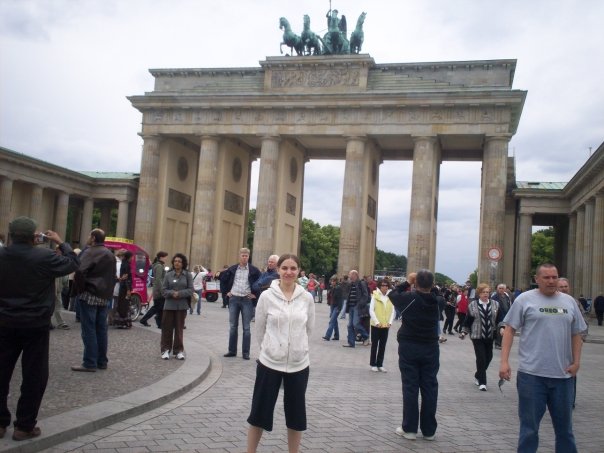
At the Brandenburg Gate in Berlin. Learning German wasn’t done in a day, but years.

Some of our goals and experiences are going to be things we have to do for the long haul. You want to learn a skill and not just try a skill, you’re going to have to put in the time, effort and sometimes expense to do so. I could do the free version of duolingo but after 5 mistakes, I would either have to wait hours for the hearts to recharge or purchase more hearts. I may as well pay for the monthly plan to help me achieve my language learning goals as I am reviewing German and learning Spanish. I’ve been at it for almost a year now and my German is almost back to where it was at the end of college, and my Spanish is still very basic. Granted, I only spend about 15 minutes a day on either language so because I don’t put in my time, my results aren’t as fast.

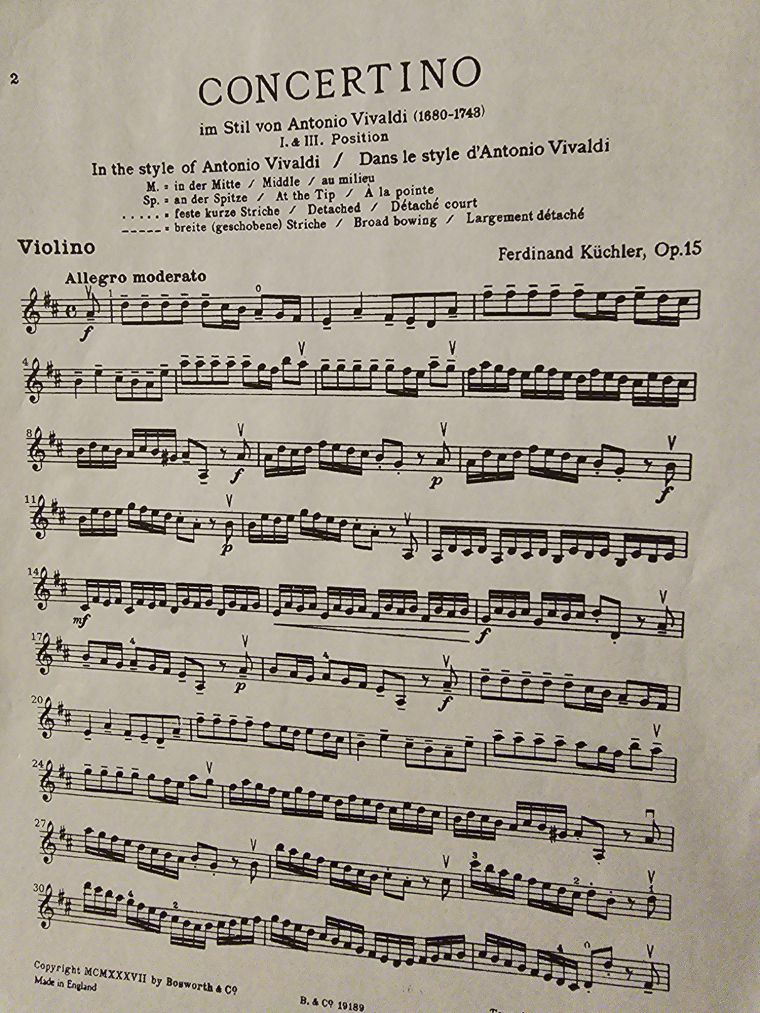
If I truly wanted to learn how to forge weapons, I would need to go weekly to the forge, buy my own steel and work hard to develop the skills necessary to make beautiful weapons. Heck if I really wanted to learn how to do it, I would learn smelting as well to master the entire process. Not only would this require time, it would require me to sacrifice other things as well. One can either be a jack of all trades or a master of one. If I spent my time at the forge, I probably wouldn’t have time to devote to my violin. My choosing the violin, I am saying no to many other activities that might fill my time. I’m not drawing or taking photographs. I’m not learning computer programming. Pursuits that I have at times toyed with but ultimately did not devote myself to. 

Sometimes we dabble in things, we may for instance take a six of twelve week course in photography or ceramics. We may take a single lesson in glassblowing or falconry. We know that these things will not confer onto us any modicum of true skill, but the taste is enough to satisfy. These are another form of “good enough” which I discussed in another post. 

However, for something we truly want to master. It requires something we have seemingly precious little of, time. One cannot become fluent in a language with a workshop or a twelve week class. It took me nearly eight years to become conversational in German and that was with semi-daily practice as I took it in both High School and college. It became quite stagnant with disuse. For one to be able to say one is fluent in a language it requires daily practice and use or else the most you will be able to say is that at one time you were fluent, but no longer. Oh it comes back quickly enough when you’re thrown in a situation requiring the language, but you are clumsy and stupid with it, the rules have gotten all muddled up in your brain and really why did the ancients insist on such an obtuse grammatical rule as changing the article based on the case? Why can’t the German “the” be, “Der, die, das, den, dem, or des”?

Taking a glass blowing class: To become proficient would takes weeks, to master would take years.

I encourage you to be judicious with the things you pick and not to overindulge in your ideas of what could be. I devote myself to just a few daily pursuits because frankly, I am a busy person. I haven’t the time to do much else. I have carefully chosen a few things that I want to do well that speak to me personally more than other activities and rarely skip on doing them. Attempting to cram in more items would mean not doing any of them all that well and I may as well not bother with more than the occasional workshop or short course on the subject. 

Now dear reader, you will not be able to become a multilingual, black belt in karate, computer engineer, doctor, guitar player, chess grandmaster, and astronaut, not unless you suddenly come into a lot of wealth and find yourself with both the time, discipline, coaches and tutors to achieve such a thing. Even then I would imagine, it would take a good ten years or so to achieve any of that. If you are not willing to put in the time and effort, it would be best to eliminate the mastery of the thing and go with simply trying the thing instead. There is nothing wrong with that and no shame in the decision. Some people are meant to be jacks-of-all-trades and masters-of-none and there are those who are meant to master one thing and be amazing at it. This is what you must consider dear reader. There are things that you want to accomplish that will not be done on a weekend or in two or three months. They may be life long pursuits that require daily practice to truly achieve the things you want to achieve with them. They will require you to give up other items in order to make room for them. By all means pick that which gives you joy and makes your heart sing. The journey will be long, frustrating and trying, but the reward will be sweet. 

Learn an Instrument: Rediscovering a Passion

One of the definitive moments in my life is sitting on the couch staring at my mother’s boombox in absolute rapture as Pacabel’s Canon in D played. I was in love. It was without a doubt one of the most beautiful things I had ever heard, the violin. It was not simply an instrument, oh no, this was the very voice of my being. If I lose my ability to speak, let me only speak in notes and songs. If someone gave me a choice between becoming deaf or blind, I would pick blindness every time, do not deny me music, it is the very sustenance of my soul. 

I unfortunately would have to wait several years before being offered the opportunity to play, but in 3rd grade our school offered us music lessons. I was absolutely elated to be able to pick the violin. I would have no other instruments. But oh, how I struggled to master it. The violin is a very easy instrument in principle. After all, how hard can it be? You have four strings, you press down your fingers to shorten said strings in order to achieve the different notes and to produce the sound you move a bow across. Other instruments require learning combinations of key presses to produce the sounds and controlling your breath to go up and down octaves. Surely those are much harder to master. 

It is in fact considered one of the most difficult instruments to learn. In part because it is such an easy thing in principle it lends itself to having a wide variety of producible sounds and variations of intonation. Additionally, it has no guides; each note (with exception of the open strings) must be produced flawlessly with little more than muscle memory and your ear to guide you as you slide your hand up and down the neck of the violin.  The spacing between your fingers varies depending on the “position” you’re in, the higher the position the closer you must space your fingers to produce the correct notes in tune. You are constantly adjusting with little more than a prayer. 

There are no words to describe the thrill of playing with mastery, effortlessly hitting the notes, cheekily moving your bow in just the right way to go from quiet to loud, hitting the bow catch to enhance the power behind the stroke, connecting the notes together in a slur or punctuating them with a staccato. The violin may be one of the most challenging, but it is also one of the most rewarding because it allows you to have so much expression and creativity with the interpretation of a piece of music. 

This isn’t to knock other instruments or to write a post about the superiority of one instrument over the other. For me, the violin is the best instrument it speaks to me in a way no other instrument or creative expression can. Which is really what this bucket list item is for me. It’s about utilizing the violin to express myself in an entirely new way. Playing is a simple joy. 

My collection of intermediate pieces that I have chosen to master over the next year or so

Sadly this was not always the case. I loved the violin and my parents knew this, so they encouraged me to pursue a potential music career. For reasons, I will not fully explain; I ended up with PTSD and unfortunately a secondary anxiety disorder. This greatly negatively impacted my ability to play. From a psychological perspective, my voice was silenced. I tried to hold on to it but the more I fought to keep my voice the worse it got and the worse my playing got. After high school, having failed my auditions for acceptance into a music program, I put the violin away. I kept telling myself that it was only temporary and I would practice again soon. It wasn’t until nearly 17 years later that I picked it back up again. 

I can’t say exactly what makes it different this time, only that I am playing 100% for myself. It isn’t to perform or to achieve anything. It was remembering why I loved playing in the first place, to reclaim that joy rather than focusing on achievement. Not having that pressure to compete has made going back to music like falling in love all over again. I think sometimes when we start to push ourselves into making our passions a profession or career or business it robs us of that joy. I probably wouldn’t have lost my music for 17 years if my violin playing had only been for joy as it is now. Granted the PTSD and secondary anxiety didn’t help but I wouldn’t have felt anxious about my playing if the playing had only been for its own sake and not my entire future. 

I cannot describe in words what it feels like to play now. Only that it feels like coming home. I approach it with a child’s enthusiasm and uncritical spirit. Mistakes are not a death sentence but a whimsical learning opportunity. I don’t mind people listening to my practice sessions, let them listen! I am in my own world once my boy hits the strings and I am in love with the violin once again. I almost never go a day without playing. It sustains me as much as food or water. A life without music was a life without color.  

Revisiting a piece I had mastered in middle school.

 I could have checked off “learn and instrument” from my reverse bucket list and continued to allow my violin to languish in the closet, but I didn’t because this wasn’t about learning to play an instrument, it was about rediscovering something that was lost and reclaiming it as my own. I wonder dear reader what creative outlets have you lost over the years? What passions have lain fallow under the guise of failure and self-doubt? What have you stopped doing because you weren’t “good enough”? What might happen if you picked it back up again? Would you rediscover a childlike wonder? Would you find yourself itching to get back to it after work? Would you find yourself refreshed in a way you haven’t been in a long time, like a desert after a rainstorm? Remember this isn’t to “turn your passion into a career”, so often that mindset was the very thing that turned you off your passion to begin with. Dear reader, you need not justify all that you do, sometimes you just love something; it brings you joy and that is the only justification that you need to pursue it 

How can you rekindle your lost passions?

If you’re like me, you may find your instrument hidden away in a closet somewhere only in need of a little TLC to get started once again. Perhaps, it requires a trip to the art store. Maybe you need to reach out to an intramural sports team.  Whatever it is, chances are you already know how to get back into it,  you just need to take the steps to do it. Even something like dance can be done by just clearing a little space in a room. After several months of play, I invested in new strings. After several more months, I am in search of a violin teacher to help coach me further.

Good Enough

There are many experiences that absolutely require “authenticity”. They require the larger cultural context of a given region, country, ethnicity, culture, etc. to be the genuine item. There are many others that don’t require much more than themselves. These are the “good enough” items that clear the bar of the Bucket List without the rest of trappings of a given thing (often those trappings require you to hop on a plane and go to a different country). 

I often work backwards to my “good enoughs”. I may find myself dreaming of going to Japan. I may picture walking through a traditional Japanese house, enjoying a tea ceremony, taking in a Japanese garden, visiting one of their Buddhist temples, strolling through the bamboo, seeing the cherry blossoms, eating their street food, and seeing demonstrations of their weaponry and armor. Upon reflection, I realized I could do almost all of these things here in America. I was able to go to the Japanese Gardens with the tea house and enjoy a tea ceremony. I went down to the annual cherry blossom festival in D.C. and enjoyed street food, weapons demonstrations, music, fashion and more. These are my “good enoughs”. I didn’t need to go to Japan in order to say that I experienced the genuine item, because I found them here.

By thinking about a given Bucket List place and considering what I wanted to get out of a trip there, I was able to then build up a list of things to find nearby. I really want to see the lavender fields in France. I found a lavender field within driving distance to go visit, the same with the sunflower fields of Italy and grape stomping. Some things may be more accessible than you might imagine. I have been consistently surprised at what’s in my own backyard and what I could potentially do.

What makes a genuine item, “genuine”? It is often up to our own ideas and definitions. There may be people who say that unless I strolled through the crowded streets of Tokyo and ordered a ramen bowl from a street vendor in Japanese, I didn’t have the real Japanese experience. Perhaps, but I tend to feel that such a view comes from self-important snobs trying to aggrandize their own experiences at the expense of trying to cheapen the experiences of others. Don’t fall for the lie that the only “genuine”, “authentic” thing has to be done in the context of the “homeland” or that the necessary cultural context to appreciate them can only be achieved in a certain location. 

When visiting the rainforest in Costa Rica, they took us into a butterfly house. The butterfly house in Hershey is just as lovely and just as amazing. Unless you are a butterfly expert, you aren’t going to notice that the ones in Hershey, PA are a mix of various tropical butterflies vs. the 100% butterflies exclusively from Costa Rica and frankly, does it matter? Don’t let your friend who is a butterfly expert ruin it for you by telling you how this species would just never be seen in the wild with this other species. It was still amazing to see the butterfly house in the rainforest, but I could have skipped the butterfly house and been perfectly fine. I did go on a small hike through the rainforest after the butterfly house to see a waterfall. For me hiking through the rainforest isn’t something that can be re-created in America. For someone else, maybe the fake rainforest at Disney World is good enough. 

It is up to you to make the decision about what constitutes as “good enough”. If it met the desired outcome of what you wanted then it is good enough and no one gets to decide what that is other than you. You are a unique individual with unique reasons for wanting to have an item on your list. What might be good enough for you isn’t good enough for someone else, but they don’t get to dictate that to you and you don’t get to dictate that to them. 

I have had a tea ceremony at the Japanese Gardens and also in the crowded, noisy basement of a church during a tea festival. Surprisingly, I enjoyed the second more because it was a more intimate affair. It speaks to her skill as a hostess that I do not really remember the crowd or the noise, only the calm and meditative nature of the ceremony. She created a space of serenity among chaos. The noise seemed to melt away as we conversed and made light conversation. I can still taste the tea on my tongue even now. Given that if I did go to Japan and schedule a tea ceremony to achieve the same level of intimacy I would have to pay a fairly high premium. For me, that is good enough and if/when I go to Japan a tea ceremony isn’t something that is going to be on my must do list. That isn’t to say I wouldn’t do one, just it’s not on my list of musts and can be sacrificed to allow me to do something else. 

In fact after meeting so many “good enough”s you may find that certain places begin to lose their appeal. For example, I have been to so many museums with egyptian artifacts that honestly, Egypt isn’t that high on my list of places to go. I would rather see the Mayan pyramids to see pyramids. When I was younger, I had a much stronger desire to see Egypt because what I really wanted to see was the artifacts. However, despite checking off so many things on my Japan list, I still want to go to Japan. For some places, my good enoughs have only enhanced my desire to go whereas for others the desire has decreased.