
A Purposeful Life: The Calling

In my last post, I referenced how living one’s best life is in part living a life with purpose or a life in which one applies ones talents in support of a calling to serve others. I went on to wax poetic about the first of three parts, mostly about talents and how to cultivate them. In this post, I shall attempt to unpack the second part of that statement, mainly one’s calling. This is probably the trickiest part of the whole thing. The first part is rather simple, just consider your interests and start to develop them, they’ll become skills and later talents. Yes, there is a certain difficulty in the discipline required to do that, but in general one is not sitting around with no idea of what one’s own interests are. The third part is also fairly easy, find other people, utilize said skills/talents to assist them. 

So what is a calling? How would we even know what it looks like? What does it mean? I am no philosopher and certainly lack the wisdom of the sages to give a definitive answer. Still, if one seeks enlightenment then one must learn to wrestle with such questions and start to consider the answers for oneself and not merely rely on the elders who have come before to answer for us. We are not here to merely echo the philosophers that came before otherwise we would have been satisfied with the answers of Plato and Socretes and Descartes and Vonnegut would have needed to occupy themselves with other diversions. So that is what I shall do here and perhaps, dear reader, you shall wrestle with this question yourself. I certainly hope so, otherwise how shall I become wiser if no one challenges me – I digress. 

So first what is a calling? Often people will feel a strong desire towards a certain profession or job that feels fulfilling. Passion + meaning = calling. However, I question the idea that it should be connected with a particular profession. At risk of coming off conceited or judgemental, I doubt that most people would consider being a garbage man or grocery work a calling. Do not mistake, dear reader, the statement for condescension. It takes little stretch of the imagination to see how vital these roles are, but our society does not hold such roles in high regards despite their inherent importance. When the pandemic shut down much of the world, it was not the garbage collectors and grocery workers who stayed home. Yet, I doubt that many of those in those positions would say that such a profession is their calling even though these are vital to the functioning of society.  Those jobs are meaningful in that they help others, but few people are passionate about them. 
Photo by shajahan shaan on Pexels.com

Contrarywise, many people in higher paying and higher status jobs lack both passion and meaning. They may push papers around a desk, crunch numbers and complete tasks for the corporate overlords. Many may not even really understand why their position is vital to the company, some may even struggle to articulate what precisely they do when their friends and families ask. If their job disappeared tomorrow would it have a negative impact on society? Would others miss it? Would they even notice it’s passing? When mass layoffs occurred in the tech sector, were many of us concerned about it? Did any of us outside the industry truly worry that vital goods and services would be disrupted? That isn’t to diminish the pain of those who were part of that, it is merely to illustrate that those jobs most likely do not have much meaning associated with them as it requires the stretch of the imagination to consider how they are all that helpful to society as a whole. 

 In fact, there’s an anthropologist who theorizes that up to 40% of our jobs are “bullshit” jobs or a job that is so completely pointless, unnecessary, the person doing it can’t justify its existence. These are jobs usually taken up by meetings and emails and are so bogged down in paperwork that one is left wondering if you’re doing anything other than existing. Elon Musk fired 90% of people at twitter and it had almost zero impact on the service it provided. Do you see the danger in tying a calling to one’s profession? These jobs are still important, some are quite meaningful if not readily recognized and others lack passion and meaning are nonetheless important in other ways. I won’t go too far down the rabbit trail of the sheer amount of job bloat in corporate America. It is only that there are very few professions that will allow a person to pursue a passion and have meaning. 

For most of human history, one’s profession was the way to keep a roof overhead, food in one’s stomach and clothes on one’s back. It truly wasn’t until much more recently that we started hearing the message that we should follow our dreams and surely good things would follow. Most of my generation grew up on stories admonishing us that happiness was to be found in pursuing jobs that were our “calling” and the reality came crashing down on us. While others may waggle their fingers at us for pursuing “underwater basket weaving” as majors, who was it that told us we not only could by offering it to us in the first place as a legitimate major but encouraged us that we should do it from our earliest years? I know I certainly grew up on stories that one should follow one’s passions as the path to happiness. A lovely notion perhaps for a different time. 

Photo by Pixabay on Pexels.com

As with many ideals our society pushes, we must free ourselves of the shackles that bind us to them. Our calling need not be our job – a good thing too, considering the constraints upon us otherwise. That isn’t to say that one cannot find a profession that exactly matches one’s calling, simply that it isn’t necessary. Your job does not have to be your calling or even your passion. It’s nice when that happens and there are a few lucky people who “never have to work” because they love what they do so much. If you are one of them, I raise a glass to your good fortune friend! However, there will always be people who are needed to complete the passionless work – whether that be the necessary paper pushing bureaucrats who shuffle the necessary government forms about or the oil rig workers who risk life and limb to ensure we have the necessary fuel for our modern world. It is a rare person indeed who finds either one of those to be their passion. 

Now that we’ve dispensed, such a silly notion that our calling must directly lead to our job, we discover that there is in fact quite a wide range of things we could do in those hours not spent on the job. Your job could help fund your passion or otherwise help connect you with the right resources be they monetary or social to pursue them. So long as whatever you do arises from things that you are truly passionate about and works towards the benefit of others. Perhaps, you have a strong talent for sports and take up coaching youth soccer in your hometown. Perhaps, you have strong feelings about conservation and turn your efforts to going to your town meetings to make your voice heard or you go around collecting signatures on a petition. 

You may not even quite know yet how to figure out which one of your many passions to pursue. There are a myriad of things to be passionate about, music, art, sports, politics, the environment, trees, air quality, public health, homelessness, the law, philosophy, teaching, psychology, and well, pretty much anything in existence. I am rather passionate about cats myself, but are they my calling? I have adopted several of them and care for them, they certainly enrich my life, but I don’t know that I’d call it a calling. I don’t feel called to be a pet parent. I merely enjoy being one. A calling is the match of your deepest passions and beliefs with the deep needs of the world around you. 

It can take many years to discover one’s true calling or path and one must be willing to pivot with new information. Most people simply do not have the necessary introspection or knowledge base at 18 or 19 to decide what their calling truly is. Most have some inkling of interests if no actual skill set or talent and they certainly don’t know enough to be truly passionate about anything. If you, dear reader, are of the younger sort, put down your pitch fork before you angrily respond to the above statement in the comments. There is simply far too much to know about the world in order for you not to go down some well-meaning and perhaps misguided path. There is some evidence to suggest that you don’t really have a good idea of your true calling until you’re about 40 years old. Which is honestly a bit of a relief for those of us who are younger than that. You may dear reader, be breathing a sigh of relief – “Oh good, I’m not supposed to have it figured out yet”. Perhaps, I really am meant to open up that cat cafe and spending my days with my feline friends is actually my calling after all! 

Photo by Pixabay on Pexels.com

I encourage you dear reader to take some time to journal and explore your passions. Think about the things you used to enjoy or were once interested in before the world got in the way and told you it was dumb or not valuable. Perhaps, your calling lurks in there. Consider what you enjoyed when you were quite small. Think about your heroes and people you really admired. I find that a lot of good things comes from journaling, especially when you let go and just let the thoughts come forth. It’s like your subconscious builds a bridge to your unconscious and everything just sort of flows out. You may be quite shocked at what you put to page once you let it go. 

The key is not to let whatever you think your calling is become part of your ego. Don’t get too attached to any one path or idea because it will change and evolve. After all, I just said that one’s job is probably not one’s calling. Money is necessary to do things like eat and have a roof over your head. And the expression of ones calling can take many forms. A person whose calling is working with the youth may become a teacher, a coach, a youth pastor, a therapist who specializes in children, a volunteer for big brothers, big sisters, a mentor, a foster parent or something else not listed here. However, if one is too stuck on a singular idea or path you may miss the boat entirely. If you think that you must be a teacher because you feel called to prepare the next generation and you objectively suck at teaching larger groups of students, you will be miserable and your students won’t get your gifting. If you instead volunteer for big brothers, big sisters after becoming an accountant, you will find that your gift is working as a mentor for disadvantaged youth and perhaps tutoring them in math thus helping shape their futures in a much more meaningful and powerful way. 

I’m not exactly sure if this post is all that useful, since finding one’s calling is rather tricky. I only hope that I have helped dispel some of the misconceptions that people have around their calling to help free you to be a bit more creative and open to the possibilities of how it might manifest itself. Truth be told, I’m still working out exactly what my calling is, but I keep getting closer with each trial and error that I make and with each new experience that I have. After all, part of my bucket list is to help me explore and get to know myself better. 

A Purposeful Life: Practice Becoming

I’ve written earlier about how living one’s best life is in part living a life with purpose. It was truthfully a small paragraph at the end of another post which mostly amounted to applying your talents in support of your calling to serve others in some nebulous manner. A trite piece of advice which commits to almost nothing and leaves you saying “yes, yes, very nice, but how exactly is one supposed to do that?!” An understandable response, dear reader. I beg your indulgence as I did not wish to make a long winded post. 

There are some clues in my nebulous statement. The first is understanding and cultivating your talents. The second is understanding your calling, which is probably the trickiest part and the “meat” of this series of posts. The third is service to others. Which can honestly range from your next door neighbors to strangers on the other side of the globe. 

Depending on your level of self-esteem, finding and cultivating your talents may be as easy as taking a walk or as difficult as learning to do a 360 flip on a snowboard. Although, those with an inflated sense of self may find reality is a cruel teacher when faced with the truth that one is not as “smart” and “talented” as one first believed. When reality inevitably smacks one in the face, there can be an understandable re-examining. This can lead to questions of whether one really has a talent worthy of cultivating and the temptation to “throw in the towel” or “give up” may soon creep in. It may be better to replace the idea of talents with skills or interests. These may be less daunting to consider and our egos are not as tied up in a skill or interest allowing us to be more honest in our current abilities.

Given that most of the population is on a bell curve for almost any given trait, the best most of us can hope for is slightly above average, maybe, if we are quite lucky, gifted in a certain area. For those of you unfamiliar with the actual definition of gifted when discussing the overall population, it means that a person is above 84% of the population in a given ability. I can assure you dear reader that neither yourself nor me shall find ourselves in that coveted 26%. To be a true “genius”, one must be greater than 98% of the population. Can you truly say, dear reader, that you are better than nearly 8 billion people in anything?

Photo by Shelagh Murphy on Pexels.com

Now the pessimistic reader will most likely be throwing up their hands in defeat at these facts. If one cannot expect greatness why even bother? Should we not leave such things to those who are our betters? Let those with the gifts toil away and leave the rest of us to our petty amusements. If you are one of those, do not despair just yet!  As most people are not innately talented in any given area we can free ourselves of a false assumption that people are talented because they are born that way or that we cannot better ourselves. However, talent is often just a skill or interest that someone has built upon with consistent practice and coaching. It is not a matter of “having it or not”, it is more a matter that you are born with inclinations towards certain skills or interests and then in building upon those they become talents.

One does not need to be a child prodigy or the world’s “best whatever” to use talents for a calling. The world famous violinist Joshua Bell is not described as a child prodigy. In fact, he is considered rather unremarkable until his natural inclination towards music was cultivated by his parents and then his teachers when he was an older child. Nor was it the goal for him to become a prodigy of sorts, instead his parents simply wanted him to enjoy the instrument. He became what he is through dedicated practice and excellent coaching. Having access to world class teachers, he became a world class violinist thus shattering any notion that unless a person begins before the age of 5 one can never achieve the greatest heights. 

Now, this doesn’t mean that one should expect that you will achieve the greatest heights in any given field or area. The higher one goes the less and less opportunities there are for advancement that is the way of things. Competition becomes more fierce as the field narrows. So focusing overly much on climbing a ladder of sorts is probably not the best use of your time and consideration. The aforementioned example was more to illustrate that one need not begin in early childhood to start cultivating a skill or talent and that you can, through hardwork and dedication, achieve a true talent. Remember the cultivation of the skill is part of the purposeful life not the end of itself. 

Not every interest and skill needs to lead to the highest heights. Not every hobby must become a fortune 500 business, not every skill must yield profit. Cannot a thing be simply for yourself? It is nice when one’s talents and purposes yield income, but it is not necessary. There is something in us as humans that longs to simply be – a drive towards something. It may be the creation of art or music; it may be a connection to nature through hiking or fishing; it may be the thrill of pushing yourself physically through a sport. It needs no audience other than ourselves. In the words of Kurt Vonnegurt, “Practice any art, music, singing, dancing, acting, drawing, painting, sculpting, poetry, fiction, essays, reportage, no matter how well or badly, not to get money and fame, but to experience becoming, to find out what’s inside you, to make your soul grow.” 

So how do we make room for our souls to grow? My general rule of thumb is 10-15 minutes a day. After all, finding an hour or even 30 minutes every day can be challenging. However, it’s almost impossible not to find a spare 10-15 minutes laying around. You certainly scroll on your phone for longer than that here and there in those awkward in between moments where you don’t quite have enough time for longer activities like when you’re waiting on water to boil or you’ve got a few minutes in the morning after you’re done getting ready. Besides, there’s almost certainly some sort of app that you can put on your phone which will allow you to focus on that interest. Perhaps, you can utilize your morning commute to listen to a podcast or audiobook about your given interest area. Maybe you can enroll in an online course, or read textbooks on your phone. Replace your phone habit with your interests and suddenly, you’ve started to develop a talent. 

Photo by Kelvin Siqueira on Pexels.com

What’s interesting is that oftentimes, I may start a given activity under my “10-15 minute rule” and soon discover that I have spent 20 to 40 minutes on it. Sometimes it’s difficult to muster up the mental energy to do something for 60 minutes or even 30, but once you get going it’s easy to keep going. Just as objects that once in motion stay in motion, so too do we. However, given my busy schedule, there are just as many days where it’s all I can do to find the 10 minutes. Still, by keeping with the 10-15 minutes every day, I stay in the habit of making time to do the interests I actually want to develop. This way the habits don’t slip away among the busyness of life. Sometimes, you have a period of days where it’s all you can do to go to work, make dinner, clean up the house and take care of the basics. It can be so easy to let your good habits slip and let doom scrolling or other distractions take over if you’re trying for those longer stretches of time every day as opposed to those “stolen” in between moments. 

Soon, those interests start to muscle in on the parts of your day that aren’t dedicated to other things. It becomes your way of relaxing and instead of reaching for the TV remote you find yourself locking yourself away to be with that thing. There are certainly days when I spend a considerable amount of time playing the violin and have even found myself getting irritated if I haven’t been able to play. It has become part of my self-care routine as important as any other form of relaxation. I cannot tell you the last time I binged watched a show. My time has been consumed by other interests that I am actively trying to develop. Scrolling on my phone has been replaced with learning languages, practicing calligraphy and reading. That isn’t to say I look down my nose at people who watch shows or scroll, I still do those things along with playing video games. It’s that those things are no longer my first “go-to” activities because I’m now focused on skills that I want to improve. 

I’m not entirely sure what I am “becoming” just yet. However, I do know that by spending time each day on those things I feel more myself than I have before. What might your own interests yield if given the opportunity to grow? 

What is Work Life Balance? Setting Boundaries

With the age of the internet and cell-phones work has managed to invade almost every aspect of our lives. People have stopped talking about work-life balance and talk about things like blending work and life together. Which is really short hand to say, having no boundaries with work and work being able to take precedence in your everyday life. It has even begun to take over things like people’s vacations. 

In countries like France, they’ve adopted the right to disconnect meaning your work may not send you emails after work hours. Some companies have a system in place where if you’re on PTO any email is automatically responded to with “this person is on vacation and your email has been deleted, please reach out to this other team member”. I LOVE these. We should work to live, not live to work. Setting appropriate boundaries with work and holding to them is both difficult and extremely rewarding. 

No wonder we dream of packing up and leaving our homes. Our homes are no longer sanctuaries from work. Instead it follows us to the door, hounding us with phone calls and emails. Sometimes seemingly frantic demands during your off hours. I’m going to hazard a guess that you dear reader are not in the medical profession and therefore are not tasked with the life and death of others. This means that since no one is going to die if you don’t answer that email at 9 pm, maybe it can wait until 8 am. What objectively are  you going to accomplish at 9 pm that cannot be done at 8 am? It will probably take you twice as long to accomplish it late at night than in the morning, when you’re awake and refreshed, especially when adding in the inevitable and natural human response of grumbling to yourself and emotionally having to process this unwanted demand on your private time. 

Rest is important to our functioning, our physical health, our mental well-being, our emotional wellness and spiritual wellness. Paradoxically, when we’re allowed to rest our work performance and output increases rather than decreases. Unfortunately, companies fail to understand that thinking they can just continue to push us to get more results.When we keep work at work and home at home, it allows us to thrive in both places. Once we start blending the two, it can be hard to perform well at either. You find yourself torn in two trying to constantly please two masters. You allow work to encroach on your life so you don’t meet the obligations of the home so then home may start to encroach on your work. It feeds anxieties, worries and distractions. You start to need more and more time to talk out your emotions and process which only robs you of more precious moments and gets you further behind. Just writing this makes me want to scream in frustration. How is anyone supposed to thrive let alone survive in such conditions?  

If you are hourly, you’re probably not tracking this time and ensuring you’re getting reimbursed. If you are, you’re likely getting push back for it. If you’re salaried you have to consider that every hour you work extra is time you aren’t getting back and you aren’t getting paid for, thus lowering your hourly salary. Consider working for 50,000 a year. At 40 hours a week that’s about $24 an hour. If you consistently work closer to 50, you’re now lowering your rate to $19. Would you really do all that you’re doing for $19 an hour? Because you are. By working so many extra hours, your company is essentially robbing you. Even just 1 hour each evening still adds up to 5 extra hours a week or $21 an hour. You’re allowing them to undervalue you and it also means they will continue to not hire the help they clearly need by you enabling this behavior. If protecting your rest time isn’t motivating enough to start setting some boundaries, this monetary incentive should be. 

So what does setting boundaries look like? Well first, what is a boundary?The American Psychological Association defines boundaries as the psychological demarcations that protect the integrity of an individual or group, or that help someone or a group set realistic limits on participation in a relationship or activity. In the most basic terms, it’s about what’s okay and what’s not okay. A boundary isn’t about controlling the other person, that’s impossible. It’s about when person x does y, what will you do? 

Your boss or work colleague will continue to email you even if you request he or she stop. It can be as simple as refusing to answer until the next business day. It could be setting your phone to “do not disturb” and communicating to your boss that after work, your phone goes to “do not disturb”. Some phones let you select which apps and phone numbers to block when which can be really helpful. It could be having a frank conversation about your contracted hours and how often you’re going over them. Letting your boss know that you’re no longer willing to go over your hours without additional compensation because you’re not contracted to (if you have a contract of course). It may be asking your boss to then prioritize the duties and re-allocate them to other team members if you do not have enough time in your day to complete everything they are demanding of you. Some bosses don’t even realize how much they’re asking you to do until you show them. They may even have tricks or strategies to help you structure your day better. Not every boss who has you working overtime is nefarious, sometimes they just don’t know how much you’re doing or how you’re struggling. Use your voice and speak up. 

Photo by Andrea Piacquadio on Pexels.com

It is important to remember that someone else’s poor boundaries does not give them the right to violate yours. It can be very tempting to give in when other people around you consistently allow their boundaries to be violated. You may fear not looking like a team player or missing out on a promotion. The thing is, in most companies, you are no longer rewarded for going above and beyond. It’s often easier to get a promotion or pay raise going to another company than sticking with your current job. That’s why quiet quitting or “acting your wage” was trending as a movement. The reality wasn’t that people were quitting working, rather they were setting healthy boundaries with their company and refusing to be taken unfairly advantage of. 

It will probably look different depending on your company’s culture and your boss. It’s easy for me to say “turn your phone to “do not disturb”, refuse to answer work emails until the next day”, but if your boss berates you if you don’t respond immediately or continues to send escalating emails that will make it more difficult. Especially if you feel you need this job and it’s currently difficult to simply go get another one. So it may be responding with “I saw your email boss and I put your request on my calendar to get done first thing in the morning.” rather than simply ignoring it. You still responded, but you didn’t immediately get it completed on your off hours. It’s a small but important step. Once they start accepting that initial boundary, you may find it easier to follow up with “Hey I’m not going to keep sending you a response that I saw your email, just trust that I will see it and get it done like I’ve been doing”. It may be having a conversation with your boss letting them know that you want to be a team player, and you’d like to know which requests are expected to be answered right away and which requests can wait until the next day. Maybe your boss doesn’t even realize that you don’t know you can wait until the next day to respond. Only you know your boss and your company’s culture to know what approach is right for you. It may also involve going to therapy to get coaching on how to set boundaries if you’re someone who struggles with pleasing people or assertiveness. 

We want to live rich and meaningful lives, but how can we if our jobs are always lurking around every corner of our lives, demanding our time, energy and sacrifice while giving us so little in return? It’s time to return to work being at work and home being at home, keeping those spheres separated to allow us to thrive in both. I always do my best work when I hold to strong boundaries and I think that my performance allows me to back up that claim when I’ve had to speak with my supervisor or colleagues about my boundaries. I do let them know I’m available for emergencies and I define what emergencies look like and what they aren’t. 

Am I perfect with this? No, but I always found that the more I’ve held to my boundaries the better work I do at work and the less burned out I feel because I am able to get the necessary break every day not just when I escape to another state or country. The reality it this, soon you will be dead and then all the emails, powerpoints, deadlines and team meetings will be meaningless. No one gets to the end of their life and wishes they had spent more time at work. They wish they had spent more time with their children or their pets. They wish they had prioritized their personal relationships more than their work colleagues. They wish they had taken the time to learn a language, play and instrument or pursue their hobbies. Life is too short to work all the time, work to live, don’t live to work.

How I Prioritize Conflicting Values

I’ve written before that we often have to pick and choose our battles when it comes to living out our values as almost nothing we can do in this modern world exempts us from harming others, short of going completely off grid and homesteading out in the middle of the wilderness surviving on nothing but what you create yourself. However, even those intrepid homesteaders buy some of their things at least to get started, so they still participate even if they say otherwise because without a village full of specialized craftsmen how could they not? Even the fact that they can live peacefully on their land free from marauding warbands is because they are surrounded by a modern society with an active army and local law enforcement agencies.Plus the tax man always comes in one form or another and if they’re youtubing their experience guess what they’re participating in?

The truth is we have to accept that we cannot make perfectly ethical choices that always align with our values. We have to pick and choose our battles and make compromises. I value the environment, but I have gone on cruises with my mother. Which is arguably one of the worst choices when it comes to environmentalism. Unfortunately, I’ve found that cruising is one of the friendliest travel options for someone with chronic health conditions if you want to see multiple countries and a bit more of the world. She worked very hard as my mom and practically killed herself to provide for me a modicum of middle class lifestyle growing up and to support me as best she could through college, a job that while it required a college degree paid me less than 20,000 a year, and grad school. She gave up her dreams of travel to give me a good life, so I help make her bucket list happen. The best way to do that has been cruising once every three to four years.  

The two values that conflict are the environment and family. In general, my family lives in a very environmentally friendly way. We reduce our energy consumption as much as possible, avoid purchasing new items preferring thrift shops, ebay and Facebook marketplace. We buy “ugly” produce and check the quick sale items to reduce food waste. As one can see in the rest of this blog, in general we avoid travel to far flung places. I try to garden with native plants or at least plants that are non-invasive and friendly to my local area. I’ve planted a number of trees which all contribute to the environment. Even our toilet paper and tissues are made from bamboo to try and reduce the waste. However, every three to four years we do go on a trip that is truthfully bad for the environment. Is it better than the person who takes a week trip to various foreign countries around the world once a year? It’s probably on par to be honest. 

Photo by Burst on Pexels.com

It could be easy to start trying to calculate carbon “credits” to “off-set” the indulgence, which isn’t really the point of our daily lifestyle choices. If you indulge occasionally in fast fashion you may try to justify it with all the second hand purchases you’ve made. It may be a logical fallacy to say “well I can be ‘bad’ in this one instance because I’m so good all the other times.” We see this when people decide to go off their diets, or buy something from a place they know has a terrible reputation for how they treat their employees. It can be easy to judge people (or ourselves) who do make these compromises negatively. However, we all do it and we all make judgments about what compromises we’re willing to make when our values conflict or our budgets come up against certain realities of life. 

It may not even be about having different values but how we rank our values in a given situation. Would I much rather purchase all my clothing from etsy shops supporting American small businesses? Absolutely. Do I have the money to do so? Absolutely not. Clothing is expensive to make at $15 to $20 an hour for a living wage. It’s even more expensive if you want them to use material that is also American made; perhaps you want it to be of all natural fibers and dyes from an organic cotton farm here on US soil using only the best sustainable, environmentally friendly practices. 

I’m someone blogging about living her best life on a salary that is less than the median income. I don’t have that sort of cash, despite my greatest wishes otherwise. Almost none of us do and sometimes despite your best efforts you can’t find what you need at the thrift store given that it’s based on donations. I’m lucky in that I wear pretty common sizes but even then I can’t always find what I need and I’m forced to go to a regular store to purchase something new and not sustainably made, free from exploitative labor practices. 

The overarching value is reduction of waste, but it sometimes conflicts with what I may feel I need. Like when I needed to go to the gala as part of a fundraising event as part of my job and I didn’t have a dress for the occasion. I wasn’t spending over $100 on a dress for my non-profit job. I also wasn’t buying a used prom dress from my local thrift shop to do it because I don’t want to look like I’m 15 instead of over 30. I placed the value of helping raise money for a good cause over my usual value of reducing consumption of goods.  

Photo by Andrea Piacquadio on Pexels.com

The point of this post is to simply have you begin to reflect on how you personally navigate your values and to recognize that sometimes it’s not about being a hypocrite but rather having two conflicting values where you make a decision about which one to value more given your own limited resources whether that be time, money or energy. It’s not about telling you what to do but to get you to pause and reflect on how you may be navigating these conflicts without putting much thought into it leading to negative judgements of yourself and perhaps even others. This is a time to practice some self-compassion as well as compassion for the choices that others are making. It’s easy to throw stones in glass houses, but one really shouldn’t. It’s a kinder gentler approach to living out values

You can be more mindful about the decisions you are making to more align your actions with the things you actually care about. This allows us to create more meaningful and impactful lives that bring us joy. This also causes reflection about what we might be doing that doesn’t align and to ask, is there a different way to achieve the same ends without as extreme of a compromise? I like quality clothing that will last years not months, so I may go to ebay and try to find used designer clothing for a steal. Goodbye fast fashion, hello sustainability that isn’t breaking the bank. If I decide to go on a cruise because I want to be able to travel places with my mother and help her obtain her dreams, is there a line that is a little better for the environment than the rest? Is there one that also treats their staff well? What about the excursions it offers? Even something as simple as purchasing biodegradable paper plates if I decide I want to have a picnic with my sister in the park. 

I’m always asking, is there a way I can do this better to fit my values? I am also willing to revisit previous decisions. I may say that upon further reflection that it was a compromise I shouldn’t have made. I can’t change the past, but I can move forward with making a different decision moving forward. Perhaps, I am at a different place where I have more freedom to choose. When I was purchasing my car there wasn’t really a hybrid with four wheel drive in my price range. I had to determine which was more important to me: the safety of having four wheel drive in a job that required me to drive in bad weather or a hybrid that was better for the environment considering the amount of driving I was doing. At the time, I chose safety, because I like living and couldn’t afford to become disabled from a catastrophic accident. As I begin to consider purchasing another car, my driving needs have changed so I will more likely choose a hybrid. Additionally, there are now more options which combine hybrid technology with all wheel drive.

We won’t always be able to live out our lives in perfect harmony with our values. We will have to pick and choose. We should be asking ourselves which values are in competition with one another and weigh the impact of those choices against the conflicting values. Sometimes one value will win out over another value. The ranking can vary from decision to decision. We should be willing to recognize when there is conflict to allow for self-reflection and arrive at the best decision for ourselves while owning that we are making a choice that conflicts with the values we have. 

Take the Risk and Let Go 

In an earlier post, I wrote about letting go of the wall while ice skating. The wall was a place of safety, it kept me from falling and allowed me to build up the skills that I needed in order to traverse the ice. After all, it is by definition a rather hard surface and falling on it of course causes pain and potential injury. Yet, the wall is very limiting. One can only go as far out as one’s arms reach. If there are many people clinging to the wall, then one cannot go faster than the slowest person. One does not know the joy of freedom even though freedom brings risk (as it always does). 

If skaters only ever clung to walls we certainly wouldn’t get the phenomenal performances by the top figure skaters, we wouldn’t have hockey or speed skating. In order to be able to reach great heights one must be willing to take those risks. What we often don’t see if the number of times these top performing athletes have fallen. Those who stand on the precipice have a path paved in failure. 

In order to truly live authentic, extraordinary lives, we have to be willing to forgo some safety and take risks. If you want to pursue a certain career most of us would have to take on a least some risk of taking on student loans and going to school. Even a technical school usually requires a modest sum of money which many of us don’t have ready access to. Even if you do have that money, you’re still risking having spent a good chunk of change in hopes that it will pay off. In order to find love and get married, you have to risk heartache and loss. If you do manage to find love and get married, you risk losing that love through death or abandonment. If you go on an amazing once in a lifetime vacation, you still have to travel which carries a risk. If you want genuine friendships, then you have to risk rejection. You may lose your current relationships in your pursuit to be more authentically yourself. The pay off to these things is worth the risk because otherwise you risk living a small, unfulfilled, lonely life. 

Photo by Alexandre Cubateli Zanin on Pexels.com

Isn’t that what so many great stories are about? The person who risked it all and became famous? The person who made the big discovery or invented the next big technology. The person who became the hero. All of these stories require great risk and often personal sacrifice. Over and over again, the stories we tell require the protagonist to step outside of their comfort zone. It is the only way for them to grow and change enough to overcome the obstacles to their goals. 

It’s actually the only way for us to grow and change as well. Without letting go and challenging ourselves how will we gain new skills to overcome life’s obstacles? Can we really risk not taking the risks? After all, if we haven’t pushed ourselves to go further then we may find that we aren’t able to keep up with the ever changing world. 

We are taking a risk either way, but one way gives us an illusion of safety. We stay in the same dead-end job because it seems safer than looking for a new one or starting our own business. That is until the economy tanks and you lose that once seemingly secure job or your salary is no longer enough to keep up with inflation. The safety we had becomes our downfall because we aren’t in a position to pivot. 

Photo by Pixabay on Pexels.com

The truth is when we cling to the safety nets in fear of something bad happening to us we are choosing to let something bad happen to us anyways. I don’t condemn people who choose the wall and choose the safety net. After all, I’m a bit of a risk averse person myself. I have a lot of responsibilities and someone who is dependent on me. You, dear reader, may have children or other dependents. It is very difficult to choose the uncertainty that comes with risk. Research has demonstrated that people would rather choose the unpleasant reality that they know then experience the anxiety that uncertainty brings, even if that uncertainty would most likely lead to a better outcome. It is very difficult to fight that and we can come up with all sorts of reasons as to why we shouldn’t let go. 

I don’t wish to lie to myself or to you. When we choose not to take the risk, we are choosing the certainty of a life that is smaller than what could have been. However for all my risk aversion, I, for one, do not want to choose a small life, so it’s time to let go.

Loneliness Epidemic: How a Bucket List Can Bring Connection

In May 2023, the U.S. The Surgeon General announced that we were experiencing a loneliness epidemic and that it was killing us. Many experts linked loneliness to adverse health effects similar to those of smoking and obesity. It is associated with increased risk for heart disease, stroke, diabetes, dementia, depression, anxiety, self-harm and suicidality. It’s not just in the United States, the World Health Organization recognized this as a global issue and in the fall of 2023 launched an international commission to study the problem.

There are many ideas as to why we’ve increasingly become isolated even though we’re more connected than ever. As we’ve increased our digital presence, we’ve decreased our physical one replacing deeper connections with superficial online ones. That isn’t to say you cannot have a deep connection with someone you met online, people have done it. I’ve done it – but it is rare. There is only one deep online relationship that I’ve had that has lasted more than a year or two, but there’s many more people in my life outside my immediate family whom I’ve had a deep and lasting relationship with for over 20 years.

As a culture we are isolated, in our homes, scrolling on our phones not really knowing each other more than superficially. We present the curated version of ourselves to the outside world, never sharing our struggles or vulnerabilities. We don’t share real authentic conversations and disagreements usually end in blocking and a refusal to work things out. We’ve lost our ability to civilly coexist with differing opinions and perspectives which only leads to more isolation because no one is going to agree with you 100% of the time on every issue. Or we don’t share our whole views and ideas because we don’t want to begin an argument that will lose us yet another friend, leaving us with shallow relationships. We are afraid to be open and vulnerable, to make a mistake or work through discomfort to arrive at a place of mutual understanding and respect. 

Photo by Lisa Fotios on Pexels.com

We fill our spare time up with meaningless and empty consumption of media, to numb the pain of being isolated. With our own family members we sit next to each other in our own worlds on our phones and not with each other. In 2006, I read a book called Bowling Alone which discussed our already declining social capital. Membership in community organizations such as churches, sports leagues, and volunteerism was on the decline then and continues to be now. So this isn’t really a new issue, since at the time of the book’s publication social media and smartphones hadn’t really taken off. Unfortunately, rather than helping the problem, it exasperated the issue of social capital. 

One reason for this, is that we’ve lost third spaces, or places where people can gather for a relatively low cost. Even without the loss of parks, with more extreme weather, we’re losing the ability to access them. No one wants to sit together for hours at a park when it’s 100 degrees and a pool membership is expensive. Malls have closed. Libraries are under funded. Even activities that used to be relatively cheap are no longer accessible. Going to the bowling alley used to be a cheap family activity, but no longer. Many formerly free events open to the public have become ticketed experiences. This means our relationships have suffered from lack of consistent contact and engagement.

So what are we to do, dear reader? Well there are some recommendations which are more policy level, which while we can influence a little bit. Although, it is difficult for the average voter to leverage much in the way of power to force change. However, we can cultivate a culture of connection. How might you ask? Why by inviting your friends and families along to your bucket list adventures, which when kept closer to home are more accessible for everyone. 

Photo by cottonbro studio on Pexels.com

We all know that shared experiences strengthen relationships. These moments become more than just peaks for you, they become peaks for them as well. They become part of the trove of memories that you can reminisce about and form a special shared history. By joining in the ups and downs with one another we foster empathy, support and understanding. Sometimes these moments can create opportunities to be vulnerable with one another. In getting away from the busyness of everyday life and into a relaxing quiet setting, you find yourself opening up and sharing parts of yourself that you wouldn’t necessarily post on your social media pages. There’s room for the nuance of discussion.  

We also know that spending time together is part of the way we express love and caring for one another. Having to navigate experiences helps to foster trust between you and demonstrates reliability. There have been many times when my sister and I have had to come to an agreement about where to go, how to get there or make decisions on the best approach. Luckily, years of sharing a room together had already taught us how to negotiate with one another, but it reinforces the relationship. I’ve often been surprised by how little time other people spend with their siblings who live relatively close by, but consistently going on dates together keeps our bond strong.  

You will almost never read a post about an activity undertaken alone, because part of any bucket list moment is sharing it with people I care about. It’s not about doing alone, it’s about using these as times to connect, to build bridges and create strong relationships. What has been inspiring to me is that by going out and experiencing more of the world, friends have reached out to me with cool ideas knowing that I am someone who will take them up on their offer.  There have been times when I’ve come along for the ride for someone else’s bucket list activity. I was delighted to help make their dreams come true. 

I’ve also inspired them to enjoy more of what our local area has to offer. They’ve taken their boyfriends places or invited their family to join them for adventures. We’re fostering a culture of connection among each other and it’s spreading to other groups. It’s my ardent hope that this blog inspires you, dear reader, to go out with your loved ones on your adventures big and small. I hope that it helps you build connections with people and strengthens your bonds to combat loneliness, anxiety and depression. I hope that these adventures help foster confidence and self-assurance. I hope that this does not stop with myself or your, dear reader, but rather it spreads to other groups so that we’re all a little less lonely and feel like we belong to our communities. I can’t do much to change the world, but I can be the change I want to see in the world. One thing I hope to do is help build stronger connections and help others feel a little less alone. 

Not my Monkey, Not my Circus 

Those have got to be six of the most freeing words I have ever heard uttered. They were spoken by the executive director of my internship placement and it was a lightbulb moment. As a young, budding professional still in graduate school, I often took on more than what was mine. I was shouldering burdens, piling on unnecessary stress and adding to my every growing pile of responsibilities. Seeing her close her eyes and utter those words were deeply profound, it was like getting permission to start setting boundaries around my professional and personal responsibilities even if the actions of other people affected my responsibilities. It gave me the freedom to say if someone else doesn’t get their piece done, it doesn’t mean I have to step in. 

The idiom actually comes from a Polish proverb, but its colorful imagery resonates so strongly that it needed almost no translation when it crossed over to the English speaking world. It perfectly encapsulates personal boundaries and discretion, encouraging us to consider where our responsibilities lie. We we invoke this phrase it means that we must practice discernment about what is ours to handle and what we have to others handle. It helps us prioritize our energy and attention rather than leaping to intervene. It also helps us relinquish control to others. 

I can at times be a bit of a control freak. This probably stems from perfectionism and anxiety. I want to do a good job; I want to be helpful; I want the whole group to do well, and I want to know that it’s done. This means that if someone else on the team isn’t doing their part, I just step in and take over without necessarily being asked or considering that maybe the other person was in the process of doing it, just not on my timeline. This means that sometimes I jump in and just do for someone rather than allowing them to do it themselves.

Photo by RF._.studio on Pexels.com

I was on the receiving end of this once and I was rather annoyed. I was working with a partner in class and we had split the parts of the project it was due in three weeks. Not a week after the assignment, she had completed the entire thing, robbing me of the experience of learning and I was worried I’d get a bad grade on the project because she didn’t let me do anything. It communicated a lack of trust and a poor assessment of my skills. So, instead of both of us being happy with the work and doing well, she felt resentful and overburdened and I felt insulted. 

My mother is also someone who has needed to learn this phrase. She is a go-getter and also a bit of a perfectionist- I can’t imagine where I got my perfectionistic trait from, ‘tis a mystery that only the wisest of sages shall ever be able to solve. Alas, us mere mortals shall simply have to remain in the dark. 

My mother too has fallen into the trap taking on that which was not hers. I saw this play out in her stories from her job. Where one of her co-workers would fall behind and leave work undone. My mother, being the responsible person that she is, would complete her work and then help that person. Well, that person kept leaving more and more work for my mother. Until, she would simply never do anything she didn’t feel like doing leaving my mother feeling resentful and angry. The final straw was when my mother’s supervisor tried to start holding my mother accountable for the undone work instead of her fellow employee! 

So you can see dear reader, the dangers that lurk when one forgets which monkeys belong to your circus and which monkeys belong to the other persons. Your relationships with others suffer. You may reinforce the idea that the person is a failure and can’t be trusted with responsibility undermining their sense of competency and self-worth. You may find them upset that you rob them of opportunities to grow and try. You may find that they take advantage of you by constantly passing on the responsibility to you. You will also find that you’re overburdened and burned out. You will be resentful towards those whose responsibilities you now hold. One thing we know about resentment is that it is a relationship killer. It often leads to anger, fuels criticism and feeds contempt. 

Photo by Merilin Kirsika Tedder on Pexels.com

This phrase is part of setting boundaries, of knowing where you start and stop. It is not my responsibility to get my neighbor to mow his lawn, even though the tall grass might annoy me. Going over there and mowing the lawn for him, may be seen as a nice gesture, but only if I knocked on the door and asked if he would like some assistance. Otherwise, it’s trespassing on private property and socially unacceptable. While it may be nice for me to watch my friend’s child when she goes to the hospital, it’s not my responsibility to do so and if I can’t watch the child because I have other responsibilities that I need to take care of, those needs come before hers. It is not my responsibility to complete the work of my neighbor, partner, parent, friend, co-worker or anyone else. 

My co-worker recently asked if I could switch on-call weeks with her. I almost said yes, but then checked my calendar. I had an appointment that weekend and I purposefully had not taken the on-call phone so I could keep that appointment. I told her no. The on-call phone was not my monkey that week and it wasn’t my problem that she had forgotten about her plans that weekend when she agreed to take it. She did get another co-worker to switch, but had I not heard that phrase I probably would have said yes and then felt resentful and angry if I had gotten called that weekend. 

When I can clearly see what monkeys belong in my circus, I can focus on the things that I am responsible for and let go of what I am not. This freeing phrase is a stable of my life and I hope, dear reader, it becomes a stable of yours. 

Being Okay With Missing Out

In the spring of 2024, a wonderful and amazing phenomenon occurred. The Northern Lights were visible throughout much of Northern America, even down as far as Puerto Rico. Not only was it visible, it was visible on a Friday night, meaning that one was free to stay up late and really enjoy the rare visual display so far south. Unless you were where I lived. Where it was cloudy for miles. Unfortunately, I did not have the capacity to go drive for miles just to see them, though the temptation was certainly there. 

The level of frustration that I felt the next morning seeing thousands of pictures flooding my feeds and social media was astronomical. It seemed that everyone else had gotten to enjoy my dream, but me. People who had not even cared about ever seeing the Northern Lights got to see them, but not me, a person who has been dreaming about it since she was a young child! It is always cloudy during major astronomical events at my house from the planetary alignment, to the comet to this!  It was unfair! It wasn’t right! Stupid weather! Stupid sky! Stupid sun! Grrrrrrrr!!!

I took a deep breath, closed my eyes and reminded myself of all the times the universe had responded to my hopes with a no and how often those “no’s” had led to bigger and better things later. I would trust in the process of life. Had I not just experienced a total solar eclipse in Vermont after missing one almost seven years prior? If I had not missed out on the one, would I have gone to Vermont or New England? Perhaps, not. Did the “no” not open up something wonderful, even if seven years in the making? 

Photo by Andrea Piacquadio on Pexels.com

I could continue to dwell on it, cursing the decision I made to not drive in the middle of the night to go see them. But then would I have even enjoyed them, being tired and stressed out from rushing to see them? Would I have cut my experience short, because of the obligations I needed to meet the next day? Then having “crossed it off the list” no longer consider trying to go and see them to really enjoy them? A bucket list dream come true or a check in the box? There is a reason I opted not to jump in my car and rush to go see them. There is a reason, I choose to wait for the right time, because trying to force an experience often robs us of fully enjoying it. And truth be told, there have been several more instances since May of the Northern lights gracing the skies, only for it to be cloudy. Every. Single. Time. At this point, it’s just comedic, and I just laugh at the universe remembering that now is not the time to force things.

When we try to force things, it’s like trying to fit a square peg into a round hole, it just doesn’t work. There’s all these gaps around the peg where something is missing and it’s a tenuous hold at best. We rush through the experience, we don’t savor or enjoy it. The anxiety and stress of trying to just “make it work” is what we remember rather than the end journey. In our faulty human ways, we may end up sabotaging ourselves and robbing the future us of something much better. We miss the blessing that was being given to us in that moment, rejecting both the current one and the future one.  

It can be difficult to accept missing out, especially when it is something you really wanted. It can be even more so when it seems that everyone else got it. The question becomes when is it my turn? When is it my time? Why can’t I have it right now? Don’t I deserve to have it? The answer may be not yet, it may even be not ever. That last one can be a difficult truth to swallow. Sometimes the “no” is unchanging and we will never get what we’ve asked for. We cannot know the reason for this, but focusing on the no, blinds us to all the times we hear yes. It robs us of the joy of what we have and the gratitude for all the blessings that are still coming. The not ever may be because we were meant for a bigger blessing than the one we were asking for, but if we constantly reject the blessing because we are so focused on the thing we wanted, then we may get neither. 

Photo by Pixabay on Pexels.com

No one likes missing out, and it is a perfectly human response to be frustrated and sad. However, we should not swim in these feelings, building up anger and resentment. Imagine if I had spent my time shaking my fist at heaven for a missed “blessing” when I had only a few weeks prior experienced an awe inspiring total eclipse? How quickly we forget the things we have, when we sit in a moment of lack. How fleeting those moments become when we let them slip through our fingers when the next obstacle comes into our path? If instead we focus on the blessings we have received, we bring those blessings forward with us into the moment. We instill hope for the future and begin to look forward to what surprises the universe may have in store for us. We find ourselves enriched rather than lacking. 

The moment of frustration passed, leaving me sipping my coffee and reminiscing about my recent trip to New England. I relived the awe of seeing the sun slip behind the moon, the way the day turned to twilight, the sudden drop in temperature as the darkness took hold. The northern lights will come again and I will see them when the moment is right. Until then, I will continue to cultivate a bucket list life in all the moments between and continually recall the blessings I have received. I certainly don’t need to wait for the lights to check the other things off my list. After all, if I am become too laser focused on the lights, I may miss other opportunities for bigger and better things. Whatever blessings that are in store for me, I want to be there with arms open to receive them.

Accepting the Suck: Emotional Honesty

I spend quite a bit of my time here writing about having a positive outlook. I talk about looking at challenges as opportunities, to focus on the blessings you have and going with the flow. These are all good things to do. 

However, there are times when life sucks. Sure you may have lost your job and the magical opportunity for a new one may be just around the corner, but in the meantime you still have to pay the electric bill and put food on your table. That’s stressful and it stinks. Sometimes you get terrible news about your health. I suppose good things can come of having cancer but let us not pretend it will be a picnic or that in general life is much better having not had cancer. I have yet to meet a single person with a chronic illness who says the “perks” are worth the price. I know I have written about how lost relationships can be opportunities for new ones to come into our lives, but a loss through death isn’t something that should be reframed in that light. 

It would be emotional dishonesty to not allow yourself the time to really process the negative emotions. Skipping over the “suck” right to the positive rainbows and unicorns of positive thinking renders positive thinking into exactly that, useless positive thoughts. Repressing our emotions is not healthy. If we are hurt, sad or angry, we need to let ourselves fully feel them first before we can move forward. Like a small child our emotions deserve more than a cold “buck up”. They deserve a warm hug and an understanding ear. They deserve acknowledgement and compassion. 

How do we feel when we try to express ourselves to a loved one only to have them rush us through because they cannot sit in our discomfort? Do we feel seen or even valued? Why do we do this to ourselves? 

Photo by Ioana Motoc on Pexels.com

I try to approach myself in the way I might a dear friend when trying to offer genuine comfort. The key is to be curious about what’s really going on rather than offering trite “it will be okay” or “well at least….” I may ask myself why I am so worried. I may ask some challenging questions to stop turning my worries into a catastrophe or even ask okay well if the worst does happen then what? I may ask myself what beliefs about myself I’m currently cultivating or if the situation is a threat to my sense of identity. These are all hard questions that can be difficult to face, but face them I must if I am to truly get down in the muck and embrace the suck. I often find that journaling out the emotions to examine them is the most helpful exercise. I can look at the entries for themes and underlying negative beliefs that ought to be challenged. I can see when I’ve blown something out of proportion.

Often by working through the emotions and acknowledging the truth of the situation as one that is objectively awful to go through, I can start to shift into a genuinely positive state. I can find ways to look at the situation as a place of opportunity. I may look at the situation as a time for me to grow closer to God and renew my faith. I can feel true gratitude for being in such a place at this time. I can say that while not a great experience, it is a necessary one for my own personal growth. This is not always the case, after having a terminal cancer diagnosis isn’t going to suddenly become a good thing with a few journal entries and some light cognitive behavioral therapy. Potentially losing your home and becoming homeless may later on be a great thing because it helped you get your life on a better track and even led to you being eligible for a program that got you permanently out of poverty, but the process is not fun by any stretch of the imagination. It is often extremely traumatizing and trauma isn’t something to be covered up with fairy stickers and glitter.

However, only by working through negative emotions, even trauma, can we begin to move beyond them to the place where we want to be. As long as we ignore them and suppress them, they will continue to rule our lives popping up in the form of anxieties, doubts, negative self-talk, poor self-esteem, depression, sleep disorders and other psycho-somatic and psychological symptoms. We’re not just trying to cross off things on our bucket lists, we’re striving to live life to the fullest and be the best possible versions of ourselves. After all, if we don’t deal with the things that are bothering us, then we may fall into the trap of hedonism and escapism, not fully experiencing life because we’re too numb to feel.

Photo by Andrea Piacquadio on Pexels.com

So embrace, the suck, feel it deeply and fully, cry, scream, yell, punch your pillow, throw something at the wall and watch it shatter! Seriously, go to Goodwill buy some $2 cups and go nuts! Just don’t damage your walls, ensure pets and small children are clear from the area, warn your partner/roommates. Or smash it to bits with a hammer! Put it in a plastic bag wrap it in an old towel and enjoy! Do whatever you need to do to get your emotions out and feel some catharsis. It’s only when we’re emotionally honest and recognize our negative feelings, that we can really begin to process them.

Visiting History: Gettysburg Battlefield

The battle of Gettysburg was one of the defining moments of American history. The Union’s victory over the Confederate army was the turning point in the Civil War, leading to the restoration of the union and ensuring the end of slavery. The battle took place over the course of three days from July 1st to July 3rd, almost coinciding with our nation’s 86th birthday. It was also one of the bloodiest most devastating battles in our history. 

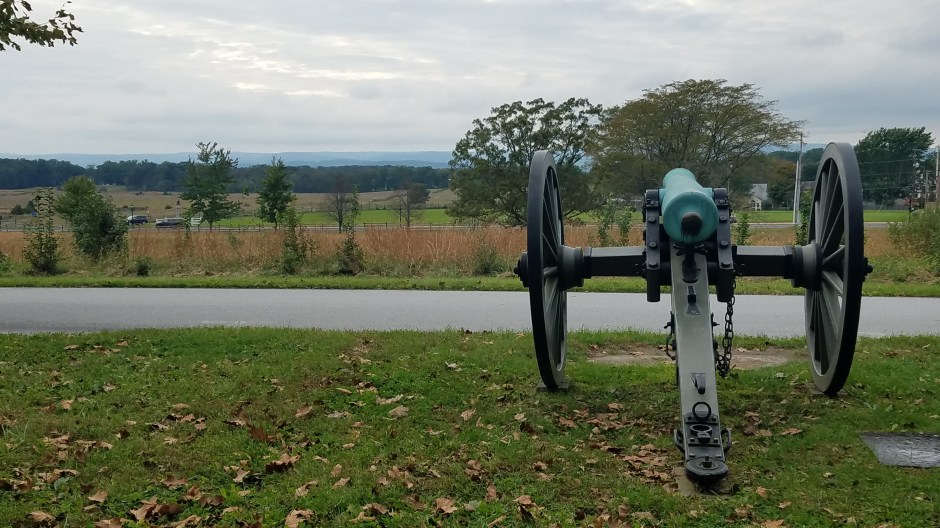
Visiting the site of this place can be a bit surreal. Today, the fields lay semi-empty. The dead have been given proper burial. The gunfire has long since ceased and it only returns for reenactments and salutes to honor the fallen. To the educated eye one can still see the evidence of the battle and how the lay of the land was shaped by it and helped to shape the battle itself. For example, one can still see clearly how the Union’s superior position of the high ground helped them win despite having less troops. 

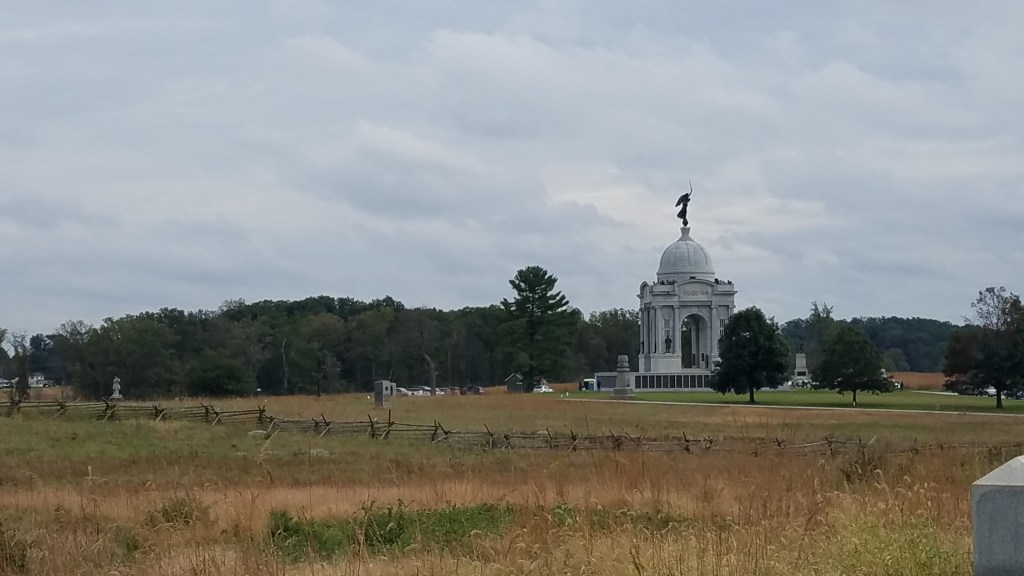
 It is now home to many monuments to the fallen from all over the states. Naturally, the Pennsylvania monument is absolutely massive, but others are smaller. Some are dedicated to large groups, but then there are more specific battalions and legions remembered. It is easy to forget that each of the men who perished on the field had a name, a story and purpose to be there. It is not easy to take up arms against one’s own countrymen. 

In the surrounding town, they offer various walking tours highlighting moments of history. They talk about the miracle that only one civilian died in the fighting, they point out bullet holes. What is really striking though is the sheer amount of death the residents saw, the description of pools of blood from the surgeries and piles of limbs that had been hacked off to try to save lives. They describe the stench that lingered for weeks in the hot summer. They whisper of ghosts still lingering on over a century later. If one believes in such things. 

Still in among the ghost stories, there is real history being remembered. There was a high cost to pay to preserve our country more than the cost to form it originally. It answered the question of whether we truly were a nation of freedom for all or only for some. A question that will need to be periodically asked and answered as we continue to navigate conflicting rights and values. It is a place that when visited demands at least some reflection of the cost that had to be paid for today’s America. 

Despite growing up relatively close to it, I had not really visited the battlefield until I was an adult. The annual classroom field trip that year had been replaced with a trip to Philadelphia to see the visiting display of the Russian Tsars. When my family did finally visit, I was a teenager and the thought of tramping about a field in the heat of summer with my father was unappealing, and I opted to go elsewhere with my mom and let my brother and father walk about the fields. So in the fall of 2018, I finally went with my boyfriend to see where it all happened, put history in perspective and learn more about this monumental event in our nation’s history. 

I can’t say that I necessarily learned anything new about the battle that I hadn’t already heard in the classroom or seen in documentaries, but what I did know was brought to life by seeing the physical artifacts from the battle and hearing the intimate stories of the people who were there both solider and civilian on both sides of the war. There’s something to be said about seeing and interacting with physical objects that allows our minds to form a more emotional connection with the knowledge or at least enhance our knowledge through other senses. 

It is always strange to visit the site where tragedy took place and one must acknowledge the Civil War was tragic. It was tragic for a nation to be ripped apart and that the effects of that can still be seen over a hundred years later. It is also tragic it took a civil war to confer the basic human right of freedom from slavery to all living under our nation’s flag. On one hand, it is a place of history that should be remembered and respected, a place where people died to give other people freedom. On the other hand, it’s a site of enjoyment and relaxation. People come to visit on their vacations and for a day off of school. They enact the battle for entertainment, as well as to keep the stories alive. Children run through the fields laughing and playing around the cannons. Tourists take goofy pictures in front of memorials. For me the juxtaposition of both is important, because in some ways it means healing has taken place and is a testament to the resilience of people and our nation. 

How can you add this to your own bucket list?

Unfortunately, this is one of those things that cannot be substituted easily if going to the actual Battlefield of Gettysburg is on your list. It’s in PA and unless you’re nearby, it won’t be cheap or easy to get here. In which case, may I recommend google flight tracker and hotels.com? This may be an instance of the principle of the item rather than the item itself. The principle behind visiting Gettysburg was to see an important site of our nation’s history that helped shape our identity and defined us. If you live in the south, there are many other Civil War battlefields that you can visit. If you live in the North East, especially in New England, then you can visit many sites from the Revolutionary War. In the South West, you have the Mexican-American War. California was home to the gold rush as well as the Japanese Internment Camps and the Watts-Riots. The Midwest is of course home to the west itself and the expansion of white settlers into the territories. I highly recommend seeing what is near your hometown. You may be surprised to find your seemingly insignificant part of the country actually helped shape us in the amazing country that it is today.

Completed: 2018

Miles from home: 75

Cost: Free to visit the Battlefield, Visitor’s Center. Museum is $15, Museum+ Film is $21